
CHO-based Biosimilars Market Size and Share
Market Overview
| Study Period | 2020 - 2031 |
|---|---|
| Market Size (2026) | USD 15.19 Billion |
| Market Size (2031) | USD 25.27 Billion |
| Growth Rate (2026 - 2031) | 10.71 % |
| Fastest Growing Market | Asia Pacific |
| Largest Market | North America |
| Market Concentration | Medium |
Major Players *Disclaimer: Major Players sorted in no particular order Image © Mordor Intelligence. Reuse requires attribution under CC BY 4.0. | |

CHO-based Biosimilars Market Analysis by Mordor Intelligence
The CHO-based Biosimilars Market size is expected to grow from USD 13.77 billion in 2025 to USD 15.19 billion in 2026 and is forecast to reach USD 25.27 billion by 2031 at 10.71% CAGR over 2026-2031.
Competitive entry is no longer driven only by patent expiry; instead, the economics of advanced CHO cell-line engineering, real-time analytics, and continuous bioprocessing now dictate launch timing. The intensifying loss-of-exclusivity (LoE) across blockbuster biologics, worth up to USD 400 billion in annual originator sales, has prompted both vertically integrated manufacturers and contract development and manufacturing organizations (CDMOs) to accelerate capacity expansions. Payer-led formulary restructuring, exemplified by U.S. private-label consortia, is compressing adoption cycles, while FDA and EMA harmonization has shaved analytical risk and costs for new entrants. Meanwhile, CHO process intensification is cutting the cost of goods sold, resetting pricing expectations, and spurring scale-up investments.
Key Report Takeaways
- By product and service, the products segment captured 60.35% of the CHO-based biosimilars market share in 2025, and services & platforms are forecast to expand at a 12.65% CAGR through 2031.
- By clinical indication, oncology led with 55.67% revenue share in 2025, while autoimmune & inflammatory is projected to post the fastest 11.26% CAGR to 2031.
- By geography, North America accounted for 42.5% of 2025 revenue, but Asia-Pacific is expected to advance at the strongest 12.34% CAGR during 2026-2031.
Note: Market size and forecast figures in this report are generated using Mordor Intelligence’s proprietary estimation framework, updated with the latest available data and insights as of January 2026.
Market Trends and Insights
Drivers Impact Analysis of CHO-based Biosimilars Market*
| Driver | (~) % Impact on CAGR Forecast | Geographic Relevance | Impact Timeline |
|---|---|---|---|
| Accelerating loss of exclusivity for high-value biologics | +3.2% | Global, with peak impact in North America and Europe | Medium term (2-4 years) |
| FDA/EMA streamlining of biosimilar approval pathways | +1.8% | North America and Europe, spillover to APAC | Short term (≤ 2 years) |
| Payer cost-containment and tendering expand access and uptake | +2.5% | North America and Europe core, emerging in APAC | Medium term (2-4 years) |
| EU scientific interchangeability and national adoption mechanisms | +1.1% | Europe, with gradual influence in Latin America | Long term (≥ 4 years) |
| CHO process intensification/continuous bioprocessing drives 40–80% COGS reductions | +2.0% | Global, led by APAC manufacturing hubs | Medium term (2-4 years) |
| Precision glycoengineering/advanced analytics reduce comparability risk/costs | +1.3% | Global, with early adoption in North America and APAC | Long term (≥ 4 years) |
| Source: Mordor Intelligence | |||
Accelerating Loss of Exclusivity for High-Value Biologics
Blockbusters with annual sales of USD 200 billion to USD 400 billion will lose protection by 2030, with Keytruda, Stelara, and denosumab prominent among them [1]Angus Liu, “The Great Patent Cliff Is Back, and This Time It Is Biological,” fiercepharma.com. Many of these molecules carry complex glycosylation patterns that require high-fidelity CHO platforms, which discourage less-capitalized players but reward early movers who can quickly validate comparability. Premium pricing often holds during the first 18 months after launch, but late entrants face steep margin compression. The dynamic is splitting the CHO-based biosimilars market into a tier of scale-driven incumbents and a cluster of niche specialists. As a result, capacity reservation and early regulatory engagement are now more decisive than simply aligning with patent windows. Biosimilar uptake in immunology and insulin classes reached a modest penetration within 5 years of launch, compared with high adoption in oncology and ophthalmology, underscoring the persistence of formulary inertia in outpatient settings. This bifurcation suggests that regulatory interchangeability designations, while symbolically important, matter less than payer willingness to restructure formularies and absorb short-term disruption costs.
FDA ⁄ EMA Streamlining of Biosimilar Approval Pathways
By the end of 2025, the FDA had authorized 90 biosimilars across 20 reference molecules, achieving a 70% commercialization rate. Guidance released in September 2025 simplified glycosylation profiling using lectin microarrays, significantly reducing analytical risk [2]U.S. FDA, “Glycosylation Profiling for Biosimilar Products,” fda.gov. In Europe, the EMA’s interchangeability position statement spurred national substitution policies, accelerating adoption in France, Germany, and the Netherlands. Harmonized requirements have shortened clinical development timelines, which benefits resource-rich sponsors that can run concurrent global filings. Smaller firms are increasingly pairing with CDMOs to bridge knowledge gaps and amortize compliance costs across portfolios.
Payer Cost-Containment and Tendering Expand Access and Uptake
CVS’s Cordavis, Optum’s Nuvaila, and Cigna’s Quallent bypass traditional rebate schemes, pushing Humira biosimilar penetration surged significantly within one year of an April 2024 formulary shift. Europe’s smart tendering has delivered cumulative savings above EUR 10 billion since 2020. China’s volume-based procurement slashed prices by up to 80%, broadening access in tier-2 and tier-3 cities. Such cost-containment measures elevate the importance of flexible pricing, multi-SKU portfolios, and rapid supply ramp-up in the CHO-based biosimilars market.
EU Scientific Interchangeability and Adoption Mechanisms
The EMA affirmed scientific interchangeability in 2022, but roll-out across member states remains uneven. Automatic substitution for therapy-naïve patients is live in France, while Germany maintains physician discretion. Sandoz lifted biosimilar revenue 13% in 2025 by tailoring contracts country by country rather than adopting a single EU strategy. Regional tender quotas in Italy and hospital-level targets in Spain suggest gradual convergence, yet near-term market penetration gains will come mainly from early-adopter nations.
Restraints Impact Analysis of CHO-based Biosimilars Market*
| Restraint | (~) % Impact on CAGR Forecast | Geographic Relevance | Impact Timeline |
|---|---|---|---|
| US PBM rebate/formulary dynamics delay uptake in pharmacy-benefit classes | -1.5% | North America, particularly United States | Short term (≤ 2 years) |
| Biosimilar "void" for many upcoming LoEs due to technical complexity | -0.9% | Global, with acute impact in specialty therapeutic areas | Medium term (2-4 years) |
| Price-erosion/tender concentration risks sustainability and shortages | -1.2% | Europe and APAC, emerging in North America | Long term (≥ 4 years) |
| CHO glycosylation/CQA control complexity raises development/manufacturing risk | -0.7% | Global, with higher impact in emerging APAC markets | Medium term (2-4 years) |
| Source: Mordor Intelligence | |||
US PBM Rebate/Formulary Dynamics Delay Uptake in Pharmacy-Benefit Classes
Although payer consortia have accelerated adoption in oncology and ophthalmology, immunology, and insulin still see only 25% penetration five years post-launch due to entrenched rebate contracts that blunt net price advantages. Patient assistance programs further insulate originators, limiting near-term upside for CHO-based biosimilars in outpatient settings. Ongoing scrutiny by regulators and employers may pressure PBMs to adjust, but the timeline remains uncertain.
Biosimilar "Void" for Many Upcoming LoEs Due to Technical Complexity
Antibody-drug conjugates, bispecific antibodies, and Fc-engineered products approaching patent expiry lack active biosimilar pipelines because of conjugation, dual-target binding, and CQA hurdles. This gap preserves premium pricing for innovators and caps total savings achievable through substitution, tempering overall market acceleration.
*Our forecasts treat driver/restraint impacts as directional, not additive. The impact forecasts reflect baseline growth, mix effects, and variable interactions.
CHO-based Biosimilars Market Segment Analysis
By Products & Services:
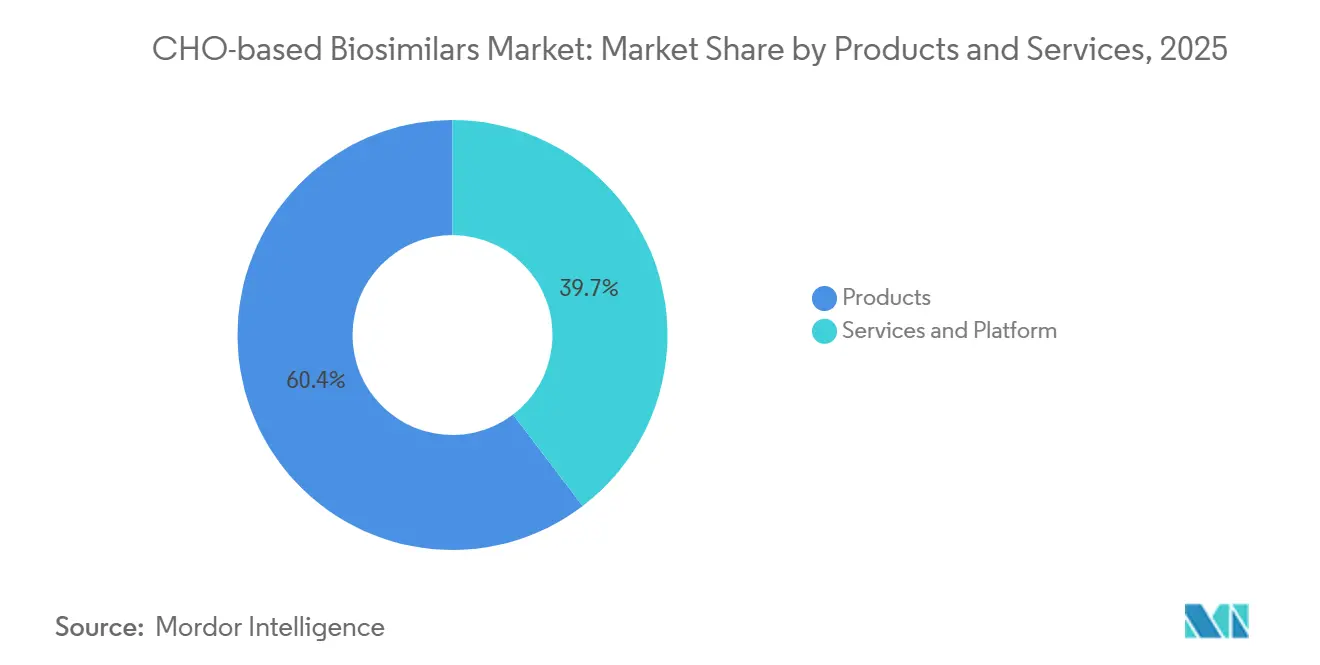
Platform Partnerships Reshape Value CaptureProducts contributed 60.35% of 2025 revenue. Monoclonal antibodies alone represented a significant share of global revenue in 2024, while Fc-fusion proteins and glycoprotein hormones trailed by wide margins [3]BioProcess International, “Global Biosimilar Antibody Market,” bioprocessintl.com. Continuous-processing facilities from Celltrion and Samsung Bioepis aim to keep per-gram COGS below USD 80, positioning integrated players to withstand price erosion.
Services and platforms are expected to register a 12.65% CAGR through 2031, as emerging biotechs outsource to CDMOs. WuXi Biologics’ UITM platform achieved 18 g⁄L at 2,000 L GMP scale, illustrating how asset-light pathways help small sponsors sidestep heavy capital outlays. The arrangement also channels incremental volume into Asia-Pacific facilities, reinforcing the region’s role as a cost-optimized manufacturing hub in the CHO-based biosimilars market.


By Clinical Indication:
Oncology Penetration Masks Immunology InertiaOncology held 55.67% of 2025 revenue. Trastuzumab, bevacizumab, and rituximab biosimilars have achieved significant market penetration in mature markets, underscoring the speed with which payers pivot once formulary barriers fall.
Autoimmune and inflammatory uses are on track to expand at 11.26% annually through 2031. The surge follows private-label moves by CVS Cordavis, Optum Nuvaila, and Cigna Quallent, which lifted Humira biosimilar share significantly within a year of CVS’s April 2024 exclusion of the originator. Together, adalimumab, infliximab, and etanercept chase a USD 40 billion market, but they long sat below major share because rebates and patient-assistance programs hid net prices. With payer-driven swaps now proven, infliximab led 2022 revenue, and adalimumab is set for the fastest climb through 2030 as more formularies follow suit.
Geography Analysis
North America CHO-based Biosimilars Market
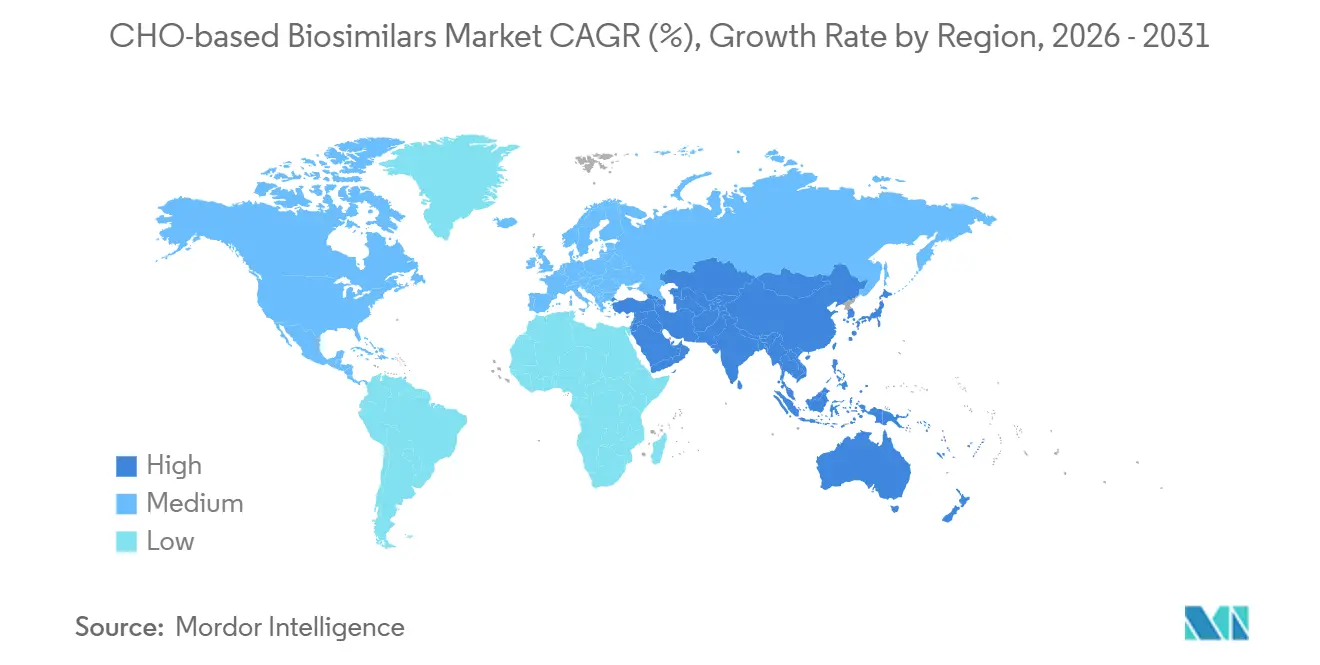
North America commanded a 42.15% share in 2025, supported by 90 FDA approvals and aggressive payer steering that drove significant Humira biosimilar uptake over 12 months. Growth is expected to plateau in saturated classes, yet upcoming LoEs for Keytruda and other oncology agents will spark new surges.
Europe CHO-based Biosimilars Market
Europe combines lower absolute revenue with policy leadership; tendering delivered price drops in the United Kingdom, France, and Germany, saving health systems more than EUR 10 billion since 2020. Implementation of automatic substitution varies by country, compelling manufacturers to localize pricing and contracting strategies.
APAC, MEA and South America CHO-based Biosimilars Market
Asia-Pacific is forecast to post a 12.34% CAGR to 2031, underpinned by China’s 87 cumulative approvals by year-end 2024 and Japan’s premium pricing for first-to-market products. India and South Korea extend regional production advantages, with Samsung Bioepis targeting 571,000 L capacity to anchor global supply. Markets in the Middle East, Africa, and South America remain nascent but show gradual progress through pilot tenders and local regulatory reforms, ultimately broadening the footprint of the CHO-based biosimilars market.

Competitive Landscape
The CHO-based biosimilars industry shows moderate consolidation. Pfizer, Samsung Bioepis, and Celltrion together accounted for a significant share of global revenue in 2025. Samsung Bioepis committed more than KRW 3 trillion (USD 2.2 billion) to expand Songdo capacity, while Sandoz invested USD 1.1 billion in Slovenia to secure economies of scale before further price deflation.
Pure-play CDMOs such as WuXi Biologics and Avid Bioservices power smaller entrants, offering turnkey CHO platforms that significantly shorten time to clinic. Technology differentiation is shifting from molecule choice to manufacturing agility; continuous processing, AI-enabled control, and flexible fill-finish lines are now prime competitive levers.
Patent litigation remains a first-line defense for originators. Regeneron filed 38 patent infringement lawsuits against Celltrion and filed complaints against several other biosimilar developers to delay competitors to aflibercept. Even so, FDA guidance on glycosylation comparability has narrowed the technical moat, tilting the advantage toward companies that can price aggressively without sacrificing quality. The resulting landscape balances a handful of scale leaders with a growing cadre of agile specialists, shaping the trajectory of the CHO-based biosimilars market.
CHO-based Biosimilars Industry Leaders
Pfizer Inc
Samsung Bioepis
Wuxi Biologics
Avid Bioservices
Celltrion
- *Disclaimer: Major Players sorted in no particular order

CHO-based Biosimilars Market Companies Covered in this Report
- Abzena
- Aragen life Sciences
- Avid Bioservices
- Celltrion
- CHO Plus
- Enzene Biosciences
- Evotec
- ExcellGene
- Henlius
- Olon France
- Organon
- Patheon Pharma Services
- Peak Proteins
- Pfizer
- Samsung Bioepis
- Thermo Fisher Scientific
- Wuxi Biologics

Recent Industry Developments in CHO-based Biosimilars Market
- January 2026: PanGen Biotech accelerated cell-line R&D programs to sharpen its competitive position as a biopharmaceutical CDMO, expanding proprietary CHO libraries and boosting transfection throughput
- September 2025: Global private-equity firm ARCHIMED acquired majority stakes in ExcellGene and Magellan Biologics & Consulting, forming an integrated group that spans gene transfer, cell-line development, and CHO-based manufacturing.
- August 2025: CHO Plus entered a project agreement with BARDA’s BioMaP consortium to develop ultra-high-productivity CHO cell lines for filovirus monoclonal antibody programs.


Global CHO-based Biosimilars Market Report Scope
As per the scope of the report, CHO-based biosimilars are biological drugs produced using Chinese Hamster Ovary (CHO) cell lines, which currently serve as the "gold standard" for manufacturing complex therapeutic proteins. These biosimilars are highly similar, but not identical, versions of original brand-name biologics that have lost patent protection. CHO cells are preferred for this role because they possess the cellular machinery required for human-like post-translational modifications, particularly N-linked glycosylation, which is critical for a drug's biological activity, safety, and stability in the human body.
The CHO-based biosimilars market is segmented by product and service, clinical indication, and geography. Based on product and service, the market is segmented into products (monoclonal antibodies, Fc-fusion proteins, Glycoprotein hormones, C5 inhibitors, RANKL inhibitors, and Anti-VEGF fusion proteins) and services & platform. By clinical indication, oncology, autoimmune & inflammatory, ophthalmology, and others. Geographically, the market is segmented into North America, Europe, Asia-Pacific, the Middle East & Africa, and South America. The market report also covers the estimated market sizes and trends for 17 countries across major regions globally. For each segment, the market size and forecast are provided in terms of value (USD).
| Products | Monoclonal antibodies (mAbs) |
| Fc-fusion proteins | |
| Glycoprotein hormones (e.g., EPO, FSH) | |
| C5 inhibitors (eculizumab) | |
| RANKL inhibitors (denosumab) | |
| Anti-VEGF fusion proteins (aflibercept) | |
| Services & Platform |
| Oncology |
| Autoimmune & Inflammatory |
| Ophthalmology (retina) |
| Others |
| North America | United States |
| Canada | |
| Mexico | |
| Europe | Germany |
| France | |
| United Kingdom | |
| Italy | |
| Spain | |
| Rest of Europe | |
| Asia-Pacific | China |
| India | |
| Japan | |
| South Korea | |
| Australia | |
| Rest of Asia-Pacific | |
| Middle East and Africa | GCC |
| South Africa | |
| Rest of Middle East and Africa | |
| South America | Brazil |
| Argentina | |
| Rest of South America |
| By Products & Services | Products | Monoclonal antibodies (mAbs) |
| Fc-fusion proteins | ||
| Glycoprotein hormones (e.g., EPO, FSH) | ||
| C5 inhibitors (eculizumab) | ||
| RANKL inhibitors (denosumab) | ||
| Anti-VEGF fusion proteins (aflibercept) | ||
| Services & Platform | ||
| By Clinical Indication | Oncology | |
| Autoimmune & Inflammatory | ||
| Ophthalmology (retina) | ||
| Others | ||
| By Geography | North America | United States |
| Canada | ||
| Mexico | ||
| Europe | Germany | |
| France | ||
| United Kingdom | ||
| Italy | ||
| Spain | ||
| Rest of Europe | ||
| Asia-Pacific | China | |
| India | ||
| Japan | ||
| South Korea | ||
| Australia | ||
| Rest of Asia-Pacific | ||
| Middle East and Africa | GCC | |
| South Africa | ||
| Rest of Middle East and Africa | ||
| South America | Brazil | |
| Argentina | ||
| Rest of South America | ||


Key Questions Answered in the Report
What is the projected value of the CHO-based biosimilars market by 2031?
The market is forecast to reach USD 25.27 billion by 2031.
How fast is the market expected to grow between 2026 and 2031?
It is forecast to register a 10.71% CAGR over the period.
Which region is likely to post the fastest growth?
Asia-Pacific is projected to expand at 12.34% CAGR through 2031.
Which therapeutic class currently leads revenue?
Oncology accounts for 55.67% of 2025 revenue.
Page last updated on:





