
Biomaterials Market Size and Share
Market Overview
| Study Period | 2020 - 2031 |
|---|---|
| Market Size (2026) | USD 229.72 Billion |
| Market Size (2031) | USD 433.06 Billion |
| Growth Rate (2026 - 2031) | 13.51 % |
| Fastest Growing Market | Asia-Pacific |
| Largest Market | North America |
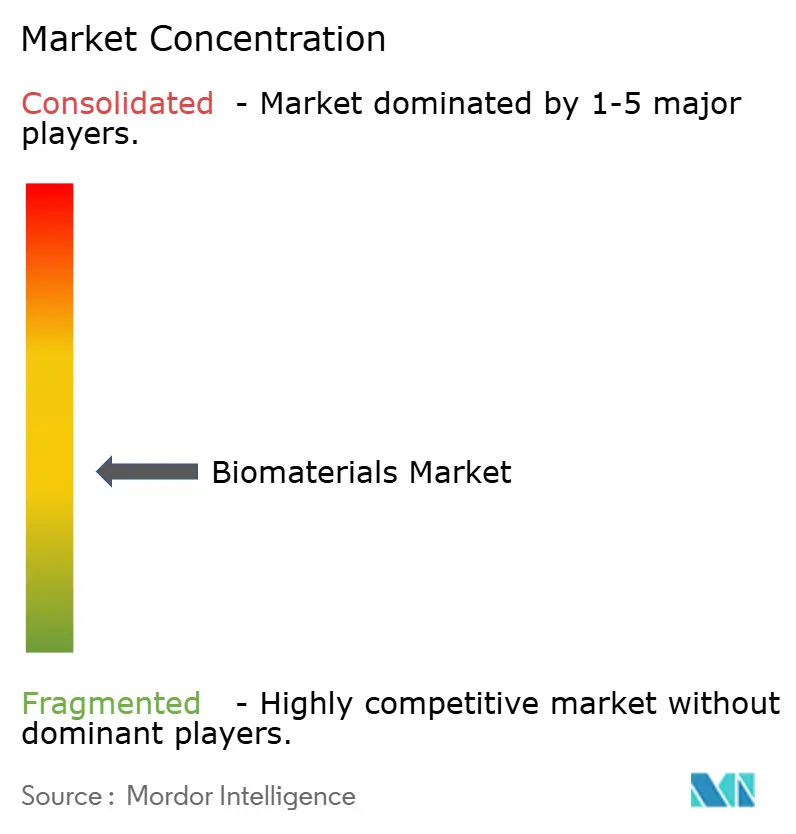
| Market Concentration | Medium |
Major Players *Disclaimer: Major Players sorted in no particular order Image © Mordor Intelligence. Reuse requires attribution under CC BY 4.0. | |
Biomaterials Market Analysis by Mordor Intelligence
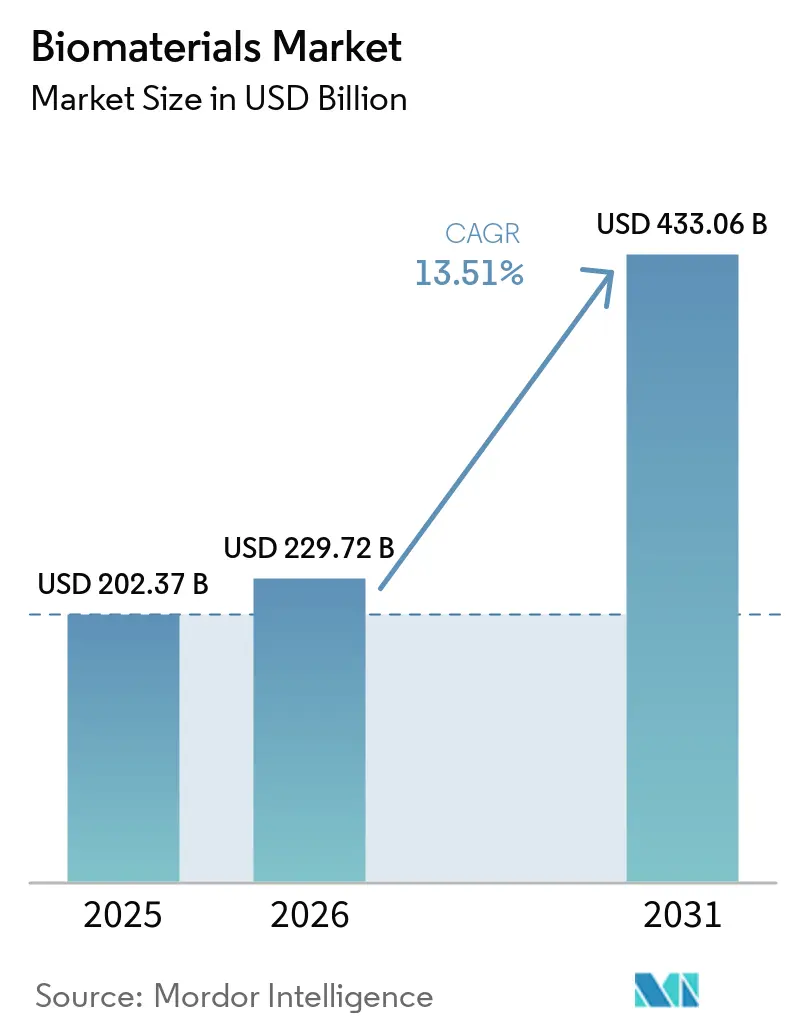
Biomaterials Market size in 2026 is estimated at USD 229.72 billion, growing from 2025 value of USD 202.37 billion with 2031 projections showing USD 433.06 billion, growing at 13.51% CAGR over 2026-2031.
Growth gathers momentum from aging‐driven procedure volumes, rapid regenerative medicine breakthroughs, and streamlined regulatory pathways. Polymeric materials keep demand buoyant thanks to their adaptability in cardiovascular stents and orthopedic inserts, while waste-derived natural materials expand quickly as circular-economy mandates intensify. North America benefits from 1,041 FDA breakthrough device designations that de-risk commercialization, yet Asia-Pacific outpaces with double-digit growth backed by China’s fivefold rise in knee replacements and Japan’s induced-pluripotent-stem-cell (iPSC) innovations. Strategic acquisitions—such as Enovis’ EUR 800 million purchase of LimaCorporate—underscore vertical-integration moves aimed at buffering raw-material shortages and EU MDR compliance bottlenecks[1].
Key Report Takeaways
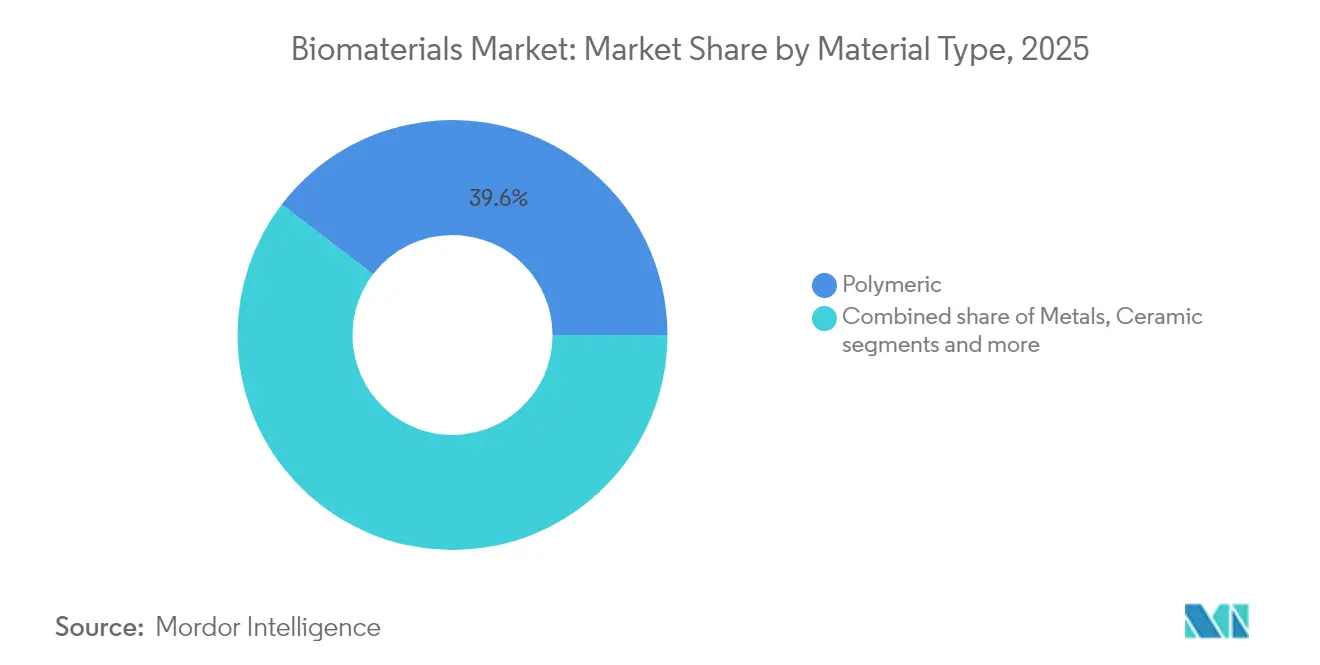
- By material type, polymeric materials led with 39.62% of biomaterials market share in 2025, while natural biomaterials are projected to post the fastest 14.52% CAGR to 2031.
- By origin, synthetic biomaterials accounted for 70.05% of the biomaterials market size in 2025; natural counterparts expand at a 14.71% CAGR through 2031.
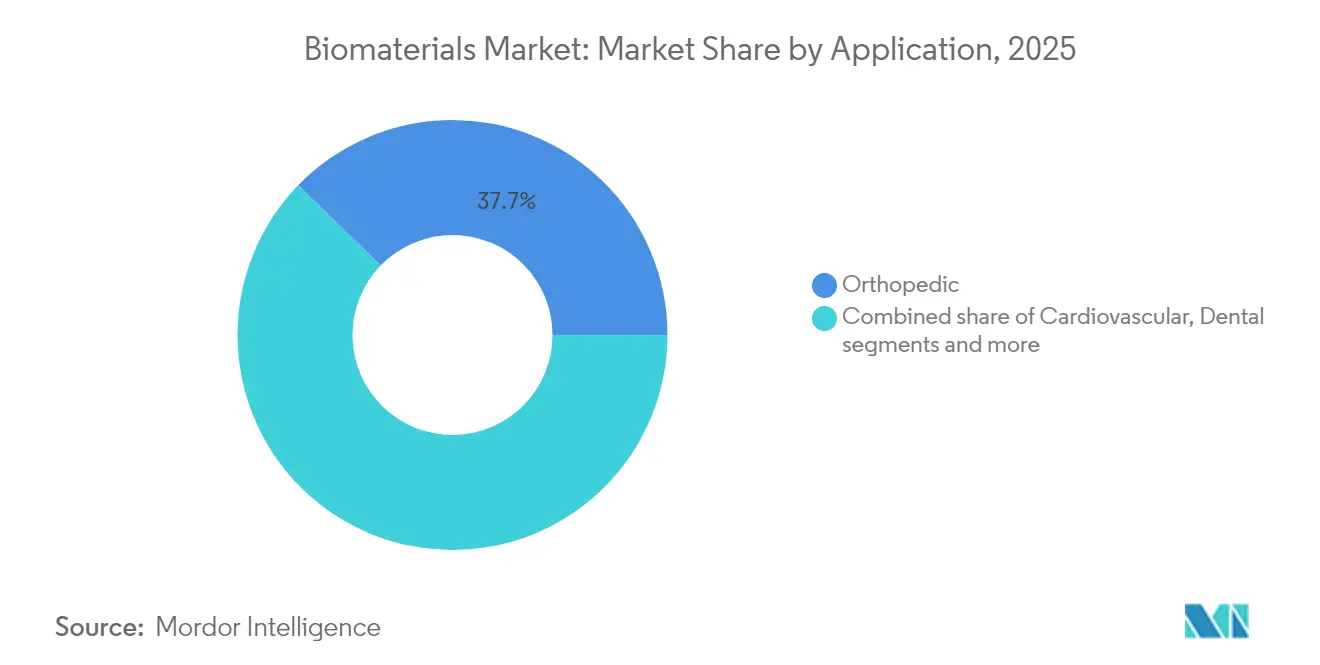
- By application, orthopedics captured 37.74% of biomaterials market size in 2025, while tissue engineering and regenerative medicine record the highest 14.86% CAGR to 2031.
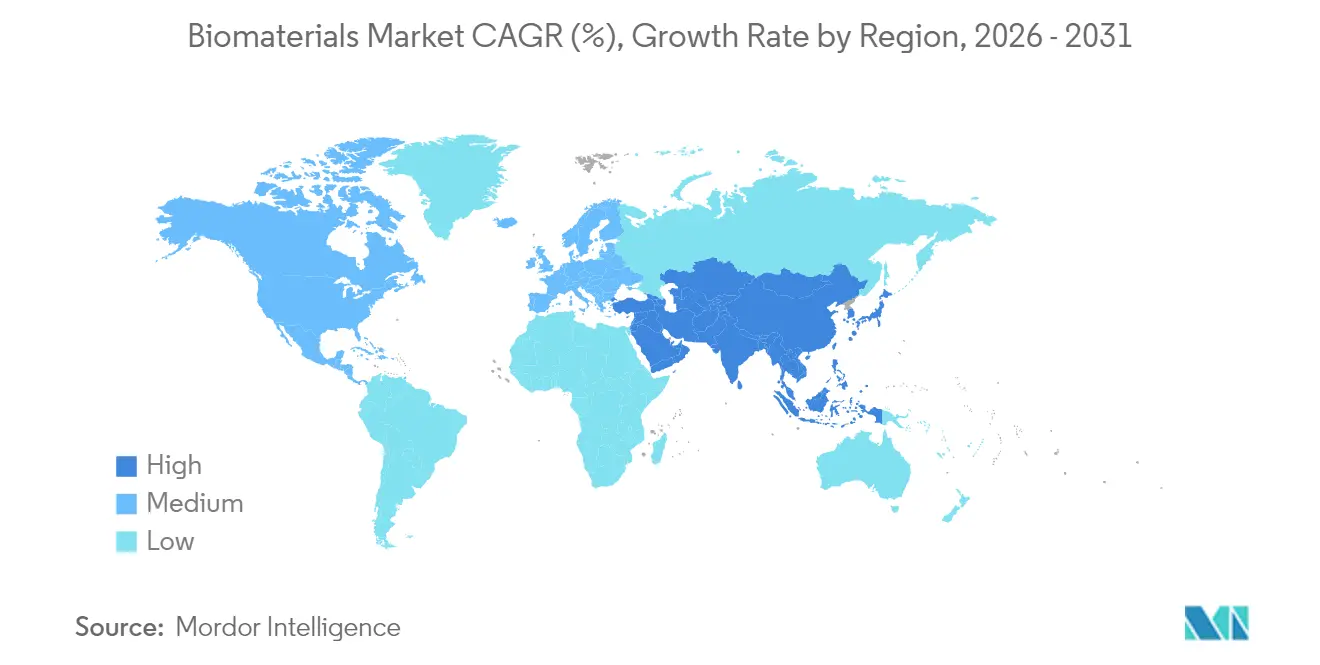
- By geography, North America retained 41.78% biomaterials market share in 2025; Asia–Pacific is set to chart the fastest 15.03% CAGR through 2031.
Note: Market size and forecast figures in this report are generated using Mordor Intelligence’s proprietary estimation framework, updated with the latest available data and insights as of 2026.
Market Trends and Insights
Drivers Impact Analysis of Biomaterials Market*
| Driver | (~) % Impact on CAGR Forecast | Geographic Relevance | Impact Timeline |
|---|---|---|---|
| Aging population-led surge in joint-replacement volumes | +3.2% | Global, with highest impact in North America and Europe | Long term (≥ 4 years) |
| Rapid advances in regenerative medicine & 3-D bioprinting | +2.8% | North America & EU leading, APAC catching up | Medium term (2-4 years) |
| Expansion of cardiovascular interventions using bio-stents | +2.1% | Global, with emerging market acceleration | Medium term (2-4 years) |
| Government R&D grants and fast-track approvals for breakthrough implants | +1.9% | North America & EU primarily | Short term (≤ 2 years) |
| Emergence of 4-D stimuli-responsive biomaterials | +1.4% | North America & EU research hubs | Long term (≥ 4 years) |
| Circular-bioeconomy push for waste-derived natural biomaterials | +1.1% | EU leading, global adoption following | Medium term (2-4 years) |
| Source: Mordor Intelligence | |||
Aging population-led surge in joint-replacement volumes
Primary knee arthroplasty volumes in the United States alone are projected to climb 673% by 2030, and Germany anticipates a 55% rise in knee arthroplasties by 2040. Younger and more active patients now represent a majority of candidates, forcing implant developers to prioritize wear resistance and osseointegration longevity. Colombia projects 39,270 lower-limb arthroplasties by 2050, 52.7% of which will involve women, spurring gender-specific biomaterial formulations. The sustained procedure pipeline cushions the biomaterials market against traditional healthcare spending cycles.
Rapid advances in regenerative medicine & 3-D bioprinting
The Canadian government’s CAD 72.75 million grant to Aspect Biosystems signals policy confidence in bioprinted tissues, while machine-learning-driven modelling achieves R² > 0.999 for shape predictions in 4D scaffolds. FDA clearance of Symvess, the first acellular tissue-engineered vessel, establishes precedent and accelerates clinical translation. As regulatory clarity improves, venture activity spreads to Asia–Pacific, where Japan’s iPSC-based corneal epithelial transplants underscore regional competitiveness, further strengthening the biomaterials market outlook.
Expansion of cardiovascular interventions using bio-stents
Biodegradable platforms are displacing permanent metallic stents by mitigating late thrombosis, and tantalum-niobium alloys enable precise 3-D printed, patient-specific devices. Teleflex’s EUR 760 million purchase of BIOTRONIK’s vascular arm validates growth prospects for drug-coated balloons and resorbable scaffolds. Coupled with predictive degradation modelling, developers can fine-tune stent lifecycles, compressing time-to-market and reinforcing the biomaterials market trajectory.
Government R&D grants and fast-track approvals for breakthrough implants
The FDA’s Breakthrough Devices Program has conferred 1,041 designations, 128 of which have secured marketing authorization, sharply reducing commercialization risk. NIH bioengineering grants and RMAT pathways funnel capital into orthopedic and cardiovascular implants. Early adopters such as Amphix Bio and Renovos leverage these mechanisms to speed orthopedic graft alternatives into clinics, bolstering innovation pipelines across the biomaterials market.
Restraints Impact Analysis of Biomaterials Market*
| Restraint | (~) % Impact on CAGR Forecast | Geographic Relevance | Impact Timeline |
|---|---|---|---|
| High production & surgical costs of next-gen biomaterials | -2.3% | Global, with higher impact in emerging markets | Medium term (2-4 years) |
| Lengthy multi-phase regulatory & clinical validation timelines | -1.8% | Global, with EU MDR creating additional complexity | Long term (≥ 4 years) |
| Supply-chain volatility for specialty alloying elements (e.g., Nb, Ta) | -1.5% | Global, with highest impact in North America and Europe | Short term (≤ 2 years) |
| Environmental scrutiny over synthetic-polymer leachables | -0.9% | EU leading, North America following, global adoption expected | Medium term (2-4 years) |
| Source: Mordor Intelligence | |||
High production & surgical costs of next-gen biomaterials
Inflation and supply chain shocks inflated contract manufacturing costs during 2024, while polytetrafluoroethylene shortages forced insourcing and inventory stockpiling, impairing cash flow for small device makers. Tantalum prices climbed to USD 5,190 per kg in 2023, tightening margins for specialty implant suppliers. EU MDR compliance adds 18–24 months and significant certification costs, prompting 50% of surveyed European firms to trim portfolios.
Lengthy multi-phase regulatory & clinical validation timelines
Only 4,873 MDR certificates were issued against 14,539 applications in 2023, creating a backlog that limits new product launches and risks device shortages in Europe. Academic labs struggle with quality-management adaptation, while the FDA’s expanded chemical-analysis guidance lengthens U.S. biocompatibility testing cycles.
*Our forecasts treat driver/restraint impacts as directional, not additive. The impact forecasts reflect baseline growth, mix effects, and variable interactions.
Biomaterials Market Segment Analysis
By Material Type:
Polymeric Strength Meets Natural DisruptionPolymeric materials retained a 39.62% share of the biomaterials market in 2025, dominating cardiovascular and orthopedic uses. Fish-waste collagen and insect-derived chitosan speed natural-material uptake, driving a 14.52% CAGR that challenges polymeric supremacy. Composite hybrids marry metallic strength with polymeric elasticity, meeting load-bearing preferences in younger arthroplasty patients. Shape-memory polymers produced via 4D printing enable scaffolds that conform in vivo, a differentiator for tissue-engineering firms seeking reimbursement premiums.
Natural candidates also benefit from EU circular-economy incentives, accelerating collagen extraction from sardine scales and upcycling crustacean waste. Metallic biomaterials, though vulnerable to tantalum-and-niobium supply risks, remain indispensable in hip prostheses demanding high fatigue resistance. The biomaterials market continues to reward suppliers able to hedge raw-material volatility through recycling and dual-sourcing strategies.

By Origin:
Synthetic Dominance Faces Sustainable MomentumSynthetic materials accounted for 70.05% of biomaterials market size in 2025 thanks to well-established production and predictable performance. However, natural alternatives are expanding at a 14.71% CAGR on the back of precision-fermentation collagen, biobased polymers, and bacterial cellulose hydrogels that achieve comparable mechanical integrity. Regulatory scrutiny of synthetic-polymer leachables is nudging developers toward bio-based substitutes, particularly in pediatric and long-term implants.
Synthetic innovators focus on biodegradable poly-lactic-co-glycolic acid and polyhydroxyalkanoates that resorb safely, shielding margins against potential bans on persistent polymers. Natural newcomers leverage patents in lignocellulosic biomass conversion, turning forestry residues into medical-grade nanofibers, widening supplier diversity and tempering synthetic price power.
By Application:
Orthopedic Lead Challenged by Regenerative UpswingOrthopedic devices captured 37.74% of biomaterials market size in 2025, supported by record hip-and-knee volumes. Demand for implant materials used in hip and knee procedures supports the orthopedic biomaterials market. Yet tissue engineering and regenerative medicine post the strongest 14.86% CAGR, as FDA approvals such as Symvess and local iPSC corneal grafts validate biological substitutes. Cardiovascular segments accelerate through bio-stents, and dental players deploy 3-D printing for chair-side crowns, shortening treatment cycles.
Plastic-surgery and neurology fields emerge as next-wave adopters, integrating bioresorbable meshes and neural-interface polymers that limit inflammation. Wound-healing solutions combine antimicrobial peptides with hydrogel matrices to tackle diabetic ulcers prevalent in aging populations. Overall, diversified clinical pipelines cushion the biomaterials market against single-segment reliance.
Geography Analysis
North America Biomaterials Market
North America held 41.78% of biomaterials market share in 2025, buoyed by 1,041 FDA breakthrough designations and heavy corporate R&D. Established reimbursement and robust surgeon training programs encourage rapid adoption of premium implants signals federal backing for bioprinting ventures.
Europe Biomaterials Market
Europe grapples with MDR bottlenecks—only 4,873 certificates were issued from 14,539 applications in 2023—delaying launches and prompting some manufacturers to withdraw legacy devices. Despite this, Germany expects knee-replacement incidence to climb 55% by 2040, guaranteeing demand once compliance hurdles ease. EU circular-bioeconomy grants also fast-track insect-derived chitosan plants, giving natural materials an early-mover edge.
APAC Biomaterials Market
Asia–Pacific charts the fastest 15.03% CAGR, propelled by China’s fivefold jump in knee replacements and Japan’s first-in-human iPSC corneal transplants. Even with venture funding down 22% from 2021 highs, the region’s medtech sector still targets USD 225 billion in 2030 revenue, encouraging global OEMs to localize manufacturing. South Korea and Australia add capacity through advanced composite printing hubs, while India’s growing middle class amplifies volume demand for cost-efficient implants.
Regulatory Landscape
Biomaterials used in medical devices are managed through risk-based frameworks that tie device requirements to biological safety and technical documentation expectations. In the United States, FDA pathways such as the Breakthrough Devices Program (1,041 designations, with 128 marketing authorizations referenced in the report context) interact with product-specific classifications, including a June 2026 FDA final order that classified a resorbable calcium salt bone void filler containing a single approved aminoglycoside antibacterial into Class II with special controls. This clarifies a route for certain antibacterial, resorbable bone graft substitutes.
In Europe, Regulation (EU) 2017/745 (EU MDR) continues to shape conformity assessment strategy amid capacity constraints, with the report context noting that only 4,873 MDR certificates were issued versus 14,539 applications in 2023. The European Commission also updated the operating environment through early-2026 updates to harmonized standards supporting MDR (including EN ISO 10993 updates), alongside Regulation (EU) 2026/1359 amending MDR provisions related to subsets of Class IIb implantable devices. Across major markets, ISO 10993-1:2025 remains a central reference for biocompatibility within risk management and affects test planning for polymer leachables, absorbables, and tissue-contacting materials.
Value Chain Analysis
The biomaterials value chain runs from upstream feedstocks (petrochemical and biobased monomers, specialty metals such as tantalum and niobium, ceramics, collagen/chitosan streams, and bio-derived proteins), through conversion and purification (polymerization, alloying, fermentation, extraction, compounding, and sterilization-compatibility work), and into midstream qualification (CMC-style documentation, ISO 10993 biological evaluation, and mechanical and degradation characterization). Downstream, materials are incorporated by medical device OEMs and contract manufacturers into implants and disposables across orthopedics, cardiovascular, dental, wound care, neurology, and tissue engineering. Distribution then occurs through regulated healthcare channels, where traceability and post-market surveillance obligations influence vendor selection.
Capacity and partnering signals point to where bottlenecks and resilience investments are concentrating. Covation Biomaterials completed mechanical work on its first commercial plant in Qidong, Jiangsu Province, China, for bioTHF and bioPTMEG with 50,000 tons annual capacity, supporting scale-up for bio-based polymer intermediates. In protein-based biomaterials, AMSilk signed a long-term manufacturing and supply agreement with Ajinomoto Foods Europe using a dedicated line in Nesle, France, while Kraig Biocraft Laboratories reported record recombinant spider silk output (1.3 metric tons in March 2026) aimed at qualification testing thresholds. These developments sit alongside the report-context emphasis on supply-chain volatility for specialty alloying elements, and the role of vertical integration and multi-sourcing to manage cost, certification lead times, and compliance risk.
Competitive Landscape
Consolidation is accelerating as firms secure raw-material pipelines and regulatory expertise. Enovis acquired LimaCorporate for EUR 800 million, adding 3-D printed Trabecular Titanium know-how and lifting its reconstruction revenue target to USD 1 billion. Teleflex’s EUR 760 million takeover of BIOTRONIK’s vascular arm expands its interventional cardiology reach amid rising resorbable-scaffold demand[2].
Innovation advantages accrue to companies harnessing 4D printing and machine-learning optimisation. Stryker logged 11.9% net-sales growth in Q1 2025, bolstered by record Mako robotic-system installations. Zimmer Biomet’s FDA-cleared cementless partial knee underpins its foot-and-ankle diversification, following the Paragon 28 buyout. Smaller innovators exploit regulatory fast-tracks—Curiteva’s trabecular PEEK interbody system won 510(k) clearance, showcasing additive-manufactured polymer potential.
White-space niches surface in biodegradable photopolymers and smart materials that adjust to body temperature or pH, where university spin-outs partner with OEMs for scaled production. Meanwhile, supply-chain resilience is a focal point; U.S. import dependence on Brazilian tantalum raises concerns as China increases its Latin-American influence. Integrated majors able to multi-source or recycle critical metals fortify their strategic positions in the biomaterials market.
Biomaterials Industry Leaders
-
Koninklijke DSM N.V.
-
Corbion NV
-
Noble Biomaterials, Inc.
-
Dentsply Sirona
-
Zimmer Biomet
- *Disclaimer: Major Players sorted in no particular order
Biomaterials Market Companies Covered in this Report
- Johnson & Johnson
- Stryker
- Medtronic
- Evonik Industries
- Corbion NV (Purac)
- Zimmer Biomet
- Covestro
- BASF
- Celanese Corporation
- Invibio (Victrex plc)
- DSM Biomedical
- Berkeley Advanced Biomaterials
- Dentsply Sirona
- Carpenter Technology
- Collagen Solutions plc
- Straumann Group
- Organogenesis
- Precision Biomaterials Inc.
- Wright Medical (now Stryker)
- 3M Health Care
Market Opportunities and Future Outlook
White-space opportunities are clearest where biomaterials move from passive structural roles toward active, multifunctional performance in regenerative medicine and wound management. Research disclosed in July 2026 outlines specific innovation corridors: MIT reported a method to control the growth of artificial blood vessels by mechanically stretching endothelial cells to trigger angiogenesis, targeting vascularization constraints that limit engineered tissue thickness and viability. In parallel, IMDEA Materials Institute described mechanically tunable, transparent chitosan-based hydrogel membranes sourced from seafood-industry waste for skin regeneration and tissue engineering, linking circular-economy inputs with medical-grade function.
Wound healing is also expanding the design space for infection control and chronic wound management. July 2026 work from IIT Gandhinagar and Nirma University described a smart, injectable hydrogel with a cerium-rutin nanocomplex for sustained-release, antibiotic-free wound care, while University of Bath researchers reported a plant-derived bi-layer dressing that delivers tetracycline to intercept biofilm formation early in infection. For manufacturers, the opportunity centers on scaling these chemistries into reproducible, sterilization-tolerant formulations with ISO 10993-1:2025-aligned safety packages, and on building supply chains that can qualify waste-derived or biobased inputs without compromising traceability and regulatory documentation.
Recent Industry Developments in Biomaterials Market
- July 2026: TotalEnergies Corbion launched Luminy Foam 50F, a biobased PLA foam positioned as a drop-in replacement for expanded polystyrene (XPS) in food packaging. The launch supports commercial pull-through for bio-based polymer platforms and may broaden qualification of PLA-based materials where sustainability requirements influence material selection.
- April 2026: TotalEnergies Corbion partnered with Useon to accelerate industrial adoption of PLA foam extrusion technology for protective packaging. Scaling partnerships like this expand downstream conversion capacity and improve availability of engineered biopolymer formats that can feed into adjacent medical and healthcare materials development and sourcing strategies.
- April 2025: dsm-firmenich collaborated with Peijia Medical to develop innovative medical device products using polymer materials including ultra-high molecular weight polyethylene (UHMWPE) and thermoplastic polyurethane (TPU). The collaboration highlights continued R&D focus on high-performance polymers for cardiovascular and implantable applications, supporting differentiation through material science and device-material co-development.
Biomaterials Market Report Scope and Research Methodology
Market Definition and Coverage
For this study, the biomaterials market includes materials engineered to safely interact with the human body for medical use, where demand is tied to procedures and devices that use these materials.
Scope exclusions: We exclude general industrial materials that are not designed for medical or diagnostic use, even if they are chemically similar.
Segments Covered in This Report
- By Material Type
- Metals
- Polymeric
- Ceramic
- Composite
- Natural
- By Origin
- Synthetic
- Natural
- By Application
- Orthopedic
- Cardiovascular
- Dental
- Wound Healing
- Neurology
- Plastic Surgery
- Tissue Engineering & Regeneration
- Others
- By Geography
- North America
- United States
- Canada
- Mexico
- Europe
- Germany
- United Kingdom
- France
- Italy
- Spain
- Rest of Europe
- Asia-Pacific
- China
- India
- Japan
- Australia
- South Korea
- Rest of Asia-Pacific
- South America
- Brazil
- Argentina
- Rest of South America
- Middle East and Africa
- GCC
- South Africa
- Rest of Middle East and Africa
- North America
Data Sources, Market Sizing, and Validation
Desk Research
Desk research was used to set the market boundaries, build a consistent time series, and anchor major demand signals to real-world healthcare activity. We referred to public sources such as the US FDA databases and guidance, the US CDC health statistics, OECD health data, World Bank indicators, and peer-reviewed journals covering implants and tissue response.
To cross-check the commercial side, we also reviewed company annual reports and investor presentations, device and material association websites, and trusted press coverage of approvals and capacity expansions. Where needed, paid subscriptions were used only for company financial intelligence and patent databases, which helped validate directional innovation and revenue exposure when public detail was limited. The desk sources listed above are illustrative only, and many other public references were used for data collection, validation, and clarification during the analysis.
Primary Interviews and Surveys
Primary work was carried out through expert interviews and structured surveys with manufacturers, distributors, clinicians, and procurement and regulatory-facing roles, so assumptions could be checked against how products are actually adopted. We used this step to validate pricing logic, material mix shifts, and the timing of demand recovery or acceleration across APAC, EMEA, and the Americas, and then we adjusted inputs where desk signals did not align with field reality.
Distribution of primary research fieldwork respondents
| Company type | Respondent position | Region |
|---|---|---|
| Top tier: 34% | CXOs: 22% | APAC: 48% |
| Mid tier: 44% | Functional/Unit leaders: 22% | EMEA: 32% |
| Smaller Players: 22% | Managers: 56% | Americas: 20% |
Market-Sizing & Forecasting
Sizing was built using both top-down and bottom-up thinking, but the core model starts from a top-down demand pool that is reconstructed from healthcare activity and procedure intensity by region. The totals were then corroborated using selective bottom-up approximations, such as sampled revenue exposure checks, indicative volume-by-ASP logic in key applications, and channel feedback, which are then used to correct obvious overcounts.
A few market-specific inputs that mattered in the model include procedure volumes for orthopedics and cardiovascular interventions, the mix shift between polymeric, metallic, ceramic, and natural materials, and average selling price progression for implantable and non-implantable uses. We also tracked adoption patterns in tissue engineering and regeneration, regulatory approval pace as a timing signal, and regional healthcare spending trajectories because they influence how quickly higher-value materials penetrate. For forecasting, scenario analysis was used around the base case, with growth rates and mix changes stress-tested using expert consensus so the output stays realistic when adoption timing varies. When bottom-up visibility was uneven in smaller countries, gaps were handled through ratio-based interpolation from comparable markets, followed by a second pass against macro and clinical indicators.
Data Validation & Update Cycle
Outputs were checked through triangulation across multiple indicators, followed by variance scans to spot jumps that are not supported by procedure trends, pricing logic, or regional healthcare spend. If an anomaly was found, we rechecked the underlying assumption and re-contacted relevant experts when the issue was linked to adoption timing, regulatory changes, or supply constraints.
Before sign-off, the model and assumptions go through multi-step analyst review so unit logic, currency conversions, and growth pacing remain consistent across regions and applications. Reports are refreshed annually, with interim updates added when major events materially change demand, supply, or pricing. Right before delivery, we do a fresh final pass so clients receive the latest updated view rather than an older snapshot.
Mordor Intelligence's Biomaterials Market Size Measured Against Other Published Estimates
Published market numbers for biomaterials can look far apart, even when they sound like they cover the same topic, because the counted revenue pool is not always defined in the same way. Differences usually come from how firms treat adjacent materials, what year they anchor on, and whether the size is tied to procedure-led demand signals or to broader materials value chains.
In our checks, the biggest gap drivers were whether the estimate leans toward medical-use biomaterials only versus also folding in wider materials sold into non-medical channels, and how pricing is escalated across the forecast window. Another common driver is refresh cadence, since approval cycles and shifts in implant mix can move the numbers quickly, and some estimates also apply different currency timing when converting regional totals.
Benchmark comparison
| Source | Market Size | Gaps in Research Methodology |
|---|---|---|
| Mordor Intelligence | USD 229.72 B (2026) | |
| Global Consultancy A | USD 194.83 B (2024) | Anchors on an earlier base year and appears to keep scope broad at a headline level, with less transparent linkage to procedure-driven demand and material mix shifts by application. |
| Industry Publisher B | USD 146.58 B (2024) | Uses an indicative website figure tied to a longer historical window, and the number likely reflects a narrower counted revenue pool or a different inclusion of higher-value implant categories. |
The spread in the table is mainly explained by base-year choice and what is counted as biomaterials revenue, especially for implant-heavy applications where pricing and mix can swing totals. By keeping the sizing tied to application demand signals and by separating medical-use materials from adjacent non-medical materials, the estimate stays traceable to clear inputs, a modeling choice applied by Mordor Intelligence near the end.
Key Questions Answered in the Report
What is the current value of the biomaterials market?
The Biomaterials Market size is USD 229.72 billion in 2026 and is projected to reach USD 433.06 billion by 2031 at a 13.51% CAGR.
Which segment holds the largest share in the biomaterials market?
Polymeric materials led with 39.62% biomaterials market share in 2025, mainly due to cardiovascular and orthopedic applications.
Which region is growing the fastest?
Asia–Pacific posts the highest 15.03% CAGR through 2031 because of China’s rising joint-replacement volumes and Japan’s regenerative-medicine advances.
What are the main growth drivers for the biomaterials industry?
Key drivers include aging demographics, breakthroughs in regenerative medicine and bioprinting, expanding cardiovascular interventions, and supportive fast-track regulatory programs.
How is regulation affecting biomaterials commercialization in Europe?
EU MDR implementation has generated certificate backlogs, with only 4,873 approvals out of 14,539 applications in 2023, delaying product launches and increasing compliance costs.