
Carbon Border Adjustment Mechanism (CBAM) Compliance Software Market Size and Share
Market Overview
| Study Period | 2020 - 2031 |
|---|---|
| Market Size (2026) | USD 4.18 Billion |
| Market Size (2031) | USD 8.94 Billion |
| Growth Rate (2026 - 2031) | 16.44 % |
| Fastest Growing Market | Asia-Pacific |
| Largest Market | Europe |
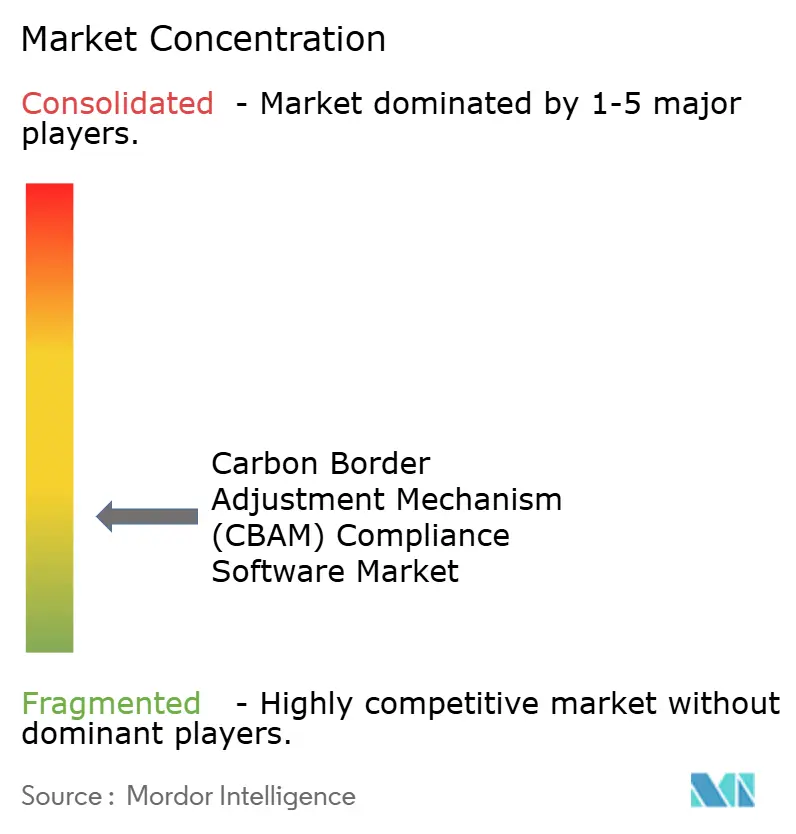
| Market Concentration | Low |
Major Players *Disclaimer: Major Players sorted in no particular order Image © Mordor Intelligence. Reuse requires attribution under CC BY 4.0. | |
Carbon Border Adjustment Mechanism (CBAM) Compliance Software Market Analysis by Mordor Intelligence
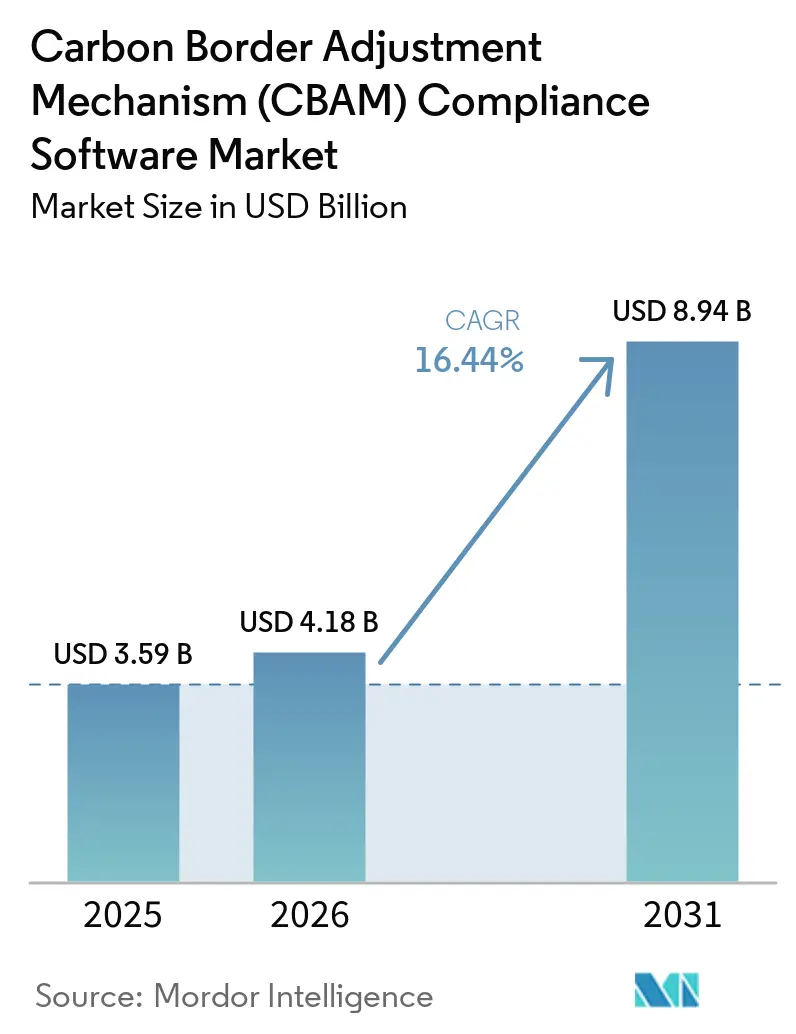
The Carbon Border Adjustment Mechanism (CBAM) compliance software market size is projected to be USD 3.59 billion in 2025, USD 4.18 billion in 2026, and reach USD 8.94 billion by 2031, growing at a CAGR of 16.44% from 2026 to 2031. The Carbon Border Adjustment Mechanism (CBAM) compliance software market is being shaped by the transition from transitional reporting to a definitive regime that now imposes certificate purchase, surrender, and verification obligations for covered imports. This change has made emissions calculation, declaration filing, supplier data capture, and certificate management core operating tasks rather than optional sustainability projects. The Carbon Border Adjustment Mechanism (CBAM) compliance software market is also gaining momentum from cross-border supply chain pressure, as EU importers are pushing non-EU suppliers to deliver plant-level emissions records in a format that supports annual declarations and third-party review. A second demand layer is forming around multi-jurisdiction compliance, as companies prepare for additional border carbon mechanisms beyond the EU and seek platforms that can handle changing rules without repeated process redesign. Competition is being defined by software providers that can combine regulatory updates, supplier collaboration, customs workflows, and enterprise system integration into a single operating environment, while the largest openings remain in exporter-facing tools, implementation support, and cloud delivery models that reduce compliance friction.
Key Report Takeaways
- By component, software held 65.18% of the Carbon Border Adjustment Mechanism (CBAM) compliance software market share in 2025, while services are projected to expand at a 17.66% CAGR through 2031.
- By deployment mode, cloud-based solutions accounted for 71.22% of the Carbon Border Adjustment Mechanism (CBAM) compliance software market share in 2025, and this segment is projected to record the fastest CAGR of 18.27% through 2031.
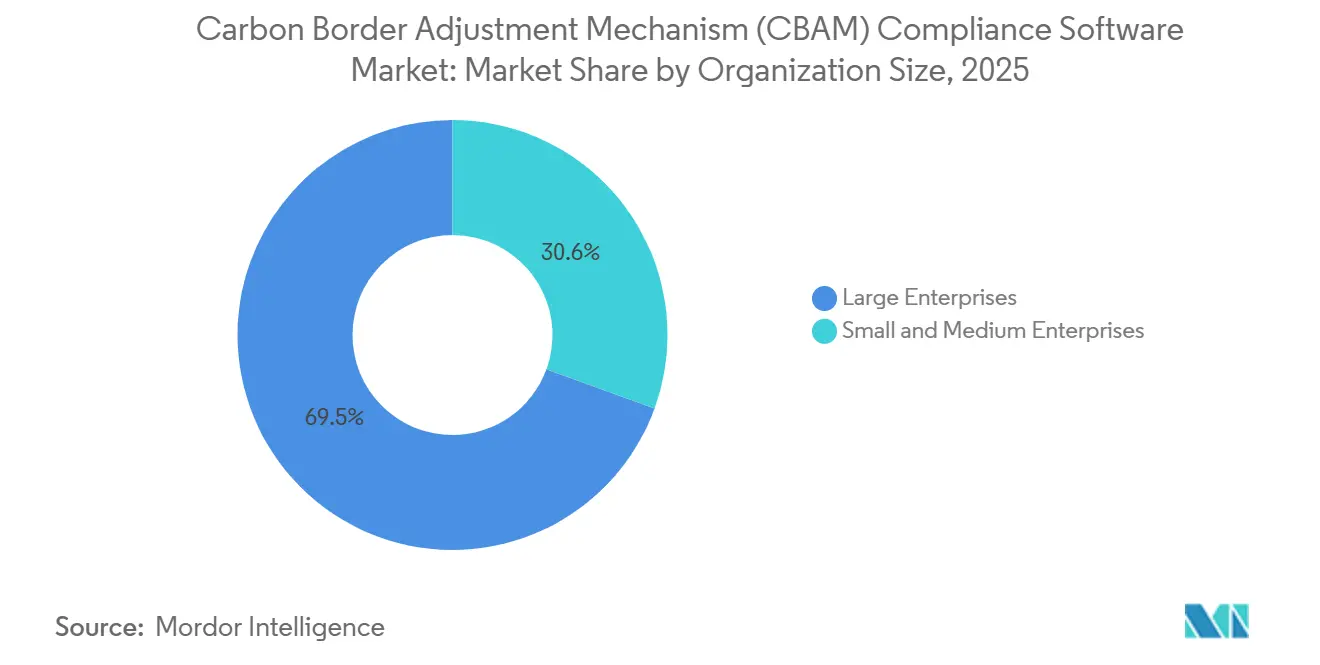
- By organization size, large enterprises held 69.45% share in 2025, while small and medium enterprises are projected to grow at a 17.92% CAGR through 2031.
- By end user, importers and declarants captured 54.21% share in 2025, while exporters and suppliers are projected to expand at a 17.23% CAGR through 2031.
- By geography, Europe held 37.19% share in 2025, while Asia-Pacific is projected to grow at a 16.81% CAGR through 2031.
Note: Market size and forecast figures in this report are generated using Mordor Intelligence’s proprietary estimation framework, updated with the latest available data and insights as of January 2026.
Market Trends and Insights
Drivers Impact Analysis of Carbon Border Adjustment Mechanism (CBAM) Compliance Software Market*
| Driver | (~) % Impact on CAGR Forecast | Geographic Relevance | Impact Timeline |
|---|---|---|---|
| EU CBAM Definitive Regime Adoption From 2026 | +4.5% | Europe core, with spillover to Asia-Pacific and the Middle East | Short term (≤ 2 years) |
| Rising Demand for Digital MRV and Audit-Ready Reporting | +3.5% | Global, concentrated in Europe and Asia-Pacific export markets | Short term (≤ 2 years) |
| Expansion of Carbon Pricing and Border Carbon Policies Beyond the European Union | +2.0% | North America, the UK, Australia, Japan, and South Korea | Medium term (2-4 years) |
| Supplier Data Digitization across Multi-Tier Supply Chains | +1.8% | Asia-Pacific core, with spillover to the Middle East and Africa | Medium term (2-4 years) |
| Internal Carbon Pricing and Procurement Decarbonization Programs | +1.5% | Europe and North America | Medium term (2-4 years) |
| Customs-ERP Integration and Trade Compliance Automation | +1.1% | Global, with early gains in Germany, the Netherlands, and Belgium | Long term (≥ 4 years) |
| Source: Mordor Intelligence | |||
EU CBAM Definitive Regime Accelerates Immediate Software Demand
The definitive phase, which took effect on January 1, 2026, shifted the Carbon Border Adjustment Mechanism (CBAM) compliance software market from a planning-led to an execution-led space. Regulation (EU) 2023/956 places the legal burden on authorized CBAM declarants, meaning importers now need systems that can capture embedded emissions, support annual declarations, and manage certificate obligations in a structured manner. The first real financial exposure tied to certificate surrender has shortened software buying cycles, as delayed preparation can now affect both costs and the continuity of imports. Implementing Regulation (EU) 2025/2546 added another layer by requiring physical on-site verification visits at non-EU production installations in the first verification year, which has increased the value of platforms that organize supplier evidence before a verifier arrives. SAP’s planned Green Ledger release for CBAM certificate repository management in 2026 showed that large enterprise software vendors also viewed this shift as a permanent compliance need rather than a temporary reporting requirement.
Rising Demand for Digital MRV and Audit-Ready Reporting Reshapes Platform Requirements
The Carbon Border Adjustment Mechanism (CBAM) compliance software market is also being boosted by the move toward digital monitoring, reporting, and verification workflows that can withstand external review. Under the definitive phase, actual embedded emissions submitted in annual declarations must be independently verified, which has made traceability, document control, and structured data retention basic purchase requirements. Article 6(6) requires that declaration records be maintained for 4 years, so platforms that collect data without preserving a clean audit trail are becoming less competitive. This is changing buyer expectations within the carbon border adjustment mechanism compliance software market, as customers increasingly want supplier questionnaires, calculation checks, and verifier-ready evidence packs in a single workflow. Delegated Regulation (EU) 2025/2551 has also tightened attention on verifier accreditation conditions, which gives an advantage to software that can structure data in a way that reduces review friction for accredited bodies.
Carbon Pricing Expansion Beyond the EU Creates a Compound Compliance Environment
The Carbon Border Adjustment Mechanism (CBAM) compliance software market is gaining another layer of support as border carbon measures spread beyond the EU. The UK confirmed its own CBAM through the Finance Act 2026, with implementation from January 1, 2027, creating a live dual-compliance setup for businesses that sell into both the EU and UK markets.[1] That development matters because companies are less willing to buy single-regime tools when neighboring jurisdictions are moving on different timelines and with different methods. The OECD also noted that wider product coverage and additional jurisdictions may deliver only modest global emissions effects, yet each new regime materially increases the addressable compliance workload for importers and exporters. As a result, the Carbon Border Adjustment Mechanism (CBAM) compliance software market is tilting toward vendors that can adapt reporting logic, evidence structures, and calculation settings across multiple regulatory frameworks rather than just one.
Supplier Data Digitization Demand Spans Multi-Tier Supply Chains
Supplier data readiness remains one of the clearest growth drivers inside the Carbon Border Adjustment Mechanism (CBAM) compliance software market. The core issue is not only that EU importers need data, but that they need plant-level emissions records from facilities outside the EU in a form that can be verified and linked to shipments. Implementing Regulation (EU) 2025/2546 raised the operational stakes by requiring first-year verification to include physical checks at production sites, pushing companies toward more disciplined supplier workflows. This has exposed long-standing data fragmentation across procurement, sustainability, customs, and operations teams, especially in supply chains spanning multiple supplier tiers. The practical effect is that software demand is moving beyond declaration filing alone and toward platforms that can standardize requests, collect evidence, manage follow-up, and preserve records across recurring reporting cycles. That broader supplier collaboration role is becoming a durable source of expansion for the Carbon Border Adjustment Mechanism (CBAM) compliance software market.
Restraints Impact Analysis of Carbon Border Adjustment Mechanism (CBAM) Compliance Software Market*
| Restraint | (~) % Impact on CAGR Forecast | Geographic Relevance | Impact Timeline |
|---|---|---|---|
| Regulatory Volatility across CBAM Methodologies and Timelines | -1.8% | Global, most acute in Europe and Asia-Pacific export economies | Short term (≤ 2 years) |
| Supplier Data Gaps and Verification Friction in Non-EU Supply Chains | -1.3% | Asia-Pacific, the Middle East, and Africa | Medium term (2-4 years) |
| High Implementation Cost for Mid-Market Importers and Exporters | -0.9% | Europe for SME importers, Asia-Pacific for mid-tier exporters | Medium term (2-4 years) |
| Limited Interoperability with Legacy Enterprise and Customs Systems | -0.6% | Global, concentrated in established industrial enterprises | Long term (≥ 4 years) |
| Source: Mordor Intelligence | |||
Regulatory Volatility Slows Procurement Decisions
The Carbon Border Adjustment Mechanism (CBAM) compliance software market is moving quickly, but regulatory volatility is still slowing some procurement decisions. The European Commission finalized major implementing and delegated acts late in 2025, which meant many companies had to validate whether their early workflows still aligned with the final operating rules. That timing created hesitation around long-term software contracts, because buyers wanted to avoid investing in tools that might need redesign just after deployment. The proposed downstream scope extension under COM(2025) 783, which would add more steel- and aluminum-based goods from 2028, has reinforced that caution, as software architecture decisions made now may soon require broader product coverage. This does not remove demand from the Carbon Border Adjustment Mechanism (CBAM) compliance software market, but it does shift spending toward flexible platforms, shorter implementation cycles, and vendors with stronger update capabilities.
Supplier Data Gaps Create Friction across the Value Chain
Supplier data gaps remain one of the most challenging operational barriers in the Carbon Border Adjustment Mechanism (CBAM) compliance software market. Many non-EU producers still manage emissions data using national or internal methods that do not align neatly with EU calculation boundaries, product mapping rules, or verification expectations. That mismatch slows importer readiness, as even willing suppliers may not have plant-level records that can be used directly in annual CBAM declarations. The first-year requirement for physical verification visits makes this challenge even more severe, as incomplete records can lead to delays, rework, and greater reliance on default values. This friction is especially visible in multi-tier supply chains where precursor materials come from foundries, mills, and upstream processors with weaker data systems. In response, the CBAM compliance software market is favoring platforms that can combine fallback reporting logic with structured supplier engagement programs that improve data quality over time.
*Our forecasts treat driver/restraint impacts as directional, not additive. The impact forecasts reflect baseline growth, mix effects, and variable interactions.
Carbon Border Adjustment Mechanism (CBAM) Compliance Software Market Segment Analysis
By Component:
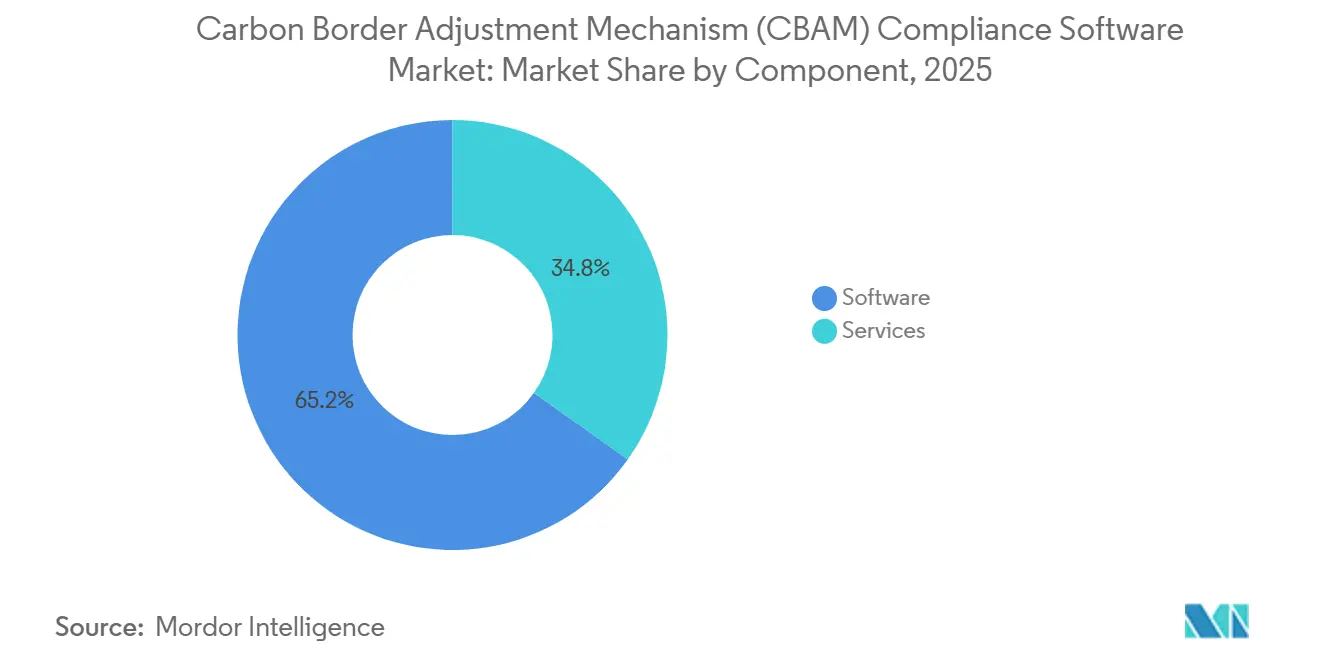
Software Leads on Compliance Obligation, Services Fill the Implementation GapSoftware held 65.18% of the Carbon Border Adjustment Mechanism (CBAM) compliance software market share in 2025, which reflected the central role of platforms in certificate management, declaration workflows, and embedded emissions calculations. That leadership position was rooted in the regime's legal structure, because certificate surrender and annual declarations require repeatable controls rather than one-time advisory support. Regulation (EU) 2023/956 made those obligations binding, which pushed software to the front of spending plans for affected importers. Within the software layer, certificate management and declaration support stood out as the most essential capabilities because they sit closest to the point of legal exposure. Embedded emissions engines also gained strategic weight, because companies need a consistent calculation logic that can feed both compliance records and internal finance or sustainability reporting. SAP’s product roadmap signaled this broader shift, with Green Ledger positioned to connect certificate management with wider carbon accounting workflows in enterprise environments.
Services are projected to expand at a 17.66% CAGR through 2031, making them the fastest-growing component, even though software remains the larger revenue pool. This pattern shows that the Carbon Border Adjustment Mechanism (CBAM) compliance software market is not just about buying a tool, but also about setting up supplier processes, internal controls, and verifier-facing workflows around it. Many companies can acquire software quickly, yet still need help with ERP configuration, data governance, customs alignment, and team training before the system becomes operationally reliable. carbmee’s EUR 20 million (USD 21 million) Series A in December 2024 reflected that combined software and implementation opportunity, because the funding was tied to product innovation, international expansion, and stronger delivery capability. Ongoing support also matters more here than in many adjacent compliance categories, since regulatory updates and accreditation conditions require recurring platform adjustments rather than a one-time completed build.
By Deployment Mode:
Cloud Infrastructure Reinforces Market DominanceCloud-based solutions accounted for 71.22% of the Carbon Border Adjustment Mechanism (CBAM) compliance software market in 2025, and this segment is projected to grow at an 18.27% CAGR through 2031. Holding both the largest share and the fastest growth rate shows that cloud delivery matches this category's operating rhythm unusually well. The strongest reason is regulatory change, because certificate handling rules, verification requirements, and regime updates need to be reflected quickly across users, entities, and supplier networks. In the Carbon Border Adjustment Mechanism (CBAM) compliance software market, subscription delivery and central updates are compliance features as much as technology preferences. Cloud setups also support distributed collaboration more effectively, which matters when importing teams, suppliers, verifiers, and finance functions all need access to the same records across reporting cycles.
On-premises deployment remains relevant, especially for large industrial groups and regulated organizations that maintain strict data residency, access control, or internal governance standards. Those customers may still prefer tighter infrastructure control even if it increases implementation time and reduces update speed. Even so, the balance of demand continues to favor cloud because the category depends on cross-entity coordination, recurring rule changes, and faster vendor support. Large software providers have reinforced that direction by embedding carbon and compliance functions into broader enterprise platforms that are increasingly delivered through cloud-first models.[2] This leaves on-premises vendors competing in narrower pockets of the carbon border adjustment mechanism compliance software market, where security policy or legacy infrastructure still outweighs agility.
By Organization Size:
Enterprise Incumbency Meets SME UrgencyLarge enterprises held a 69.45% share in 2025, reflecting their greater import exposure, broader compliance teams, and stronger ability to fund rapid system rollouts. Existing enterprise software estates also supported their position, as companies already running large ERP environments could activate carbon and reporting capabilities within established governance structures. SAP’s carbon accounting suite illustrates this advantage, as enterprise users can extend current system logic rather than build an entirely separate tool stack. In practical terms, this makes large organizations faster buyers in the Carbon Border Adjustment Mechanism (CBAM) compliance software market, even when their deployment scope is wider and more complex. Their spending also tends to include integration, controls, and reporting depth that raise average contract values above those for smaller accounts.
Small and medium enterprises are projected to grow at a 17.92% CAGR through 2031, which shows that urgency is spreading beyond the largest importers. The 50-tonne threshold means that once an SME crosses the covered volume level, it faces the same core certificate and declaration obligations as a larger company, even if it has fewer internal specialists. That has created space for vendors offering faster onboarding, simpler workflows, and lighter service models in the Carbon Border Adjustment Mechanism (CBAM) compliance software market. The shift is important because smaller firms often rely on external brokers, advisors, and suppliers for core trade processes, which makes ease of use and guided setup especially valuable. The rise of purpose-built platforms, including offerings from Carbmee and other focused vendors, is reducing the historic barrier that long implementation cycles kept many smaller firms from adopting formal compliance software.
By End User:
Importers Drive Volume, Exporter Demand AcceleratesImporters and declarants captured 54.21% share in 2025, making them the largest end-user group in the Carbon Border Adjustment Mechanism (CBAM) compliance software market. That outcome followed directly from the mechanism's legal structure, because only authorized CBAM declarants established in the EU can import covered goods under the definitive phase. This places the core obligations for declarations, certificate surrender, and recordkeeping on EU-side entities, which have become the first major buyers of dedicated software. Customs brokers and trade compliance advisors form a meaningful adjacent customer group, as many smaller importers rely on external specialists to manage filing and processing. Consulting and verification service providers remain a smaller end-user pool, yet they require high-quality workflow, document, and review functionality, as their role involves handling client data in a way that supports accredited verification.
Exporters and suppliers are projected to grow at a 17.23% CAGR through 2031, which makes them the fastest-rising end-user category. This demand is no longer indirect, as EU importers increasingly embed emissions disclosure and evidence requirements into supplier relationships, making exporter readiness a commercial necessity. Implementing Regulation (EU) 2025/2546 further strengthened that pressure by requiring physical on-site verifier inspections in the first year, which raises the value of having organized plant-level data before audits begin. Exporter-facing software is therefore moving from a niche offering to a recognized need within the CBAM compliance software market, especially where suppliers must align domestic carbon reporting efforts with EU expectations. Uniqus’ UniCORE platform is a clear example of this direction, as it is positioned to support Indian exporters that need both domestic carbon workflow alignment and EU CBAM modeling in a single environment.
Geography Analysis
Europe and United Kingdom Carbon Border Adjustment Mechanism (CBAM) Compliance Software Market
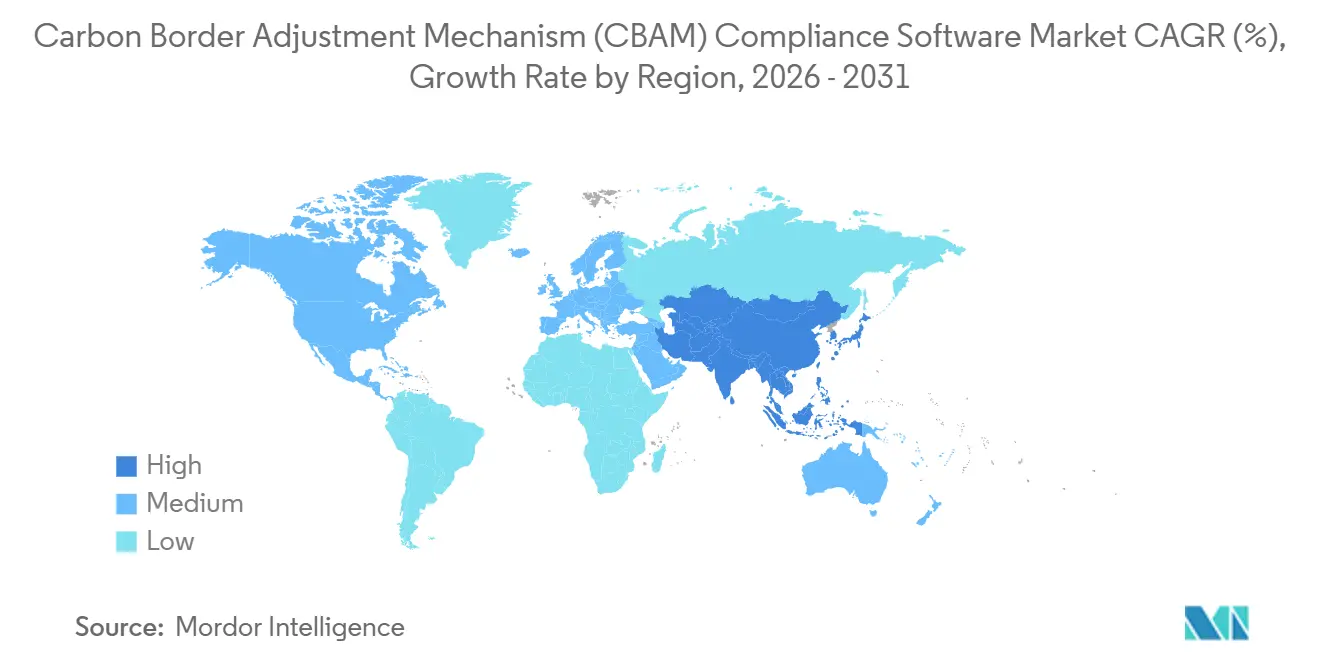
Europe held 37.19% of the Carbon Border Adjustment Mechanism (CBAM) compliance software market share in 2025, maintaining its lead. The regional base is structurally strong because the legal obligation sits with EU-established declarants, so the first wave of software demand is anchored inside the bloc rather than outside it.[3] Germany, France, the Netherlands, and Italy stand out because their covered import flows create repeated demand for certificate tracking, supplier record management, and declaration support across many industrial users. Europe is also where the Carbon Border Adjustment Mechanism (CBAM) compliance software market is seeing the earliest competitive normalization, as buyers compare specialist platforms with larger enterprise suites rather than simply settling for any available solution. The UK is adding another regional layer because its own CBAM is set to start on January 1, 2027, and that has already pushed dual-jurisdiction importers to review software that can manage parallel reporting frameworks.
APAC Carbon Border Adjustment Mechanism (CBAM) Compliance Software Market
Asia-Pacific is projected to grow at a 16.81% CAGR through 2031, making it the fastest-growing geography in the Carbon Border Adjustment Mechanism (CBAM) compliance software market. The main driver is exporter-side demand, since producers in China, India, South Korea, and Japan are under growing pressure to supply verified plant-level emissions data to EU customers. That need is expanding beyond large multinational exporters to broader supplier networks, especially where upstream materials are sourced from multiple facilities and countries. The region, therefore, represents a large long-term opportunity for platforms that can organize facility data, support supplier collaboration, and bridge local reporting practices with EU verification expectations.
The Americas and MEA Carbon Border Adjustment Mechanism (CBAM) Compliance Software Market
North America, South America, the Middle East, and Africa remain smaller revenue pools, but they are still relevant to the future shape of the carbon border adjustment mechanism compliance software market. In North America, demand is more closely tied to export compliance and multinational group readiness than to a fully developed domestic border carbon framework. South America is gaining attention through export exposure and policy discussion, with Brazil specifically referenced in the European Commission’s review of broader CBAM diffusion. In the Middle East and Africa, current demand is still at an earlier stage, but exporters in sectors such as steel and fertilizers are beginning to invest in readiness tools, as EU trade relationships make emissions documentation more commercially important. Over time, these regions can widen the CBAM compliance software market beyond its current Europe-led structure as supplier compliance becomes a standard condition of cross-border trade.
Competitive Landscape
The Carbon Border Adjustment Mechanism (CBAM) compliance software market remains fragmented, with competition spread across specialist providers, broader sustainability platforms, and large enterprise software companies. This structure reflects how the category formed: early demand came from a narrow regulatory mandate, while later demand widened to include supplier data, trade compliance, carbon accounting, and verification support. Specialist vendors such as Carbmee, Coolset, and Osapiens built early credibility around focused CBAM workflows, while larger platforms entered from adjacent environmental, supply chain, and ERP capabilities. The result is a field where the carbon border adjustment mechanism compliance software market is not controlled by a single product type or commercial model. Buyers instead evaluate vendors based on regulatory update speed, supplier collaboration tools, integration depth, audit readiness, and the ability to support both import-side and export-side workflows.
Recent strategic moves show that vendors are seeking to expand their role in the CBAM compliance software market. Schneider Electric launched Resource Advisor+ in January 2026 to bring carbon performance, supply chain sustainability, and regulatory reporting into a single platform, signaling a stronger push toward an end-to-end compliance architecture. EcoVadis expanded its Carbon Data Network by adding carbmee in April 2026, demonstrating how supplier-network platforms are leveraging partnerships to improve primary emissions data quality and product-level visibility.[4] EcoVadis had already partnered with Watershed in March 2026, reinforcing the same pattern of linking supplier data networks with stronger emissions analysis capability.
A second pattern is that enterprise vendors are trying to connect CBAM needs with broader financial and operational systems rather than treat them as stand-alone reporting tasks. SAP’s Green Ledger roadmap pointed in that direction by tying certificate repository management to wider carbon accounting structures that large companies already use. Service intensity is also becoming a differentiator, because software alone rarely solves supplier outreach, data validation, and verifier preparation without support around the tool. Sweep’s global partnership with Arcadis in May 2026 reflected this need for combined software and delivery capability in complex enterprise programs. As the Carbon Border Adjustment Mechanism (CBAM) compliance software market matures, vendors that can blend regulatory responsiveness, supplier engagement, and enterprise integration are likely to hold a stronger position than providers competing only on narrow filing automation.
Carbon Border Adjustment Mechanism (CBAM) Compliance Software Industry Leaders
-
SAP SE
-
IBM Corporation
-
Schneider Electric SE
-
Watershed Technology, Inc.
-
Sphera Solutions, Inc.
- *Disclaimer: Major Players sorted in no particular order
Carbon Border Adjustment Mechanism (CBAM) Compliance Software Market Companies Covered in this Report
- Assent Inc.
- carbmee GmbH
- Coolset B.V.
- IntegrityNext AG
- Normative AB
- Sphera Solutions, Inc.
- SAP SE
- Microsoft Corporation
- Salesforce, Inc.
- Enablon France SAS
- Persefoni AI, Inc.
- Sweep SAS
- Plan A Earth GmbH
- Emitwise Limited
- Watershed Technology, Inc.
- EcoVadis SAS
- Quentic GmbH
- Position Green AB
- IBM Corporation
- Schneider Electric SE
Recent Industry Developments in Carbon Border Adjustment Mechanism (CBAM) Compliance Software Market
- June 2026: Sweep SAS built a complete cloud emissions measurement solution leveraging the AWS Sustainability service, enabling enterprise customers to automatically consolidate Scope 1, 2, and 3 cloud emissions data within Sweep's sustainability intelligence platform for audit-ready reporting. This development is significant as it integrates cloud infrastructure emissions, a growing component of corporate footprints, directly into CBAM-adjacent carbon accounting workflows.
- May 2026: Persefoni AI launched Persefoni Analytics Agent, an agentic AI tool that enables compliance and sustainability teams to analyze emissions data via plain-language prompts within the platform, reducing time-to-insight for CBAM declaration preparation and internal carbon-cost modeling. The product operates on an auditability-first architecture aligned with evolving climate disclosure requirements.
- May 2026: Sweep SAS and Arcadis announced a global partnership combining Sweep's sustainability intelligence platform with Arcadis's advisory and delivery capabilities, targeting enterprise clients that require both software automation and expert implementation support for climate compliance programs. This partnership addresses the integration gap between compliance platform deployment and operational decarbonization, which is critical for CBAM-relevant supply chain re-engineering.
- April 2026: EcoVadis expanded its Carbon Data Network by adding carbmee as a strategic partner and integrating carbmee's AI-native EIS™ Environmental Intelligence System for SKU-level emissions hotspot identification into its Carbon Action Manager platform. This integration directly enhances EcoVadis's ability to supply primary emissions data for CBAM declarations, reducing importer dependence on punitive default values.
Global Carbon Border Adjustment Mechanism (CBAM) Compliance Software Market Report Scope
The carbon border adjustment mechanism (CBAM) compliance software market comprises solutions that help organizations comply with carbon-related trade regulations, notably the EU's CBAM framework. These platforms compute embedded emissions for imported goods, streamline reporting and declaration processes, and oversee CBAM certificate management. By merging supplier emissions data with customs documents and regulatory processes, they ensure compliance. Additionally, the software offers audit trails and traceability, and evaluates risks associated with cross-border carbon liabilities.
The Carbon Border Adjustment Mechanism (CBAM) Compliance Software Market Report is Segmented by Component (Software [CBAM Certificate Management and Trading Platforms, Import Declaration and Customs Filing Automation, Embedded Emissions Verification and Third-Party Validation Integration, and Other Software], and Services [Implementation and Integration Services, and Support and Maintenance Services]), Deployment Mode (Cloud-Based, and On-Premises), Organization Size (Large Enterprises, and Small and Medium Enterprises), End User (Importers and Declarants, Exporters and Suppliers, Customs Brokers and Trade Compliance Advisors, and Consulting and Verification Service Providers), and Geography (North America, South America, Europe, Asia-Pacific, Middle East, and Africa). The Market Forecasts are Provided in Terms of Value (USD).
Segmentation Overview
| Software | CBAM Certificate Management and Trading Platforms |
| Import Declaration and Customs Filing Automation | |
| Embedded Emissions Verification and Third-Party Validation Integration | |
| Other Softwares | |
| Services | Implementation and Integration Services |
| Support and Maintenance Services |
| Cloud-Based |
| On-Premises |
| Large Enterprises |
| Small and Medium Enterprises |
| Importers and Declarants |
| Exporters and Suppliers |
| Customs Brokers and Trade Compliance Advisors |
| Consulting and Verification Service Providers |
| North America | United States |
| Canada | |
| Mexico | |
| South America | Brazil |
| Argentina | |
| Rest of South America | |
| Europe | Germany |
| United Kingdom | |
| France | |
| Italy | |
| Spain | |
| Russia | |
| Rest of Europe | |
| Asia-Pacific | China |
| India | |
| Japan | |
| South Korea | |
| Australia | |
| Rest of Asia-Pacific | |
| Middle East | Saudi Arabia |
| United Arab Emirates | |
| Turkey | |
| Rest of Middle East | |
| Africa | South Africa |
| Nigeria | |
| Rest of Africa |
| By Component | Software | CBAM Certificate Management and Trading Platforms |
| Import Declaration and Customs Filing Automation | ||
| Embedded Emissions Verification and Third-Party Validation Integration | ||
| Other Softwares | ||
| Services | Implementation and Integration Services | |
| Support and Maintenance Services | ||
| By Deployment Mode | Cloud-Based | |
| On-Premises | ||
| By Organization Size | Large Enterprises | |
| Small and Medium Enterprises | ||
| By End User | Importers and Declarants | |
| Exporters and Suppliers | ||
| Customs Brokers and Trade Compliance Advisors | ||
| Consulting and Verification Service Providers | ||
| By Geography | North America | United States |
| Canada | ||
| Mexico | ||
| South America | Brazil | |
| Argentina | ||
| Rest of South America | ||
| Europe | Germany | |
| United Kingdom | ||
| France | ||
| Italy | ||
| Spain | ||
| Russia | ||
| Rest of Europe | ||
| Asia-Pacific | China | |
| India | ||
| Japan | ||
| South Korea | ||
| Australia | ||
| Rest of Asia-Pacific | ||
| Middle East | Saudi Arabia | |
| United Arab Emirates | ||
| Turkey | ||
| Rest of Middle East | ||
| Africa | South Africa | |
| Nigeria | ||
| Rest of Africa | ||
Key Questions Answered in the Report
What is the current and forecast value of the Carbon Border Adjustment Mechanism compliance software space?
The Carbon Border Adjustment Mechanism (CBAM) compliance software market size stood at USD 3.59 billion in 2025, reaches USD 4.18 billion in 2026, and is forecast to reach USD 8.94 billion by 2031 at a 16.44% CAGR.
What is driving demand for CBAM compliance software in 2026?
Demand is being driven by the definitive EU regime, certificate obligations, annual declarations, third-party verification needs, and rising pressure on suppliers to deliver plant-level emissions data in a usable format.
Which component category leads revenue and which one grows the fastest?
Software led with 65.18% share in 2025 because it handles core workflows such as emissions calculation, declaration filing, and certificate management, while services are projected to grow the fastest at 17.66% CAGR through 2031.
Why are cloud-based platforms leading adoption?
Cloud-based solutions held 71.22% share in 2025 and are projected to grow at 18.27% CAGR because users need faster regulatory updates, easier collaboration across entities, and lower friction in recurring compliance cycles.
Which customer group is creating the fastest new demand?
Importers and declarants remained the largest end-user group at 54.21% share in 2025, but exporters and suppliers are projected to grow the fastest at 17.23% CAGR as EU buyers push emissions data responsibilities across the supply chain.
Which region offers the strongest growth opportunity over the forecast period?
Europe remained the largest region with 37.19% share in 2025, while Asia-Pacific is projected to grow the fastest at 16.81% CAGR as exporters in the region build systems to support EU-facing compliance needs.