
Boiler Control Market Size and Share
Boiler Control Market Analysis by Mordor Intelligence
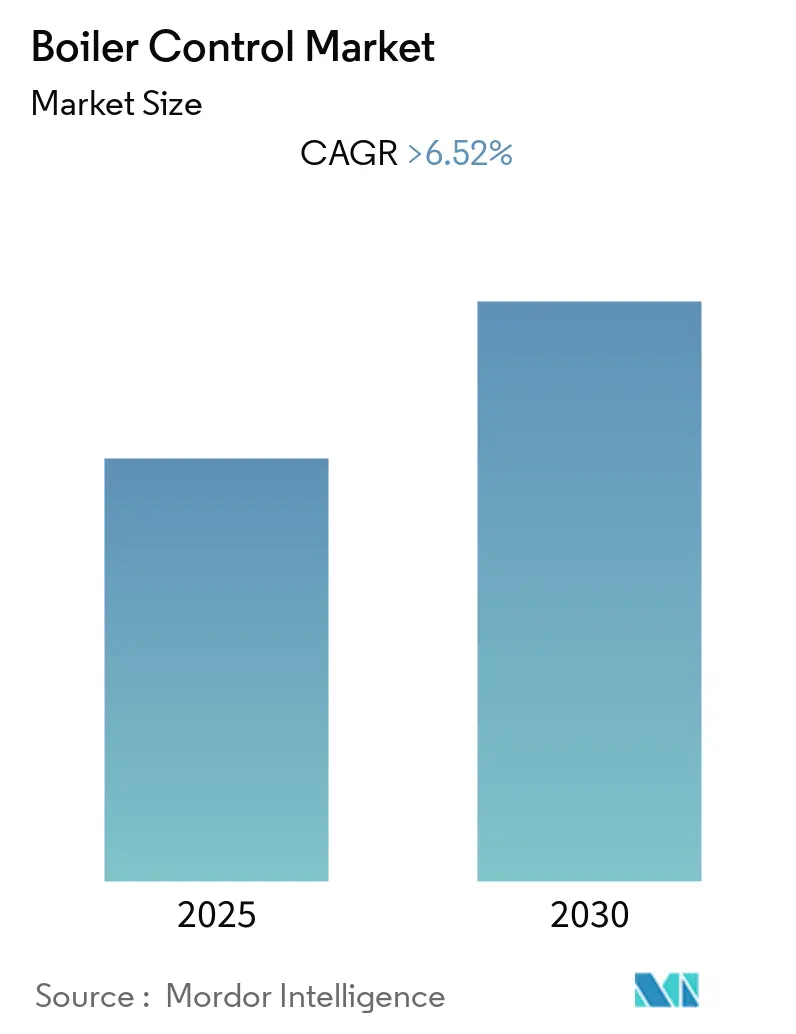
The boiler control market size stands at USD 2.1 billion in 2026 at manufacturer or system integrator selling prices, with next year's value estimated at USD 2.15 billion and a forecast of USD 2.49 billion for 2032, representing a 2.98% CAGR over 2027-2032. Replacement controls, combustion upgrades, and boiler-house software provide the main opportunities in a market tied closely to equipment already operating. Suppliers gain revenue when owners improve an existing boiler's safety, fuel use, or availability, even when those owners add little steam-generating capacity.
Efficiency-led replacement supports the increase estimated for 2027, while the retirement of older combustion equipment limits its pace. In January 2026, an official from China's State Administration for Market Regulation told Workers' Daily that average industrial-boiler operating thermal efficiency had improved by 4.2 percentage points from 2021. China's industrial boiler association subsequently reported a national action plan, published in November 2026, calling for the elimination of coal-fired boilers rated at 10 tonnes of steam per hour or below. Better controls can capture part of the spending on replacement and modernization, although each retired boiler also removes a future combustion-control customer.
Key Report Takeaways
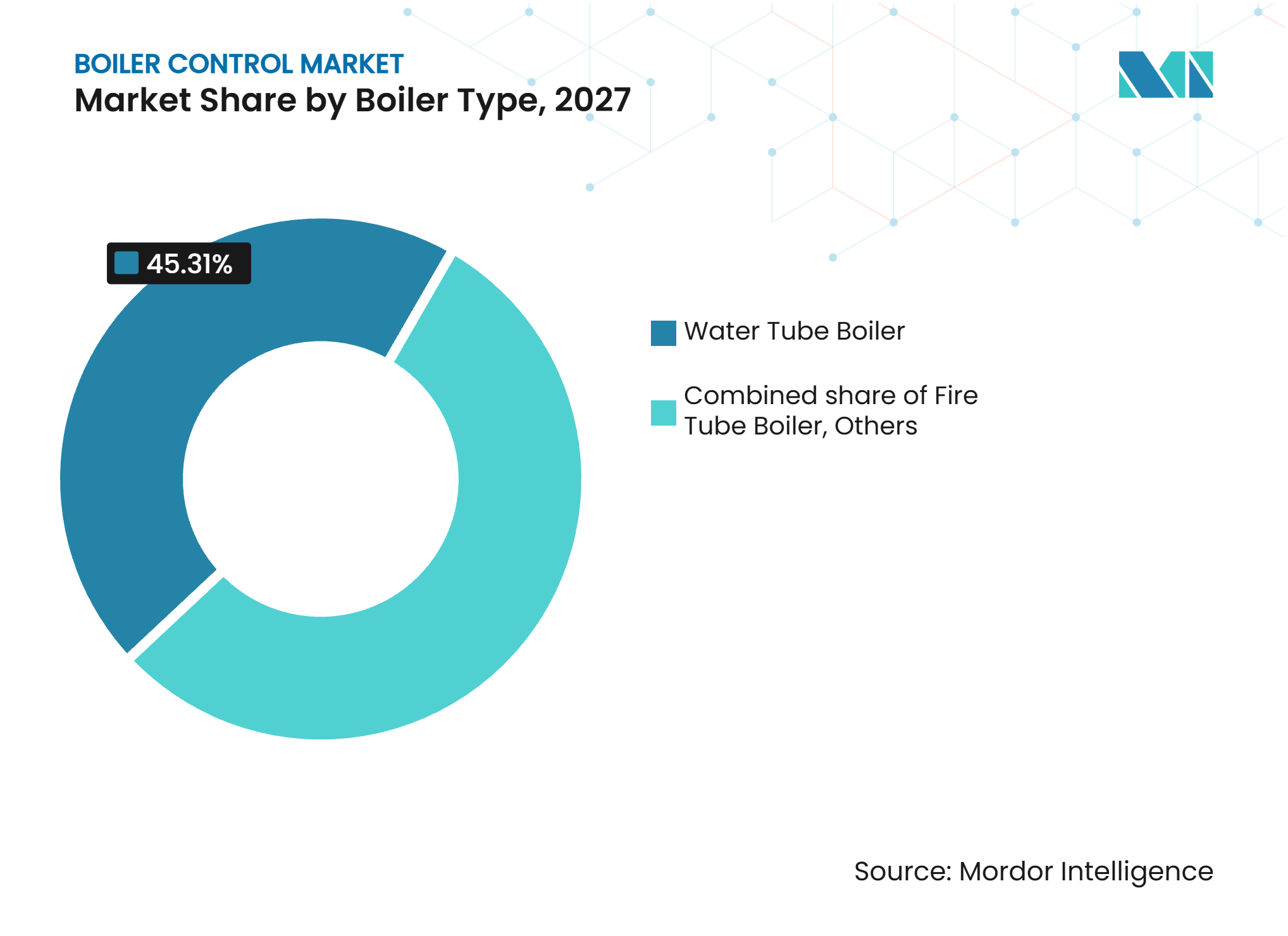
- Water-tube equipment is expected to command 45.31% of the boiler control market share in 2027, while fire-tube controls are forecast to grow at a 3.05% CAGR during 2027-2032.
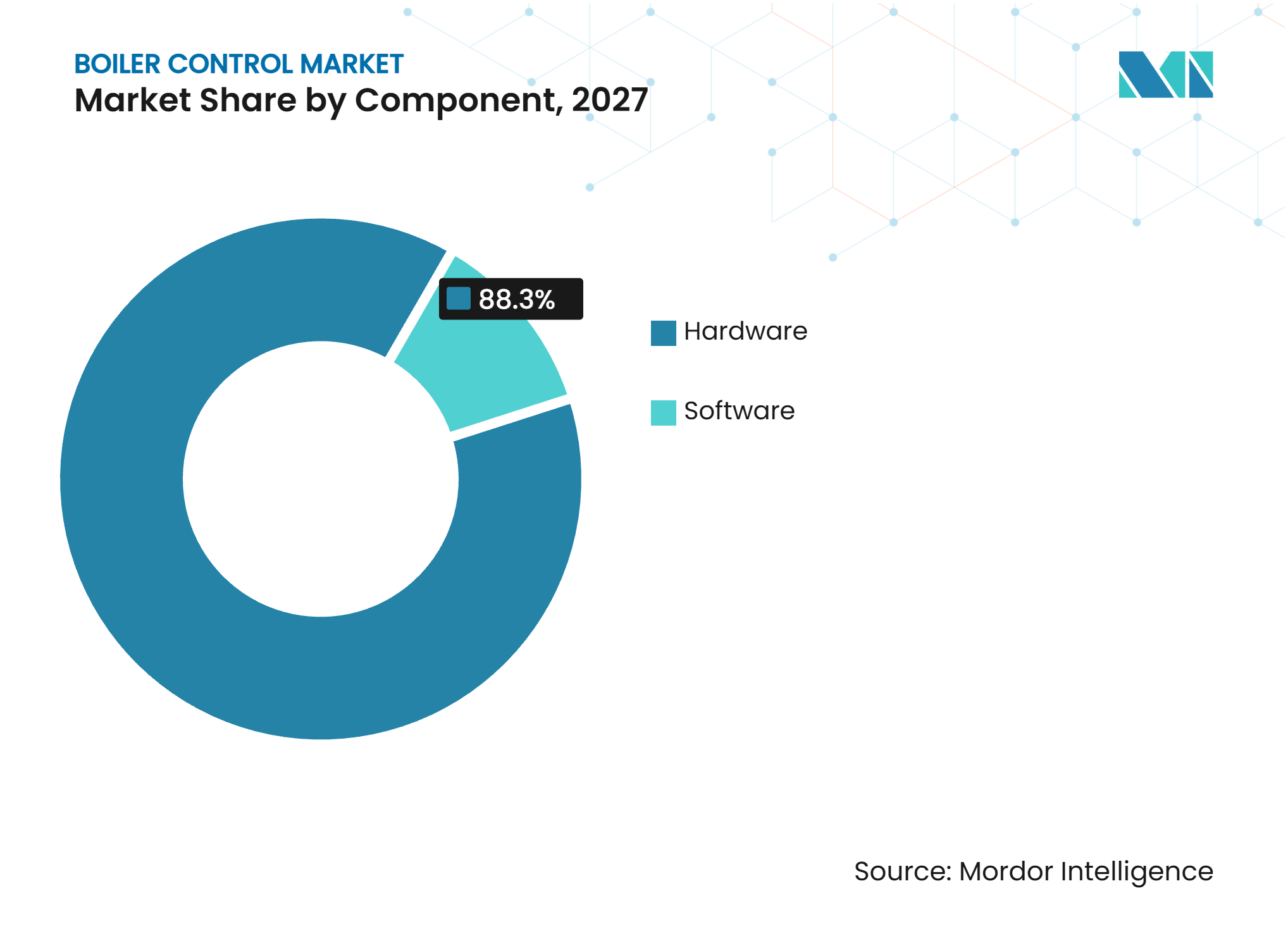
- Hardware is estimated to account for 88.30% of the boiler control market size in 2027, but software is forecast to expand faster, at a 4.60% CAGR over 2027-2032.
- Industrial owners are expected to represent 67.48% of the boiler control market share in 2027 and lead end-user growth at a forecast 3.21% CAGR during 2027-2032.
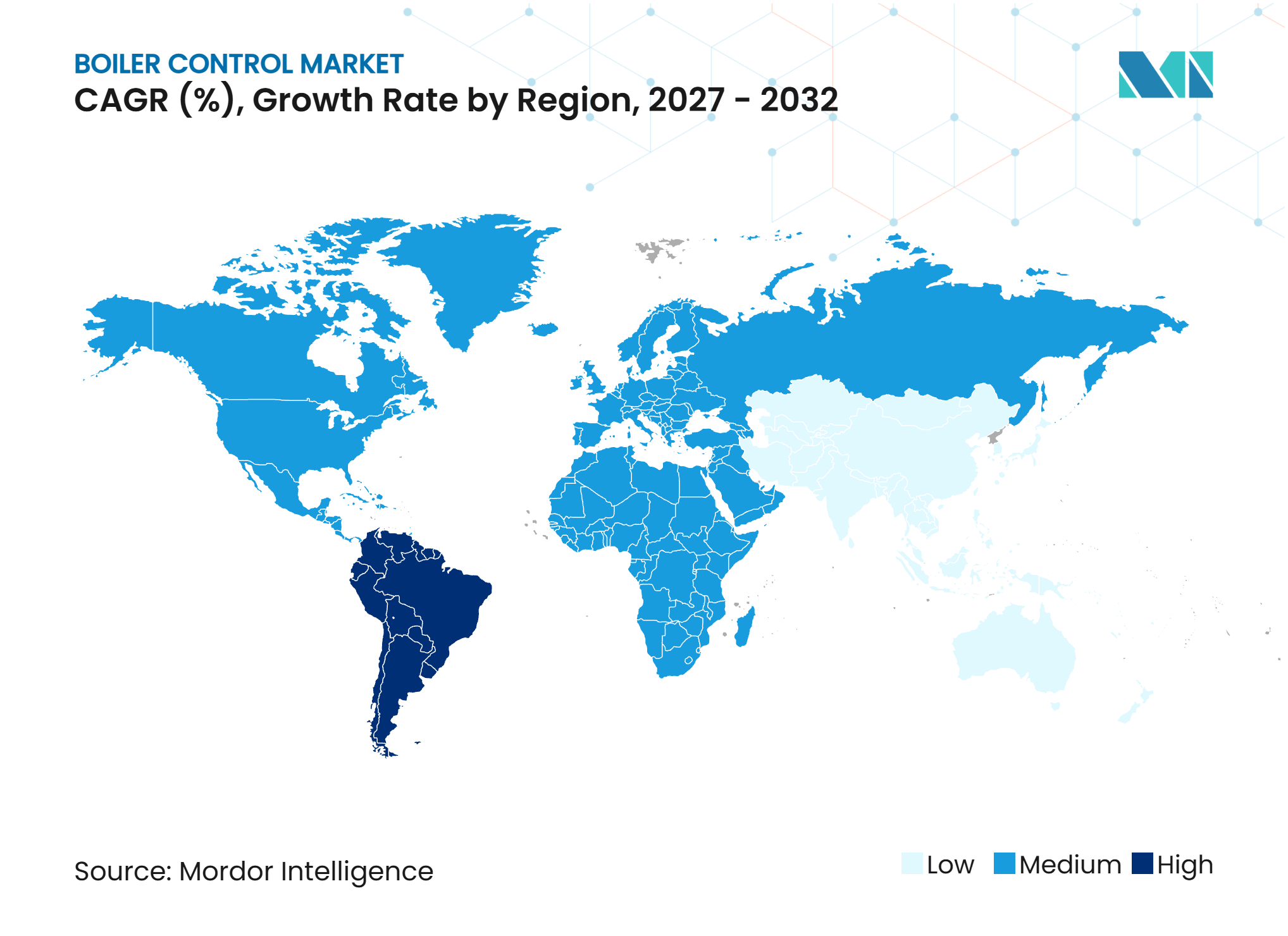
- Asia-Pacific is estimated to contribute 40.76% of the boiler control market size in 2027, while South America is forecast to record the fastest regional growth, at a 5.76% CAGR over 2027-2032.
- Subscription monitoring and energy-management requirements carry the largest individual positive forecast impact, adding approximately 0.5 percentage points to baseline growth.
Note: Market numbers in this report are based on Mordor Intelligence's proprietary estimation framework, which combines nine months of actuals with Q4 projections for base year 2026.
Market Trends and Insights
Baseline growth is 2.2% annually, supported mainly by pricing, replacement expenditure, and a broadly stable installed base of industrial and commercial boilers. The market's combined forces lift that baseline by approximately 0.78 percentage points to the forecast 2.98% CAGR for 2027-2032. Each impact in the following 2 tables adds to or takes from baseline growth. Smaller changes and product-mix effects account for the remaining difference.
Drivers Impact Analysis of Boiler Control Market*
| Driver | (~) % Impact on CAGR Forecast | Geographic Relevance | Impact Timeline |
|---|---|---|---|
| Adopted carbon price on small-boiler fuels amid tight gas supply | +0.2% | Europe | Medium term (2-4 years) |
| Subscription boiler-house monitoring and mandated energy management systems | +0.5% | Global, particularly Europe and North America | Long term (≥ 4 years) |
| Medium combustion plant limits for existing small plants | +0.1% | Europe | Medium term (2-4 years) |
| Pending Chinese national boiler emission and efficiency standards | +0.1% | China | Medium term (2-4 years) |
| Aging North American boiler fleet driving replacement and control upgrades | +0.1% | North America | Medium term (2-4 years) |
| Japanese subsidy for high-performance boiler replacement | +0.1% | Japan | Medium term (2-4 years) |
| Source: Mordor Intelligence | |||
Adopted Carbon Price on Small-Boiler Fuels Amid Tight Gas Supply
Europe's extension of carbon pricing improves the case for reducing fuel consumption in smaller boiler houses. The European Commission's September 2026 update on ETS2, the EU's second emissions trading system, places full operation in 2028 and identifies buildings and additional sectors, principally small industry, within its coverage.[1] Fuel suppliers carry the allowance obligation, which gives carbon costs a route into boiler owners' fuel bills. Combustion tuning, oxygen trim (automatic adjustment of the air supply to the fuel burned), and better sequencing let owners cut that exposure before the new system begins operating. Small-boiler control upgrades in Europe gain a cost-saving rationale from the carbon price.
Subscription Boiler-House Monitoring and Mandated Energy Management Systems
Energy-management obligations create demand for reliable operating records and repeatable efficiency improvements. Bureau Veritas' November 2026 guidance identifies an October 2027 deadline for energy-management systems at EU enterprises averaging more than 85 TJ of annual energy consumption, following the October 2026 first-audit deadline for enterprises above 10 TJ without such a system. Product offerings are developing alongside that requirement. Cleaver-Brooks introduced its myBoilerRoom digital asset-management solution in February 2025, while Yokogawa announced a February 2026 agreement with CMC Solutions covering predictive emissions monitoring for equipment including boilers. Recurring revenue from monitoring, validation, and maintenance grows in Europe and North America where the software gives owners information they can use in operating decisions.
Medium Combustion Plant Limits for Existing Small Plants
European emissions limits on medium combustion plants create a staged retrofit opportunity across the existing fleet. The European Commission's September 2025 implementation report restated that existing plants above 5 MW thermal input faced emissions limits from January 2025, with existing plants of 1-5 MW following in January 2030. Boiler owners must assess whether burner changes, combustion controls, fuel switching, or replacement provide a practical compliance route. The resulting work connects control suppliers with replacement projects in the Europe boiler system market. The 2030 deadline for smaller plants extends that upgrade cycle into the forecast period.
Pending Chinese National Boiler Emission and Efficiency Standards
China's pending standards encourage preparation for tighter performance requirements while leaving final equipment specifications subject to adoption. The China National Institute of Standardization issued the consultation draft of revised industrial-boiler efficiency requirements in June 2026, with comments closing in August. Separately, the Chinese Research Academy of Environmental Sciences reported that the revised national power-plant and boiler air-pollutant standard passed technical review in June 2026. Boiler and burner manufacturers have an incentive to prepare control platforms that support revised testing, combustion adjustment, and emissions documentation, while owners time major purchases around the final rules. Chinese control demand therefore waits on the final text of these standards.
Restraints Impact Analysis of Boiler Control Market*
| Restraint | (~) % Impact on CAGR Forecast | Geographic Relevance | Impact Timeline |
|---|---|---|---|
| Shrinking Chinese boiler fleet and falling new-boiler output | -0.2% | China, with effects on international OEM supply chains | Long term (≥ 4 years) |
| Electric boilers and heat pumps displacing fuel-fired steam and heat | -0.2% | Europe, China, Japan, and North America | Long term (≥ 4 years) |
| Structural closures of European chemical and petrochemical capacity | -0.2% | Europe | Medium term (2-4 years) |
| Zero-emission building standard and fossil-boiler phase-out for commercial buildings | -0.1% | Europe, with selected local markets elsewhere | Long term (≥ 4 years) |
| Source: Mordor Intelligence | |||
Shrinking Chinese Boiler Fleet and Falling New-Boiler Output
China's declining boiler population reduces the number of assets available for future combustion-control sales. SAMR reported 293,300 registered boilers at the end of 2025, compared with 309,900 at the end of 2024. National Bureau of Statistics data reported by Mysteel showed industrial-boiler output falling 19% year on year in January-July 2026, measured by rated evaporation capacity. Both trends constrain new-equipment packages and the longer-term retrofit pool, which raises the importance of spending per retained boiler for suppliers in China.
Electric Boilers and Heat Pumps Displacing Fuel-Fired Steam and Heat
Electrification changes the contents of a boiler-control package and can remove the boiler altogether in suitable low-temperature applications. Harbin Electric announced a November 2025 thermal-storage electric-boiler project intended to replace coal-fired steam generation at CNPC's Harbin Petrochemical operation. Pohjolan Voima subsequently reported that a 60 MW electric boiler supplying industrial steam and district heat entered commercial operation in Pori, Finland, in August 2026. Growth in the electric boiler market preserves demand for sequencing, pressure control, electrical protection, and dispatch software, while reducing demand for flame safeguards and fuel-air controls.
*Our forecasts treat driver/restraint impacts as directional, not additive. The impact forecasts reflect baseline growth, mix effects, and variable interactions.
Boiler Control Market Segment Analysis
By Boiler Type:
Water-Tube Systems Anchor Control SpendingWater-tube boilers are estimated to hold 45.31% of the boiler control market share in 2027. Larger process-steam installations require coordinated control of feedwater, pressure, drum level, combustion, and safety, which gives each package substantial engineering content. Cleaver-Brooks' February 2026 update to its FLX water-tube boiler paired the equipment with new Hawk controls and an optional integral economizer, a heat exchanger that recovers heat from flue gas.[2] Water-tube suppliers pair control modernization with thermal-performance gains to raise the value of each equipment upgrade.
Fire-tube controls are forecast to grow at a 3.05% CAGR during 2027-2032, supported by packaged steam systems bought by manufacturing and institutional users. Cleaver-Brooks' February 2025 CBEX-3W announcement described a fire-tube product designed to maintain 3% oxygen across a 10:1 turndown range, the span of loads the burner can serve. Combustion performance has become part of the packaged-boiler proposition. Electric, thermal-fluid, sectional, and condensing designs collectively grow faster from a smaller position, with different requirements for power regulation and multi-unit sequencing. Those designs open room for adaptable control platforms, while fire-tube equipment keeps a broad route to market through packaged boilers.



By Component:
Hardware Dominates, Software Builds Recurring ValueHardware is estimated to absorb 88.30% of the boiler control market size in 2027. Safety logic, controllers, panels, scanners, analyzers, and dedicated transmitters remain essential purchases, and commissioning adds to the value of each installed package. Cleaver-Brooks' February 2025 EOS 500 launch combined parallel positioning with integrated flame-safeguard functions, which shows combustion and safety functions consolidating in a single product. Hardware suppliers compete on dependable operation, installation effort, and the ability to accommodate existing burners and plant interfaces.
Software is forecast to advance at a 4.60% CAGR over 2027-2032 as owners connect operating data with maintenance and energy decisions. In November 2025, Hysopt reported that a project with SPIE at a Dutch care facility reduced gas consumption by 52% through digital modeling, hydraulic optimization, and building-management adjustments. The saving came from a hybrid plant with several combined interventions, so the value sits in coordinating the whole heating system. Software revenue gains depend on turning plant data into persistent operating improvements.

By End-User:
Industrial Steam Sustains the Revenue BaseIndustrial owners are expected to represent 67.48% of the boiler control market share in 2027, with spending forecast to increase at a 3.21% CAGR during 2027-2032. Food processing, chemicals, pulp and paper, and textiles depend on steam conditions that directly affect production continuity and product quality. In a September 2025 ETManufacturing interview, Thermax's managing director described the installation of 8 biomass boilers across 4 factories for a food manufacturer. Fuel conversion across multiple production sites gives control suppliers openings in combustion management, load sharing, and integration with the wider steam boiler system market.
Commercial spending is forecast to grow at a 2.45% CAGR over 2027-2032, supported by hospitals, universities, hotels, and municipal heating operators. FacilitiesNet's July 2025 account of Abbott Northwestern Hospital described new smart boilers equipped with Preferred Utilities combustion controls, including wide-range modulation and fuel switching. Institutional owners value continuity of service and maintenance access alongside energy savings. Commercial demand therefore grows more slowly than industrial demand but favors suppliers with strong service networks.
Geography Analysis
Asia-Pacific: Scale With Replacement Pressure
Asia-Pacific is estimated to account for 40.76% of the boiler control market size in 2027, reflecting its substantial industrial heat requirements and boiler installed base. China's replacement pressure sits alongside opportunities to coordinate new energy sources elsewhere in the region. In December 2025, Daigas announced a service following an October demonstration that linked its Energy Brain management system with a Miura electric steam boiler for automated demand response. Asia-Pacific demand spans conventional boiler modernization and controls that adjust steam production to electricity-system conditions.
North America: Institutional Retrofit Demand
North American opportunities concentrate on modernizing existing steam infrastructure and improving the service network that supports it. Ameresco announced a USD 197 million energy-savings performance contract for the US Naval Research Laboratory in October 2025, including steam-generation modernization, boiler-plant work, and SCADA (supervisory control and data acquisition) supervision. Cleaver-Brooks' completed partnership with R.F. MacDonald in October 2026 also strengthened its California and Nevada sales and service coverage. Campus modernization and local technical support give suppliers routes to recurring retrofit business across the US boiler control market.
Europe: Compliance Meets Industrial Restructuring
European demand combines mandatory upgrades with a shrinking customer base in parts of heavy industry. Cefic reported in January 2026 that announced European chemical-capacity closures totaled 37 million tonnes across 2022-2025, equivalent to approximately 9% of regional production capacity. Meanwhile, the European Commission's building guidance sets zero-emission requirements for new publicly owned buildings from 2028 and other new buildings from 2030. Surviving industrial sites remain candidates for compliance investment, while new commercial heating in Europe increasingly favors controls suited to electric and hybrid systems.
South America: Industrial Energy Projects Lead Growth
South America is forecast to deliver the fastest regional expansion, at a 5.76% CAGR during 2027-2032, from a comparatively small base. Valmet reported in June 2025 that Klingele's Nova Campina paper operation in Brazil had commissioned DNA automation for its biomass boiler, associated plant, and steam turbine. BASF's Brazilian steam-electrification project provides a separate example, with Valor Econômico reporting in September 2026 that operation was expected by year-end. Biomass and electric-steam projects call for different control architectures, which widens South American control work beyond conventional burner replacement.
Middle East and Africa: Fuel Conversion and Reliability Projects
Middle Eastern and African demand is shaped by individual industrial upgrades with substantial integration requirements. Mitsubishi Power completed the conversion of ANRPC's 100-tonne-per-hour refinery boiler in Egypt to hydrogen firing in August 2025, including the associated control systems. In South Africa, Cape Business News reported in July 2025 that Tomotex's boiler, burner, and Autoflame management-system replacement delivered fuel-cost savings above 30%. Fuel flexibility and equipment reliability win project awards in the region, and local engineering and commissioning capabilities influence which supplier is chosen.
Mordor Intelligence provides coverage of the boiler control market across other key regional markets, including Asia, each with their regulatory frameworks and demand patterns. Detailed country-level analysis extends to Indonesia, India, and China incorporating local coverage and market participation, as required.
Competitive Landscape
Market Concentration
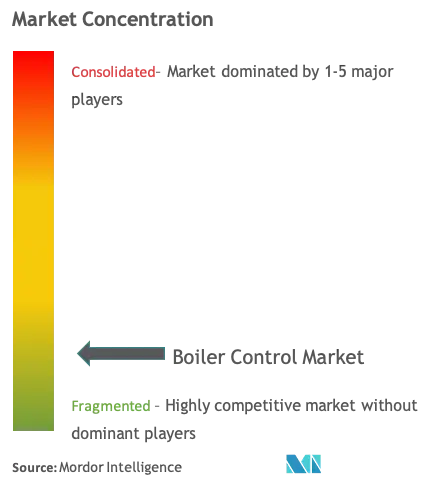
Competition combines integrated boiler manufacturers, automation companies, combustion specialists, and local system integrators. Cleaver-Brooks Inc sells integrated boiler, burner, and control packages. Emerson Electric Co supplies automation and instrumentation used in dedicated boiler applications, while Yokogawa Electric Corporation provides industrial automation and boiler-related emissions-monitoring capabilities. Bosch's industrial-boiler controls are supplied by Bosch Industriekessel, and Weil-McLain's commercial products incorporate proprietary hydronic controls. Bosch Ltd and Weil-McLain (Shandong) Cast-Iron-Boiler Co., Ltd. complete the top 5, so the leading names span integrated boiler makers, automation companies, and hydronic specialists.
Automation suppliers bring software development capacity and established plant relationships to this market. Emerson's FY2026 Form 10-K reported 5% underlying sales growth in Control Systems & Software, while Schneider Electric's third-quarter 2026 release reported 8% organic growth in Industrial Automation. Both businesses serve applications well beyond boiler houses, but their expanding platforms provide components and engineering tools used by boiler integrators. Dedicated combustion suppliers compete through application expertise and easier retrofit deployment, as Fireye's March 2026 acquisition of Energy Technology & Control shows.
The leading 5 suppliers are estimated to account for approximately 20% of global market value in 2026. Distribution across OEM packages, independent combustion products, and locally engineered retrofits keeps concentration low. Suppliers with strong commissioning and service coverage can defend installed-base relationships even when competing hardware offers similar functions.
Boiler Control Industry Leaders
-
Cleaver-Brooks Inc
-
Emerson Electric Co
-
Bosch Ltd
-
Yokogawa Electric Corporation
-
Weil-McLain (Shandong) Cast-Iron-Boiler Co., Ltd.
- *Disclaimer: Major Players sorted in no particular order
Boiler Control Market Companies Covered in this Report
- Cleaver-Brooks Inc
- Emerson Electric Co
- Bosch Ltd
- Yokogawa Electric Corporation
- Weil-McLain (Shandong) Cast-Iron-Boiler Co., Ltd.
- Siemens AG
- HBX Control Systems Inc
- ABB Ltd
- Schneider Electric SE
- Spirax Group plc
- Honeywell Technologies
Retrofit Economics
Bundled burner-and-control retrofits can support short investment-recovery periods at suitable commercial sites. The UK government's Energy Technology List reported in March 2025 that the Leadenhall Building's management company confirmed annual energy savings of USD 79,152 (GBP 60,000) and a 2-year investment recovery period following a Limpsfield burner and Autoflame controller installation.[3] Those figures imply approximately USD 158,300 (GBP 120,000) of investment for the bundled intervention, using the Federal Reserve's 2025 average of USD 1.3192 per GBP. The same case study described a separate NHS installation with projected annual fuel-cost savings of 7.03%. Smaller boiler-house interventions therefore sit alongside major plant replacements as a source of commercial retrofit demand.
Hybrid Heat Dispatch
Hybrid boiler houses create demand for software that chooses which heat source should operate as fuel and electricity prices change. The IEA's December 2025 industrial-heat analysis assumed 87% efficiency for gas boilers, 98% for electric boilers, and a heat-pump coefficient of performance of 3.5, meaning 3.5 units of heat per unit of electricity. Those inputs imply energy-only electricity-to-gas price parity ratios of 0.98 ÷ 0.87 = 1.13 for electric boilers and 3.5 ÷ 0.87 = 4.02 for heat pumps. The ratios cover energy cost alone, with capital recovery, network charges, maintenance, and process-temperature constraints sitting outside them. An electric boiler matches gas on energy cost when electricity costs up to 1.13 times as much per unit, and a heat pump when it costs up to 4.02 times as much, so dispatch software has to track both price ratios.
Dispatch software sits where the approximately 0.2-percentage-point restraint from thermal electrification meets growth in boiler-house software. Bosch's February 2025 industrial-heating release described operating electric-steam installations at PepsiCo in Poland and the Stríbro dairy in the Czech Republic, each paired with a gas-fired boiler. Such configurations require decisions about cost, steam availability, and backup capacity, creating an interface between boiler controls and the district heating market where shared heat networks are involved. Support for multiple heat sources lets suppliers retain control-system revenue as combustion-specific hardware demand declines.
Recent Industry Developments in Boiler Control Market
- Nov 2026: ASPE reported tekmar's launch of the Smart Boiler Control 294BAC, adding native BACnet (a building-automation communication standard) connectivity for commercial boiler-plant integration.
- Oct 2026: Cleaver-Brooks announced completion of its partnership agreement with R.F. MacDonald, which continues operating under its own name as a subsidiary.
- Mar 2026: Fireye announced its acquisition of Energy Technology & Control, expanding its combustion-control portfolio.
Boiler Control Market Report Scope and Research Methodology
Market Definition and Coverage
The boiler control market comprises control systems dedicated to industrial and commercial boilers. Coverage includes burner management and flame safeguards, combustion and oxygen-trim controllers, boiler PLCs, drum-level and feedwater controls, pressure and sequencing systems, dedicated sensors and analyzers, and boiler-house software and remote monitoring. Sales include packages supplied to boiler and burner OEMs and retrofits or subscriptions supplied to industrial, institutional, commercial, and district-heating owners.
The study excludes utility power-station boilers, residential boilers and thermostats, and general plant distributed control systems without a dedicated boiler function. Market value is measured in USD at the manufacturer's or system integrator's selling price of the boiler control package or retrofit. A sale represents a boiler's control package, a retrofit, or a software subscription.
Boiler type follows the design receiving the controls, and end-user classification follows the boiler owner. Hardware includes bundled installation and commissioning, while separately charged boiler-house software, monitoring, and analytics fall under software. Company attribution follows the selling legal entity where established. Bosch Industriekessel's industrial-boiler operations are distinguished from Bosch Ltd, and the Shandong entity is distinguished from the US Weil-McLain brand. Concentration is a rounded structural analyst estimate based on the breadth of OEMs, specialists, and integrators, rather than a summation of separately disclosed boiler-control revenues.
Segments Covered in This Report
- By Boiler Type
- Water Tube Boiler
- Fire Tube Boiler
- Others
- By Component
- Hardware
- Burner Management and Flame Safeguard Systems
- Combustion and Boiler Controllers
- Sensors, Analysers and Field Devices
- Software
- Hardware
- By End-User
- Industrial
- Food, Beverage and Agro-processing
- Chemicals, Petrochemicals and Refining
- Pulp, Paper and Textiles
- Other Industries
- Commercial
- Commercial and Institutional Buildings
- District and Municipal Heating
- Industrial
- By Geography
- North America
- Asia-Pacific
- Europe
- Middle East and Africa
- South America
Data Sources, Market Sizing, and Validation
Desk Research
Public research draws on China's SAMR boiler registers, National Bureau of Statistics production series, European Commission energy and emissions publications, the US Department of Energy, the International Energy Agency, and the UK government's Energy Technology List. Analysts distinguish registered equipment counts from manufacturing output, rated evaporation capacity, and operating energy consumption.
Company filings, product documentation, contract announcements, and industry publications provide evidence on package contents, routes to market, retrofit activity, and operating outcomes. Manufacturer statements are assessed according to their product and project scope, and whole-plant savings remain separate from controls-only performance. These sources are not exhaustive, and further sources inform data collection, validation and clarification.
Primary Interviews and Surveys
Analysts interview boiler and burner OEM executives, control-system manufacturers, integrators, service contractors, and industrial or institutional boiler owners. Interviews test installed-base assumptions, annual control spending, replacement frequency, commissioning content, and software adoption. Regional discussions validate differences in procurement, regulation, and local service delivery.
Distribution of primary research fieldwork respondents
| Company type | Respondent position | Region |
|---|---|---|
| Top tier: 35% | CXOs: 20% | APAC: 40% |
| Mid tier: 45% | Functional/Unit leaders: 30% | EMEA: 35% |
| Smaller Players: 20% | Managers: 50% | Americas: 25% |
Market-Sizing & Forecasting
Market sizing starts with installed industrial and commercial boiler populations across 18 countries and estimated annual control spending per boiler. Spending assumptions draw on distributor prices and public retrofit awards, with allocations by owner, boiler design, component, and new-equipment versus installed-base demand. Country estimates are summed to regional and global totals without treating general plant automation spending as boiler-control revenue.
The forecast applies price movements and underlying equipment demand to establish baseline growth, then reflects regulation, monitoring adoption, replacement activity, fleet contraction, and electrification. Boiler counts in the US, China, Japan, India, and Europe anchor the installed-base assessment. Cross-checks compare resulting spending with supplier activity, public projects, product configurations, and comparable published market estimates.
Data Validation and Update Cycle
Analysts triangulate equipment populations, annual spending assumptions, company disclosures, and project evidence. Anomaly review examines changes in registration coverage, production samples, currency conversion, package boundaries, and unusually large contracts. The report receives an annual refresh, with interim updates following major regulatory changes, acquisitions, or material shifts in industrial boiler demand.
Comparison with Published Estimates
Global Consultancy A measures the same global product category with broader end-use and service coverage. Its inclusion of power-generation applications and separately identified services places additional revenue inside the total. The publisher does not disclose its price point, so the comparison rests on its stated coverage. That broader coverage explains a moderately larger estimate despite its earlier reference year.
Comparison with Published Estimates
| Publisher | Market Size | Key gap |
|---|---|---|
| Mordor Intelligence | USD 2.1 billion in 2026 | Industrial and commercial boiler control packages and retrofits at manufacturer or system integrator selling prices |
| Global Consultancy A | USD 2.45 billion in 2025 | Includes power generation and a separate services component |
| Industry Research Publisher B | USD 3.4 billion in 2025 | Includes residential applications, utility boilers, power generation, and services |
Industry Research Publisher B extends coverage further into residential applications and utility boilers, alongside services. Those additional equipment populations and spending categories explain why its estimate is substantially larger than the industrial and commercial package market measured here. The earlier reference year would otherwise tend to reduce its value, but the wider scope is the stronger difference. Comparable market sizing therefore starts with equipment coverage and the revenue boundary before comparing forecast rates.
Key Questions Answered in the Report
What is the boiler control market size?
The boiler control market is worth USD 2.1 billion in 2026 at manufacturer or system integrator selling prices. Value is estimated at USD 2.15 billion in 2027 and forecast to reach USD 2.49 billion by 2032, a 2.98% CAGR over 2027-2032.
Which boiler type holds the largest boiler control market share?
Water-tube boilers are estimated to hold 45.31% of the market in 2027, supported by the control requirements of larger industrial steam systems.
What drives demand for boiler control solutions?
Subscription monitoring and mandated energy management systems add about 0.5 percentage points to growth, the largest single lift. Carbon pricing on small-boiler fuels adds about 0.2 points. Emissions limits, Chinese standards, North American fleet aging, and Japanese subsidies add about 0.1 points each.
What holds back the boiler control market?
The shrinking Chinese boiler fleet, electric boilers and heat pumps, and European chemical-capacity closures each take about 0.2 percentage points from forecast growth. Zero-emission building rules take about 0.1 points.
Who leads the boiler control market and how concentrated is it?
Cleaver-Brooks Inc, Emerson Electric Co, Bosch Ltd, Yokogawa Electric Corporation, and Weil-McLain (Shandong) Cast-Iron-Boiler Co., Ltd. are the top 5 players. The leading 5 suppliers are estimated to hold approximately 20% of global market value in 2026.
Which region is growing fastest in boiler controls?
South America is forecast to grow fastest, at a 5.76% CAGR during 2027-2032, supported by industrial boiler and energy-system projects. Asia-Pacific is the largest region, estimated at 40.76% of 2027 value.