
Fuel Flexible Boiler Market Size and Share
Market Overview
| Study Period | 2021 - 2031 |
|---|---|
| Forecast Data Period | 2026 - 2031 |
| Historical Data Period | 2021 - 2024 |
| Growth Rate | 3.08 % |
| Fastest Growing Market | Asia Pacific |
| Largest Market | Asia Pacific |
| Market Concentration | Low |
Major Players *Disclaimer: Major Players sorted in no particular order Image © Mordor Intelligence. Reuse requires attribution under CC BY 4.0. | |
Fuel Flexible Boiler Market Analysis by Mordor Intelligence
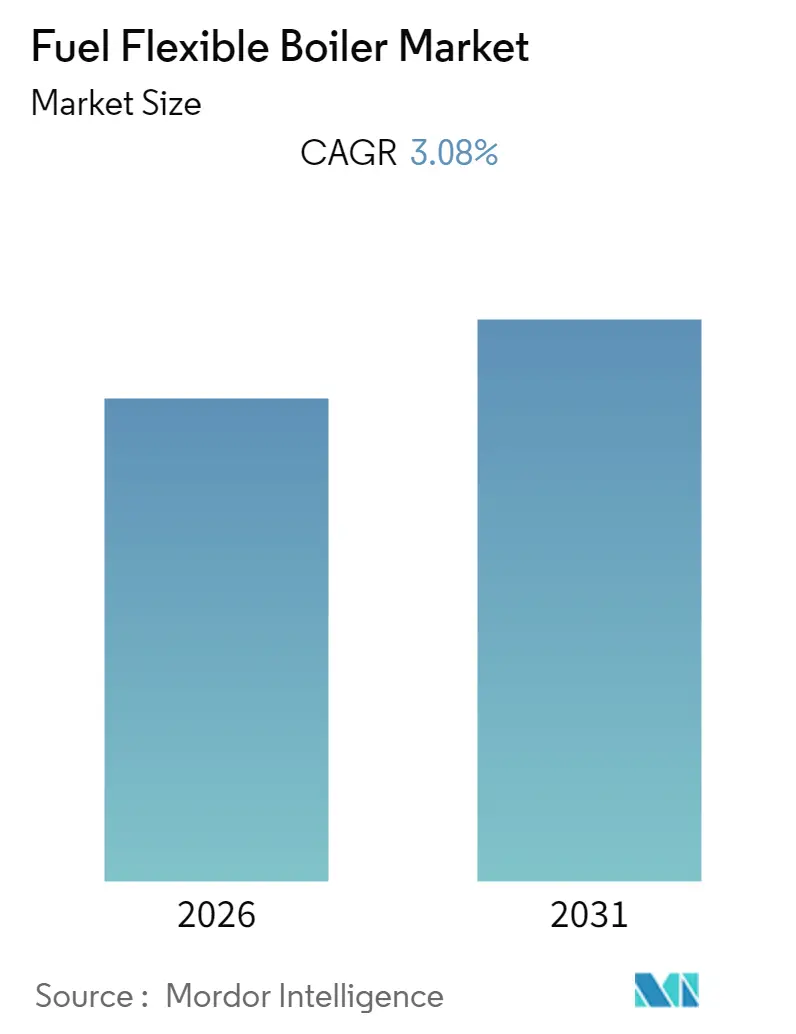
The Fuel Flexible Boiler market size is expected to grow from USD 2.47 billion in 2025 to USD 2.55 billion in 2026 and is forecast to reach USD 2.96 billion by 2031 at 3.08% CAGR over 2026-2031.
- The power generation sector is expected dominate the fuel flexible boiler market during the forecast period.
- Instead of using different type of boilers for different quality of fuel countries such as China, India, and Japan are planning to replace boilers with fuel flexible boilers by 2030. This is likely to create a opportunity for fuel flexible boiler market.
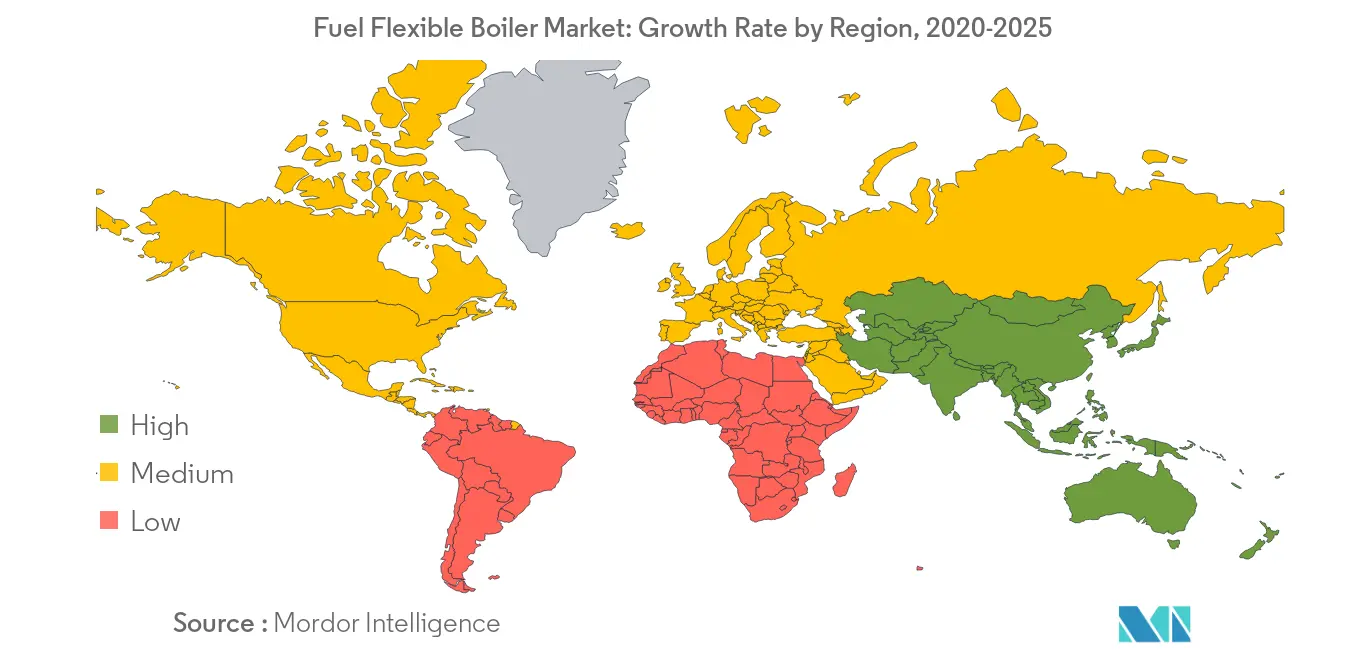
- Asia-Pacific has dominated the fuel flexible boiler market and is expected to continue its dominance in the forecast period due to its increasing industrial development and urbanization, especially in the emerging economies.
Note: Market size and forecast figures in this report are generated using Mordor Intelligence’s proprietary estimation framework, updated with the latest available data and insights as of 2026.
Global Fuel Flexible Boiler Market Trends and Insights
Thermal Power Generation to Dominate the Market
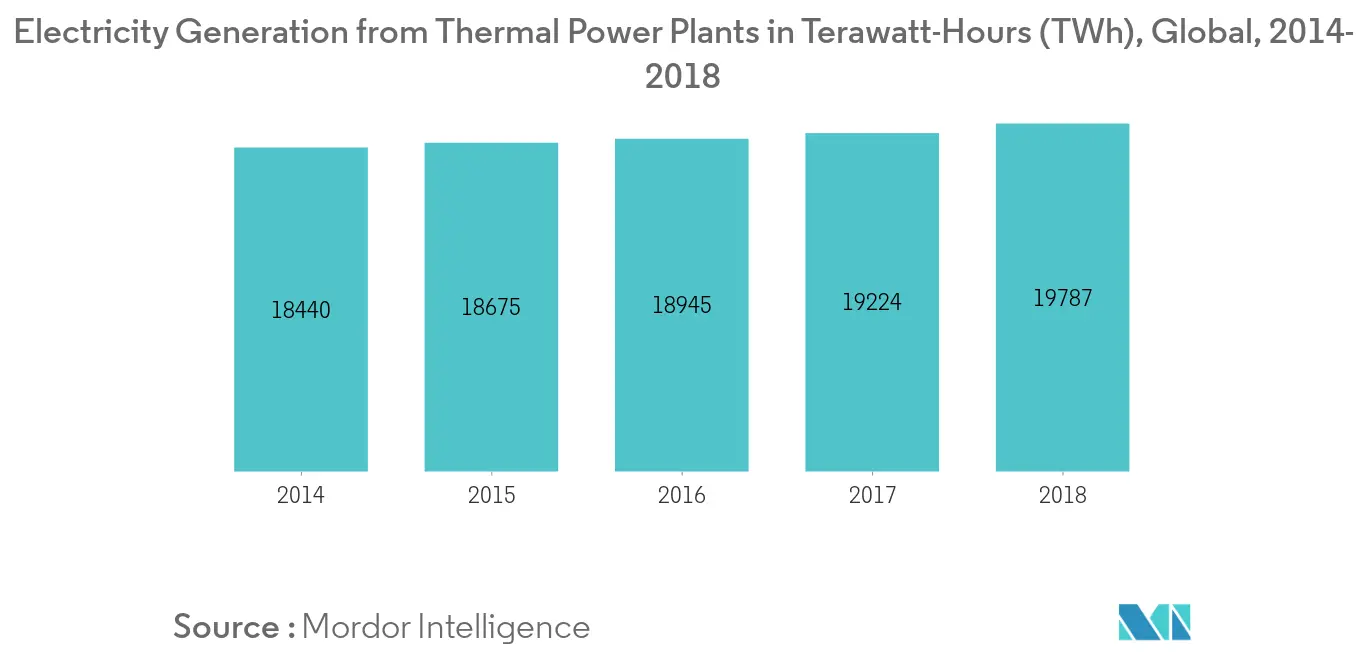
- According to the International Energy Agency (IEA), the thermal power generation in which fuel flexible boilers are widely used is likely to grow at a CAGR of 3% in the upcoming years. Due to which fuel flexible boiler market is expected to have a positive impact in the forecast period.
- In 2018, the electricity generation from thermal power plant was 19787 Tera-watt (TWh), which is more than that was generated in 2017, 19224 Tera-watt (TWh).
- Shandong Shenglu Coal-Fired Power Project in China has the capacity to produce 4000 mega-watts (MW) of energy. Its first phase was started in 2016, and the second phase to be started in 2020.
- The movement in Europe carbon emission targets, which aims to cut down greenhouse gases by at least 40% by 2030, compared to 1990, has increased the usage of fuel flexible boilers in the past both in the thermal power generation sector.
- Patratu Super Thermal Power Project, Jharkhand in India, started in 2018 and is expected to be completed in 2022. The project has the capacity to produce 4000 mega-watts (MW) of power and is likely to use a fuel flexible boiler.
- Hence the above thermal power generation projects are likely to drive the fuel flexible boiler market in the forecast period as the usage of fuel flexible boiler increases efficiency and decreases the greenhouse gas emissions.
Asia-Pacific to Dominate the Market
- Asia-Pacific has dominated the fuel flexible boiler market in the past and is expected to dominate the market in the forecast period because of the several thermal power generation projects under construction.
- Bharat Heavy Electrical Limited in 2015 began to construct Kothagudem Thermal Power Plant for Telangana state, India. The project included the use of fuel flexible boilers and was completed in 2019.
- Leizhou Thermal Power Project in China has a power generation capacity of 6000 mega-watts (MW). It started in 2015 and is expected to be completed by 2022. This is likely to drive the fuel flexible boiler market in the forecast period.
- Shin Kori Nuclear Power Plant Project Units 4, 5, and 6 in South Korea, is the expansion of Kori Nuclear Power plant by adding three new reactors in it, totally having a power generation capacity of 4200 mega-watts (MW). Reactor 1 was already decommissioned in 2017 while reactors 2 and 3 are to be decommissioned in mid of the 2020s. Construction of reactor 4 started in 2015 and commissioned in 2019. The development of reactors 5 and 6 are under progress and is expected to complete by 2022.
- Hence, from the above points, it can be concluded that Asia-Pacific is going to dominate the fuel flexible boiler market in the forecast period due to several numbers of projects in the future.
Regulatory Landscape
Emissions and permitting requirements for boilers and adjacent combustion equipment are tightening across major markets, which raises the compliance bar for fuel-flexible installations and retrofits. In the European Union, the revised Industrial Emissions Directive, Directive (EU) 2024/1785, entered into force in August 2024 and reinforces the use of best available techniques (BAT) and permitting practices for large industrial installations. Member states are required to align national rules by July 2026, affecting equipment specifications such as combustion controls and monitoring requirements.
In the United States, the Environmental Protection Agency (EPA) regulates air emissions for steam generating units and related stationary combustion sources under New Source Performance Standards (NSPS). On January 15, 2026, the US EPA finalized amendments to the NSPS for stationary combustion turbines (subpart KKKKa), tightening NOx limits and reinforcing the technology pathway of advanced combustion controls and selective catalytic reduction (SCR). For boiler OEMs and EPCs supplying fuel-flexible systems, these updates increase the focus on demonstrated low-NOx performance, continuous emissions monitoring readiness, and documentation packages that support permitting and compliance during fuel switching.
Value Chain Analysis
The fuel-flexible boiler value chain begins with engineered design and combustion integration, covering fuel handling, burners, combustion controls, and safety systems. It then moves into sourcing pressure parts and heat-transfer components, including tubes, drums, and superheaters/economizers, as well as emissions-control interfaces such as SCR tie-ins and instrumentation, including continuous monitoring.
Manufacturing and assembly are typically handled by boiler OEMs and specialized fabricators, with EPC integration and installation/commissioning followed by long-cycle aftermarket services. These services include spares, inspections, tuning, and upgrades for alternate fuels or tighter emissions limits. Downstream, end users in thermal power generation and process industries influence specification requirements for multi-fuel capability, turndown, and conversion readiness. Technology providers and program bodies also shape requirements, including UK environmental permitting guidance that emphasizes demonstrating decarbonisation readiness through a hydrogen route, which pushes OEMs toward designs that can be converted to hydrogen or hydrogen blends. Capability development is also visible in adjacent boiler ecosystems, including the June 2026 multi-fuel residential boiler proof-of-concept in Groningen led by DNV with Stedin, GasTerra, Intergas, and Bekaert, pointing to supply chain emphasis on adaptive controls and hardware able to handle changing gaseous fuel compositions.
Competitive Landscape
The fuel flexible boiler market is moderately fragmented. Some of the key players in this market include AE&E Nanjing boiler Co., Ltd,Bharat Heavy Electricals Limited, Doosan Heavy Industries Constrctn Co Ltd, Mitsubishi Hitachi Power Systems, Ltd, and Harbin Electric Co Ltd.
Fuel Flexible Boiler Industry Leaders
-
AE&E Nanjing boiler Co., Ltd
-
Bharat Heavy Electricals Limited (BHEL)
-
Doosan Heavy Industries Constrctn Co Ltd
-
Mitsubishi Hitachi Power Systems, Ltd.
- *Disclaimer: Major Players sorted in no particular order

Market Opportunities and Future Outlook
A key opportunity area is retrofit-led fuel switching and hybridization that reduces the need to replace existing steam assets for industrial users managing emissions compliance alongside capital preservation. This is supported by recent product and project activity, including Babcock Wanson UKs July 2026 launch of a Hybrid Add-on electric boiler designed to integrate with existing industrial steam boilers. Mitsubishi Powers also signed a July 2026 contract to convert existing heavy oil-fired boilers to dual-fuel operation (natural gas and heavy oil) at the Jeddah South and Shuqaiq power plants in Saudi Arabia. Together, these examples support a conversion-oriented pathway centered on retrofit packages, bolt-on electrification, and dual-fuel upgrades beyond greenfield boiler builds.
Another opportunity area is ultra-low emissions combustion and controls that support broader fuel flexibility under tightening regulatory limits, including low-NOx performance during fuel blending and switching. In March 2026, ClearSign Technologies reported successful testing of a flexible-fuel ultra-low NOx burner effort funded through a USD 1.65 million US Department of Energy SBIR Phase II award, indicating continued investment in combustion hardware that supports compliance while expanding usable fuel envelopes. On the utility and large-industrial side, technical validation for co-firing and flexible operation continues, such as the April 2026 publication on 1000 MW tangential-fired tower boilers demonstrating coal-biomass co-firing for flexible operation, which aligns with demand for boilers that can accommodate more variable fuels while maintaining operability.
Recent Industry Developments
- June 2026: Bharat Heavy Electricals Limited (BHEL) received a Limited Notice to Proceed (LNTP) from Damodar Valley Corporation (DVC) for the 1x800 MW Durgapur supercritical thermal power station main plant package. The award reinforces ongoing ordering activity tied to large thermal generation projects, supporting demand for advanced boiler islands and associated fuel and emissions-related design requirements.
- February 2026: Bharat Heavy Electricals Limited (BHEL) received a Letter of Intent (LOI) from Hindalco Industries Limited for a 2x150 MW Boiler-Turbine-Generator (BTG) package for the Aditya Expansion Project Phase II in Odisha. The industrial captive power win highlights continued investment in integrated steam and power systems where fuel flexibility and compliance-driven upgrades can be differentiated at the package level.
- August 2024: The European Union brought into force Directive (EU) 2024/1785 revising the Industrial Emissions Directive (IED), strengthening best available techniques-based compliance and permitting requirements for large industrial installations. The revision increases the weight of BAT-linked performance, monitoring, and permitting practices in boiler and combustion project specifications across member states ahead of national alignment by July 2026.
Research Methodology Framework and Report Scope
Market Definition and Coverage
For this methodology, the fuel flexible boiler market covers boiler systems sold for industrial and power applications where the design supports switching between more than one fuel type during normal operation, and revenues are measured at the equipment level across regions.
Scope exclusions: We exclude routine aftermarket services, standalone burners or controls sold without the boiler, and on-site civil works that are not part of the boiler equipment value.
Segmentation Overview
- Type
- Circulating Fluidised Bed Combustion (CFBC) Boiler
- Atmospheric Fluidised Bed Combustion (AFBC) Boiler
- Others
- End-User
- Chemical Industry
- Metal and Mining Industry
- Food and Beverages Industry
- Thermal Power Generation Industry
- Others
- Geography
- North America
- Europe
- Asia-Pacific
- South America
- Middle-East and Africa
Data Sources, Market Sizing, and Validation
Desk Research
Desk research sets the foundation for the model by mapping where fuel switching is technically and economically relevant, and by checking country-level demand signals. We mainly reviewed public sources such as energy ministries and national statistics offices, the International Energy Agency (IEA), the US Energy Information Administration (EIA), and trade bodies focused on boilers, power, and industrial energy use.
To translate these signals into market numbers, we also used import and export statistics where they are published, customs and tariff headings relevant to boilers, and peer reviewed literature that discusses fluidized bed performance and fuel mixes. We reviewed company annual reports, investor presentations, and reputable press releases to confirm capacity additions, retrofit activity, and the timing of large projects. For cross-checks on company exposure and deal flow, we selectively used paid subscriptions for company financials and shipment-level trade data. The sources mentioned here are illustrative and not exhaustive, and we also used other public references to collect, validate, and clarify inputs.
Primary Interviews and Surveys
Primary work was used to confirm what buyers and engineering teams mean by fuel flexibility in actual bid specifications, and to test assumptions on price premiums versus single-fuel boilers. We spoke with a mix of OEM side experts, EPC and project engineering participants, and industrial end users across APAC, EMEA, and the Americas. The feedback was then used to adjust adoption rates and pricing bands before finalizing the model.
Distribution of primary research fieldwork respondents
| Company type | Respondent position | Region |
|---|---|---|
| Top tier: 27% | CXOs: 15% | APAC: 46% |
| Mid tier: 58% | Functional/Unit leaders: 27% | EMEA: 35% |
| Smaller Players: 15% | Managers: 58% | Americas: 19% |
Market-Sizing & Forecasting
Market sizing was built using a top-down approach where industrial steam demand, power generation additions, and fuel mix shifts are used to reconstruct the realistic pool of projects that tend to specify multi fuel firing. Once that demand pool was formed, it was translated into value using typical boiler capacity ranges and region-specific price bands, which were validated through interviews.
To keep the model grounded, a few key inputs were tracked consistently, including announced coal and biomass co-firing programs, the share of new capacity using fluidized bed combustion, replacement and refurbishment cycles for large boilers, and regional spreads in fuel availability that influence switching behavior. For checks, we also used selective bottom-up approximations such as sampling large project awards, applying average selling prices to a limited set of capacity additions, and comparing the implied revenues with publicly discussed order intake trends. Where deal visibility was limited, we used conservative adoption ratios, then rebalanced them with expert feedback when the implied installation pace appeared inconsistent.
Forecasting relied on scenario analysis supported by a light multivariate regression layer, where macro industrial output indicators, electricity demand growth, and expected fuel price volatility were used as the main drivers. The final growth path was then reviewed with primary respondents, since procurement timing and permitting often shift year to year even when the long term trend remains stable.
Data Validation & Update Cycle
Before sign-off, outputs were cross checked against independent signals such as large boiler tender activity, major plant commissioning timelines, and regional fuel policy developments, and then variances were investigated rather than averaged away. When outliers were found, the assumptions were traced back to the variable level, followed by a second analyst review to ensure calculations and unit conversions were consistent.
The model is refreshed annually, and interim updates are triggered when material events occur, such as a step change in fuel policy, a wave of major project delays, or a sharp move in energy prices that alters fuel switching economics. Right before delivery, a fresh pass is completed so clients receive the latest updated view based on the most recent public data and interview checks.
Mordor Intelligence's Global Fuel Flexible Boiler Market Size Versus Other Published Estimates
Published market sizes for fuel flexible boilers can look far apart because each publisher defines the market a little differently and uses different pricing and timing assumptions. The base year selected, the share of demand attributed to industrial versus power projects, and the way multi fuel capability is interpreted are usually the biggest reasons for the spread.
In many public estimates, the gap mostly comes from counting broader boiler demand beyond project specified multi fuel units, including residential or commercial heating boilers, and sometimes even adding related equipment value into the same total. Differences also show up when aggressive price uplift curves are applied without checking recent bid levels, and when currency conversion timing is not aligned to the same year for large contract markets. When the scope is kept to equipment revenues tied to explicit multi fuel boiler specifications and checked against tender pipelines and commissioning schedules, the 2025 market size stays closer to observable demand signals, which is how it is handled by Mordor Intelligence.
Benchmark comparison
| Source | Market Size | Gaps in Research Methodology |
|---|---|---|
| Mordor Intelligence | USD 2.47 B (2025) | |
| Industry Publisher A | USD 6.34 B (2025) | Appears to apply a wider scope that includes broader boiler categories and additional end uses such as residential and commercial heating, which expands the revenue pool beyond industrial and power projects that specify multi fuel operation. |
| Global Consultancy B | USD 14.79 B (2025) | Uses a very expansive fuel and application definition and likely applies higher value capture assumptions across installations, which can inflate totals if multi fuel readiness is not verified through boiler specifications and pricing checks. |
The comparison points to scope and price logic as the main drivers behind the spread, not a disagreement about overall industry direction. By tying the model to clear project signals and repeatable checks, the market value can be traced and updated consistently as new tenders and commissioning dates change.
Key Questions Answered in the Report
What is the current Fuel Flexible Boiler Market size?
The Fuel Flexible Boiler Market is projected to register a CAGR of 3.08% during the forecast period (2026-2031)
Who are the key players in Fuel Flexible Boiler Market?
AE&E Nanjing boiler Co., Ltd, Bharat Heavy Electricals Limited (BHEL), Doosan Heavy Industries Constrctn Co Ltd and Mitsubishi Hitachi Power Systems, Ltd. are the major companies operating in the Fuel Flexible Boiler Market.
Which is the fastest growing region in Fuel Flexible Boiler Market?
Asia Pacific is estimated to grow at the highest CAGR over the forecast period (2026-2031).
Which region has the biggest share in Fuel Flexible Boiler Market?
In 2025, the Asia Pacific accounts for the largest market share in Fuel Flexible Boiler Market.
What years does this Fuel Flexible Boiler Market cover?
The report covers the Fuel Flexible Boiler Market historical market size for years: 2020, 2021, 2022, 2023, 2024 and 2025. The report also forecasts the Fuel Flexible Boiler Market size for years: 2026, 2027, 2028, 2029, 2030 and 2031.