
India Boiler Control Market Size and Share
India Boiler Control Market Analysis by Mordor Intelligence
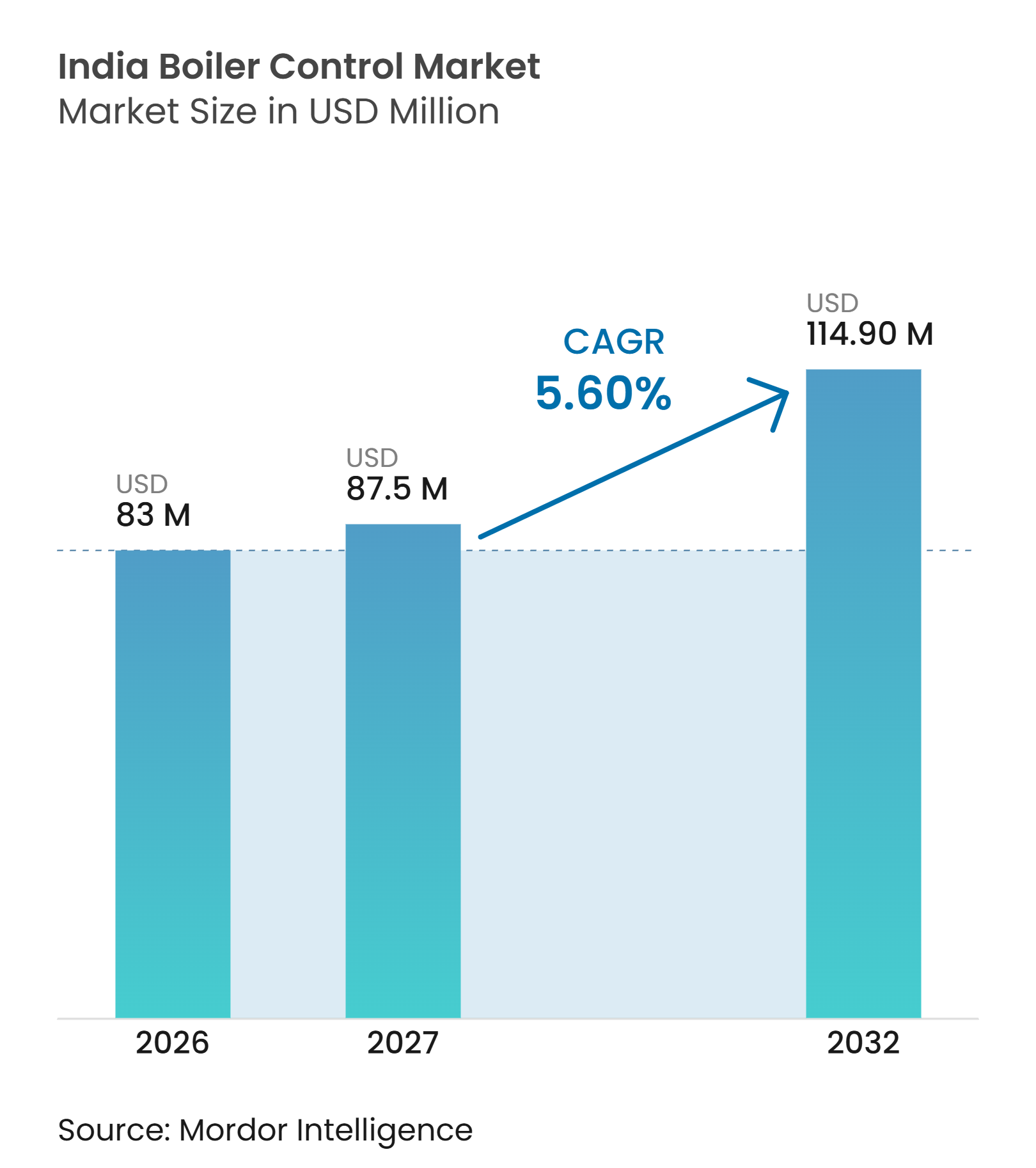
The India boiler control market size stands at USD 83 million in 2026, with an estimated USD 87.5 million in 2027 providing the starting point for a forecast rise to USD 114.9 million by 2032, at a CAGR of 5.60% during 2027-2032, measured at manufacturer or system integrator selling prices. Industrial steam users carry most of the demand, while software creates a smaller, faster-growing revenue stream. The commercial opportunity centers on making existing boilers safer and more economical to operate, alongside supplying controls with new equipment.
Manufacturing expansion and the replacement of aging equipment support the expected increase between 2026 and 2027. The Reserve Bank of India reported manufacturing capacity utilization of 77.4% in January-March 2026, up from 75.6% in the preceding quarter.[1] Higher utilization strengthens the case for additional steam capacity at expanding plants, although equipment orders remain sensitive to project timing. Control suppliers serve a mix of new-boiler contracts and shorter-cycle retrofit jobs.
India's installed steam infrastructure gives retrofit demand a substantial foundation. In its May 2025 national inventory, iFOREST estimated 45,226 process boilers producing approximately 1.26 billion tonnes of steam annually. Controls spending depends on the operating condition and fuel performance of this large existing fleet, as well as on annual boiler additions. Suppliers that can document gains in fuel use, operating stability and maintenance response hold a stronger position than suppliers selling connectivity alone.
Key Report Takeaways
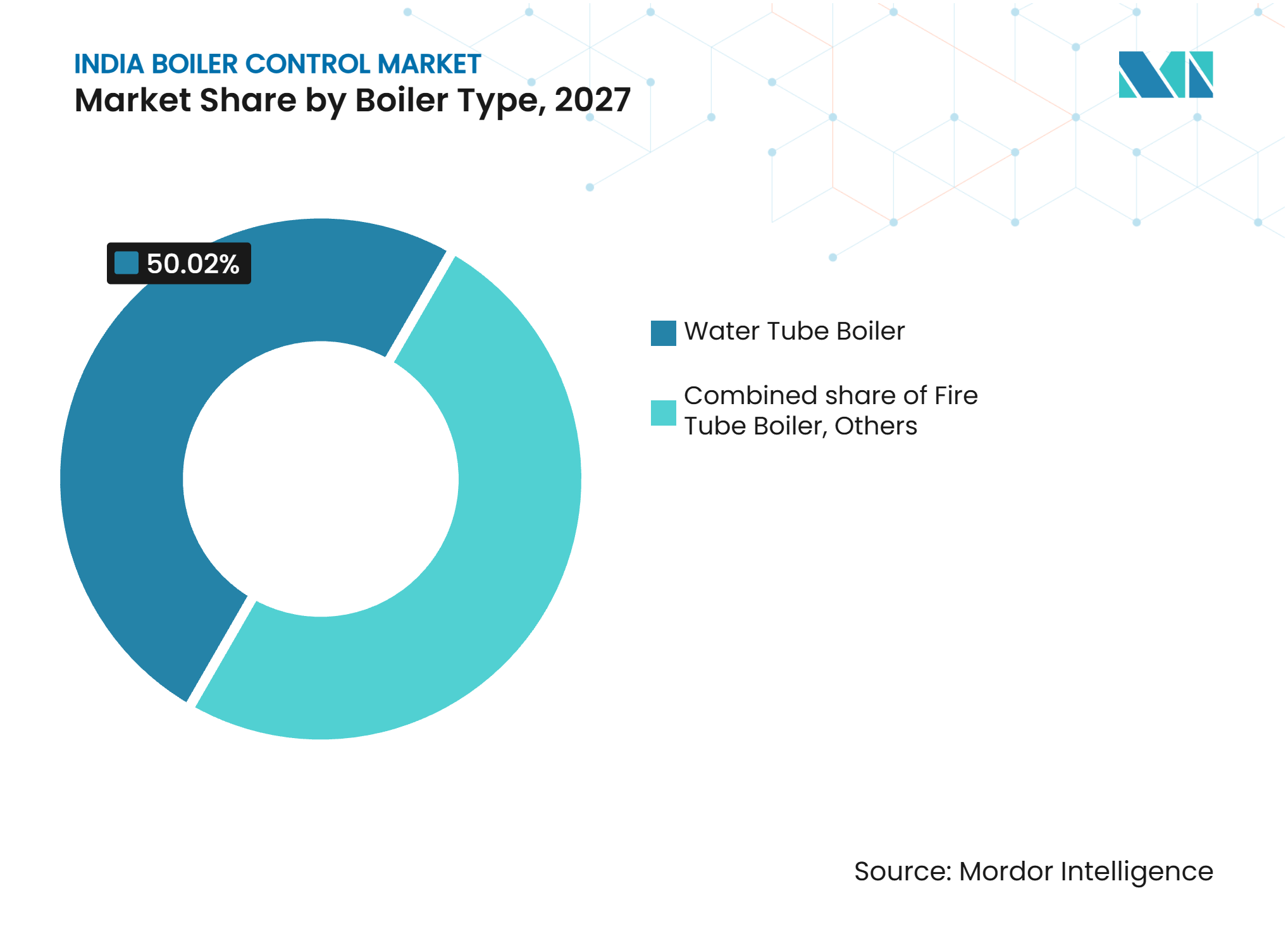
- Water-tube boilers are expected to command 50.02% of the India boiler control market share in 2027, while controls fitted to this major named boiler category are forecast to grow at 5.89% during 2027-2032.
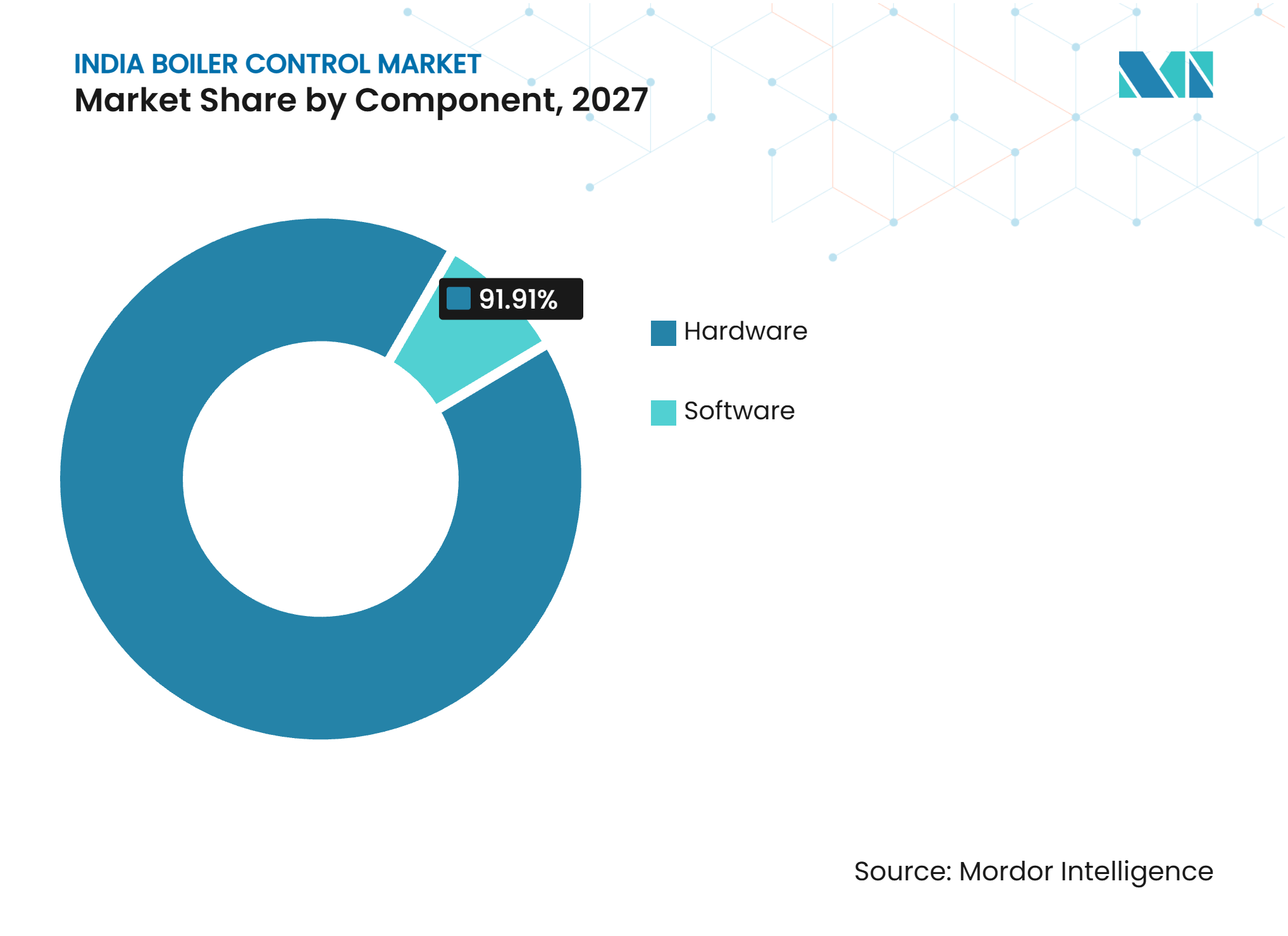
- Hardware is estimated to represent 91.91% of the India boiler control market size in 2027, but software is forecast to advance faster, at an 8.03% CAGR during 2027-2032.
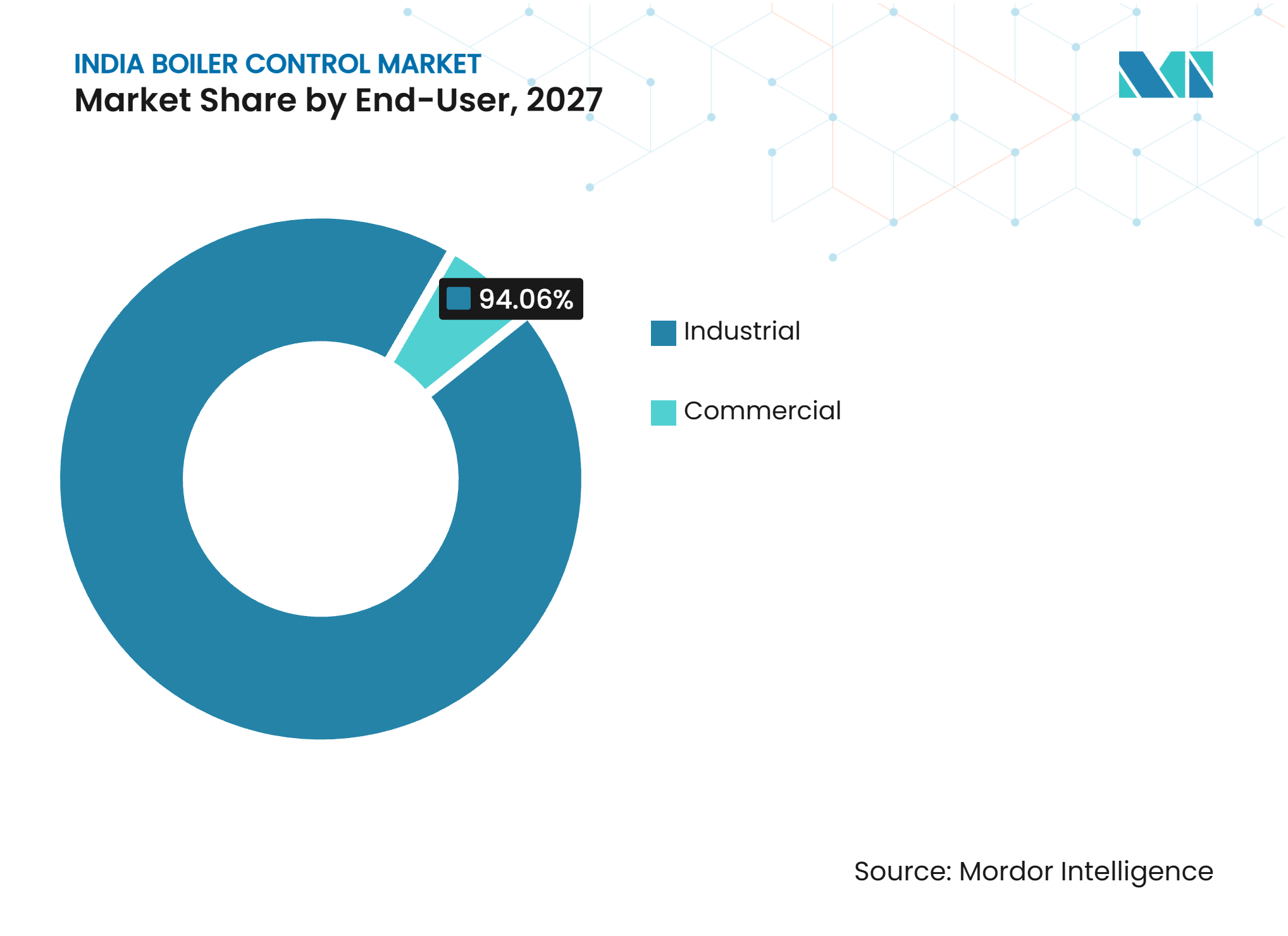
- Industrial users are expected to account for 94.06% of the India boiler control market share in 2027, while commercial demand is forecast to expand at a 5.77% CAGR during 2027-2032.
- Manufacturing investment is the largest identified growth accelerator, adding approximately 1.0 percentage point to the forecast CAGR through new-boiler and associated control orders.
- Approximately 9,000 process boilers fall into the older-equipment opportunity identified from iFOREST's national stock and age estimates, creating a substantial pool for condition-led retrofit screening.
Note: Market numbers in this report are based on Mordor Intelligence's proprietary estimation framework, which combines nine months of actuals with Q4 projections for base year 2026.
Global valuation is built by aggregating outputs from multiple countries and regions, with India being one of the contributors. Our global boiler control market size represents that cumulative total.
Market Trends and Insights
Baseline growth of 4.1% a year reflects additions to India's boiler stock, replacement spending on equipment already operating, and changes in control-package prices. The underlying assumptions include a boiler population growing by approximately 2-3% annually and USD-denominated price increases of approximately 1.5%. Market forces together lift growth approximately 1.5 percentage points above that baseline to the forecast CAGR of 5.60% during 2027-2032. Each impact in the driver and restraint tables represents an addition to, or deduction from, baseline growth, with smaller forces and changes in sales mix accounting for the rounding difference.
Drivers Impact Analysis of India Boiler Control Market*
| Driver | (~) % Impact on CAGR Forecast | Geographic Relevance | Impact Timeline |
|---|---|---|---|
| Aging process-boiler stock entering mandatory remaining-life assessment | +0.2% | Nationwide, particularly established manufacturing clusters | Long term (≥ 4 years) |
| Private manufacturing capex upswing lifting new boiler orders | +1.0% | Nationwide industrial investment locations | Medium term (2-4 years) |
| Delhi-NCR stricter stack-emission limit and approved-fuel rules in force | +0.1% | Delhi-NCR | Short term (≤ 2 years) |
| Notified carbon-intensity targets for boiler-heavy industries | +0.3% | Covered industrial facilities across India | Medium term (2-4 years) |
| Fuel-saving case for combustion optimization and remote boiler monitoring | +0.3% | Nationwide, particularly continuously operated process plants | Long term (≥ 4 years) |
| Boiler accident scrutiny prompting proposed third-party safety audits | +0.2% | Nationwide, with state-led implementation | Medium term (2-4 years) |
| Source: Mordor Intelligence | |||
Aging Process-Boiler Stock Entering Mandatory Remaining-Life Assessment
A remaining-life assessment is a check of how many safe operating years a boiler has left. It gives owners a reason to review controls alongside the mechanical condition of older units. iFOREST's May 2025 inventory put the average age of India's process boilers at 18 years, so a substantial part of the fleet predates current monitoring and control architectures. DPIIT's February 2026 Chintan Shivir on Boilers also listed remnant-life assessment and the responsibilities of third-party inspecting authorities among its review topics. Shutdowns for assessment give owners a practical window to inspect flame safeguards, level instruments, shutdown logic and obsolete panels before returning equipment to service, which makes assessment a steady source of retrofit orders.
Private Manufacturing Capex Upswing Lifting New Boiler Orders
Private capital spending turns into control demand when added production needs a more dependable steam supply. The RBI's Annual Report 2025-26 reported private-sector net fixed-asset growth of 11.5% in the first half of FY2025-26, with metals and automobiles among the contributing activities. At the equipment level, CRISIL Ratings reported that Cheema Boilers' operating income grew 12% in FY2024-25 and noted repeat business from industrial customers. Expansion in the steam boiler system supply chain brings work for control packages, commissioning and integration into factory operating systems. This upswing is the largest single force in the market's growth forecast.
Notified Carbon-Intensity Targets for Boiler-Heavy Industries
Carbon-intensity obligations make steam efficiency part of a plant's compliance economics. In January 2026, the Ministry of Environment, Forest and Climate Change stated that India's carbon-market compliance mechanism covered 490 obligated entities after further industrial sectors were added.[2] A September 2026 amendment changed the target schedule for refineries and textiles, Business Standard reported in November 2026. Covered plants need reliable measurement of boiler fuel use and steam output, because combustion gains must be told apart from changes in production. Metering and combustion control at these plants therefore become a compliance-linked purchase for boiler control suppliers.
Fuel-Saving Case for Combustion Optimization and Remote Boiler Monitoring
Combustion optimization earns its place in investment budgets through operating gains that plant teams can measure. Forbes Marshall's February 2026 Maharashtra pharmaceutical case reported boiler efficiency rising from 80% to 83% after its digital-efficiency intervention.[3] A Tamil Nadu textile case published by Forbes Marshall in February 2026 reported a rise from 80% to 82%, supported by changes in excess oxygen, feedwater conditions and boiler loading. In both cases monitoring found the losses and control adjustments held the improvement. Such results support a service-led opportunity in remote monitoring and optimization for continuously operated process plants.
Restraints Impact Analysis of India Boiler Control Market*
| Restraint | (~) % Impact on CAGR Forecast | Geographic Relevance | Impact Timeline |
|---|---|---|---|
| Proposed industrial heat pump mission displacing small gas boilers | -0.1% | Low-temperature industrial heat applications nationwide | Long term (≥ 4 years) |
| Unreliable imported gas supply deterring gas-fired boiler additions | -0.2% | Gas-connected industrial clusters and city-gas networks | Medium term (2-4 years) |
| Price-sensitive small boiler owners treating control upgrades as discretionary | -0.2% | Small industrial and commercial boiler owners nationwide | Long term (≥ 4 years) |
| Food-processing incentive scheme ending with successor undecided | -0.3% | Food-processing investment locations nationwide | Medium term (2-4 years) |
| Source: Mordor Intelligence | |||
Unreliable Imported Gas Supply Deterring Gas-Fired Boiler Additions
Dependence on imported gas complicates the case for new gas-fired steam capacity. PPAC data reported by Moneycontrol in October 2026 put India's natural-gas import dependence at 52.3% during April-September 2026, against 50.1% a year earlier. Emergency limits on industrial gas allocation, introduced during the March 2026 supply disruption, were largely withdrawn in July 2026, according to the government notification reported by Mint. The disruption raises interest in fuel flexibility and in the fuel flexible boiler market, while making single-fuel boiler additions harder to approve and holding back the control orders that come with them.
Food-Processing Incentive Scheme Ending With Successor Undecided
The scheduled end of food-processing incentives adds uncertainty to the next investment cycle. MoFPI's July 2026 scheme update confirmed that the production-linked incentive program runs through FY2026-27, so the drag on growth comes from the period after its scheduled conclusion. MoFPI also held a July 2026 consultation on the next phase of fiscal support, and the successor's design is still under discussion. Food processors can keep completing current projects, but control suppliers have less visibility on the timing of the next incentive-supported expansion cycle.
*Our forecasts treat driver/restraint impacts as directional, not additive. The impact forecasts reflect baseline growth, mix effects, and variable interactions.
India Boiler Control Market Segment Analysis
By Boiler Type:
Water-Tube Systems Carry Larger Control PackagesAn estimated 50.02% of the India boiler control market size in 2027 comes from water-tube applications, reflecting the value of controls fitted to larger and more demanding industrial steam systems. Privilege Biksons Boilers announced a 185 TPH (tonnes of steam per hour) bagasse-fired boiler project for a Karnataka sugar factory in November 2026, which shows the scale of process and cogeneration installations in this category. High-pressure equipment needs coordinated control of fuel delivery, combustion air, drum level, feedwater and steam pressure. Water-tube control demand benefits from both package complexity and the high cost of production interruptions.
Water-tube controls are forecast to grow at 5.89% during 2027-2032, ahead of the other major named boiler category. Fire-tube boilers keep a substantial position because packaged steam equipment serves smaller industrial duties with standard configurations and commissioning needs. Steamax Energy's July 2026 product comparison placed fire-tube equipment around compact installations and lower initial costs, and linked water-tube designs to larger and higher-pressure duties. Electric, thermal-fluid, sectional and condensing boilers need specialized controls but form a much smaller revenue pool.



By Component:
Hardware Dominates While Software Expands FasterHardware is expected to capture 91.91% of the India boiler control market share in 2027, because every operating package needs physical controllers, protective devices and dedicated instruments. Emerson's August 2025 launch of the PACSystems RX3i CPS400 safety controller listed burner-management systems, which start and stop the flame safely, among its applications. Bosch's October 2026 BCO and SCO refresh paired new operator panels with updated control architecture. Hardware competition centers on dependable operation, commissioning support and compatibility with the installed boiler.
Software is forecast to record an 8.03% CAGR during 2027-2032 as suppliers extend monitoring and optimization to existing equipment. Thermax's October 2026 launch of the Thermax-i series included EDGE Control as a retrofit offering, alongside its use on new biomass boilers. Bosch's November 2026 Industrial Boiler Assist announcement likewise offered remote access for both new and existing BCO and SCO systems. Retrofit-ready software lets suppliers sell monitoring to the installed fleet, which is why the software segment outgrows hardware.

By End-User:
Industrial Steam Demand Determines Market ScaleIndustrial owners are estimated to represent 94.06% of the India boiler control market size in 2027, which makes process reliability the central buying concern. Forbes Marshall's September 2025 presentation at Anuga FoodTec India described a portfolio running from pressure measurement to boilers and process automation for food and beverage users. Its March 2026 PaperMart interview also described a substantial steam-and-condensate installation base in Indian paper mills. Food processing, chemicals, refining, pulp, paper and textiles provide recurring demand because steam availability directly affects output.
Commercial applications are forecast to grow at 5.77% during 2027-2032 from a much smaller base. Hitze Boilers' September 2025 hospital offering in Kozhikode named sterilization, hot water and medical processes as steam uses, and an October 2026 institutional tender at Tirumala sought LPG-fired steam boilers for kitchen operations. Such owners favor simple operation, dependable start-up and accessible maintenance support. Developments in the commercial boilers market shape the format of controls sold to hospitals, hotels and institutional facilities.
Competitive Landscape
Market Concentration
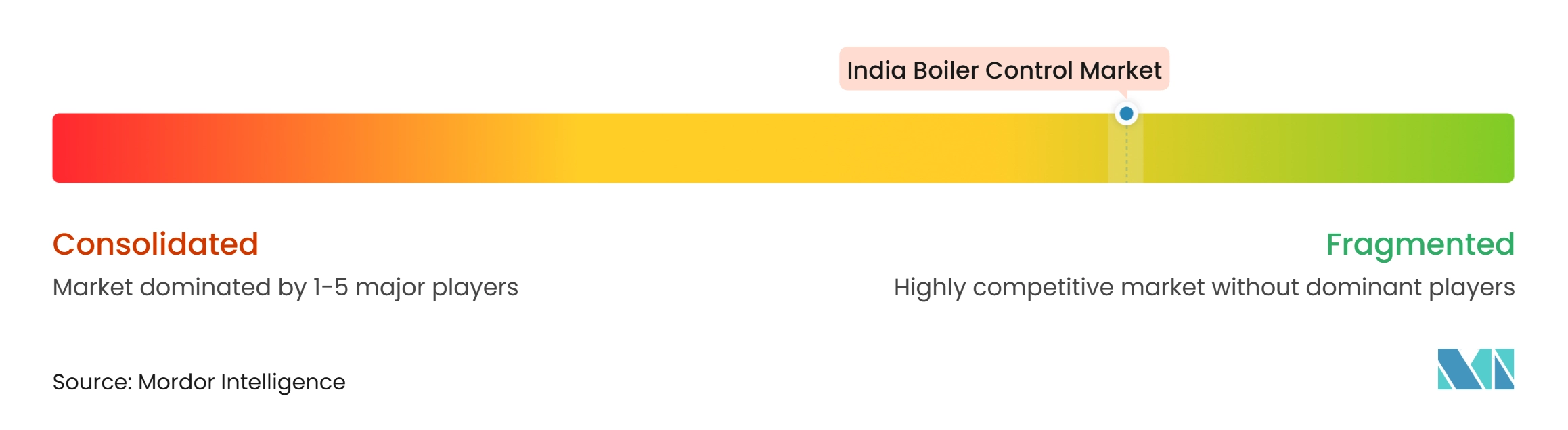
Competition spans international automation platforms, boiler manufacturers, steam-engineering specialists and regional panel builders. Among the companies profiled, GE Vernova offers controls services around industrial steam assets, Emerson Electric Co. supplies burner-management safety hardware and boiler instrumentation, and Bosch Industriekessel GmbH integrates boiler and boiler-house controls with its equipment. Siemens AG participates through burner-management and combustion-control systems, while ABB Ltd supplies boiler-loop instrumentation, actuators and automation. Routes to market differ because a boiler OEM, an independent integrator or an owner commissioning a retrofit can each choose the control architecture.
Automation suppliers compete through software, lifecycle support and integration as well as physical equipment. Emerson's FY2026 Form 10-K reported 5% underlying sales growth in its Control Systems & Software segment, which includes platforms used in industrial control applications. Siemens' FY2026 results reported 13% comparable growth in Digital Industries software, which points to a wider shift toward software-supported automation. These are global business-line readings, and Indian boiler-control contracts stay tied to local engineering, commissioning and after-sales execution.
Domestic suppliers hold an important position in the competitive structure. Forbes Marshall's 2026 Indian retrofit cases show locally delivered optimization services, and Cheema Boilers' November 2025 CRISIL assessment described an integrated engineering, manufacturing, installation and commissioning business. Multibrand panel builders add further options for smaller packages, which limits the reach of any single platform supplier. The leading 5 profiled players are estimated to account for approximately 25% of market value in 2027.
India Boiler Control Industry Leaders
-
GE Vernova
-
Emerson Electric Co.
-
Bosch Industriekessel GmbH
-
Siemens AG
-
ABB Ltd
- *Disclaimer: Major Players sorted in no particular order
India Boiler Control Market Companies Covered in this Report
- GE Vernova
- Emerson Electric Co.
- Bosch Industriekessel GmbH
- Siemens AG
- ABB Ltd
- Schneider Electric SE
- Boilertech Systems Pvt. Ltd.
- Boiler Controls Private Limited
- Cheema Boilers Limited
- List of Other Prominent Platers
- Market Ranking/Share (%) Analysis
Retrofit Opportunity
India's older boiler fleet gives control modernization a sizeable screening pool. iFOREST's May 2025 findings put nearly 20% of process and cogeneration boilers at 25 years or older. Applied to the inventory of 45,226 boilers, that share gives approximately 9,000 older boilers needing condition-led review. This pool underpins the remaining-life-assessment driver, worth approximately 0.2 percentage points of forecast growth.
Older equipment moves into replacement and retrofit programs at uneven speeds. iFOREST's Uttar Pradesh assessment, reported by Dainik Jagran in February 2026, identified about 420 boilers more than 25 years old and low utilization across that older group. DPIIT's February 2026 boiler-sector consultation also placed remnant-life assessment on the regulatory review agenda. Retrofit suppliers gain a more actionable sales pipeline by screening older units for operating hours, fuel losses, spare-parts availability and planned shutdowns before proposing a control package.
Boiler-House Consolidation
Boiler-house modernization can raise production support while cutting the number of operating units. In April 2026, Valmet reported that a modern recovery boiler at ITC's Bhadrachalam mill replaced 3 older boilers, alongside a pulp-capacity increase from 1,100 to 1,400 tonnes per day, a 27.27% rise. The project shows that industrial control demand depends on package complexity and production duty as well as on boiler counts.
The Bhadrachalam investment sequence also shows how later process expansion creates more integration work. Valmet announced a further BCTMP (bleached chemi-thermo-mechanical pulp) line for the mill in October 2026, with start-up planned for the second quarter of 2028. The new line is a separate project, but it adds to the site's needs for coordinated utilities and process operation. Industrial buyers that consolidate boilers must budget for instrumentation, interfaces and commissioning around the surviving boiler-house architecture, alongside the main equipment purchase.
Recent Industry Developments in India Boiler Control Market
- Nov 2026: Bosch Industrial announced Industrial Boiler Assist for remote visualization, alarms, and diagnostics on new and existing BCO and SCO control systems.
- Oct 2026: Thermax launched its Thermax-i intelligent boiler and heater series at Boiler India 2026. The initial UltraPac-i biomass boiler incorporated EDGE Control, which the company also offered for retrofit applications.
- Jul 2025: Treon and Forbes Marshall announced a long-term partnership for industrial asset monitoring, with an initial rollout in India and subsequent expansion planned for other regions.
India Boiler Control Market Report Scope and Research Methodology
Market Definition and Coverage
The India boiler control market covers control systems dedicated to industrial and commercial boilers, including water-tube, fire-tube, electric, thermal-fluid, sectional, and condensing designs. Products include burner-management and flame-safeguard systems, combustion and oxygen-trim controllers, boiler PLCs and panels, dedicated sensors and analyzers, and boiler-house software and remote monitoring. Sales include packages supplied through boiler and burner OEMs and retrofits or software subscriptions purchased by boiler owners.
The study excludes utility power-station boilers, residential boilers and thermostats, and general plant DCS expenditure that is not dedicated to a boiler. Market value is measured in USD at the manufacturer's or system integrator's selling price of the boiler control package or retrofit, including bundled installation and commissioning where applicable. A package containing embedded software is classified as hardware, while separately priced boiler-house software and subscriptions are classified as software.
Boiler-type allocation follows the design to which the controls are fitted, and end-user allocation follows the boiler owner. Industrial captive-process steam applications belong to industrial end users, while hospitals, hotels, universities, public buildings, and municipal heat users belong to commercial end users. Dedicated boiler-control expenditure is counted once, avoiding duplication between an OEM package and the integrator's associated work.
Segments Covered in This Report
- By Boiler Type
- Water Tube Boiler
- Fire Tube Boiler
- Others
- By Component
- Hardware
- Burner Management and Flame Safeguard Systems
- Combustion and Boiler Controllers
- Sensors, Analysers and Field Devices
- Software
- Hardware
- By End-User
- Industrial
- Food, Beverage and Agro-processing
- Chemicals, Petrochemicals and Refining
- Pulp, Paper and Textiles
- Other Industries
- Commercial
- Industrial
Data Sources, Market Sizing, and Validation
Desk Research
Desk research draws on iFOREST's national process-boiler inventory, RBI manufacturing surveys, Bureau of Energy Efficiency programs, DPIIT and Central Boilers Board publications, MoEFCC carbon-market notifications, and MoFPI scheme updates. These sources establish the installed-equipment base, investment conditions, regulatory requirements, and the outlook for important steam-consuming industries.
Company annual reports, quarterly filings, product documentation, and releases supplement the official and institutional sources. Relevant material includes boiler OEM disclosures, automation business results, industrial control launches, and operating case studies, with vendor-reported outcomes retained at their stated plant or product scope. These sources are not exhaustive, and further sources inform data collection, validation and clarification.
Primary Interviews and Surveys
Analysts interview boiler and burner OEMs, control-package manufacturers, system integrators, instrumentation suppliers, and industrial and commercial boiler owners. Interviews test package prices, replacement cycles, purchasing criteria, commissioning requirements, and adoption of monitoring subscriptions against desk findings. Responses also help distinguish dedicated boiler-control spending from wider plant automation expenditure.
Distribution of primary research fieldwork respondents
| Company type | Respondent position | Region |
|---|---|---|
| Top tier: 30% | CXOs: 20% | Western India: 40% |
| Mid tier: 50% | Functional/Unit leaders: 30% | Northern India: 35% |
| Smaller Players: 20% | Managers: 50% | Southern and Eastern India: 25% |
Market-Sizing & Forecasting
Market sizing combines the installed industrial and commercial boiler population with estimated annual control spending per boiler. The calculation distinguishes boiler design, owner category, new equipment versus the installed base, and hardware versus separately priced software. The stock estimate builds from iFOREST's process-boiler inventory, an allowance for non-IBR equipment, and an estimate of commercial installations, producing a working population of approximately 53,000 boilers.
Forecasting begins with baseline growth in the boiler population, replacement spending, and package prices. Manufacturing investment, combustion optimization, carbon-intensity obligations, condition assessments, safety scrutiny, and NCR requirements raise demand, while fuel-supply risk, price sensitivity, the food-processing incentive transition, and heat electrification moderate it. The proposed heat-pump mission is treated as a policy scenario within the forecast, while current adoption evidence is distinguished from a notified government mission.
Cross-checks compare implied control spending with boiler OEM activity, automation product economics, and replacement opportunities across the installed fleet. Thermax's Industrial Products performance is used as a broader equipment indicator because that segment also includes cooling and water businesses. Exchange-rate changes affect USD results, and annual control spending per boiler remains a judgment-sensitive input. The competitive concentration rating assesses the spread of OEM packages, international platforms, domestic specialists, and regional integration work, with only boiler-dedicated sales included in the market boundary.
Data Validation and Update Cycle
Validation triangulates installed-stock estimates, supplier activity, package-price observations, and end-user purchasing patterns. Analysts review unusual movements, double counting, inconsistent product boundaries, and differences between plant-level case studies and market-wide adoption. Particular attention is given to whether a reported efficiency improvement measures relative efficiency, percentage-point efficiency, or fuel intensity.
The market is refreshed annually, with interim updates following material regulatory changes, major supply disruptions, significant company transactions, or changes in industrial investment conditions. Forecast assumptions retain the distinction between announced plans, notified obligations, and completed operating outcomes. Segment estimates are reviewed against the total market before publication.
Comparison With Published Estimates
Industry Research A describes an India boiler-control market with water-tube and fire-tube segmentation, hardware and software, and control-type analysis. Its public coverage is close enough to warrant a scope review, but the summary does not disclose a numerical estimate or valuation point. A numerical difference cannot therefore be assigned to coverage, pricing, or forecasting assumptions.
Comparison With Published Estimates
| Publisher | Market Size | Key gap |
|---|---|---|
| Mordor Intelligence | USD 83 million in 2026 | Dedicated industrial and commercial boiler controls at manufacturer or system integrator selling prices |
| Industry Research A | Not publicly disclosed | India-only boiler-control coverage identifies hardware and software, but its public summary does not state a value estimate |
| Industry Research B | Not publicly disclosed | An India boiler-control chapter is identified within a global study, but its public summary does not disclose the India value |
Industry Research B includes India within a global boiler-control study, with country-level segmentation by boiler type, component, and end user. Its published global total is a different geographic quantity and is not substituted for an India estimate. Comparisons of India boiler-control market value require the country-level figure and its coverage before any gap can be explained reliably.
Key Questions Answered in the Report
What is the India boiler control market size in 2026?
The India boiler control market size is USD 83 million in 2026, measured at the manufacturer's or system integrator's selling price of the control package or retrofit.
How fast is India's boiler control market expected to grow?
The market is estimated at USD 87.5 million in 2027 and is forecast to reach USD 114.9 million by 2032, at a CAGR of 5.60% during 2027-2032.
Which boiler type has the largest demand for controls in India?
Water-tube boilers are expected to hold 50.02% of the India boiler control market share in 2027, supported by larger industrial steam duties and more complex control requirements.
Which companies supply boiler controls in India?
Suppliers include international automation companies, boiler OEMs, steam-engineering specialists, and local integrators. Profiled companies include GE Vernova, Emerson Electric Co., Bosch Industriekessel GmbH, Siemens AG, and ABB Ltd.
Why do Indian industrial plants upgrade boiler controls?
Plants upgrade controls to improve combustion, stabilize steam pressure and water level, strengthen protective functions, and monitor operating losses. Shutdowns for condition assessment also provide opportunities to replace obsolete instruments and panels.
Is boiler-control software growing faster than hardware?
Yes. Software is forecast to grow at 8.03% during 2027-2032, supported by remote monitoring, boiler-house analytics, and optimization subscriptions. Hardware continues to account for most market value.