
China Boiler Control Market Size and Share
China Boiler Control Market Analysis by Mordor Intelligence
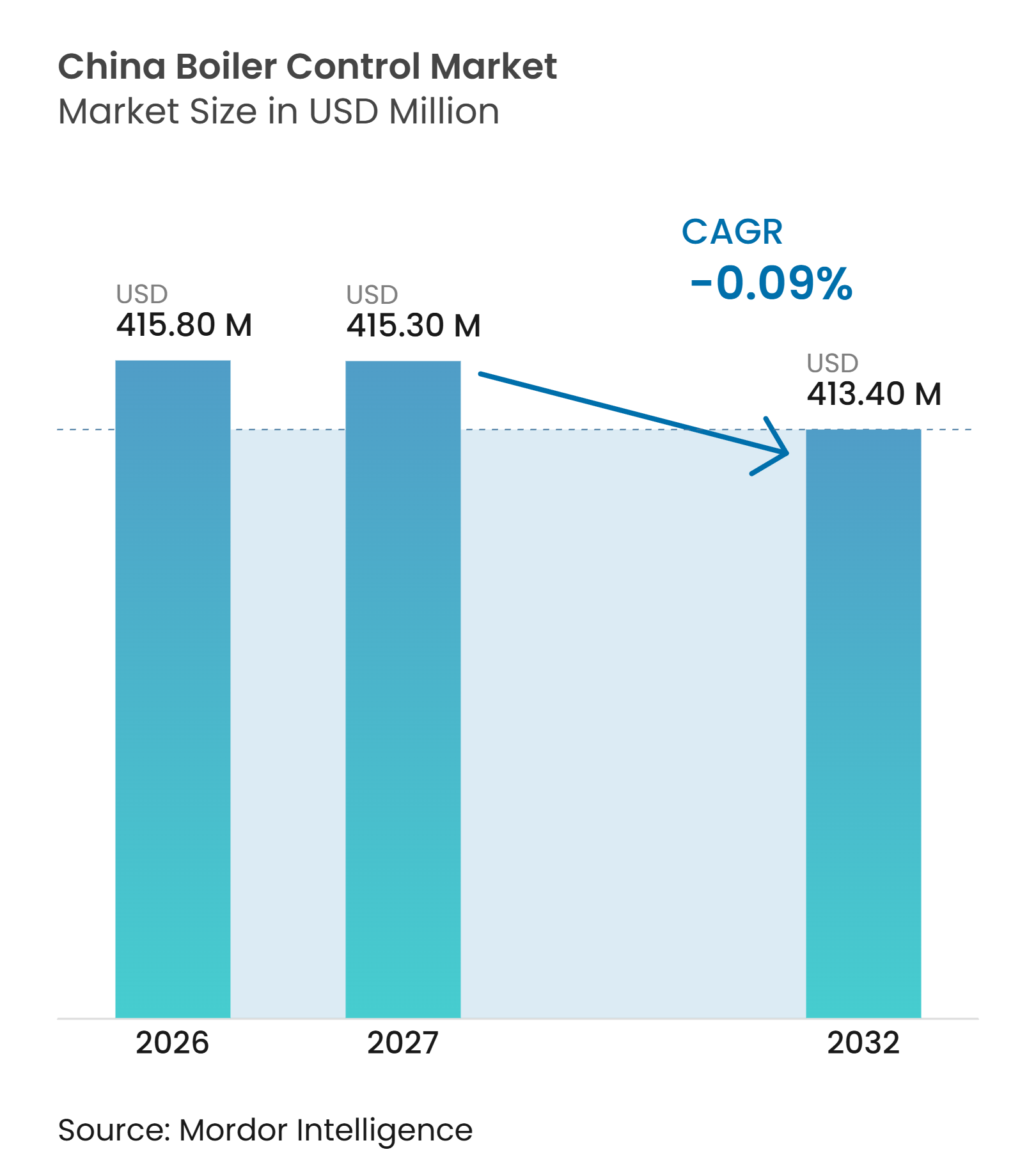
At manufacturer or system integrator selling prices, the China boiler control market size stands at USD 415.8 million in 2026, is estimated at USD 415.3 million in 2027, and is forecast to reach USD 413.4 million by 2032, representing a CAGR of -0.09% during 2027-2032. Retirement of older boilers and falling new-equipment output explain the slight decline expected next year. The State Administration for Market Regulation (SAMR) reported 293,300 registered boilers across China at the end of 2025, including power-station boilers. National Bureau of Statistics data reproduced by Zhiyan Consulting show industrial boiler output falling 17.9% year on year during January-August 2026, following an 8.9% decline in 2025. Fewer new installations reduce orders for original control packages, while retirement removes units from the future retrofit pool.
Compliance work is supporting spending on the boilers that remain in service. SAMR reported that its 2025 boiler safety campaign inspected 120,400 boilers, and the Ministry of Industry and Information Technology (MIIT) included industrial boilers in its 2026 equipment-efficiency supervision program. Emissions requirements add a separate reason to replace combustion controllers, flame safeguards (devices that cut off fuel when a flame goes out) and associated instruments. Demand is shifting toward retrofits that keep in-service steam and heating boilers compliant, efficient and available.
Electrification changes the content of a control package as well as the number of fuel-fired boilers requiring controls. Electric boiler projects, such as the April 2026 references of Hangzhou Huayuan Qianxian, retain demand for pressure control, sequencing and electrical protection while removing burner-management functions. The nearly flat value forecast for the China boiler control market therefore hides a meaningful change in product mix.
Key Report Takeaways
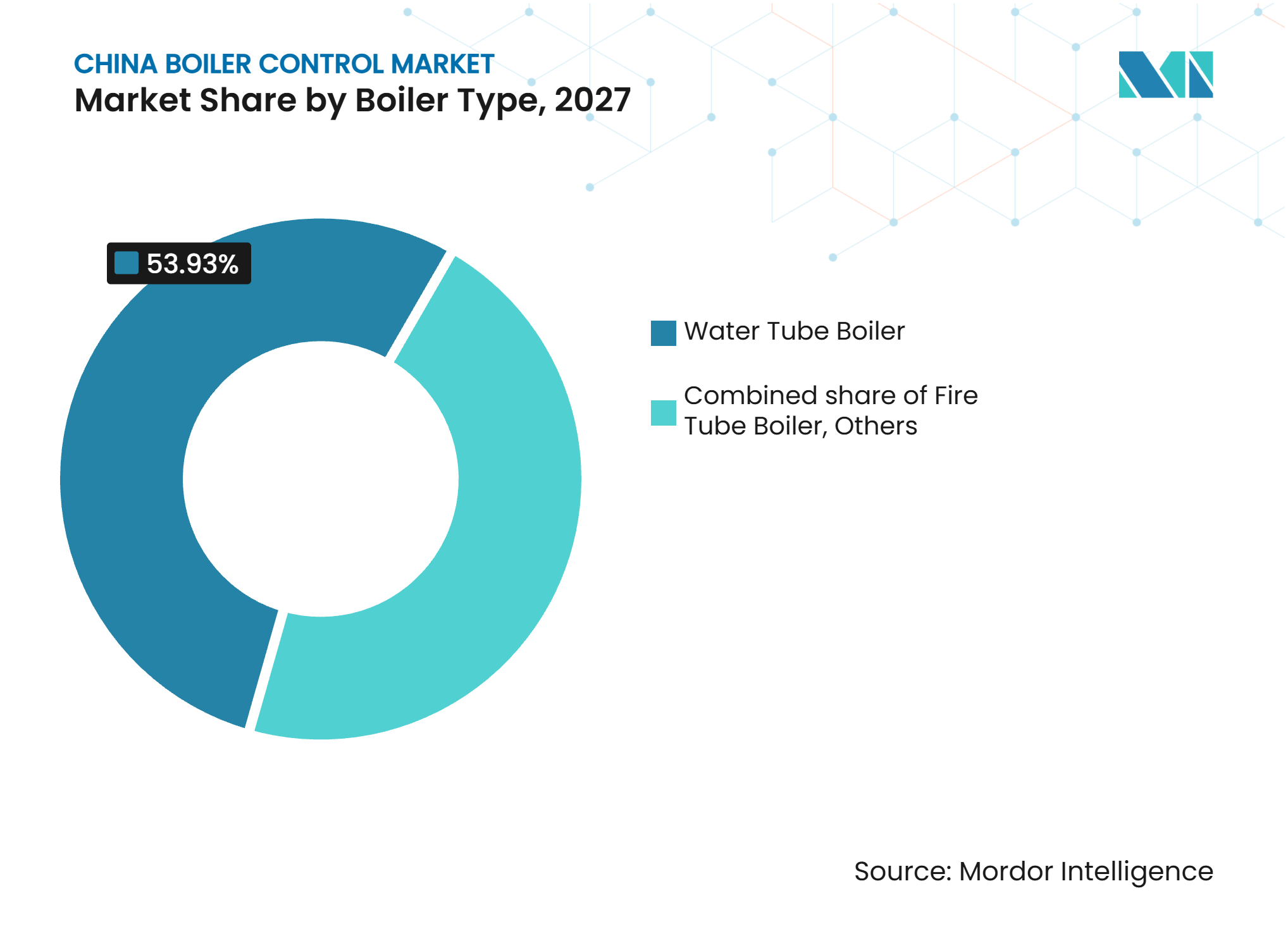
- Water-tube applications are estimated to command 53.93% of the China boiler control market share in 2027, while fire-tube control spending is forecast to grow at a 0.24% CAGR during 2027-2032 as packaged units retain demand.
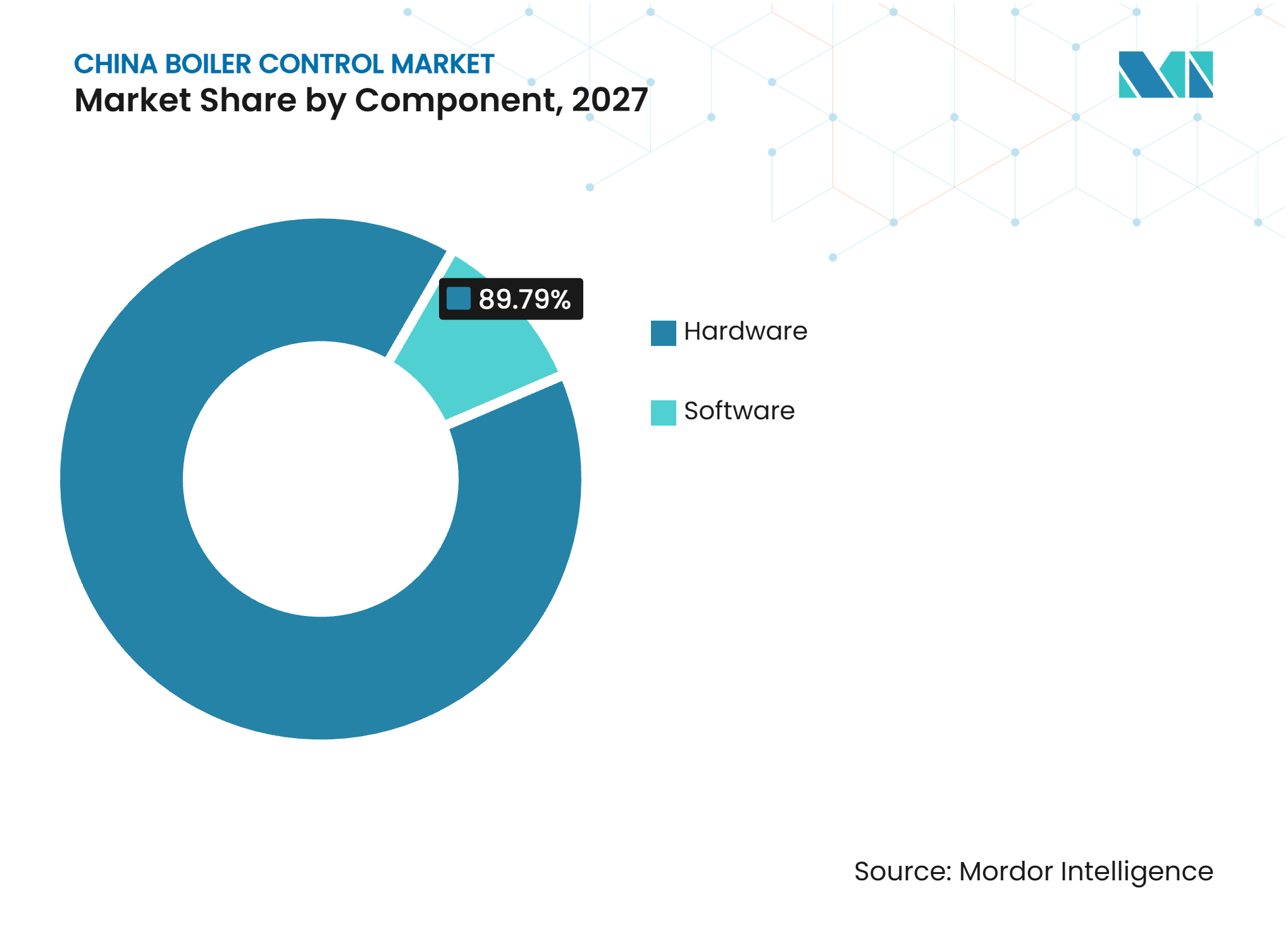
- Hardware is expected to account for 89.79% of the China boiler control market size in 2027, with software forecast to expand at a 0.46% CAGR during 2027-2032 as monitoring and optimization gain ground.
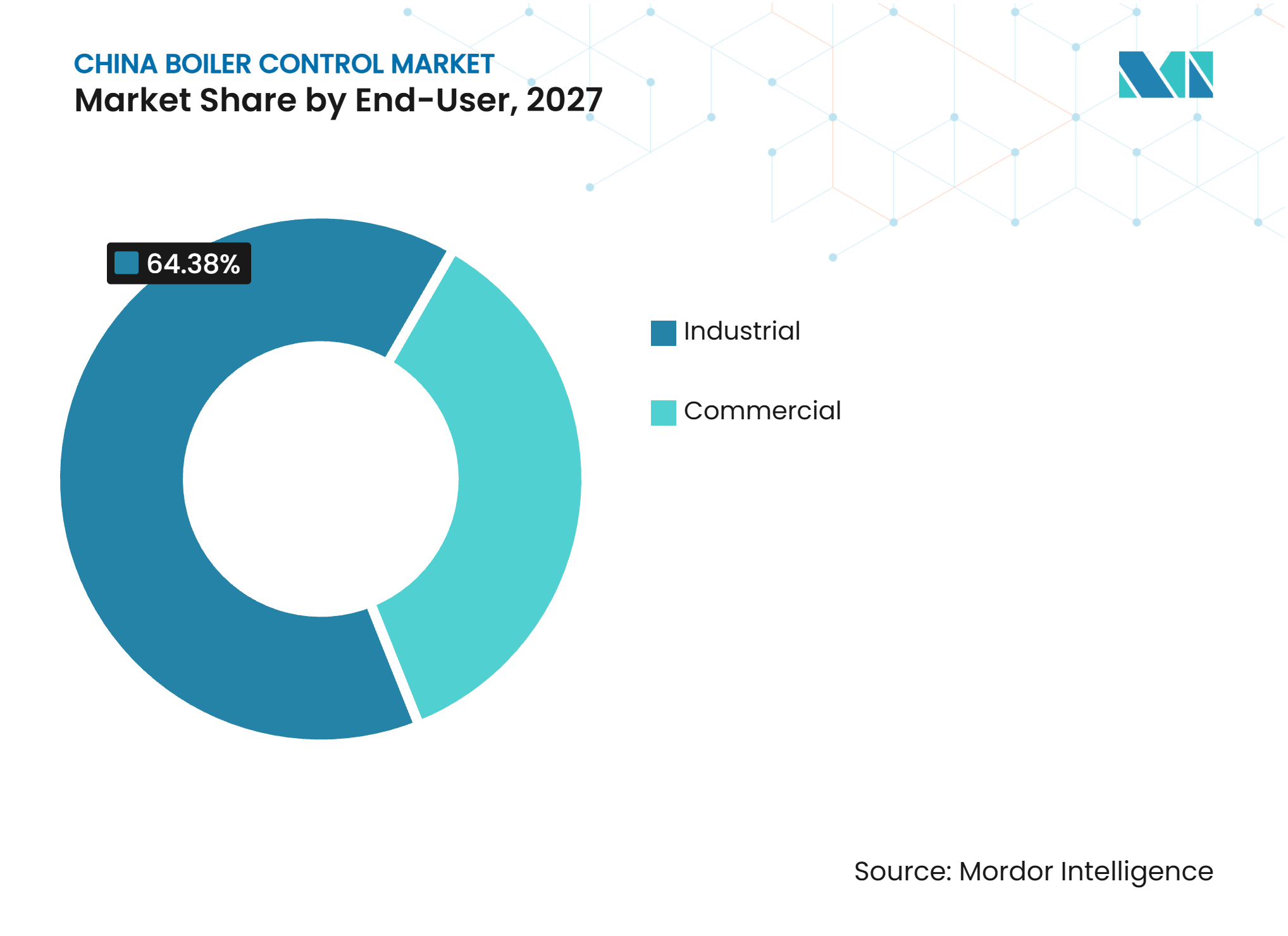
- Industrial users are estimated to represent 64.38% of the China boiler control market share in 2027 and lead end-user growth at a forecast CAGR of 0.43% during 2027-2032.
- Gas-boiler nitrogen-oxide requirements and smart special-equipment supervision each add an estimated +0.6% to the CAGR forecast, supporting compliance controls and remote monitoring despite declining boiler installations.
- Electric boilers and heat pumps exert the largest individual restraint, taking an estimated -0.8% from forecast CAGR as industrial heat users change their heat-generation technology.
Note: Market numbers in this report are based on Mordor Intelligence's proprietary estimation framework, which combines nine months of actuals with Q4 projections for base year 2026.
Proportional positioning is established by comparing country level and regional contributions against the global total, including that of China. The boiler control market share in our global report expresses these relative weights.
Market Trends and Insights
Baseline growth is 0.5% annually, supported by replacement of installed controls and modest selling-price increases in a mature domestic equipment base. The combined market outcome, including the forces below and smaller demand and mix adjustments, is 0.59 percentage points below that baseline, producing the -0.09% CAGR forecast for 2027-2032. Each impact in the driver and restraint tables represents an addition to or subtraction from baseline growth, expressed in percentage points.
Drivers Impact Analysis of China Boiler Control Market*
| Driver | (~) % Impact on CAGR Forecast | Geographic Relevance | Impact Timeline |
|---|---|---|---|
| Energy-saving retrofit action for refining, chemicals and heavy industry | +0.2% | Nationwide industrial clusters, particularly refining, chemicals and heavy manufacturing | Medium term (2-4 years) |
| Mandatory boiler efficiency limits under energy inspection and pending revision | +0.4% | Nationwide industrial boiler users | Medium term (2-4 years) |
| Gas-boiler nitrogen-oxide limits tightening locally and proposed nationally | +0.6% | Nationwide, with near-term implementation concentrated in stricter provincial and municipal jurisdictions | Medium term (2-4 years) |
| Major-hazard rule requiring working flame-out and interlock protection on boilers | +0.2% | Nationwide industrial and commercial boiler houses | Short term (≤ 2 years) |
| Remaining coal-boiler phase-out replaced by gas and electric boilers | +0.3% | Remaining small-coal-boiler fleets, including central and southern provinces | Medium term (2-4 years) |
| Smart special-equipment supervision guidance favoring boiler remote monitoring | +0.6% | Nationwide, with municipal implementation led by digitally advanced jurisdictions | Long term (≥ 4 years) |
| Source: Mordor Intelligence | |||
Mandatory Boiler Efficiency Limits Under Energy Inspection and Pending Revision
Mandatory efficiency limits are turning industrial boiler efficiency into a procurement constraint, through both equipment standards and operating inspections. The China National Institute of Standardization published the proposed replacement for GB 24500-2020, the current mandatory efficiency standard for industrial boilers, in June 2026, with comments due by August 15, 2026.[1] Separately, MIIT's 2026 energy-conservation supervision program directs enterprises to remove equipment that fails mandatory efficiency limits. Existing obligations support current retrofit spending, while the proposed revision shapes the specifications of longer-lived replacement controls.
Efficiency requirements favor controls that maintain performance across changing steam loads. The China Electrical Equipment Industry Association's Industrial Boiler Branch also publicized consultation on industrial boiler system energy-management requirements in September 2026. Equipment-level limits and system-management requirements address different sources of loss, including combustion settings, auxiliary equipment and operating practices. Control upgrades that combine measurable fuel savings with the operating records needed for inspection therefore carry the strongest commercial case in the efficiency-driven retrofit market.
Gas-Boiler Nitrogen-Oxide Limits Tightening Locally and Proposed Nationally
Local nitrogen-oxide limits are turning environmental policy into burner and control-system work. Zhejiang's ecology authorities reported that standard DB33/1415-2025 took effect for new boilers in May 2025 and for existing boilers in October 2025. Yangjiang's municipal government subsequently issued a November 2026 notice applying a 50 mg/m³ nitrogen-oxide limit to gas boilers throughout its jurisdiction. Local implementation creates demand for coordinated burner adjustment, fuel-air control and emissions verification.
National emissions policy is also advancing, although its proposed requirements retain draft status. The Ministry of Ecology and Environment issued a consultation draft combining the power-plant and boiler air-pollutant standards in March 2026, and the Chinese Research Academy of Environmental Sciences reported technical review in June 2026. For suppliers serving the commercial boilers market, the commercial opportunity lies in controls that sustain emissions performance during low-load heating operation. Provincial and municipal compliance dates remain the immediate reference for gas-boiler control specifications until a national standard takes effect.
Remaining Coal-Boiler Phase-Out Replaced by Gas and Electric Boilers
The remaining coal-boiler phase-out generates new control orders where users keep on-site steam or hot-water production. Guangxi's market regulator reported in January 2026 that 1,745 coal boilers had been decommissioned or retrofitted, completing its stated task. Anhui's ecology authorities reported in June 2026 that the province had eliminated coal boilers below 35 t/h (tonnes of steam per hour). The mix of retirement and conversion means suppliers compete for replacement projects within a smaller overall equipment fleet.
Gas and electric replacements require different engineering packages. Zhoushan's December 2024 air-quality plan identified heat-storage electric boilers and condensing gas boilers as preferred choices for smaller new industrial units. Gas projects retain combustion and flame-safety requirements, while electric projects emphasize electrical protection, water level, pressure and load scheduling. Suppliers with both control architectures can keep coal-phase-out customers as their fuel choices change.
Smart Special-Equipment Supervision Guidance Favoring Boiler Remote Monitoring
Smart-supervision guidance is giving remote monitoring a stronger regulatory role in boiler operation. SAMR's March 2026 guidance calls for low-cost sensor networks, lifecycle online monitoring and intelligent diagnosis across special equipment. Shanghai's May 2026 implementation opinion encourages online monitoring of older pressure equipment and sets an end-2027 objective for a smart-supervision platform. These policies support gateways, data collection and condition-monitoring functions alongside conventional local control.
Municipal implementation makes equipment identity and maintenance records commercially useful. Beijing's November 2026 heating-season inspections covered more than 2,700 heating boilers, with its market regulator describing equipment-code-based access to registration, inspection and maintenance information. Shanghai's 2026 work program separately targets equipment-code adoption and boiler smart-supervision pilots. Boiler software sold under this guidance depends on reliable asset records and alarm handling as much as on operating dashboards.
Restraints Impact Analysis of China Boiler Control Market*
| Restraint | (~) % Impact on CAGR Forecast | Geographic Relevance | Impact Timeline |
|---|---|---|---|
| Registered boiler stock shrinking as coal and surplus units retire | -0.7% | Nationwide, especially jurisdictions retiring small coal boilers | Medium term (2-4 years) |
| Electric boilers and heat pumps replacing fuel-fired steam supply | -0.8% | Industrial parks, food and beverage plants, pharmaceutical sites and commercial heat users nationwide | Long term (≥ 4 years) |
| Price competition squeezing bought-in boiler control content | -0.1% | Nationwide OEM, panel-building and retrofit channels | Medium term (2-4 years) |
| Falling new industrial boiler output on weak capex and licensing | -0.6% | Nationwide industrial boiler manufacturing base | Medium term (2-4 years) |
| Source: Mordor Intelligence | |||
Registered Boiler Stock Shrinking as Coal and Surplus Units Retire
Boiler retirement reduces the installed equipment available for future control replacement. Calculations from SAMR's annual bulletins show the national registered boiler fleet declining 5.4% between the end of 2024 and the end of 2025. Huaihua's ecology bureau reported in July 2025 that the city had removed 124 of the 151 small coal boilers in its elimination program. National stock contraction and local removal programs both cut the volume of replacement controls.
Retirement programs are extending into industries with substantial steam requirements. Guangdong's November 2026 industrial decarbonization program targets coal boilers of 35 t/h and below in ceramics, paper and textiles for phase-out by 2028. Hunan's April 2026 consultation draft separately proposed eliminating 52 coal boilers of 35 t/h and below by the end of 2026. The window for retrofits on equipment already marked for removal is narrowing, so the owner's remaining asset life decides which retrofit projects qualify.
Electric Boilers and Heat Pumps Replacing Fuel-Fired Steam Supply
Electrification reduces demand for combustion-specific controls even when a plant continues to generate heat on-site. MIIT's January 2026 zero-carbon factory guidance explicitly encourages efficient heat pumps, electric boilers and electric heating as substitutes for coal-fired captive boilers. The Chinese Academy of Sciences' Guangzhou Institute of Energy Conversion reported a separate steam-heat-pump demonstration in November 2024 producing 170°C steam. Policy support and working high-temperature equipment widen the range of processes able to change heat sources.
Electric boilers preserve a smaller set of boiler-specific control functions. Hangzhou Huayuan Qianxian's April 2026 reference list describes 3 electrode boilers of 6.4 MW each at China Resources Snow Breweries' Xichang site. Electrode boilers heat water by passing current through it. Its Guizhou distillery reference combines a 25 MW electrode boiler with 100 MWh of thermal storage. Growth in the electric boiler market supports sequencing and storage dispatch controls while displacing flame scanners, combustion actuators and burner safeguards.
*Our forecasts treat driver/restraint impacts as directional, not additive. The impact forecasts reflect baseline growth, mix effects, and variable interactions.
China Boiler Control Market Segment Analysis
By Boiler Type:
Water-Tube Systems Anchor Control SpendingAn estimated 53.93% share of the China boiler control market size in 2027 belongs to water-tube applications. Larger industrial units require coordinated drum-level, feedwater, pressure, combustion and protection functions, giving each installation substantial control content. Fangkuai's May 2026 water-tube product description includes remote monitoring, automatic load adjustment and fault warnings within its intelligent control system. Water-tube suppliers compete on integration and operating reliability across several connected control loops.
Fire-tube controls serve packaged-boiler users who want repeatable installation and straightforward operation. Fangkuai's July 2026 brewing-plant reference describes a 4 t/h condensing steam boiler with automatic monitoring of pressure, temperature and gas consumption by a programmable logic controller (PLC), the industrial computer that runs boiler sequences. Fire-tube control spending is forecast to grow at a 0.24% CAGR during 2027-2032, supported by packaged steam applications and installed-base replacement. Standardized commissioning and practical load management carry particular weight in the fire-tube segment.
Electric, thermal-fluid, sectional and condensing designs form the other-boiler category and add growth beyond the two main types. A China Government Procurement Network award published in October 2026 specified a 240 kW electric boiler with a matching PLC-and-touchscreen cabinet, remote monitoring and multiple protective functions. Electric units keep pressure control, sequencing and electrical protection but drop burner management, so their control packages differ considerably from those of larger fuel-fired water-tube installations. These designs broaden the product set open to control suppliers in the other-boiler category.



By Component:
Hardware Retains the Revenue BaseHardware is estimated to capture 89.79% of the China boiler control market share in 2027. The category combines burner safeguards, controllers, panels, boiler-specific instruments and bundled installation and commissioning. Hebei Baisha Tobacco's August 2026 combustion-control tender required program and flame controllers, air and gas actuators, variable-frequency drives (motor speed controllers) and complete system reprogramming for factory boilers. Equipment and site work of this kind absorb most project spending in the hardware segment.
Software is forecast to expand at a 0.46% CAGR during 2027-2032 as owners add optimization and fleet visibility. Taiyuan Boiler Group's February 2026 intelligent control launch for circulating fluidized bed (CFB) boilers, which burn solid fuel suspended in an air stream, uses real-time operating data and adaptive models to coordinate coal feed, airflow, bed temperature and pressure. Kenuo's August 2026 boiler IoT offering separately combines cloud access, alarm information and multi-boiler group control. Software tied to fuel use, availability or staffing carries the strongest case, and its subscription revenue sits apart from bundled control hardware.

By End-User:
Industrial Retrofits Offset New-Build WeaknessIndustrial owners are expected to generate 64.38% of the China boiler control market size in 2027, with spending forecast to grow at a 0.43% CAGR during 2027-2032. Their demand spans continuous-process plants and batch manufacturers requiring dependable steam quality. Henan Jinkai Chemical's February 2026 candidate-award notice covered an emissions retrofit across 5 CFB boilers, including electrical, instrumentation and control work. Retrofits like this keep industrial control spending growing even as national new-boiler production contracts.
Commercial owners follow a different replacement cycle, with spending forecast to decline at a -1.07% CAGR during 2027-2032. Beijing's November 2026 heating-boiler inspection campaign shows safety obligations continuing across municipal heat assets. Operating schedules, seasonal loads and alternative heat supplies shape the timing of upgrades in buildings and the district heating market. Compact retrofit packages and dependable service carry commercial-segment sales, since boiler counts there are not expanding.
Competitive Landscape
Market Concentration
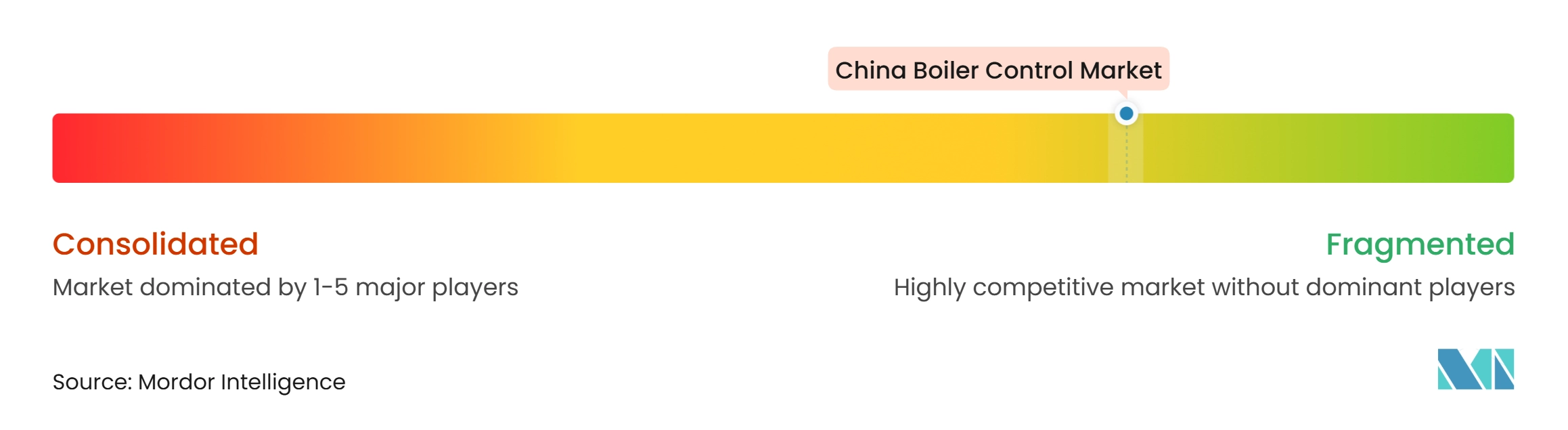
Competition is fragmented across control-platform companies, burner specialists, boiler OEMs and local system integrators. Taiyuan Boiler Group's February 2026 optimization launch and Kenuo's August 2026 connected-boiler offering show domestic OEMs adding their own control and software layers. International component brands can appear inside locally engineered packages, while the integrator keeps the customer relationship and commissioning responsibility. Based on this distributed supply structure, the leading 5 profiled players are estimated to account for a combined 25% of market value in 2027.
The profiled companies participate through different product routes. Emerson Electric Co. supplies process-control platforms used in boiler-house automation, and its fiscal 2026 filing reported USD 4.58 billion in Control Systems & Software sales across its wider global business. Bosch Industriekessel GmbH supplies industrial boilers with internally configured controls, while Siemens AG supplies burner-management and automation technology. ABB Ltd's June 2025 industrial-steam application describes OPTIMAX coordinating boiler loads and sequencing across complex steam networks, making boiler-specific optimization a clear part of its offering.
GE Vernova's March 2026 controls-workshop release describes Mark VIe and Mark VIeS modernization across power generation and industrial applications. Its power-station control packages sit in the separate Power Plant Control System market, outside industrial and commercial boiler controls. Platforms and engineering from the industrial process automation market underpin many of these offerings. Suppliers that combine safety engineering, local commissioning and continuing service hold more ways to defend margins than suppliers selling interchangeable panels alone.
China Boiler Control Industry Leaders
-
GE Vernova
-
Emerson Electric Co.
-
Bosch Industriekessel GmbH
-
Siemens AG
-
ABB Ltd
- *Disclaimer: Major Players sorted in no particular order
China Boiler Control Market Companies Covered in this Report
- GE Vernova
- Emerson Electric Co.
- Bosch Industriekessel GmbH
- Siemens AG
- ABB Ltd
- Schneider Electric SE
- Xizi Clean Energy Equipment Manufacturing Co., Ltd.
- Dongfang Boiler Group Co., Ltd.
- EPCB Boiler
- List of Other Prominent Platers
- Market Ranking/Share (%) Analysis
Compliance Engineering
Emissions compliance increasingly requires coordinated operation of the burner, controller and instruments. Guangzhou's ecology bureau explained in August 2026 that its nitrogen-oxide limit had tightened from 150 mg/m³ to 50 mg/m³ under the earlier implementation schedule, a 66.67% cut, and that the reissued 2026 notice preserves the existing limit. A cut of that scale helps explain the +0.6% contribution that gas-boiler nitrogen-oxide requirements make to the CAGR forecast.
Control performance across operating conditions matters alongside the stated emissions limit. Guangzhou's 2026 notice maintains its requirements, while Zhejiang's 2025 standard sets separate dates for new and existing boilers. Commissioning and acceptance tests follow the jurisdiction and the boiler's operating profile. Value in gas-boiler compliance projects therefore rests on emissions verification, control settings and service responsibility delivered together.
Heat Electrification
High-temperature heat pumps can materially reduce electricity input per unit of useful heat where a suitable waste-heat source exists. Dongfang Electric reported that its February 2026 pharmaceutical-plant installation in Fuling combined approximately 330 kW of electrical input with 890 kW of rated heat output, producing 165°C saturated steam from a 40°C heat source.[2] That gives 2.70 units of heat per unit of electricity. The installation shows a technical route behind the -0.8% CAGR restraint assigned to electric boilers and heat pumps replacing fuel-fired supply.
The Fuling installation lifts temperature by 125°C, from 40°C to 165°C. Industrial steam requirements extend well beyond the lower temperatures commonly associated with building heating, so this lift matters for process users. Project economics at such sites depend on the available waste heat, utilization and electricity prices. Usable waste heat and required steam conditions decide whether heat pumps, electric boilers or combustion-based systems win a given industrial heat project, and with it the demand for combustion-specific controls.
Recent Industry Developments in China Boiler Control Market
- Nov 2026: Yangjiang's municipal government issued a notice applying special emissions limits to gas boilers citywide, including nitrogen oxides of 50 mg/m³.
- Aug 2026: Guangzhou's ecology bureau published its reissued gas- and biomass-boiler emissions notice, effective August 15, preserving the applicable special emissions limits.
- Jun 2026: The China National Institute of Standardization opened consultation on the proposed replacement for the mandatory industrial-boiler energy-efficiency standard GB 24500-2020.
China Boiler Control Market Report Scope and Research Methodology
Market Definition and Coverage
The market covers control systems dedicated to industrial and commercial boilers, including water-tube, fire-tube, electric, thermal-fluid, sectional and condensing designs. Products include burner-management and flame-safeguard systems, combustion and oxygen-trim controllers, boiler PLCs and panels, dedicated sensors and analyzers, and boiler-house software, remote monitoring and analytics. Sales include packages supplied through boiler and burner OEMs, owner-purchased retrofits and software subscriptions.
Utility power-station boilers, residential boilers and thermostats, and general plant distributed control systems not dedicated to a boiler are excluded. Industrial captive-process boiler applications are included within the stated industrial boundary. Market value is measured in USD at the manufacturer's or system integrator's selling price of the boiler control package or retrofit.
Boiler type follows the design receiving the controls, component follows what the buyer pays for, and end-user follows the boiler owner. Hardware includes bundled installation and commissioning, while separately sold boiler-house software and subscriptions enter software. Electric boilers enter the other-boiler category, and district or municipal heat-only boiler plants enter commercial use.
Segments Covered in This Report
- By Boiler Type
- Water Tube Boiler
- Fire Tube Boiler
- Others
- By Component
- Hardware
- Burner Management and Flame Safeguard Systems
- Combustion and Boiler Controllers
- Sensors, Analysers and Field Devices
- Software
- Hardware
- By End-User
- Industrial
- Food, Beverage and Agro-processing
- Chemicals, Petrochemicals and Refining
- Pulp, Paper and Textiles
- Other Industries
- Commercial
- Commercial and Institutional Buildings
- District and Municipal Heating
- Industrial
Data Sources, Market Sizing, and Validation
Desk Research
Desk research uses SAMR's annual special-equipment bulletins, National Bureau of Statistics industrial-output series, Ministry of Ecology and Environment standards and notices, MIIT energy-supervision documents, China National Institute of Standardization consultations, and China Electrical Equipment Industry Association Industrial Boiler Branch publications. National registered-boiler statistics provide a broad stock benchmark, with adjustments for equipment outside the report's industrial and commercial coverage.
Company annual and quarterly filings, OEM product releases, procurement notices and project announcements inform product content, channel structure and control-package pricing. Source review separates draft requirements from effective rules, tender budgets from awards, and supplier-reported performance from independently measured results. These sources are not exhaustive, and further sources inform data collection, validation and clarification.
Primary Interviews and Surveys
Analysts interview boiler and burner OEMs, control-system suppliers, panel builders, system integrators and industrial or commercial boiler operators. Interviews test control content per installation, retrofit frequency, commissioning costs, pricing pressure and software attachment against desk findings. Functional leaders and managers provide application detail, while senior executives inform channel and investment assessments.
Distribution of primary research fieldwork respondents
| Company type | Respondent position | Region |
|---|---|---|
| Top tier: 35% | CXOs: 20% | East China: 45% |
| Mid tier: 45% | Functional/Unit leaders: 30% | North and Northeast China: 25% |
| Smaller Players: 20% | Managers: 50% | Central, South and Western China: 30% |
Market-Sizing & Forecasting
Market sizing starts with the installed industrial and commercial boiler base and annual control expenditure per boiler. The principal variables are boiler design, owner industry, new-installation versus installed-base demand, hardware content, retrofit frequency and separately purchased software. Tender and package-price observations inform spending assumptions, with adjustments to exclude complete burners, boiler bodies and unrelated plant work where required.
Forecasting applies baseline growth from replacement demand and price changes, then incorporates efficiency, emissions, safety, remote-monitoring, retirement, electrification and competitive-pricing effects. The 0.5% baseline is calibrated against the declining stock and production indicators, with the stated forces and smaller adjustments producing the -0.09% forecast CAGR. Cross-checks compare implied control spending with procurement observations, OEM activity and the available installed-equipment base.
Company concentration is an analyst assessment of the distributed OEM, component and integrator structure. Public filings generally disclose broader automation businesses, so the combined-share estimate does not allocate their entire segment revenue to boiler controls. Aggregated other-boiler growth is described qualitatively because the category combines several different technologies and does not provide an individual technology forecast.
Data Validation and Update Cycle
Validation triangulates official equipment statistics, regulatory requirements, procurement records, company disclosures and primary research. Analysts review anomalies in boiler counts, output units, project scope and package pricing, including possible double counting between component vendors and integrators. The market receives an annual refresh, with interim updates following major regulatory changes, material company events or significant revisions to equipment statistics.
Comparison with Published Estimates
Country Research Publisher A identifies the same country and broadly similar boiler-control categories. Its public coverage includes water-tube and fire-tube applications and hardware and software, but the public page does not state a China value or its price basis. A numerical gap cannot therefore be assigned to scope, valuation or forecast assumptions.
Comparison with Published Estimates
| Publisher | Market Size | Key gap |
|---|---|---|
| Mordor Intelligence | USD 415.8 million in 2026 | China industrial and commercial dedicated boiler controls at manufacturer or system integrator selling prices. |
| Country Research Publisher A | Not publicly disclosed | China boiler-control report covers hardware and software, with country revenue estimates available within the report. |
| Industrial Research Publisher B | Not publicly disclosed | Boiler-control report lists a China sales-value series, but its public summary provides global figures only. |
Industrial Research Publisher B identifies China within its boiler-control country series and measures sales value. Its public summary does not expose the country value or enough detail to reconcile utility exclusions and integrator content. Comparable country values and consistent product boundaries are necessary before differences can support a commercial conclusion.
Key Questions Answered in the Report
What is the China boiler control market size in 2026?
The China boiler control market is valued at USD 415.8 million in 2026 at manufacturer or system integrator selling prices.
What is the forecast for China's boiler control market?
Market value is forecast to reach USD 413.4 million by 2032, representing a CAGR of -0.09% during 2027-2032. Retirement and electrification broadly offset compliance and retrofit spending.
Which boiler type has the largest market share?
Water-tube applications are estimated to hold 53.93% of the China boiler control market share in 2027, reflecting their substantial requirements for combustion, feedwater, level and pressure control.
How does China boiler compliance affect control demand?
Efficiency supervision, local emissions limits and safety inspections support spending on combustion adjustment, flame safeguards, interlocks, instruments and operating records. Requirements vary by boiler and jurisdiction, so provincial and municipal rules set most project specifications.
Are hardware or software sales more important in boiler controls?
Hardware supplies most revenue, with an estimated 89.79% share in 2027. Software is forecast to grow at a 0.46% CAGR during 2027-2032 as monitoring and optimization develop.
How do electric boilers and heat pumps affect control suppliers?
Electric boilers retain pressure, level, sequencing and electrical-protection functions but remove burner-management requirements. Heat pumps can also replace on-site boiler steam, reducing demand for combustion-specific controls.