
Asia-Pacific Boiler Control Market Size and Share
| Study Period | 2019 - 2030 |
| Forecast Data Period | 2025 - 2030 |
| Historical Data Period | 2019 - 2023 |
| Market Size (2025) | USD 1 Billion |
| Market Size (2030) | USD 1.39 Billion |
| CAGR (2025 - 2030) | 6.87% |
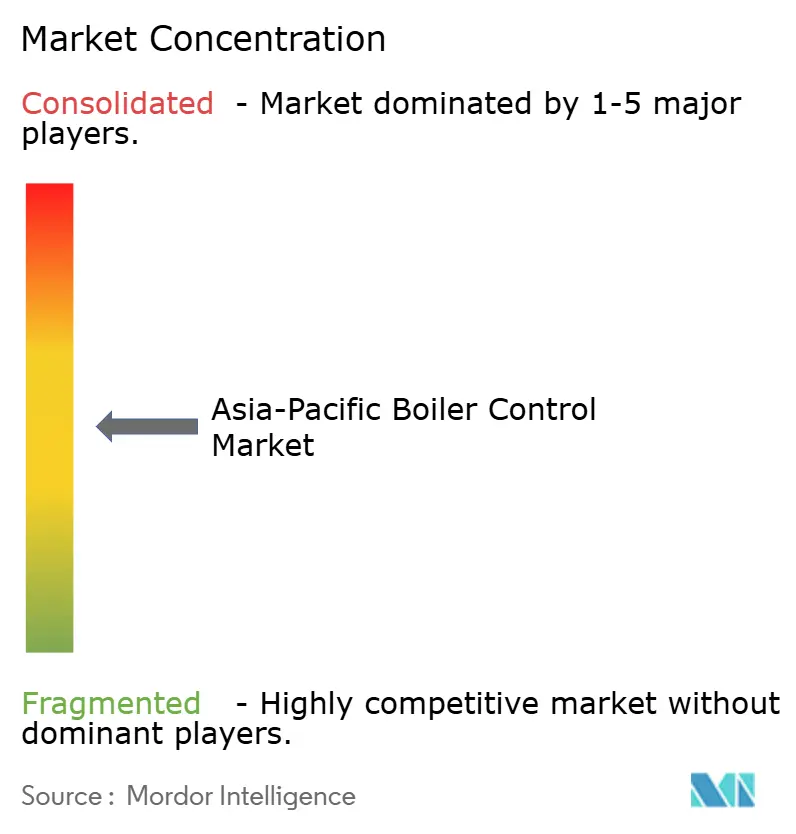
| Market Concentration | Medium |
Major Players *Disclaimer: Major Players sorted in no particular order |
Asia-Pacific Boiler Control Market Analysis by Mordor Intelligence
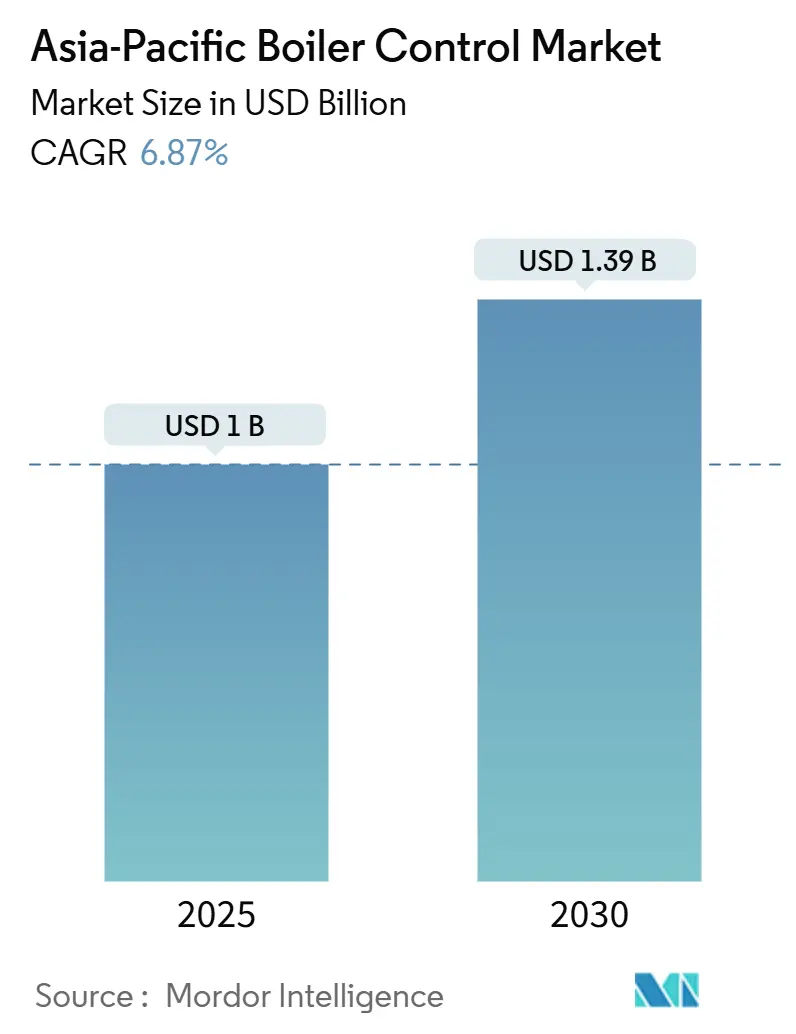
The Asia-Pacific Boiler Control Market size is estimated at USD 1 billion in 2025, and is expected to reach USD 1.39 billion by 2030, at a CAGR of 6.87% during the forecast period (2025-2030).
- Over the medium term, factors such as increasing demand from natural gas-fired power plants and rising demand for automated boiler control systems to drive the market likely to drive the Asia-Pacific boiler control market during the forecast period.
- On the other hand, the high cost of upgrading aging power plants and the lack of standardization of boiler control protocols are likely to restrain the Asia-Pacific boiler control market during the forecast period.
- Nevertheless, concentrated solar power and biomass-based power generation in various developing nations, owing to the high solar irradiation, are expected to create several opportunities for market players in the Asia-Pacific boiler control market during the forecast period.
- India is likely to be one of the major player in the Asia-Pacific boiler control market due to the increasing demand for energy efficiency, stricter environmental regulations, and rising industrialization during the forecast period.
Worldwide, activity is shaped by contributions from multiple regions, with Asia representing one of the more structurally developed among them. The global report on boiler control market by Mordor Intelligence reflects how these regional layers combine into a single system.
Asia-Pacific Boiler Control Market Trends and Insights
Water Tube Boiler Segment is Expected to Have a Significant Growth
- Water tube boilers, which use water-filled tubes to produce steam, serve multiple purposes. The steam generated can power turbines, support industrial processes, or heat buildings through district heating. More efficient than their counterparts, water tube boilers produce larger volumes of steam at elevated pressures and temperatures. These attributes render them ideal for power plants and industries demanding higher capacities.
- While often found in natural gas-fired power plants, their role varies by plant type. In the prevalent combined cycle power plants, water tube boilers function as Heat Recovery Steam Generators (HRSGs). Here, a gas turbine burns natural gas for electricity, and its hot exhaust gases traverse the water tube HRSG, generating steam that powers a steam turbine for added electricity. Thus, the HRSG, a variant of the water tube boiler, stands as a pivotal component.
- Natural gas-fired power plants are significantly boosting the Asia-Pacific boiler control market. The region's rapid industrialization and urbanization have spiked electricity demand. Natural gas, favored for its lower emissions than coal and oil, is becoming the go-to fuel for power generation.
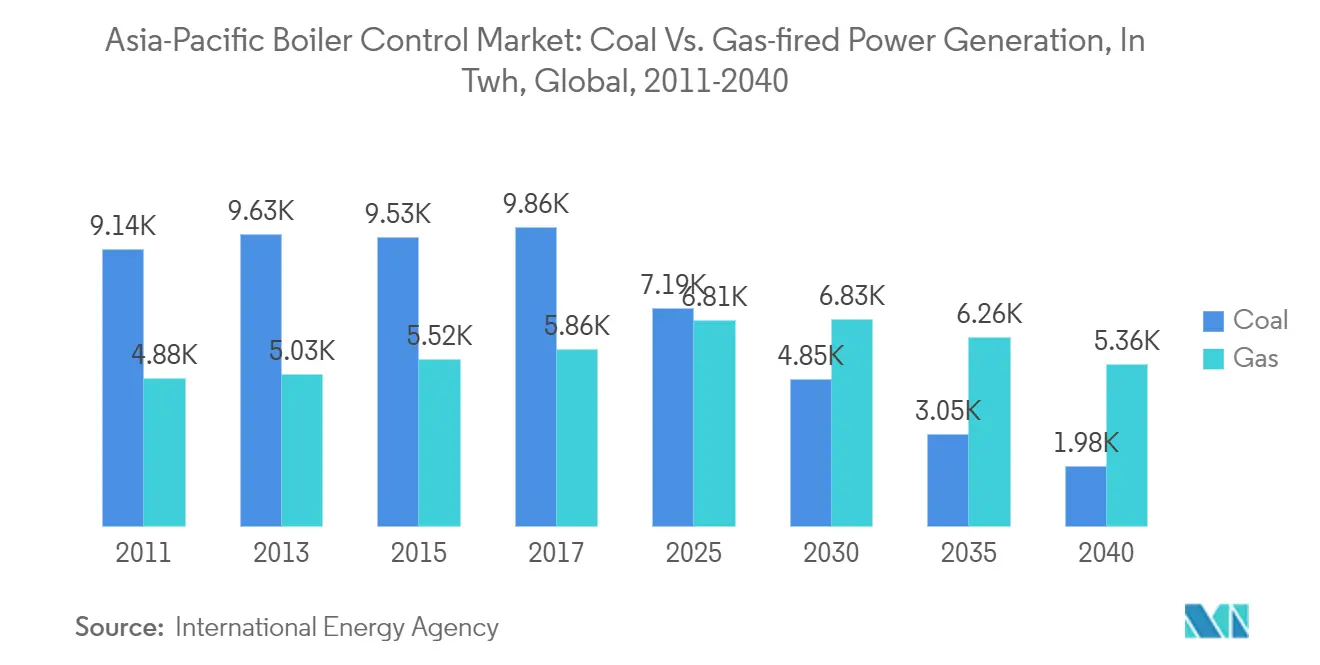
- The International Energy Agency forecasts gas-fired power generation to hit 6,810 terawatt-hours (TWh) by 2025, a 39.46% jump from 2011. Conversely, coal-fired generation is set to drop by 21.3% from 2011, landing at 7,193 TWh. This uptick in natural gas power not only provides operational flexibility but also guarantees stable and safe boiler conditions.
- Governments in the Asia-Pacific are tightening emission regulations for power plants. Advanced boiler control systems play a crucial role in helping these plants meet the new standards. As of 2024, numerous countries have introduced fresh policies. For example, India's Central Pollution Control Board (CPCB) mandates emission standards for particulate matter: 150 mg/m3 for larger power plants and 350 mg/m3 for smaller ones.
- China has intensified emission standards for its power and heat facilities, leading to marked reductions in PM2.5, SOx, NOx, and CO emissions. ASEAN nations are being urged to align their coal-fired power plant emissions with OECD standards. The Republic of Korea has even retracted financing for coal initiatives. Such regulatory shifts are likely to amplify gas power generation, subsequently boosting the demand for boilers that convert gas energy into steam.
- Moreover, integrating advanced technologies like IoT, AI, and cloud computing into boiler control systems enables real-time monitoring, predictive maintenance, and performance enhancement. This trend is making these systems more attractive for both new and retrofitted power plants, fueling the demand for boiler controls in the foreseeable future.
- In summary, the Asia-Pacific's power plants are on the rise, driven by increasing electricity demand, a shift towards cleaner energy sources like natural gas, stringent environmental regulations, and a quest for operational efficiency. This landscape is set to amplify the demand for boiler controls, especially in the water tube boiler segment.


India is Expected to Have a Significant Growth
- India's industrial sectors, notably chemicals, food processing, and pharmaceuticals, are witnessing robust growth, with each heavily reliant on boilers. This surge in industrial activity, coupled with rapid urbanization, is driving a heightened demand for district heating systems. Furthermore, the adoption of advanced technologies and proactive government initiatives to promote industrial development are amplifying the demand for both boilers and heating systems.
- Through initiatives like the Perform, Achieve, and Trade (PAT) scheme, India is urging industries to embrace energy-efficient equipment, including advanced boiler control systems. This push aligns with India's overarching commitment to curtail carbon emissions. Echoing this sentiment, governments throughout the Asia-Pacific are tightening regulations to enhance energy efficiency and address environmental concerns.
- India's industrial boiler sector is witnessing significant changes, highlighted by the introduction of the Boilers Bill and an intensified focus on safety and efficiency. The 2024 Boilers Bill, poised to replace the century-old 1923 Act, aims to modernize regulations and enhance safety in boiler operations. Such forward-thinking policies are setting the stage for a wider adoption and growth of boilers across the country.
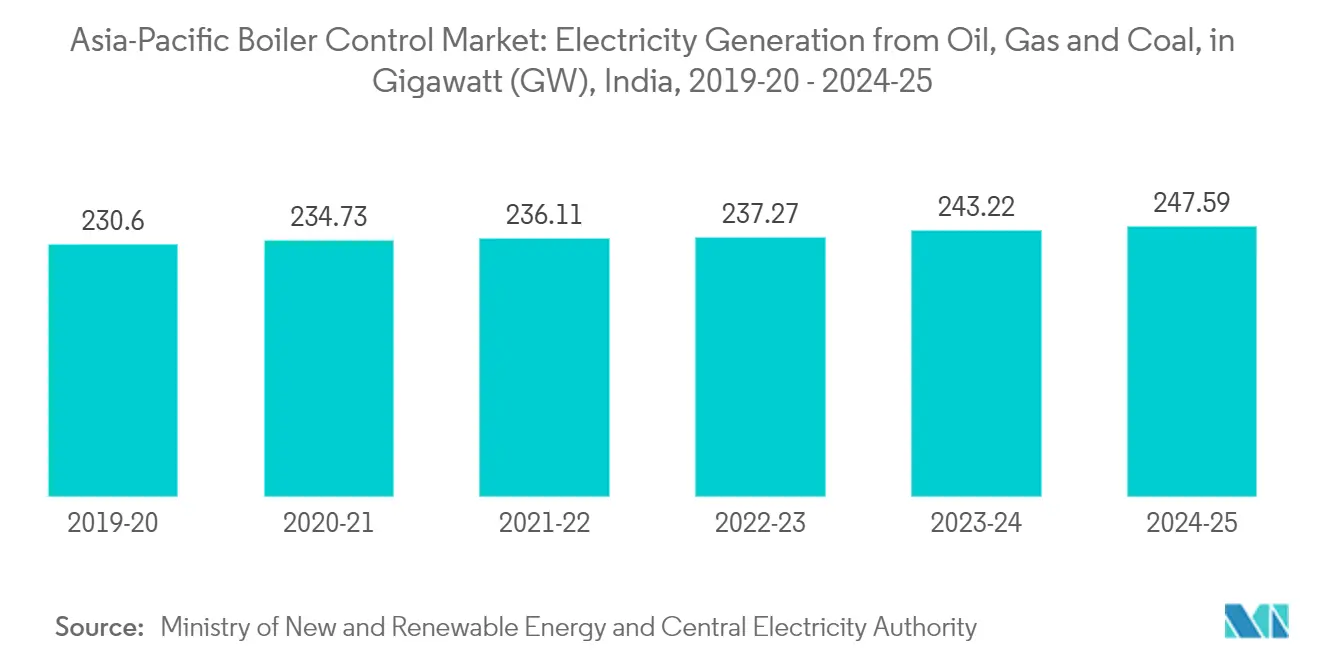
- With India's population and economy on the rise, the nation faces mounting energy demands. Boilers play a crucial role in power generation and various industrial processes, emphasizing the need for efficient and dependable control systems. Data from the Ministry of New and Renewable Energy and the Central Electricity Authority indicates that in FY 2024-25, electricity generation from oil, gas, and coal reached 247.59 gigawatts, a 7.37% increase from FY 2019-20.
- According to the Short-Term National Resource Adequacy Plan (ST-NRAP) by the National Load Despatch Centre (NLDC), peak power demand is projected to hit 277.2 GW in the summer of 2025. Looking ahead, forecasts suggest electricity demand will continue to rise, with peaks of 277.2 GW anticipated by 2026-27 and 366.4 GW by 2031-32. This surging power demand highlights the growing need for gas power plants and their infrastructure, subsequently boosting the demand for boilers and, in turn, the boiler control market.
- In summary, with robust government backing and a rapidly expanding domestic boiler market, India's industrial and energy sectors are poised for significant growth, positioning the nation as a potential leader in the Asia-Pacific boiler control market in the foreseeable future.

Mordor Intelligence provides coverage of the boiler control market across other key regional markets. Detailed country-level analysis extends to Indonesia, India, and China incorporating local coverage and market participation, as required.
Competitive Landscape
The Asia-Pacific boiler control market is semi-consolidated. Some of the major players in the market (in no particular order) include General Electric Company, Emerson Electric Co, Bosch Industriekessel GmbH, ABB Ltd, and Toshiba Corporation, among others.
Asia-Pacific Boiler Control Industry Leaders
General Electric Company
Emerson Electric Co
Bosch Industriekessel GmbH
ABB Ltd.
Toshiba Corporation
- *Disclaimer: Major Players sorted in no particular order

Recent Industry Developments
- January 2024: At BOILER 2024, Miura showcased its upgraded boiler room management system, Miura Connect 2.0, which boasts real-time monitoring and predictive maintenance features. Furthermore, they rolled out a 5 ppm Ultra Low NOx boiler, engineered to adhere to strict emissions standards without compromising on performance and efficiency.
- August 2023: NYK IDEMITSU Green Solutions Co., Ltd., based in Shinagawa-ku, Tokyo, has unveiled the ULTY-V plus AT, an upgraded version of its ULTY-V plus model. The ULTY-V plus AT, an advanced boiler fuel control optimization system, harnesses artificial intelligence (AI) to fine-tune boiler operations, resulting in diminished fuel consumption and lower CO2 emissions. Seamlessly integrating with current boiler control systems, the ULTY-V plus AT adjusts fuel flow controls to enhance performance.


Asia-Pacific Boiler Control Market Report Scope
A boiler control system is a network of hardware and software components that regulate the operation of a boiler. It ensures efficient, safe , and reliable boiler operation by monitoring and adjusting various parameters like temperature, pressure, fuel flow, airflow, etc. Key components of the boiler include sensors, controllers, actuators, Human Machine Interface (HMI), and other hardware (control panel, temperature sensors, and actuators)
Asia Pacific boiler control market is segmented by boiler type, components, end-user, and geography. By boiler type, the market is segmented into water tube boiler, fire tube boiler, and others. By components, the market is segmented into hardware and software. By end-user, the market is segmented into industrial and commercial. The report also covers the market size and forecasts for the boiler control market across major countries in the region.
For each segment, the market sizing and forecasts have been done based on revenue (USD).
| Water Tube Boiler |
| Fire Tube Boiler |
| Others |
| Hardware |
| Software |
| Industrial |
| Commercial |
| China |
| India |
| South Korea |
| Japan |
| Malaysia |
| Thailand |
| Indonesia |
| Vietnam |
| Australia |
| Rest of Asia-Pacific |
| Boiler Type | Water Tube Boiler |
| Fire Tube Boiler | |
| Others | |
| Components | Hardware |
| Software | |
| End User | Industrial |
| Commercial | |
| Geography | China |
| India | |
| South Korea | |
| Japan | |
| Malaysia | |
| Thailand | |
| Indonesia | |
| Vietnam | |
| Australia | |
| Rest of Asia-Pacific |


Key Questions Answered in the Report
How big is the Asia-Pacific Boiler Control Market?
The Asia-Pacific Boiler Control Market size is expected to reach USD 1 billion in 2025 and grow at a CAGR of 6.87% to reach USD 1.39 billion by 2030.
What is the current Asia-Pacific Boiler Control Market size?
In 2025, the Asia-Pacific Boiler Control Market size is expected to reach USD 1 billion.
Who are the key players in Asia-Pacific Boiler Control Market?
General Electric Company, Emerson Electric Co, Bosch Industriekessel GmbH, ABB Ltd. and Toshiba Corporation are the major companies operating in the Asia-Pacific Boiler Control Market.
What years does this Asia-Pacific Boiler Control Market cover, and what was the market size in 2024?
In 2024, the Asia-Pacific Boiler Control Market size was estimated at USD 0.93 billion. The report covers the Asia-Pacific Boiler Control Market historical market size for years: 2019, 2020, 2021, 2022, 2023 and 2024. The report also forecasts the Asia-Pacific Boiler Control Market size for years: 2025, 2026, 2027, 2028, 2029 and 2030.
Page last updated on:
Asia-Pacific Boiler Control Market Report
Statistics for the 2025 Asia-Pacific Boiler Control market share, size and revenue growth rate, created by Mordor Intelligence™ Industry Reports. Asia-Pacific Boiler Control analysis includes a market forecast outlook for 2025 to 2030 and historical overview. Get a sample of this industry analysis as a free report PDF download.


 Your data is secure and never sold or shared.


