
Indonesia Boiler Control Market Size and Share
Indonesia Boiler Control Market Analysis by Mordor Intelligence
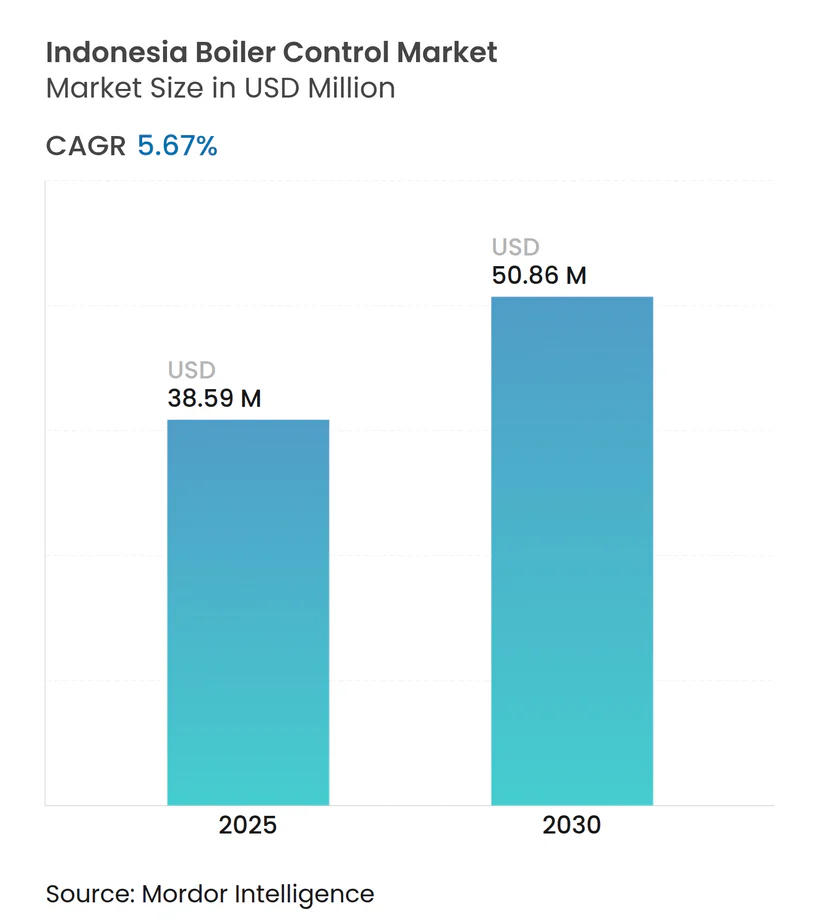
The Indonesia boiler control market size stands at USD 25 million in 2026 at manufacturer or system integrator selling prices, with USD 25.9 million estimated for 2027 and USD 31.3 million forecast for 2032, representing a 3.86% CAGR over 2027-2032. Industrial steam users account for most spending, while the strongest opportunities combine boiler safety, fuel management, and replacement of controls already in service. Growth depends on selective mill investment and control upgrades across a varied installed base.
Sugar-mill investment, tighter industrial gas supply, and updated operating requirements support the increase expected next year. Indonesia’s Ministry of Agriculture reported in November 2026 that the Indonesian Sugar Association expected national sugar production to reach at least 2.8 million metric tons for the season, supporting continued attention to mill productivity. Separately, the Ministry of Industry reported that western Java received 65.69% of its allocated industrial gas volume under the specified-price gas program in 2025. Sugar investment creates new control requirements, while gas shortages raise the value of dependable fuel and combustion management.
Palm processing provides a large existing customer base, although production growth alone gives an incomplete picture of investment demand. GAPKI reported that Indonesian crude palm oil production increased 7.26% to 51.66 million metric tons in 2025.[1] In its October 2026 industry assessment, GAPKI also identified slow smallholder replanting as a structural constraint on future output. Palm-mill control suppliers face a mix of throughput recovery, selective expansion, and maintenance-led spending, with slow replanting limiting how much new mill capacity is added.
Key Report Takeaways
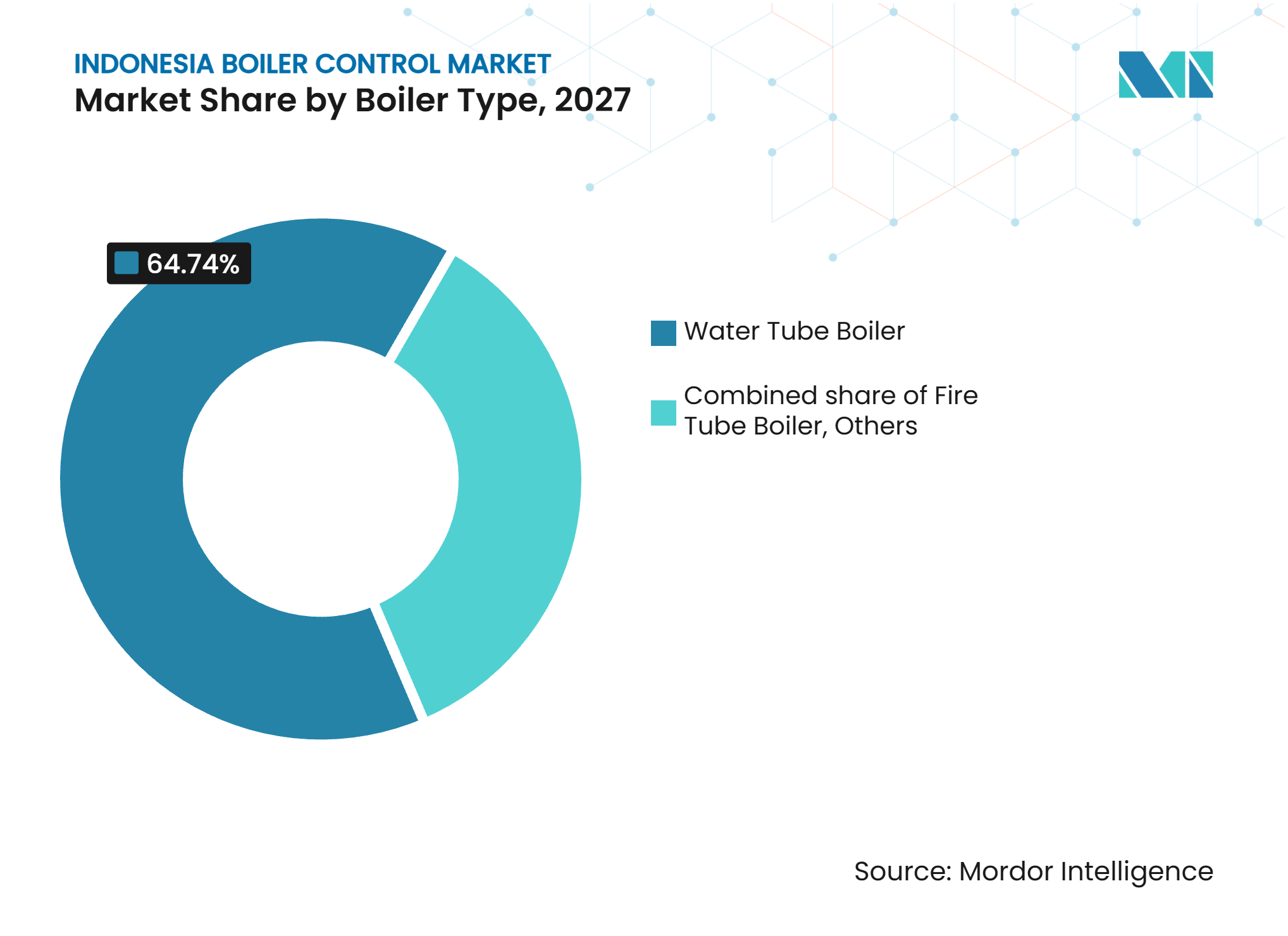
- Water-tube boilers are expected to command 64.74% of the Indonesia boiler control market share in 2027 and are forecast to lead boiler-type growth at a 4.15% CAGR during 2027-2032.
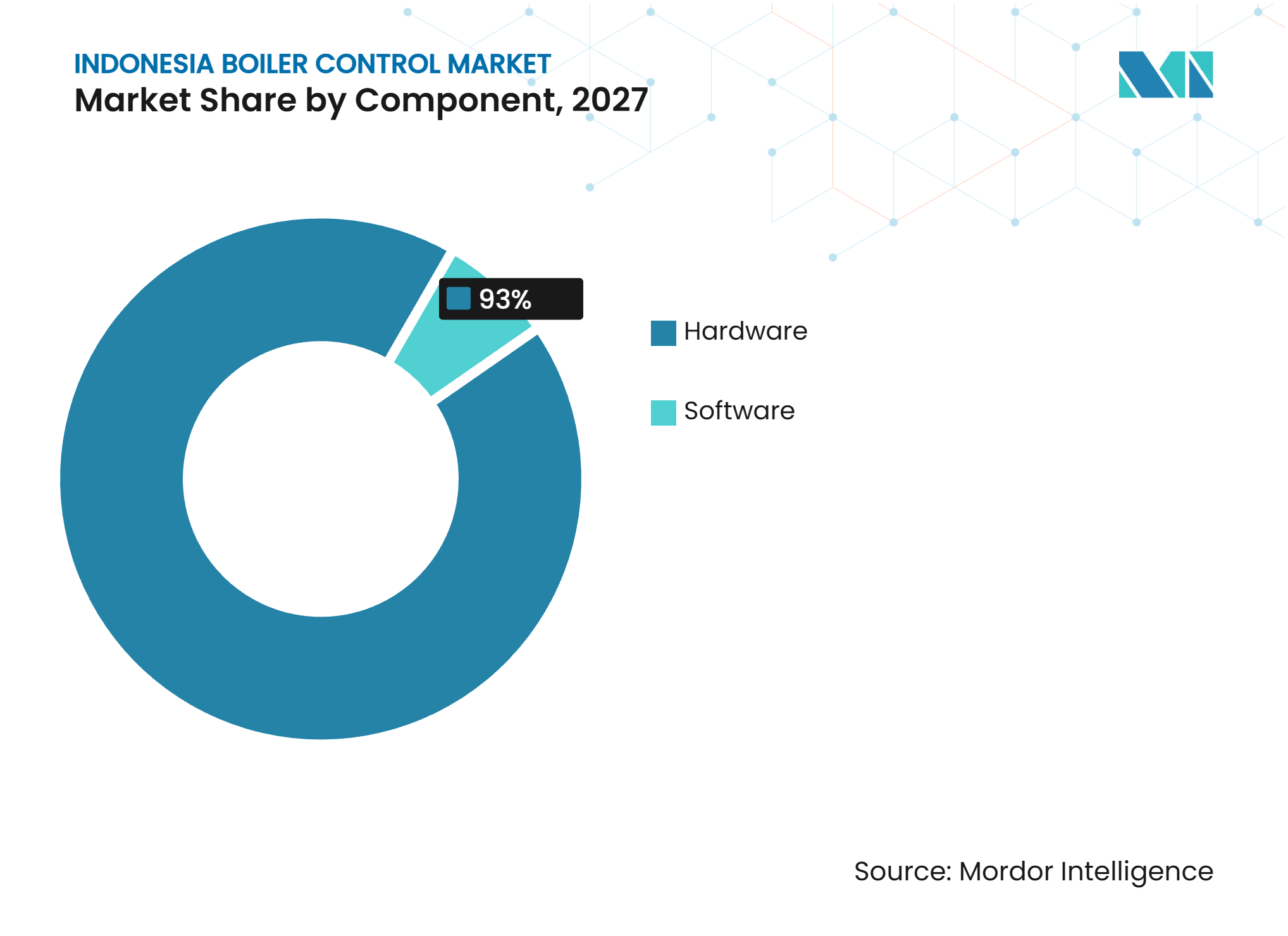
- Hardware represents an estimated 93.00% of the Indonesia boiler control market size in 2027, while software is forecast to expand faster at a 6.31% CAGR over 2027-2032.
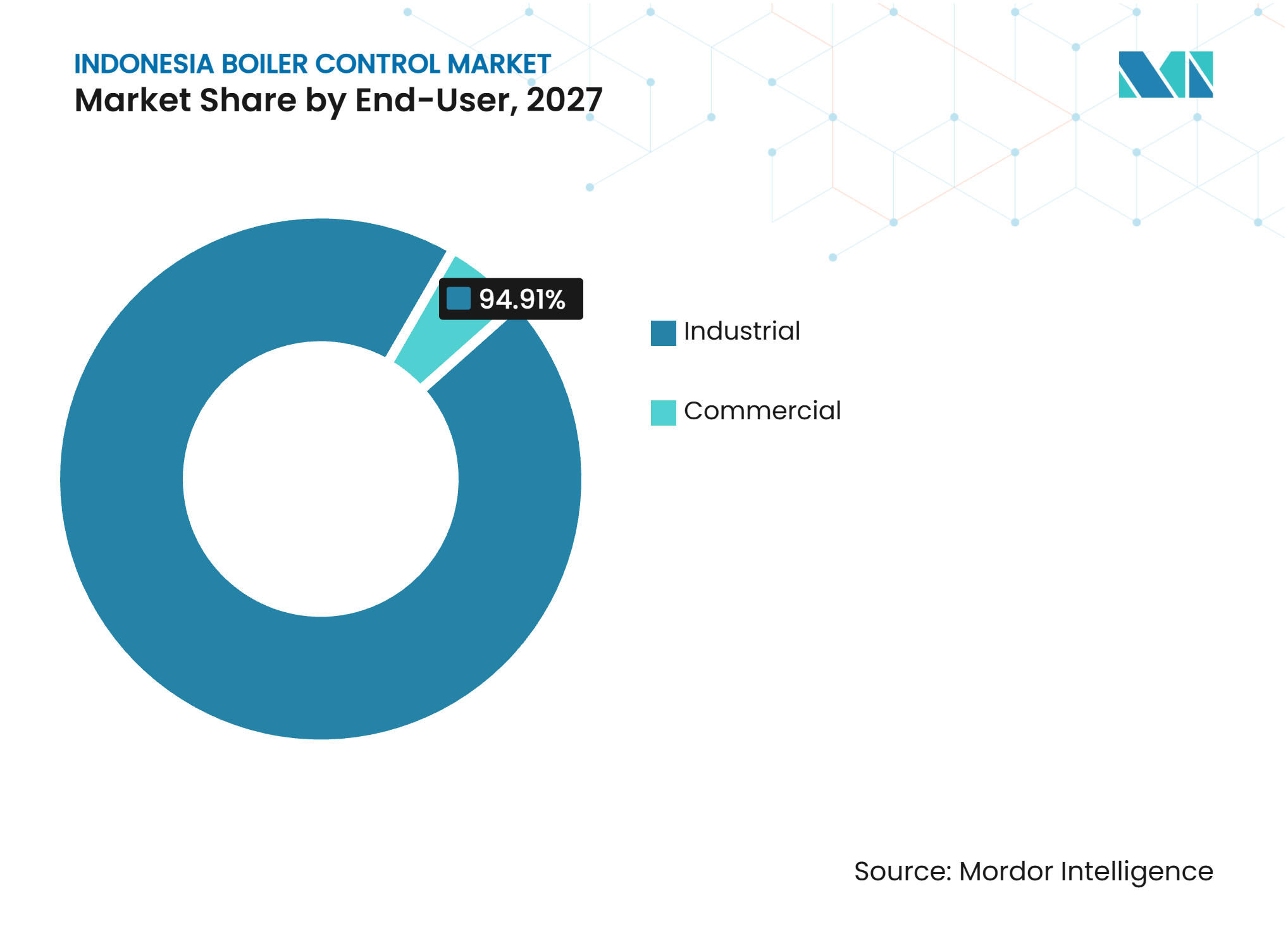
- Industrial owners are expected to contribute 94.91% of the Indonesia boiler control market share in 2027, with industrial demand also recording the leading end-user CAGR of 3.86% during 2027-2032.
- The sugar self-sufficiency program contributes an estimated +0.4 percentage points to forecast CAGR, making mill construction and revitalization the strongest individual growth driver assessed.
Note: Market numbers in this report are based on Mordor Intelligence's proprietary estimation framework, which combines nine months of actuals with Q4 projections for base year 2026.
Indonesia contributes to a system defined not by any single country or region but by the interaction of many. The global boiler control market data by Mordor Intelligence represents that combined structure.
Market Trends and Insights
Baseline growth is approximately 3.3% annually, supported by a gradually expanding boiler population, routine replacement of equipment already in use, and changes in USD selling prices. Together, the market forces lift forecast growth by approximately 0.56 percentage points to a 3.86% CAGR over 2027-2032. Each impact in the driver and restraint tables adds to or takes from baseline growth. Smaller forces and changes in the sales mix account for the remaining difference between the rounded impacts.
Drivers Impact Analysis of Indonesia Boiler Control Market*
| Driver | (~) % Impact on CAGR Forecast | Geographic Relevance | Impact Timeline |
|---|---|---|---|
| Sugar self-sufficiency program driving mill builds and revitalization | +0.4% | Java and emerging sugar-production locations outside Java | Medium term (2-4 years) |
| Announced cooperative and state-estate palm mill build program | +0.2% | Sumatra, Kalimantan, and other palm-growing areas | Medium term (2-4 years) |
| Pipeline gas shortfall pushing West Java toward solid-fuel boilers | +0.3% | West Java, with exposure in Banten and Jakarta | Medium term (2-4 years) |
| Licensed steam-plant operator rule with automatic-control provisions | +0.3% | Nationwide industrial and commercial steam plants | Medium term (2-4 years) |
| Mandatory energy management and audits for large industrial users | +0.2% | Nationwide energy-intensive industrial facilities | Medium term (2-4 years) |
| Aging installed base from the previous boiler import peak | +0.3% | Established industrial clusters nationwide | Long term (≥ 4 years) |
| Source: Mordor Intelligence | |||
Sugar Self-Sufficiency Program Driving Mill Builds and Revitalization
Sugar investment creates control demand through both new steam capacity and the removal of operating bottlenecks at existing mills. John Thompson announced an Indonesian order in August 2026 for a 320 t/h bagasse-fired industrial water-tube boiler, its fourth Indonesian order. Separately, SGN announced in December 2025 that its East Java mill program would address bottlenecks across 24 mills, where average capacity utilization was approximately 70%. Together these projects support demand for new boiler packages and for upgrades to feedwater, pressure, combustion, and sequencing controls at sugar mills.
Sugar-mill steam systems connect process heat with bagasse, the fibrous residue left after cane crushing. The Ministry of Agriculture’s August 2026 assessment identified 58 operating sugar mills, including state-owned and private facilities, which gives the program an established operating base. At those sites, changes in cane throughput and bagasse quality affect steam production and combustion stability. Bagasse firing ties the sugar program to the biomass boiler market, where fuel handling integration, air control, and steam-load management create work for boiler-control vendors.
Pipeline Gas Shortfall Pushing West Java Toward Solid-Fuel Boilers
West Java’s gas shortage raises the commercial value of fuel flexibility, although the documented immediate responses are LNG purchases and production curtailment. PGN restricted deliveries to approximately 78% of contracted minimum volumes from mid-September 2026, according to its instructions reported by Kontan. The Ministry of Energy and Mineral Resources also attributed declining western Java pipeline availability to natural field decline in its August 2026 policy explanation. Boiler owners in the region have stronger reasons to assess alternative-fuel equipment and the controls needed to operate it safely.
Domestic equipment suppliers are widening the options for those assessments. PT Sinergi Teknik Abadi introduced biomass and dual-fuel boiler technology at Heatech Indonesia in November 2026, while Basuki Pratama Engineering presented fluidized-bed equipment for moisture-variable biomass at the 2025 exhibition. A conversion to solid fuel requires coordinated fuel feeding, combustion-air control, furnace-pressure management, and additional interlocks. The fuel flexible boiler market therefore shapes how complex West Java control packages become, while the pace of conversion depends on project economics and fuel availability.
Licensed Steam-Plant Operator Rule With Automatic-Control Provisions
Indonesia’s updated boiler operator framework reinforces the importance of qualified personnel and dependable operating systems. The Ministry of Manpower promulgated Regulation No. 4 of 2025 on boiler operators on May 21, 2025, replacing the earlier operator regulation. The ministry’s official record identifies requirements covering qualifications, occupational safety licensing, duties, supervision, and sanctions. Boiler owners have a stronger operational reason to maintain clear alarms, reliable interlocks, and control systems that trained operators can diagnose.
Commercial suppliers are building those operating needs into their packages. Samson Indonesia Boiler’s March 2026 guidance for hospitals and hotels emphasizes low-water protection, pressure controls, burner interlocks, commissioning, and operator training. PT Indira Mitra Boiler’s May 2026 burner offering similarly combines flame monitoring, emergency shutdown, and modulating control. Suppliers that deliver tested protective functions and usable operating documentation compete on operational assurance as well as equipment price.
Aging Installed Base From the Previous Boiler Import Peak
Boilers installed during the previous import peak create a long-duration market for replacement instruments, control panels, and protective devices. Corplox’s September 2026 compilation of UN Comtrade data identified boiler parts as 33.2% of Indonesia’s 2025 imports under the steam-boiler customs category. That parts mix points to continuing spending on equipment already operating, which retrofit suppliers can capture without depending on new boiler construction.
Control-system renewal also follows the availability of supported electronics and service expertise. Emerson introduced its PACSystems RX3i CPS400 safety controller in August 2025 for applications that include burner management, while Bosch announced a new generation of BCO and SCO boiler-control interfaces in October 2026. These products give owners replacement paths for safety and operator-interface functions. Replacement demand for aging boiler controls builds as individual plants schedule outages and swap out unsupported or unreliable elements.
Restraints Impact Analysis of Indonesia Boiler Control Market*
| Restraint | (~) % Impact on CAGR Forecast | Geographic Relevance | Impact Timeline |
|---|---|---|---|
| Stagnant palm-oil output and slow replanting capping mill investment | -0.3% | Sumatra, Kalimantan, and other palm-processing areas | Medium term (2-4 years) |
| Textile closures and weak utilization shrinking the boiler-owning base | -0.2% | West Java, Central Java, and other textile clusters | Medium term (2-4 years) |
| Nickel ore quota cuts and reportedly halted new HPAL licensing | -0.3% | Sulawesi and Maluku nickel-processing clusters | Medium term (2-4 years) |
| Local-content preference substituting cheaper domestic controls for imports | -0.4% | Nationwide, especially public and state-linked procurement | Medium term (2-4 years) |
| Source: Mordor Intelligence | |||
Local-Content Preference Substituting Cheaper Domestic Controls for Imports
Local-content policy shifts the relative appeal of imported packages and locally assembled systems. Presidential Regulation No. 46 of 2025 strengthened domestic-product preferences in public procurement, while the Ministry of Industry’s Regulation No. 35 of 2025 revised local-content certification rules. The ministry also offered a 2025 program covering 1,000 free certification places for upstream and intermediate manufacturers. Local assembly and certification improve a supplier’s position in public procurement even when critical electronics remain internationally sourced.
Indonesia-based boiler production makes localization a practical competitive option. Thermax’s Indonesian subsidiary reported in April 2025 that its Cilegon facility could manufacture up to 40 boilers annually, while Basuki reported local content approaching 50% in November 2025. Both point to an established platform for local engineering and package integration. Localized panels and commissioning let control vendors keep sales while lowering the average value captured by a fully imported package, which makes this the largest single drag on market growth.
Nickel Ore Quota Cuts and Reportedly Halted New HPAL Licensing
Nickel-processing investment faces tighter feedstock allocation and more selective project approvals. S&P Global Commodity Insights reported in November 2026 that Indonesia’s revised nickel-ore quota was approximately 290-300 million metric tons, above the initial allocation but still restrictive for the processing base. Separately, Reuters reported in June 2026 that rotary-kiln electric-furnace utilization had fallen to 76%, compared with 84% in 2025. Lower utilization reduces the urgency of additional process-steam capacity and associated controls at exposed nickel sites in Sulawesi and Maluku.
Licensing limits fall on new projects, while plants already under construction continue. Government Regulation No. 28 of 2025 introduced conditions on new industrial-license applications for specified nickel intermediates, including facilities producing only mixed hydroxide precipitate. These are the HPAL plants, which use high-pressure acid leaching, a hydrometallurgical process. The Ministry of Energy and Mineral Resources described a broader smelter moratorium in October 2026 as a measure under study. Control suppliers face a narrower new-project pipeline in nickel, while operating and previously committed facilities continue to offer maintenance and upgrade work.
*Our forecasts treat driver/restraint impacts as directional, not additive. The impact forecasts reflect baseline growth, mix effects, and variable interactions.
Indonesia Boiler Control Market Segment Analysis
By Boiler Type:
Water-Tube Systems Anchor Project ValueWater-tube applications are expected to account for 64.74% of the Indonesia boiler control market share in 2027 and are forecast to grow at a 4.15% CAGR during 2027-2032. Larger industrial units require coordinated drum-level, feedwater, pressure, fuel, and air controls. Their project complexity gives water-tube control packages a larger revenue role than boiler counts alone would suggest.
Fire-tube boiler controls rank second by value and are forecast to grow more slowly than water-tube controls, supported by packaged process-steam and building-service applications. PT Indira Mitra Boiler’s April 2026 Bejo offering covers 0.5-10 t/h fire-tube units and makes automatic or PLC control an option. That choice sets a price-sensitive decision between basic operation and a more integrated package. Fire-tube suppliers win business when they can show the operating value of modulation, sequencing, and protective functions in a compact installation.
Other boiler designs form the smallest and slowest-growing boiler-type group, serving more specialized heating requirements. Bosch’s current industrial offering includes electric electrode-boiler development alongside its established steam and hot-water portfolio. Electric, thermal-fluid, sectional, and condensing equipment need controls suited to their own heat-transfer and safety characteristics, which keeps this group a specialist niche.



By Component:
Hardware Carries Revenue, Software Leads GrowthHardware accounts for an estimated 93.00% of the Indonesia boiler control market share in 2027. PT Indira Mitra Boiler’s May 2026 dual-fuel burner package includes burner management, flame detection, pressure switches, emergency shutdown, and automatic modulation, together with commissioning services. Those functions need physical devices and on-site testing before a boiler can operate reliably. Hardware captures most package spending, including bundled installation and commissioning.
Software is forecast to record a 6.31% CAGR during 2027-2032 as boiler owners add remote visibility and operating-history tools. PT Miura Indonesia promoted its remote-monitoring device in September 2026 to address manual alarm checking, data logging, and troubleshooting. Bosch’s October 2026 control-interface announcement also included remote interface access through its Industrial Boiler Assist offering. Separately purchased boiler-house monitoring and analytics create incremental software revenue, while embedded control functionality stays within the hardware package.

By End-User:
Industrial Steam Demand Sets the Market’s DirectionIndustrial owners are expected to represent 94.91% of the Indonesia boiler control market size in 2027, with spending forecast to rise at a 3.86% CAGR over 2027-2032. Thermax reported completed Indonesian references in June 2025 that included a 35 t/h vegetable-oil boiler and a 40 t/h rice-husk boiler for a pharmaceutical company. These projects show process-steam demand reaching well beyond sugar. Demand in the steam boiler system market creates control opportunities wherever steam availability directly affects industrial production.
Commercial owners form a much smaller segment, growing at close to the industrial pace and supported by institutional and building-service requirements. Miura Indonesia identified hotels and hospitals among its customer groups in December 2025, alongside industrial users. Hospital sterilization and hotel laundry create different load profiles, but both place a premium on reliable start-up, safe operation, and service access. Commercial boilers, tracked in the commercial boilers market, offer a small, service-sensitive channel for control packages and retrofits.
Competitive Landscape
Market Concentration
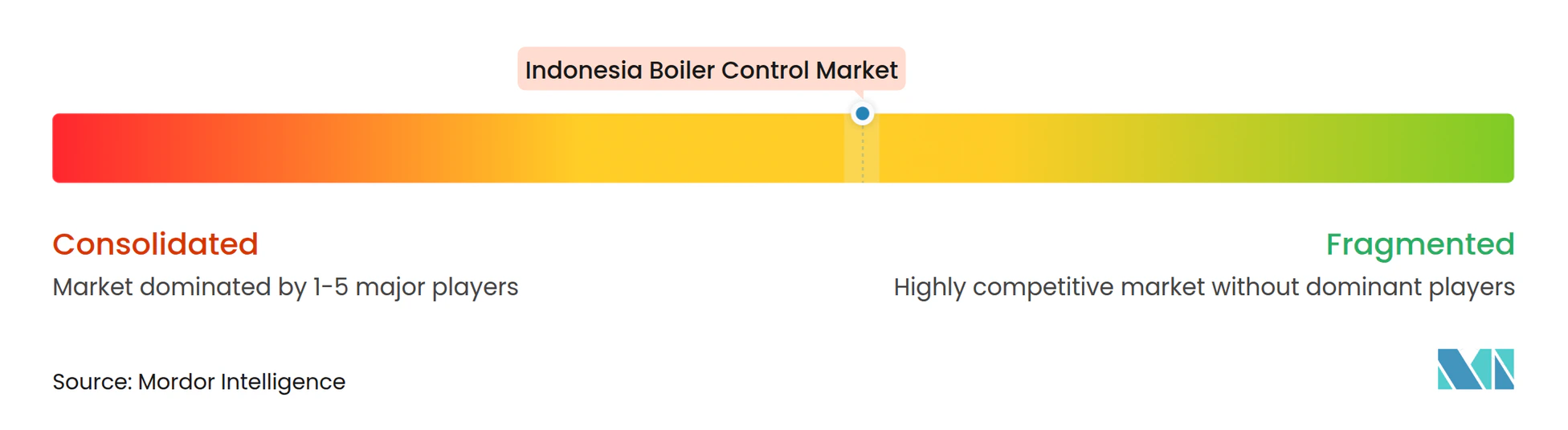
Indonesia’s competitive structure combines international automation platforms, boiler manufacturers, instrumentation vendors, and local package integrators. GE Vernova’s industrial-boiler services and boiler-control capabilities place it in engineered upgrade opportunities, with only boiler-dedicated industrial work falling within this market. Emerson Electric Co. supplies burner-management controllers, valves, and automation, while Bosch Industriekessel GmbH supplies integrated BCO boiler and SCO multi-boiler controls. The breadth of those routes makes engineering responsibility and local service coverage important differentiators among the key players.
Siemens AG participates through industrial burner-management technology, including the LMV platform with fuel-air ratio control and optional boiler-load and oxygen-trim functions. ABB Ltd supplies combustion-analysis devices such as its Endura oxygen and combustibles analyzers, which enter this market when dedicated to boiler duty. Emerson’s fiscal 2026 filing reported USD 4.58 billion in Control Systems & Software sales, up 6% on a reported basis.[2] That division figure shows the scale of the platform behind Emerson’s product development, while its Indonesian boiler-control sales remain a much narrower slice.
Local integration keeps supplier concentration relatively low. PT Indira Mitra Boiler combines locally supplied packages with imported burner and control components, while Thermax’s Indonesian manufacturing operation provides another route to locally engineered systems. Against that fragmented supply structure, the leading 5 players are estimated to account for approximately 30% of 2027 market value. Suppliers that pair recognizable control platforms with commissioning, spare parts, and dependable local response hold the advantage.
Indonesia Boiler Control Industry Leaders
-
GE Vernova
-
Emerson Electric Co.
-
Bosch Industriekessel GmbH
-
Siemens AG
-
ABB Ltd
- *Disclaimer: Major Players sorted in no particular order
Indonesia Boiler Control Market Companies Covered in this Report
- GE Vernova
- Emerson Electric Co.
- Bosch Industriekessel GmbH
- Siemens AG
- ABB Ltd
- Schneider Electric SE
- Thermax Ltd
- Mitsubishi Heavy Industries
- List of Other Prominent Platers
- Market Ranking/Share (%) Analysis
Gas Procurement Economics
Replacement LNG carries a material fuel-cost premium even under Indonesia’s announced industrial support price. In June 2026, the Ministry of Energy and Mineral Resources announced an LNG price of USD 13/MMBtu for eligible non-HGBT industrial consumers in West Java, Banten, and Jakarta. HGBT is the specified-price gas program, and average non-HGBT pipeline gas in West Java cost USD 9.6/MMBtu. The difference is USD 3.4/MMBtu, calculated as USD 13 minus USD 9.6, or 35.42% of the pipeline price. Because these are announced prices for specified customer groups, individual procurement contracts set the premium that West Java plants actually pay.
Fuel-price exposure underpins the gas-shortfall driver’s +0.3 percentage-point contribution to forecast CAGR. The ministry’s 2026 policy response addresses replacement-fuel affordability, while PGN’s delivery restrictions show that volume availability also affects production planning. Combustion tuning and fuel flexibility address different parts of that exposure, with tuning reducing consumption and alternative-fuel capability widening operating choice. For West Java industrial plants, the return on a control upgrade rests on actual fuel contracts, operating hours, and interruption costs.
Retrofit Economics
Industrial energy audits identify an efficiency opportunity in boilers already operating. WRI Indonesia’s 2026 SETI assessment reported boiler efficiencies of only 70-80% at some audited facilities.[3] At unchanged useful heat output, improving a boiler from 70% to 80% efficiency would cut required fuel input by 12.5%, calculated as 1 minus 70 divided by 80. This figure follows from WRI’s reported efficiency endpoints and indicates the scale of fuel saving available at low-efficiency industrial boilers.
Energy-management and audit requirements add +0.2 percentage points to forecast CAGR through efficiency-led procurement. WRI’s assessment considered boilers alongside compressed air and other heating systems, so savings have to be allocated to each intervention. Oxygen trim, sensor renewal, burner tuning, and operating changes deliver different results depending on a plant’s starting condition. In the retrofit market, a boiler-specific baseline and verification method turn an audit finding into a defensible purchase.
Recent Industry Developments in Indonesia Boiler Control Market
- Nov 2026: PT Sinergi Teknik Abadi introduced biomass and dual-fuel boiler technology at Heatech Indonesia and described plans to expand production capacity.
- Oct 2026: Bosch Industrial announced upgraded BCO and SCO control interfaces for selected industrial boiler series, including new touch displays and remote interface access.
- Aug 2026: John Thompson announced a 320 t/h bagasse-fired industrial boiler order for an Indonesian greenfield sugar development.
Indonesia Boiler Control Market Report Scope and Research Methodology
Market Definition and Coverage
The market covers control systems sold for industrial and commercial water-tube, fire-tube, and other boilers. Products include burner-management and flame-safeguard systems, combustion and oxygen-trim controllers, boiler PLCs, drum-level and feedwater controls, pressure and sequencing controls, dedicated sensors and analyzers, and boiler-house software and remote monitoring. Sales include packages supplied to boiler and burner manufacturers for new equipment and retrofits or software subscriptions supplied to boiler owners. Market value is measured in USD at the manufacturer’s or system integrator’s selling price of the boiler control package or retrofit.
The market excludes utility power-station boilers, residential boilers and thermostats, and general plant distributed control systems that are not dedicated to a boiler. Industrial captive-power boiler controls remain included where they serve an industrial owner within the report’s scope. General plant automation expenditure enters the estimate only to the extent that a separately identifiable package is dedicated to boiler operation.
Boiler type follows the design to which the controls are fitted, including industrial circulating fluidized-bed and heat-recovery boilers within water-tube applications. Hardware includes bundled installation and commissioning, while separately purchased boiler-house software, monitoring, and analytics subscriptions enter software. End-user classification follows the boiler owner, so a packaged boiler supplied through an OEM is assigned to its final industrial or commercial application.
Segments Covered in This Report
- By Boiler Type
- Water Tube Boiler
- Fire Tube Boiler
- Others
- By Component
- Hardware
- Burner Management and Flame Safeguard Systems
- Combustion and Boiler Controllers
- Sensors, Analysers and Field Devices
- Software
- Hardware
- By End-User
- Industrial
- Food, Beverage and Agro-processing
- Chemicals, Petrochemicals and Refining
- Pulp, Paper and Textiles
- Other Industries
- Commercial
- Industrial
Data Sources, Market Sizing, and Validation
Desk Research
The research uses BPS-Statistics Indonesia manufacturing and trade statistics, Ministry of Manpower regulations, Ministry of Energy and Mineral Resources publications, Ministry of Agriculture sugar-sector reporting, GAPKI industry data, and UN Comtrade customs records. Those sources establish the industrial customer base, operating requirements, fuel conditions, and the scale and direction of boiler-related investment.
Company filings, product documentation, project announcements, and trade reporting supplement the public-source framework. Analysts distinguish industrial boilers from utility equipment and separate control-package value from complete boiler and plant costs. These sources are not exhaustive, and further sources inform data collection, validation and clarification.
Primary Interviews and Surveys
Analysts interview boiler manufacturers, burner and instrumentation suppliers, system integrators, service contractors, and industrial or commercial boiler owners. Interviews test package pricing, replacement intervals, purchasing priorities, component allocations, and the timing of announced investment. Respondent coverage spans the main domestic industrial clusters and different supplier sizes.
Distribution of primary research fieldwork respondents
| Company type | Respondent position | Region |
|---|---|---|
| Top tier: 30% | CXOs: 20% | Java: 55% |
| Mid tier: 50% | Functional/Unit leaders: 30% | Sumatra: 30% |
| Smaller Players: 20% | Managers: 50% | Kalimantan, Sulawesi, and other domestic regions: 15% |
Market-Sizing & Forecasting
The estimate starts with an industrial and commercial installed base of approximately 11,000 boilers and annual control expenditure per boiler. The calculation distinguishes new equipment from the installed base, industrial from commercial ownership, boiler design, and hardware from separately purchased software. Control-package pricing and replacement activity determine spending within those groups.
The baseline assumes approximately 2% annual growth in the boiler population and approximately 1% annual change in USD prices, producing underlying growth of about 3.3% after mix effects. Sugar investment, gas availability, operating requirements, audits, and replacement demand raise the outlook, while localization, nickel restrictions, palm-sector constraints, and textile closures reduce it. The resulting forecast is cross-checked against supplier activity, industrial investment, and boiler-related imports.
No comprehensive official boiler-count or dedicated boiler-control production series underpins the estimate. Analysts reconstruct the installed base from palm-mill counts, industrial structure, supplier evidence, and trade flows, recognizing that imports vary sharply between project years. Company concentration is an analyst assessment of supplier structure, product coverage, local integration, and competitor breadth, rounded to avoid unsupported precision.
Data Validation and Update Cycle
Analysts triangulate public statistics, supplier disclosures, project records, and primary-research findings. Anomaly review checks changes in customs categories, unusually large projects, duplicated package values, and the boundary between utility and industrial applications. Forecasts receive an annual refresh, with interim updates following major regulatory changes, investment decisions, fuel-supply disruptions, or supplier transactions.
Comparison With Published Estimates
Market Research Publisher A covers the same country and the closest named product category. Its public segmentation does not establish whether utility boiler controls are excluded, and its price basis is unstated. A numerical difference cannot be attributed to methodology without a disclosed country value and equivalent coverage.
Comparison With Published Estimates
| Publisher | Market Size | Key gap |
|---|---|---|
| Mordor Intelligence | USD 25 million in 2026 | Industrial and commercial boiler-specific packages and retrofits at manufacturer or system integrator selling prices. |
| Market Research Publisher A | Not publicly disclosed | Its Indonesia boiler-control report identifies hardware, software, water-tube, and fire-tube coverage, but provides no public numerical estimate or explicit utility exclusion. |
| Market Research Publisher B | Not publicly disclosed | Its industrial boiler-control report includes Indonesia revenue tables, but the public material withholds the country value and does not establish an equivalent valuation basis. |
Market Research Publisher B identifies Indonesia within an industrial boiler-control study, giving it a closer product boundary than complete-boiler or heating-equipment estimates. Its public country tables do not disclose a market value, so no numerical gap is asserted. Comparable market sizing requires the same product boundary, annual-sales measure, and selling-price point.
Key Questions Answered in the Report
What is the Indonesia boiler control market size in 2026?
The Indonesia boiler control market is valued at USD 25 million in 2026 at manufacturer or system integrator selling prices.
How fast will Indonesia’s boiler control market grow?
The Indonesia boiler control market size is forecast to reach USD 31.3 million by 2032, expanding at a 3.86% CAGR during 2027-2032.
Which boiler type leads demand for controls in Indonesia?
Water-tube boilers are expected to hold 64.74% of the Indonesia boiler control market share in 2027, supported by larger industrial steam applications.
Is boiler-control software growing faster than hardware?
Software is forecast to grow at a 6.31% CAGR during 2027-2032, faster than hardware, as owners add remote monitoring, operating-history tools, and analytics.
What is driving boiler-control investment in Indonesian sugar mills?
New mills and revitalization projects require combustion, feedwater, pressure, safety, and sequencing controls. The sugar program contributes an estimated +0.4 percentage points to forecast CAGR.
How concentrated is Indonesia’s boiler control market?
The leading 5 suppliers are estimated to account for approximately 30% of 2027 market value. International technology vendors compete alongside boiler manufacturers and local system integrators.