
Blood Grouping Reagents Market Size and Share
Market Overview
| Study Period | 2020 - 2031 |
|---|---|
| Market Size (2026) | USD 0.72 Billion |
| Market Size (2031) | USD 1.21 Billion |
| Growth Rate (2026 - 2031) | 11.12 % |
| Fastest Growing Market | Asia-Pacific |
| Largest Market | North America |
| Market Concentration | Medium |
Major Players *Disclaimer: Major Players sorted in no particular order Image © Mordor Intelligence. Reuse requires attribution under CC BY 4.0. | |
Blood Grouping Reagents Market Analysis by Mordor Intelligence
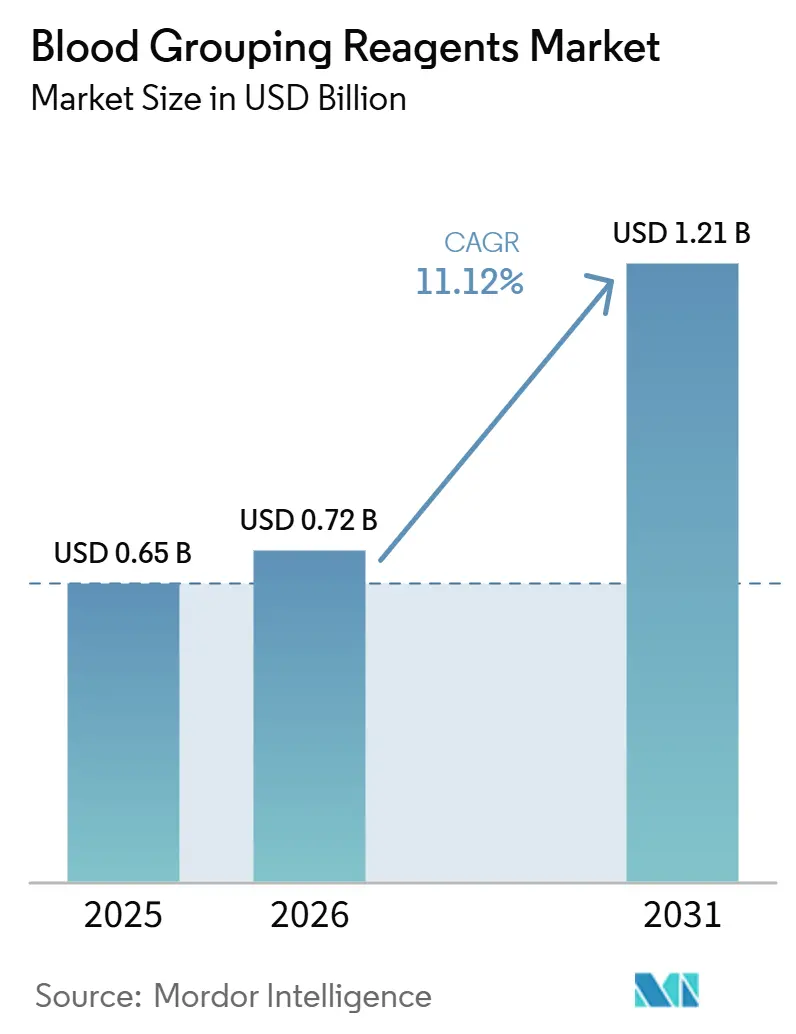
The blood grouping reagents market is expected to grow from USD 0.65 billion in 2025 to USD 0.72 billion in 2026 and is forecast to reach USD 1.21 billion by 2031 at 11.12% CAGR over 2026-2031. The blood grouping reagents market is moving higher because blood safety rules are tightening, hospital transfusion protocols are becoming stricter, and laboratories are giving more weight to validated performance during procurement. Cancer care, organ transplantation, and other transfusion-intensive treatments are increasing repeat compatibility testing, which keeps demand firm for routine typing reagents and more specialized antigen profiling products. The blood grouping reagents market also benefits from hospital automation, because analyzer placements are usually tied to dedicated consumables, controls, and software-supported workflows that increase repeat reagent use over time. At the same time, patient blood management programs are making each transfusion decision more selective, which raises the value of every pre-transfusion test and supports demand for higher-performing reagents rather than only higher test volume. Competition in the blood grouping reagents market is shaped by closed analyzer platforms, strict validation rules, and cold chain reliability, which together favor large suppliers with established manufacturing, regulatory, and service capabilities.
Key Report Takeaways
- By product type, serological reagents held 58.92% of the blood grouping reagents market share in 2025, while molecular reagents are projected to expand at 12.84% CAGR through 2031.
- By technology, manual testing accounted for 51.34% of the blood grouping reagents market size in 2025, while automated testing is expected to advance at 13.21% CAGR through 2031.
- By test type, blood typing captured 45.16% of the blood grouping reagents market size in 2025, while blood grouping and phenotyping are forecast to grow at 13.47% CAGR through 2031.
- By end-user, hospitals represented 49.85% of the blood grouping reagents market share in 2025, while blood banks are anticipated to rise at 12.96% CAGR through 2031.
- By geography, North America accounted for 41.72% of the blood grouping reagents market size in 2025, while the Asia-Pacific is expected to advance at 14.25% CAGR through 2031.
Note: Market size and forecast figures in this report are generated using Mordor Intelligence’s proprietary estimation framework, updated with the latest available data and insights as of January 2026.
Market Trends and Insights
Drivers Impact Analysis of Blood Grouping Reagents Market*
| Driver | (~) % Impact on CAGR Forecast | Geographic Relevance | Impact Timeline |
|---|---|---|---|
| Rising Demand for Safe Blood Transfusion Workflows | +3.2% | Global | Short term (≤ 2 years) |
| Expansion of Automated Blood Typing and High-Throughput Immunohematology Platforms | +2.8% | North America and Europe, spillover to Asia-Pacific | Medium term (2-4 years) |
| Increasing Organ Transplant and Prenatal Screening Volumes | +1.9% | North America, Europe, Asia-Pacific | Medium term (2-4 years) |
| Growth in Rare Blood Type Identification and Extended Phenotyping Needs | +1.5% | Global, Asia-Pacific | Long term (≥ 4 years) |
| Shift Toward Molecular Blood Group Genotyping in Reference Laboratories | +1.8% | North America and Europe, spillover to Asia-Pacific | Long term (≥ 4 years) |
| Procurement Standardization in Large Blood Banks and National Transfusion Services | +0.7% | Global | Short term (≤ 2 years) |
| Source: Mordor Intelligence | |||
Rising Demand for Safe Blood Transfusion Workflows
The blood grouping reagents market continues to gain support from the constant need for safe transfusion workflows in hospitals and blood services. The United States required nearly 29,000 units of red blood cells every day and transfused nearly 16 million blood components annually, which shows how large the testing base remains even before more advanced compatibility work is considered.[1]The care mix is also shifting, because oncology and cardiovascular procedures now account for a larger share of transfusion demand in advanced health systems, and these patients often return for repeated testing over time. This matters for the blood grouping reagents market because patient blood management programs reduce unnecessary transfusions, but they also increase the clinical importance of each approved transfusion event and each test result. Comparative 2025 research showed sensitivity gaps of up to 19 percentage points between reagent red blood cell brands on the same platform, which is pushing buyers to prioritize published performance evidence instead of only purchase price.
Expansion of Automated Blood Typing and High-Throughput Immunohematology Platforms
The blood grouping reagents market is also being lifted by the spread of automated immunohematology systems in high-volume laboratories. Automated platforms use proprietary cartridges, defined reagent suspensions, and built-in controls, so they create steady consumable demand that manual tube methods do not reproduce. QuidelOrtho received FDA clearance in October 2025 for its Micro Typing Systems DAT Card on the ORTHO VISION platform, which expanded the company’s gel-based direct antiglobulin testing offering and strengthened its installed system proposition.[2]Bio-Rad launched the IH-500 NEXT system in May 2025 with a 6-axis robotic arm and 7 day on-board reagent stability, targeting blood banks that need higher throughput and fewer manual steps. These placements matter in the blood grouping reagents market because analyzer contracts are often paired with multi-year reagent commitments, which raise repeat revenue visibility and make account switching less likely.
Increasing Organ Transplant and Prenatal Screening Volumes
The blood grouping reagents market is benefiting from the rising complexity of transplant-related immunohematology workups. The Global Observatory on Donation and Transplantation recorded 173,727 solid organ transplants in 2024, including 110,467 kidney transplants, while lung transplants rose 6%, marking the highest annual total in the reporting series.[3]These patients often need extended Rh and Kell phenotyping, crossmatch testing, and continued antibody monitoring, which means reagent use expands faster than procedure counts alone. Prenatal screening also sustains routine demand because maternal blood group testing and anti-D related pathways depend on reliable serological workflows in both hospital and blood bank settings. This supports the blood grouping reagents market because the value of testing is increasing in clinical pathways where compatibility errors can lead to severe patient harm.
Growth in Rare Blood Type Identification and Extended Phenotyping Needs
The blood grouping reagents market is seeing broader demand for extended phenotyping as donor pools become more diverse and chronically transfused patients need tighter antigen matching. Centers for Medicare and Medicaid Services maintained LCD L38331 for blood product molecular antigen typing, which provides a defined, though still limited, coverage path for molecular phenotyping in pre-transfusion evaluation. As rare donor identification becomes more important, laboratories need broader reagent menus and more repeat characterization of both donors and recipients. That is favorable for the blood grouping reagents market because extended matching uses more specialized products and supports higher clinical value per test episode.
Restraints Impact Analysis of Blood Grouping Reagents Market*
| Restraint | (~) % Impact on CAGR Forecast | Geographic Relevance | Impact Timeline |
|---|---|---|---|
| High Validation Burden for New Reagent Lots and Methods | -1.8% | Global | Short term (≤ 2 years) |
| Cold Chain Dependence and Shelf-Life Losses in Distribution | -1.2% | Asia-Pacific, Middle East and Africa, South America | Medium term (2-4 years) |
| Limited Adoption Capacity in Smaller and Resource-Constrained Facilities | -0.9% | Middle East and Africa, South America | Long term (≥ 4 years) |
| Fragmented Reimbursement and Tender Pricing Pressure in Public Systems | -0.7% | Global | Long term (≥ 4 years) |
| Source: Mordor Intelligence | |||
High Validation Burden for New Reagent Lots and Methods
The blood grouping reagents market faces a meaningful constraint from the validation burden attached to biologics-grade and regulated transfusion products. In the United States, blood grouping reagents must meet potency, specificity, and avidity requirements under 21 CFR Part 660, which makes development and method extension more demanding than in many routine diagnostics categories. The FDA also approved a Biologics License Application supplement for Immucor in August 2025 with explicit language that placed responsibility on users to validate methods beyond the manual tube procedure described in the insert. This slows the pace of change in the blood grouping reagents market because every new lot, method, or workflow extension can add documentation, staff time, and audit exposure. The result is a competitive advantage for larger manufacturers that have established quality systems and enough installed base to absorb compliance costs over a wider revenue pool.
Cold Chain Dependence and Shelf-Life Losses in Distribution
The blood grouping reagents market is also constrained by strict temperature control needs during storage and transport. Reagent red blood cells and monoclonal antibody based antisera need controlled cold storage, and a documented temperature excursion can trigger batch non-conformance under blood establishment quality frameworks. This issue is more serious than logistics cost alone, because reagent quality can weaken without obvious visual change, which increases the risk of false negative performance if handling is poor. In infrastructure-constrained settings, laboratories often stay with basic ABO and RhD testing because higher-sensitivity or broader-menu products are harder to store and distribute consistently. That creates a two-tier structure in the blood grouping reagents market, with broader product adoption in reliable cold chain settings and narrower product use in lower-reliability settings.
*Our forecasts treat driver/restraint impacts as directional, not additive. The impact forecasts reflect baseline growth, mix effects, and variable interactions.
Blood Grouping Reagents Market Segment Analysis
By Product Type:
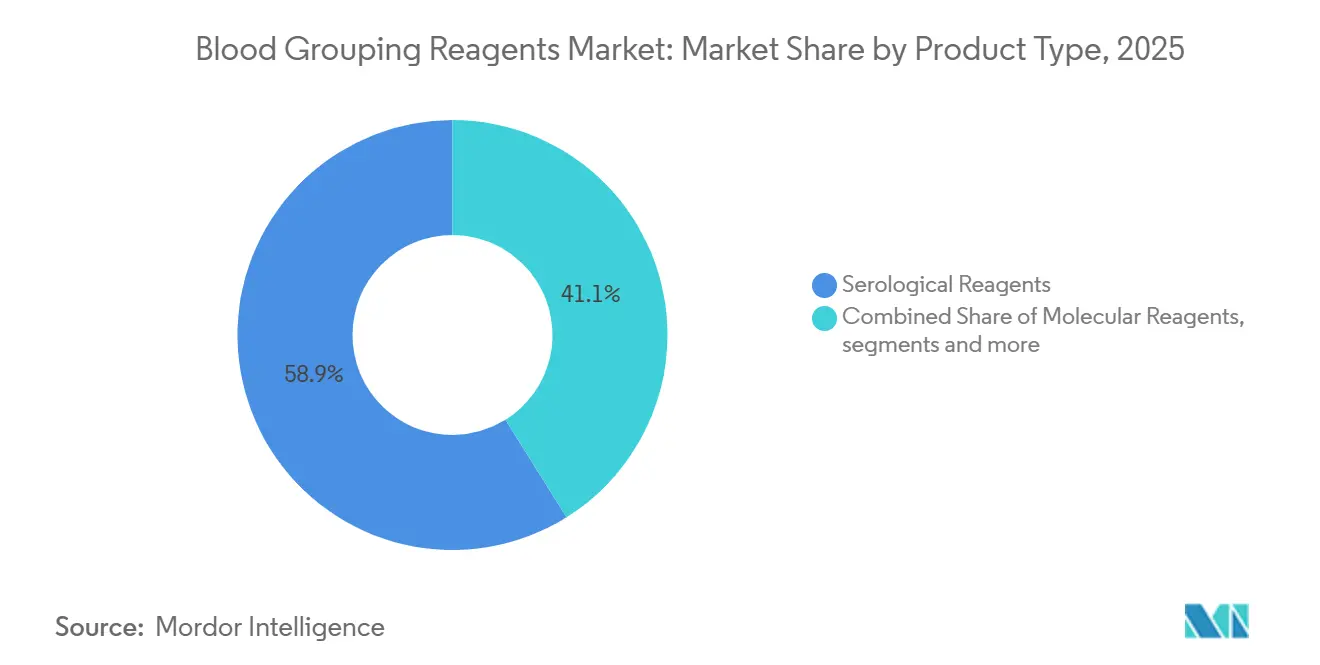
Serological Scale Remains Strong While Molecular Reagents Gain DepthSerological reagents commanded 58.92% of the blood grouping reagents market in 2025, reflecting their central role in ABO, Rh, and crossmatch protocols across hospitals, blood banks, and clinical laboratories. Their leadership remains durable because serology is built into standard operating procedures, staff training, and daily transfusion practice in most formal blood systems. The blood grouping reagents market continues to depend on these products for routine pre-transfusion and donor testing, which gives the segment a broad installed base that is difficult to replace quickly. Control reagents also maintain steady demand because validated quality assurance remains essential for every approved workflow and every serious laboratory environment.
Molecular reagents are expected to be the fastest-growing product type at 12.84% CAGR through 2031, showing where the blood grouping reagents industry is moving as case complexity rises. The Journal of Translational Medicine study on Del allele detection also supports the value of DNA-based typing where serology can miss clinically meaningful donor variation. Even so, the blood grouping reagents market is not moving toward a simple substitution pattern, because molecular products are being added first in reference, transplant, and chronically transfused patient workflows rather than replacing all routine serological use. The result is a mixed product structure in which serological reagents keep the volume base, while molecular reagents account for an increasing share of high-value work inside the blood grouping reagents industry.

By Technology:
Automation Is Expanding Faster Than Manual WorkflowsManual testing held 51.34% share in 2025, which shows that the blood grouping reagents market still rests on tube agglutination and other conventional techniques in a large part of the global installed base. Manual methods remain common where laboratory throughput is low, service support is limited, or analyzer investment is hard to justify. They also remain useful in facilities that want operational flexibility and simple reagent-only protocols without dependence on proprietary instruments. This leaves manual workflows with a meaningful role in the blood grouping reagents market, especially in emerging settings and smaller hospital laboratories. The segment therefore keeps scale even while newer systems take more share in centralized sites.
Automated testing is forecasted to grow at 13.21% CAGR through 2031, making it the fastest-growing technology in the blood grouping reagents market. Automation is attractive in higher-volume blood banks because it reduces manual handling, supports standardization, and helps address technologist shortages. Other technology formats, especially gel card and intermediate automation platforms, still hold a useful middle position because they bridge the gap between manual workflows and full analyzer dependence.
By Test Type:
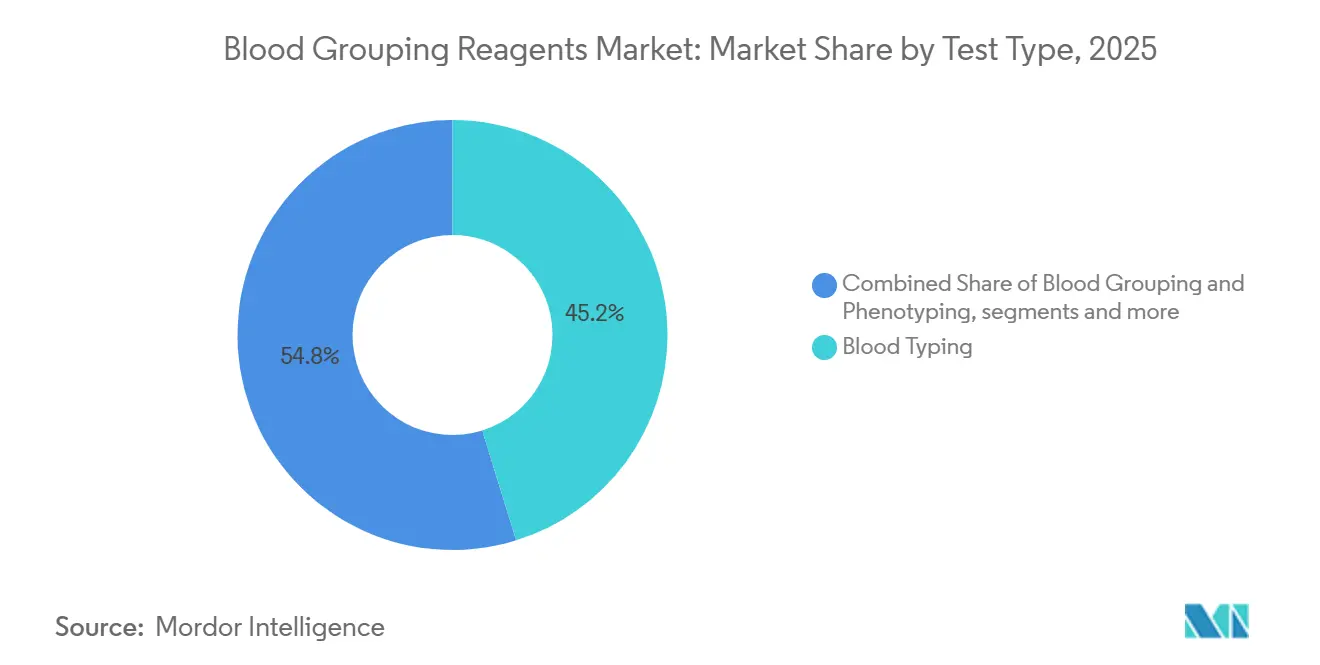
Routine Blood Typing Holds the Base While Phenotyping Adds More Value Per CaseBlood typing held 45.16% of the test type segment in 2025, which confirms that the blood grouping reagents market still relies on the universal need for ABO and RhD determination before donation and transfusion. This demand is stable because every blood unit and every recipient pathway starts with the same essential typing requirement. The segment therefore has a dependable floor that tracks blood collection and transfusion activity rather than sudden changes in treatment fashion. Antibody screening and cross-matching also retain important volume because prior transfusion exposure continues to enlarge the pool of patients who need broader compatibility assessment.
Blood grouping and phenotyping are projected to rise at 13.47% CAGR through 2031, making it the fastest-growing test type in the blood grouping reagents market. Organ transplant workups, chronic transfusion programs, and prenatal pathways all require more detailed antigen characterization than routine typing, which increases both reagent breadth and repeat use over time. The blood grouping reagents market gains from this shift because phenotyping typically uses more differentiated products than a basic type and screen. Other test types, including direct antiglobulin testing and titration assays, remain steady because they are tied to transfusion reaction investigation and specialized patient management rather than general volume growth alone.
By End-User:
Hospitals Lead Current Demand While Blood Banks Expand FasterHospitals accounted for 49.85% of end-user demand in 2025, which places them at the center of the blood grouping reagents market because most pre-transfusion testing still happens near acute care delivery. Surgical procedures, emergency medicine, oncology treatment, and inpatient care all keep hospital transfusion services active. Large integrated networks are also centralizing testing from smaller affiliated facilities, which concentrates volume into sites that can support automation and deeper menu usage. This operating model helps hospitals maintain their lead position in the blood grouping reagents market, even as the customer base becomes more consolidated. Clinical and diagnostic laboratories remain relevant as referral points for complex antibody work and specialized compatibility testing.
Blood banks are forecasted to grow at 12.96% CAGR through 2031, making them the fastest-growing end-user segment in the blood grouping reagents market. The blood grouping reagents market benefits further when national or regional blood services centralize procurement, since large contracts often favor suppliers with broad product range, training capacity, and reliable delivery performance. Academic and research institutions remain smaller in direct purchasing terms, but they still matter because new molecular and phenotyping workflows often move into routine practice after validation in these settings.
Geography Analysis
North America Blood Grouping Reagents Market
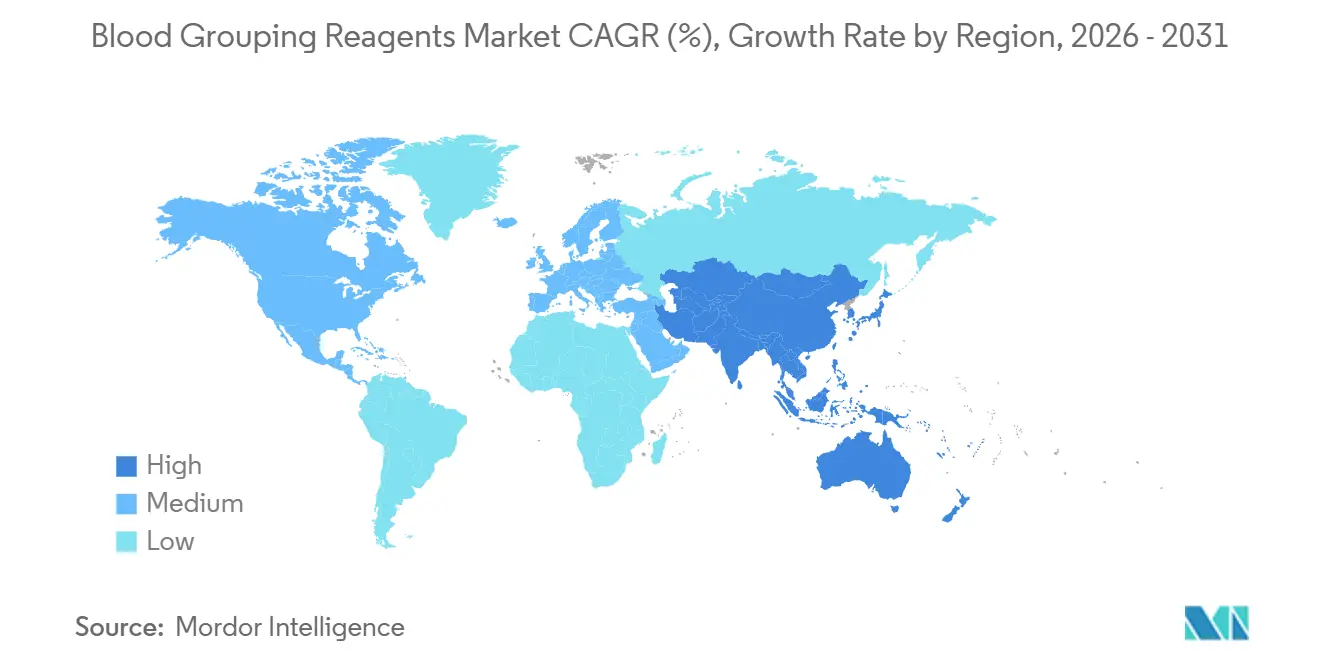
North America held 41.72% of the blood grouping reagents market size in 2025, making it the largest regional contributor. The region benefits from a broad hospital blood bank network, strong transfusion volumes, and a strict regulatory framework that supports product quality and premium positioning. The United States alone required nearly 29,000 units of red blood cells each day and transfused nearly 16 million blood components annually, which gives suppliers a large and recurring installed testing base. The FDA licensing framework under 21 CFR Part 660 also raises the entry threshold for new participants and favors companies that can manage extensive validation and post-approval obligations.
EMEA Blood Grouping Reagents Market
Europe remains one of the most established areas in the blood grouping reagents market because hospital consolidation, formal blood banking infrastructure, and advanced immunohematology practice are already well developed across major countries. Germany, the United Kingdom, and France anchor demand through mature transfusion systems and early use of gel and automation-based workflows. Italy and Spain provide steady secondary volume, while parts of Central and Eastern Europe offer room for adoption as healthcare systems modernize. The Middle East and Africa show a split picture, with GCC countries moving toward more modern blood banking standards while many Sub-Saharan markets still face cold chain and workforce constraints that limit the usable reagent range.
APAC and South America Blood Grouping Reagents Market
Asia-Pacific is projected to grow at 14.25% CAGR through 2031, making it the fastest-growing region in the blood grouping reagents market. The region is gaining from expanding blood banking capacity, a larger formal donation base, and stronger institutional attention to standardized quality in transfusion services. Growth is especially meaningful in large countries where hospital capacity, donor infrastructure, and automation adoption are all rising from a lower base than in North America and Western Europe. Japan and South Korea contribute mature demand with high automation intensity, while China and India provide scale and system expansion that can lift total reagent consumption over the forecast period. South America remains a longer-cycle opportunity in the blood grouping reagents market, with Brazil and Argentina leading regional demand as healthcare formalization and quality expectations improve across major urban centers.
Competitive Landscape
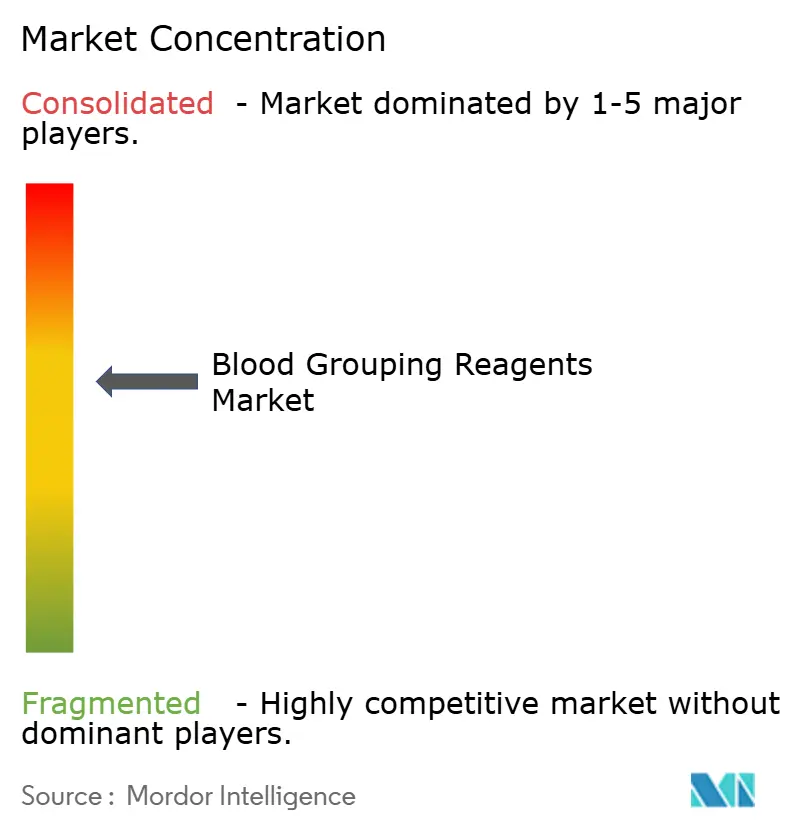
The blood grouping reagents market is moderately concentrated, with a small group of large suppliers holding important positions through proprietary analyzer platforms and broad immunohematology portfolios. QuidelOrtho, Grifols, Bio-Rad, and Immucor are the most visible global names in this structure, and each benefits from installed systems that can lock in repeat consumable demand over long contract cycles. The blood grouping reagents market, therefore, rewards scale in manufacturing, validation, field support, and menu breadth rather than low standalone reagent price alone. This structure also creates meaningful switching costs, because laboratories that standardize on a platform usually validate around that workflow and remain tied to approved consumables. Even so, the market is not fully closed, because mixed-platform laboratories and regional buyers still create openings for differentiated suppliers.
Strategic activity in 2025 showed that leading companies are still investing to widen workflow control inside the blood grouping reagents market. Grifols began manufacturing DG Gel cards and reagent red blood cells at its San Diego facility in October 2025, which added regional production depth and supported supply responsiveness in North America. Bio-Rad launched the IH-500 NEXT in May 2025, showing that product development remains focused on automation, throughput, and reduced manual dependency.
A clear opening remains in the blood grouping reagents market for platform-agnostic products that can perform consistently across mixed analyzer fleets. Research published in BMC Research Notes in 2025 reported that cross-platform reagent red blood cells reached 100% sensitivity across 3 major column agglutination systems, while proprietary alternatives ranged from 81.48% to 95.71% without a loss of specificity. That finding matters because many reference laboratories and large blood centers operate more than 1 system and value flexibility when performance is proven. Smaller regional companies can still compete in the blood grouping reagents market through local regulatory familiarity, access-driven distribution, and pricing that fits public procurement budgets. Molecular typing suppliers may also take some value from the top end of serology, but the broader market still favors companies that can combine analyzers, reagents, service, and compliance support into one stable purchasing relationship.
Blood Grouping Reagents Industry Leaders
-
Grifols, S.A.
-
Bio-Rad Laboratories, Inc.
-
QuidelOrtho Corporation
-
Thermo Fisher Scientific Inc.
-
Immucor, Inc.
- *Disclaimer: Major Players sorted in no particular order
Blood Grouping Reagents Market Companies Covered in this Report
- Abbott Laboratories
- Atlas Medical
- BAG Diagnostics GmbH
- Beckton Dickinson
- Beckton Dickinson
- Bio-Rad Laboratories
- Danaher
- DIAGAST SAS
- Roche
- Grifols
- Immucor
- Lorne Laboratories
- Merck
- QuidelOrtho
- Quotient Limited
- Rapid Labs Limited
- Siemens Healthineers
- Sysmex
- Thermo Fisher Scientific
- Tulip Diagnostics (P) Ltd.
Recent Industry Developments in Blood Grouping Reagents Market
- March 2026: India's Central Drugs Standard Control Organization (CDSCO) issued a directive requiring all licensed blood banks to register on the e-Raktkosh portal and update blood stock data on a daily basis, marking a significant digitization milestone for India's blood banking regulatory framework and accelerating adoption of certified, trackable reagent supplies.
- October 2025: Grifols commenced manufacturing of DG Gel cards and reagent red blood cells at its new 73,541 square foot San Diego, California facility following FDA licensing approvals.
Global Blood Grouping Reagents Market Report Scope
According to the report’s scope, the blood grouping reagents market refers to the segment of in‑vitro diagnostics focused on reagent red cells and antisera used to determine blood types and compatibility for transfusions. These reagents are essential for blood typing, cross‑matching, and donor screening, ensuring transfusion safety and compliance with blood‑safety regulations.
The blood grouping reagents market is segmented into product type, technology, test type, end-user, and geography. By product type, the market is segmented into serological reagents, molecular reagents, blood grouping kits, and control reagents. By technology, the market is segmented into manual testing, automated testing, PCR-based and microarray techniques, and other technologies. By test type, the market is segmented into blood typing, blood grouping and phenotyping, antibody screening, cross-matching tests, and other test types. By end-user, the market is segmented into hospitals, blood banks, clinical and diagnostic laboratories, and academic and research institutes. By geography, the market is segmented into North America, Europe, Asia-Pacific, the Middle East and Africa, and South America. The report also covers the estimated market sizes and trends for 17 countries across major regions globally. The report offers values (USD) for all the above segments.
Segmentation Overview
| Serological Reagents |
| Molecular Reagents |
| Blood Grouping Kits |
| Control Reagents |
| Manual Testing |
| Automated Testing |
| PCR-Based and Microarray Techniques |
| Other Technologies |
| Blood Typing |
| Blood Grouping and Phenotyping |
| Antibody Screening |
| Cross-Matching Tests |
| Other Test Types |
| Hospitals |
| Blood Banks |
| Clinical and Diagnostic Laboratories |
| Other End-Users |
| North America | United States |
| Canada | |
| Mexico | |
| Europe | Germany |
| United Kingdom | |
| France | |
| Italy | |
| Spain | |
| Rest of Europe | |
| Asia-Pacific | China |
| Japan | |
| India | |
| Australia | |
| South Korea | |
| Rest of Asia-Pacific | |
| Middle East and Africa | GCC |
| South Africa | |
| Rest of Middle East and Africa | |
| South America | Brazil |
| Argentina | |
| Rest of South America |
| By Product Type | Serological Reagents | |
| Molecular Reagents | ||
| Blood Grouping Kits | ||
| Control Reagents | ||
| By Technology | Manual Testing | |
| Automated Testing | ||
| PCR-Based and Microarray Techniques | ||
| Other Technologies | ||
| By Test Type | Blood Typing | |
| Blood Grouping and Phenotyping | ||
| Antibody Screening | ||
| Cross-Matching Tests | ||
| Other Test Types | ||
| By End-User | Hospitals | |
| Blood Banks | ||
| Clinical and Diagnostic Laboratories | ||
| Other End-Users | ||
| By Geography | North America | United States |
| Canada | ||
| Mexico | ||
| Europe | Germany | |
| United Kingdom | ||
| France | ||
| Italy | ||
| Spain | ||
| Rest of Europe | ||
| Asia-Pacific | China | |
| Japan | ||
| India | ||
| Australia | ||
| South Korea | ||
| Rest of Asia-Pacific | ||
| Middle East and Africa | GCC | |
| South Africa | ||
| Rest of Middle East and Africa | ||
| South America | Brazil | |
| Argentina | ||
| Rest of South America | ||
Key Questions Answered in the Report
What is the expected value of blood grouping reagents by 2031?
The blood grouping reagents market is forecasted to reach USD 1.21 billion by 2031, rising from USD 0.65 billion in 2025 to USD 0.72 billion in 2026 at an 11.12% CAGR over 2026-2031.
Which product category leads current demand?
Serological reagents led with 58.92% share in 2025 because ABO, Rh, and crossmatch testing still depend heavily on routine serological workflows.
Which technology is expanding the fastest?
Automated testing is projected to grow at 13.21% CAGR through 2031 as high-volume laboratories adopt analyzer-linked workflows and proprietary consumables.
Which region offers the fastest growth outlook?
Asia-Pacific is expected to grow at 14.25% CAGR through 2031, supported by rising blood banking capacity, larger formal donation systems, and expanding automation adoption.