
Belarus Telecom MNO Market Size and Share
Market Overview
| Study Period | 2019 - 2030 |
|---|---|
| Forecast Data Period | 2025 - 2030 |
| Historical Data Period | 2019 - 2023 |
| Market Size (2025) | USD 1.07 Billion |
| Market Size (2030) | USD 1.29 Billion |
| Growth Rate (2025 - 2030) | 3.75 % |
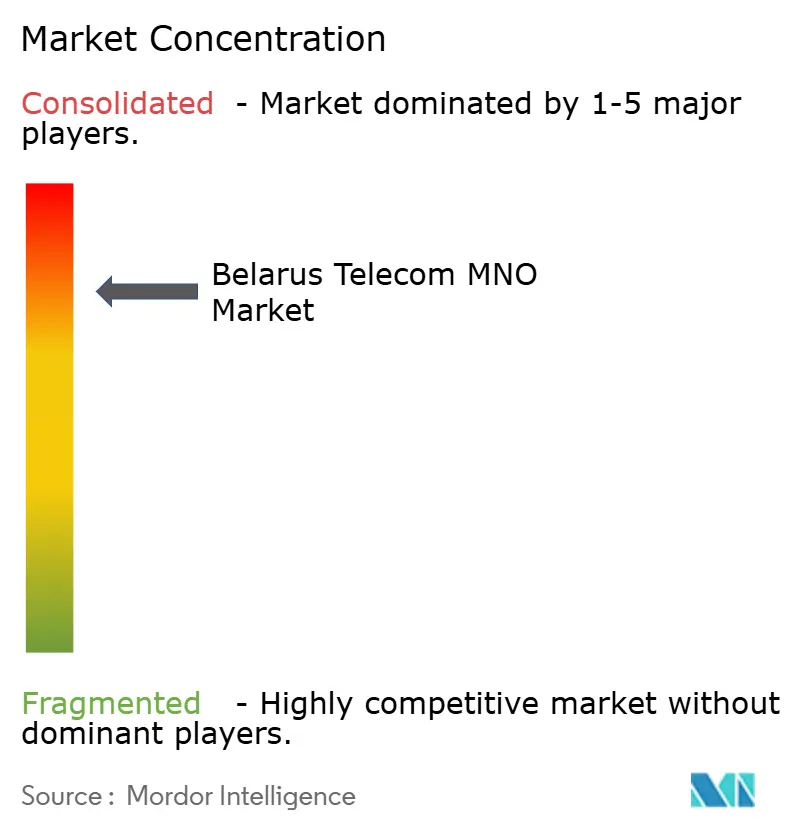
| Market Concentration | High |
Major Players *Disclaimer: Major Players sorted in no particular order Image © Mordor Intelligence. Reuse requires attribution under CC BY 4.0. | |
Belarus Telecom MNO Market Analysis by Mordor Intelligence
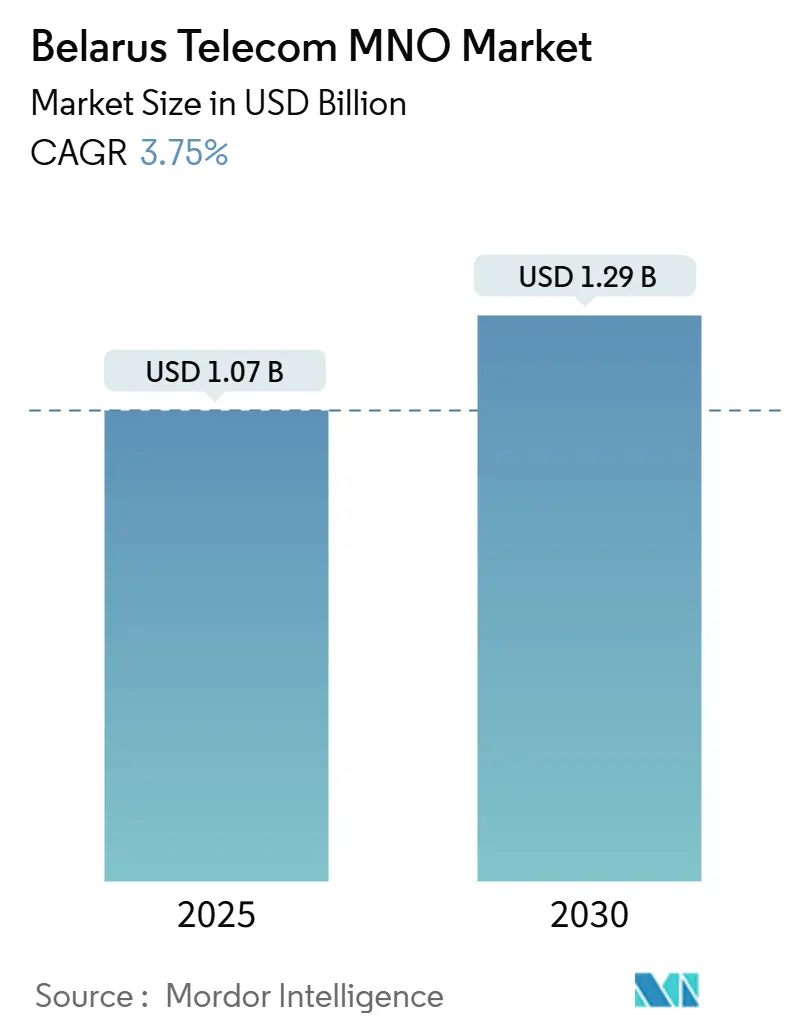
The Belarus Telecom MNO Market size is estimated at USD 1.07 billion in 2025, and is expected to reach USD 1.29 billion by 2030, at a CAGR of 3.75% during the forecast period (2025-2030). In terms of subscriber volume, the market is expected to grow from 12.32 million Subscribers in 2025 to 14.58 million Subscribers by 2030, at a CAGR of 3.42% during the forecast period (2025-2030).
Strong data-service demand, the government’s Digital Economy and Society 2030 agenda, and near-ubiquitous 4G coverage support this outlook. Operators have standardized basic social tariffs yet continue to differentiate through premium offers, enterprise IoT bundles, and rural broadband upgrades. Growing adoption of cloud applications, streaming platforms, and cross-border roaming with Russia keeps traffic volumes high, while sanctions on 5G equipment redirect supplier choices toward Asian vendors. [1]Ministry of Communications and Informatization, “Telecommunications Statistics 2025,” mpt.gov.by Despite currency volatility and near-saturated mobile penetration, the Belarus telecom MNO market continues to invest in fiber backbones, spectrum refarming, and value-added services that raise average revenue per user.
Key Report Takeaways
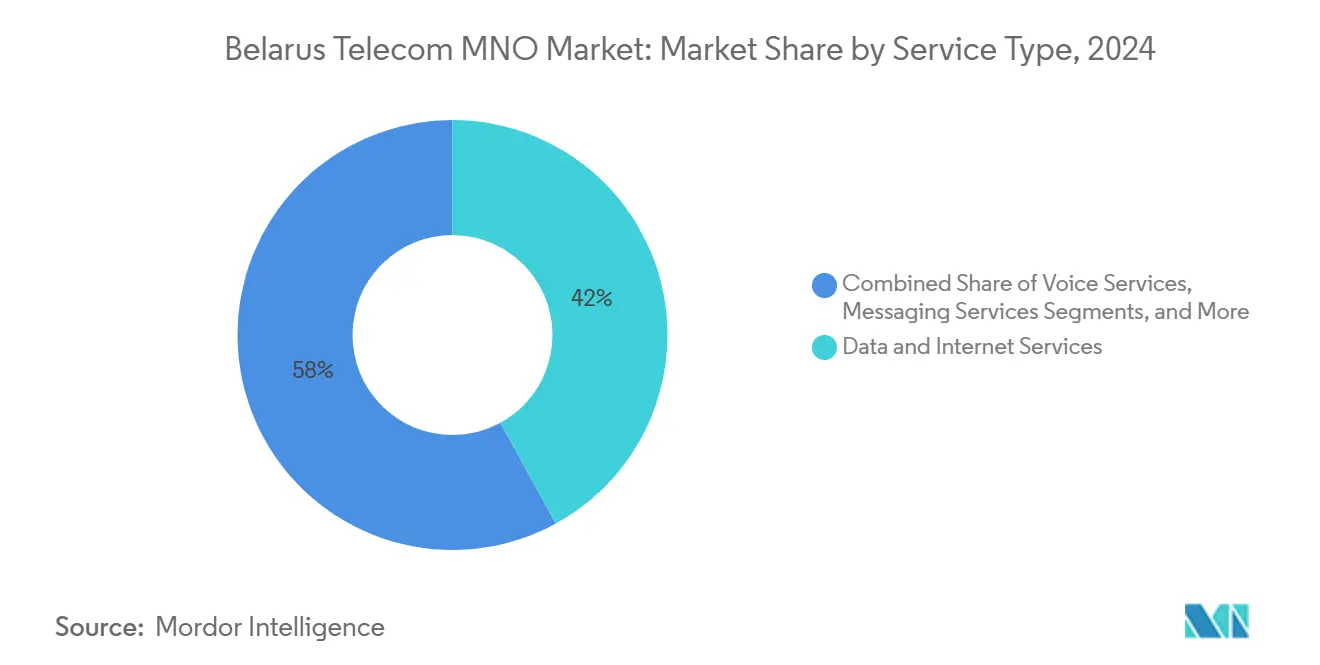
- By service type, data and internet services led with 42.02% of Belarus telecom MNO market share in 2024; IoT and M2M services are projected to expand at a 4.90% CAGR through 2030.
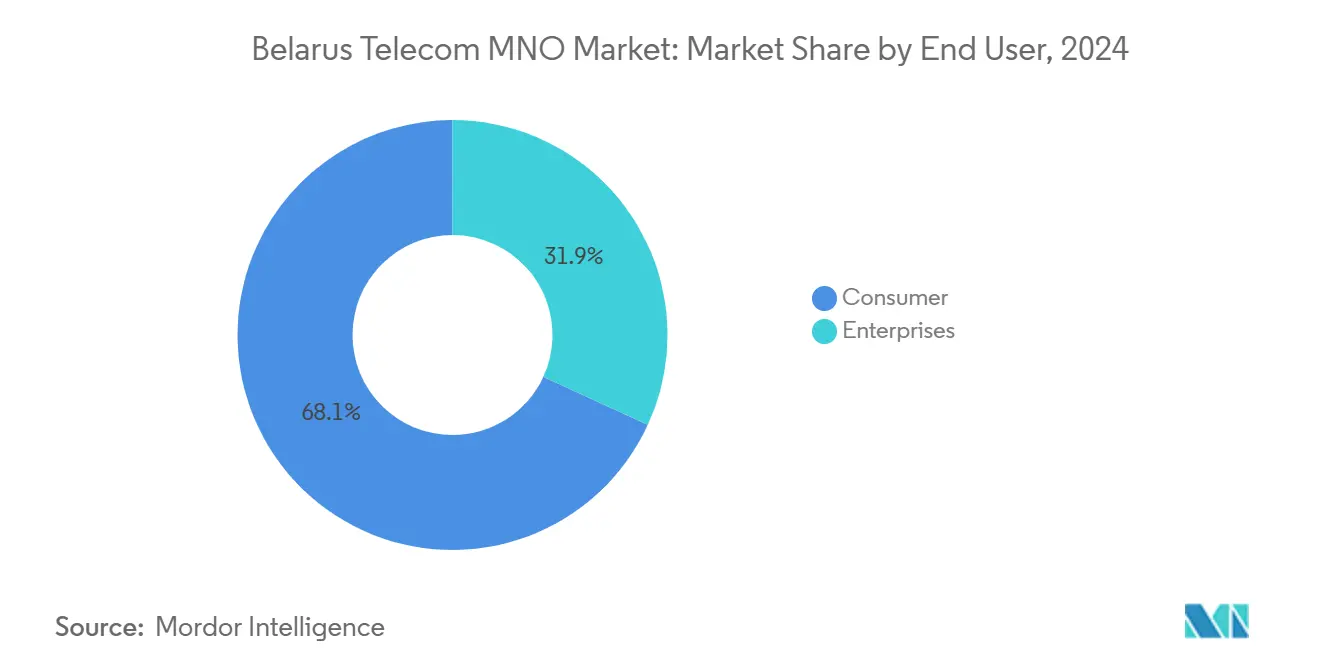
- By end user, the consumer segment accounted for 68.14% of Belarus telecom MNO market share in 2024, while the enterprise segment is advancing at a 4.31% CAGR to 2030.
Belarus Telecom MNO Market Trends and Insights
Drivers Impact Analysis*
| Driver | (~) % Impact on CAGR Forecast | Geographic Relevance | Impact Timeline |
|---|---|---|---|
| Surge in video-led mobile data traffic | +1.2% | National, with concentration in Minsk and major cities | Short term (≤ 2 years) |
| Nationwide 4G coverage and 5G pilots | +0.8% | National, prioritizing urban centers and IT hubs | Medium term (2-4 years) |
| Government "Digital Economy and Society 2030" program | +1.5% | National, with emphasis on regional digital equality | Long term (≥ 4 years) |
| Enterprise demand for IoT connectivity | +0.9% | National, concentrated in industrial regions | Medium term (2-4 years) |
| Russia-Belarus intra-roam tariff alignment (2025) | +0.3% | Border regions and major cities with Russian business ties | Short term (≤ 2 years) |
| Growth of Minsk IT outsourcing hubs needing premium links | +0.6% | Minsk region and emerging tech centers | Medium term (2-4 years) |
| Source: Mordor Intelligence | |||
Surge in Video-Led Mobile Data Traffic
Video streaming and social media have lifted mobile data volumes to record levels, prompting operators to add carrier-aggregation layers, refarm 1800 MHz spectrum, and optimize core networks. A1 doubled its 4G capacity in Gomel, while MTS enabled VoLTE for iPhone users to free up spectrum for broadband data. Wider deployment of the 800 MHz band improves rural coverage, ensuring uninterrupted streaming even in low-density districts. These upgrades position the Belarus telecom MNO market for continued revenue growth through differentiated quality-of-service offerings.
Nationwide 4G Coverage and 5G Pilots
All towns above 50,000 inhabitants now have 4G, creating the foundation for limited 5G pilots. The state affirmed its five-year 5G timeline, contingent on standards convergence and sanction mitigation strategies. A1’s memorandum with ZTE showcases a shift toward Chinese ecosystems as operators seek supply-chain resilience. [2]South China Morning Post, “A1 Belarus Taps ZTE to Bypass 5G Sanctions,” scmp.com Full 4G build-out also allowed mobile connectivity inside the Minsk Metro, underscoring the readiness of the Belarus telecom MNO market to layer upcoming 5G services atop an already dense LTE grid.
Government Digital Economy and Society 2030 Program
The program earmarks BYN 3.57 billion (USD 1.42 billion) for fiber roll-outs, software-defined transport networks, and e-government platforms. Goals include 85% broadband penetration by 2035, SDH migration, and wider AI adoption. Presidential Decree No. 135 further designates digital technologies as priority R&D areas. [3]Presidential Press Service, “Decree No. 135 on Priority Scientific Activities,” president.gov.by The policy framework has already helped the digital economy contribute 7.3% to national GDP, underscoring its macroeconomic relevance.
Enterprise Demand for IoT Connectivity
Factories, logistics parks, and smart-city projects rely on secure, low-latency networks. The China-Belarus Great Stone Industrial Park attracts manufacturing firms that deploy sensor networks, while municipal authorities connect traffic lights, waste bins, and energy meters. The UNDP-supported Digital Development Strategy for 2026-2030 promotes AI and big-data use in public services, amplifying bandwidth requirements.
Restraints Impact Analysis*
| Restraint | (~) % Impact on CAGR Forecast | Geographic Relevance | Impact Timeline |
|---|---|---|---|
| State-controlled market and unpredictable regulation | -0.7% | National, affecting all operators equally | Long term (≥ 4 years) |
| Near-100% SIM penetration limiting subscriber growth | -0.5% | National, with urban saturation most pronounced | Medium term (2-4 years) |
| BYN volatility constraining operator CAPEX | -0.4% | National, impacting equipment procurement and investments | Short term (≤ 2 years) |
| Export-control sanctions on 5G equipment | -0.9% | National, delaying advanced network deployment | Long term (≥ 4 years) |
| Source: Mordor Intelligence | |||
State-Controlled Market and Unpredictable Regulation
Operators must comply with state-mandated pricing, data retention, and content-filtering rules. The April 2025 decree that introduced basic social tariffs illustrates policy unpredictability and restricts free-market pricing. Such interventions curb strategic autonomy, delay innovative product launches, and elevate compliance costs in the Belarus telecom MNO market.
Export-Control Sanctions on 5G Equipment
US-EU sanctions limit the import of advanced radio units and software licences, raising capital costs and slowing standalone 5G roll-outs. Operators now negotiate multi-vendor deals with Asian suppliers, which could create interoperability challenges and elongate payback periods. [4]U.S. Department of the Treasury, “Belarus Sanctions Regulations,” treasury.gov Equipment scarcity also hampers spectrum-refarming schedules, moderating the Belarus telecom MNO market growth outlook.
*Our forecasts treat driver/restraint impacts as directional, not additive. The impact forecasts reflect baseline growth, mix effects, and variable interactions.
Segment Analysis
By Service Type: Data and Internet Services Lead, IoT Accelerates
Data and Internet services generated 42.02% of Belarus telecom MNO market revenue in 2024, with mobile streaming, cloud back-ups, and online gaming fueling bandwidth growth. Operators promote tiered-speed bundles and zero-rating offers that encourage higher usage. The segment benefits from steady upgrades to GPON backbones and carrier aggregation on LTE. IoT and M2M services, while contributing a modest share today, exhibit the fastest 4.90% CAGR and underpin future diversification in the Belarus telecom MNO market.
Continuous fiber deployment and private LTE pilots support smart-factory frameworks at industrial parks, lifting average revenue per connection. Voice and messaging retain niche relevance, but OTT and Pay-TV add incremental income through bundled internet-TV boxes and sports packages. Together, these offerings position the Belarus telecom MNO market for balanced top-line expansion.



By End User: Consumer Volume, Enterprise Value
Consumers accounted for 68.14% of 2024 revenue as prepaid data plans remain affordable and handset subsidies keep smartphone ownership high. Bundles that blend unlimited messengers, youth-focused social-media passes, and family voice buckets sustain usage in a near-saturated environment. Enterprise lines contribute lower volume yet deliver higher margins and are expected to grow at a 4.31% CAGR, driven by cloud migrations, SD-WAN, and managed IoT networks.
In Minsk, outsourcing firms procure gigabit links and mobile VPNs to serve global clients. Municipal agencies adopting e-ticketing and online citizen portals further widen enterprise opportunity. This shift steers capital expenditure toward data centres, edge nodes, and service orchestration platforms, cementing enterprise relevance in the Belarus telecom MNO market.
Geography Analysis
Minsk dominates revenue and traffic on account of its 2 million residents, a high density of IT outsourcing firms, and advanced retail channels. The metropolitan area absorbs the earliest 5G trials, boasts the country’s highest fiber-to-home ratio, and records the largest video-traffic surge. Network reliability within Minsk Metro and public Wi-Fi hotspots underlines the operator's focus on the urban experience in the Belarus telecom MNO market.
Regional capitals such as Gomel, Brest, Vitebsk, and Grodno show rapid adoption once coverage gaps close. A1’s expansion to 1,200 settlements in the Brest region lifted 4G availability to 99.9%, enabling e-commerce and tele-education across small towns. Industrial belts along the Minsk-Grodno corridor leverage dedicated fibre rings for manufacturing digitalization, highlighting regional diversity within the Belarus telecom MNO market.
Rural districts still rely on 800 MHz LTE, yet state subsidies and universal-service funds promote tower sharing and microwave backhaul upgrades. Cross-border roaming with Russia eases travel communication, specifically benefiting border communities engaging in trade and tourism. This integration cements Belarus’s positioning as a regional connectivity bridge, while ensuring equitable access remains a central objective of the Belarus telecom MNO market.
Competitive Landscape
The market functions as an oligopoly. MTS Belarus, A1, and life:) together handle nearly all mobile traffic, while Beltelecom anchors fixed broadband. Mandatory social tariffs reduce price dispersion, so operators compete on network depth, service bundles, and customer experience. Each invests heavily in carrier aggregation, VoLTE, and metro-fiber to sustain differentiation within the Belarus telecom MNO market.
A1 collaborates with ZTE on 5G pilots, MTS trials NB-IoT solutions for logistics trackers, and life:) leverages Turkcell’s digital-wallet expertise to bundle payments with data plans. Wholesale RAN-sharing agreements lower rural roll-out costs, with regulators approving joint passive-infrastructure use to speed coverage. Enterprise contracts for SDWAN and cloud PBX remain the newest battleground in the Belarus telecom MNO market.
Strategic focus now tilts toward vertical solutions. Operators bundle analytics dashboards for agriculture, deploy private LTE at the Great Stone Park, and integrate cybersecurity layers for public-sector clients. Such moves build ecosystem stickiness, offsetting slower consumer revenue growth and anchoring long-term value within the Belarus telecom MNO market.
Belarus Telecom MNO Industry Leaders
MTS Belarus
A1 Belarus
Life:) (Turkcell Group)
- *Disclaimer: Major Players sorted in no particular order

Recent Industry Developments
- May 2025: MTS Belarus launched a youth-focused tariff plan for users under 24, offering unlimited internet and reduced subscription fees to grow data adoption.
- March 2025: The Russia-Belarus roaming agreement went live, granting 150 minutes of calls and 5 GB of data at harmonized rates.
- February 2025: MTS unveiled new Comfortable tariffs with free incoming calls for 15 minutes daily and revised roaming charges.
- December 2024: A1 announced network upgrades and RAN-sharing projects to enhance efficiency.


Belarus Telecom MNO Market Report Scope
Telecom or telecommunication is the long-range transmission of information by electromagnetic means. The Belarus telecom MNO market includes in-depth trend analysis based on connectivity, such as fixed networks, mobile networks, and telecom towers. Telecom services are divided into voice services (wired and wireless), data and messaging services, and OTT and PayTV services. Several factors, including an increasing demand for 5G, will likely drive the adoption of telecom services.
The market sizes and forecasts are provided in terms of value (USD) for all the above segments.
| Voice Services |
| Data and Internet Services |
| Messaging Services |
| IoT and M2M Services |
| OTT and PayTV Services |
| Other Services (VAS, Roaming and International Services, Enterprise and Wholesale Services, etc.) |
| Enterprises |
| Consumer |
| Service Type | Voice Services |
| Data and Internet Services | |
| Messaging Services | |
| IoT and M2M Services | |
| OTT and PayTV Services | |
| Other Services (VAS, Roaming and International Services, Enterprise and Wholesale Services, etc.) | |
| End-user | Enterprises |
| Consumer |


Key Questions Answered in the Report
What is the current size of the Belarus telecom MNO market?
The Belarus telecom MNO market size is USD 1.07 billion in 2025.
How fast is the market expected to grow?
It is projected to post a 3.75% CAGR, reaching USD 1.29 billion by 2030.
Which service type generates the most revenue?
Data and Internet services lead with 42.02% of 2024 revenue, driven by video streaming and cloud usage.
Why is enterprise IoT considered a high-growth niche?
Industrial parks, smart-city projects, and logistics firms require dedicated, secure connectivity, propelling a 4.90% CAGR for IoT and M2M services.
How do sanctions affect 5G deployment in Belarus?
Export restrictions on Western equipment slow roll-outs and steer operators toward Asian suppliers, lengthening payback periods.
What regions show the fastest 4G adoption?
Regional centers like Brest and Gomel witnessed near-universal 4G coverage after targeted tower builds, narrowing the urban-rural digital divide.
Page last updated on:





