
Slovenia Telecom MNO Market Size and Share
Market Overview
| Study Period | 2020 - 2031 |
|---|---|
| Forecast Data Period | 2026 - 2031 |
| Base Year Market Size (2025) | USD 1.23 Billion |
| Market Size (2026) | USD 1.28 Billion |
| Market Size (2031) | USD 1.54 Billion |
| Growth Rate (2026 - 2031) | 3.84 % |
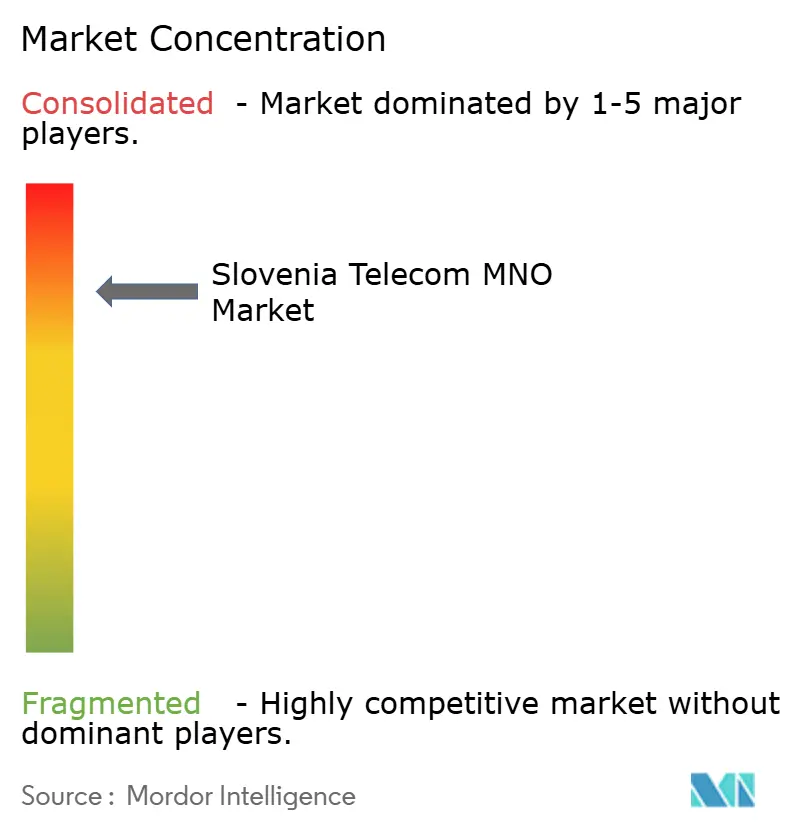
| Market Concentration | High |
Major Players *Disclaimer: Major Players sorted in no particular order Image © Mordor Intelligence. Reuse requires attribution under CC BY 4.0. | |
Slovenia Telecom MNO Market Analysis by Mordor Intelligence
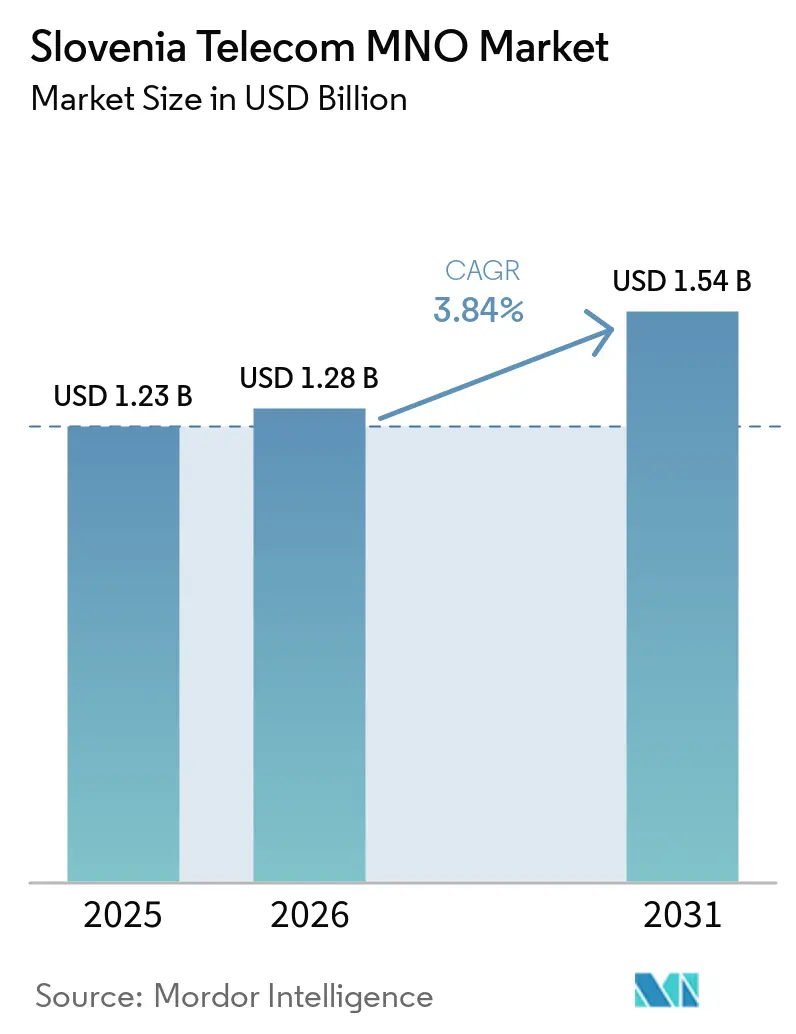
The Slovenia Telecom MNO Market size was valued at USD 1.23 billion in 2025 and is estimated to grow from USD 1.28 billion in 2026 to reach USD 1.54 billion by 2031, at a CAGR of 3.84% during the forecast period (2026-2031). In terms of subscriber volume, the market was valued at 3.68 million subscribers in 2025 and is expected to grow from 3.82 million subscribers in 2026 to 4.59 million subscribers by 2031, at a CAGR of 3.77% during the forecast period (2026-2031).
Ongoing 5G densification, a sharp pivot toward enterprise digitalization, and sustained public-sector funding underpin this steady trajectory in the Slovenia telecom MNO market. Operators channel capital into standalone 5G cores, fiber backhaul, and AI-enabled automation to lift capacity while restraining unit costs. Service revenues tilt further toward data, IoT, and private networks as voice and SMS continue to commoditize. Competitive intensity rises as Telemach finalizes its acquisition of T-2, compressing the field to three nationwide rivals vying for share through unlimited tariffs, content partnerships, and differentiated enterprise propositions. On the policy front, the Recovery and Resilience Plan, together with the Digital Decade targets, aligns public money, spectrum policy, and universal-service milestones, thereby reinforcing long-term visibility for investors in the Slovenia telecom MNO market.
Key Report Takeaways
- By service type, data and internet services led with a 51.62% share of the Slovenia telecom MNO market size in 2025, while IoT and M2M services are advancing at a 4.02% CAGR through 2031.
- By end user, the consumer segment still dominates the Slovenia telecom MNO market; however, enterprise connections are projected to grow at a 4.18% CAGR between 2026-2031, outpacing mass-market demand.
Note: Market size and forecast figures in this report are generated using Mordor Intelligence’s proprietary estimation framework, updated with the latest available data and insights as of 2026.
Slovenia Telecom MNO Market Trends and Insights
Drivers Impact Analysis*
| Driver | (~) % Impact on CAGR Forecast | Geographic Relevance | Impact Timeline |
|---|---|---|---|
| Rapid 5G roll-out enabled by full pioneer-band assignments | +1.2% | Ljubljana, Maribor, national corridors | Medium term (2-4 years) |
| Government gigabit targets and RRF funding | +0.8% | Underserved rural districts | Long term (≥ 4 years) |
| Surge in mobile data consumption via unlimited tariffs | +0.6% | Urban centers | Short term (≤ 2 years) |
| Enterprise digitalization demanding private networks | +0.9% | Industrial zones | Medium term (2-4 years) |
| Roaming traffic uplift from tourism rebound | +0.3% | Coastal and alpine resorts | Short term (≤ 2 years) |
| Early adoption of AI-enabled network automation | +0.4% | Operator nationwide footprints | Long term (≥ 4 years) |
| Source: Mordor Intelligence | |||
Rapid 5G roll-out enabled by full pioneer-band assignments
Nationwide allocation of 700 MHz and 3.4 to 3.8 GHz spectrum gives operators the contiguous blocks required for high-capacity 5G, allowing Telekom Slovenije to reach 70% population coverage by 2024 and propelling targets of 98% by late-2025. Equipment scale economies, shared infrastructure agreements, and standalone core migrations position the Slovenia telecom MNO market for low-latency industrial use cases, immersive entertainment, and enhanced mobile broadband services. Early leadership in spectrum policy helps local carriers avoid fragmentation experienced elsewhere in Europe, improving vendor pricing power and accelerating device availability.
Government gigabit targets and RRF funding boost fiber backhaul
Slovenia has earmarked EUR 30 million in RRF grants and a broader EUR 685 million digital transformation envelope to extend gigabit connectivity to every household by 2030. [1] AKOS enforces technology-neutral subsidy rules that spur fiber trenching in remote villages while obliging operators to share subsidized assets at cost-oriented rates. The result is a denser backhaul fabric that slashes 5G site deployment costs and lifts average downlink speeds for end users across the Slovenia telecom MNO market.
Surge in mobile data consumption driven by unlimited tariffs
A1 Slovenija’s MIO plans and Telemach’s VEČ bundles popularized uncapped data with premium speed tiers, driving per-SIM usage into double-digit terabyte territory and nudging ARPU upward despite saturation. [2] Operators leverage 5G’s spectral efficiency to sustain traffic without linear cost escalation, packaging video, cloud gaming, and streaming to heighten stickiness. Elevated usage levels also unlock incremental wholesale revenues from MVNO partners that piggyback on macro networks in the Slovenia telecom MNO market.
Enterprise digitalization demands private networks and IoT
Iskratel and Telekom Slovenije’s private 5G campus at the Cinkarna Celje plant anchors a growing pipeline of manufacturing, logistics, and utility projects requiring secure, deterministic wireless links. Local licenses in 2.3 GHz and 3.6 GHz bands empower factories and municipalities to establish contained networks that integrate robotics, AGVs, and sensor arrays. These deployments shift revenue growth toward SLA-backed connectivity, system integration, and managed cloud, diversifying the Slovenia telecom MNO industry away from consumer cyclicality.
Restraints Impact Analysis*
| Restraint | (~) % Impact on CAGR Forecast | Geographic Relevance | Impact Timeline |
|---|---|---|---|
| Market saturation – SIM penetration >130% | -0.7% | Nationwide, urban skew | Long term (≥ 4 years) |
| High energy prices eroding EBITDA margins | -0.5% | Nationwide | Medium term (2-4 years) |
| Regulatory pressure on retail and wholesale prices | -0.4% | Nationwide, EU regulation | Long term (≥ 4 years) |
| Fiber wholesale access diluting mobile-fixed bundling power | -0.3% | Dense urban areas | Medium term (2-4 years) |
| Source: Mordor Intelligence | |||
Market saturation – SIM penetration >130%
With 2.75 million mobile connections serving 2.12 million residents, Slovenia’s 130% penetration rate constrains organic subscriber growth. Operators pivot toward ARPU enrichment, upselling 5G tiers, devices, and entertainment, yet aggressive promotions compress margins. The impending Telemach-T-2 merger reflects the need for scale to sustain network investments and fend off switching churn within the Slovenia telecom MNO market.
High energy prices eroding EBITDA margins
New capacity-based electricity tariffs introduced in 2024 elevate power bills for dense 5G RANs and edge sites, reducing EBITDA headroom. [3] Flood restoration costs and renewable energy capex compound the burden. Operators respond with AI-driven sleep modes, RAN sharing, and solar-backed towers, but monetization levers remain limited under retail price-cap regulation in the Slovenia telecom MNO market.
*Our forecasts treat driver/restraint impacts as directional, not additive. The impact forecasts reflect baseline growth, mix effects, and variable interactions.
Segment Analysis
By Service Type: Data-centric revenue mix accelerates
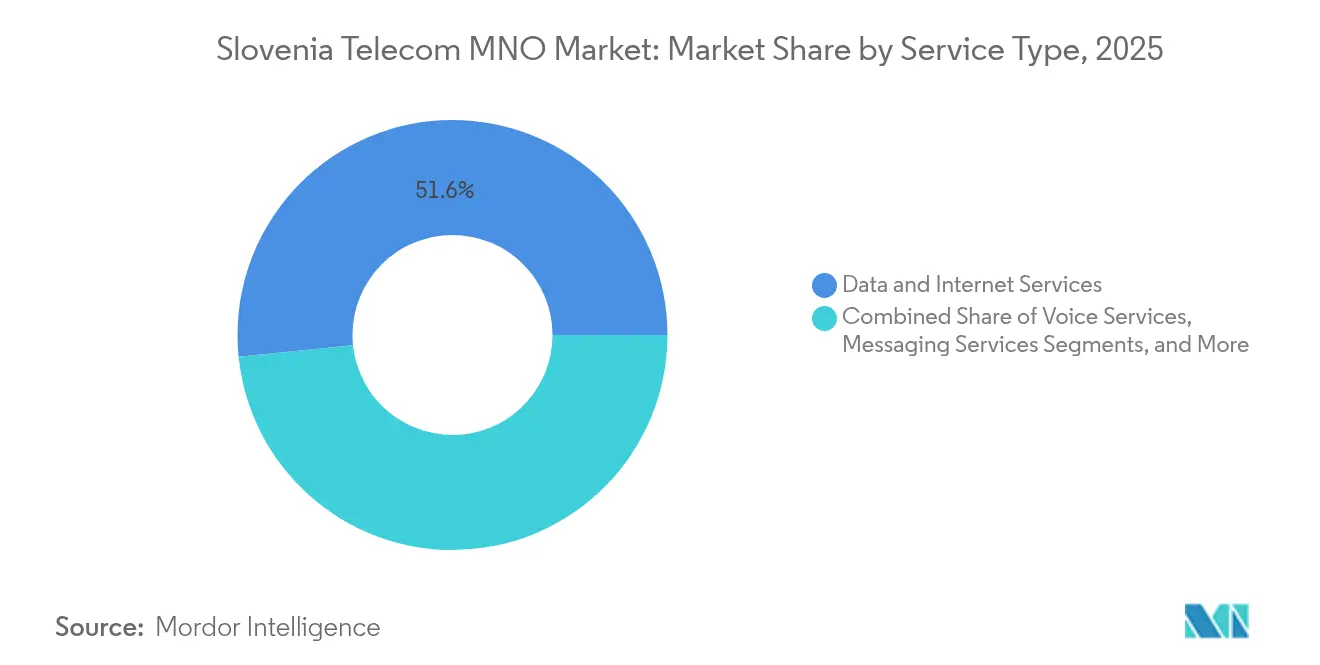
Data and internet services generated 51.62% of the Slovenia telecom MNO market size in 2025, reflecting sustained 4G migration and broad 5G adoption. Voice persists primarily through bundled minutes, whereas SMS revenue keeps declining amid OTT substitution. IoT and M2M lines clock the fastest 4.02% CAGR, underpinned by industrial sensors, smart metering, and connected vehicles that capitalize on low-latency 5G slices. OTT video and Pay-TV products, integrated into mobile tariffs by A1 Slovenija and Telemach, further raise average spend while deepening customer engagement.
Operators combine mobile and fixed services to maximize household share of wallet, yet regulated wholesale fiber terms temper pricing power in densely cabled districts. Roaming income rebounds alongside tourism, lifting seasonal top-line spikes and balancing domestic ARPU stagnation. Ancillary value-added services, such as cloud backup and cybersecurity add-ons, furnish incremental margins that offset eroding legacy voice yields. The Slovenia telecom MNO market share of data services will widen through 2031 as device upgrades and immersive applications propel per-capita traffic.

By End User: Enterprise gains momentum
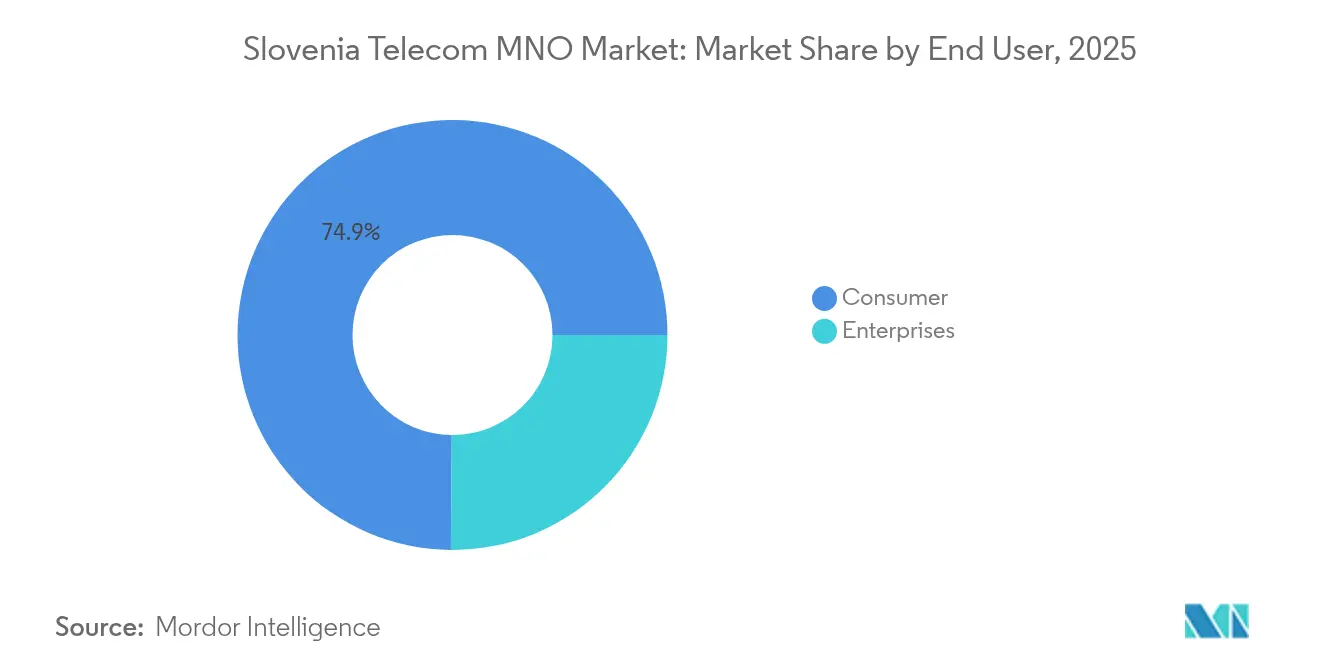
Consumer segment generated 74.88% of the Slovenia telecom MNO market size in 2025. It still delivers the bulk of revenue for the Slovenia telecom MNO market, but growth has plateaued in the absence of subscriber expansion. Enterprises, ranging from SMEs to export-oriented factories, are forecast to post a 4.18% CAGR through 2031. Private 5G campuses, multi-access edge computing, and managed IoT platforms drive this surge, with operators bundling connectivity, hardware, and SLAs into one-stop packages. Telekom Slovenije leverages its systems integrator arm to stitch cloud, security, and data analytics layers atop connectivity, capturing a higher margin share.
A1 Slovenija taps its group-wide solution catalog to cross-sell SD-WAN and unified communications, capitalizing on regional headquarters in Ljubljana. Telemach positions its United Group affiliation to source competitive cloud capacity and OTT content, coaxing enterprises seeking converged ICT partners. As digital-maturity gaps narrow, mid-market clients demand outcome-based contracts, reinforcing long-term stickiness in the Slovenia telecom MNO market.
Geography Analysis
The Slovenia telecom MNO market operates within 20,273 km² of diverse topography. Urban belts anchored by Ljubljana and Maribor absorb roughly 60% of national traffic volumes, benefiting from early 5G roll-outs and extensive fiber backhaul. Rural Alpine valleys rely on RRF-funded base stations and shared mast agreements to close the coverage gap to 98% by 2025.
Tourist-heavy Adriatic and ski resorts inflate seasonal roaming demand, cushioning revenue in summer and winter peaks. Industrial clusters along the Sava corridor exhibit outsized enterprise connectivity orders, propelling private 5G proofs of concept in manufacturing, mining, and logistics. Slovenia’s compact geography enables relatively low incremental capex per site, allowing operators to monetize nationwide 5G faster than peers in larger EU countries. Regional expansion potential emerges through Telekom Slovenije’s affiliates in Kosovo and North Macedonia, creating cross-border synergies and wholesale transit revenues. Meanwhile, EU regulatory harmonization facilitates seamless roaming, yet also imposes uniform price caps, compressing per-unit margins across the Slovenia telecom MNO market.
Competitive Landscape
Four mobile network operators were compressed to three once Telemach completed the T-2 buyout, raising combined top-three control above 90% of the Slovenia telecom MNO market share. Telekom Slovenije preserves leadership via an extensive fiber footprint, early standalone 5G deployment, and partial state ownership that secures public-sector contracts. A1 Slovenija leverages scale economies from its Austrian parent to negotiate network equipment, distribute flagship devices, and co-design content bundles. Telemach, backed by United Group, focuses on challenger pricing, unlimited data, and sports-centric TV rights to poach urban subscribers.
The technology race centers on 5G Carrier-Aggregation throughput, private network proofs, and AI-driven self-optimizing networks that promise opex savings. Operators seek vertical differentiation: Telekom Slovenije pursues industrial automation, A1 prioritizes cloud and cybersecurity, and Telemach emphasizes value-led convergence. MVNOs and OTT voice apps add fringe competition but lack spectrum ownership, limiting structural threat to the Slovenia telecom MNO market. Consolidation raises potential regulatory scrutiny around wholesale access and spectrum pooling, yet authorities balance competition concerns with the need for sustainable infrastructure investment.
Slovenia Telecom MNO Industry Leaders
-
Telekom Slovenije
-
A1 Slovenija
-
Telemach Slovenija
-
T-2
- *Disclaimer: Major Players sorted in no particular order
Recent Industry Developments
- June 2025: Telemach announced tariff adjustments taking effect on 1 Aug 2025, expanding Arena Sport promotions, boosting mobile data allowances, and revising price tiers.
- February 2025: Telekom Slovenije and Kontron launched the first private 5G standalone network at Cinkarna Celje, showcasing 8 Gbps throughput for mission-critical manufacturing applications.
- August 2024: Telemach signed a binding deal to acquire more than 98% of T-2, settling EUR 90 million debt and creating a 33% share challenger in the Slovenia telecom MNO market.
Slovenia Telecom MNO Market Report Scope
Telecommunication involves transmitting information at a speed akin to face-to-face conversations. It encompasses exchanging data, voice, and video over long distances through electronic mediums.
The report covers the Slovenian telecom market companies, and the market is segmented by service (voice services (wired and wireless), data and messaging services, and OTT and pay TV services).
The report offers market sizes and forecasts in value (USD) for all the above segments.
| Voice Services |
| Data and Internet Services |
| Messaging Services |
| IoT and M2M Services |
| OTT and PayTV Services |
| Other Services (VAS, Roaming and International, Enterprise and Wholesale, etc.) |
| Enterprises |
| Consumer |
| Service Type | Voice Services |
| Data and Internet Services | |
| Messaging Services | |
| IoT and M2M Services | |
| OTT and PayTV Services | |
| Other Services (VAS, Roaming and International, Enterprise and Wholesale, etc.) | |
| End-user | Enterprises |
| Consumer |
Key Questions Answered in the Report
How large is the Slovenia telecom MNO market in 2026?
The Slovenia telecom MNO market size reached USD 1.28 billion in 2026 and is expected to grow steadily through 2031.
Which operator leads in market share?
Telekom Slovenije holds about 45% of the national subscriber base, maintaining the top position since 2024.
What drives revenue growth despite subscriber saturation?
Higher data usage from unlimited 5G tariffs, enterprise private networks, and IoT connectivity offset flat subscriber numbers.
How will 5G coverage evolve by 2025?
Population coverage is projected to climb from 70% in 2024 to 98% by end-2025 as operators finish densification.
Why are enterprises important for future growth?
Manufacturing, logistics, and Smart City projects need private 5G and IoT services, pushing enterprise CAGR to 4.18% through 2031.
What regulatory support exists for network expansion?
EUR 30 million in RRF grants and Digital Decade targets mandate nationwide gigabit access, lowering build-out risk for carriers.