
Automotive Surround View Systems Market Size and Share
Market Overview
| Study Period | 2019 - 2031 |
|---|---|
| Market Size (2026) | USD 4.75 Billion |
| Market Size (2031) | USD 9.06 Billion |
| Growth Rate (2026 - 2031) | 13.79 % |
| Fastest Growing Market | Asia Pacific |
| Largest Market | Asia Pacific |
| Market Concentration | Medium |
Major Players *Disclaimer: Major Players sorted in no particular order Image © Mordor Intelligence. Reuse requires attribution under CC BY 4.0. | |
Automotive Surround View Systems Market Analysis by Mordor Intelligence
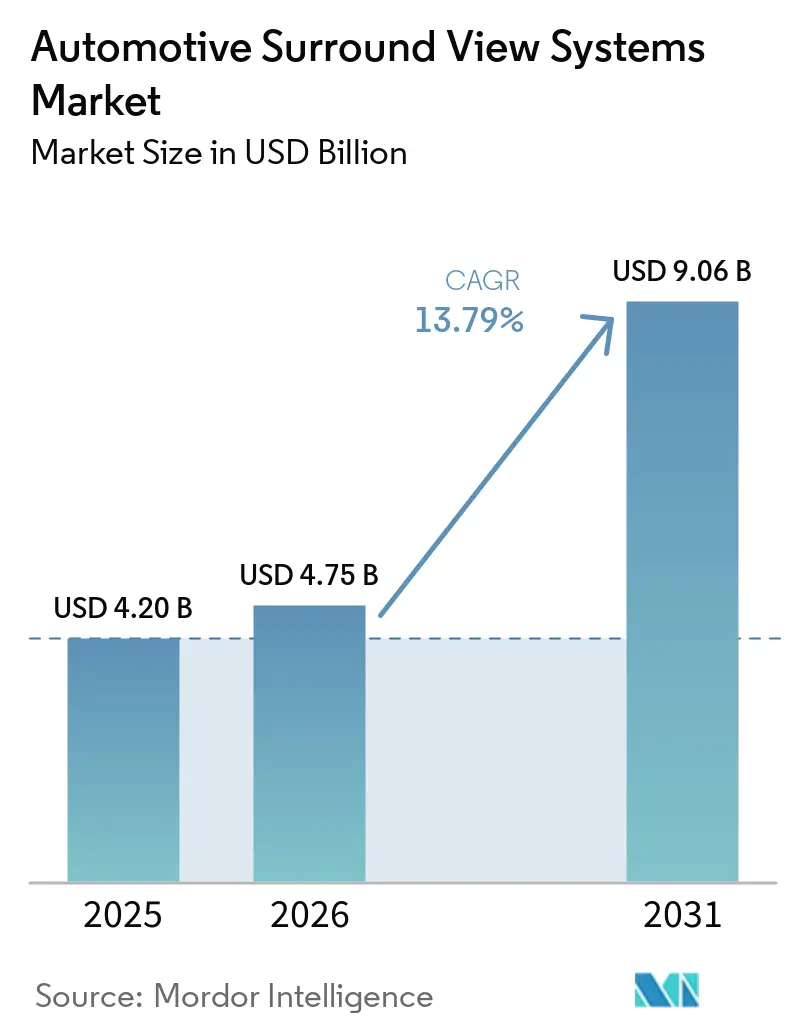
The Automotive Surround View Systems market size was valued at USD 4.20 billion in 2025, and is projected to grow from USD 4.75 billion in 2026 to USD 9.06 billion by 2031, registering a 13.79% CAGR from 2026 to 2031. Growing demand for centralized domain controllers that pool camera, radar, and ultrasonic data is lowering silicon cost per function and turning surround-view from a parking aid into a core perception layer across Level 2+ driver-assistance features. Rear-visibility mandates that triggered initial adoption are now dovetailing with insurance incentives for commercial fleets and subscription-based software unlocks in passenger cars. Between 2022 and 2025, declining camera module costs have driven down component expenses, making the Automotive Surround View Systems market more accessible. Meanwhile, advancements such as generative AI stitching and 3D displays are elevating user experience standards. As semiconductor vendors embed perception software into system-on-chips, automakers can sidestep traditional tier-1 suppliers, intensifying competition in the market.
Key Report Takeaways
- By camera count, 4-camera systems led with 66.15% of the Automotive Surround View Systems market share in 2025, while more-than-4-camera configurations are advancing at an 18.33% CAGR through 2031.
- With camera functionality, automatic switching captured 74.36% of the Automotive Surround View Systems market share in 2025 and is projected to expand at a 15.03% CAGR through 2031.
- By vehicle type, passenger cars accounted for 88.13% of the Automotive Surround View Systems market share in 2025, whereas commercial vehicles are forecast to grow at a 17.35% CAGR through 2031.
- By sales channel, OEM-fitted systems accounted for 90.08% of the Automotive Surround View Systems market share in 2025; the aftermarket retrofit segment is scaling at an 18.74% CAGR to 2031.
- By sensor technology, CMOS sensors commanded 89.14% of the Automotive Surround View Systems market share in 2025 and are advancing at a 14.81% CAGR toward 2031.
- By display type, 2-D displays led with 69.32% of the Automotive Surround View Systems market share in 2025, while 3-D and augmented displays are growing at a 20.39% CAGR through 2031.
- By geography, Asia-Pacific accounted for 48.17% of the Automotive Surround View Systems market share in 2025 and is expected to grow at a 14.45% CAGR during 2026-2031.
Note: Market size and forecast figures in this report are generated using Mordor Intelligence’s proprietary estimation framework, updated with the latest available data and insights as of January 2026.
Market Trends and Insights
Drivers Impact Analysis of Automotive Surround View Systems Market*
| Driver | (~) % Impact on CAGR Forecast | Geographic Relevance | Impact Timeline |
|---|---|---|---|
| 3-D Surround-View in ADAS | +3.2% | North America, Europe, Asia-Pacific | Medium term (2-4 years) |
| Mandated Rear-Visibility Regulations | +2.8% | North America, Europe, Asia-Pacific | Short term (≤ 2 years) |
| Generative-AI Based Stitching | +2.4% | North America, Europe, China | Medium term (2-4 years) |
| Falling Multi-Camera ASPs | +1.9% | Asia-Pacific, South America | Short term (≤ 2 years) |
| OTA-Driven Feature Unlocking | +1.6% | North America, Europe, Asia-Pacific | Medium term (2-4 years) |
| Logistics Fleets Adopting Retrofit | +1.3% | Global | Short term (≤ 2 years) |
| Source: Mordor Intelligence | |||
Integration of 3-D Surround-View in ADAS Domain Controllers
Centralized domain controllers running shared SoCs enable parking assistance, lane-keeping, and traffic-jam pilot to reuse a single multi-camera suite, dramatically lowering per-feature cost. Qualcomm, Bosch, and Mobileye demonstrate that four high-resolution feeds can be stitched and evaluated for object detection on the same silicon that executes emergency braking logic, thereby reducing wiring harnesses and cooling hardware. In 2025, new vehicles in China adopted Level 2+ features, with mid-tier electric models incorporating advanced eight-camera setups. As domain controllers become the global standard for safety-compute architecture, the Automotive Surround View Systems market continues to experience significant growth.
Mandated Rear-Visibility Regulations
Rear-view camera mandates in the United States, Europe, China, and India have transformed optional systems into baseline safety equipment, compressing OEM decision cycles and accelerating production volumes. Between 2008 and 2021, NHTSA noted a significant drop in back-over fatalities for children under five. This success has prompted regulators to expand safety requirements to encompass full 360-degree coverage. In India, the Bharat NCAP 2.0 is incentivizing automakers with higher safety scores for features such as blind-spot detection and rear cross-traffic alerts [1]“Bharat NCAP 2.0 Draft,” Ministry of Road Transport and Highways, morth.nic.in. As a result, automakers are increasingly adopting multi-camera systems to achieve coveted 4- and 5-star ratings. Meanwhile, China's GB standards and Europe's General Safety Regulation are harmonizing on visibility criteria, bolstering growth in the Asia-Pacific region. Additionally, insurance companies are offering discounts to compliant commercial fleets, further driving the demand.
Generative-AI Based Stitching Boosting Perception Accuracy
Valeo's open-source multi-camera world foundation, a transformer-based model, effectively addresses challenges such as occlusions and lighting inconsistencies. By generating seamless 360-degree images, it overcomes limitations that traditional geometric techniques could not resolve [2]“Open Source Multi-Camera World Model,” Valeo Group, valeo.com. These high-fidelity surround views significantly enhance ADAS decision-making, particularly in dense urban traffic scenarios where precision is critical. As a result, the applications of this technology have extended beyond parking, driving increased interest from OEMs in forming data-sharing partnerships to leverage its full potential.
Falling Multi-Camera ASPs
Due to economies of scale in CMOS image sensor fabrication, module prices have significantly declined since 2020. This price reduction has enabled the integration of six- and eight-camera arrays even into mid-tier vehicles. By incorporating serializer and power-management chips, PCB footprints have been minimized. This not only reduces the footprint but also cuts down on assembly labor. In China, where 4-camera systems were dominant in 2025, the trend is evident. The accelerated price erosion is driving smaller lens manufacturers to either consolidate or exit the Automotive Surround View Systems market.
Restraints Impact Analysis of Automotive Surround View Systems Market*
| Restraint | (~) % Impact on CAGR Forecast | Geographic Relevance | Impact Timeline |
|---|---|---|---|
| Heat-Dissipation and In-Vehicle Networking | -1.8% | Global, especially hot climates | Short term (≤ 2 years) |
| Cyber-Security Certification Delays | -1.4% | Europe, Japan, Korea, Australia | Short term (≤ 2 years) |
| Price Sensitivity in Entry-Level Cars | -1.2% | Asia-Pacific, South America, Africa | Medium term (2-4 years) |
| Shortage of Wide-Angle Lens Suppliers | -0.9% | Global | Short term (≤ 2 years) |
| Source: Mordor Intelligence | |||
ECU Heat-Dissipation and In-Vehicle Networking Bottlenecks
Consolidating domain controllers with high power densities significantly increases enclosure temperatures, necessitating active cooling solutions for automakers. This approach raises module costs and impacts overall efficiency. In hotter climates, certain OEMs reduce frame rates to prevent thermal shutdowns, which negatively affects driver perception. At the same time, while modern data streams demand higher bandwidth, many vehicle architectures still rely on older Ethernet standards. Upgrading to advanced technologies introduces additional costs per node.
Cyber-Security Certification Delays (UNECE R155/R156)
Mandatory lifecycle cybersecurity management extends the validation period for OTA-capable surround-view systems, requiring additional time to ensure compliance. This timeline is driven by the need to implement robust cybersecurity measures, including penetration testing, vulnerability audits, and comprehensive documentation to meet industry standards. These activities place financial pressure on suppliers, particularly smaller ones, who often struggle to manage the increased costs. Consequently, many smaller suppliers either exit the market or form partnerships with larger integrators. Larger integrators, with their ability to distribute costs across a broader portfolio, are better equipped to handle these demands, enabling them to remain competitive and address the evolving cybersecurity requirements that have become increasingly critical in recent years.
*Our forecasts treat driver/restraint impacts as directional, not additive. The impact forecasts reflect baseline growth, mix effects, and variable interactions.
Automotive Surround View Systems Market Segment Analysis
By Camera Count:
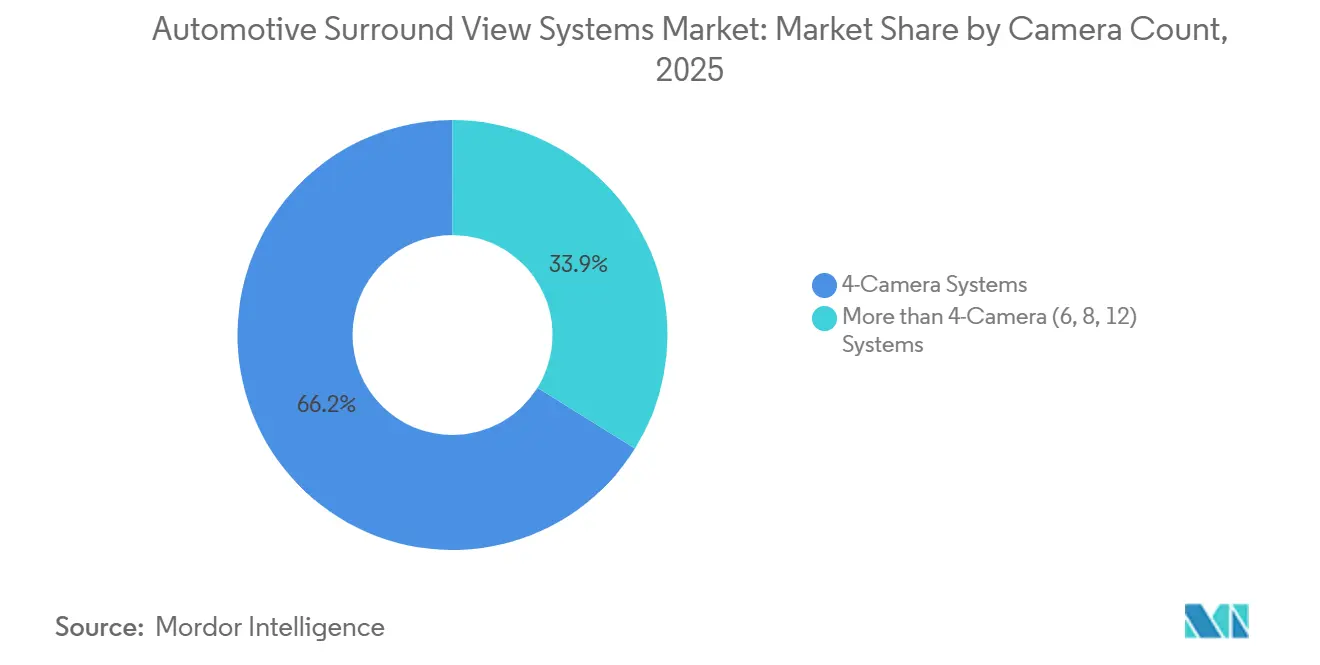
Multi-Camera Adoption Accelerates4-camera setups held 66.15% of the Automotive Surround View Systems market share in 2025, yet more-than-4-camera arrays are forecast to post an 18.33% CAGR as Level 2+ autonomy spreads. The automotive surround-view systems market for eight-camera configurations is projected to expand rapidly. In China, as economies of scale continue to advance, vehicles are now being equipped with six-camera systems, a trend that has been evolving over recent years.
Redundant viewpoints feed into generative AI models that resolve occlusions, producing cleaner bird’s-eye imagery and enabling junction navigation. These multi-camera architectures can incorporate a side view camera system to improve lateral visibility, support blind-spot detection, and provide more comprehensive coverage around the vehicle. Bosch’s six-camera video belt enhances roundabout handling, and NEVs in China already average eight to thirteen cameras, cementing a trend toward higher counts in the Automotive Surround View Systems market.


By Camera Functioning:
Automatic Switching Takes OverAutomatic operation commanded 74.36% of the Automotive Surround View Systems market share in 2025 and is growing at 15.03% CAGR through 2031. AI algorithms embedded in domain controllers trigger the proper view based on speed and gear position, eliminating driver distraction.
Manual systems cling to the retrofit niche but face obsolescence as augmented-reality overlays need seamless viewpoint changes. BMW’s Panoramic Vision and Volvo’s EX60 embed trajectory lines directly in the 3-D surround display, reinforcing automatic control as the mainstream experience in the Automotive Surround View Systems market [3]“Panoramic Vision HMI,” BMW Group, bmwgroup.com.
By Vehicle Type:
Commercial Fleets Spur New DemandPassenger cars dominated, with 88.13% of the Automotive Surround View Systems market share in 2025; however, commercial vehicles are pacing at a 17.35% CAGR through 2031 as fleets retrofit to cut accident-related downtime. Europe’s upcoming 2027 standard extends blind-spot mandates to vans and trucks, while India’s draft BSIS rule sets similar requirements.
Passenger models continue adding cameras for subscription features, but commercial operators see immediate insurance savings, making retrofit economics compelling. This divergent dynamic broadens the Automotive Surround View Systems market size across both new-build and installed-base vehicles.
By Sales Channel:
Retrofit Momentum BuildsOEM installations represented 90.08% of the Automotive Surround View Systems market share in 2025; nonetheless, the aftermarket is projected to post an 18.74% CAGR through 2031. Logistics fleets find that plug-and-play camera kits achieve break-even within one to two years.
Original Equipment Manufacturers (OEMs) take a different route: they pre-install dormant hardware in vehicles and bank on Over-The-Air (OTA) subscriptions as their revenue stream. This divergence in monetization strategies—hardware resale for retrofitted vehicles and recurring software subscriptions for factory-fitted ones—fuels growth in the Automotive Surround View Systems market.
By Sensor Technology:
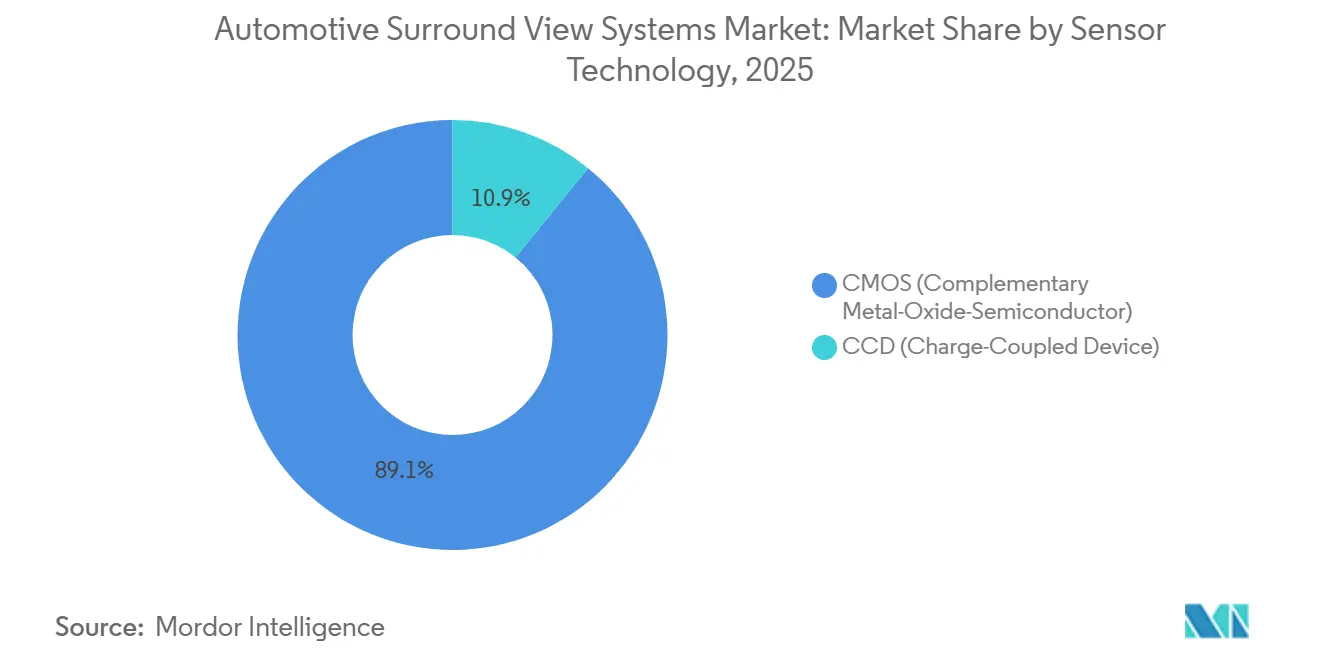
CMOS Consolidates DominanceBy 2031, CMOS sensors are anticipated to reach near-ubiquity, driven by a strong CAGR of 14.81%, following their substantial 89.14% share of the Automotive Surround View Systems market in 2025. In contrast, CCDs are projected to decline as leading fabs phase out their automotive lines. Enhancements like rolling-shutter improvements, HDR capabilities, and a power draw optimized for electric platforms cater to the need for minimizing auxiliary loads.
With integrated ISP and serializer functions, module sizes shrink, enabling eight-camera arrays that stay within thermal limits, further solidifying CMOS's dominance in the Automotive Surround View Systems market.
By Display Type:
3-D/Augmented Reality Drives Innovation2-D screens retained 69.32% of the Automotive Surround View Systems market share in 2025, while 3-D and AR displays are growing at a 20.39% CAGR. BMW's 3-D projection, integrated with TI's advanced SoC, has significantly reduced parking errors and now adds minimal cost to the incremental BOM.
In recent years, with declining compute costs, Chinese OEMs have started offering AR surround-view features on vehicles in the mainstream segment, marking a shift from luxury and driving the growth of the Automotive Surround View Systems market.
Geography Analysis
APAC Automotive Surround View Systems Market
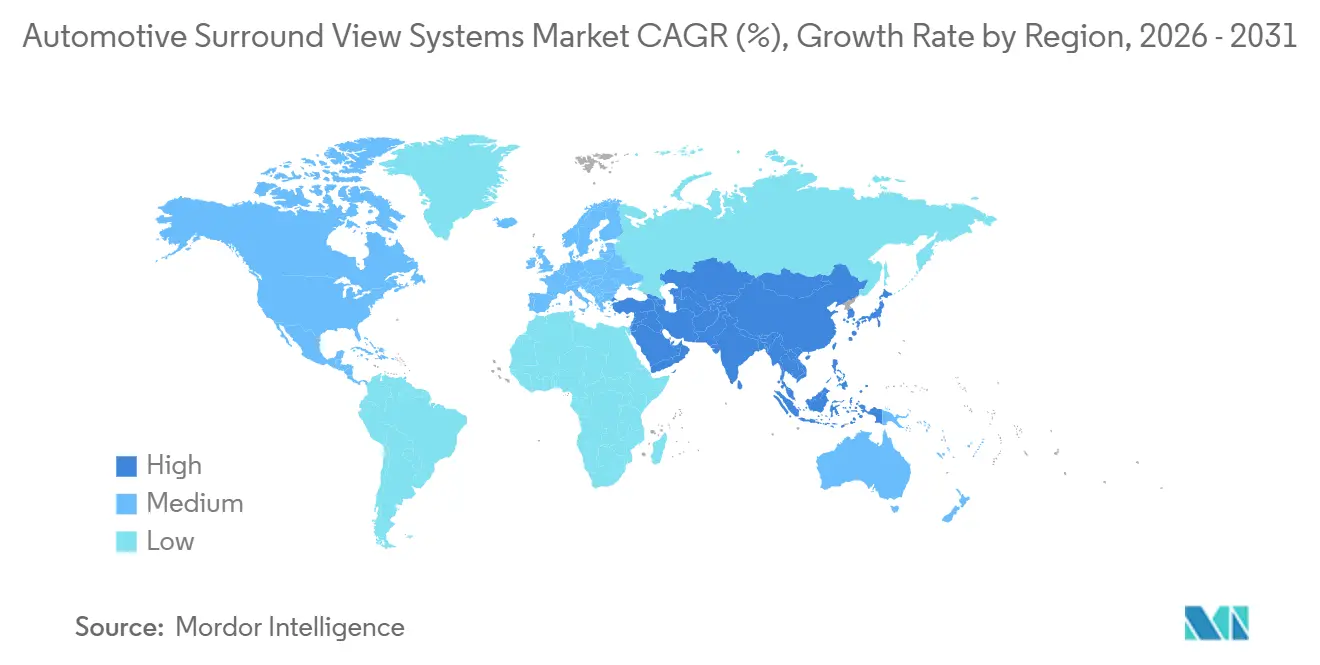
Asia-Pacific contributed 48.17% of the Automotive Surround View Systems market share in 2025 and is growing at a 14.45% CAGR through 2031. China’s NEV boom, with vehicles averaging eight or more cameras, anchors regional demand, while India’s Bharat NCAP 2.0 ties higher safety ratings to 360-degree visibility. Bosch’s China-first ADAS suite, beginning serial production in mid-2025, underscores the region’s testbed status for cost-efficient innovation.
North America and Europe Automotive Surround View Systems Market
By 2026, North America and Europe are expected to collectively account for a significant share of total sales. Mobileye's U.S. contract and Volkswagen's European deal underscore the growing integration of surround-view technology across mass-market platforms. Regulatory mandates for lane keeping, driver monitoring, and emergency braking are driving the adoption of multi-camera systems. However, delays in cybersecurity certifications are extending product cycles, temporarily slowing growth.
South America and MEA Automotive Surround View Systems Market
South America, the Middle East, and Africa remain smaller but are catching up as Euro-style safety norms spread. Urban delivery fleets in Brazil retrofit kits to reduce insurance premiums, and Gulf consumers favor premium SUVs that already include 3-D surround-view. High ambient temperatures in the Middle East stress thermal design, yet robust purchasing power sustains adoption, ensuring that the Automotive Surround View Systems market gains a diversified global footprint.

Competitive Landscape
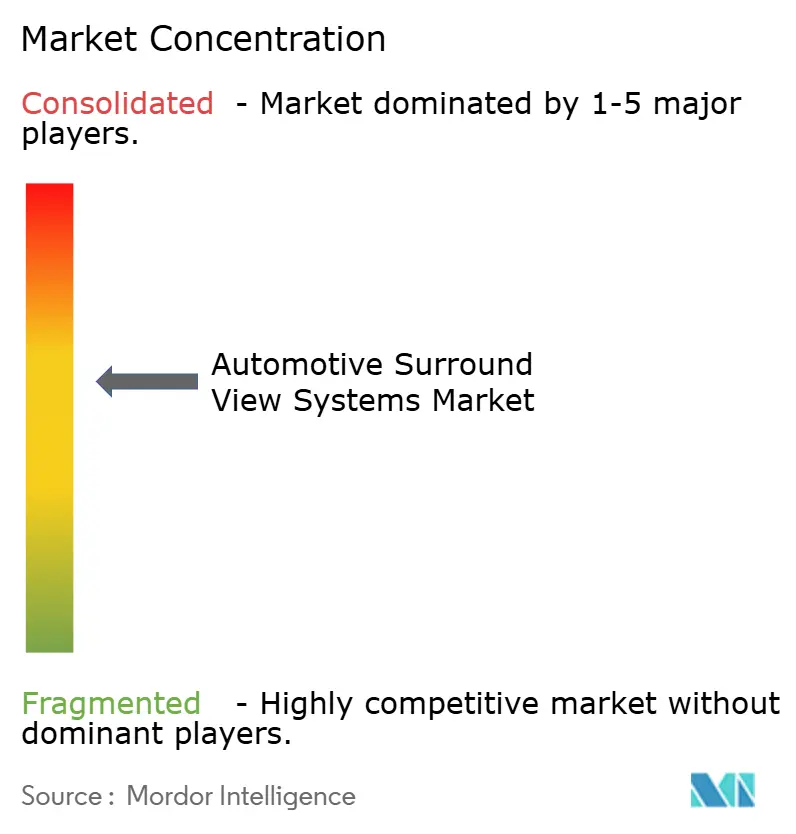
Tier-1 suppliers Magna, Valeo, Continental, Denso, and Bosch collectively hold a significant share of OEM-fit volume, indicating moderate concentration. Semiconductor houses are eroding that share by embedding stitching and perception software inside SoCs. Texas Instruments’ 10–1200 TOPS TDA5 line shipped with a virtual development kit in 2026, allowing automakers to design in-house systems 12 months faster [4]“TDA5 SoC Family Launch,” Texas Instruments, ti.com. Mobileye’s massive multi-year bookings position it as a direct competitor to traditional tier-1s, exemplifying vertical disintermediation.
Valeo’s partnership with Natix to build an open-source multi-camera foundation model shifts emphasis from hardware margins to data network effects. Smaller vendors such as Stonkam and Hikvision Automotive exploit retrofit white space, offering lower-priced kits to fleets in North America and China.
UNECE R155/R156 compliance costs accelerate consolidation, with resource-constrained tier-2 suppliers merging or exiting. Real-time AI detection accuracy, dataset scale, and security certification prowess have become the primary competitive levers in the Automotive Surround View Systems market.
Automotive Surround View Systems Industry Leaders
Valeo SA
Magna International
Continental AG
DENSO Corporation
Robert Bosch GmbH
- *Disclaimer: Major Players sorted in no particular order
Automotive Surround View Systems Market Companies Covered in this Report
- Magna International Inc.
- Valeo SA
- Continental AG
- Denso Corporation
- Robert Bosch GmbH
- Texas Instruments Inc.
- Renesas Electronics Corporation
- Aisin Corporation
- Mobileye NV
- Aptiv PLC
- NVIDIA Corporation
- ON Semiconductor Corporation
- Sunny Optical Technology
- OmniVision Technologies
- Stonkam Co. Ltd.
- STMicroelectronics
- NXP Semiconductors N.V.
- Hikvision Automotive

Recent Industry Developments in Automotive Surround View Systems Market
- August 2026: Pektron launched its new integrated 360° Vision and Infotainment System at iVT Expo. The platform enhances operator visibility, connectivity, and the in-cab experience across agricultural, construction, and off-highway vehicles.
- January 2026: NATIX Network and Valeo began jointly developing an open-source, multi-camera world foundation model, trained on 5,000 hours of VX360 driving data, to accelerate simulation before real-world deployment.
- July 2025: Pioneer India launched a 360° surround-view camera system featuring ultra-wide-angle lenses and advanced image processing to improve visibility in dense traffic.
- June 2025: Valeo secured a contract to supply its Smart Safety 360 suite to a European premium OEM, leveraging its hardware, software, and system integration expertise.


Global Automotive Surround View Systems Market Report Scope
The scope includes segmentation by camera count (4-camera systems and more than 4-camera (6, 8, 12) systems), camera functioning (automatic (auto switching/AI) and manual), vehicle type (passenger cars and commercial vehicles), sales channel (OEM-fitted and aftermarket retrofit), sensor technology (complementary metal-oxide-semiconductor and charge-coupled device), and display type (2-D and 3-D / augmented). The analysis also covers regional-level segmentation, including North America, South America, Europe, Asia-Pacific, the Middle East, and Africa. Market size and growth forecasts are presented in USD value.
| 4-Camera Systems |
| More than 4-Camera (6, 8, 12) Systems |
| Automatic (Auto-Switching / AI) |
| Manual |
| Passenger Cars |
| Commercial Vehicles |
| Original Equipment Manufacturer (OEM)-fitted |
| Aftermarket Retrofit |
| CMOS (Complementary Metal-Oxide-Semiconductor) |
| CCD (Charge-Coupled Device) |
| 2-D |
| 3-D / Augmented |
| North America | United States |
| Canada | |
| Rest of North America | |
| South America | Brazil |
| Argentina | |
| Rest of South America | |
| Europe | Germany |
| France | |
| United Kingdom | |
| Italy | |
| Spain | |
| Rest of Europe | |
| Asia-Pacific | China |
| Japan | |
| India | |
| South Korea | |
| Rest of Asia-Pacific | |
| Middle East and Africa | Saudi Arabia |
| United Arab Emirates | |
| South Africa | |
| Rest of Middle East and Africa |
| By Camera Count | 4-Camera Systems | |
| More than 4-Camera (6, 8, 12) Systems | ||
| By Camera Functioning | Automatic (Auto-Switching / AI) | |
| Manual | ||
| By Vehicle Type | Passenger Cars | |
| Commercial Vehicles | ||
| By Sales Channel | Original Equipment Manufacturer (OEM)-fitted | |
| Aftermarket Retrofit | ||
| By Sensor Technology | CMOS (Complementary Metal-Oxide-Semiconductor) | |
| CCD (Charge-Coupled Device) | ||
| By Display Type | 2-D | |
| 3-D / Augmented | ||
| By Geography | North America | United States |
| Canada | ||
| Rest of North America | ||
| South America | Brazil | |
| Argentina | ||
| Rest of South America | ||
| Europe | Germany | |
| France | ||
| United Kingdom | ||
| Italy | ||
| Spain | ||
| Rest of Europe | ||
| Asia-Pacific | China | |
| Japan | ||
| India | ||
| South Korea | ||
| Rest of Asia-Pacific | ||
| Middle East and Africa | Saudi Arabia | |
| United Arab Emirates | ||
| South Africa | ||
| Rest of Middle East and Africa | ||


Key Questions Answered in the Report
What is the current market size and growth rate of the automotive surround-view systems market?
The Automotive Surround View Systems market size was valued at USD 4.20 billion in 2025, and is projected to grow from USD 4.75 billion in 2026 to USD 9.06 billion by 2031, registering a 13.79% CAGR from 2026 to 2031.
Which region contributes nearly half the 2025 revenue for Automotive Surround View Systems?
Asia-Pacific supplied 48.17% of 2025 global sales and remains the primary volume engine.
What camera configuration is expanding fastest within Automotive Surround View Systems?
Arrays with more than four cameras are rising at an 18.33% CAGR as Level 2+ autonomy gains traction.
Which sensor type dominates Automotive Surround View Systems shipments in 2025?
CMOS sensors accounted for 89.14% of 2025 unit volume and will capture almost the entire segment by 2031.
Page last updated on:





