
Automotive Fluid Transfer System Market Size and Share
Market Overview
| Study Period | 2019 - 2031 |
|---|---|
| Market Size (2026) | USD 24.82 Billion |
| Market Size (2031) | USD 29.18 Billion |
| Growth Rate (2026 - 2031) | 3.29 % |
| Fastest Growing Market | North America |
| Largest Market | Asia-Pacific |
| Market Concentration | Medium |
Major Players
*Disclaimer: Major Players sorted in no particular order Image © Mordor Intelligence. Reuse requires attribution under CC BY 4.0. |
|
Automotive Fluid Transfer System Market Analysis by Mordor Intelligence
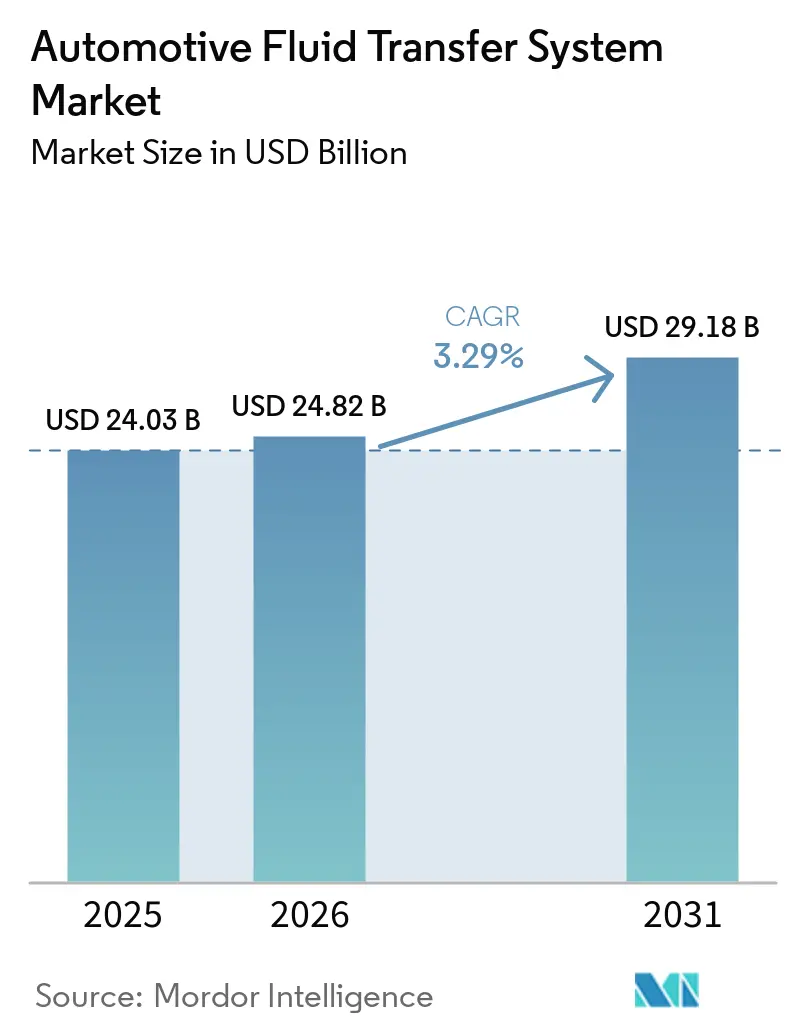
The automotive fluid transfer system market size was valued at USD 24.03 billion in 2025 and is expected to increase from USD 24.82 billion in 2026 to reach USD 29.18 billion by 2031, growing at a 3.29% CAGR over 2026-2031. Persistent regulatory tightening, especially Euro 7 in Europe, is forcing automakers to upgrade emissions-control and thermal-management lines even as battery-electric platforms spread. Asia-Pacific anchors demand on the back of China’s energy-consumption standards that took effect in January 2026. In North America, the U.S. EPA’s 2025 heavy-duty rules are spurring the adoption of high-spec diesel exhaust fluid (DEF) circuits. Meanwhile, India’s forthcoming BS-VII norms require commercial-vehicle fleets to retrofit diesel particulate filters (DPFs) and selective catalytic reduction (SCR) plumbing[1]"BS7 Emission Norms: What it Means for Car Prices in India by 2026," eAuto, eauto.co.in.
Key Report Takeaways
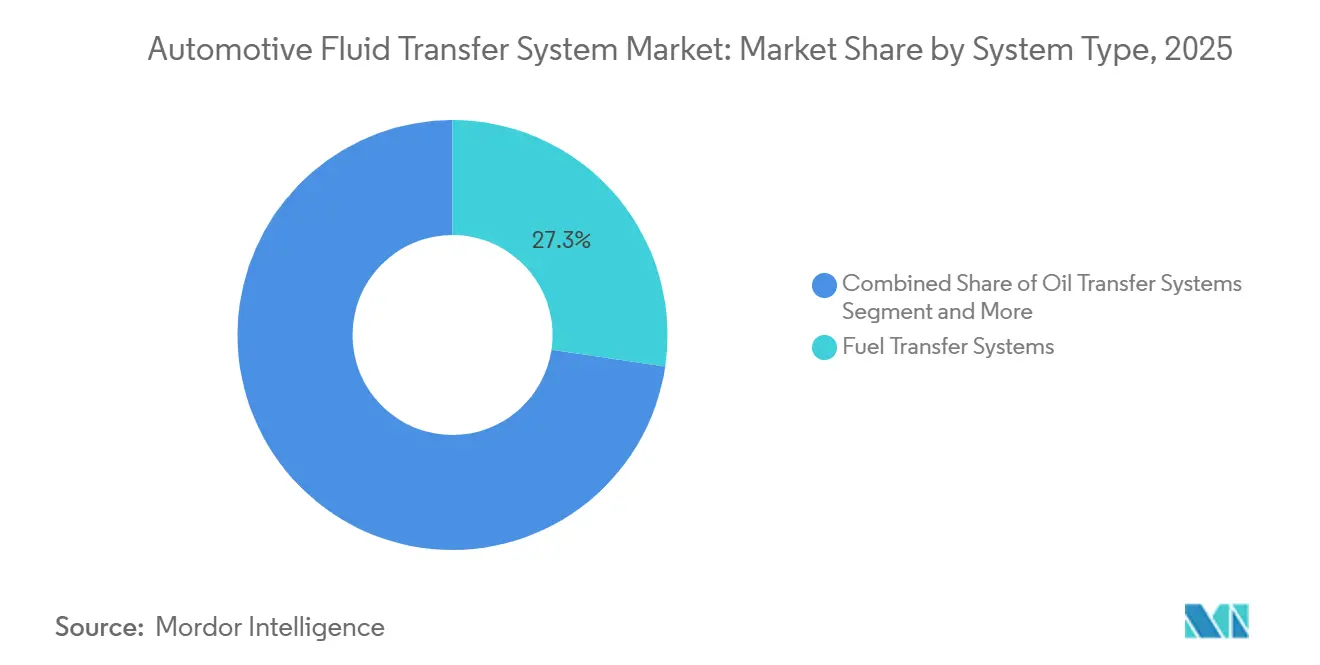
- By system type, fuel transfer systems led with 27.34% of the automotive fluid transfer system market share in 2025, while coolant transfer systems are set to record the fastest CAGR at 3.91% through 2031.
- By vehicle type, passenger cars held a 62.84% of the automotive fluid transfer system market share in 2025, while medium and heavy commercial vehicles are advancing at a 4.73% CAGR through 2031.
- By propulsion type, internal-combustion vehicles accounted for 85.06% of the automotive fluid transfer system market share in 2025, yet battery electric vehicles are projected to expand at a 6.57% CAGR between 2026 and 2031.
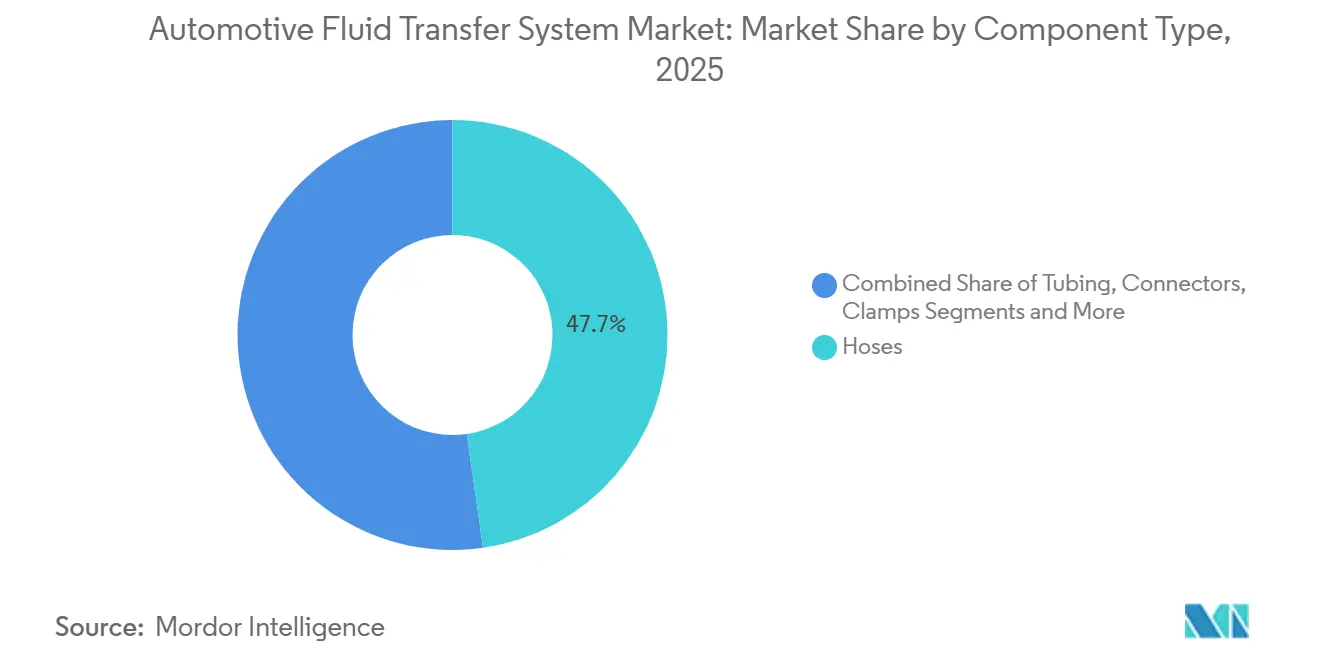
- By component type, hoses captured 47.74% share of the automotive fluid transfer system market size in 2025, and pumps are set to grow at a 5.11% CAGR over the same horizon.
- By distribution channel, the OEM channel accounted for 73.99% of the automotive fluid transfer system market share in 2025, whereas the aftermarket is expected to post a 5.29% CAGR through 2031.
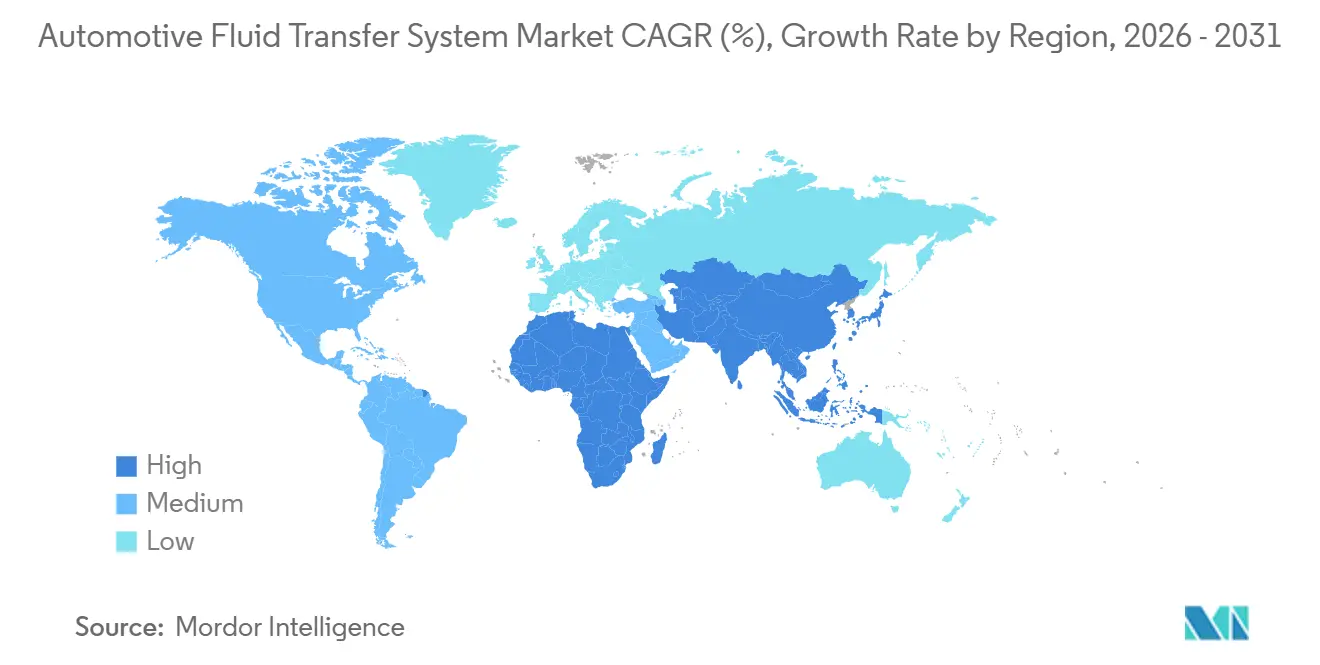
- By geography, Asia-Pacific accounted for 48.87% of the automotive fluid transfer system market share in 2025, and North America is forecast to post the fastest CAGR at 4.17% through 2031.
Note: Market size and forecast figures in this report are generated using Mordor Intelligence’s proprietary estimation framework, updated with the latest available data and insights as of January 2026.
Market Trends and Insights
Drivers Impact Analysis of Automotive Fluid Transfer System Market*
| Driver | (~) % Impact on CAGR Forecast | Geographic Relevance | Impact Timeline |
|---|---|---|---|
| Multi-Loop Thermal Circuit Growth | +0.9% | Asia-Pacific, Europe | Long term (≥ 4 years) |
| DPF and SCR Fluid-Line Demand | +0.8% | Europe, North America | Medium term (2-4 years) |
| High-Temperature Oil and Coolant Demand | +0.6% | Asia-Pacific, North America | Short term (≤ 2 years) |
| Smart Hoses With Embedded Fluid-Quality Sensors | +0.5% | North America, Europe | Medium term (2-4 years) |
| Laser-Welded Multilayer Nylon-Aluminum Brake Tubing | +0.4% | Global premiums | Short term (≤ 2 years) |
| Megawatt Depot Charging for Electric Trucks | +0.3% | North America, Europe | Medium term (2-4 years) |
| Source: Mordor Intelligence | |||
Rapid BEV/HEV Sales Growth Creating Multi-Loop Thermal-Management Fluid Circuits
Battery-electric and hybrid platforms now integrate multi-loop coolant networks that link battery cold plates, power-electronics chillers, and cabin HVAC modules. China's new GB rules, effective January 2026, mandate thermal optimization for vehicles weighing over 2 tons, thereby cementing demand for variable-speed electric pumps and low-permeation hoses[2]Adrian Leung, "China to enforce world’s first mandatory EV energy standard in 2026, capping two-tonne models at 15.1 kWh per 100 km," CarNewsChina, carnewschina.com. Tesla’s recent dual-mode patent demonstrates how secondary CO₂ loops improve low-temperature charging. Tier-1 suppliers answer with modular coolant manifolds that slash leak points and expedite assembly. As BEV ranges edge higher, quick-disconnect couplings rated for dielectric fluids are rapidly standardizing across new platforms.
Tightening Emission and Fuel-Economy Norms Accelerating Adoption of DPF/SCR Fluid Lines
Euro 7 applies to new light-duty vehicle types starting in November 2026[3]"Meeting Euro 7 Regulations," Automotive IQ, automotive-iq.com. It lowers NOx ceilings and extends durability to 300,000 km, obliging OEMs to specify heated urea hoses capable of operating at -28 °C. The U.S. EPA’s 2025 inducement update likewise enforces in-cab warnings and speed derates when DEF quality sags. India’s BS-VII draft mirrors Euro 7 with real-driving emissions tracking, driving retrofits across legacy truck fleets. Collectively, these measures are entrenching high-grade SCR and DPF circuits worldwide.
Turbo-GDI Engine Proliferation Raising Demand for High-Temperature Oil and Coolant Lines
Automakers still relying on internal combustion turn to turbocharged gasoline direct-injection engines to hit fuel-efficiency targets without sacrificing performance. The 350-bar fuel rail on Stellantis’ latest Hurricane unit illustrates the thermal stress that ancillary hoses must endure. Suppliers respond with multilayer elastomer constructions and laser-welded tubing that resist oil coking and sustain flexibility near red-hot turbo housings. Many OEMs also add dedicated coolant loops for turbocharger jackets, thereby increasing line count despite the overall decline in ICEs. These technical upgrades keep high-temperature hose programs relevant even as electrification advances.
Smart Hoses With Embedded Fluid-Quality Sensors Enabling Predictive Maintenance
Embedding pressure, temperature, and fluid-quality sensors converts hoses from passive plumbing into active data nodes. Eaton’s LifeSense platform streams real-time readings to cloud dashboards, alerting operators before leaks cause unplanned downtime. Euro 7’s on-board monitoring requirement further encourages builders to specify sensor-ready lines that verify fluid integrity over a vehicle’s life. Fleet managers value the ability to schedule service rather than respond to roadside failures, a benefit that offsets higher acquisition prices. The trend also dovetails with cybersecurity and functional-safety mandates, pushing suppliers to harden data pathways and demonstrate fail-safe behavior during audits.
Restraints Impact Analysis of Automotive Fluid Transfer System Market*
| Restraint | (~) % Impact on CAGR Forecast | Geographic Relevance | Impact Timeline |
|---|---|---|---|
| ICE Phase-Out Curbs Demand | –0.7% | Europe, select regions | Long term (≥ 4 years) |
| Volatile PA-12 Inflates Polymer Costs | –0.5% | Global | Medium term (2-4 years) |
| Low Replacement Limits Aftermarket Revenue | –0.4% | Mature markets | Short term (≤ 2 years) |
| Direct-Immersion Cooling Cuts Hoses | –0.3% | Premium EVs | Long term (≥ 4 years) |
| Source: Mordor Intelligence | |||
ICE Phase-Out Targets Curbing Long-Term Demand for Fuel and Oil Transfer Lines
The EU's 2035 CO₂ mandate and California's ZEV roadmap are discouraging new ICE investments, reducing the addressable market for gasoline and diesel lines. Automakers are redirecting R&D toward battery thermal management, indicating a gradual decline for conventional fuel plumbing. This shift is already visible in procurement decisions and platform planning cycles. Suppliers with BEV-focused offerings are better positioned to weather the transition. At the same time, aftermarket inventories of legacy fuel hoses face growing obsolescence risks as scrappage schemes accelerate and older ICE vehicles exit the fleet sooner than anticipated.
Volatile PA-12 Supply Inflating High-Performance Polymer Costs
High-pressure fuel and brake lines rely on PA-12 for its chemical resilience. Recent price increases, driven by tight global production, are compressing tier-1 margins. Procurement teams are under real pressure to justify material costs while maintaining supply continuity. Some OEMs are piloting recycled PA-66 or bio-based alternatives, but qualification cycles are lengthy, and performance ranges are narrower than expected. This situation highlights material security as a strategic consideration, prompting firms to dual-source or vertically integrate compounding capacity to reduce exposure.
*Our forecasts treat driver/restraint impacts as directional, not additive. The impact forecasts reflect baseline growth, mix effects, and variable interactions.
Automotive Fluid Transfer System Market Segment Analysis
By System Type:
Coolant Circuits Outpace Fuel LinesFuel transfer systems remain the largest sub-segment, capturing 27.34% of the automotive fluid transfer system market share in 2025, reflecting their ubiquity across gasoline and diesel platforms. Even so, coolant circuits are expanding at a 3.91% CAGR, propelled by the shift toward multi-loop thermal management architectures in battery-electric and hybrid vehicles. Automakers are integrating battery cold plates, power-electronics chillers, and cabin HVAC loops, all of which depend on high-performance hoses, pumps, and quick connectors. Tier-1 suppliers respond by offering modular coolant manifolds that reduce leak paths and simplify assembly, while material specialists develop low-conductivity elastomers for dielectric fluids.
Platform redesigns under Euro 7 and comparable regulations further accelerate the pivot toward advanced coolant routing. Engineers are replacing belt-driven pumps with smart, variable-speed electric units that optimize thermal loads without sapping driveline efficiency. At the same time, direct-immersion battery-cooling patents hint at an eventual reduction in discrete hoses, spurring experimentation with molded composite channels within pack enclosures. Suppliers hedge by offering interchangeable fittings that serve both glycol-water and new dielectric formulations. This flexibility positions them to capture value as OEMs iterate battery strategies over the decade.



By Vehicle Type:
Commercial Fleets Drive MomentumPassenger cars accounted for 62.84% of the automotive fluid transfer system market share in 2025 because of their sheer production volume across global assembly lines. Nevertheless, medium and heavy commercial vehicles are forecasted to record a 4.73% CAGR as depot charging, telematics, and stricter emissions rules collide. Fleets retrofitting diesel trucks with selective catalytic reduction and particulate filter plumbing provide an immediate aftermarket lift. In parallel, long-haul electric trucks require dielectric quick-connects rated for megawatt-class charging, opening a premium niche for high-spec connectors. These factors together explain why commercial platforms, though numerically smaller than cars, command growing engineering attention.
Urban logistics growth adds another layer of complexity. Light commercial vans toggle between internal-combustion and battery-electric powertrains depending on duty cycle, so their fluid architectures must support both low-viscosity oils and sophisticated coolant loops. Bus operators in Asia and Europe are adopting hydrogen or battery solutions for zero-emission zones, requiring 700-bar hydrogen lines and stack coolers. Component makers that can tailor hose assemblies for vibration, road-salt exposure, and 24-hour duty cycles gain an edge with fleet buyers. This service orientation differentiates them from car-centric competitors that focus mainly on launch-year volume.
By Propulsion Type:
Electrification Picks Up PaceInternal-combustion vehicles still dominate the installed base and remain the largest propulsion sub-segment, accounting for 85.06% of the automotive fluid transfer system market share in 2025. Battery-electric vehicles, however, are advancing at a 6.57% CAGR, buoyed by government incentives, falling battery costs, and expanding fast-charging corridors. As EV penetration climbs, every vehicle adds multiple coolant branches for batteries, inverters, and onboard chargers, generating incremental hose and pump content. Hybrid architectures further complicate matters by combining fuel, oil, and coolant circuits within tight engine bays, thereby increasing routing density. Suppliers capable of integrating sensors for predictive maintenance earn preferred-source status with OEMs pursuing uptime guarantees.
Fuel-cell programs, though niche, influence material innovation across the board. The need to contain hydrogen at 700 bar pressures pushes the development of multilayer polymers and metal-plastic composites that also benefit brake and transmission lines. Meanwhile, turbo-GDI engines remain relevant in markets where electrification lags, sustaining demand for high-temperature oil feed and return hoses. This overlapping technology map means suppliers must sustain dual investment tracks: one advancing electrified-vehicle fluidics, the other optimizing legacy systems for cost and durability.
By Component Type:
Smart Pumps AccelerateHoses accounted for the largest share, 47.74%, of the automotive fluid transfer system market in 2025 because every fluid circuit, from fuel to brake to coolant, relies on flexible lines for vibration isolation and packaging freedom. Pumps, on the other hand, are rising the fastest, with a 5.11% CAGR, as belt-driven units give way to compact electric designs controlled by vehicle software. These smart pumps improve thermal system responsiveness while enabling automakers to meet energy-efficiency mandates. Concurrently, quick-connect couplers that eliminate the need for tools during assembly are becoming standard, enhancing serviceability for dealership technicians. Each advancement underscores the broader shift from passive plumbing toward intelligent, value-added assemblies.
Material science underpins much of the current innovation. Multilayer nylon-aluminum brake tubing delivers meaningful weight savings yet resists road-salt corrosion, an attribute prized in cold-climate markets. Reservoirs for BEV coolant now incorporate integrated deaeration chambers to manage micro-bubble formation, extending pump life. Connectors feature redundant sealing grooves to meet Euro 7 lifetime-leak targets, while embedded RFID tags in hoses simplify after-sales traceability. Altogether, component evolution favors suppliers with vertical expertise in polymers, electronics, and precision molding.
By Distribution Channel:
Aftermarket Complexity UpsideOriginal-equipment supply accounted for 73.99% of the automotive fluid transfer system market share in 2025, reflecting automakers’ preference for long-term contracts and rigorous quality oversight. The aftermarket is growing faster at a 5.29% CAGR as Euro 7 anti-tampering rules mandate certified replacements and electrified drivetrains shorten service intervals for pumps and valves. Independent repair shops increasingly stock sensor-equipped hoses to avoid extended vehicle downtimes triggered by onboard monitoring alerts. Tier-1 brands leverage technical hotlines and training programs to keep technicians current on evolving specifications, reinforcing loyalty at the counter. This service ecosystem differentiates premium offerings from generic imports.
Digital commerce also changes the replacement-parts landscape. Fleet managers use telematics data to forecast component wear and schedule just-in-time deliveries, boosting demand for exact-fit kits shipped directly from regional depots. Subscription platforms bundle parts with diagnostic software updates, generating predictable revenue streams for suppliers willing to support both legacy and next-gen vehicles. Meanwhile, OEMs experiment with proprietary connector geometries to preserve post-warranty parts pull-through, a strategy that keeps margins healthier than volume alone. Collectively, these trends lift the aftermarket’s strategic importance even as the new-vehicle pipeline remains critical for scale.
Geography Analysis
APAC Automotive Fluid Transfer System Market
Asia-Pacific led the automotive fluid transfer system market with 48.87% revenue in 2025. China’s January 2026 GB standards hard-wire thermal management, ensuring continuous demand for low-permeation coolant and DEF lines. India’s April 2026 BS-VII launch compels retrofits of DPF and SCR hoses across freight fleets. Japan and South Korea prioritize hydrogen bus corridors, generating early orders for 700-bar fuel lines. Tier-1 firms cluster extrusion and compounding plants near resin suppliers to curb freight costs and import duties.
North America Automotive Fluid Transfer System Market
North America is forecasted to clock the swiftest 4.17% CAGR through 2031. The U.S. EPA’s 2025 heavy-duty incentive rules require fleet-wide upgrades to DEF plumbing. Megawatt charging pilots along interstate corridors are accelerating demand for dielectric quick-connects capable of handling gigawatt-class pulse loads. Canada’s ZEV mandate pushes OEMs to localize battery-thermal supply chains, while Mexico’s cost-competitive plants absorb reshored hose programs freed from Asian tariffs.
Europe Automotive Fluid Transfer System Market
Europe faces an ICE phase-out debate, but Euro 7’s milestones anchor near-term fluid-line upgrades. Heated urea circuits and 300,000-km durability thresholds lift specification floors. Germany remains a production hub, exporting multilayer nylon-aluminum brake tubing to global platforms. The United Kingdom aligns with Euro 7 from November 2026 onward, extending demand for compliant components across the continent.

Competitive Landscape
The automotive fluid transfer system market is moderately concentrated. Global players combine material science, lightweighting, and sensor integration to maintain their market share. Cooper-Standard's recycled-PA66 quick connectors reduce insertion force and meet Euro 7 durability requirements. TI Automotive's acquisition of a major plastic-component firm provides vertical integration, securing OEM supply pipelines. Smaller regional suppliers, however, continue to compete by offering faster customization cycles and lower tooling costs, keeping the competitive landscape dynamic.
Suppliers are directing R&D toward dielectric-coolant compatibility for 350-kW-plus charging systems and hydrogen permeation barriers for fuel-cell trucks. North American reshoring, driven by the Inflation Reduction Act, is prompting capacity expansions in Mexico and the U.S. Midwest. These expansions reduce lead times and limit exposure to maritime freight disruptions.
Innovation activity is concentrated around direct-immersion battery cooling, where eliminating discrete hoses could disrupt existing revenue models. Modular thermal-management skids that arrive pre-filled reduce assembly complexity but require reliable leak-proofing. Aftermarket sensor retrofits are also creating recurring revenue opportunities as fleet operators pursue predictive maintenance to improve uptime.
Automotive Fluid Transfer System Industry Leaders
-
Cooper-Standard Holdings Inc.
-
TI Automotive (TI Fluid Systems)
-
Continental AG (ContiTech)
-
Gates Corporation
-
Kongsberg Automotive
- *Disclaimer: Major Players sorted in no particular order

Automotive Fluid Transfer System Market Companies Covered in this Report
- Cooper-Standard Holdings Inc.
- TI Automotive (TI Fluid Systems)
- Continental AG (ContiTech)
- Gates Corporation
- Kongsberg Automotive
- Akwel Group
- Hutchinson SA
- Tristone Flowtech
- Lander Automotive
- Castello Italia
- Parker Hannifin Corporation
- Sanoh Industrial Co., Ltd.
- Delfingen
- Eaton Corporation
- Kuriyama Holdings Corporation
- Transfer Oil S.p.A.
- Toyoda Gosei
- Manuli Hydraulics
- Trelleborg AB

Recent Industry Developments in Automotive Fluid Transfer System Market
- August 2026: AISIN Aftermarket & Service of America expanded its chemicals portfolio by introducing a new line of engine oils and gear oils, including fully synthetic and semi-synthetic formulations.
- June 2026: Valvoline Global Operations launched Beyond by Valvoline, a next-generation fluid platform designed for advanced technologies, including high-performance computing and utility-scale battery storage.
- May 2026: Castrol launched Castrol ON EV Transmission Fluid W3, a full-synthetic fluid engineered for electric vehicles with wet e-motors, helping to extend drivetrain life and improve range.
- April 2026: Hot Shot's Secret introduced Green Diamond ULV ATF, designed for Ford and GM 10-speed transmissions and select European models, offering thermal and oxidative stability for modern transmissions.


Global Automotive Fluid Transfer System Market Report Scope
The Automotive Fluid Transfer System market is analyzed across system type, vehicle type, propulsion type, component type, distribution channel, and geography.
By System Type, the market is segmented into Fuel Transfer Systems, Oil Transfer Systems, Brake Fluid Systems, Transmission Fluid Systems, and Coolant Transfer Systems. By Vehicle Type, the market is segmented into Passenger Cars, Light Commercial Vehicles, Medium and Heavy Commercial Vehicles, and Buses and Coaches. By Propulsion Type, the market is segmented into Internal Combustion Engine (ICE), Battery Electric Vehicle (BEV), Plug-in Hybrid Electric Vehicle (PHEV), Hybrid Electric Vehicle (HEV), and Fuel-Cell Electric Vehicle (FCEV). By Component Type, the market is segmented into Hoses, Tubing, Connectors, Clamps, Reservoirs, Pumps, and Others. By Distribution Channel, the market is segmented into OEM and Aftermarket. By Geography, the market is segmented into North America (United States, Canada, and Rest of North America), South America (Brazil, Argentina, and Rest of South America), Europe (United Kingdom, Germany, Spain, Italy, France, Russia, and Rest of Europe), Asia-Pacific (India, China, Japan, South Korea, and Rest of Asia-Pacific), and Middle East and Africa (United Arab Emirates, Saudi Arabia, Turkey, Egypt, South Africa, and Rest of Middle East and Africa).
Market forecasts are provided in terms of Value (USD) and Volume (Units).
| Fuel Transfer Systems |
| Oil Transfer Systems |
| Brake Fluid Systems |
| Transmission Fluid Systems |
| Coolant Transfer Systems |
| Passenger Cars |
| Light Commercial Vehicles (LCVs) |
| Medium and Heavy Commercial Vehicles (M&HCVs) |
| Buses and Coaches |
| Internal Combustion Engine (ICE) |
| Battery Electric Vehicle (BEV) |
| Plug-in Hybrid Electric Vehicle (PHEV) |
| Hybrid Electric Vehicle (HEV) |
| Fuel-Cell Electric Vehicle (FCEV) |
| Hoses |
| Tubing |
| Connectors |
| Clamps |
| Reservoirs |
| Pumps |
| Others |
| Original Equipment Manufacturer (OEM) |
| Aftermarket |
| North America | United States |
| Canada | |
| Rest of North America | |
| South America | Brazil |
| Argentina | |
| Rest of South America | |
| Europe | United Kingdom |
| Germany | |
| Spain | |
| Italy | |
| France | |
| Russia | |
| Rest of Europe | |
| Asia-Pacific | India |
| China | |
| Japan | |
| South Korea | |
| Rest of Asia-Pacific | |
| Middle East and Africa | United Arab Emirates |
| Saudi Arabia | |
| Turkey | |
| Egypt | |
| South Africa | |
| Rest of Middle East and Africa |
| By System Type | Fuel Transfer Systems | |
| Oil Transfer Systems | ||
| Brake Fluid Systems | ||
| Transmission Fluid Systems | ||
| Coolant Transfer Systems | ||
| By Vehicle Type | Passenger Cars | |
| Light Commercial Vehicles (LCVs) | ||
| Medium and Heavy Commercial Vehicles (M&HCVs) | ||
| Buses and Coaches | ||
| By Propulsion Type | Internal Combustion Engine (ICE) | |
| Battery Electric Vehicle (BEV) | ||
| Plug-in Hybrid Electric Vehicle (PHEV) | ||
| Hybrid Electric Vehicle (HEV) | ||
| Fuel-Cell Electric Vehicle (FCEV) | ||
| By Component Type | Hoses | |
| Tubing | ||
| Connectors | ||
| Clamps | ||
| Reservoirs | ||
| Pumps | ||
| Others | ||
| By Distribution Channel | Original Equipment Manufacturer (OEM) | |
| Aftermarket | ||
| By Geography | North America | United States |
| Canada | ||
| Rest of North America | ||
| South America | Brazil | |
| Argentina | ||
| Rest of South America | ||
| Europe | United Kingdom | |
| Germany | ||
| Spain | ||
| Italy | ||
| France | ||
| Russia | ||
| Rest of Europe | ||
| Asia-Pacific | India | |
| China | ||
| Japan | ||
| South Korea | ||
| Rest of Asia-Pacific | ||
| Middle East and Africa | United Arab Emirates | |
| Saudi Arabia | ||
| Turkey | ||
| Egypt | ||
| South Africa | ||
| Rest of Middle East and Africa | ||


Key Questions Answered in the Report
How large is the automotive fluid transfer system market in value terms?
It is projected to reach USD 29.18 billion by 2031, expanding at a 3.29% CAGR from 2026 to 2031.
Which system type currently dominates sales?
Fuel transfer systems held the largest 27.34% share in 2025.
What is the fastest-growing vehicle segment for fluid transfer lines?
Medium and heavy commercial vehicles are anticipated to grow at a 4.73% CAGR through 2031.
Why are coolant circuits gaining traction in electric cars?
Multi-loop battery-thermal architectures in BEVs require dedicated coolant routing, driving a 3.91% CAGR for coolant systems.
Page last updated on:


 Your data is secure and never sold or shared.


