
Automotive Pump Market Size and Share
Market Overview
| Study Period | 2019 - 2031 |
|---|---|
| Market Size (2026) | USD 12.81 Billion |
| Market Size (2031) | USD 15.42 Billion |
| Growth Rate (2026 - 2031) | 3.77 % |
| Fastest Growing Market | Asia Pacific |
| Largest Market | Asia Pacific |
| Market Concentration | Medium |
Major Players *Disclaimer: Major Players sorted in no particular order Image © Mordor Intelligence. Reuse requires attribution under CC BY 4.0. | |
Automotive Pump Market Analysis by Mordor Intelligence
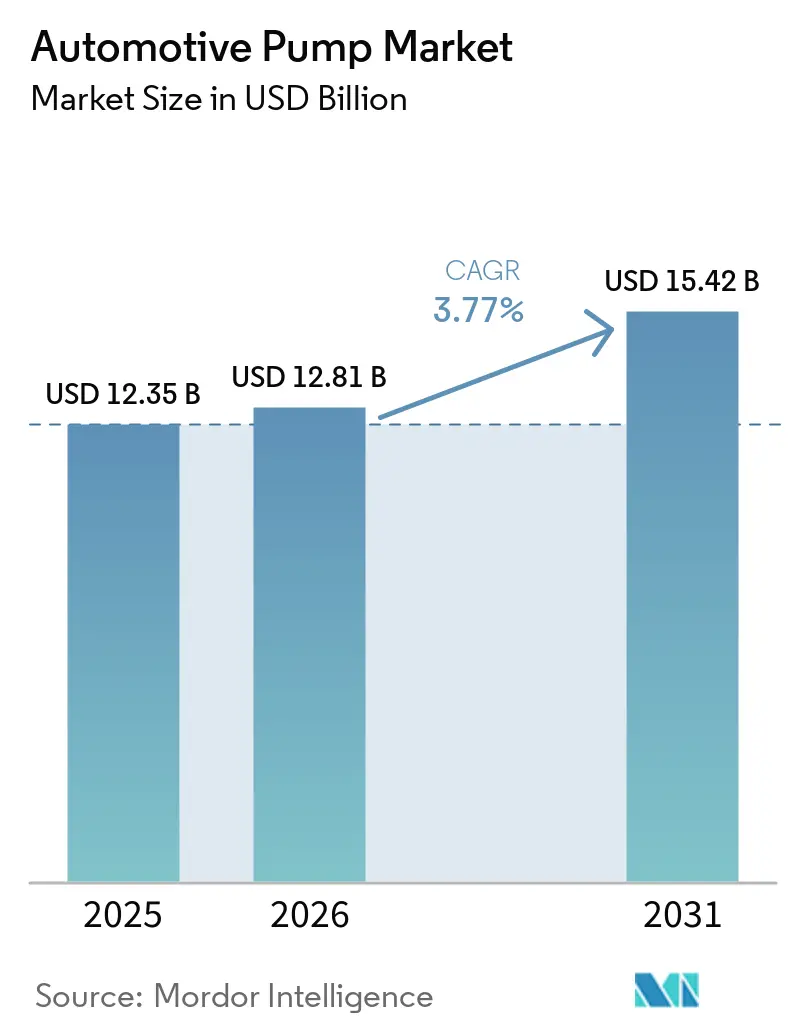
The Automotive Pump Market size is projected to expand from USD 12.35 billion in 2025 to USD 12.81 billion in 2026, and to USD 15.42 billion by 2031, registering a CAGR of 3.77% during the forecast period (2026-2031). Demand is shifting toward electronically controlled pumps that reduce parasitic losses, improve battery-pack thermal balance, and help OEMs meet tightening CO₂ limits. While mechanical designs still account for two-thirds of the unit volume, electric variants capture virtually all incremental value, aided by sensor-rich modules that feed predictive maintenance analytics. Asia-Pacific leads volume on the back of commercial-vehicle electrification, whereas Europe drives technology adoption through stringent functional-safety and embedded-carbon rules. Suppliers that blend motor, control, and diagnostics expertise are gaining margin, especially where 800-volt EV platforms, hydrogen pilots, and turbo-hybrid ICEs lift pressure and flow requirements across engines, transmissions, and cooling loops.
Key Report Takeaways
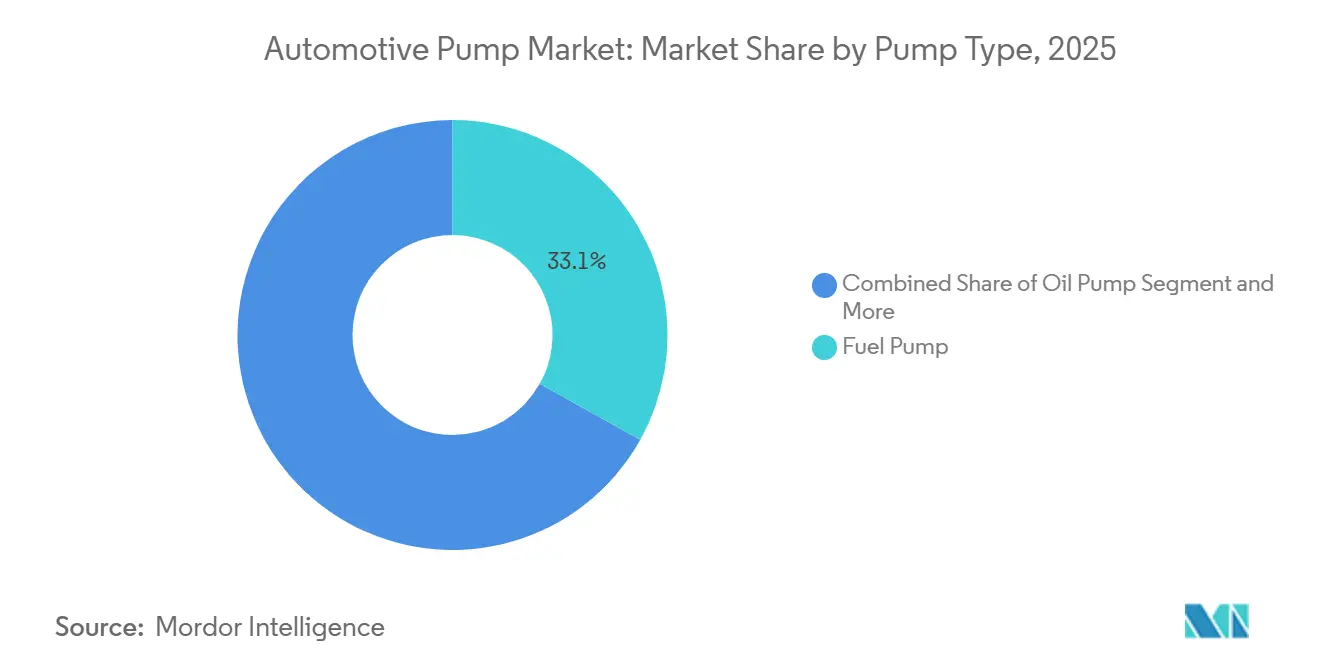
- By pump type, fuel pumps led with 33.14% of the automotive pump market share in 2025, while water pumps are projected to expand at a 3.79% CAGR through 2031.
- By technology, mechanical pumps accounted for 67.73% of the automotive pump market in 2025, while electric pumps recorded the fastest CAGR at 3.92% through 2031.
- By vehicle type, passenger cars accounted for 48.71% of revenue in 2025, whereas medium and heavy commercial vehicles are forecast to grow at a 3.83% CAGR through 2031.
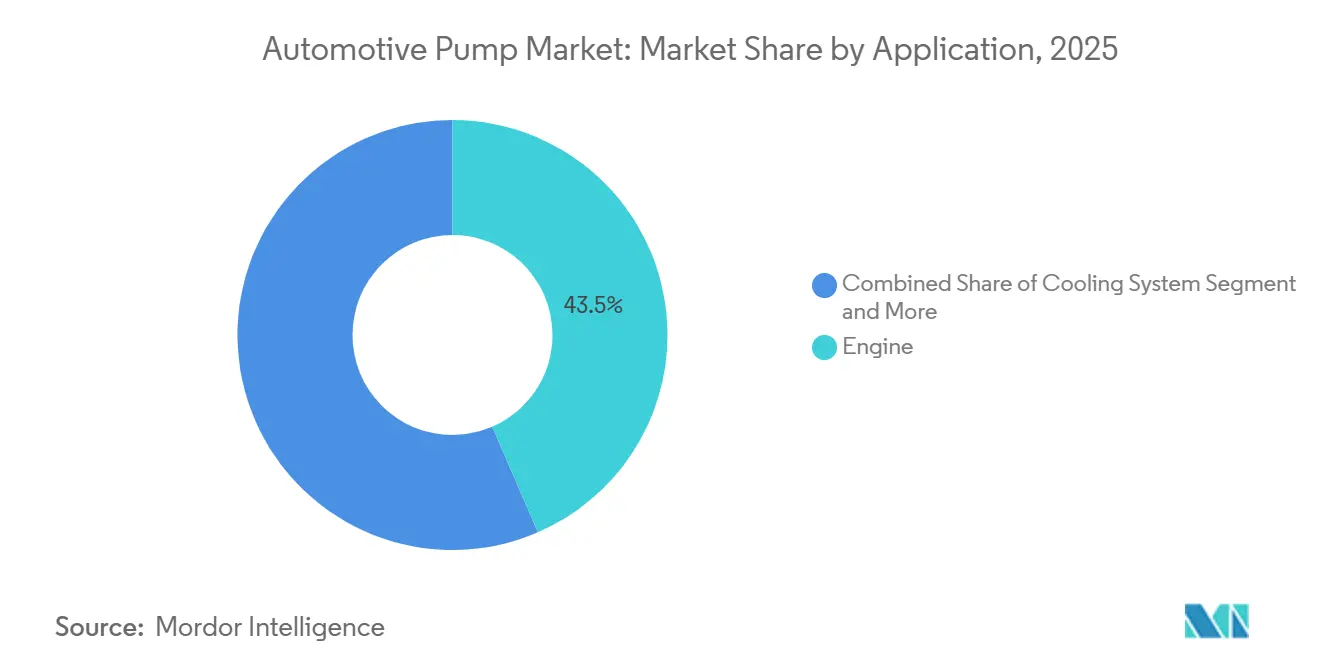
- By application, engine circuits accounted for 43.46% of revenue in 2025, and cooling-system applications are advancing at a 3.87% CAGR over the same horizon.
- By sales channel, the OEM segment commanded a 77.24% share of the automotive pump market in 2025 and is maintaining a 3.85% growth trajectory through 2031.
- By geography, Asia-Pacific led with 42.36% revenue share in 2025 and is projected to expand at a 3.91% CAGR through 2031.
Note: Market size and forecast figures in this report are generated using Mordor Intelligence’s proprietary estimation framework, updated with the latest available data and insights as of January 2026.
Global Automotive Pump Market Trends and Insights
Drivers Impact Analysis*
| Driver | (~) % Impact on CAGR Forecast | Geographic Relevance | Impact Timeline |
|---|---|---|---|
| Tightening Global CO₂ / CAFÉ Norms Accelerating E-Pump Adoption | +0.9% | Global, with EU, China, and India leading enforcement | Medium term (2-4 years) |
| Rapid Ramp-Up of Asia-Pacific ICE and EV Production Capacity | +0.8% | Asia-Pacific core, spill-over to South America | Short term (≤ 2 years) |
| Shift Toward Power-Dense Turbo-Hybrid Engines Demanding High-Pressure Fuel and Oil Pumps | +0.6% | North America, Europe, China premium segments | Medium term (2-4 years) |
| OEM Preference for Integrated, Modular Pump Packages | +0.5% | Global, concentrated in OEM assembly hubs | Long term (≥ 4 years) |
| On-Board Diagnostics and Smart-Sensor Integration Enabling Predictive Maintenance | +0.4% | North America, Europe, premium Asia-Pacific models | Long term (≥ 4 years) |
| Hydrogen ICE Pilots Driving Ultra-High-Pressure Injection Pumps | +0.2% | Europe, Japan, select North America R&D clusters | Long term (≥ 4 years) |
| Source: Mordor Intelligence | |||
Tightening Global CO₂ / CAFÉ Norms Accelerating E-Pump Adoption
Greenhouse gas regulations are the single most powerful catalyst for the automotive pump market. The U.S. EPA’s Phase 3 standards, finalized in 2024, compel light-duty fleets to cut CO₂ emissions by 56 g/mi by model year 2032, prompting OEMs to replace fixed-displacement coolant and oil pumps with variable-speed electric units that run only on demand [1]“Multi-Pollutant Emissions Standards for Model Years 2027-2032,” U.S. Environmental Protection Agency, epa.gov . India’s CAFÉ III rules, toughened in 2024, impose credit penalties for inefficient auxiliaries, and China’s dual-credit policy awards compliance points when electric pumps are fitted even in hybrids. Decoupled coolant flow keeps HVAC and battery-pack temperatures stable during engine-off events, a requirement for start-stop, plug-in hybrids, and idle-reduction mandates. Consequently, nearly every new 800-volt EV platform launched in 2025-2026 specifies dual or triple electric coolant pumps sized from 150 W to 600 W.
Rapid Ramp-Up of Asia-Pacific ICE and EV Production Capacity
In the near future, the Asia-Pacific region is expected to dominate the automotive pump market with a significant share, driven by the establishment of new assembly lines. Recently, Stellantis made a substantial investment to modernize its plants in India and Indonesia, ensuring the production of localized pump modules in compliance with content regulations. Meanwhile, Chinese electric vehicle newcomer VinFast is setting up factories in ASEAN, necessitating the use of pre-validated thermal-management skids that seamlessly integrate pumps, valves, and reservoirs. Schaeffler's Integrated Coolant System, with plans to scale up production at its Xiangtan and Wuhu facilities by the end of the year, showcases the trend among suppliers to enhance value by consolidating multiple wet components into a single, coded assembly. The electrification of two-wheelers presents additional growth potential; a recent SAE paper underscores the use of forced-air and micro-liquid pumps in Indian e-scooters, signaling a shift of active thermal loops into more budget-friendly segments [2]“Thermal Management Needs in Indian Electric Two-Wheelers,” SAE International, sae.org .
Shift Toward Power-Dense Turbo-Hybrid Engines
Turbo-hybrids with higher specific outputs are driving up demands for fuel and oil pressure. This trend is steering the industry towards variable-displacement and tandem electric pumps. In 2024, BorgWarner introduced its tandem electric oil pump on the Buick GL8 plug-in hybrid. This innovation not only reduces driveline friction but also aligns with real-world fuel economy cycles. Meanwhile, JATCO's CVT-X employs a combination of a downsized mechanical pump and an electric booster, achieving a significant reduction in system loss. In regions like India and parts of South America, where internal combustion engines (ICE) still dominate and charging networks are sparse, high-pressure gasoline-direct and diesel-common-rail pumps play a pivotal role. In the automotive electric fuel pumps market, Gasoline direct-injection (GDI) now dominates new gasoline-engine programs, and every GDI engine requires a high-pressure, electronically controlled feed pump. As the market sees a rise in turbo-hybrids, suppliers equipped with pressure-control algorithms and brushless-motor intellectual property are safeguarding their margins, even amidst material inflation.
OEM Preference for Integrated, Modular Pump Packages
Automakers are increasingly seeking sub-assemblies that seamlessly integrate into flexible platforms, eliminating the need to re-validate each component. In mid-2024, Cooper Standard unveiled its eCoFlow Switch Pump, a groundbreaking fusion of pump and valve technology. This innovation not only conserves multiple hose joints per vehicle but also significantly reduces the likelihood of leaks. Meanwhile, TI Fluid Systems introduced its ITMA thermal manifold, which adeptly combines multiple pumps, valves, and flow sensors. Arriving at assembly plants as a singular SKU, it seamlessly integrates into just-in-time sequencing. The emphasis on ISO 26262 functional safety design is intensifying, particularly for critical components such as brake-vacuum and steering-assist pumps. This heightened scrutiny elevates the entry standards for specialized suppliers. Such advancements in plug-and-play modules are not only streamlining platform commonization but also steering the automotive pump market towards a greater emphasis on electronics and software integration.
Restraints Impact Analysis*
| Restraint | (~) % Impact on CAGR Forecast | Geographic Relevance | Impact Timeline |
|---|---|---|---|
| Upfront Cost Delta of Electric Versus Mechanical Pumps | -0.7% | Global, most acute in price-sensitive Asia-Pacific and South America segments | Short term (≤ 2 years) |
| Global Aluminum Price Volatility Inflating Pump Housing Costs | -0.5% | Global, with EU and North America facing CBAM and tariff premiums | Medium term (2-4 years) |
| Decline in Diesel Vehicle Share in Europe | -0.3% | Europe, spill-over to diesel-export markets in Africa and Middle East | Short term (≤ 2 years) |
| Tier-2 Recall Exposure from Counterfeit Aftermarket Parts | -0.2% | North America, Europe, emerging aftermarket fraud in Asia-Pacific | Long term (≥ 4 years) |
| Source: Mordor Intelligence | |||
Upfront Cost Delta of Electric Versus Mechanical Pumps
OEMs remain hesitant to adopt electric pumps in entry-level vehicles, deterred by a significant price premium. Munro's 2024 teardown highlighted an electric coolant pump priced notably higher compared to its mechanical counterpart. Innovations like brushless-motor scaling, rare-earth-free magnets, and integrated electronics are gradually bridging this price divide. For instance, TI Fluid Systems' latest eCP family achieves a remarkably low sound level at minimal power consumption. However, achieving price parity within a close margin seems improbable in the near future. Consequently, in cost-sensitive markets such as India and Brazil, a blend of mechanical and electric units persists, hindering the full electrification of the automotive pump sector.
Global Aluminum Price Volatility Inflating Pump Housing Costs
Aluminum futures swung from USD 2,600/t in early 2024 to USD 2,400/t by late 2025 as energy shortages and Chinese smelting caps disrupted supply. EU Carbon Border Adjustment tariffs add 8-12% to imported billet, squeezing European pump margins and pushing die-casting operations to Mexico and Turkey. Some suppliers respond with glass-filled nylon housings for non-structural parts, trading raw-material savings for higher tooling investment. Vertical integration into casting and long-term hedging differentiate resource-rich tier-ones from cash-constrained tier-twos.
*Our forecasts treat driver/restraint impacts as directional, not additive. The impact forecasts reflect baseline growth, mix effects, and variable interactions.
Segment Analysis
By Pump Type: Fuel Pumps Anchor Revenue, Water Pumps Capture Growth
Fuel pumps accounts 33.14% of the share 2025 revenue, cementing their importance in gasoline direct-injection and diesel systems where pressures exceed 200 bar. The automotive pump market size for water pumps is projected to expand fastest, reflecting a 3.79% CAGR as 800-volt EVs and hydrogen ICE pilots demand multi-circuit cooling. Schaeffler’s 260-W electric water pump now services range-extended EVs that outgrow earlier 150-W designs. Although oil pumps remain indispensable, steering pumps decline as electric power steering saturates. Vacuum pumps enjoy modest upside in hybrids that cannot rely on manifold vacuum.
Second-generation electric water pumps from Nidec GPM and Grayson Thermal Systems push flow beyond 100 L/min for buses and off-highway gear, illustrating how the automotive pump market is bifurcating between high-volume mechanical legacy and low-volume, high-margin electronic modules. Hydrogen injection, if commercialized, could reshape the supplier pecking order because ultra-high-pressure fuel pumps require fresh metallurgy and sealing expertise.



By Technology: Mechanical Pumps Retain Volume, Electric Variants Seize Margin
Mechanical units held 67.73% of the automotive pump market share in 2025, owing to their proven reliability and low cost. Electric counterparts grow at 3.92% CAGR through 2031, capturing margins with brushless motors and firmware upgrades. Automotive electric water pumps are gaining traction as OEMs increasingly use variable-speed coolant circulation to improve thermal efficiency and reduce parasitic energy losses. Bosch’s PDE line spans 110-200 W, letting OEMs reuse the same casting with software tweaks. Europe leads penetration, Asia lags due to price sensitivity, and North America sits in between. A 2025 Applied Sciences study confirmed that 10-30 L/min liquid cooling is now viable even for e-motorcycles, foreshadowing wider adoption.
As battery-electric penetration climbs toward half in the early 2030s, the crossover where electric pumps exceed mechanical pumps in unit terms approaches. Suppliers scaling motor winding and embedded-control capacity earlier will lock in design wins, shaping the next decade of the automotive pump market.
By Vehicle Type: Passenger Cars Lead Volume, Commercial Vehicles Drive Growth
Passenger cars account for 48.71% of revenue in the 2025 segmental share. Yet, medium and heavy commercial vehicles are projected to grow at a 3.83% CAGR through 2031 due to idle-reduction laws and fleet electrification. Stellantis’ India-Indonesia LCV push and U.S. long-haul trucks adopting electric coolant and brake-vacuum pumps sustain demand. Off-highway equipment boasts the highest pump intensity per unit, with lifetimes above 10,000 hours and downtime costs topping USD 2,000 per incident, making condition-monitored pumps attractive.
Two-wheelers represent a promising niche; 2026 research on Indian e-scooters documented battery temperatures exceeding 55 °C, justifying the use of micro liquid pumps. This diversity helps stabilize the automotive pump market against cyclical swings in passenger cars.
By Application: Engine Dominates, Cooling Systems Accelerate
Engine circuits accounted for 43.46% of revenue in 2025, encompassing fuel, oil, and coolant duties for ICEs. Cooling systems, however, clock the quickest 3.87% CAGR as EV batteries, power electronics, and cabin heat pumps intensify thermal loads. Xiaomi’s SU7 EV employs a nine-way valve with dual pumps to juggle battery, motor, and cabin requirements. Transmission pumps grow with hybrid dual-clutch and CVT volumes, but taper as single-speed EV gearboxes proliferate.
HVAC pump demand rises modestly as heat-pump HVAC replaces resistive heaters. Windshield and washer pumps remain low-value but steady. The automotive pump market size for cooling applications will increasingly mirror EV adoption curves, tying supplier prospects to battery cost trajectories.
By Sales Channel: OEM Channel Anchors Growth, Aftermarket Faces Headwinds
OEMs absorbed 77.24% of 2025 revenue and will inch higher as vehicle complexity increases, with a CAGR of 3.85% through 2031. Integrated modules like TI’s ITMA 1.4 arrive ready-validated, easing assembly and warranty risks. ISO 26262 certification for electric brake-vacuum and steering pumps effectively locks aftermarket suppliers out without costly redesigns, consolidating share for tier-ones.
Counterfeits and longer EV maintenance intervals restrain aftermarket value. Blockchain traceability and certified-reseller portals are rolling out, yet seizure data suggest persistent leakages. Hence, the OEM pipeline remains the dominant engine of growth in the automotive pump market.
Geography Analysis
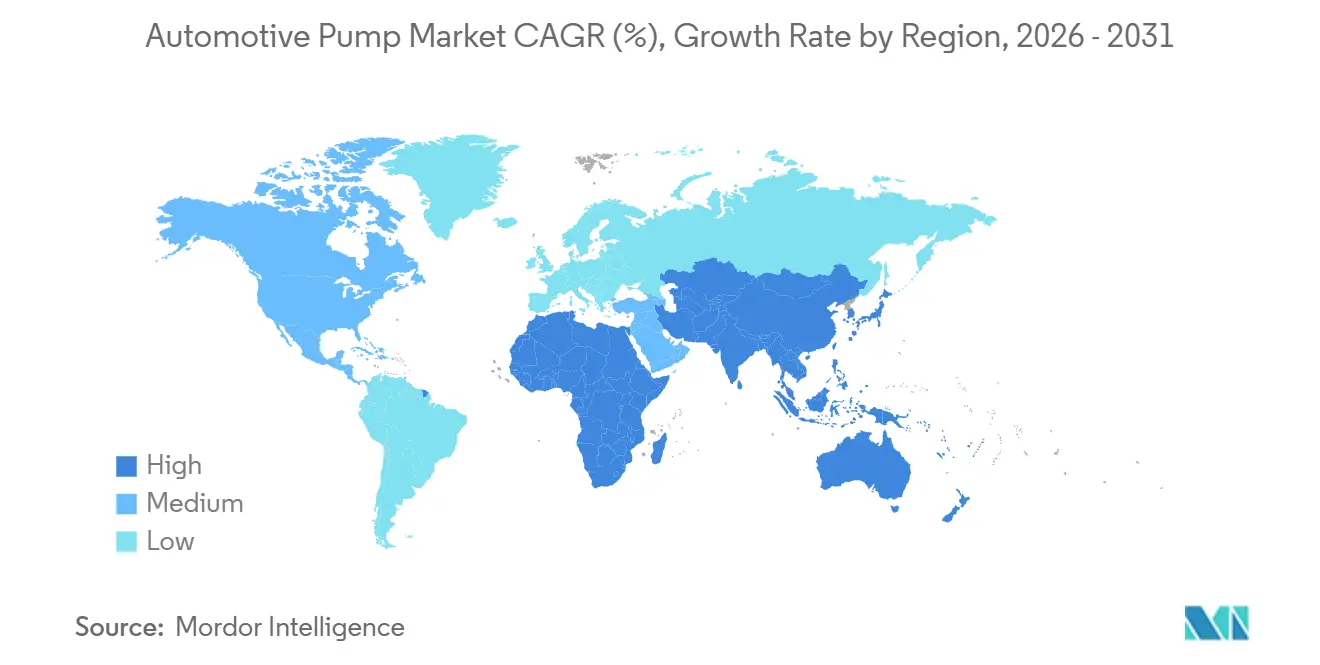
Asia-Pacific generated 42.36% revenue in 2025 and will expand 3.91% CAGR through 2031. China's dual-credit scheme incentivizes electric auxiliaries, while India's CAFÉ III regulations steer compact cars towards variable-speed pumps. Schaeffler's lines in Xiangtan and Wuhu produce significant volumes monthly, primarily for local range-extended EVs.
Even as diesel's prominence wanes, Europe retains its foothold through technological innovation. The C-Class EQ heat-pump HVAC from Mercedes sets a new standard with substantial energy reduction. Meanwhile, Continental's hydrogen hose plant in Korbach signals a strategic move towards alternative fuels. Although CBAM tariffs have driven aluminum casting operations to Turkey and Mexico, R&D remains firmly rooted in Germany and France.
North America's growth is tempered, primarily supported by ICE pickups but increasingly buoyed by a shift towards off-highway electrification. Evidence of this trend is seen in BorgWarner's long-term contract for off-highway controllers and Continental's significant investment in a hose plant in Mexico, both highlighting OEMs' focus on regional supply stability.

Competitive Landscape
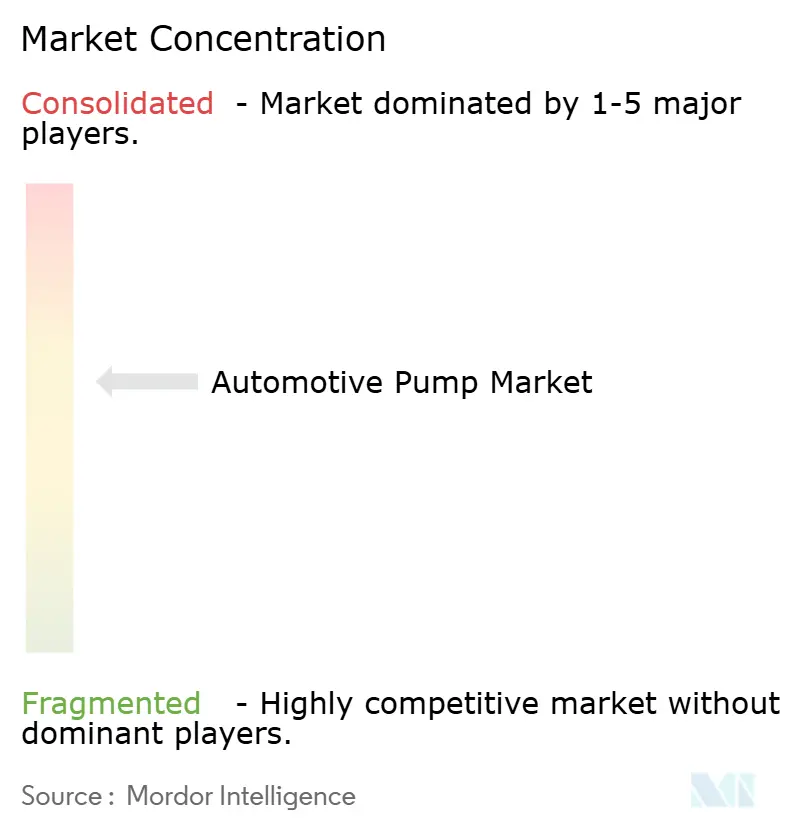
The top five suppliers—Bosch, Denso, Continental, Aisin, and Mahle—command roughly half of the revenue, leaving room for regional and niche entrants. Bosch’s modular PDE coolant-pump ladder covers multiple vehicle classes with a shared core, cutting tooling, and accelerating launches. Aisin’s Manufacture 2030 tie-up aligns with OEM scope 3 reporting, making carbon footprint transparency a differentiator. Chinese players such as Sanhua and Yinlun punch above their weight in domestic EV programs, exporting cost-optimized thermal modules to ASEAN and Latin America.
Sensor-rich electric coolant and vacuum pumps lead to margin expansion. Schaeffler’s Integrated Coolant System bundles pump, valve, and reservoir, slashing OEM installation time and unlocking software-based flow control.
Suppliers lacking motor or firmware IP face shrinkage or consolidation. Hydrogen ICE injectors, two-wheeler micro-pumps, and off-highway electrification present white spaces where scale is less decisive than materials science and control algorithms, shaping the next epoch of the automotive pump industry.
Automotive Pump Industry Leaders
Robert Bosch GmbH
Denso Corporation
Aisin Seiki Co. Ltd.
Continental AG
Magna International Inc.
- *Disclaimer: Major Players sorted in no particular order

Recent Industry Developments
- June 2025: Setco Automotive Limited unveiled an engine-cooling water pump tailored for LCVs and MHCVs.
- February 2025: TIF Fluid Systems launched the eCP electric coolant pump series featuring integrated flow sensors and predictive-maintenance firmware.
- October 2024: Honda Cars India Limited initiated a preventive fuel-pump replacement campaign covering 90,468 vehicles manufactured in earlier years.
- June 2024: Rheinmetall secured a multi-million-unit order for electric coolant pumps supplying a global hybrid-vehicle platform.


Global Automotive Pump Market Report Scope
The scope of the report includes Pump Type (Fuel Pump, Fuel Injection Pump, and More), Technology (Mechanical Pumps and Electric Pumps), Vehicle Type (Passenger Cars and More), Application (Engine, Transmission, and More), Sales Channel (OEM and Aftermarket), and Geography.
| Fuel Pump |
| Fuel Injection Pump |
| Oil Pump |
| Water Pump |
| Steering Pump |
| Windshield Washer Pump |
| Vacuum Pump |
| Others |
| Mechanical Pumps |
| Electric Pumps |
| Passenger Cars |
| Light Commercial Vehicles |
| Medium and Heavy Commercial Vehicles |
| Two-Wheelers |
| Off-Highway Vehicles |
| Engine |
| Transmission |
| Cooling System |
| Lubrication |
| Windshield |
| HVAC |
| Others |
| OEM |
| Aftermarket |
| North America | United States |
| Canada | |
| Rest of North America | |
| South America | Brazil |
| Argentina | |
| Rest of South America | |
| Europe | United Kingdom |
| Germany | |
| Spain | |
| Italy | |
| France | |
| Russia | |
| Rest of Europe | |
| Asia-Pacific | India |
| China | |
| Japan | |
| Indonesia | |
| Malaysia | |
| Singapore | |
| Vietnam | |
| Philippines | |
| South Korea | |
| Rest of Asia-Pacific | |
| Middle East and Africa | United Arab Emirates |
| Saudi Arabia | |
| Turkey | |
| Egypt | |
| South Africa | |
| Rest of Middle East and Africa |
| By Pump Type | Fuel Pump | |
| Fuel Injection Pump | ||
| Oil Pump | ||
| Water Pump | ||
| Steering Pump | ||
| Windshield Washer Pump | ||
| Vacuum Pump | ||
| Others | ||
| By Technology | Mechanical Pumps | |
| Electric Pumps | ||
| By Vehicle Type | Passenger Cars | |
| Light Commercial Vehicles | ||
| Medium and Heavy Commercial Vehicles | ||
| Two-Wheelers | ||
| Off-Highway Vehicles | ||
| By Application | Engine | |
| Transmission | ||
| Cooling System | ||
| Lubrication | ||
| Windshield | ||
| HVAC | ||
| Others | ||
| By Sales Channel | OEM | |
| Aftermarket | ||
| By Geography | North America | United States |
| Canada | ||
| Rest of North America | ||
| South America | Brazil | |
| Argentina | ||
| Rest of South America | ||
| Europe | United Kingdom | |
| Germany | ||
| Spain | ||
| Italy | ||
| France | ||
| Russia | ||
| Rest of Europe | ||
| Asia-Pacific | India | |
| China | ||
| Japan | ||
| Indonesia | ||
| Malaysia | ||
| Singapore | ||
| Vietnam | ||
| Philippines | ||
| South Korea | ||
| Rest of Asia-Pacific | ||
| Middle East and Africa | United Arab Emirates | |
| Saudi Arabia | ||
| Turkey | ||
| Egypt | ||
| South Africa | ||
| Rest of Middle East and Africa | ||


Key Questions Answered in the Report
How big will the automotive pump market be by 2031?
The automotive pump market size is projected to reach USD 15.42 billion by 2031, advancing at a 3.77% CAGR from 2026.
Which pump type grows fastest toward 2031?
Water pumps post the segment’s quickest 3.79% CAGR as multi-circuit EV cooling and 800-volt architectures multiply thermal loops.
What region leads demand for automotive pumps?
Asia-Pacific holds 42.36% revenue share and expands at 3.91% CAGR through 2031, driven by China’s dual-credit incentives and India’s CAFE III norms.
Why are electric pumps gaining share?
Variable-speed electric pumps cut parasitic losses, enable predictive maintenance, and help OEMs meet stricter CO₂ standards such as EPA Phase 3, accelerating their penetration in new vehicle programs.
Who are the top suppliers in the automotive pump space?
Bosch, Denso, Continental, Aisin, and Mahle collectively hold about half of revenue, while Schaeffler and TI Fluid Systems advance in integrated electric modules.
Page last updated on:


 Your data is secure and never sold or shared.


