
Market Overview
| Study Period | 2020 - 2031 |
|---|---|
| Market Size (2026) | USD 26.79 Billion |
| Market Size (2031) | USD 36.46 Billion |
| Growth Rate (2026 - 2031) | 6.36 % |
| Fastest Growing Market | Asia-Pacific |
| Largest Market | Asia-Pacific |
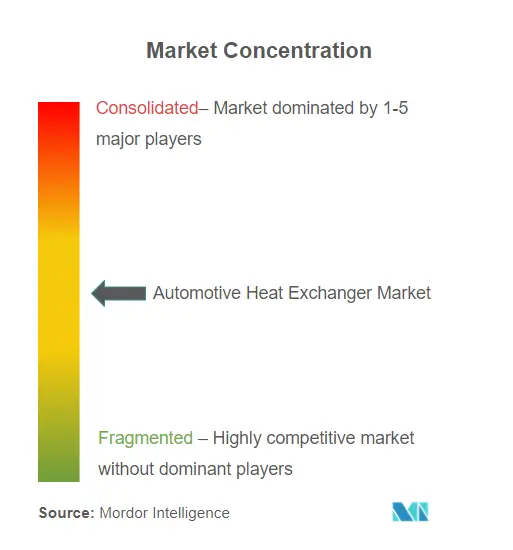
| Market Concentration | Medium |
Major Players *Disclaimer: Major Players sorted in no particular order Image © Mordor Intelligence. Reuse requires attribution under CC BY 4.0. | |
Automotive Heat Exchanger Market Analysis by Mordor Intelligence
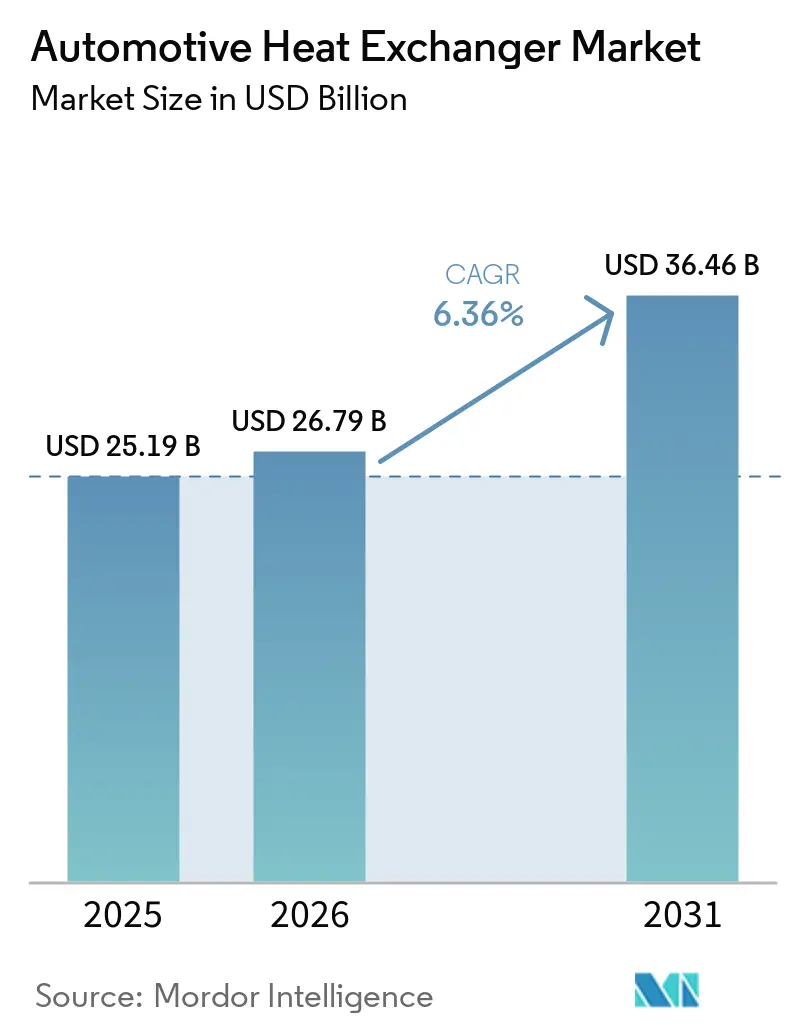
The Automotive Heat Exchanger Market size was valued at USD 25.19 billion in 2025 and estimated to grow from USD 26.79 billion in 2026 to reach USD 36.46 billion by 2031, at a CAGR of 6.36% during the forecast period (2026-2031). The shift from internal-combustion cooling loops to multi-loop architectures for battery, power electronics, and cabin climate control underpins this expansion across the automotive heat exchanger market. Electrified platforms demand components that prevent battery thermal runaway, manage 800-V charging loads, and conserve vehicle range[1]. Strong electric-vehicle adoption in Asia-Pacific, Euro 7 durability rules, and heat-pump integration also elevate product complexity and value content in the automotive heat exchanger market. Suppliers are responding with micro-channel designs, corrosion-resistant alloys, and integrated heat-pump modules, while materials volatility in aluminum and copper continues to pressure margins across the automotive heat exchanger market.
Key Report Takeaways
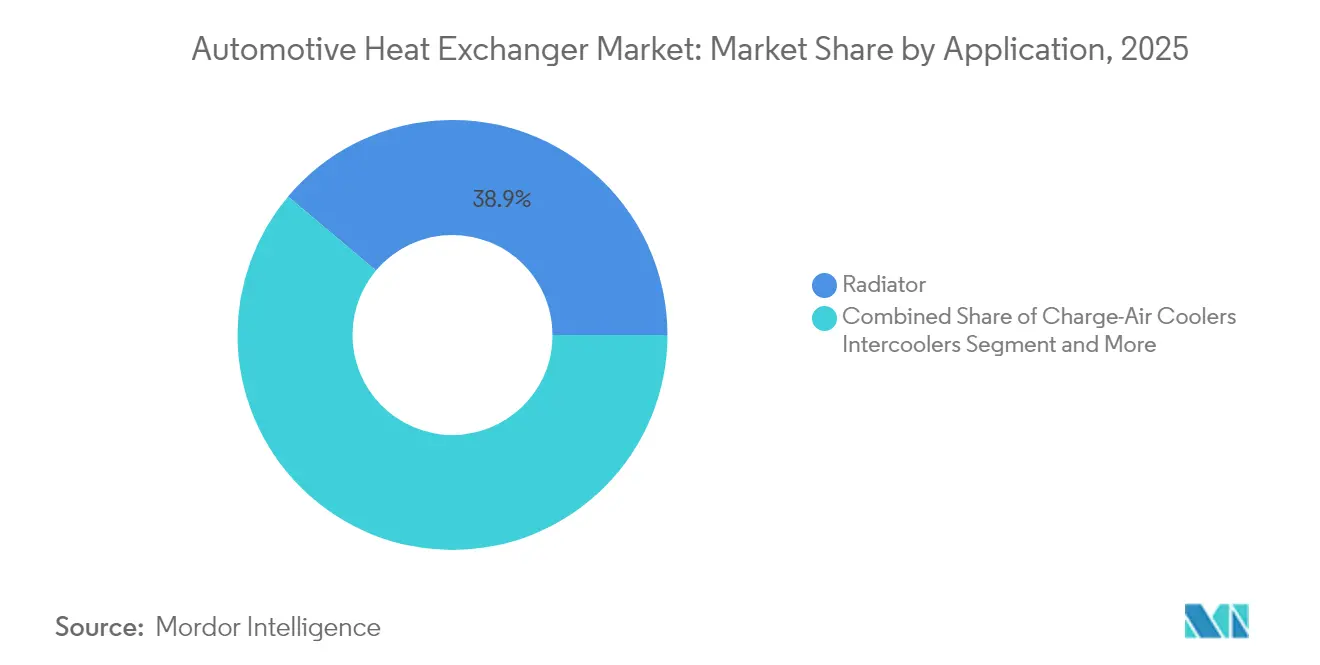
- By application, radiators led the automotive heat exchanger market with 38.86% of the share in 2025, while battery and power electronics coolers are advancing at a 12.74% CAGR through 2031.
- By design type, tube-fin configurations commanded a 46.92% share of the automotive heat exchanger market in 2025; plate-bar units are expected to grow at an 8.65% CAGR.
- By material, aluminum accounts for 72.84% share of the automotive heat exchanger market in 2025, whereas stainless steel is the fastest-growing material, forecast to expand at an 8.36% CAGR from 2026 - 2031.
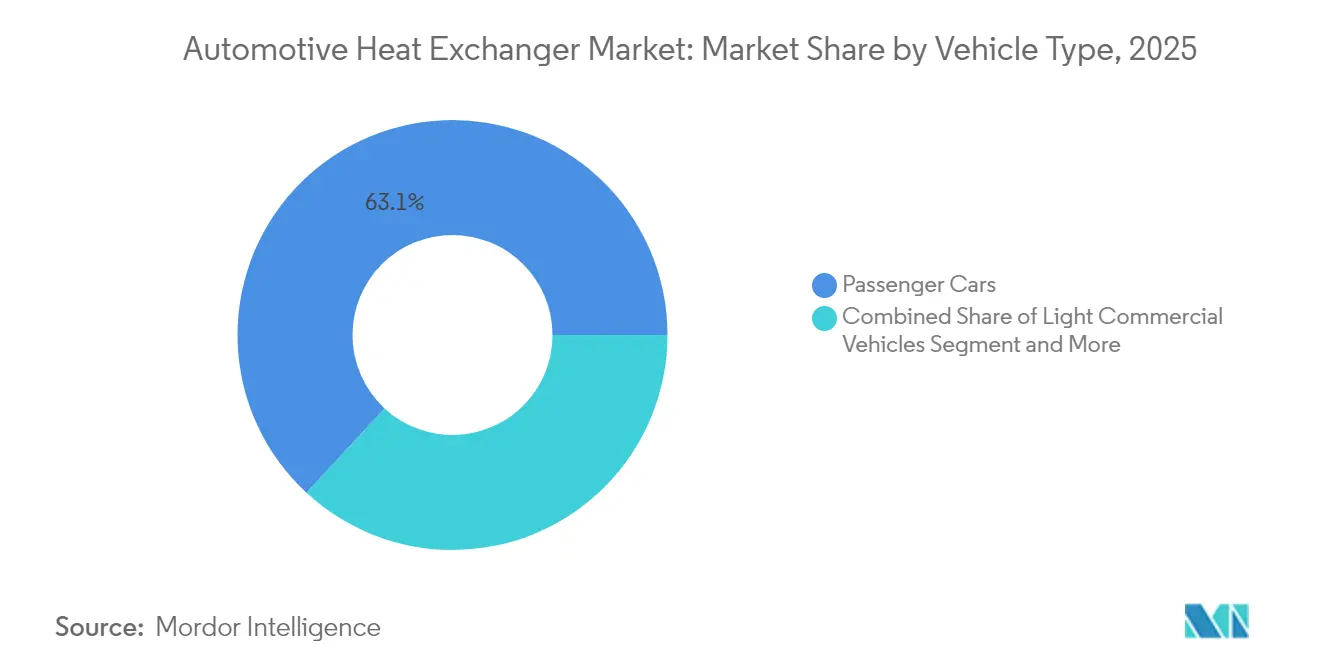
- By vehicle type, passenger cars held 63.12% of the automotive heat exchanger market share in 2025; light commercial and heavy vehicle segments are forecast to post the fastest collective CAGR at 8.61% to 2031.
- By powertrain, internal-combustion engines accounted for 51.96% of the automotive heat exchanger market size in 2025, whereas battery electric vehicles are expanding at a 14.97% CAGR.
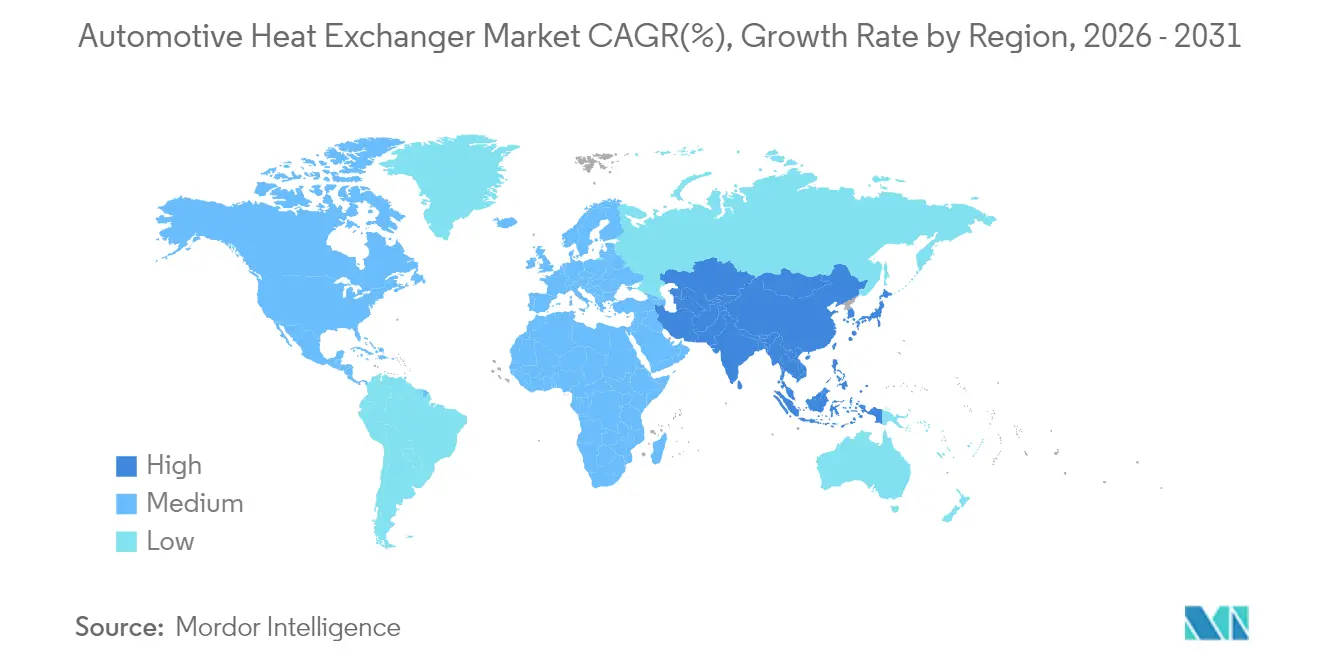
- By geography, Asia-Pacific captured 46.88% revenue in 2025 and remains the fastest-growing region with an 8.62% CAGR to 2031.
Note: Market size and forecast figures in this report are generated using Mordor Intelligence’s proprietary estimation framework, updated with the latest available data and insights as of 2026.
Market Trends and Insights
Drivers Impact Analysis of Automotive Heat Exchanger Market*
| Driver | (~) % Impact on CAGR Forecast | Geographic Relevance | Impact Timeline |
|---|---|---|---|
| EV Sales-Driven Demand For Advanced Thermal Management | +2.1% | Global, with APAC and Europe leading adoption | Medium term (2-4 years) |
| Stringent Global Emission Regulations | +1.8% | Europe and North America primary, spillover to APAC | Long term (≥ 4 years) |
| Heat-Pump System Integration In Electric Vehicles | +1.2% | Europe and North America, expanding to APAC | Medium term (2-4 years) |
| Rising HVAC Penetration In Emerging Markets | +0.9% | APAC core, spillover to MEA and South America | Medium term (2-4 years) |
| 800-V High-Voltage XEV Architectures | +0.7% | Premium segments globally, mass market following | Long term (≥ 4 years) |
| Fuel-Cell Humidifier Exchanger Adoption | +0.3% | Japan, South Korea, select European markets | Long term (≥ 4 years |
| Source: Mordor Intelligence | |||
EV Sales-Driven Demand for Advanced Thermal Management
Electric vehicles require roughly 30% more aluminum than combustion cars, forcing the redesign of exchangers beyond radiator duty. Battery loops must keep cell temperatures within a 2 °C band to avoid runaway, while silicon-carbide inverters impose localized heat spikes handled by micro-channel cores[2]. Low-conductivity fluids, such as Prestone’s GB29743-2–compliant coolant shape alloy and coating choices, and direct-immersion cooling, open a niche for dielectric units that eliminate conductivity risk.
Stringent Global Emission Regulations
Euro 7 rules published in May 2024 unify tailpipe limits and add brake- and tire-particulate caps, indirectly raising thermal loads as automakers chase efficiency gains. Required battery durability pushes exchanger life targets beyond a decade, spurring corrosion-proof brazing sheets while onboard diagnostics enable predictive flow control. Program timelines to November 2026 tighten validation windows, favoring suppliers with pre-certified test benches.
Heat-pump System Integration in Electric Vehicles
Reversible heat-pump loops now pre-condition packs and cabin air. Hyundai’s radiant heating cuts energy draw by 17% through nanotube films, letting exchangers run cooler yet sustain comfort[3]. Valeo’s Smart eDrive 6-in-1 uses internal oil cooling to shrink radiator area, showing how integrated modules free vehicle packaging for larger batteries.
Rising HVAC Penetration in Emerging Markets
Demand for affordable climate control lifts combined cabin-and-powertrain modules in Asia. Hanon’s USD 300 million Canadian compressor plant targets 900,000 electric units annually, underlining volume growth. High recycling rates—secondary aluminum needs 95% less energy, which aligns with cost-sensitive buyers while meeting OEM decarbonization targets.
Restraints Impact Analysis of Automotive Heat Exchanger Market*
| Restraint | (~) % Impact on CAGR Forecast | Geographic Relevance | Impact Timeline |
|---|---|---|---|
| Aluminum and Copper Price Volatility | -1.4% | Global, with particular impact on North America and Europe | Short term (≤ 2 years) |
| Micro-Channel Extrusion Supply Bottlenecks | -1.1% | Global manufacturing, concentrated in Asia-Pacific supply chains | Short term (≤ 2 years |
| Stringent Durability and Corrosion Validation Costs | -0.8% | Europe and North America regulatory markets | Medium term (2-4 years) |
| Declining Heat-Load In Solid-State Battery Packs | -0.6% | Premium segments initially, mass market following | Long term (≥ 4 years) |
| Source: Mordor Intelligence | |||
Aluminum and Copper Price Volatility
Electric models can contain up to 80 kg copper—four times that of combustion cars—making exchanger cost highly sensitive to spot prices. Automakers hedge with multiyear contracts and closed-loop recycling, yet regional premiums still skew sourcing strategies. Alloy innovation that lifts conductivity per unit weight helps limit primary metal demand, stabilizing costs when exchange rates spike.
Micro-channel Extrusion Supply Bottlenecks
High-precision dies and limited presses restrict micro-channel output to several Asian suppliers. Lead times lengthen during demand surges, slowing model launches. Additive manufacturing offers a workaround, as 3-D-printed lattice cores cut scrap and permit localized build-to-order production. Scaling that approach could rebalance bargaining power between OEMs and extrusion specialists.
*Our forecasts treat driver/restraint impacts as directional, not additive. The impact forecasts reflect baseline growth, mix effects, and variable interactions.
Automotive Heat Exchanger Market Segment Analysis
By Application:
Battery Cooling Drives Thermal InnovationRadiators accounted for the largest slice of the automotive heat exchanger market size, holding 38.86% revenue in 2025. Their share slips as battery and power-electronics coolers record a 12.74% CAGR to 2031, reflecting electrification priorities. Lithium-ion packs demand ±2 °C thermal stability for fast charging, prompting integrated chill plates and dielectric immersion modules in the automotive heat exchanger market. Charge-air systems keep pace with turbocharging, while oil coolers pivot toward e-axle lubrication. Cabin evaporators and condensers evolve into reversible heat-pump exchangers, and hydrogen fuel-cell humidifiers surface as a nascent niche.
The automotive heat exchanger market continues to prize radiator volumes. Yet, white-space lies in stack humidification modules for fuel-cell buses and trucks, where Eberspächer’s exhaust-air unit blends water recovery with acoustic damping. Hybrid exhaust-heat recovery remains relevant in Euro-7-compliant powertrains, giving suppliers a bridge product as pure battery adoption climbs.

By Design Type:
Micro-channel Technology Gains TractionTube-fin cores represented 46.92% of automotive heat exchanger market share in 2025 owing to mature tooling and low cost. Plate-bar assemblies grow 8.65% CAGR as OEMs trade off thickness for crash packaging in skateboard chassis. The automotive heat exchanger market size for micro-channel flat tube units is scaling fastest because superior transfer coefficients enable slim modules around crowded battery trays. Heat pipes and vapor chambers appear in premium battery packs, a trend likely to cascade as solid-state cells lower heat loads but tighten temperature uniformity needs.
In high-pressure loops, shell-and-tube exchangers preserve a foothold, mainly in hydrogen fuel-cell and waste-heat recovery systems where robustness outweighs weight penalties. Concurrently, plate-bar variants adopt internal offset fins to temper flow velocity and noise, reinforcing their position in commercial-vehicle charge-air cooling and automotive charge air cooler applications.
By Material:
Aluminum Dominance Persists, Stainless Steel AcceleratesAluminum held 72.84% of the automotive heat exchanger market share in 2025, Electric vehicles require 30% more aluminum than combustion models, so secondary smelters that cut energy use by 95% help stabilize raw-material supply while cushioning cost swings. High extrusion throughput also keeps unit prices low, supporting radiator volumes that still dominate the automotive heat exchanger market size. Copper remains favored in high-flux zones but exposes OEMs to spot-price volatility, while brass use slips as light-weighting pressures mount. Polymer-coated aluminum tubes that resist coolant acidity enter mass production, extending exchanger life under Euro 7 durability rules.
Stainless steel is the fastest-growing material, forecast to expand at an 8.36% CAGR from 2026 - 2031 as Euro 7 pushes exhaust-gas heat-recovery and hydrogen fuel-cell stacks that demand corrosion resistance at temperatures above 700 °C. Its share rise comes despite higher density, because robustness outweighs weight penalties in heavy-duty and off-highway applications. Hybrid waste-heat recovery, fuel-cell humidifiers, and 350-bar hydrogen tanks favor stainless-steel plate-bar or shell-and-tube cores, carving a profitable niche inside the broader automotive heat exchanger market. Composites and carbon-fiber-reinforced polymers continue to attract R&D budgets owing to dielectric and weight benefits, yet automation and resin-infusion costs will likely confine them to premium programs until volume efficiencies improve.
By Vehicle Type:
Commercial Electrification AcceleratesPassenger cars delivered 63.12% of the automotive heat exchanger market size in 2025 as multi-loop systems proliferate. Urban delivery fleets spur the electrification of light commercial vehicles, demanding exchangers tolerant of frequent rapid-charge cycles and payload swings allowing to grew at 8.61% CAGR . Heavy trucks and off-highway machinery add parallel coolant loops for 350-kW fuel-cell stacks, cementing long-term growth channels in the automotive heat exchanger market.
Prototype cycles for e-platforms continue compressing; TI Fluid Systems’ innovation hub cut sample lead times to two weeks, underscoring mounting time-to-market pressures. Fleet operators value total cost of ownership, creating a demand for durable, serviceable exchanger modules that sustain efficiency over the vehicle’s second life.
By Powertrain Type:
Electric Surge Reshapes DemandInternal-combustion engines still contributed 51.96% revenue in 2025, yet battery electric vehicles are racing ahead at a 14.97% CAGR. Hybrids pose the greatest complexity, merging engine, inverter, and pack loops; waste-heat scavenging recovers exhaust energy to preheat batteries and cabins. Fuel-cell stacks introduce humidifiers and high-temperature radiators, expanding the automotive heat exchanger market scope.
BorgWarner’s USD 400 million coolant-heater deal for a 400-V plug-in platform underlines how integrated heating functions complement classic exchangers. Toyota’s standardized 70-MPa tanks indicate hydrogen’s role in the 2030 power mix, keeping demand alive for stainless-steel and composite shell-and-tube units.
Geography Analysis
APAC Automotive Heat Exchanger Market
Asia-Pacific dominated the automotive heat exchanger market with 46.88% share in 2025 and is forecast to expand 8.62% CAGR. China exceeded 35 million vehicle builds in 2025, with EV sales up 50% yearly, benefiting vertically integrated aluminum extruders that produce micro-channel tubes at scale. Japan’s fuel-cell roadmap and South Korea’s radiant heating breakthroughs further diversify technical demand across the automotive heat exchanger market.
North America Automotive Heat Exchanger Market
North America confronts mixed signals: softer retail EV demand led Ford to trim F-150 Lightning volumes, yet the Inflation Reduction Act spurs localized supply chains. Gentherm booked USD 400 million in new awards while achieving USD 354 million Q1 2025 revenue, reflecting resilience in climate-comfort niches. Domestic extrusion and brazing investment could cushion against foreign material shocks.
Europe Automotive Heat Exchanger Market
Europe’s share is shaped by Euro 7’s November 2026 compliance deadline. Automakers are boosting recycled aluminum use, leveraging a 76% collection rate. Onsemi’s USD 2 billion SiC facility in Czechia elevates regional heat-sink demand owing to higher junction temperatures. National funding also targets hydrogen truck corridors, keeping fuel-cell humidifier lines viable within the automotive heat exchanger market
Regulatory Landscape
Automotive heat exchanger specifications and validation requirements are tightening as emission, safety, and durability rules move from engine-centric compliance to electrified-vehicle system integrity. In the European Union, Euro 7 (Regulation (EU) 2024/1257) sets type-approval requirements spanning emissions and battery durability, with program timelines running into the November 2026 compliance milestone. This is raising expectations for corrosion resistance, long-life brazed joints, and multi-loop thermal architectures that support onboard monitoring and diagnostics.
In the United States, FMVSS No. 305a (49 CFR 571.305a) adds electric powertrain integrity requirements that are pushing OEMs and suppliers to improve thermal event detection and isolation strategies around high-voltage components. That is shaping cooler design, routing, and sensor integration. China is also adding more explicit thermal-management-oriented standards for new energy vehicles, including T/CMEEEA 121-2026 (effective April 2026) for intelligent thermal management radiators for NEVs and GB/T 44851.16-2025 for LNG heat exchanger-vaporizers on March 1, 2026, broadening the compliance footprint beyond conventional radiators into specialized exchanger applications.
Value Chain Analysis
The automotive heat exchanger value chain begins with upstream metals and consumables, including aluminum and copper feedstock, stainless steel for high-temperature niches, brazing alloys, and fluxes. This is followed by semi-fabrication, such as extrusion and rolling of tubes and fins, micro-channel flat-tube extrusion, and the supply of coated and brazing sheets. Core manufacturing typically uses controlled atmosphere brazing (CAB) or vacuum brazing to assemble radiators, condensers and evaporators, oil coolers, and battery and power-electronics coolers. Assembly then extends into headers, end tanks, valves, sensors, and, in some programs, pumps and control hardware into higher-content thermal modules.
Tier suppliers such as DENSO, MAHLE, Valeo, Hanon Systems, Modine, and T.RAD supply either component exchangers or integrated assemblies to OEM plants and platform programs. Downstream, OEM integration and validation dominate timelines because electrified platforms rely on multi-loop architectures across the battery, inverter, e-axle, and cabin systems, which increases test cycles for corrosion, pressure drop, leak integrity, and long-life durability tied to regulations such as Euro 7. The chain’s recurring friction points include aluminum and copper price volatility and micro-channel extrusion capacity constraints concentrated in Asia-Pacific, which can lengthen lead times for compact, high-efficiency cores. Countermeasures visible across the ecosystem include closed-loop recycling for aluminum content, growing use of corrosion-resistant coatings and alloys, and selective application of additive manufacturing for prototyping and part consolidation where packaging constraints are severe.
Competitive Landscape
Competition remains fragmented, DENSO, MAHLE, and Valeo anchor global programs, while Hanon’s acquisition by Hankook strengthens Korean vertical integration. Wieland’s takeover of Onda broadens access to shell-and-tube cores for niche segments, and Aspen Aerogels’ PyroThin barrier award on Porsche’s 718 EV highlights material-science entrant.
Strategically, incumbents pursue micro-channel capacity, 3-D-printed lattice R&D, and low-conductivity coolant partnerships. Integrated module offerings—combining pump, valve, condenser, and control electronics—differentiate bids, particularly where space constraints dominate skateboard platforms. Currency-hedged aluminum contracts and closed-loop recycling help shield margins, yet raw-material volatility can still sway sourcing away from high-labor-cost regions.
Start-ups focus on direct-immersion battery cooling and fuel-cell condensate recycling, eyeing white space in commercial-vehicle duty cycles. Collaborations with inverter suppliers align design interfaces, and software-enabled prognostics open aftermarket revenue through predictive-maintenance subscriptions.
Automotive Heat Exchanger Industry Leaders
-
Hanon Systems
-
DENSO Corporation
-
Valeo SA
-
MAHLE GmbH
-
Modine Manufacturing Co.
- *Disclaimer: Major Players sorted in no particular order
Automotive Heat Exchanger Market Companies Covered in this Report
- DENSO Corporation
- MAHLE GmbH
- Valeo SA
- Hanon Systems
- Modine Manufacturing Company
- Dana Incorporated
- Marelli (Calsonic Kansei)
- Sanden Holdings
- GEA Group
- Kelvion Holdings
- T.RAD Co. Ltd.
- Behr Hella Service
- AKG Thermal Systems
- American Industrial Heat Transfer
- Banco Products (India) Ltd.
- Climetal SL
- Constellium SE
- GandM Radiator
- Nippon Light Metal Holdings
- Valeo SA (Thermal Systems)
Market Opportunities and Future Outlook
Electrified-vehicle thermal management is creating room for compact, high-performance exchanger architectures and integrated modules that reduce parts count while supporting multi-loop control. The move from single radiator duty to battery, power electronics, and reversible heat-pump loops is supporting opportunities in micro-channel and plate-bar designs, dielectric or low-conductivity compatible cooling solutions, and integrated assemblies that combine condenser and evaporator functions with internal heat exchangers and valve blocks.
Hanon Systems provides a module-level direction as its April 2026 push for a highly integrated cooling entity for electric vehicles combines an eCompressor, an electronic expansion valve block, a water-cooled condenser, and an internal heat exchanger into one module. This fits OEM packaging constraints and system-level efficiency targets. At the technology frontier, hybrid battery thermal management approaches that combine liquid cooling with phase change materials and advanced fin and channel designs are widening the design toolbox for next-generation battery and power-electronics coolers. Peer-reviewed 2026 research points to measurable thermal performance gains from optimized cold-plate flow paths and combined architectures, including serpentine liquid-cooled aluminum cold plates and hybrid systems that integrate phase change materials with mini-channel cold plates, aligning with fast-charging duty cycles and tighter cell temperature uniformity needs. In parallel, refrigerant and materials shifts are driving product-refresh cycles across HVAC heat exchangers, with Hanon Systems’ July 2026 work on PFAS-free natural refrigerant approaches covering R744 (CO2) and R290 (propane) system elements that use internal heat exchanger functions, which reinforces demand for suppliers that can industrialize compliant, efficient HVAC exchanger designs alongside EV multi-loop cooling hardware.
Recent Industry Developments in Automotive Heat Exchanger Market
- July 2026: Hanon Systems published a white paper on next-generation PFAS-free natural refrigerant technologies, advancing R744 (CO2) and R290 (propane) approaches for future mobility. The work highlights system architectures that can incorporate accumulator and internal heat exchanger functions, supporting OEM transitions away from PFAS-linked materials in thermal systems.
- May 2026: Modine announced a long-term capacity agreement through 2029 for Airedale by Modine cooling solutions, backed by an upfront cash payment earmarked for capacity investments. While centered on data center cooling, the scale supports manufacturing leverage and thermal engineering investment capacity for an in-scope thermal management supplier.
- November 2024: Hankook completed the acquisition of Hanon Systems, adding a global thermal management footprint under a tire and mobility components group. The ownership change strengthens vertical integration potential across thermal systems and can influence sourcing, platform coverage, and investment priorities for automotive heat exchangers and modules.
Automotive Heat Exchanger Market Report Scope and Research Methodology
Market Definition and Coverage
For this study, the market includes revenue generated from automotive heat exchangers used to move heat between fluids or air in vehicles. This covers heat transfer usage across engine cooling, cabin HVAC, and electrified powertrain thermal loops, and is counted at the point of sale to OEM and replacement channels.
Scope exclusions: It excludes non-automotive industrial heat exchangers and stationary HVAC equipment.
Segments Covered in This Report
- By Application
- Radiators
- Charge-Air Coolers / Intercoolers
- Oil Coolers
- EGR and Exhaust Gas Heat Recovery
- Cabin HVAC (Evaporator and Condenser)
- Battery / Power-electronics Coolers
- Fuel-cell Humidifiers
- Other Applications
- By Design Type
- Tube-Fin
- Plate-Bar
- Micro-channel Flat Tube
- Shell-and-Tube
- Others
- By Material
- Aluminum
- Copper / Brass
- Stainless Steel
- Composites and Polymers
- By Vehicle Type
- Passenger Cars
- Light Commercial Vehicles
- Heavy Commercial and Off-Highway Vehicles
- By Powertrain Type
- Internal Combustion Engine (ICE)
- Hybrid Electric Vehicles (HEV/PHEV)
- Battery Electric Vehicles (BEV)
- Fuel-Cell Electric Vehicles (FCEV)
- By Geography
- North America
- United States
- Canada
- Rest of North America
- South America
- Brazil
- Argentina
- Rest of South America
- Europe
- Germany
- United Kingdom
- France
- Italy
- Russia
- Rest of Europe
- Asia-Pacific
- China
- Japan
- India
- South Korea
- Rest of Asia-Pacific
- Middle East and Africa
- United Arab Emirates
- Saudi Arabia
- Turkey
- South Africa
- Rest of Middle East and Africa
- North America
Data Sources, Market Sizing, and Validation
Desk Research
Desk work started with mapping the demand pool using vehicle production and parc, then aligning it to where heat exchangers are typically installed by vehicle type and powertrain. To keep assumptions grounded, we leaned on public series such as OICA vehicle production data, IEA electric vehicle outlook datasets, and government transportation statistics for fleet and sales trends.
Next, we used trade and specification signals to sanity check unit demand direction and pricing, using sources such as UN Comtrade for cross-border flows, NHTSA and EPA publications for thermal and emissions related context, and SAE or other peer-reviewed technical papers for architecture shifts, for example higher heat loads on turbocharged and electrified platforms. We also relied on company annual reports, investor presentations, press releases, and a paid subscription for company financials and patent searching to validate product mix and technology movement. These desk research sources are illustrative only, and we used additional public and paid references for collection, validation, and clarification.
Primary Interviews and Surveys
Primary work was used to convert desk assumptions into more realistic inputs, especially around heat exchanger content per vehicle, price movement, and the pace at which EV thermal modules replace single-part heat exchangers. We spoke with OEM-facing component suppliers, aftermarket participants, and engineering and procurement stakeholders across APAC, EMEA, and the Americas so that regional build plans and localization patterns could be reflected. Where answers varied, we ran follow-ups until a stable range was reached, then applied that range in the model as a checked assumption set.
Distribution of primary research fieldwork respondents
| Company type | Respondent position | Region |
|---|---|---|
| Top tier: 37% | CXOs: 13% | APAC: 43% |
| Mid tier: 47% | Functional/Unit leaders: 32% | EMEA: 33% |
| Smaller Players: 16% | Managers: 55% | Americas: 24% |
Market-Sizing & Forecasting
Sizing was built using a top-down demand reconstruction, where global and regional vehicle production and parc trends were translated into expected heat exchanger fitment and replacement needs. Value was then derived by applying application-level price bands across radiators, intercoolers, oil coolers, HVAC condenser and evaporator units, EGR and exhaust gas systems, and EV battery and power electronics cooling. Finally, we rolled the results up to the market total.
To keep the output realistic, the totals were corroborated with selective bottom-up approximations. These included sampling supplier revenue exposure to automotive thermal products, checking typical content per vehicle by powertrain, and validating ASP direction through channel checks. The model used market fingerprints such as passenger car versus commercial vehicle mix, EV share by region, turbocharged penetration (which shifts charge air cooling demand), refrigerant system intensity in hot climates, and aluminum versus copper/brass material substitution, which affects pricing. Forecasts used scenario analysis with expert ranges, where the base case was anchored to vehicle production outlooks and EV thermal architecture adoption. The high and low cases flexed pricing and content growth to reflect uncertainty. Where a country-level variable was missing, we backfilled using regional ratios tied to production and parc, then reviewed it with interview feedback before finalizing.
Data Validation & Update Cycle
Outputs were cross-checked against independent signals, including vehicle build trajectories, announced platform launches, and the implied heat exchanger content per vehicle at the regional level. When the model produced a jump that did not match these signals, we reopened the underlying assumptions, and we recontacted respondents if the variance was material.
A multi-step review was followed, where calculations were audited first, then the narrative and numbers were aligned, and only then was sign-off provided. Reports are refreshed annually, and interim updates are triggered by large production changes, major regulation shifts that affect thermal load, or meaningful changes in commodity-driven pricing. Before delivery, a final pass is done so the client receives the most current view available at that time.
Mordor Intelligence's Automotive Heat Exchanger Market Sizing Compared With Other Published Estimates
Published market values for automotive heat exchangers can differ because firms count different product sets, select different base years, and use their own pricing paths for high-growth EV thermal systems. Some gaps also come from whether the number is built from vehicle demand indicators or from a revenue aggregation that is not consistently tied back to production and parc signals.
Off-highway vehicle heat exchangers and related thermal parts can be included in some estimates. That category sits outside Mordor Intelligence's scope for this market, which keeps the sizing tied to on-road passenger and commercial vehicles only. Other gaps are driven by how EV content per vehicle is treated (module-level versus component-level), how OEM versus aftermarket splits are applied, and whether currency timing and inflation are normalized across regions before aggregation.
Benchmark comparison
| Source | Market Size | Gaps in Research Methodology |
|---|---|---|
| Mordor Intelligence | USD 26.79 B (2026) | |
| Trade Journal A | USD 27.70 B (2024) | Uses an earlier base year and mixes in broader segmentation that can fold off-highway and a wider application set, and the price path is not clearly normalized across regions before conversion. |
| Regional Consultancy B | USD 29.58 B (2022) | Anchored to an older base year and a shorter forecast window, and it appears to use a wider vehicle universe (including off-highway) which can lift the total versus on-road-only accounting. |
The spread across published numbers is mostly explained by what is counted as an automotive heat exchanger and which vehicle universe is included, and then by the year used for the starting point. By tying the market value to clear demand drivers like vehicle builds, parc, and application-level content and pricing, the approach stays traceable and repeatable, and it becomes easier for buyers to adjust assumptions for their own planning needs.
Key Questions Answered in the Report
How big is the Automotive Heat Exchanger Market?
The Automotive Heat Exchanger Market size is expected to reach USD 26.79 billion in 2026 and grow at a CAGR of 6.36% to reach USD 36.46 billion by 2031.
Which region leads revenue in the automotive heat exchanger market?
Asia-Pacific holds the largest share at 46.88% in 2025 and is also the fastest-growing region with an 8.62% CAGR.
How will Euro 7 regulations influence automotive heat exchangers?
Euro 7 raises durability and emissions-control requirements, driving the adoption of corrosion-resistant materials and data-driven predictive cooling strategies ahead of the November 2026 enforcement date.
Why are micro-channel heat exchangers gaining popularity?
Micro-channel designs deliver higher heat-transfer efficiency in compact packages, making them ideal for space-constrained electric-vehicle platforms where multiple cooling loops are required.
What strategic moves are suppliers making to stay competitive?
Key players are investing in micro-channel capacity, integrated heat-pump modules, recyclable alloys and additive manufacturing to meet evolving EV requirements and shorten development cycles.