
ASEAN CRM Marketing Services Market Size and Share
Market Overview
| Study Period | 2020 - 2031 |
|---|---|
| Forecast Data Period | 2026 - 2031 |
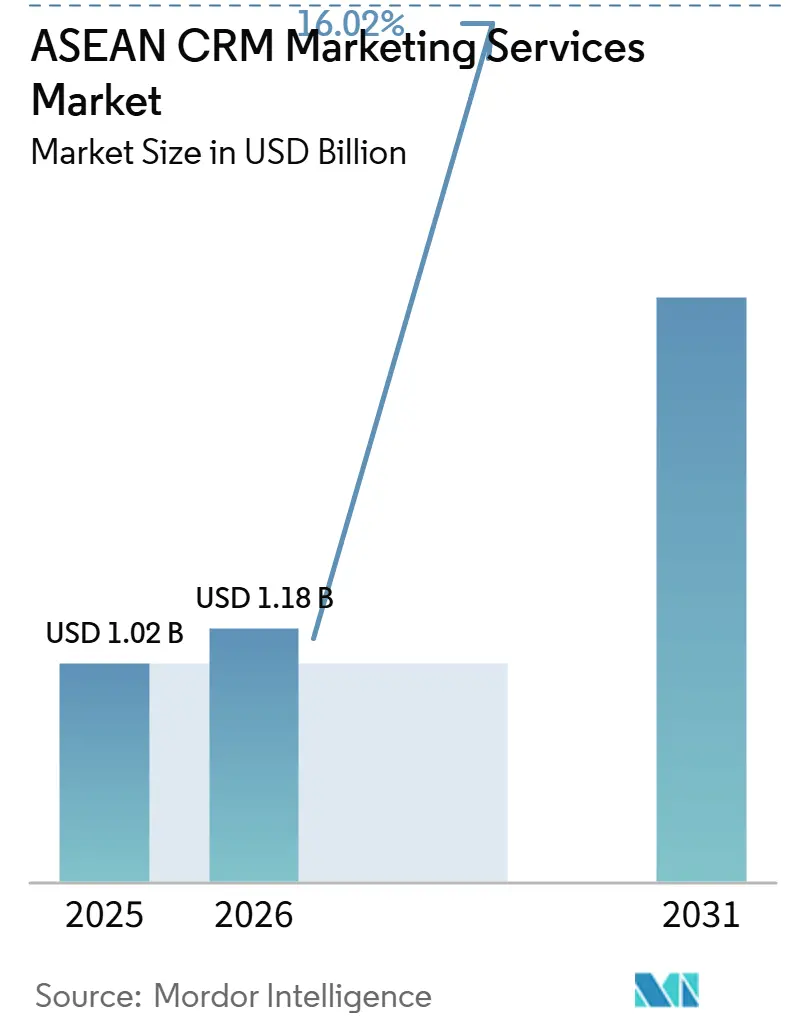
| Base Year Market Size (2025) | USD 1.02 Billion |
| Market Size (2026) | USD 1.18 Billion |
| Market Size (2031) | USD 2.49 Billion |
| Growth Rate (2026 - 2031) | 16.02 % |
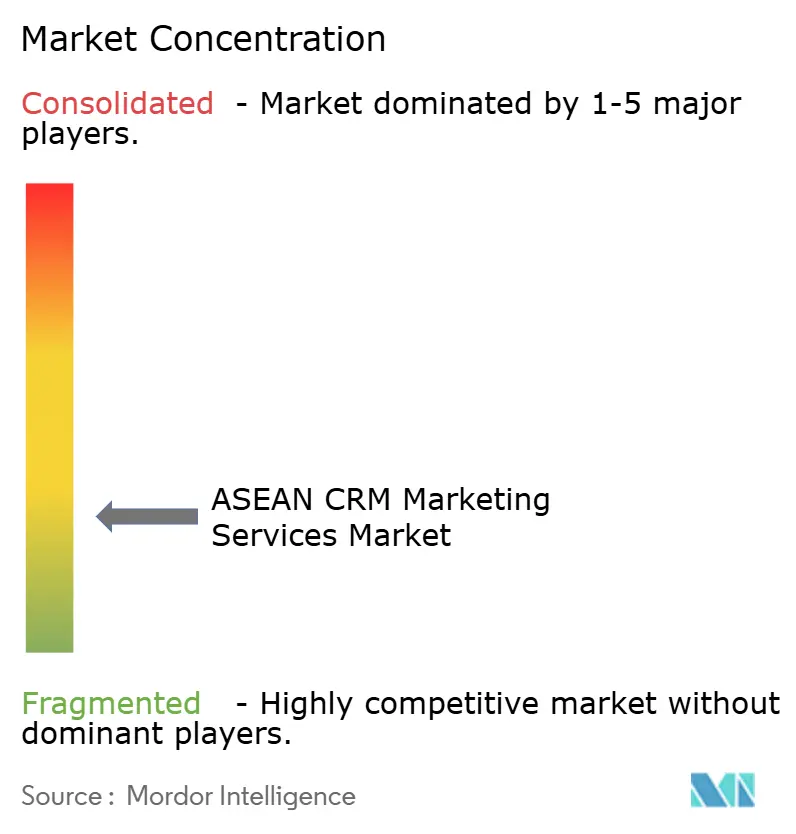
| Market Concentration | Low |
Major Players *Disclaimer: Major Players sorted in no particular order Image © Mordor Intelligence. Reuse requires attribution under CC BY 4.0. | |
ASEAN CRM Marketing Services Market Analysis by Mordor Intelligence
The ASEAN CRM marketing services market size is expected to grow from USD 1.02 billion in 2025 to USD 1.18 billion in 2026 and is forecast to reach USD 2.49 billion by 2031 at 16.02% CAGR over 2026-2031. The wider adoption of AI-led personalization is supporting growth, the rising reliance on chat-based commerce, and greater acceptance of cloud delivery models that reduce setup friction for both large companies and smaller firms. Singapore remains the regional software hub, while Vietnam, Indonesia, Thailand, Malaysia, and the Philippines are seeing expanding demand as digital sales channels deepen and businesses seek better customer data, campaign, and retention tools. The ASEAN CRM marketing services market is also being shaped by competition between global platforms with stronger compliance and deeper ecosystems, and regional vendors built for local languages, chat commerce, and faster rollout cycles. Talent shortages, uneven privacy rules, and USD-denominated subscription budgets still slow parts of the buying cycle, especially when companies want multi-country deployments with a common data model. Even with those limits, policy-backed digitalization programs and stronger buyer preference for managed delivery keep the spending outlook firm through 2031.
Key Report Takeaways
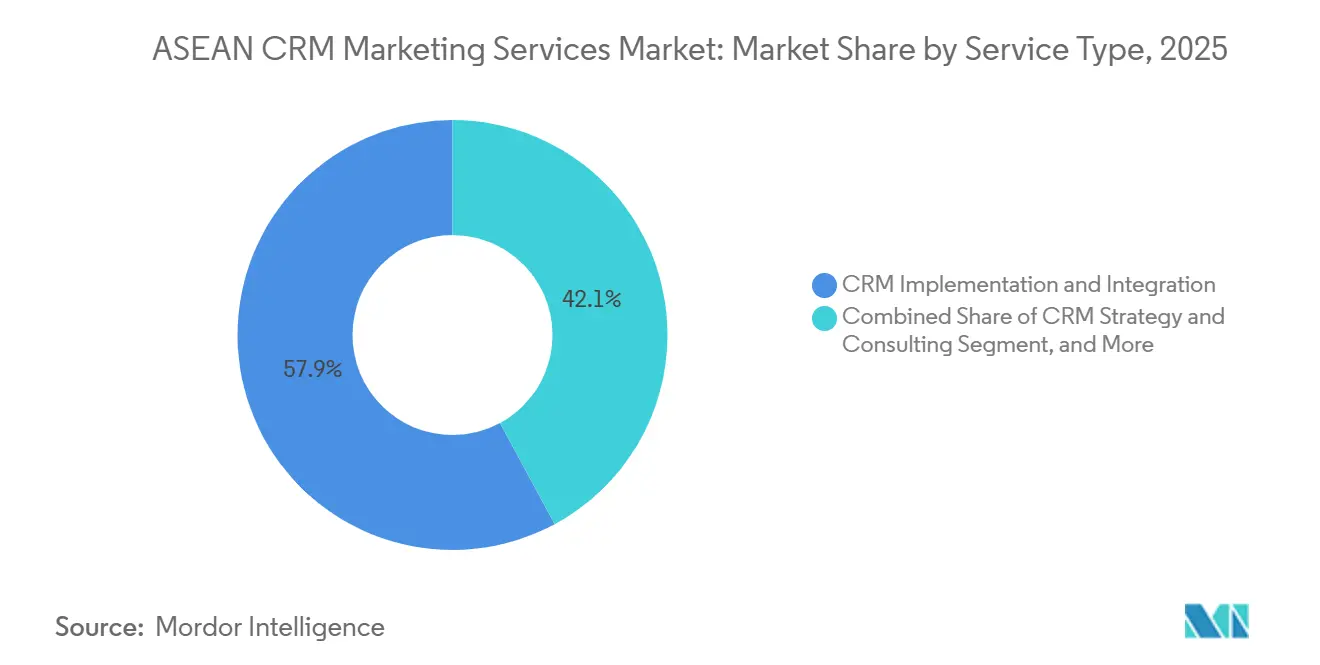
- By service type, CRM Implementation and Integration held 57.88% of the ASEAN CRM marketing services market share in 2025, while CRM Managed Services is projected to expand at a 19.04% CAGR through 2031.
- By enterprise size, Large Enterprises held 70.21% of the ASEAN CRM marketing services market share in 2025, while Small and Medium Enterprises are projected to grow at a 19.45% CAGR through 2031.
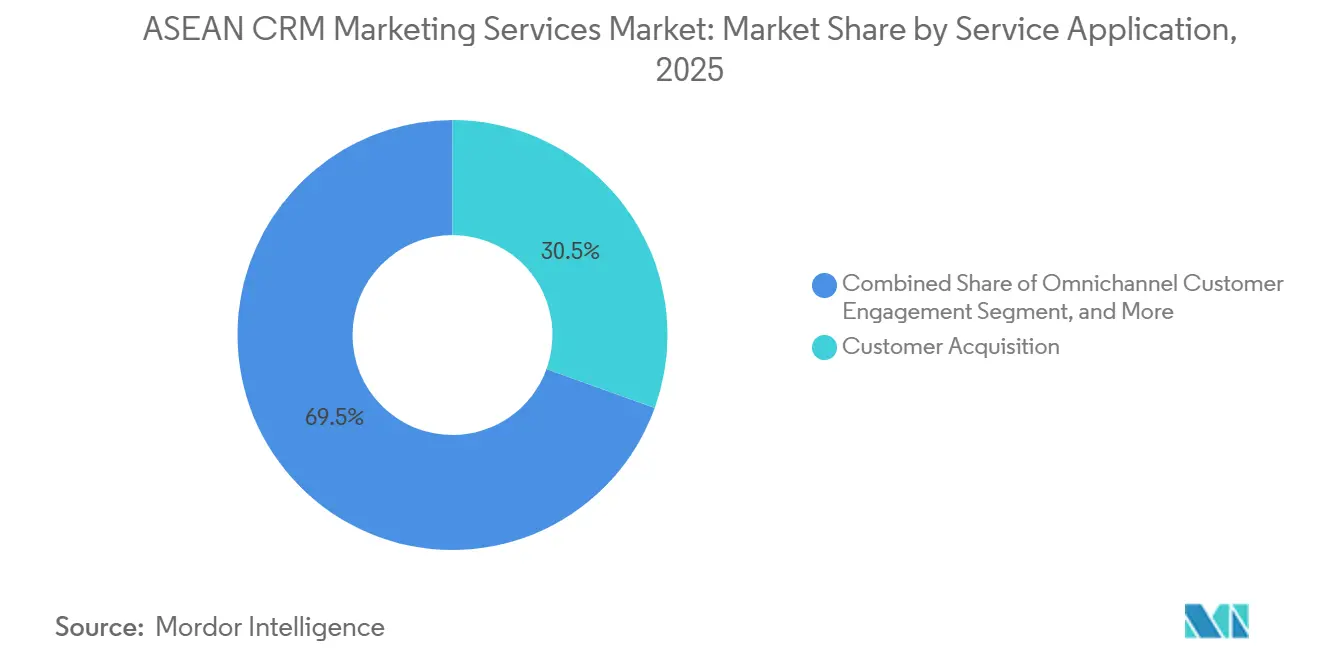
- By service application, Customer Acquisition accounted for 30.52% of the ASEAN CRM marketing services market share in 2025, while Personalization Services are projected to advance at an 18.66% CAGR through 2031.
- By end-user industry, Retail and E-commerce held 29.41% share in 2025, while BFSI is projected to grow at a 17.87% CAGR through 2031.
- By geography, Singapore held 32.12% share in 2025, while Vietnam is projected to expand at an 18.29% CAGR through 2031.
Note: Market size and forecast figures in this report are generated using Mordor Intelligence’s proprietary estimation framework, updated with the latest available data and insights as of January 2026.
Market Trends and Insights
Drivers Impact Analysis of ASEAN CRM Marketing Services Market*
| Driver | (~) % Impact on CAGR Forecast | Geographic Relevance | Impact Timeline |
|---|---|---|---|
| Ai-Enabled Hyper-Personalization Driving Upsell | +3.5% | ASEAN-wide, with Indonesia, Thailand, and Vietnam as major beneficiaries | Medium term (2-4 years) |
| Cloud-First Digitalization Across SMEs | +3.2% | ASEAN-wide, with Indonesia, Vietnam, and the Philippines leading adoption | Short term (≤ 2 years) |
| Social-Commerce Boom Integrating CRM into Chat Apps | +2.8% | Thailand, Vietnam, Indonesia, and the Philippines, with spillover across ASEAN | Short term (≤ 2 years) |
| Government Go-Digital Incentives in ASEAN | +2.4% | Singapore, Malaysia, the Philippines, Indonesia, and Vietnam | Medium term (2-4 years) |
| Open API Ecosystems Lowering Vendor Lock-In | +2.0% | Indonesia and Singapore, with spillover into Malaysia and Thailand | Medium term (2-4 years) |
| CX Outsourcing Pivoting to Value-Add CRM Services | +1.8% | The Philippines, Malaysia, and Singapore | Long term (≥ 4 years) |
| Source: Mordor Intelligence | |||
AI-Enabled Hyper-Personalization Driving Upsell
AI-led personalization has moved well beyond experimentation in Southeast Asia, and that shift is widening the scope of service work within the ASEAN CRM marketing services market, as buyers now need cleaner data, stronger orchestration, and more frequent campaign tuning. Adobe reported in 2025 that only 9% of surveyed senior executives in Southeast Asia rated their organization’s digital customer experience as exceptional, and data fragmentation was identified as the largest barrier to improvement.[1] That gap matters because personalization programs rarely succeed when customer data remains split across commerce, loyalty, support, and messaging systems, so service providers are being asked to solve data quality and activation problems together. HubSpot’s Spring Spotlight 2026 launch introduced an Agentic Engagement Object that leverages CRM history and real-time intent signals for more contextual outreach, demonstrating how core platform design is shifting toward AI-native execution rather than optional add-ons. As more vendors build these capabilities into the product layer, buyers are placing less emphasis on software access alone and more emphasis on the partner’s ability to operationalize analytics, journeys, and content across channels. That is pushing managed personalization and analytics work higher up in the ASEAN CRM marketing services market, as enterprises need continuous optimization after the initial deployment rather than a one-time implementation effort.
Cloud-First Digitalization Across SMEs
Cloud-first adoption is changing the economics of CRM for smaller businesses, and that matters in the ASEAN CRM marketing services market because lower upfront cost and faster setup make formal customer management tools accessible to a wider buyer base. Cybozu stated in March 2026 that Southeast Asia had become its main global investment and growth engine, and it earmarked MYR 25 million (USD 6.4 million) for Malaysia expansion as part of that push. The company also launched a new CRM Suite in February 2026 with Malay language support, demonstrating that vendors are tailoring products to local workflows, reducing administrative burden, and making adoption easier for smaller firms. Salesforce noted in its March 2025 Singapore investment disclosure that 65% of firms in Malaysia identify digital talent as a priority, a signal that many companies still need tools that reduce the need for large internal technical teams. This combination of lighter deployment, local language support, and lower staffing intensity is widening the addressable base beyond large enterprises that can afford dedicated CRM specialists and longer rollout cycles. It also explains why some of the fastest-growing demand in the ASEAN CRM marketing services market is coming from buyers who prefer subscription-led delivery, no-code administration, and bundled support over large transformation programs.
Social-Commerce Boom Integrating CRM Into Chat Apps
Social commerce continues to pull sales, service, and loyalty activities into messaging channels, reshaping the ASEAN CRM marketing services market because customer journeys often begin and continue in chat rather than on a conventional website path. In markets such as Thailand, Vietnam, and Indonesia, businesses commonly use chat applications as the first touchpoint for product discovery, transaction coordination, service response, and repeat engagement, which creates a very different operating model for CRM service delivery. That structure raises the value of integration work because customer records, campaign logic, agent workflows, and follow-up messaging need to remain connected in near real time if businesses want a usable view of each account. Mekari Qontak said in June 2026 that Indonesian businesses typically use 4 to 6 separate systems to manage customers, a setup that fragments data and weakens campaign context. Its platform update combined a Customer Data Platform, Agentic AI, and loyalty management into a single dashboard, reflecting the kind of consolidation that regional buyers increasingly expect from both software vendors and implementation partners. As a result, chat-linked orchestration, customer data unification, and loyalty activation are becoming more valuable service lines inside the ASEAN CRM marketing services market than traditional templates built around a more linear digital funnel.
Government Go-Digital Incentives in ASEAN
Government-backed digitalization is creating a steadier base of demand for CRM adoption, and this support matters to the ASEAN CRM marketing services market because it lowers hesitation among mid-sized firms, public-linked entities, and newer digital businesses. The 48th ASEAN Summit in May 2026 adopted a declaration on AI-powered MSME growth, formalizing regional support for smaller businesses using AI to improve productivity and customer management. Vietnam also approved its Program for Digital Economy and Digital Society Development for 2026-2030, with a target for the digital economy to reach 30% of GDP by 2030, up from 14.02% in 2025, and a policy direction that supports broader enterprise software spending. Singapore remains an anchor for regional capability building because Salesforce’s March 2025 investment plan aligned with the country’s National AI Strategy 2.0 and expanded its local data residency footprint. These policy signals make CRM projects easier to justify within broader modernization budgets because they connect customer management tools with productivity, digital services, and national competitiveness goals. They also help lengthen vendor pipelines in the ASEAN CRM marketing services market because buyers can tie CRM work to larger digital programs rather than treat it as a narrow marketing expense.
Restraints Impact Analysis of ASEAN CRM Marketing Services Market*
| Restraint | (~) % Impact on CAGR Forecast | Geographic Relevance | Impact Timeline |
|---|---|---|---|
| Scarcity of CRM Implementation Talent | -1.8% | Singapore, Malaysia, Indonesia, and Vietnam, with the sharpest pressure in Singapore and Malaysia | Long term (≥ 4 years) |
| Patchy Data Privacy Enforcement Across SEA | -1.5% | Thailand, Vietnam, and Indonesia, with more mature enforcement in Singapore and Malaysia | Medium term (2-4 years) |
| Legacy On-Premise ERP Lock-Ins Slowing Migration | -1.2% | Thailand, Indonesia, and the Philippines, especially among large banks and manufacturers | Long term (≥ 4 years) |
| Currency Volatility Squeezing SaaS Budgets | -0.9% | Indonesia, Vietnam, and the Philippines | Short term (≤ 2 years) |
| Source: Mordor Intelligence | |||
Scarcity of CRM Implementation Talent
The shortage of certified CRM administrators, developers, and change-management specialists remains one of the clearest operating constraints on the ASEAN CRM marketing services market, as it slows rollouts and raises delivery costs even when software demand is healthy. Salesforce said in March 2025 that 83% of employers in Singapore report hiring challenges, and that the country will need 41,000 additional technology roles by 2028. The same disclosure noted that only 15% of citizens in Malaysia possess advanced ICT skills, while 65% of firms list digital talent as a priority, suggesting a regional execution bottleneck rather than a single-country issue. In practical terms, that shortage lengthens deployment cycles, raises the cost of customization, and makes post-launch optimization harder for buyers who want to run CRM programs with lean in-house teams. It also favors vendors with larger partner ecosystems, repeatable templates, and standardized service methods over firms that depend heavily on scarce custom implementation talent. That is one reason managed delivery is rising faster than several other service lines in the ASEAN CRM marketing services market, because many enterprises prefer ongoing external support to the risk of building small internal teams that are hard to hire and harder to retain.
Patchy Data Privacy Enforcement Across SEA
Data privacy rules across Southeast Asia are becoming more stringent, but they are not moving at the same pace in every country, which complicates multi-country execution in the ASEAN CRM marketing services market. Enterprises with operations in Singapore or Malaysia often face stricter governance expectations and more structured data-handling processes than peers in markets where enforcement is still evolving, creating an uneven compliance burden within regional programs. That difference matters because CRM deployments now sit closer to customer identity, behavioral history, campaign consent, and cross-channel engagement records than before, so privacy design can no longer be treated as a late-stage legal review. Salesforce’s March 2025 Singapore announcement highlighted the expansion of Hyperforce with in-country data residency for Data Cloud, Agentforce, and Unified Marketing Applications, a step that shows vendors are already adapting product delivery to privacy-sensitive procurement needs. Buyers with regional footprints, therefore, need more architecture review, governance work, and workflow control before they can scale a single customer data model across several ASEAN markets. The friction does not stop demand, but it does slow the pace at which the ASEAN CRM marketing services market can move from local deployments toward fully integrated cross-border CRM programs.
*Our forecasts treat driver/restraint impacts as directional, not additive. The impact forecasts reflect baseline growth, mix effects, and variable interactions.
ASEAN CRM Marketing Services Market Segment Analysis
By Service Type:
Implementation Dominates, but Managed Services Rewrites the Growth CurveCRM Implementation and Integration accounted for 57.88% of the ASEAN CRM marketing services market in 2025, indicating that current spending is still weighted toward first-wave deployment rather than later-stage optimization and maturity work. Many enterprises are still moving from spreadsheet, email, and siloed workflow environments to centralized CRM platforms, and that transition requires configuration, API-based data integration, workflow redesign, and user onboarding support across different business functions. In ASEAN, that work is made more complex by multi-language operating environments, varied reporting practices, and the need to align customer data across commerce, service, and marketing systems that were not originally built together. CRM Managed Services is projected to grow at a 19.04% CAGR through 2031, reflecting a client base that increasingly wants ongoing execution after the first rollout rather than a project that ends at go-live. Strategy and Consulting, Migration and Modernization, and Training and Support continue to matter because buyers still need planning, platform replacement, and user adoption support even when implementation remains the largest line item.
The February 2025 acquisition of PT Kreatif Dinamika Integrasi by EY Digital Solutions showed that larger providers were willing to invest directly in Microsoft Dynamics 365 capability for Indonesia and the wider ASEAN region. The transaction created a 114-person Microsoft Center of Excellence, indicating the scale of enterprise demand for CRM migration, integration, and process redesign, rather than just basic software setup. That move also suggests the implementation segment is tilting toward credentialed, full-service providers that can handle deployment, modernization, and governance under a single contract, especially for larger accounts that operate across several markets. At the same time, implementation partners are increasingly being asked to build privacy and governance controls into rollout frameworks for sectors such as healthcare and financial services, where customer data rules are tighter and audit requirements are stronger. This combination of integration work, modernization, training, and managed delivery keeps the service mix broad, even as implementation remains the largest revenue pool in the ASEAN CRM marketing services market.

By Enterprise Size:
Large Enterprises Lead by Value, SMEs Drive VelocityLarge Enterprises accounted for 70.21% of segment revenue in 2025, which kept them at the center of current billing because they spend more per account, run more complex deployments, and require broader integration across customer, finance, sales, and service systems. Their contracts are usually high-value and long-term because regional rollouts often involve multiple countries, several business units, and legacy systems that cannot be replaced all at once. Large banks and manufacturers, in particular, still operate older on-premises environments that must be reconciled with newer cloud CRM tools, which increases the amount of design, migration, and testing work in each engagement. Small and Medium Enterprises are projected to grow at a 19.45% CAGR through 2031, driven by cloud delivery, lower per-seat costs, and simpler administration, making CRM more practical for firms that could not justify complex deployments in the past. This keeps enterprise-scale contracts dominant in revenue terms, while smaller buyers supply a faster stream of new adoption and more frequent product-led onboarding.
Kintone’s February 2026 CRM Suite launch with Malay language support shows how vendors are tailoring products for smaller businesses that want usability and local relevance rather than deep customization from the start. The company’s March 2026 commitment of MYR 25 million (USD 6.4 million) to Malaysia expansion also points to rising confidence in SME demand across Southeast Asia, especially in markets where adoption depends on a simple first rollout and steady managed support. This part of the buyer base is moving faster because many smaller firms can leap directly into no-code or low-code tools and avoid the migration burden that still slows larger organizations. Chat-linked CRM tools also align better with existing SME habits, as many businesses already run sales follow-up and customer service through messaging channels and do not need a major behavioral change to start using structured CRM workflows. As that pattern spreads, a larger share of new bookings in the ASEAN CRM marketing services market is likely to come from buyers who value speed, affordability, and outsourced support over long transformation programs.
By Service Application:
Acquisition Leads Spend, Personalization Commands the Growth PremiumCustomer Acquisition held 30.52% of the service application segment in 2025, keeping top-of-funnel spending at the center of the ASEAN CRM marketing services market, as many firms are still focused on building structured customer databases and repeatable lead-capture systems. This weighting reflects the market’s still-developing maturity, where businesses often begin with acquisition programs before expanding into more sophisticated retention, loyalty, and lifecycle orchestration work. Acquisition projects are also easier to justify early because they connect directly with digital channel growth, new customer conversion, and near-term campaign performance, all of which remain important in a competitive regional commerce setting. Personalization Services are projected to rise at an 18.66% CAGR through 2031, and that premium reflects stronger buyer interest in tailored outreach, product recommendation logic, intent-based targeting, and more responsive customer journeys. Adobe’s 2025 Asia study found that data fragmentation remains the biggest barrier to a strong digital customer experience, which helps explain why personalization work often begins with data cleanup and orchestration before it reaches creative or offer optimization.
The rest of the application mix includes Retention and Loyalty, Campaign Management, Marketing Automation, Customer Analytics and Insights, and Omnichannel Customer Engagement, and each category is gaining importance as companies try to connect marketplace, direct, and social channels into a more coherent operating model. Customer Analytics and Insights and Omnichannel Customer Engagement are moving up quickly because many firms still hold customer records across several tools, which makes it hard to coordinate campaigns, measure outcomes, or deliver a consistent experience across touchpoints. Mekari Qontak’s June 2026 platform update combined a Customer Data Platform, Agentic AI, and loyalty management into a single dashboard, following the company's observation that Indonesian businesses often use 4 to 6 separate systems for customer management. That product direction supports service providers that can unify fragmented data, tune cross-channel journeys, and run loyalty and automation programs across the channel mix that is common in Southeast Asia. It also shows why the ASEAN CRM marketing services market is placing greater value on service partners that can integrate messaging, loyalty, analytics, and automation into a single practical workflow rather than treating each application as a separate point solution.
By End-User Industry:
Retail Anchors Share, BFSI Claims the Fastest GrowthRetail and E-commerce captured 29.41% of the ASEAN CRM marketing services market share in 2025, making it the largest end-user segment, as transaction frequency is high, competition is intense, and customer switching costs are usually low. CRM service demand is especially strong in this segment because campaigns need to be tightly timed around promotions, seasonal demand peaks, and large regional commerce events such as 11.11 and 12.12, which require constant monitoring and rapid adjustment. Loyalty and retention also matter more in retail than in many other sectors because businesses need to keep reacquiring buyers who can compare offers across marketplaces, direct channels, and social commerce interfaces in real time. BFSI is projected to grow at a 17.87% CAGR through 2031 as banks, insurers, and fintechs invest more heavily in onboarding, retention, and cross-sell programs shaped by digital competition and customer churn pressure. Oracle’s April 2026 rollout of NetSuite Next AI features in Southeast Asia, with the Philippines and Singapore as priority early markets, directly supports this push toward smarter customer management workflows in finance-linked customer environments.
IT and Telecom companies are also investing in migration work as they retire older CRM environments and connect service data with newer digital engagement tools, keeping modernization work relevant beyond the retail and finance segments. Healthcare and Life Sciences buyers in Singapore and Malaysia face a different challenge: patient engagement initiatives require stronger controls over data handling, access, and process design, which underscores the value of governance-aware implementation partners. Government and Public Administration remain smaller in revenue terms, but it is strategically important because public digital service programs create additional use cases for CRM-based outreach, response management, and citizen communication as more services move online.[2] Industrial Manufacturing is still early in adoption, yet distributor and dealer management across multi-country supply chains is creating a practical reason for wider CRM adoption as manufacturers try to improve visibility and account coordination. This broad end-user spread helps the ASEAN CRM marketing services market remain resilient, as demand does not depend on a single vertical, even though retail and e-commerce still set the pace for current revenue.
Geography Analysis
Singapore CRM Marketing Services Market
Singapore held 32.12% of the ASEAN CRM marketing services market share in 2025, which kept it in the lead because many regional enterprise software decisions are still made there, and a large share of multinational coordination runs through the city-state. Salesforce’s USD 1 billion investment plan over 5 years, together with the expansion of Hyperforce and the introduction of local data residency for Data Cloud, Agentforce, and Unified Marketing Applications, reinforced Singapore’s position as the region’s main enterprise CRM hub.[3] The AI Innovation Hub opened at Salesforce’s Singapore office in May 2026, and planned data and AI Centers of Excellence with Accenture, PwC Singapore, and Huron demonstrate how implementation capacity is being more closely tied to AI-led delivery. Stronger privacy expectations also make Singapore attractive to buyers who want clearer governance structures and in-country data-handling options before they scale more advanced customer programs. For those reasons, Singapore continues to attract higher-value implementation, compliance, and managed service work than most neighboring markets, even though its volume opportunity is smaller than Indonesia’s in terms of pure business counts.
Vietnam CRM Marketing Services Market
Vietnam is projected to grow at an 18.29% CAGR through 2031, making it the fastest-growing country segment in the ASEAN CRM marketing services market, as digital demand is rising quickly and policy support remains strong. VietnamPlus reported that the government aims to raise the digital economy's share of GDP to 30% by 2030, up from 14.02% in 2025, supporting wider enterprise software spending across major customer-facing sectors. VCCI said Vietnam’s digital economy was set to reach USD 39 billion in 2025, and that pace helps explain why customer acquisition, campaign, and personalization services are gaining traction quickly. Salesforce’s April 2026 data and AI Center of Excellence with FPT Software adds a local capability base that should make future deployments easier for domestic and regional clients.
ASEAN CRM Marketing Services Market
Indonesia, Malaysia, Thailand, and the Philippines provide the ASEAN CRM marketing services market with a broad second tier of demand, with each country contributing a distinct mix of SME adoption, enterprise modernization, and delivery capacity. Indonesia’s opportunity is shaped by scale and fragmentation at the same time, and Mekari Qontak’s June 2026 product expansion reflects how local demand is leaning toward tools that connect messaging, loyalty, and customer data into a single operating layer. The Philippines is attracting more direct vendor attention, as shown by Salesforce’s November 2025 launch of its Manila office and the January 2026 expansion of its startup program, while Oracle also placed the Philippines in the first wave for NetSuite Next AI features. Malaysia and Thailand remain important mid-sized opportunities because digitalization efforts, BFSI competition, and rising demand outside top metro areas are widening the need for implementation and managed support.
Competitive Landscape
The ASEAN CRM marketing services market is moderately consolidated at the platform layer, but remains fragmented in service delivery, as global software vendors, regional partners, and local SaaS firms compete for different buyer groups and account sizes. Large vendors still hold an advantage with enterprise brand recognition, established compliance structures, and partner ecosystems that can support multi-country programs without requiring buyers to assemble several providers on their own. Salesforce’s 2026 network of data and AI Centers of Excellence across Vietnam, Singapore, Thailand, the Philippines, and Indonesia shows how leading platforms are pairing software scale with local execution depth. Oracle followed a similar path when it launched an AI Center of Excellence in Singapore in March 2025 to support customer management innovation for businesses operating across Southeast Asia.[4] This structure raises the competitive bar for smaller providers, as enterprise buyers increasingly want both platform maturity and local service responsiveness under a single contract, especially when privacy, data residency, and AI use cases are part of the brief.
India-origin vendors such as Zoho, Freshworks, and Capillary Technologies remain competitive because pricing is often sharper, deployment can be quicker, and regional language and workflow needs are treated more directly than in some Western-first delivery models. ASEAN-native platforms compete on another front, especially where chat commerce, messaging integration, and conversational service design matter more than long enterprise feature lists or deep global functionality. Mekari Qontak’s June 2026 move to combine a Customer Data Platform, Agentic AI, and loyalty management into a single dashboard is a clear example of that localized product strategy. Freshworks reported in its first-quarter 2026 results that it landed the 2 largest deals in company history, including its first USD 1 million-plus annual recurring revenue contract, which shows that India-origin challengers are beginning to win larger enterprise opportunities.
The next competitive battleground in the ASEAN CRM marketing services market is likely to be managed services and personalization for SMEs outside Singapore and Malaysia, where credentialed delivery capacity remains thinner than underlying demand. Vendors that can offer repeatable templates, faster onboarding, and ongoing optimization at modest cost are in a stronger position than firms that depend heavily on long custom projects and scarce specialist teams. Compliance is also becoming a moat because providers that can package privacy controls, cross-border data handling practices, and audit-ready reporting into standard delivery models remove a real source of friction for enterprise buyers. This leaves room for both global leaders and regional specialists rather than for one dominant provider, because the market still rewards local execution, workflow fit, and channel integration almost as much as software scale.
ASEAN CRM Marketing Services Industry Leaders
-
Salesforce, Inc.
-
Microsoft Corporation
-
Oracle Corporation
-
SAP SE
-
Adobe Inc.
- *Disclaimer: Major Players sorted in no particular order
ASEAN CRM Marketing Services Market Companies Covered in this Report
- Salesforce, Inc.
- Microsoft Corporation
- Adobe Inc.
- Oracle Corporation
- SAP SE
- HubSpot, Inc.
- Zoho Corporation Pvt. Ltd.
- Freshworks Inc.
- SugarCRM Inc.
- Zendesk, Inc.
- Pipedrive OÜ
- Creatio, Inc.
- monday.com Ltd.
- Keap, Inc.
- Insightly, Inc.
- Odoo S.A.
- Vtiger Systems Pvt. Ltd.
- Barantum PT Kosada Group
- Capillary Technologies India Limited
- Deskera Holdings Ltd.
- Qontak Pte. Ltd.
Recent Industry Developments in ASEAN CRM Marketing Services Market
- June 2026: Mekari Qontak (parent company of Qontak Pte. Ltd.) announced a major platform evolution, integrating a Customer Data Platform, Agentic AI, and Loyalty Management into a single unified system. The upgrade addresses a core ASEAN challenge: Indonesian businesses reportedly use four to six separate systems to manage customer data, and the consolidated architecture positions Qontak as a full-stack alternative to multi-vendor CRM marketing services stacks.
- May 2026: Salesforce opened an AI Innovation Hub at its Singapore office and announced the launch of data and AI Centers of Excellence with Accenture, PwC Singapore, and Huron in Singapore, and with Thailand, the Philippines, and Indonesia expected this year. A first CoE had already been established with FPT Software in Vietnam in April 2026, significantly expanding the company's regional AI delivery network.
- April 2026: Oracle announced the rollout of its NetSuite Next AI features across Southeast Asia, with the Philippines and Singapore designated as priority markets in the first wave. The new capabilities include AI-powered workflow automation, natural language search, and analytics enhancements targeting customer management functions, directly expanding Oracle's addressable CRM services engagement base in the region.
- March 2026: Cybozu Inc., parent of Kintone, formally designated Southeast Asia as its most promising global investment region, earmarking MYR 25 million (approximately USD 6.4 million) for Malaysia expansion following a 106.4% surge in operating profit. The company launched a new CRM Suite in February 2026 with Malay language support, targeting SME digitalization across the region as its growth thesis.
ASEAN CRM Marketing Services Market Report Scope
The ASEAN CRM Marketing Services Market includes professional and managed services that help businesses leverage customer relationship management (CRM) platforms to improve marketing effectiveness and customer engagement across the Association of Southeast Asian Nations (ASEAN). These services include customer segmentation, campaign orchestration, marketing automation, customer journey management, and analytics-driven marketing optimization. Rapid digitalization, expanding e-commerce ecosystems, and increasing demand for personalized customer experiences support the market. The market enables organizations to strengthen customer relationships and improve marketing return on investment across diverse regional markets.
The ASEAN CRM Marketing Services Market Report is Segmented by Service Type (CRM Strategy and Consulting, CRM Implementation and Integration, CRM Migration and Modernization, CRM Managed Services, and CRM Training and Support), Enterprise Size (Large Enterprises, and Small and Medium Enterprises), Service Application (Customer Acquisition, Customer Retention and Loyalty, Campaign Management Services, Marketing Automation Services, Customer Analytics and Insights, Omnichannel Customer Engagement, and Personalization Services), End-user Industry (Banking, Financial Services, and Insurance (BFSI), Healthcare and Life Sciences, Information Technology and Telecom, Retail and E-commerce, Industrial Manufacturing, Government and Public Administration, and Other End-user Industries), and Geography (Singapore, Indonesia, Malaysia, Philippines, Thailand, Vietnam, and Rest of ASEAN). The Market Forecasts are Provided in Terms of Value (USD).
Segmentation Overview
| CRM Strategy and Consulting |
| CRM Implementation and Integration |
| CRM Migration and Modernization |
| CRM Managed Services |
| CRM Training and Support |
| Large Enterprises |
| Small and Medium Enterprises |
| Customer Acquisition |
| Customer Retention and Loyalty |
| Campaign Management Services |
| Marketing Automation Services |
| Customer Analytics and Insights |
| Omnichannel Customer Engagement |
| Personalization Services |
| Banking, Financial Services, and Insurance (BFSI) |
| Healthcare and Life Sciences |
| Information Technology and Telecom |
| Retail and E-commerce |
| Industrial Manufacturing |
| Government and Public Administration |
| Other End-user Industries |
| Singapore |
| Indonesia |
| Malaysia |
| Philippines |
| Thailand |
| Vietnam |
| Rest of ASEAN |
| By Service Type | CRM Strategy and Consulting |
| CRM Implementation and Integration | |
| CRM Migration and Modernization | |
| CRM Managed Services | |
| CRM Training and Support | |
| By Enterprise Size | Large Enterprises |
| Small and Medium Enterprises | |
| By Service Application | Customer Acquisition |
| Customer Retention and Loyalty | |
| Campaign Management Services | |
| Marketing Automation Services | |
| Customer Analytics and Insights | |
| Omnichannel Customer Engagement | |
| Personalization Services | |
| By End-user Industry | Banking, Financial Services, and Insurance (BFSI) |
| Healthcare and Life Sciences | |
| Information Technology and Telecom | |
| Retail and E-commerce | |
| Industrial Manufacturing | |
| Government and Public Administration | |
| Other End-user Industries | |
| By Geography | Singapore |
| Indonesia | |
| Malaysia | |
| Philippines | |
| Thailand | |
| Vietnam | |
| Rest of ASEAN |
Key Questions Answered in the Report
What is the size and growth outlook for the ASEAN CRM marketing services market?
The ASEAN CRM marketing services market was valued at USD 1.02 billion in 2025, stands at USD 1.18 billion in 2026, and is forecast to reach USD 2.49 billion by 2031 at a 16.02% CAGR.
Which service type currently leads regional revenue?
CRM Implementation and Integration led the region with a 57.88% share in 2025, which shows that most spending still goes to first-wave deployment and integration work.
Which buyer group is expanding fastest across Southeast Asia?
Small and Medium Enterprises are projected to grow at a 19.45% CAGR through 2031, supported by cloud delivery, simpler tools, and lower adoption costs.
Why are personalization services growing faster than many other applications?
Personalization Services are projected to rise at an 18.66% CAGR because buyers want better targeting, cleaner customer data, and more relevant engagement across chat, commerce, and service channels.
Which country leads regional demand and which one is growing fastest?
Singapore held the largest share at 32.12% in 2025 because it remains the main enterprise software hub, while Vietnam is projected to grow fastest at an 18.29% CAGR through 2031.
What are the main factors that could slow adoption in the region?
The main limits are shortages of certified CRM talent, uneven privacy enforcement across countries, legacy system complexity, and budget pressure from USD-denominated software spending.