
Asia-Pacific CRM Marketing Services Market Size and Share
Market Overview
| Study Period | 2020 - 2031 |
|---|---|
| Forecast Data Period | 2026 - 2031 |
| Base Year Market Size (2025) | USD 7.14 Billion |
| Market Size (2026) | USD 8.05 Billion |
| Market Size (2031) | USD 14.72 Billion |
| Growth Rate (2026 - 2031) | 12.83 % |
| Market Concentration | Medium |
Major Players *Disclaimer: Major Players sorted in no particular order Image © Mordor Intelligence. Reuse requires attribution under CC BY 4.0. | |
Asia-Pacific CRM Marketing Services Market Analysis by Mordor Intelligence
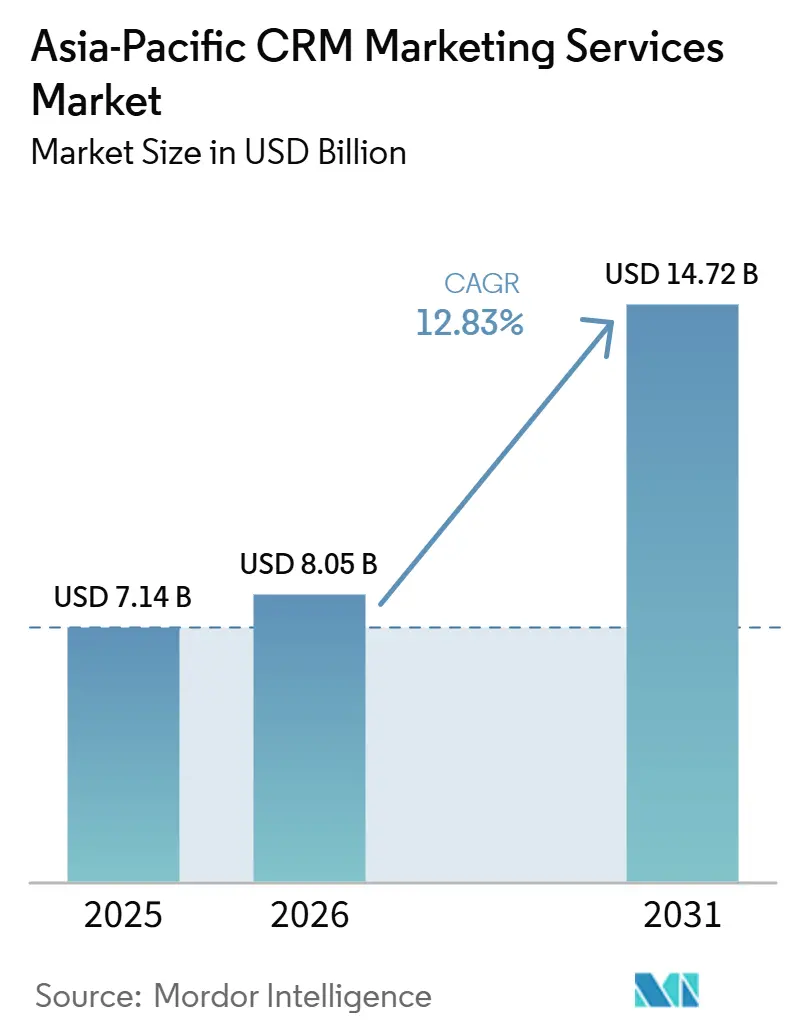
The Asia-Pacific CRM marketing services market size was valued at USD 7.14 billion in 2025 and USD 8.05 billion in 2026, and is forecast to reach USD 14.72 billion by 2031, at a CAGR of 12.83% from 2026 to 2031. The Asia-Pacific CRM marketing services market is moving beyond basic customer management, as enterprises across the region are linking CRM systems more closely with sales, service, marketing, and data operations. Cloud adoption in Japan, South Korea, and Australia is helping organizations replace fragmented vendor setups with more unified service environments, while India and Southeast Asia continue to adopt cloud-native models with fewer legacy constraints. The spread of first-party data requirements, the growth of super-app ecosystems, and rising demand for more coordinated customer engagement are changing how the Asia-Pacific CRM marketing services market is designed, bought, and managed. Large regional programs still support high-value implementation work, but recurring service models are gaining ground as companies seek outside support for administration, analytics, and campaign execution. Competitive activity also reflects this split, with global platform vendors focusing on large enterprise accounts and regional specialists expanding in mobile-first, AI-enabled, and SME-oriented service areas.
Key Report Takeaways
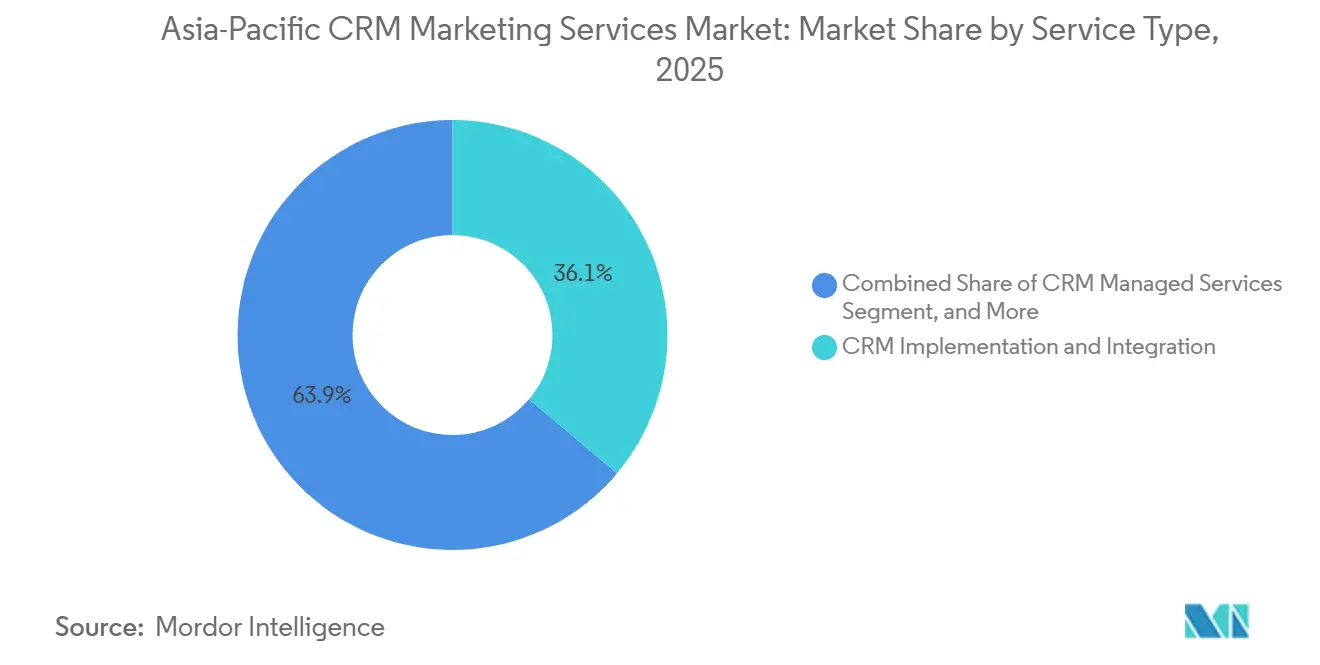
- By service type, implementation and integration held 36.12% of revenue in 2025 in the Asia-Pacific CRM marketing services market, while managed services are projected to expand at a 15.91% CAGR through 2031.
- By enterprise size, large enterprises accounted for 66.81% of revenue in 2025, while SMEs are expected to grow at a 14.68% CAGR through 2031.
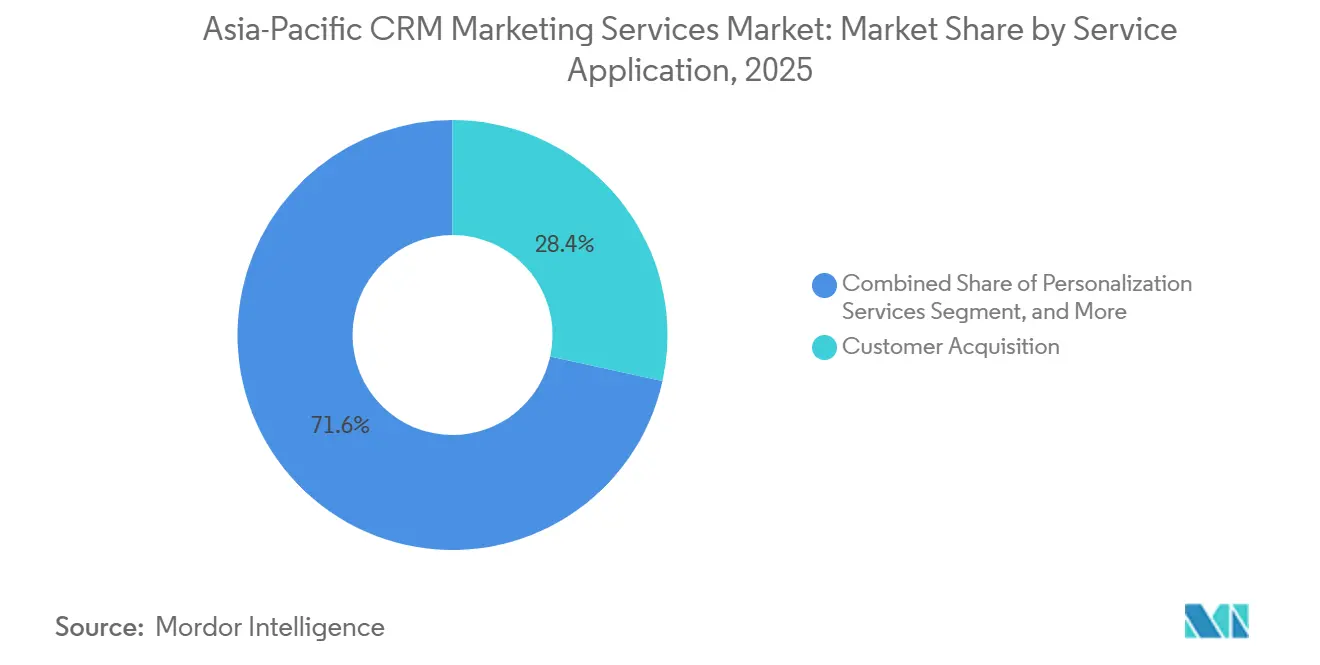
- By service, customer acquisition accounted for 28.43% of revenue in 2025, while omnichannel customer engagement is projected to grow at a 16.63% CAGR through 2031.
- By end-user industry, retail and e-commerce captured 24.11% of revenue in 2025, while healthcare and life sciences are projected to expand at a 17.27% CAGR through 2031.
- By geography, China held 33.41% of the Asia-Pacific CRM marketing services market in 2025, while India is projected to record the fastest growth at an 18.17% CAGR through 2031.
Note: Market size and forecast figures in this report are generated using Mordor Intelligence’s proprietary estimation framework, updated with the latest available data and insights as of January 2026.
Market Trends and Insights
Drivers Impact Analysis of Asia-Pacific CRM Marketing Services Market*
| DRIVER | (~) % IMPACT ON CAGR FORECAST | GEOGRAPHIC RELEVANCE | IMPACT TIMELINE |
|---|---|---|---|
| Rising Need for AI-Driven Customer Journey Orchestration | +3.2% | Global, with concentrated gains in China, India, and Australia | Short term (≤ 2 years) |
| Expansion of First-Party Data Strategies Across Privacy-Sensitive Markets | +2.1% | APAC core, particularly China, India, Singapore, and Indonesia | Medium term (2-4 years) |
| Growth of Commerce Media and Retail CRM Activation Budgets | +1.8% | China, India, and Southeast Asia RMN ecosystems | Short term (≤ 2 years) |
| Shift From Campaign Execution to Revenue Operations Alignment | +1.6% | Concentrated in Australia, Japan, and South Korea, expanding into India and ASEAN | Medium term (2-4 years) |
| Adoption of Real-Time Personalization Across Super-Apps and Mobile-First Ecosystems | +1.4% | APAC-wide, with intensity in Southeast Asia, Japan, and South Korea | Short term (≤ 2 years) |
| Underutilized Customer Data in Legacy MarTech Stacks Creating Outsourcing Demand | +1.1% | Japan, South Korea, Australia, and large Indian enterprises | Long term (≥ 4 years) |
| Source: Mordor Intelligence | |||
Rising Need for AI-Driven Customer Journey Orchestration
AI is becoming a standard operating layer for the Asia-Pacific CRM marketing services market, not a niche feature reserved for early adopters. Enterprises across the region are trying to manage large volumes of customer interactions across sales, service, and marketing channels without depending on disconnected tools. That shift is increasing demand for service providers that can unify campaign execution, personalization, analytics, and support workflows inside one operating model. It is also pushing more spending toward longer-duration managed contracts instead of one-time implementation work. Salesforce reinforced this direction in March 2025 when it committed USD 1 billion in Singapore over 5 years to support Agentforce adoption, Hyperforce expansion, and AI development with Singapore Airlines, showing how platform vendors are tying AI capability to regional CRM service growth.[1] As more enterprises expect AI-assisted case handling and next-best-action workflows, the Asia-Pacific CRM marketing services market is shifting toward providers that can manage both platform setup and ongoing orchestration at scale.
Expansion of First-Party Data Strategies Across Privacy-Sensitive Markets
The Asia-Pacific CRM marketing services market is also benefiting from the move toward first-party data strategies across countries with tighter privacy expectations. Enterprises can no longer rely on a single regional activation model when consent rules, data transfer requirements, and local storage expectations differ from one jurisdiction to another. This is making CRM architecture more country-aware, especially in China, India, Singapore, Indonesia, and other regulated markets. Service providers that can connect consent management, data residency design, and CRM activation are gaining a stronger role in buying decisions. Salesforce’s April 2025 expansion of Hyperforce data residency in Singapore reflected this need, especially for organizations in regulated sectors that require local handling of customer data. As privacy rules become part of core CRM planning, the Asia-Pacific CRM marketing services market is moving toward service models where compliance design and customer engagement execution sit much closer together.
Growth of Commerce Media and Retail CRM Activation Budgets
Commerce-linked advertising and retail activation are becoming a stronger growth channel for the Asia-Pacific CRM marketing services market. Brands are using transaction data, loyalty signals, and post-purchase behavior more directly inside CRM programs, which is increasing the need for integration and activation services. This matters in Asia-Pacific because retail, messaging, and commerce platforms are often closely connected inside the same digital environment. The practical result is that CRM programs are being built less as isolated marketing systems and more as extensions of commerce operations. That change is visible in platform partnerships such as the deeper Klaviyo and Shopify integration announced in March 2026, which added support for translated content, regional pricing, market-specific URLs, and multi-market synchronization in CRM workflows. As retail activation becomes more data-intensive, the Asia-Pacific CRM marketing services market is gaining new demand from brands and commerce platforms that need coordinated service support across acquisition, retention, and loyalty functions.
Shift From Campaign Execution to Revenue Operations Alignment
The Asia-Pacific CRM marketing services market is also being shaped by a shift from isolated campaign work toward broader revenue operations alignment. Enterprises increasingly want marketing, sales, and post-sales teams to work from shared definitions, shared customer records, and shared performance views. This raises the role of CRM service partners because the work now involves process alignment as much as technical deployment. Engagements tied to revenue operations tend to be larger because they include pipeline design, data governance, workflow mapping, and reporting logic across functions. Oracle’s regional push through its AI Customer Excellence Center in Singapore reflects this direction, as it focuses on organizations that are modernizing customer and business workflows through the city-state as a regional base.[2] As more companies connect CRM spending to revenue accountability, the Asia-Pacific CRM marketing services market is shifting toward broader transformation programs instead of narrow campaign support mandates.
Restraints Impact Analysis of Asia-Pacific CRM Marketing Services Market*
| RESTRAINT | (~) % IMPACT ON CAGR FORECAST | GEOGRAPHIC RELEVANCE | IMPACT TIMELINE |
|---|---|---|---|
| Fragmented Consent Management Across Asia-Pacific Jurisdictions | -2.4% | APAC-wide, with highest friction in China, India, Indonesia, and Vietnam | Medium term (2-4 years) |
| Difficulty Proving Incremental ROI in Multi-Touch CRM Programs | -1.8% | Global, with stronger intensity in Indonesia, Thailand, and India | Long term (≥ 4 years) |
| Skills Shortage in Marketing Automation, Data Engineering, and CRM Ops | -1.3% | APAC-wide, most acute in India, Australia, and Southeast Asia | Medium term (2-4 years) |
| Integration Complexity Across CRM, CDP, and Commerce Platforms | -1.0% | Japan, South Korea, Australia, and Southeast Asia | Long term (≥ 4 years) |
| Source: Mordor Intelligence | |||
Fragmented Consent Management Across Asia-Pacific Jurisdictions
Consent management remains a real barrier for the Asia-Pacific CRM marketing services market because regional deployments still face different national requirements for customer data handling. Programs that appear compliant at a regional level may still need redesign when they enter China, India, Indonesia, Vietnam, or other markets with specific processing and transfer rules. This raises delivery costs for service providers because architecture, workflows, and governance often need to be tailored country by country. It also slows execution, especially when real-time personalization depends on data movement across borders or between business units. Multi-country CRM programs, therefore, carry a higher compliance burden than their surface design suggests, and that burden affects pricing, staffing, and project timing. Until more organizations standardize local consent frameworks within their CRM programs, the Asia-Pacific CRM marketing services market will continue to face friction in cross-border activation and regional operating efficiency.
Difficulty Proving Incremental ROI in Multi-Touch CRM Programs
The Asia-Pacific CRM marketing services market also faces a commercial restraint in the form of attribution and ROI measurement. Many customer journeys in the region run across super-apps, e-commerce platforms, messaging channels, and owned brand properties, which makes it difficult to isolate the revenue impact of one CRM program. This problem is especially relevant for retention, loyalty, and lifecycle programs because those programs often influence behavior over a longer period and across more touchpoints. When finance teams cannot clearly connect CRM spending to incremental outcomes, budget approval becomes harder even when the strategic logic is strong. This tends to push buyers toward simpler, more measurable use cases, while more advanced omnichannel and loyalty programs move more slowly through procurement. As a result, the Asia-Pacific CRM marketing services market is still leaving some value unrealized in complex customer engagement programs that require stronger measurement frameworks.
*Our forecasts treat driver/restraint impacts as directional, not additive. The impact forecasts reflect baseline growth, mix effects, and variable interactions.
Asia-Pacific CRM Marketing Services Market Segment Analysis
By Service Type:
Implementation Leads Revenue While Managed Services Gains MomentumImplementation and integration held 36.12% of revenue in 2025, making it the largest service category in the Asia-Pacific CRM marketing services market. That share reflects the scale of ongoing deployment work across enterprises that are replacing older on-premises tools and aligning CRM with ERP, commerce, and data platforms. The work is often complex because large organizations operate across several countries, each with different data needs, workflow rules, and customer channels. Migration and modernization work continues to support this pipeline, especially where older CRM estates still shape system architecture and data structures. Strategy and consulting remain important because many deployments begin with roadmap, platform, and operating model decisions before implementation starts.
The service mix is now shifting as managed services become the fastest-growing sub-segment, with a projected 15.91% CAGR through 2031 in the Asia-Pacific CRM marketing services market. Companies are increasingly outsourcing platform administration, campaign execution, analytics support, and data hygiene because internal teams often cannot cover all of these functions consistently. This is changing the commercial model of the CRM services industry, as providers move from project-heavy delivery into longer recurring contracts. Outcome-linked delivery is also becoming more relevant because clients want providers to support measurable improvements, not only technical stability. In practical terms, implementation still anchors current revenue, but managed services are setting the longer-term direction of the Asia-Pacific CRM marketing services market.

By Enterprise Size:
Large Enterprises Hold the Base While SMEs Drive ExpansionLarge enterprises accounted for 66.81% of revenue in 2025, which shows how much of the Asia-Pacific CRM marketing services market still depends on large, multi-country contracts. These programs usually involve customized integrations, dedicated governance structures, broader compliance review, and longer timelines than SME deployments. Large organizations also tend to buy premium support and ongoing optimization work after the first implementation is complete. This makes them central to near-term revenue even when procurement cycles are slower. The high share also reflects the fact that many large enterprises are still modernizing older CRM setups rather than starting from scratch.
SMEs are projected to grow at 14.68% CAGR through 2031, making them the fastest-moving opportunity set in the Asia-Pacific CRM marketing services market. Lower-cost cloud models, grant support, and simplified deployment pathways are helping smaller businesses adopt CRM services earlier than before. Government-linked support has reinforced this trend, including Salesforce’s January 2026 startup program in Malaysia and the Philippines, which was designed to strengthen the regional innovation ecosystem and support wider technology deployment.[3] As SME demand expands, the Asia-Pacific CRM services industry is seeing stronger interest in templated implementations, lighter onboarding models, and scalable managed service packages. Large enterprises still dominate revenue today, but SMEs are widening the addressable base of the Asia-Pacific CRM marketing services market with faster adoption across cloud-first operating environments.
By Service Application:
Acquisition Remains Largest While Omnichannel Engagement Advances FastestCustomer acquisition represented 28.43% of revenue in 2025, giving it the largest application share in the Asia-Pacific CRM marketing services market. This position involves lead generation, campaign setup, and sales pipeline support in the earliest stages of CRM adoption. Many organizations enter CRM through acquisition-focused use cases because those workflows are easier to define and easier to justify in commercial terms. Campaign management, marketing automation, analytics, retention, and personalization then expand as teams build confidence in the data and operating model. That sequence is still visible across much of the region, especially where CRM programs begin with immediate revenue priorities.
Omnichannel customer engagement is projected to grow at a 16.63% CAGR by 2031, making it the fastest-growing application in the Asia-Pacific CRM marketing services market. This reflects the reality that customer journeys in Asia-Pacific often move across commerce platforms, messaging apps, service channels, and owned digital properties within a single relationship cycle. Service providers that can unify those flows are becoming more valuable because the technical and operational complexity is high. Klaviyo and Shopify deepened that direction in March 2026 by enabling synchronization of translated content, localized pricing, currency, and market-specific URLs into CRM workflows across multiple markets.[4] As organizations seek to connect acquisition, retention, and service interactions into a single customer record, omnichannel engagement is emerging as one of the clearest structural growth areas in the Asia-Pacific CRM marketing services market.
By End-User Industry:
Retail and E-Commerce Leads While Healthcare and Life Sciences Build FasterRetail and e-commerce held 24.11% of the Asia-Pacific CRM marketing services market share in 2025, making it the largest end-user industry by revenue. This reflects the high volume of customer interactions, campaign activity, and loyalty workflows that retailers and digital commerce platforms must manage. The sector also places strong emphasis on customer behavior tracking, repeat purchase stimulation, cross-sell activity, and post-purchase engagement, all of which support CRM service demand. BFSI remains another important end-user base because customer data control and lifetime value economics justify more structured CRM investment. IT and telecom, manufacturing, and government use cases also contribute through sector-specific customer management and service modernization programs.
Healthcare and life sciences are projected to grow at a 17.27% CAGR through 2031, making it the fastest-growing end-user segment in the Asia-Pacific CRM marketing services market. The segment is expanding because digital patient engagement, appointment management, telehealth support, and pharmaceutical relationship workflows all require more coordinated CRM capabilities. This demand is not limited to front-end communications, as healthcare providers also need integration between CRM platforms and regulated data environments. In India, the expansion of private healthcare networks and the push for interoperable patient data management under the Ayushman Bharat Digital Mission are increasing the need for implementation and integration support. Healthcare growth, therefore, stands out not only because it is faster, but because it requires more specialized delivery across compliance, workflow, and service design in the Asia-Pacific CRM marketing services market.
Geography Analysis
China CRM Marketing Services Market
China accounted for 33.41% of the Asia-Pacific CRM marketing services market share in 2025, which made it the largest country market in the region. Its scale reflects the depth of its digital commerce, platform, and enterprise software ecosystems. The market is distinct because CRM activity often connects closely with domestic digital platforms and local compliance expectations. That creates a service environment that is different from more standard global CRM rollouts. Localized operating requirements also raise the importance of in-country delivery and data design. For that reason, China remains central to current revenue across the Asia-Pacific CRM marketing services market.
Northeast Asia and Oceania CRM Marketing Services Market
Japan, South Korea, and Australia form an important premium cluster within the Asia-Pacific CRM marketing services market because these countries support more complex enterprise programs and stronger managed service spending. Japan continues to matter because many organizations there are modernizing mature customer systems and integrating CRM with broader enterprise environments. South Korea is also drawing investment from service providers that want a stronger position in Northeast Asia delivery. Gruve’s June 2025 strategic investment in South Korea-based Salesforce consulting firm Pricow showed this regional logic clearly, as the company used the move to establish a base for expansion into Japan and Southeast Asia.[5] Australia remains a key market for advanced delivery models and partner-led expansion. Salesforce’s February 2025 commitment of USD 2.5 billion in Australia over 5 years further strengthened that position through local AI investment, workforce development, and ecosystem support.
India and ASEAN CRM Marketing Services Market
India is projected to grow at a 18.17% CAGR through 2031, making it the fastest-growing country in the Asia-Pacific CRM marketing services market. The country is benefiting from expanding digital spending, a large SME base, and rising demand for managed support in customer engagement functions. The Philippines, Indonesia, Malaysia, and Thailand also matter because they represent a broader Southeast Asia growth cluster with expanding digital business activity. Salesforce’s November 2025 office launch in Manila reflected that momentum and showed that the company now views the Philippines as an active investment market rather than a remote support territory. Malaysia and the Philippines are also being supported through ecosystem-building efforts aimed at startups and growing firms. Beyond the core markets, the rest of Asia-Pacific is contributing more greenfield demand as digital transformation spreads into earlier-stage economies. That gives the Asia-Pacific CRM marketing services market a broader long-term demand base than headline country shares alone might suggest.
Competitive Landscape
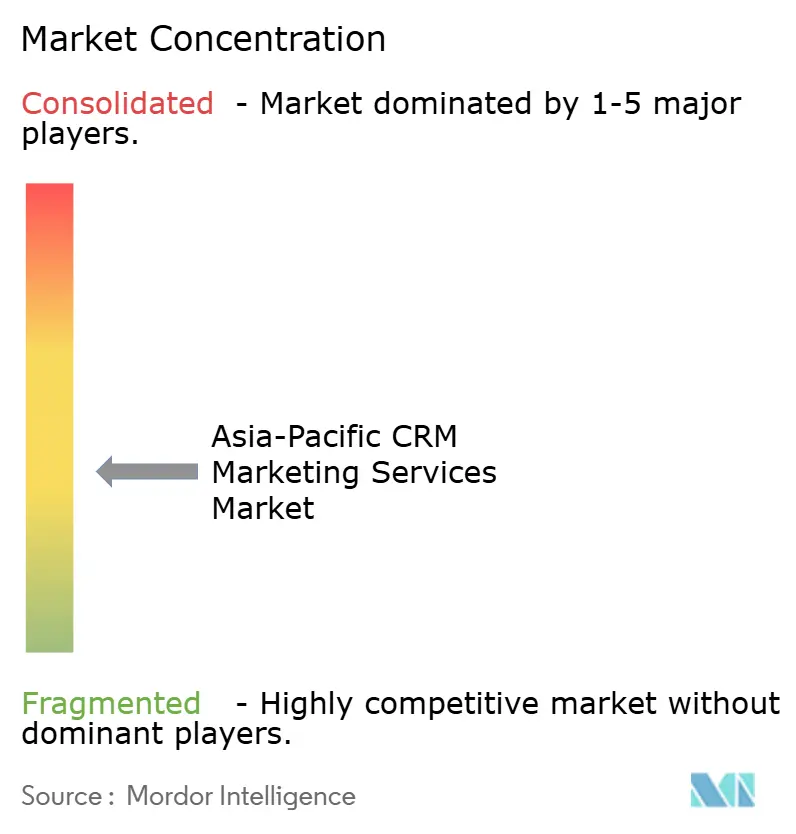
The Asia-Pacific CRM marketing services market remains moderately fragmented, with global platform vendors holding stronger positions in large enterprise accounts and regional specialists competing more actively in mobile-first and mid-market use cases. Salesforce has built a particularly visible regional position through large investment commitments and a broad partner ecosystem. Its March 2025 Singapore commitment and February 2025 Australia commitment gave it more local infrastructure, stronger AI positioning, and deeper ecosystem support across two strategic markets. Microsoft also benefits from channel strength and regional systems integrator relationships that help extend Dynamics 365 across enterprise and mid-market accounts. Oracle continues to pursue accounts that use Singapore as a regional operating base, which supports its role in larger transformation programs.
A second layer of competition comes from implementation partners and consulting-led specialists that are expanding through acquisition. Virtusa’s May 2025 acquisition of Australian Salesforce and MuleSoft partner Mav3rik strengthened its delivery footprint in Australia, New Zealand, and the wider region. These moves show that scale, local presence, and platform-certified talent are becoming more important competitive assets in the Asia-Pacific CRM marketing services market. They also show that firms want broader coverage across implementation, integration, and post-deployment support. Consolidation at the partner level is therefore reshaping competitive balance even when the platform layer remains led by larger vendors.
Regional engagement platforms are also changing the shape of competition in the Asia-Pacific CRM marketing services market by offering AI-native and mobile-first alternatives to traditional CRM stacks. MoEngage strengthened that position with a USD 100 million Series F in November 2025, an additional USD 180 million in December 2025, and the June 2026 acquisition of Aampe to deepen 1:1 agentic decisioning capabilities. Klaviyo is also strengthening its position in commerce-led deployments through product partnerships and regional expansion. The white space remains strongest in healthcare, government modernization, and revenue operations work, where specialist supply still lags demand. Overall, the Asia-Pacific CRM marketing services market is competitive enough to limit concentration, but large platform ecosystems still shape the terms of scale, trust, and regional delivery reach.
Asia-Pacific CRM Marketing Services Industry Leaders
-
Salesforce, Inc.
-
Adobe Inc.
-
Microsoft Corporation
-
Oracle Corporation
-
SAP SE
- *Disclaimer: Major Players sorted in no particular order
Asia-Pacific CRM Marketing Services Market Companies Covered in this Report
- Salesforce, Inc.
- Adobe Inc.
- Microsoft Corporation
- Oracle Corporation
- SAP SE
- HubSpot, Inc.
- Zoho Corporation Pvt. Ltd.
- Freshworks Inc.
- Braze, Inc.
- Iterable, Inc.
- Insider
- CleverTap
- MoEngage
- Klaviyo, Inc.
- SAS Institute Inc.
- Teradata Corporation
- Emarsys eMarketing Systems AG
- Acxiom LLC
- Maropost Inc.
- Customer.io, Inc.
Recent Industry Developments in Asia-Pacific CRM Marketing Services Market
- June 2026: Salesforce signs a definitive agreement to acquire Fin (formerly Intercom) for approximately USD 3.6 billion, integrating Fin's AI Agent platform, powered by its proprietary Apex model, into Agentforce. Fin's global customer base of over 30,000 companies, including APAC enterprises, will accelerate autonomous service resolution capabilities across Salesforce's CRM services ecosystem.
- June 2026: MoEngage acquires Aampe, a San Francisco-based AI infrastructure startup that provisions a dedicated, autonomous AI agent for every individual customer. The acquisition deepens MoEngage's agentic personalization capability and extends its APAC client base in Australia, New Zealand, and Southeast Asia.
- March 2026: Klaviyo and Shopify deepen their product integration, enabling enterprise brands to sync translated content, regional pricing, currency, and market-specific URLs into Klaviyo CRM workflows across all markets served through Shopify's commerce infrastructure. The integration directly addresses the multi-market localization complexity facing APAC brands.
- February 2026: Klaviyo and Google announce a strategic partnership to power autonomous AI-driven customer experiences from product discovery through loyalty, including access to Google Search-to-RCS experiences. The partnership targets APAC retailers seeking to unify commerce data with AI-powered CRM decisioning.
Asia-Pacific CRM Marketing Services Market Report Scope
The Asia-Pacific CRM marketing services market refers to the regional market for platforms and services that enable businesses to manage customer relationships and marketing operations across countries such as China, India, Japan, South Korea, Australia, and Southeast Asian nations. The market includes solutions for customer data integration, campaign automation, analytics, personalization, and omnichannel engagement, with capabilities tailored to local languages, cultural preferences, and regulatory requirements. Rapid digital adoption, mobile-first customer engagement, and the need to comply with diverse data privacy laws drive demand for these services, helping businesses improve customer loyalty and support revenue growth in one of the world’s fastest-expanding CRM markets.
The Asia-Pacific CRM Marketing Services Market Report is Segmented by Service Type (CRM Strategy and Consulting, CRM Implementation and Integration, CRM Migration and Modernization, CRM Managed Services, and CRM Training and Support), Enterprise Size (Large Enterprises, and Small and Medium Enterprises), Service Application (Customer Acquisition, Customer Retention and Loyalty, Campaign Management Services, Marketing Automation Services, Customer Analytics and Insights, Omnichannel Customer Engagement, and Personalization Services), End-user Industry (Banking, Financial Services, and Insurance (BFSI), Healthcare and Life Sciences, Information Technology and Telecom, Retail and E-commerce, Industrial Manufacturing, Government and Public Administration, and Other End-user Industries), and Country (China, Japan, India, South Korea, Australia, Indonesia, Malaysia, Thailand, and Rest of Asia-Pacific). The Market Forecasts are Provided in Terms of Value (USD).
Segmentation Overview
| CRM Strategy and Consulting |
| CRM Implementation and Integration |
| CRM Migration and Modernization |
| CRM Managed Services |
| CRM Training and Support |
| Large Enterprises |
| Small and Medium Enterprises |
| Customer Acquisition |
| Customer Retention and Loyalty |
| Campaign Management Services |
| Marketing Automation Services |
| Customer Analytics and Insights |
| Omnichannel Customer Engagement |
| Personalization Services |
| Banking, Financial Services, and Insurance (BFSI) |
| Healthcare and Life Sciences |
| Information Technology and Telecom |
| Retail and E-commerce |
| Industrial Manufacturing |
| Government and Public Administration |
| Other End-user Industries |
| China |
| Japan |
| India |
| South Korea |
| Australia |
| Indonesia |
| Malaysia |
| Thailand |
| Rest of Asia-Pacific |
| By Service Type | CRM Strategy and Consulting |
| CRM Implementation and Integration | |
| CRM Migration and Modernization | |
| CRM Managed Services | |
| CRM Training and Support | |
| By Enterprise Size | Large Enterprises |
| Small and Medium Enterprises | |
| By Service Application | Customer Acquisition |
| Customer Retention and Loyalty | |
| Campaign Management Services | |
| Marketing Automation Services | |
| Customer Analytics and Insights | |
| Omnichannel Customer Engagement | |
| Personalization Services | |
| By End-user Industry | Banking, Financial Services, and Insurance (BFSI) |
| Healthcare and Life Sciences | |
| Information Technology and Telecom | |
| Retail and E-commerce | |
| Industrial Manufacturing | |
| Government and Public Administration | |
| Other End-user Industries | |
| By Country | China |
| Japan | |
| India | |
| South Korea | |
| Australia | |
| Indonesia | |
| Malaysia | |
| Thailand | |
| Rest of Asia-Pacific |
Key Questions Answered in the Report
What is the size outlook for Asia-Pacific CRM marketing services through 2031?
The Asia-Pacific CRM marketing services market was valued at USD 7.14 billion in 2025, USD 8.05 billion in 2026, and is forecast to reach USD 14.72 billion by 2031, growing at a 12.83% CAGR from 2026 to 2031.
Which service category leads revenue in Asia-Pacific CRM marketing services?
Implementation and integration led revenue with a 36.12% share in 2025, supported by large deployment and integration programs across enterprise environments.
Which application is growing the fastest in CRM services across Asia-Pacific?
Omnichannel customer engagement is the fastest-growing application, with a projected 16.63% CAGR through 2031, as brands connect messaging, commerce, and service channels more closely.
Which end-user group is creating the strongest expansion opportunity?
Healthcare and life sciences is projected to grow at a 17.27% CAGR through 2031 because patient engagement, telehealth, and regulated data workflows require more specialized CRM support.
Which country leads the region and which one is expanding the fastest?
China held the largest share at 33.41% in 2025, while India is projected to be the fastest-growing country with an 18.17% CAGR through 2031.
How is competition evolving across Asia-Pacific CRM services?
Competition remains moderately fragmented, with Salesforce, Microsoft, Oracle, and SAP strong in large enterprise accounts, while firms such as MoEngage and Klaviyo are gaining traction in AI-native and commerce-led service models.