
India CRM Marketing Services Market Size and Share
Market Overview
| Study Period | 2020 - 2031 |
|---|---|
| Forecast Data Period | 2026 - 2031 |
| Base Year Market Size (2025) | USD 1.28 Billion |
| Market Size (2026) | USD 1.41 Billion |
| Market Size (2031) | USD 2.44 Billion |
| Growth Rate (2026 - 2031) | 11.59 % |
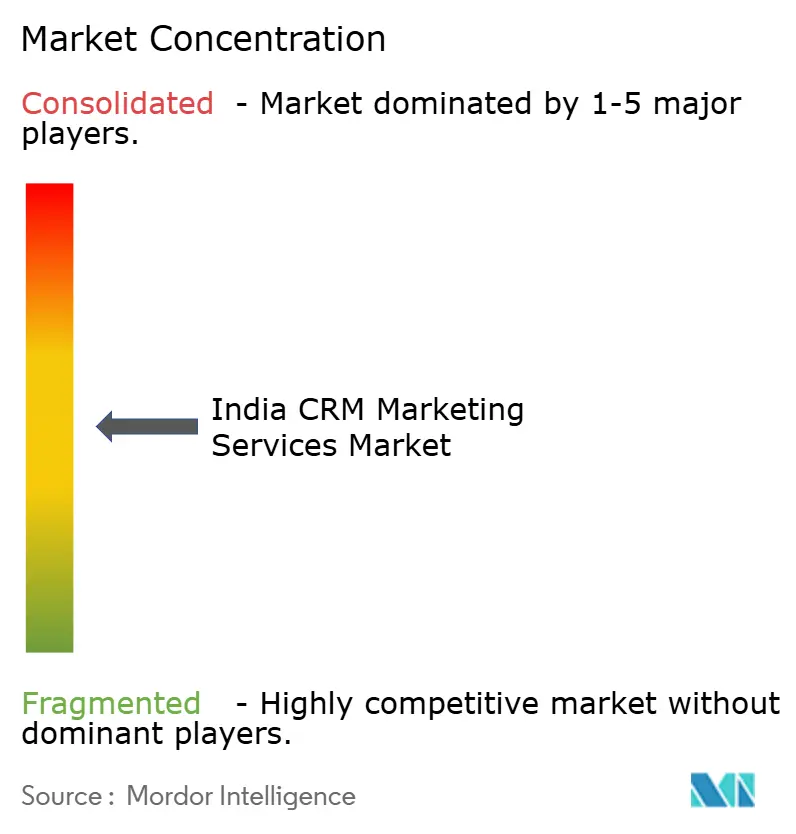
| Market Concentration | Medium |
Major Players *Disclaimer: Major Players sorted in no particular order Image © Mordor Intelligence. Reuse requires attribution under CC BY 4.0. | |
India CRM Marketing Services Market Analysis by Mordor Intelligence
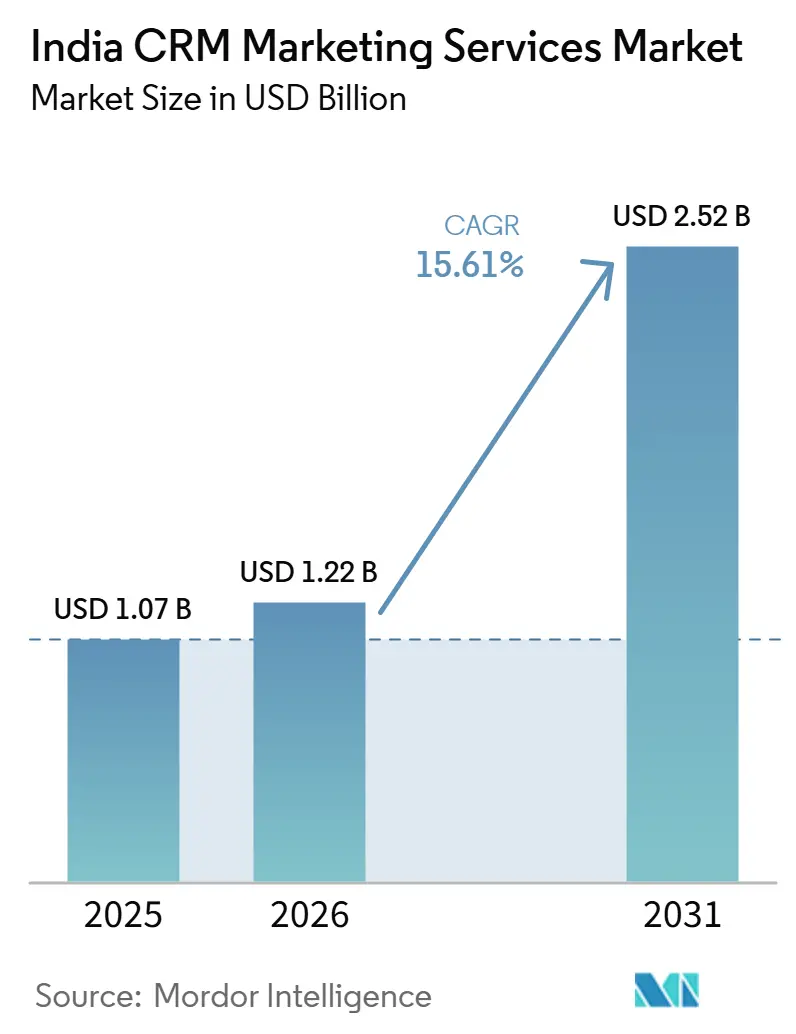
The India CRM marketing services market size is expected to increase from USD 1.28 billion in 2025 to USD 1.41 billion in 2026 and reach USD 2.44 billion by 2031, growing at a CAGR of 11.59% over 2026-2031. The India CRM marketing services market is expanding as brands shift a larger share of marketing spending into channels where campaign response, lead quality, and repeat purchase behavior can be tracked more closely. This shift is pushing CRM platforms beyond their earlier role as sales systems and turning them into the primary layer for customer engagement, campaign execution, and data-led decision-making. The India CRM marketing services market is also gaining momentum from stronger demand for multichannel execution, especially where WhatsApp, email, SMS, mobile apps, and digital commerce flows need to work together in a single journey. Competition is broadening as global software vendors, India-origin SaaS firms, and large IT services companies all try to capture larger transformation mandates through implementation, modernization, and managed services. At the same time, stricter consent requirements and attribution gaps are increasing delivery complexity, creating more room for vendors that can combine compliance support, deep integration, and measurable commercial outcomes in a single contract.
Key Report Takeaways
- By service type, CRM Implementation and Integration held 27.14% of the India CRM marketing services market share in 2025, while CRM Migration and Modernization is projected to expand at a 12.74% CAGR through 2031.
- Large Enterprises accounted for 58.12% of the Indian CRM marketing services market in 2025, while Small and Medium Enterprises are expected to record the highest CAGR of 12.85% through 2031.
- By service application, Customer Acquisition led with a 20.18% revenue share in 2025, while Omnichannel Customer Engagement is projected to grow at a 12.96% CAGR through 2031.
- By end-user industry, BFSI retained a 16.11% share of the India CRM marketing services market size in 2025, while Healthcare and Life Sciences are forecast to grow at a 13.07% CAGR through 2031.
Note: Market size and forecast figures in this report are generated using Mordor Intelligence’s proprietary estimation framework, updated with the latest available data and insights as of January 2026.
India CRM Marketing Services Market Trends and Insights
Drivers Impact Analysis*
| Driver | (~) % Impact on CAGR Forecast | Geographic Relevance | Impact Timeline |
|---|---|---|---|
| Rapid Expansion Of E-Commerce-Led Customer Acquisition Spend | +2.5% | Pan-India, strongest in Tier-1 and Tier-2 metros including Delhi NCR, Bengaluru, Mumbai, and Hyderabad | Medium term (2-4 years) |
| Shift From Blanket Digital Spend To Measurable CRM-Linked Campaigns | +2.0% | Pan-India, most pronounced in South and West India enterprise clusters | Medium term (2-4 years) |
| Rising SME Demand For Affordable Marketing Automation And CRM Workflows | +1.8% | Pan-India, growing into Tier-2 cities including Surat, Jaipur, Coimbatore, and Indore | Long term (≥ 4 years) |
| Mobile-First Consumer Journeys Increasing Multichannel Orchestration Needs | +1.5% | Pan-India, highest uptake in South India and Maharashtra | Short term (≤ 2 years) |
| Vernacular Content And Regional Personalization Unlocking Tier-2 And Tier-3 Demand | +1.2% | Pan-India, highest in North-Central India, South India, and Bengali-speaking markets | Long term (≥ 4 years) |
| Growing Adoption Of AI-Enabled Lead Scoring And Campaign Optimization | +1.0% | Pan-India, concentrated in Bengaluru, Hyderabad, and NCR technology corridors | Medium term (2-4 years) |
| Source: Mordor Intelligence | |||
Rapid Expansion of E-Commerce-Led Customer Acquisition Spend
The India CRM marketing services market is benefiting from the continued rise of digital commerce, as brands spend more to reach users whose purchase journeys now begin and end across digital channels. India’s e-commerce sector continued to post strong growth in 2026, and the pace of expansion in online retail kept pressure on brands to improve acquisition efficiency rather than rely on one-time conversion campaigns.[1] Digital advertising also continued to take a larger role in India’s overall ad spending mix, which matters because CRM-linked services work best when marketers can measure response across digital touchpoints rather than broad offline campaigns. As customer acquisition became more expensive, the India CRM marketing services market moved toward lifecycle management models, where first contact, repeat purchase, and reactivation all need to sit within a single operating framework. Quick commerce also shortened the time window between discovery and purchase, which raised the value of service providers that can design CRM journeys in near real time rather than through slower campaign calendars.[2]
Shift From Blanket Digital Spend to Measurable CRM-Linked Campaigns
The India CRM marketing services market is also growing because companies are demanding proof of revenue impact from each major marketing program rather than spending broadly on awareness. A January 2025 CMR survey found that 65% of Indian Chief Marketing Officers prioritized AI-driven personalization, and 45% named marketing ROI optimization through analytics and automation as their top mandate.[3] Indian marketers also stood out globally in AI-led revenue expectations, with 53% of Indian CMOs expecting 5-9% incremental revenue from AI use cases, ahead of the 43% global average reported in BCG’s annual CMO survey. Adobe reported in June 2025 that 23% of businesses in India were already seeing measurable results from generative AI adoption, the highest rate in Asia-Pacific. This is pushing the India CRM marketing services market toward longer mandates that combine platform setup, workflow redesign, user adoption support, and managed optimization, because software alone is not solving execution gaps inside underused martech stacks.
Rising SME Demand for Affordable Marketing Automation and CRM Workflows
The India CRM marketing services market is expanding as more small firms are entering the CRM adoption cycle. The Vi Business MSME Growth Insights Study 2026 reported that the MSME Digital Maturity Index reached 60.8 in 2026, up from 58.0 in 2025, and 57% of surveyed MSMEs viewed AI as a growth driver, while 25% had already integrated AI into workflows.[4] This matters because the India CRM marketing services market no longer depends only on large enterprise budgets, and a wider buyer base is emerging across state-level business clusters where cost sensitivity remains high. India-origin providers have helped this shift by offering INR-based pricing, GST-compliant workflows, UPI billing support, and WhatsApp-native features that better align with the operating realities of domestic businesses than many global enterprise packages. The result is that SME demand is becoming a structural growth layer for the India CRM marketing services market, especially in cities where digital maturity is rising but full-scale in-house marketing technology teams are still uncommon.
Mobile-First Consumer Journeys Increasing Multichannel Orchestration Needs
The India CRM marketing services market is being pulled forward by the fact that most digital customer journeys in India now start on mobile and often move through messaging-led interactions. Business Standard reported in June 2026 that India had 958 million active internet users and more than 500 million monthly active WhatsApp users, underscoring the centrality of mobile interfaces in customer engagement. GoKwik’s 2026 WhatsApp Commerce Intelligence Report, covered by Fortune India, found that 83% of WhatsApp-driven festive season orders came from first-time customers, which shifted WhatsApp from a retention tool toward a strong acquisition channel as well. That pattern is expanding project scope across the India CRM marketing services market, because clients now expect WhatsApp Business API integration, channel journey design, triggered messaging, and response measurement within a single services package. It is also increasing the value of providers that can connect mobile messaging with email, SMS, apps, and commerce systems without breaking attribution or consent workflows.
Restraints Impact Analysis*
| Restraint | (~) % Impact on CAGR Forecast | Geographic Relevance | Impact Timeline |
|---|---|---|---|
| Data Privacy And Consent Management Compliance Burden | -0.9% | Pan-India, highest for BFSI and healthcare firms in Bengaluru, Mumbai, and Delhi NCR | Short term (≤ 2 years) |
| Fragmented Agency Market And Price Compression | -0.7% | Pan-India, most acute in Tier-2 and Tier-3 cities with lower-margin regional agencies | Long term (≥ 4 years) |
| Attribution Gaps Across Walled Gardens And Offline Conversions | -0.5% | Pan-India, most severe in Tier-2 markets with limited CDP and GA4 stack deployment | Medium term (2-4 years) |
| Limited In-House Skills For Advanced Martech Orchestration In Smaller Firms | -0.4% | Pan-India, most pronounced in Tier-2 and Tier-3 city SME clusters | Long term (≥ 4 years) |
| Source: Mordor Intelligence | |||
Data Privacy and Consent Management Compliance Burden
The India CRM marketing services market is facing a clear compliance burden as customer engagement programs become more dependent on first-party data and regulated consent practices. India’s Digital Personal Data Protection Rules, 2025, were notified on November 13, 2025, and the phased calendar placed Consent Manager provisions into effect from November 14, 2026, with wider enforcement obligations beginning on May 13, 2027. The penalty ceiling of up to INR 250 crore, which was presented in the source material as approximately USD 29.2 million at 2026 exchange rates, is large enough to change how both clients and service partners evaluate delivery risk. In practice, this means that CRM implementations now need consent capture rules, deletion workflows, breach response processes, and audit-ready data handling built in from the start. The India CRM marketing services market therefore favors larger firms and better-prepared specialists that can turn compliance work into a formal service layer rather than treating it as a late-stage legal addition.
Fragmented Agency Market and Price Compression
The India CRM marketing services market is also constrained by a fragmented agency base, which keeps pricing pressure high even as project complexity rises. Storyboard18 reported in 2025 that agency retainer commissions had fallen sharply from older industry norms to a 2-5% range, even though content demands and technology requirements had increased. In smaller city markets, low-cost regional agencies often underbid full-service CRM partners, fragmenting the client relationship across separate vendors and reducing the size of any one contract. This makes it harder for providers in the India CRM marketing services market to build long-duration, cross-sell relationships unless they can tie pricing to measurable CRM outcomes instead of hours and deliverables alone. It also slows margin improvement in a market where demand is rising, because revenue growth does not always translate into stronger commercial discipline.
*Our forecasts treat driver/restraint impacts as directional, not additive. The impact forecasts reflect baseline growth, mix effects, and variable interactions.
Segment Analysis
By Service Type: Integration Holds The Lead While Modernization Moves Faster
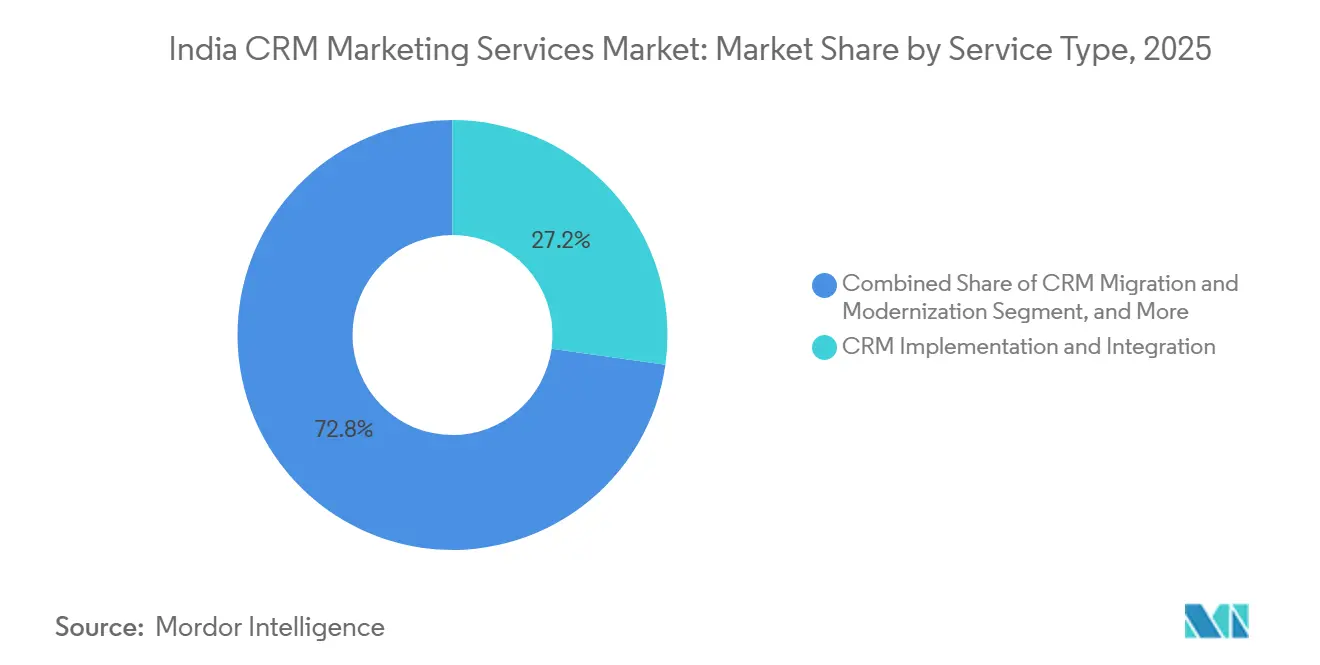
CRM Implementation and Integration captured 27.14% of the India CRM marketing services market in 2025, underscoring how often CRM programs in India begin with complex integrations across ERP systems, payment rails, tax workflows, messaging channels, and data pipelines. This segment remains central because most enterprises still need external support to connect CRM software with operating systems built at different times and often across multiple vendors. The India CRM marketing services market continues to assign high value to implementation work because deployment success depends on local workflow adaptation as much as on software configuration. Strategy and Consulting has grown alongside this demand, since companies increasingly want help defining customer journeys, governance rules, and performance logic before a full rollout begins. Managed Services, Training, and Support also matter because many firms struggle after go-live, especially when adoption, governance, and campaign execution do not mature at the same pace as platform deployment.
CRM Migration and Modernization is projected to record a 12.74% CAGR between 2026 and 2031, making it the fastest-growing service type in the India CRM marketing services market. Many legacy CRM environments in India were built during earlier cloud adoption cycles and now limit real-time segmentation, AI-led personalization, and flexible multichannel orchestration. NITI Aayog’s February 2026 technology strategy report identified CRM as a priority area within India’s broader SaaS ambition, supporting long-term investment in new CRM capabilities and demand for adjacent services. Salesforce further supported this theme in May 2026 by bringing MuleSoft on Hyperforce to India with local data residency, a move that directly addressed migration and secure integration needs for domestic enterprises. Adobe’s CX Enterprise launch in April 2026 sent the same signal as another major vendor's launch, because a more AI-centered customer experience architecture also means greater rework, integration, and certification demands for service partners.

By Enterprise Size: Large Enterprises Still Dominate While SMEs Add New Depth
Large Enterprises retained 58.12% of the India CRM marketing services market in 2025, indicating that the largest budgets still came from sectors with complex lead volumes, compliance needs, and established digital operations. These organizations usually operate across multiple business lines and channels, underscoring the need for an enterprise-grade CRM strategy, system integration, and managed operations. The India CRM marketing services market remains especially active in this segment because large firms are the most likely to fund multi-year transformation contracts rather than small project-based engagements. They also tend to demand stronger support around localization, internal adoption, analytics integration, and cross-functional workflow design. That combination keeps the large enterprise segment central, even as newer demand expands below.
At the same time, Small and Medium Enterprises are projected to grow at a 12.85% CAGR from 2026 to 2031, making them the growth engine of the India CRM marketing services market. The Vi Business MSME Growth Insights Study 2026 showed improving digital maturity and rising AI adoption among Indian MSMEs, which points to a broader upgrade in how these businesses approach sales and marketing infrastructure. Domestic vendors have lowered adoption barriers through INR-denominated pricing, GST invoicing, UPI support, and native WhatsApp integration, all of which fit how many smaller firms operate in practice. Andhra Pradesh’s entry into the top 10 digitally mature MSME state rankings in 2026 suggested that demand is moving beyond the most established digital clusters and opening fresh room for regional service expansion. This gives the India CRM marketing services market a broader geographic demand base, even though SME buying behavior remains more price-sensitive and outcome-focused than that of large enterprises.
By Service Application: Acquisition Drives Scale While Omnichannel Work Commands Premium Value
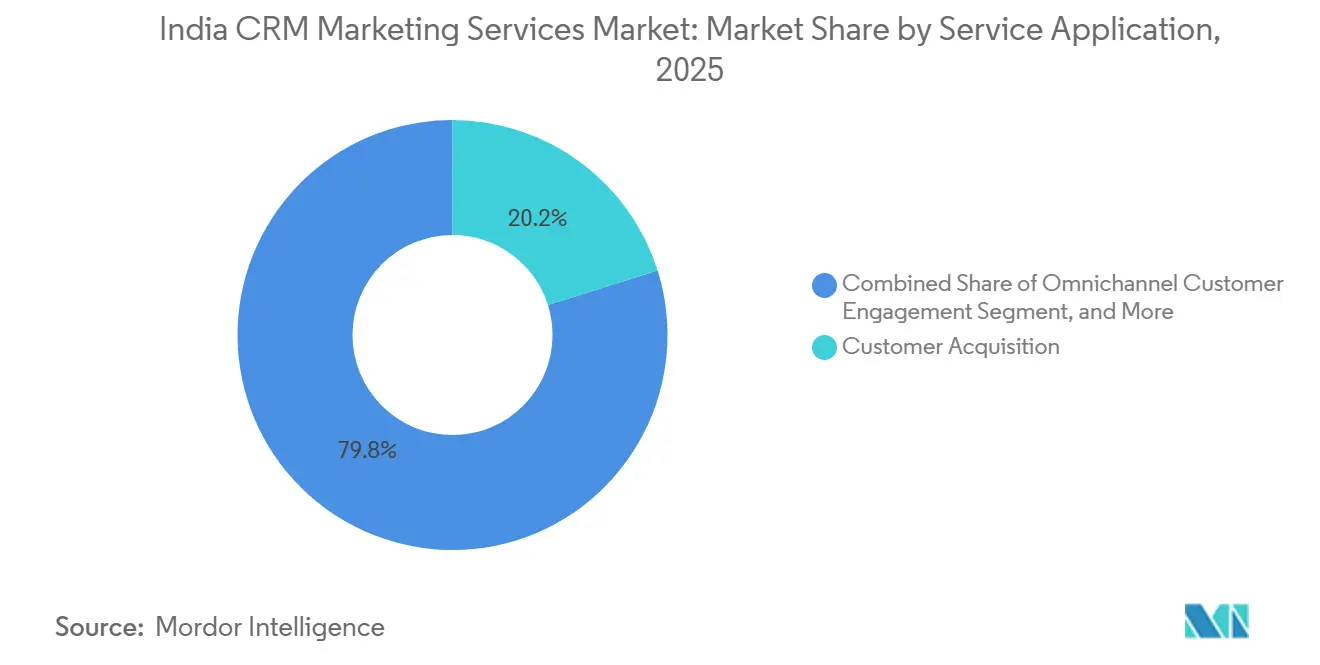
Customer Acquisition held 20.18% of the India CRM marketing services market in 2025, underscoring how strongly brands continue to prioritize pipeline growth even as acquisition costs rise. This segment remains large because e-commerce, financial services, healthcare, and other high-volume sectors still need structured lead capture, campaign execution, and conversion support at scale. A 2025 CMR survey found that customer acquisition and retention ranked as the top priority for 54% of Indian marketers, underscoring the continued dominance of acquisition-led CRM spending. The India CRM marketing services market also sees acquisition work as a gateway category, because once firms invest in capture and conversion, they often add retention, automation, analytics, and personalization services around the same base stack. That pattern keeps acquisition important not only for revenue share, but also for later wallet expansion inside existing accounts.
Omnichannel Customer Engagement is forecast to post a 12.96% CAGR through 2031, making it the fastest-growing application area in the India CRM marketing services market. India’s customer journey is now spread across WhatsApp, SMS, email, push notifications, connected commerce, and physical touchpoints, so one-channel campaigns often fail to align with real buyer behavior. Fortune India reported on GoKwik’s 2026 findings that brands using AI-determined message relevance on WhatsApp recorded 2.25x higher median GMV growth than peers, which raised the commercial case for richer journey orchestration. This is changing how work is scoped in the India CRM marketing services market, because clients increasingly expect at least four channels to be coordinated as a core requirement rather than an extra feature. Personalization Services and Customer Analytics and Insights are expanding with this shift, since omnichannel engagement cannot work well for long without stronger segmentation, data logic, and message timing control.
By End-User Industry: BFSI Anchors Spending While Healthcare And Life Sciences Advances Fastest
BFSI held 16.11% of the India CRM marketing services market share in 2025, making it the largest end-user vertical. This position reflects the sector’s high lead volumes, strict process controls, and strong need for regulated customer communication across lending, insurance, wealth, and payments activities. The India CRM marketing services market sees BFSI as a stable demand center because even modest gains in lead quality, conversion, or reactivation can scale quickly across large customer books. LiveMint reported in 2025 that LeadSquared aimed to raise BFSI contribution to 50% of its revenues within 24 months, which signaled the size of the opportunity vendors see in this segment. BFSI also tends to favor vendors that can combine workflow speed with stronger auditability, which keeps service quality and domain specialization important in contract awards.
Healthcare and Life Sciences is expected to grow at a 13.07% CAGR from 2026 to 2031, making it the fastest-growing end-user segment in the India CRM marketing services market. The source material reported that Indian healthcare brands raised digital advertising spending to USD 580 million in 2026 from USD 320 million in 2024, showing how quickly patient acquisition and engagement models have matured. Salesforce also documented how Dr. Reddy’s Laboratories connected more than 40 systems and over 750 endpoints to personalize outreach to more than 500,000 healthcare professionals, demonstrating the scale of integration work this vertical can drive. As patient discovery increasingly begins on digital search and aggregator platforms, healthcare providers need CRM-linked journeys that capture intent earlier and continue engagement across multiple decision points. That is why the India CRM marketing services market is seeing faster demand from this vertical than from many larger but more mature spending categories.
Geography Analysis
North India remains important in the India CRM marketing services market because the Delhi NCR region combines large BFSI institutions, enterprise IT buyers, and government-linked demand in a single geography. This concentration supports a steady flow of CRM work tied to regulated customer communication, public service delivery, and large-scale digital acquisition programs. Retail and e-commerce brands based in NCR also remain active users of WhatsApp-led engagement models as they pursue customer growth across wider national digital audiences. North and Central India also offer a strong vernacular engagement opportunity, as state-specific communication is becoming increasingly important for brands seeking stronger responses beyond English-led campaigns. This makes the India CRM marketing services market more dependent on localization capability in the north than on standard platform deployment alone.
South India leads in delivery maturity across the India CRM marketing services market and continues to shape the market’s modernization agenda. The Vi Business MSME Growth Insights Study 2026 placed Telangana and Karnataka at the top of the digital maturity rankings, while Tamil Nadu and Kerala also stood out on AI adoption intent among MSMEs. Bengaluru remains especially important because it hosts the India operations of major CRM vendors and a dense services ecosystem capable of executing complex migration and integration programs. This concentration makes South India the most prepared region for agentic AI-linked CRM modernization and for large enterprise work that depends on certified partners, domain talent, and faster deployment cycles.
West India, led by Maharashtra and Gujarat, remains a major commercial center for the India CRM marketing services market because it combines BFSI depth with organized retail demand. Mumbai’s financial services sector continues to drive some of the most demanding CRM projects in the country, especially when implementation quality, compliance logic, and service continuity must align. Gujarat offers a distinct demand mix through its MSME and exporter clusters, where firms are increasingly integrating commerce, payments, and customer communication into tighter operating systems. East India remains less mature by comparison, and the absence of eastern states from the top digital maturity rankings in the source material points to skills and infrastructure gaps that still limit near-term demand. Even so, the India CRM marketing services market has long-term room to expand in the east through local partnerships and regional-language delivery models as digital adoption continues to deepen in second-tier urban centers.
Competitive Landscape
The India CRM marketing services market remains moderately fragmented, with competition spread across global CRM platforms, India-origin SaaS vendors, and large IT services firms. Global providers compete on platform depth, enterprise-grade security, and the ability to support complex modernization programs across large clients. India-origin vendors compete more directly on localized workflows, domestic pricing logic, and product choices that reflect GST, WhatsApp-led engagement, and fast domestic deployment needs. Large IT services players compete differently again, because they can attach CRM work to broader transformation, cloud, data, and AI mandates already underway inside major accounts.
Salesforce remains one of the strongest enterprise-facing names in the India CRM marketing services market, and its regulatory filing for the financial year 2025 showed India revenue of INR 13,384.5 crore, which the source material reported as approximately USD 1.60 billion, up 47% year over year. The company followed that with product localization and infrastructure moves, including the May 2026 rollout of Hindi language support for Agentforce Voice and the planned availability of MuleSoft Anypoint Platform on Hyperforce India. Adobe also raised the competitive bar when it introduced CX Enterprise in April 2026, because that launch signaled a stronger shift toward AI-led customer experience orchestration that will require more partner-led service work. At the services layer, Infosys and Adobe announced a strategic collaboration in June 2025 to combine Infosys Aster capabilities with Adobe’s experience stack, demonstrating how IT firms are packaging CRM, content, and AI transformation into a single proposition.
Domestic vendors continue to matter because the India CRM marketing services market still includes large buyer groups seeking lower entry costs, faster configuration, and better alignment with Indian operating norms. Zoho and Freshworks remain strong in the mid-market and SME tiers because they can address local workflow expectations without the heavier cost structure often associated with larger enterprise software environments. LeadSquared has also emerged as a focused challenger in BFSI by pairing lead orchestration with vertical-specific compliance and execution logic, which helps it compete where conversion speed matters alongside process control. Another clear theme is that platform vendors are increasingly working through service ecosystems rather than trying to own every delivery layer themselves. Microsoft’s December 2025 partnerships with TCS, Infosys, Wipro, and Cognizant, involving more than 200,000 Copilot license deployments, illustrated how major technology firms are reinforcing existing implementation channels rather than replacing them. This keeps the India CRM marketing services market competitive across several layers at once, with software depth, localization, services reach, and domain execution all shaping vendor position.
India CRM Marketing Services Industry Leaders
-
Salesforce, Inc.
-
Adobe Inc.
-
HubSpot, Inc.
-
Zoho Corporation Private Limited
-
Freshworks Inc.
- *Disclaimer: Major Players sorted in no particular order
Recent Industry Developments
- June 2026: Salesforce made its full product portfolio, including Agentforce, Data 360, Agentforce Sales, Agentforce Service, Slack, and Tableau Next, available through AWS Marketplace India, enabling AWS-native enterprises to procure and deploy AI CRM infrastructure with local cloud residency directly through AWS procurement workflows. This significantly broadened Salesforce's mid-market reach in India without requiring direct enterprise licensing cycles.
- June 2026: Zoho Corporation signed a Memorandum of Understanding with the Indian Army under the Joint Atmanirbharta and Innovation Mission to develop secure, indigenous digital solutions, application-focused R&D, and digital skill development for defense operations. The partnership reinforced Zoho's positioning as a sovereign-grade, India-origin technology provider capable of handling sensitive enterprise data environments.
- June 2026: Salesforce committed to equipping 1 million learners across India with AI-focused skills by 2030, announced at the company's India Centre of Excellence 10th anniversary event in Hyderabad, leveraging Trailhead in partnership with academic institutions, industry leaders, and government agencies.
- May 2026: Salesforce launched Hindi language support for Agentforce Voice and announced the upcoming availability of MuleSoft Anypoint Platform on Hyperforce India at Agentforce World Tour Mumbai 2026, enabling Indian enterprises to deploy AI-powered integrations with local data residency for DPDP Act compliance.
India CRM Marketing Services Market Report Scope
The India CRM Marketing Services market comprises solutions and services that enable organizations to design, implement, and optimize customer relationship management strategies to enhance customer acquisition, retention, and engagement. These services include consulting, integration, modernization, managed services, and training, supporting applications such as campaign management, marketing automation, customer analytics, omnichannel engagement, and personalization. Driven by rapid digital transformation, the expansion of e-commerce, and the growing demand for customer-centric strategies, industries such as BFSI, healthcare, IT, retail, manufacturing, and government are increasingly adopting CRM marketing services to improve customer loyalty, operational efficiency, and sustainable business growth. The primary objective of this market is to empower enterprises in India with scalable, data-driven CRM solutions that strengthen customer relationships and deliver competitive advantage in a dynamic digital economy.
The India CRM Marketing Services market report is segmented by Service Type (CRM Strategy and Consulting, CRM Implementation and Integration, CRM Migration and Modernization, CRM Managed Services, CRM Training and Support), Enterprise Size (Large Enterprises and Small and Medium Enterprises), Service Application (Customer Acquisition, Customer Retention and Loyalty, Campaign Management Services, Marketing Automation Services, Customer Analytics and Insights, Omnichannel Customer Engagement, Personalization Services), and End-user Industry (Banking, Financial Services, and Insurance (BFSI), Healthcare and Life Sciences, Information Technology and Telecom, Retail and E-commerce, Industrial Manufacturing, Government and Public Administration, and Other End-user Industries). The Market Forecasts are Provided in Terms of Value (USD).
| CRM Strategy and Consulting |
| CRM Implementation and Integration |
| CRM Migration and Modernization |
| CRM Managed Services |
| CRM Training and Support |
| Large Enterprises |
| Small and Medium Enterprises |
| Customer Acquisition |
| Customer Retention and Loyalty |
| Campaign Management Services |
| Marketing Automation Services |
| Customer Analytics and Insights |
| Omnichannel Customer Engagement |
| Personalization Services |
| Banking, Financial Services, and Insurance (BFSI) |
| Healthcare and Life Sciences |
| Information Technology and Telecom |
| Retail and E-commerce |
| Industrial Manufacturing |
| Government and Public Administration |
| Other End-user Industries |
| By Service Type | CRM Strategy and Consulting |
| CRM Implementation and Integration | |
| CRM Migration and Modernization | |
| CRM Managed Services | |
| CRM Training and Support | |
| By Enterprise Size | Large Enterprises |
| Small and Medium Enterprises | |
| By Service Application | Customer Acquisition |
| Customer Retention and Loyalty | |
| Campaign Management Services | |
| Marketing Automation Services | |
| Customer Analytics and Insights | |
| Omnichannel Customer Engagement | |
| Personalization Services | |
| By End-user Industry | Banking, Financial Services, and Insurance (BFSI) |
| Healthcare and Life Sciences | |
| Information Technology and Telecom | |
| Retail and E-commerce | |
| Industrial Manufacturing | |
| Government and Public Administration | |
| Other End-user Industries |
Key Questions Answered in the Report
What is the current and forecast value of the India CRM marketing services space?
The India CRM marketing services market was valued at USD 1.28 billion in 2025, stood at USD 1.41 billion in 2026, and is forecast to reach USD 2.44 billion by 2031 at an 11.59% CAGR.
Which service type leads revenue in India CRM marketing services?
CRM Implementation and Integration led with 27.14% share in 2025, reflecting the heavy need for integration across ERP, payments, messaging, and data systems.
Which buyer group is growing fastest in CRM marketing services in India?
Small and Medium Enterprises are projected to grow at a 12.85% CAGR through 2031 as domestic vendors lower adoption barriers with localized pricing and workflows.
Why is omnichannel engagement becoming more important for vendors in India?
Omnichannel Customer Engagement is forecast to grow at a 12.96% CAGR because brands increasingly need coordinated journeys across WhatsApp, email, SMS, apps, and commerce channels.
Which end-user vertical offers the strongest near-term expansion opportunity?
Healthcare and Life Sciences is expected to grow fastest at a 13.07% CAGR through 2031 as digital patient acquisition and multichannel engagement become more important.
What is the main compliance issue affecting CRM marketing service providers in India?
DPDP-related consent and data handling requirements are increasing project scope, delivery timelines, and vendor screening standards, especially in regulated verticals such as BFSI and healthcare.