
Thailand CRM Marketing Services Market Size and Share
Market Overview
| Study Period | 2020 - 2031 |
|---|---|
| Forecast Data Period | 2026 - 2031 |
| Base Year Market Size (2025) | USD 114.44 Million |
| Market Size (2026) | USD 133.29 Million |
| Market Size (2031) | USD 286.49 Million |
| Growth Rate (2026 - 2031) | 16.54 % |
| Market Concentration | Medium |
Major Players *Disclaimer: Major Players sorted in no particular order Image © Mordor Intelligence. Reuse requires attribution under CC BY 4.0. | |
Thailand CRM Marketing Services Market Analysis by Mordor Intelligence
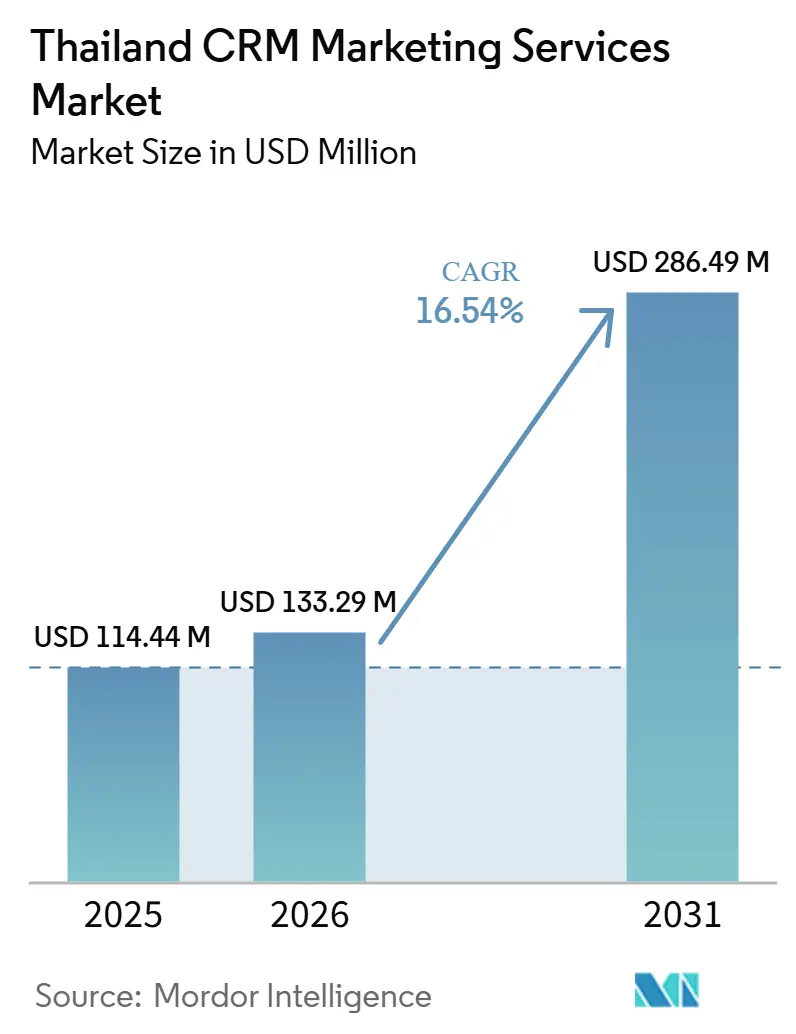
The Thailand CRM marketing services market size was valued at USD 114.44 million in 2025 and estimated to grow from USD 133.29 million in 2026 to reach USD 286.49 million by 2031, at a CAGR of 16.54% during the forecast period (2026-2031). The Thailand CRM marketing services market is moving beyond first-stage adoption as cloud delivery, lower upfront commitments, and localized deployment models make CRM programs more practical for a much wider business base. The spread of LINE Official Account across daily consumer communication is also changing how buyers judge service providers, since platform fit, API connectivity, and campaign execution across social channels now matter as much as core database functions. Public digitalization programs and enterprise modernization plans are expanding the demand base, especially where customer engagement, citizen services, investor management, and patient communication require faster response cycles and better data coordination. The Thailand CRM marketing services market is also supported by a mobile-heavy digital environment, which pushes providers to design services around app use, social touchpoints, and real-time engagement rather than desktop-first workflows. Competition remains moderately fragmented, which keeps room for both global suites and Thai specialists, even as compliance costs and talent shortages make execution quality a bigger factor in buyer decisions.
Key Report Takeaways
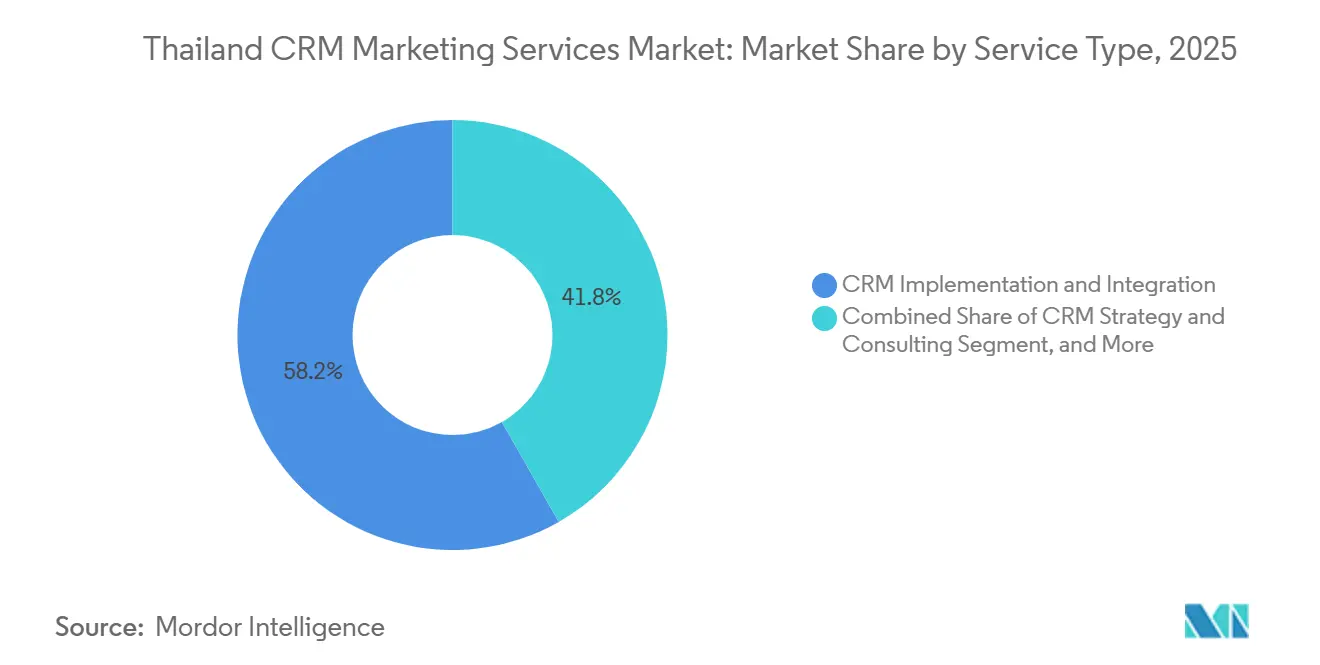
- By service type, implementation and integration held 58.23% of the Thailand CRM marketing services market revenue in 2025, while managed services are projected to expand at 18.51% CAGR through 2031.
- By enterprise size, large enterprises accounted for 68.11% of the Thailand CRM marketing services market share in 2025, while SMEs are expected to record the fastest growth at 18.97% CAGR through 2031.
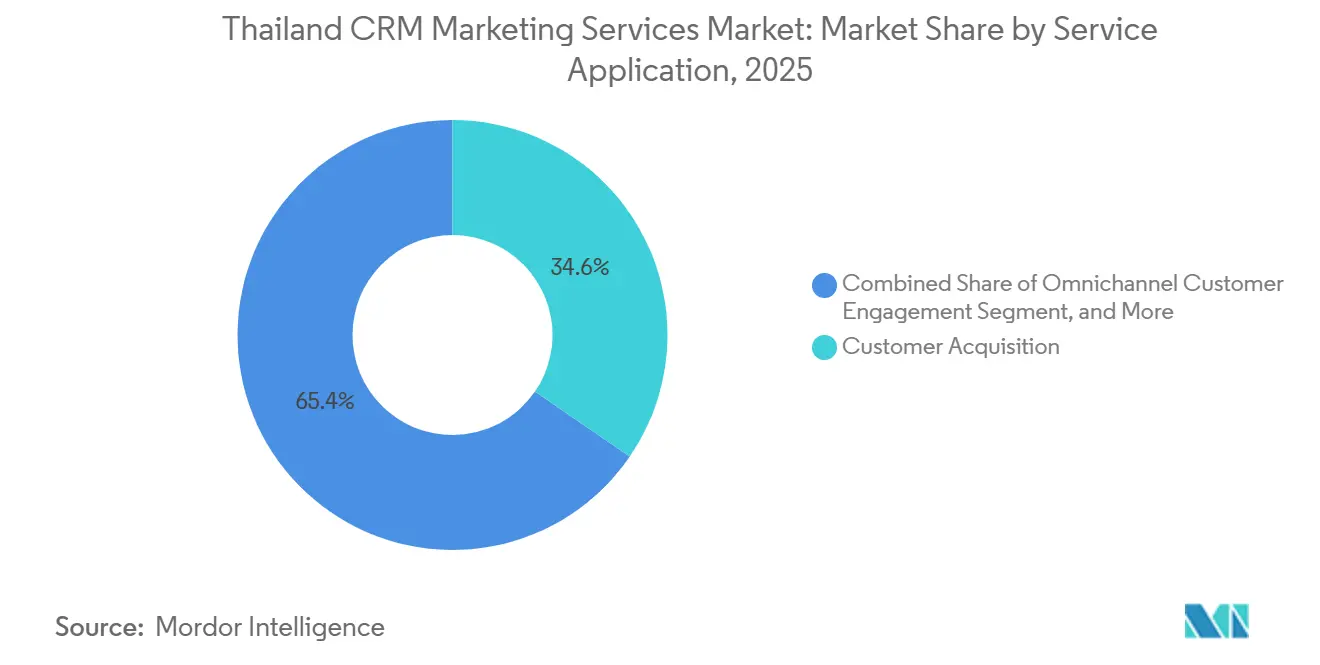
- By service application, customer acquisition accounted for 34.56% of the Thailand CRM marketing services market share in 2025, while marketing automation services are projected to grow at a 17.81% CAGR through 2031.
- By end-user industry, retail and e-commerce captured 33.81% of the Thailand CRM marketing services market share in 2025, while healthcare and life sciences are expected to grow fastest at 18.16% CAGR through 2031.
Note: Market size and forecast figures in this report are generated using Mordor Intelligence’s proprietary estimation framework, updated with the latest available data and insights as of January 2026.
Thailand CRM Marketing Services Market Trends and Insights
Drivers Impact Analysis*
| Driver | (~) % Impact on CAGR Forecast | Geographic Relevance | Impact Timeline |
|---|---|---|---|
| Rising SME Cloud Adoption | +3.8% | National, strongest in Bangkok, Chiang Mai, and EEC provinces | Medium term (2-4 years) |
| LINE Official Account-Led Social Commerce Integration | +3.2% | National, strongest in Bangkok and major retail corridors | Short term (≤ 2 years) |
| Thailand 4.0 and Public Sector Digitalization Push | +2.5% | National, with early concentration in Bangkok and EEC provinces | Medium term (2-4 years) |
| Mobile-First Customer Engagement Expectations | +2.1% | National, strongest in Bangkok and Chiang Mai | Short term (≤ 2 years) |
| AI-Enabled Personalization and Predictive Selling | +1.9% | National, strongest in BFSI and retail | Medium term (2-4 years) |
| Demand for Consent-Driven First-Party Data Infrastructure | +1.4% | National, influenced by PDPA enforcement in Bangkok | Long term (≥ 4 years) |
| Source: Mordor Intelligence | |||
Rising SME Cloud Adoption Accelerates CRM Entry
Thailand’s SME base gives the Thailand CRM marketing services market a wide demand foundation because smaller firms make up nearly all registered businesses and now operate in a more digital commercial environment. Lower entry barriers have become more important as cloud subscriptions, Thai-language interfaces, and bundled deployment support reduce the need for large internal technology teams. This matters because many buyers are no longer choosing between having CRM and not having CRM; they are choosing how quickly they can move from basic contact storage to lead tracking, workflow automation, and customer data use. The addressable opportunity in the Thailand CRM marketing services market, therefore, sits not only in new accounts, but also in deeper account expansion as early users add analytics, service support, and campaign tools. Public support for digital infrastructure and broader national digital development goals also reinforces the case for ongoing SME adoption nationwide.[1] The policy backdrop behind Thailand’s digital transformation further supports this direction by encouraging broader business participation in digital systems and service modernization.
LINE Official Account Integration Reshapes CRM Front Ends
The Thailand CRM marketing services market is being shaped by the fact that LINE functions as a core consumer communication layer rather than a side channel. LINE reported 54 million users in Thailand, covering more than 80% of the population, giving service providers a clear reason to build around this ecosystem. That scale changes platform design because buyer demand now extends beyond record management and into message orchestration, customer journey handling, consent capture, and campaign response inside the same workflow. Providers that do not support strong LINE connectors face a structural disadvantage, especially in retail, e-commerce, consumer services, and loyalty-heavy programs. Thailand has also served as an origination point for LINE OA Plus under the Open Platform for Thai initiative, which shows that local CRM requirements are influencing product development rather than simply following imported templates. As a result, the Thailand CRM marketing services market increasingly rewards vendors that can combine front-end engagement on LINE with back-end data handling and service execution within a single service model.
Thailand 4.0 and Public Sector Digitalization Expand Institutional Demand
The Thailand CRM marketing services market is benefiting from a policy environment that links digital adoption with national competitiveness and public service modernization. Thailand’s long-range digital development framework has targeted a larger digital economy contribution, providing institutional support for enterprise systems that improve responsiveness, transparency, and service delivery. The Digital Government Development Agency and the Digital Government Development Plan for 2023 to 2027 have created a more organized structure for public digital execution and procurement. This policy direction has already translated into real CRM-linked deployments, including the Social Security Office’s shift from SMS to LINE OA and the Industrial Estate Authority of Thailand’s use of Salesforce Agentforce for investor inquiry management. These examples matter because they validate CRM as an operational system for structured, high-volume engagement, not just as a marketing support tool. That validation also strengthens private-sector confidence in the Thailand CRM marketing services market, especially among procurement teams that look for local proof points before committing to larger programs.
Mobile-First Engagement Changes Platform Requirements
The Thailand CRM marketing services market is also being driven forward by consumer behavior, as mobile access has become central to how businesses reach and manage customers. Thailand recorded 96.6 million cellular mobile connections by the end of 2025, which equaled 135% of the national population, underscoring the scale of mobile reach in the country. A large share of Thai internet users also accessed the internet through mobile phones, which pushes CRM buyers toward platforms that support native mobile apps, push notifications, field access, and real-time coordination across channels. The requirement is no longer limited to usability, as mobile-first engagement also affects campaign timing, data capture quality, and the ability to connect service, sales, and marketing actions within a single customer record. Research on large Thai enterprises found that AI-CRM adoption, combined with big data analytical capabilities, improved firm performance, supporting the business case for more advanced and connected CRM programs. That link between customer-facing mobility and deeper analytics keeps raising service expectations across the Thailand CRM marketing services market.
Restraints Impact Analysis*
| Restraint | (~) % Impact on CAGR Forecast | Geographic Relevance | Impact Timeline |
|---|---|---|---|
| High Implementation and Change-Management Costs | -1.8% | National, most acute for SMEs outside Bangkok | Short term (≤ 2 years) |
| PDPA Compliance and Consent-Management Burden | -1.3% | National, concentrated in Bangkok and EEC provinces | Medium term (2-4 years) |
| Shortage of Certified CRM Implementation Talent | -0.9% | National, especially visible in Chiang Mai, Phuket, and provincial markets | Medium term (2-4 years) |
| Legacy Thai-Script ERP and Data Integration Complexity | -0.6% | National, strongest in manufacturing-heavy regions | Long term (≥ 4 years) |
| Source: Mordor Intelligence | |||
High Implementation Costs Limit Mid-Market Adoption
The Thailand CRM marketing services market continues to face friction due to implementation economics, especially when projects require process redesign, migration work, training, and post-launch support. Mid-market buyers often find that the real cost of rollout extends well beyond software subscription fees, delaying decision-making and narrowing the set of vendors they can seriously consider. This cost burden falls unevenly across the market because large enterprises can spread project costs over wider user bases, while smaller firms absorb a much heavier burden per user and per workflow. Complex enterprise examples in Thailand show why buyers take a cautious approach, since major modernization programs often involve broader ERP, cloud, and customer experience integration rather than a simple plug-in deployment. At the same time, the Thailand CRM marketing services market still has room to ease this pressure through fixed-scope packages, stronger onboarding support, and vertical templates that reduce the need for customization. Providers that simplify deployment and shorten payback periods are likely to win more of the growth coming from SMEs and regional buyers.
PDPA Compliance Raises Operating Costs and Execution Risk
The Thailand CRM marketing services market also faces a more demanding operating environment because data protection requirements are no longer theoretical for firms that process personal information. Thailand’s data privacy regime deepened its enforcement in 2025, and the PDPC’s Eagle Eye unit became more proactive. Administrative fines totaling more than THB 21.5 million (USD 0.7 million) across 8 cases were publicly announced in August 2025, and the largest single fine reached THB 7 million (USD 0.2 million). This changes vendor economics because consent management, audit trails, breach workflows, and data processing controls must now be treated as core service features rather than optional add-ons. It also affects buyer behavior in the Thailand CRM marketing services market, as procurement teams increasingly seek proof of a compliant data architecture before expanding usage across business units. The proposed PDPC Trust Mark framework for 2026 could reinforce that pattern by making compliance readiness a clearer market signal for service providers.
*Our forecasts treat driver/restraint impacts as directional, not additive. The impact forecasts reflect baseline growth, mix effects, and variable interactions.
Segment Analysis
By Service Type: Implementation Holds the Revenue Base While Managed Services Lead Growth
Implementation and integration accounted for 58.23% of 2025 revenue, making it the largest revenue pool in the Thailand CRM marketing services market. This segment remained the largest because many organizations were still moving away from disconnected legacy tools and on-premise systems toward cloud-based suites with broader workflow coverage. Service providers in this part of the Thailand CRM marketing services market usually earn not only from software setup but also from data mapping, API integration, process redesign, and local customization. That makes the segment both labor-intensive and strategically important, as it often determines which platform becomes embedded across the client’s customer operations.
The depth of that work is visible in recent enterprise programs where CRM is tied to wider modernization efforts rather than used as a stand-alone product. Salesforce’s 2026 deployments at Bumrungrad International Hospital and the Industrial Estate Authority of Thailand demonstrated that implementation now includes AI-enabled service workflows and structured inquiry handling. SAP’s RISE with SAP program at Osotspa followed a similar pattern, connecting finance, operations, and customer-facing functions into a single transformation agenda.[2] Managed services are projected to grow at a 18.51% CAGR through 2031, indicating the Thailand CRM marketing services market for ongoing administration, optimization, and campaign support is set to expand faster than first-stage rollout work. That growth reflects buyer preference for outsourcing platform upkeep, data hygiene, update cycles, and day-to-day execution after the initial deployment phase ends.

By Enterprise Size: Large Enterprises Anchor Spending While SMEs Broaden the Demand Base
Large enterprises accounted for 68.11% of 2025 revenue, keeping them at the center of commercial activity in the Thailand CRM marketing services market. Their scale, wider user counts, and multi-site operating models support larger contracts and more complex service requirements than those seen in smaller accounts. Many of these organizations are also better placed to invest in connected data environments, omnichannel programs, and AI-assisted engagement, which keeps average deal values high. Research on large Thai enterprises found that AI-CRM adoption supported better firm performance when paired with big data analytical capability, which helps explain why larger buyers remain the spending anchor in this market.
At the same time, SMEs are projected to grow at a 18.97% CAGR through 2031, providing the Thailand CRM marketing services market with a second engine of expansion beyond enterprise accounts. This growth is significant because it widens the client base geographically and by sector, especially for subscription-led, mobile-oriented, and LINE-integrated service models. The commercial upside from SMEs is not solely volume-driven, as vendors can increase account value over time as users move from simple contact management to automation, reporting, and managed execution. The Thailand CRM marketing services industry, therefore, has a clear opportunity to pair low-entry offerings with later upsell paths that deepen customer value without requiring a full platform switch. Providers that localize interfaces, simplify onboarding, and link CRM activity to daily communication channels are likely to convert more of this demand into durable recurring revenue.
By Service Application: Customer Acquisition Leads Today While Automation Gains Speed
Customer acquisition accounted for 34.56% of 2025 revenue, making it the leading application in the Thailand CRM marketing services market. This result reflects the current commercial priority of many Thai businesses, which still place immediate weight on lead generation, prospect engagement, and conversion support. In practical terms, that means CRM budgets often start with the systems and services that improve campaign execution, response handling, and sales follow-up across digital channels. The pattern has been especially visible in consumer-facing sectors where growth still depends on attracting new users through social media, commerce platforms, and performance-led outreach.
The next stage of development points toward more automated execution inside the same customer environment. Marketing automation services are projected to grow at a 17.81% CAGR through 2031, indicating that the Thailand CRM marketing services market is shifting from campaign management support to process orchestration and decision assistance. PRIMO’s July 2025 launch of Baitoey, described as Thailand’s first agentic AI working directly inside a loyalty CRM system, captured that shift toward real-time recommendation and automated marketing support. As this model spreads, application demand is likely to widen across analytics, personalization, omnichannel coordination, and closed-loop measurement. That widens the service opportunity because buyers increasingly want CRM programs that support both message delivery and data-informed decision making within the same operating workflow.
By End-User Industry: Retail Holds Revenue Leadership While Healthcare Expands Fastest
Retail and e-commerce accounted for 33.81% of 2025 revenue, making them the leading end-user segment in the Thailand CRM marketing services market. This leadership reflects the importance of repeat engagement, loyalty mechanics, promotion targeting, and social commerce coordination in a sector where customer response speed directly affects revenue performance. Retail programs also tend to require stronger alignment between communications, customer identity, and transaction context, which keeps service needs broad and recurring. Siam Piwat Group’s expanded AI partnership with Google Cloud in December 2025 showed how leading Thai retailers are using CRM-linked personalization and loyalty capabilities at scale across major consumer destinations.
Healthcare and life sciences are projected to expand at 18.16% CAGR through 2031, giving it the strongest growth pace among end-user segments in the Thailand CRM marketing services market. This rise is tied to digital patient engagement, centralized communication needs, and the growing importance of coordinated data use across hospitals, insurers, and support teams. Salesforce’s deployment at Bumrungrad International Hospital in 2026 demonstrated how patient engagement is moving toward a more structured CRM model, with automation in the contact center. InterSystems’ 2026 partnership with DataOne also showed that the healthcare segment is building the data bridge needed for stronger claims handling and future patient-facing CRM workflows. BFSI remained the second-largest vertical, while IT and telecom, manufacturing, and government added steady demand as customer engagement tools became more embedded in service and relationship management.
Geography Analysis
Bangkok Metropolitan Region accounted for the dominant share of demand in the Thailand CRM marketing services market in 2025, as it remains the main procurement hub for large enterprises, financial institutions, retail groups, telecom operators, and multinational business units. The city’s concentration of head offices means CRM buying decisions are often made there, even when final deployment spans multiple provinces. Bangkok also benefits from stronger access to implementation talent, partner ecosystems, and large-system integration capabilities than most other parts of the country. The Digital Government Development Plan has reinforced this central role by keeping governance, coordination, and high-level digital execution closely linked to institutions based in the capital. In Thailand's CRM marketing services market, Bangkok is both the commercial center and the reference point for early adoption across regulated and high-spend sectors.
The Eastern Economic Corridor has emerged as the most important secondary growth area for the Thailand CRM marketing services market because digital infrastructure investments are strengthening the practical case for cloud-based enterprise systems. Microsoft’s March 2026 commitment of more than USD 1 billion in Thailand, alongside partnerships with AIS, CP Group, True Corporation, and True IDC, strengthened local infrastructure for cloud migration and AI-enabled enterprise services.[3] The broader national push toward data centers and cloud capacity in and around Bangkok, Samut Prakan, Chonburi, Rayong, and Chachoengsao is reducing concerns around latency, scale, and data handling for larger buyers. That matters for the Thailand CRM marketing services market because regulated sectors often delay broader migration until infrastructure and residency concerns are easier to manage. As these concerns ease, enterprise demand is likely to spread more quickly across EEC-linked manufacturing, logistics, healthcare, and business services operations.
Secondary cities such as Chiang Mai, Phuket, Pattaya, and Khon Kaen form the next opportunity layer in the Thailand CRM marketing services market. Chiang Mai supports demand from startups, digital agencies, and service-led SMEs that favor lower-cost, subscription-based CRM solutions. Phuket creates a different pattern because hospitality, medical tourism, and multilingual guest engagement need more specialized communication and loyalty workflows. Over time, broader national service delivery goals are likely to support greater provincial public sector and healthcare demand, providing regional providers and specialized providers with a meaningful route to growth.
Competitive Landscape
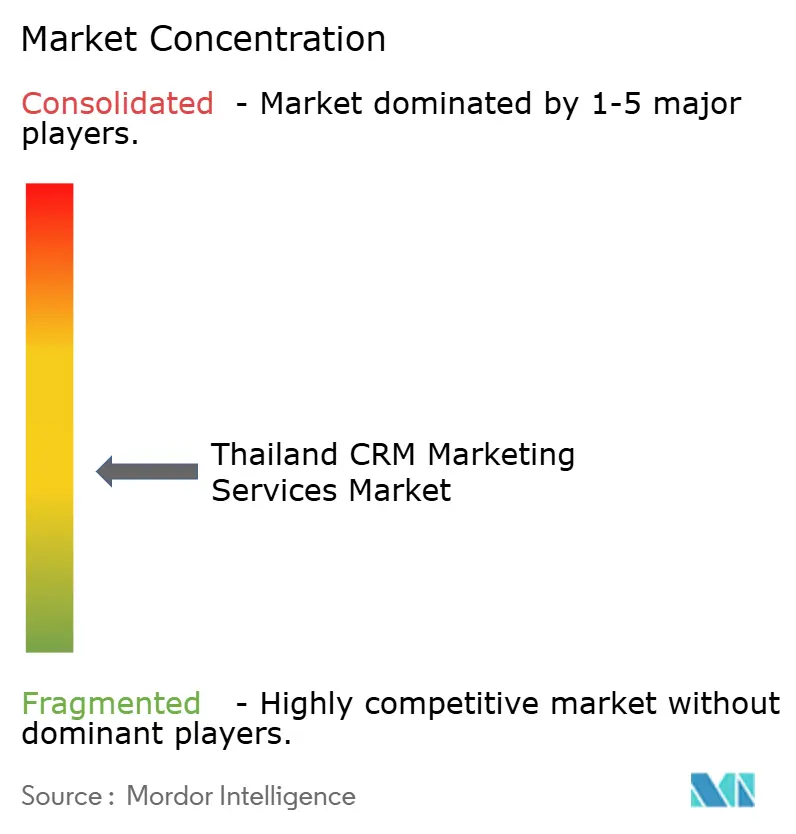
The Thailand CRM marketing services market is moderately fragmented, with global vendors strongest in large enterprise accounts and local providers holding clear advantages in selected use cases. Global suites benefit from broader functionality, established compliance frameworks, and the ability to connect CRM with cloud, analytics, and enterprise application stacks. Salesforce strengthened its position through 2026 deployments at Bumrungrad International Hospital and the Industrial Estate Authority of Thailand, which gave it visible reference accounts in healthcare and public administration.[4] Microsoft also improved its competitive standing by investing in its infrastructure and building local partnerships, making Dynamics 365 more attractive to Thai organizations already operating in the Azure ecosystem. These moves show that scale in the Thailand CRM marketing services market increasingly depends on ecosystem depth as much as direct product capability.
ERP-linked transformation work remains an important route to large contract values in the Thailand CRM marketing services market. SAP’s 2026 Osotspa program showed how customer experience functions are often considered alongside finance and operations modernization rather than as a separate initiative. This keeps switching costs high and favors providers that can remain embedded across multiple operational layers within a client organization. At the same time, mid-market competition is more open because price, ease of rollout, and local integration quality can outweigh global brand strength. Zoho, HubSpot, Freshworks, and other challenger platforms remain relevant where buyers want faster deployment, simpler operating models, and clearer cost control.
Thai-local providers still hold a strategic niche in the Thailand CRM marketing services market because they are often better aligned with LINE-based engagement, loyalty mechanics, and local workflow preferences. PRIMO’s Baitoey launch in 2025 reflected this advantage by embedding agentic AI directly into a loyalty CRM that aligned with local commercial needs. LY Corporation’s Thailand-focused platform development around LINE OA Plus also supports an environment in which local integration depth can matter more than broad feature catalogs. The result is a two-speed competitive landscape where enterprise accounts favor scale, compliance, and breadth of architecture, while many SME and loyalty-heavy programs continue to reward localized execution and channel familiarity.
Thailand CRM Marketing Services Industry Leaders
-
Microsoft Corporation
-
SAP SE
-
Salesforce, Inc.
-
Oracle Corporation
-
IBM Corporation
- *Disclaimer: Major Players sorted in no particular order
Recent Industry Developments
- June 2026: Teibto partnered with Oracle NetSuite to implement cloud ERP and CRM-ERP convergence for Central Restaurants Group (CRG), one of Thailand's largest food and beverage operators, signaling exan panding Oracle CRM footprint in Thailand's hospitality and retail food sector.
- May 2026: Salesforce announced its 2025 ASEAN Partner of the Year Awards and confirmed plans to establish Centers of Excellence for data and AI innovation across ASEAN, with the first CoE in Vietnam and additional CoEs planned with Accenture, PwC Singapore, and Huron in Singapore, directly expanding implementation capacity and technical depth available to Thailand's enterprise CRM buyers.
- April 2026: SAP SE announced that Osotspa Public Company Limited, a leading Thai FMCG company, selected RISE with SAP on Amazon Web Services for enterprise-wide finance and operations modernization via an internal "OneRise" program, implemented by Deloitte, integrating SAP cloud ERP with CRM and customer experience modules.
- April 2026: Bumrungrad International Hospital adopted Salesforce Customer 360 and Agentforce to automate patient engagement in its contact center, making it one of Thailand's first hospitals to deploy agentic AI within a CRM-powered patient service model, establishing a clinical reference account for the healthcare vertical.
Thailand CRM Marketing Services Market Report Scope
The Thailand CRM Marketing Services Market comprises professional and managed services that enable organizations to effectively leverage customer relationship management (CRM) platforms for customer acquisition, engagement, and retention. These services include CRM implementation, customer analytics, omnichannel marketing, loyalty program management, and personalization services. Growing digital commerce activity, expanding adoption of cloud-based CRM solutions, and an increased focus on customer-centric business models fuel the market. These services help enterprises deliver targeted, data-driven marketing campaigns.
The Thailand CRM Marketing Services Market Report is Segmented by Service Type (CRM Strategy and Consulting, CRM Implementation and Integration, CRM Migration and Modernization, CRM Managed Services, and CRM Training and Support), Enterprise Size (Large Enterprises, and Small and Medium Enterprises), Service Application (Customer Acquisition, Customer Retention and Loyalty, Campaign Management Services, Marketing Automation Services, Customer Analytics and Insights, Omnichannel Customer Engagement, and Personalization Services), and End-user Industry (Banking, Financial Services, and Insurance (BFSI), Healthcare and Life Sciences, Information Technology and Telecom, Retail and E-commerce, Industrial Manufacturing, Government and Public Administration, and Other End-user Industries). The Market Forecasts are Provided in Terms of Value (USD).
| CRM Strategy and Consulting |
| CRM Implementation and Integration |
| CRM Migration and Modernization |
| CRM Managed Services |
| CRM Training and Support |
| Large Enterprises |
| Small and Medium Enterprises |
| Customer Acquisition |
| Customer Retention and Loyalty |
| Campaign Management Services |
| Marketing Automation Services |
| Customer Analytics and Insights |
| Omnichannel Customer Engagement |
| Personalization Services |
| Banking, Financial Services, and Insurance (BFSI) |
| Healthcare and Life Sciences |
| Information Technology and Telecom |
| Retail and E-commerce |
| Industrial Manufacturing |
| Government and Public Administration |
| Other End-user Industries |
| By Service Type | CRM Strategy and Consulting |
| CRM Implementation and Integration | |
| CRM Migration and Modernization | |
| CRM Managed Services | |
| CRM Training and Support | |
| By Enterprise Size | Large Enterprises |
| Small and Medium Enterprises | |
| By Service Application | Customer Acquisition |
| Customer Retention and Loyalty | |
| Campaign Management Services | |
| Marketing Automation Services | |
| Customer Analytics and Insights | |
| Omnichannel Customer Engagement | |
| Personalization Services | |
| By End-user Industry | Banking, Financial Services, and Insurance (BFSI) |
| Healthcare and Life Sciences | |
| Information Technology and Telecom | |
| Retail and E-commerce | |
| Industrial Manufacturing | |
| Government and Public Administration | |
| Other End-user Industries |
Key Questions Answered in the Report
What is the size outlook for Thailand CRM marketing services through 2031?
The Thailand CRM marketing services market size was USD 114.44 million in 2025, reached USD 133.29 million in 2026, and is forecast to reach USD 286.49 million by 2031 at a 16.54% CAGR.
Which service type generates the most revenue in Thailand CRM marketing services?
Implementation and integration led the market with 58.23% of 2025 revenue, reflecting ongoing migration from legacy systems to cloud-based CRM environments.
Which buyer group is expanding fastest in Thailand?
SMEs are projected to grow at 18.97% CAGR through 2031, supported by lower-cost cloud delivery, localized interfaces, and mobile-first deployment models.
Why does LINE matter so much for CRM programs in Thailand?
LINE is a core engagement channel in Thailand, so CRM service providers need strong integration for messaging, customer journey handling, and campaign response management.
Which end-user sector offers the strongest growth potential?
Healthcare and life sciences is projected to grow fastest at 18.16% CAGR through 2031, driven by digital patient engagement, contact center automation, and stronger data coordination.
How concentrated is competition among vendors?
Competition is moderately fragmented, with global suites leading large enterprise accounts and Thai-local specialists remaining strong in loyalty, LINE integration, and localized workflow execution.