
United States CRM Marketing Services Market Size and Share
Market Overview
| Study Period | 2020 - 2031 |
|---|---|
| Forecast Data Period | 2026 - 2031 |
| Base Year Market Size (2025) | USD 10.09 Billion |
| Market Size (2026) | USD 10.70 Billion |
| Market Size (2031) | USD 15.5 Billion |
| Growth Rate (2026 - 2031) | 7.70 % |
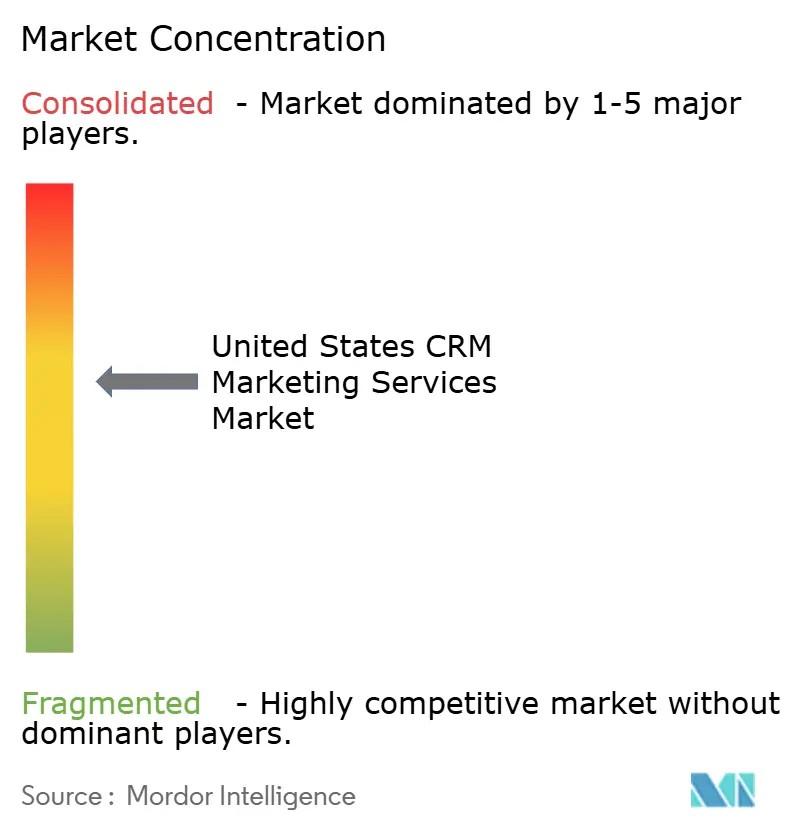
| Market Concentration | Medium |
Major Players *Disclaimer: Major Players sorted in no particular order Image © Mordor Intelligence. Reuse requires attribution under CC BY 4.0. | |
United States CRM Marketing Services Market Analysis by Mordor Intelligence
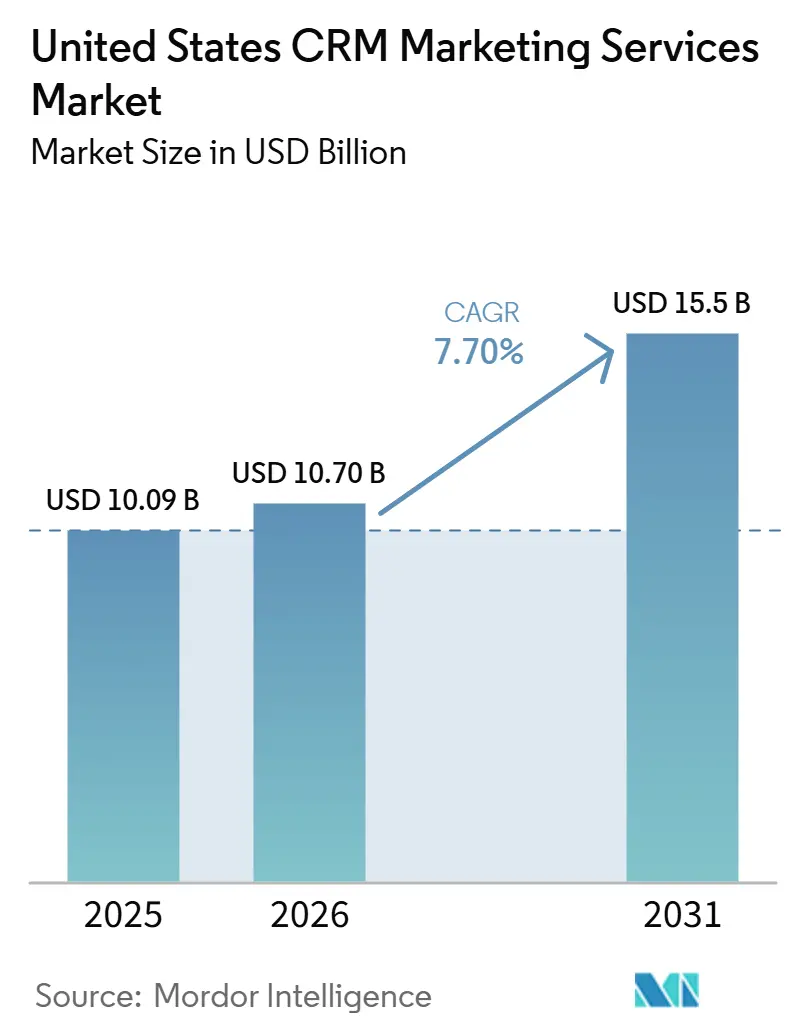
The United States CRM marketing services market size was valued at USD 10.09 billion in 2025 and is estimated to grow from USD 10.70 billion in 2026 to reach USD 15.50 billion by 2031, at a CAGR of 7.70% during the forecast period 2026-2031. The United States CRM marketing services market is moving away from project-led delivery and toward ongoing support for AI-enabled campaign execution, data flows, and workflow control. Demand is rising as enterprises add autonomous capabilities to their CRM environments, but many still need outside help to redesign systems, connect data, and manage daily operations. Vendor strategy is also shaping growth, as leading platforms are pairing new AI products with deeper partner ecosystems, which expands implementation and managed service work across the country. The market is also benefiting from a widening gap between the available CRM AI capabilities and the ability of internal teams to configure them reliably. At the same time, compliance pressure and shortages in specialized talent are raising delivery complexity, which supports outsourcing even when projects take longer to launch.
Key Report Takeaways
- By service type, CRM Managed Services held 57.22% of the United States CRM marketing services market share in 2025, while CRM Migration and Modernization is projected to expand at a 10.02% CAGR through 2031.
- By enterprise size, large enterprises accounted for 71.39% share of the United States CRM marketing services market size in 2025, while small and medium enterprises are expected to record the fastest CAGR at 10.45% through 2031.
- By service application, customer acquisition accounted for 35.21% share of the United States CRM marketing services market size in 2025, while personalization services are projected to grow at a 9.21% CAGR through 2031.
- By end-user industry, retail and e-commerce held 33.85% of the United States CRM marketing services market share in 2025, while healthcare and life sciences are expected to expand at a 9.67% CAGR through 2031.
Note: Market size and forecast figures in this report are generated using Mordor Intelligence’s proprietary estimation framework, updated with the latest available data and insights as of January 2026.
United States CRM Marketing Services Market Trends and Insights
Drivers Impact Analysis*
| Driver | (~) % Impact on CAGR Forecast | Geographic Relevance | Impact Timeline |
|---|---|---|---|
| Rising Adoption of AI-Assisted Campaign Orchestration | +2.2% | National, concentrated in tech hubs such as San Francisco, Seattle, and New York | Short term (≤ 2 years) |
| Growing Need for First-Party Data Activation | +1.8% | National, with early adoption in California and the Northeast | Short term (≤ 2 years) |
| CRM and Marketing Stack Consolidation in Mid-Market Firms | +1.2% | National, strongest in Midwest and Southeast mid-market clusters | Medium term (2-4 years) |
| Expansion of Outsourced CRM Implementation and Managed Services | +1.0% | National | Medium term (2-4 years) |
| Vertical-Specific Compliance Workflows Increasing Service Demand | +0.7% | National, with BFSI concentration in the Northeast and healthcare in the Southeast | Medium term (2-4 years) |
| Higher Share of Subscription-Based Service Contracts | +0.5% | National | Long term (≥ 4 years) |
| Source: Mordor Intelligence | |||
Rising Adoption of AI-Assisted Campaign Orchestration
AI-enabled workflow execution is becoming a core demand driver for the United States CRM marketing services market. Salesforce reported that Agentforce ARR reached USD 800 million in FY26, and that Agentforce and Data 360 ARR together exceeded USD 2.9 billion, indicating how quickly enterprises are moving from testing AI to deploying it in production CRM environments.[1] Adobe also brought CX Enterprise Coworker to general availability in June 2026, with support for campaign management, analytics, and journey orchestration, suggesting a more active role for AI in enterprise marketing workflows. ServiceNow took the same direction when it launched Autonomous CRM, with AI agents built to triage, resolve, and escalate customer cases across the lifecycle. Microsoft described this shift as agentic CRM in the flow of work, where AI tools support sales activity and customer interactions directly inside day-to-day systems rather than through isolated analytics layers. As these features become part of production environments, buyers need external partners to redesign the architecture, configure controls, and maintain stable operations after launch.
Growing Need for First-Party Data Activation
The United States CRM marketing services market is also being supported by a stronger need to activate customer data within owned systems and connected campaign tools. Salesforce and Google Cloud expanded their partnership in April 2026 to add Gemini-powered reasoning for Agentforce, Salesforce IDMC connectors for Google BigQuery, and zero-copy data federation with Google Lakehouse, which directly supports the use of unified customer data across complex CRM environments. Oracle introduced Fusion Agile Applications for customer experience, with a Marketing Command Center built on unified enterprise data, reinforcing the same shift toward connected data foundations for campaign execution. Adobe positioned CX Enterprise Coworker around campaign workflows, analytics, and journey orchestration, which further links service demand to the ability to connect clean customer data to automated decisions. In practice, this means many clients no longer view data activation as a side project, because campaign performance now depends on whether CRM data, analytics, and AI tools work together within a single operational model. That shift lifts demand for integration, migration, and ongoing governance work even when software licenses are already in place.
CRM and Marketing Stack Consolidation in Mid-Market Firms
Mid-market buyers are becoming more important to the United States CRM marketing services market as they simplify tool sprawl and move toward fewer, more connected systems. HubSpot introduced more than 100 product updates in April 2026, including Answer Engine Optimization, expanded Prospecting Agent capabilities, Smart Deal Progression, and new Customer Agent features, signaling a clear push toward broader platform usage from a single provider. Salesforce also expanded its flexible AI deployment with expanded Agentforce capabilities and broader workflow integrations with Google Cloud. This matters because mid-market firms often lack the internal teams needed to connect sales, service, marketing, and AI tools across multiple vendors simultaneously. As a result, consolidation usually creates service demand before it creates software savings, since companies need outside support to migrate data, retire old tools, and rebuild workflows around a smaller core stack. Once that transition is complete, many of those firms continue with managed support because the new platforms are leaner in number but more advanced in function.
Expansion of Outsourced CRM Implementation and Managed Services
The expansion of outsourced implementation and managed support remains a central growth factor in the United States CRM marketing services market. CRM Managed Services already led the market in 2025, and the operating model is shifting from simple maintenance toward daily oversight of AI tools, data quality, workflow logic, and compliance controls. Adobe made this direction clear when it launched CX Enterprise Coworker and expanded partnerships with Accenture, Omnicom, Stagwell, and WPP, which shows that large vendors are scaling delivery through service ecosystems rather than product-only sales. ServiceNow followed with platform moves that framed autonomous work as a governed operating model, not a one-time deployment, which supports longer service contracts and more continuous engagement. Oracle also embedded role-based AI agents into customer experience functions, underscoring the need for implementation support for planning, orchestration, and marketing operations. As CRM environments become more active and less static, buyers are more willing to outsource operations that directly affect campaign speed, customer experience, and platform stability.
Restraints Impact Analysis*
| Restraint | (~) % Impact on CAGR Forecast | Geographic Relevance | Impact Timeline |
|---|---|---|---|
| Data Privacy Consent Complexity Slows Campaign Execution | -1.8% | National, acute in high-population-state law jurisdictions such as California, Texas, and Florida | Short term (≤ 2 years) |
| Fragmented Customer Data Across Legacy Systems | -1.4% | National | Medium term (2-4 years) |
| Shortage of Specialized CRM Marketing Talent | -1.0% | National, acute in non-major metro markets | Medium term (2-4 years) |
| Buyer Pushback on Multi-Vendor Integration Costs | -0.7% | National | Long term (≥ 4 years) |
| Source: Mordor Intelligence | |||
Data Privacy Consent Complexity Slows Campaign Execution
Data privacy complexity remains a real restraint on the United States' CRM marketing services market, as campaign systems now require tighter controls before automation can scale. The burden is greatest when customer journeys, preferences, and AI-driven decisions are managed across multiple tools rather than a single coordinated workflow. Salesforce and Google Cloud emphasized deeper data federation and connector design in their April 2026 expansion, and the need for those capabilities reflects the significant operational pressure now on data handling and activation logic. Adobe also tied its latest enterprise offer to campaign management, analytics, and journey orchestration, meaning services teams must align automation with stricter control points before deployments can proceed. These conditions do not stop spending, but they do extend timelines, as clients often need redesign work on consent handling, data routing, and workflow approvals before launch. That adds friction to delivery and can delay revenue recognition for service providers even when demand remains strong.
Fragmented Customer Data Across Legacy Systems
Fragmented data across legacy systems continues to limit how fast the United States CRM marketing services market can convert demand into completed projects. Many enterprises still run disconnected CRM, analytics, service, and marketing layers, which makes migration and orchestration harder once AI capabilities are added. Salesforce and Google Cloud addressed this challenge directly through BigQuery connectors and zero-copy data federation, demonstrating that large vendors view integration barriers as a core adoption issue. Oracle also built its latest customer experience applications around a unified enterprise data model, underscoring the importance of common data structures for campaign execution and audience prioritization. Even so, legacy environments still slow delivery because service providers must spend more time cleaning records, mapping systems, and testing workflows before new tools can operate reliably. That extra work supports billable demand, but it also increases scope risk and makes it harder to standardize project outcomes across clients.
*Our forecasts treat driver/restraint impacts as directional, not additive. The impact forecasts reflect baseline growth, mix effects, and variable interactions.
Segment Analysis
By Service Type: Managed Services Hold the Revenue Base While Migration Lifts Growth
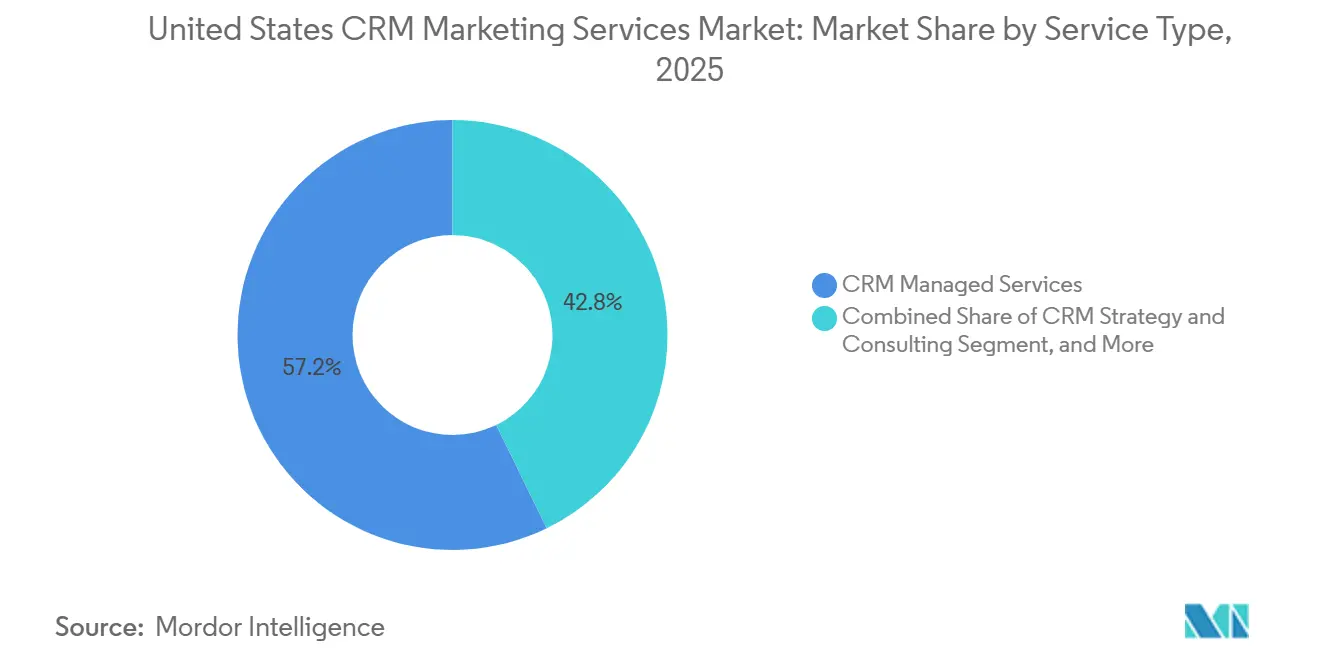
CRM Managed Services accounted for 57.22% of revenue in 2025, indicating that the largest share of the United States CRM marketing services market still came from long-duration operating support rather than one-time projects. The segment benefits from the day-to-day burden of running modern CRM environments, where teams must monitor workflows, maintain data quality, and support campaign execution after implementation. In the current market, this work is becoming broader because AI-enabled platforms need more oversight than earlier CRM systems. Adobe’s June 2026 release of CX Enterprise Coworker supported that pattern by bringing campaign management, analytics, and journey orchestration into an enterprise AI operating layer that is built for partner deployment.[2] ServiceNow reinforced this direction with Autonomous CRM, which replaced passive databases with active AI agents, thereby increasing the need for governed operations after go-live.
CRM Migration and Modernization is expected to grow at a 10.02% CAGR through 2031, which makes it the fastest-growing service type in the United States CRM marketing services industry. Growth requires moving away from older, on-premises, and fragmented cloud environments that were not built for AI-led campaign orchestration. Salesforce’s expanded integrations with Google Cloud reduce some of the data movement burden, but they also encourage more firms to start modernization projects because the target architecture is becoming clearer and more practical. Strategy and consulting, implementation and integration, and training and support remain essential entry points because buyers still need planning, deployment, and skill development before managed work can scale. This means the service mix is becoming more connected, where advisory work opens the door to migration, and migration often turns into recurring support.

By Enterprise Size: Large Enterprises Lead While SMEs Expand Faster
Large enterprises held 71.39% of the United States CRM marketing services market in 2025, reflecting their larger budgets, complex CRM estates, and greater exposure to regulated customer communications. These buyers usually operate across several channels and business units, so CRM service engagements tend to be larger, longer, and more dependent on specialist partners. The United States CRM marketing services market also remains enterprise-led, as top vendors continue to launch AI features that require broad architectural changes before companies can use them at scale. Salesforce’s FY26 performance, including USD 800 million in Agentforce ARR and more than USD 2.9 billion in combined Agentforce and Data 360 ARR, shows how much large organizations are already spending on AI-enabled CRM capabilities. Adobe, Oracle, and ServiceNow made similar product moves in 2026, which further supports demand from large organizations that need multiyear deployments and ongoing support.
Small and medium enterprises are projected to grow at a 10.45% CAGR through 2031, making them the fastest-growing buyer group in the United States CRM marketing services industry. Much of this expansion is linked to buyers who want to simplify fragmented tools and adopt more integrated CRM and marketing workflows without building large internal teams. HubSpot’s 2026 product cycle and entry-level pricing for newer AI functions lowered the threshold for mid-market adoption and made service-led activation more practical. Salesforce also widened access through more flexible AI deployment options, improving the fit for companies that need usage-led growth rather than heavy upfront commitments. Even after deployment, many smaller firms remain dependent on outside partners because they can buy advanced CRM tools more quickly than they can build internal expertise in orchestration, analytics, and ongoing optimization.
By Service Application: Customer Acquisition Stays Largest While Personalization Advances Fastest
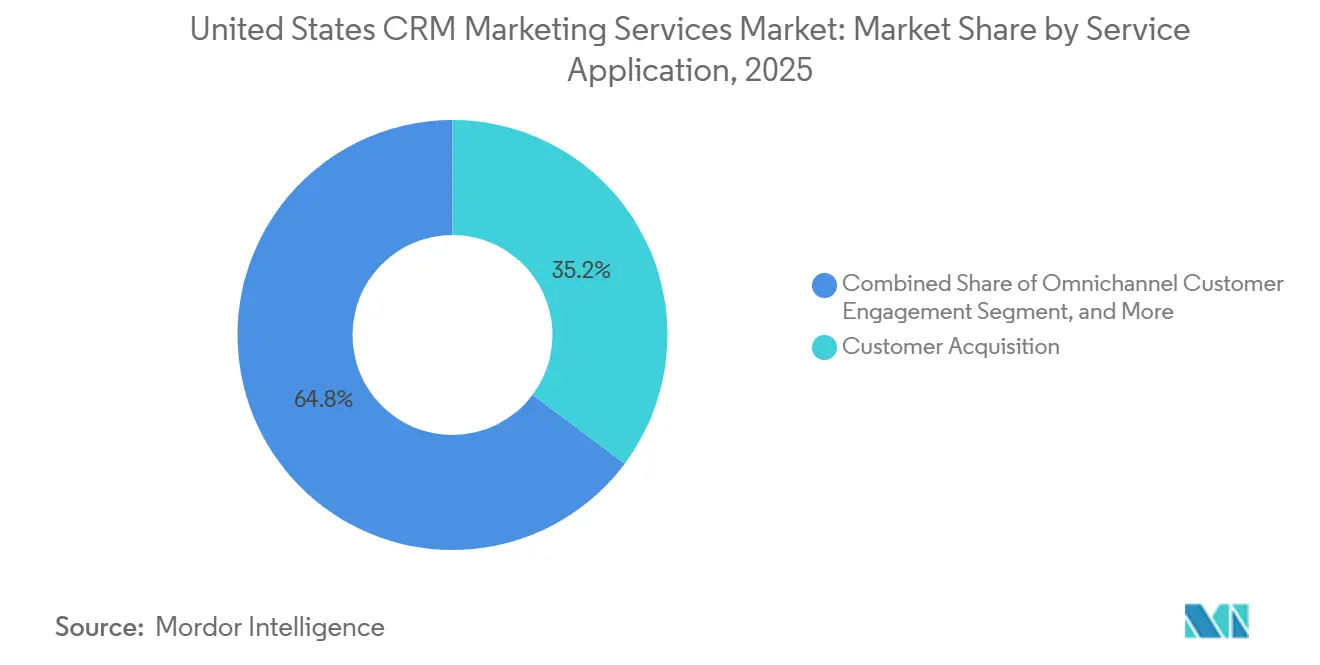
Customer acquisition led with 35.21% of revenue in 2025, which reflects the continued importance of lead capture, prospecting workflows, and campaign execution in the United States CRM marketing services market. Many companies still begin CRM service engagements with acquisition because it produces visible results and creates the first layer of structured customer data. Once that foundation is in place, it becomes easier to add retention, analytics, and cross-channel engagement services on the same platform. Salesforce expanded this logic through Summer 2026 product updates that added multi-agent orchestration and Slack-first workflow options, enabling faster coordination across marketing and customer activity. ServiceNow also tied CRM actions more closely to response and case handling, enabling the use of acquisition and service data within a single operating flow.
Personalization services are projected to grow at a 9.21% CAGR through 2031, making it the fastest-growing application area. This rise reflects the shift from broad campaign delivery to more precise engagement built on customer data, AI-led content decisions, and faster workflow responses. Adobe’s CX Enterprise Coworker centered its value proposition on campaign management, analytics, and journey orchestration, all of which support personalization at enterprise scale. Oracle’s Marketing Command Center also supported this direction by identifying revenue opportunities, prioritizing audience segments, and launching growth programs from a unified data set. Retention and loyalty, marketing automation, omnichannel engagement, and analytics remain important adjacent applications, but their value increasingly depends on how well they feed into coordinated personalization logic rather than standing alone as separate service lines.
By End-User Industry: Retail And E-Commerce Lead While Healthcare And Life Sciences Grow Fastest
Retail and e-commerce accounted for 33.85% of revenue in 2025, keeping this vertical at the center of the United States CRM marketing services market. The segment depends heavily on loyalty programs, campaign orchestration, product recommendations, and fast customer response loops, so CRM spending tends to be continuous rather than episodic. This also explains why retail buyers are early adopters of AI-enabled workflow tools that promise more direct control over targeting, content, and service quality. Adobe’s June 2026 product and partnership announcements were closely aligned with these needs because they connected campaign management, analytics, and journey design with broader agency support. Oracle’s customer experience launches also fit the sector by integrating audience prioritization and program execution into a single workflow layer.
Healthcare and life sciences are projected to grow at a 9.67% CAGR through 2031, which makes it the fastest-growing vertical in the United States CRM marketing services market. Growth is being shaped by the need for specialized CRM configurations that can support outreach, engagement, and data handling in more controlled environments. Buyers in this segment often require outside service partners because deployment standards are more demanding and errors are harder to absorb than in many other verticals. BFSI remains another major revenue base because auditability and structured communications matter as much as campaign performance in those accounts. Information technology and telecom, industrial manufacturing, and government and public administration complete the remaining base, and these sectors continue to drive demand when AI adoption, customer workflow complexity, and system integration needs co-occur.
Geography Analysis
Regional demand in the United States CRM marketing services market was influenced by enterprise density, regulatory burden, and the pace of AI adoption in 2025 and 2026. The Northeast corridor, centered on New York and Boston, remained one of the strongest demand centers because financial institutions and insurers require CRM systems that support both engagement and documented control. That combination results in longer, more comprehensive service contracts than simpler campaign deployments. California also stood out because it combines the country’s deepest concentration of technology, media, and digital commerce buyers with a heavier need for consent-aware data handling. As a result, the United States CRM marketing services market continued to generate high-value work in California around architecture redesign, platform integration, and ongoing operational support.
The Southeast and South, led by Texas, Florida, and Atlanta, are becoming increasingly important to the United States' CRM marketing services market, as healthcare networks, insurers, and large service organizations expand CRM deployments in the region. These buyers often need managed overlays and specialized implementation support rather than basic software setup. That makes the region attractive for providers that can combine vertical knowledge with data, workflow, and campaign execution skills. The regional pull is also widening beyond traditional coastal hubs, which means future growth is likely to come from a broader spread of regulated and service-heavy buyer groups.
The Midwest reflects a different pattern, with more demand tied to consolidation, migration, and implementation work among industrial and B2B firms. The West Coast, especially California, Washington, and Colorado, continues to lead in the adoption of AI-enabled CRM functions, which keeps modernization demand elevated. In those states, older marketing cloud setups are being rebuilt to support agentic workflows and connected customer data models. Across the country, the strongest regional opportunities still appear where talent scarcity, customer data complexity, and enterprise AI adoption intersect inside the same account base.
Competitive Landscape
The United States CRM marketing services market is moderately consolidated at the top and much more fragmented below that layer. Salesforce, Microsoft, Adobe, and Oracle remained the strongest names in large enterprise work, while HubSpot, SAP, Pegasystems, and a wide field of specialist partners competed more actively in the mid-market and vertical niches. The leading firms are not only selling software but also shaping how service revenue is generated by embedding AI, automation, and orchestration more deeply into CRM workflows. Salesforce strengthened that position through strong FY26 AI performance and by expanding its ecosystem around Agentforce and Data 360. Adobe followed a similar path by pairing product expansion with agency and systems integration partnerships, thereby increasing delivery capacity without relying solely on internal hiring.
Competition is also moving toward full-stack operating models rather than stand-alone tools. Oracle launched Fusion Agentic Applications for customer experience in April 2026 and added role-based AI agents in February 2026, indicating a push to combine data, marketing, sales, and service actions within a single environment.[3] ServiceNow entered more directly with Autonomous CRM, which gave it a stronger position in regulated and service-intensive accounts. Zendesk also accelerated its AI service capabilities through the Forethought acquisition, showing that platform vendors are willing to buy speed in agentic tools rather than build everything internally.
The most attractive white space remains in delivery models rather than in basic product access. Mid-market consolidation, healthcare-focused CRM services, and AI agent governance all remain areas where specialized providers can differentiate. Salesforce’s agreement to acquire Fin in June 2026 showed a direct move into broader autonomous customer engagement and increased the service runway around implementation and operationalization. Adobe’s work with Accenture, Omnicom, Stagwell, and WPP showed another route: partner ecosystems can fill capability gaps faster than individual vendors can on their own. This keeps the top tier strong, but it also leaves room for smaller firms that can offer tighter vertical packaging, faster deployment, or more controlled managed services for complex accounts.
United States CRM Marketing Services Industry Leaders
-
Oracle Corporation
-
Microsoft Corporation
-
Adobe Inc.
-
Salesforce, Inc.
-
SAP SE
- *Disclaimer: Major Players sorted in no particular order
Recent Industry Developments
- June 2026: Salesforce signed a definitive agreement to acquire Fin, formerly Intercom, for USD 3.6 billion. The transaction, expected to close in Q4 of Salesforce's fiscal year 2027, adds Fin's AI customer agent platform, resolving queries across live chat, WhatsApp, SMS, phone, and Slack, to the Agentforce suite, with the stated objective of expanding autonomous agent capabilities into the mid-market and accelerating time-to-value for CRM marketing and customer service deployments.
- June 2026: Adobe announced the general availability of CX Enterprise Coworker, an agentic AI solution that automates customer experience workflows, including campaign management, analytics, and journey orchestration. Built on the open Model Context Protocol and Agent2Agent standards, CX Enterprise Coworker interoperates with AI platforms from Amazon Web Services, Anthropic, Google Cloud, Microsoft, and OpenAI, significantly broadening deployment and partner-delivery opportunities for enterprise services.
- June 2026: Adobe accelerated its agentic AI ecosystem at Cannes Lions, announcing co-developed solutions with Accenture, Omnicom, Stagwell's Code and Theory, and WPP. Adobe Marketing Agent reached general availability within Microsoft 365 Copilot and entered beta across Anthropic Claude Enterprise, ChatGPT Enterprise, Gemini Enterprise, and IBM watsonx Orchestrate, enabling enterprise marketers to access Adobe CRM marketing capabilities within existing AI environments.
- May 2026: ServiceNow launched Autonomous CRM at Knowledge 2026, introducing a CRM platform that replaces passive databases with AI agents that triage, resolve, and escalate customer cases across the full lifecycle without human intervention. The platform includes vertical-specific Autonomous CRM features targeting financial services, telecommunications, healthcare, manufacturing, government, and retail, directly challenging Salesforce, Oracle, and Microsoft in regulated-industry CRM services.
United States CRM Marketing Services Market Report Scope
The United States CRM Marketing Services Market includes consulting, implementation, managed, and optimization services that support the use of customer relationship management (CRM) technologies for marketing and customer engagement activities. These services cover customer data management, marketing automation, campaign execution, customer journey orchestration, and analytics-based personalization. Widespread CRM adoption, advanced digital marketing ecosystems, and strong investment in artificial intelligence and customer experience technologies support the market. The market enables enterprises to enhance customer relationships, improve marketing performance, and drive long-term business growth.
The United States CRM Marketing Services Market Report is Segmented by Service Type (CRM Strategy and Consulting, CRM Implementation and Integration, CRM Migration and Modernization, CRM Managed Services, and CRM Training and Support), Enterprise Size (Large Enterprises, and Small and Medium Enterprises), Service Application (Customer Acquisition, Customer Retention and Loyalty, Campaign Management Services, Marketing Automation Services, Customer Analytics and Insights, Omnichannel Customer Engagement, and Personalization Services), and End-user Industry (Banking, Financial Services, and Insurance (BFSI), Healthcare and Life Sciences, Information Technology and Telecom, Retail and E-commerce, Industrial Manufacturing, Government and Public Administration, and Other End-user Industries). The Market Forecasts are Provided in Terms of Value (USD).
| CRM Strategy and Consulting |
| CRM Implementation and Integration |
| CRM Migration and Modernization |
| CRM Managed Services |
| CRM Training and Support |
| Large Enterprises |
| Small and Medium Enterprises |
| Customer Acquisition |
| Customer Retention and Loyalty |
| Campaign Management Services |
| Marketing Automation Services |
| Customer Analytics and Insights |
| Omnichannel Customer Engagement |
| Personalization Services |
| Banking, Financial Services, and Insurance (BFSI) |
| Healthcare and Life Sciences |
| Information Technology and Telecom |
| Retail and E-commerce |
| Industrial Manufacturing |
| Government and Public Administration |
| Other End-user Industries |
| By Service Type | CRM Strategy and Consulting |
| CRM Implementation and Integration | |
| CRM Migration and Modernization | |
| CRM Managed Services | |
| CRM Training and Support | |
| By Enterprise Size | Large Enterprises |
| Small and Medium Enterprises | |
| By Service Application | Customer Acquisition |
| Customer Retention and Loyalty | |
| Campaign Management Services | |
| Marketing Automation Services | |
| Customer Analytics and Insights | |
| Omnichannel Customer Engagement | |
| Personalization Services | |
| By End-user Industry | Banking, Financial Services, and Insurance (BFSI) |
| Healthcare and Life Sciences | |
| Information Technology and Telecom | |
| Retail and E-commerce | |
| Industrial Manufacturing | |
| Government and Public Administration | |
| Other End-user Industries |
Key Questions Answered in the Report
What is the size outlook for the United States CRM marketing services market?
The United States CRM marketing services market size was USD 10.09 billion in 2025, is estimated at USD 10.70 billion in 2026, and is forecast to reach USD 15.50 billion by 2031 at a 7.70% CAGR.
Which service type leads spending in CRM marketing services in the United States?
CRM Managed Services led with 57.22% of revenue in 2025, showing that buyers prefer ongoing operational support over one-time project work.
Which buyer group is growing fastest in this space?
Small and medium enterprises are projected to grow at a 10.45% CAGR through 2031 as they consolidate tools and rely on partners for implementation and optimization.
Which application area is expanding fastest across CRM marketing services?
Personalization services is projected to grow at a 9.21% CAGR through 2031 because buyers want more precise engagement built on connected customer data and AI-led decisions.
Which end-user vertical creates the largest demand for CRM marketing services?
Retail and e-commerce led with 33.85% of revenue in 2025 due to strong dependence on loyalty management, campaign orchestration, and personalized engagement.
Why are managed services becoming more important in CRM marketing?
AI-enabled CRM tools need continuous oversight, data quality control, workflow management, and platform optimization, which makes outsourced support more valuable after deployment.