
Indonesia CRM Marketing Services Market Size and Share
Market Overview
| Study Period | 2020 - 2031 |
|---|---|
| Forecast Data Period | 2026 - 2031 |
| Base Year Market Size (2025) | USD 164.54 Million |
| Market Size (2026) | USD 191.80 Million |
| Market Size (2031) | USD 423.75 Million |
| Growth Rate (2026 - 2031) | 17.18 % |
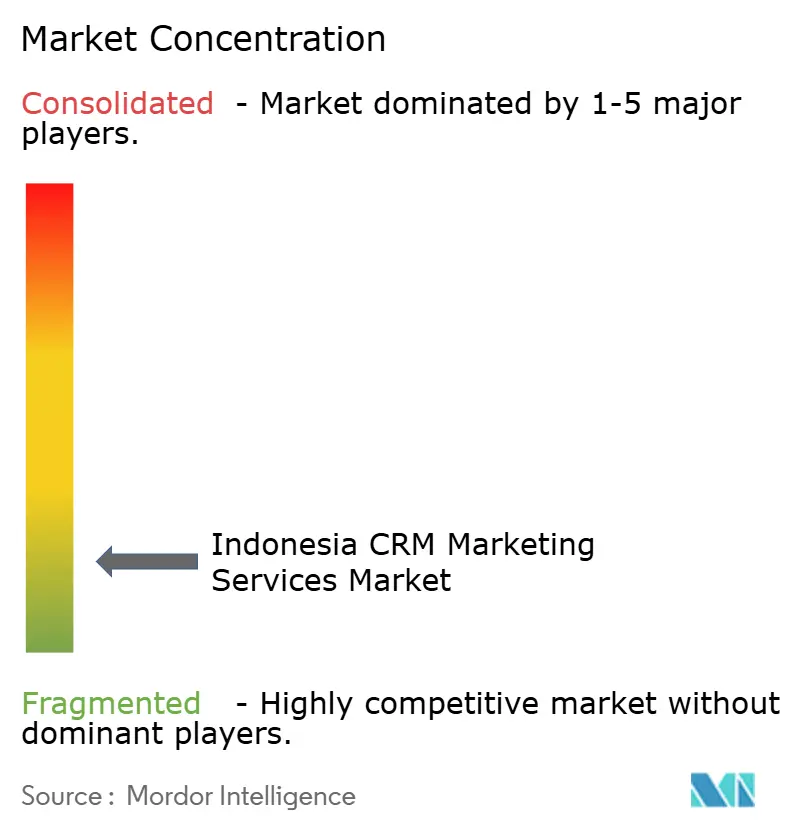
| Market Concentration | Low |
Major Players *Disclaimer: Major Players sorted in no particular order Image © Mordor Intelligence. Reuse requires attribution under CC BY 4.0. | |
Indonesia CRM Marketing Services Market Analysis by Mordor Intelligence
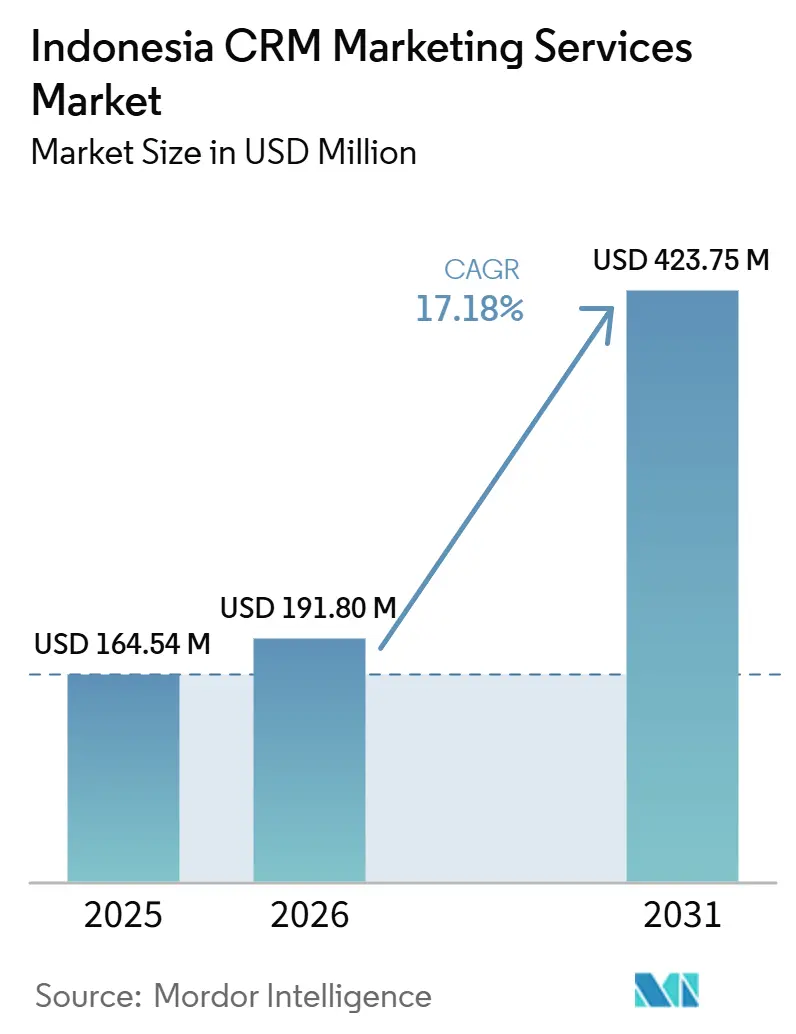
The Indonesia CRM marketing services market size is expected to increase from USD 164.54 million in 2025 to USD 191.80 million in 2026 and reach USD 423.75 million by 2031, growing at a CAGR of 17.18% over 2026-2031. The Indonesia CRM marketing services market is expanding as companies move customer engagement programs toward first-party data, stronger consent control, and more connected communication workflows. E-commerce, digital banking, and social commerce are pushing brands to manage customer journeys across marketplaces, websites, apps, contact centers, and messaging channels through the same operating layer. WhatsApp-linked engagement has become part of the core service scope, which keeps implementation work larger than in many comparable markets and also extends the need for ongoing managed support after deployment. The shift from one-time setup projects to continuous optimization is also changing how providers compete, with local deployment speed, data residency support, and workflow integration now carrying more weight in buyer decisions. The market still has room to expand beyond large accounts in Jakarta and other major Java cities, especially as smaller firms adopt lighter cloud-based CRM solutions and providers bring more productized service models to Tier-2 and Tier-3 cities.
Key Report Takeaways
- By service type, CRM Implementation and Integration held 57.88% of the Indonesia CRM marketing services market revenue in 2025, while CRM Managed Services is projected to expand at a 19.05% CAGR through 2031.
- By enterprise size, Large Enterprises held 68.71% of the Indonesia CRM marketing services market revenue in 2025, while Small and Medium Enterprises are projected to grow at a 19.49% CAGR through 2031.
- By service application, Customer Acquisition accounted for 34.12% of the Indonesia CRM marketing services market revenue in 2025, while Personalization Services is expected to expand at an 18.41% CAGR through 2031.
- By end-user industry, BFSI accounted for 35.41% of the Indonesia CRM marketing services market in 2025, while Retail and E-commerce are projected to grow at an 18.72% CAGR through 2031.
Note: Market size and forecast figures in this report are generated using Mordor Intelligence’s proprietary estimation framework, updated with the latest available data and insights as of January 2026.
Indonesia CRM Marketing Services Market Trends and Insights
Drivers Impact Analysis*
| Driver | (~) % Impact on CAGR Forecast | Geographic Relevance | Impact Timeline |
|---|---|---|---|
| Rising Omnichannel Customer Engagement Budgets | +4.2% | Global, concentrated in Jakarta, Surabaya, and Bandung corridors | Short term (≤ 2 years) |
| Rapid Expansion of E-Commerce and Retail CRM Use Cases | +3.5% | National, with primary gains in Java, spill-over to Sumatra | Medium term (2-4 years) |
| Cloud-First Adoption Among Small and Medium Enterprises | +3.0% | National, concentrated on Java and Sumatra initially | Medium term (2-4 years) |
| Marketing Automation Demand Tied to Performance Marketing | +2.5% | National, concentrated in Greater Jakarta | Medium term (2-4 years) |
| AI-Based Lead Scoring and Personalization Workflows | +1.8% | National, with early gains in enterprise clusters in Jakarta and Surabaya | Long term (≥ 4 years) |
| Under-Served Tier-2 and Tier-3 City Demand | +1.2% | Outer Java, Sumatra, Kalimantan, and Eastern Indonesia | Long term (≥ 4 years) |
| Source: Mordor Intelligence | |||
Rising Omnichannel Customer Engagement Budgets
Customer engagement budgets are moving toward CRM-centered orchestration across email, messaging, service, and commerce channels. This is increasing the amount of design, integration, and support work bundled into each deployment in the Indonesia CRM marketing services market. Vendors are no longer being asked only to connect software. They are also being asked to shape consent flows, data capture, audience logic, and message sequencing inside the same operating environment. Salesforce’s July 2025 expansion of Hyperforce services in Indonesia, including Agentforce, Data Cloud, and Marketing Cloud Next, showed that buyers in regulated sectors now expect local data residency and full-stack activation in the same program. That requirement favors service providers that can combine architecture, workflow setup, and campaign operations under a single delivery model. The result is a larger contract scope and a clearer path from implementation into recurring managed services within the Indonesia CRM marketing services market.
Rapid Expansion of E-Commerce and Retail CRM Use Cases
Retail and digital commerce are expanding the addressable market for CRM services nationwide. The U.S. International Trade Administration stated that Indonesia’s e-commerce value is projected to reach USD 86.81 billion by 2028, while social commerce is expected to reach USD 22 billion in gross merchandise value by 2028.[1] Those transaction flows create a stronger need for customer identification, lifecycle tracking, and re-engagement across marketplaces, social channels, and owned channels. In the Indonesia CRM marketing services market, this lifts demand for acquisition workflows first and then for retention and personalization programs as customer databases deepen. It also shifts value toward providers that can connect commerce data with campaign execution rather than only set up contact records. That is one reason Retail and E-commerce is becoming a major growth engine across the Indonesia CRM marketing services market.
Cloud-First Adoption Among Small and Medium Enterprises
Cloud delivery is lowering the adoption threshold for smaller companies that previously could not support long and complex CRM projects. This matters because the Indonesia CRM marketing services market still has a significant opportunity outside the largest enterprise accounts. Mekari Qontak stated in June 2026 that Indonesian businesses often operate four to six disconnected customer management systems simultaneously, which explains why simpler unification tools and faster deployment models are gaining traction. Productized onboarding, subscription pricing, and local-language support are making CRM service packages easier to buy and activate for mid-market and smaller firms. These conditions favor domestic and regional providers that can bring repeatable deployment templates into sectors with limited internal IT capacity. Over time, this widens the customer base for Indonesia CRM marketing services beyond the traditional Java-centered enterprise core.
Marketing Automation Demand Tied to Performance Marketing
Indonesian companies are tying CRM spending more closely to measurable commercial outcomes. That shift increases demand for providers that can configure lead scoring, funnel automation, and re-engagement logic rather than only install software. The need is visible in banking and customer-heavy service businesses where each interaction now spans digital and assisted channels. In April 2026, PT Bank CIMB Niaga, Google Cloud, and Artefact launched enterprise AI agents on Google Cloud’s Vertex AI platform to support relationship management and contact center use cases in Indonesia. That deployment showed how buyers are moving from simple record management toward workflow-level automation and personalized advisory inside CRM environments. As this pattern spreads, the Indonesia CRM marketing services market should continue to reward firms that can blend data operations, automation design, and ongoing optimization.
Restraints Impact Analysis*
| Restraint | (~) % Impact on CAGR Forecast | Geographic Relevance | Impact Timeline |
|---|---|---|---|
| Data Privacy Compliance and Consent Management Complexity | -1.5% | National, with heightened impact in BFSI and telecom sectors | Medium term (2-4 years) |
| Integration Friction with Legacy ERP, POS, and WhatsApp Workflows | -1.2% | National, with greater impact outside Greater Jakarta | Short term (≤ 2 years) |
| Shortage of CRM Implementation and RevOps Talent Outside Java | -0.9% | Outer Java, Sumatra, Kalimantan, Sulawesi, and Eastern Indonesia | Long term (≥ 4 years) |
| Budget Sensitivity among Micro and Small Enterprises | -0.7% | National, with higher impact in Tier-2 and Tier-3 cities | Medium term (2-4 years) |
| Source: Mordor Intelligence | |||
Data Privacy Compliance and Consent Management Complexity
Compliance now shapes project design across the Indonesia CRM marketing services market, especially in sectors that handle sensitive customer records. Buyers are asking vendors to demonstrate that campaign data, analytics workflows, and customer records can be managed within architectures that support local residency and tighter governance. Salesforce linked its July 2025 Indonesia expansion directly to data residency and compliance needs in government, financial services, and telecom. This increases the planning burden on service providers because consent capture, data movement, and channel activation must work together from the start. It also slows some buying decisions, as clients prefer to wait for greater certainty before locking in long-lived data-processing structures. The result is not a collapse in demand, but a longer path from evaluation to signed project scope in the Indonesia CRM marketing services market.
Integration Friction with Legacy ERP, POS, and WhatsApp Workflows
Integration remains one of the clearest operating limits on deployment speed. Mekari Qontak said in June 2026 that Indonesian businesses commonly run four to six disconnected customer management systems simultaneously, underscoring the scale of the unification problem facing providers. CRM projects often need to connect legacy enterprise systems, store-level data, contact center tools, and messaging workflows before customer engagement logic can function well. That raises the labor content of each project and makes it harder to compress timelines, especially outside the deepest partner ecosystems. In the Indonesia CRM marketing services market, this supports implementation revenue but also increases execution risk and total ownership cost for buyers. Providers with stronger middleware capabilities, deeper local partner networks, and repeatable integration templates are therefore better positioned to sustain margins.
*Our forecasts treat driver/restraint impacts as directional, not additive. The impact forecasts reflect baseline growth, mix effects, and variable interactions.
Segment Analysis
By Service Type: Implementation Services Lead While Managed Support Gains Weight
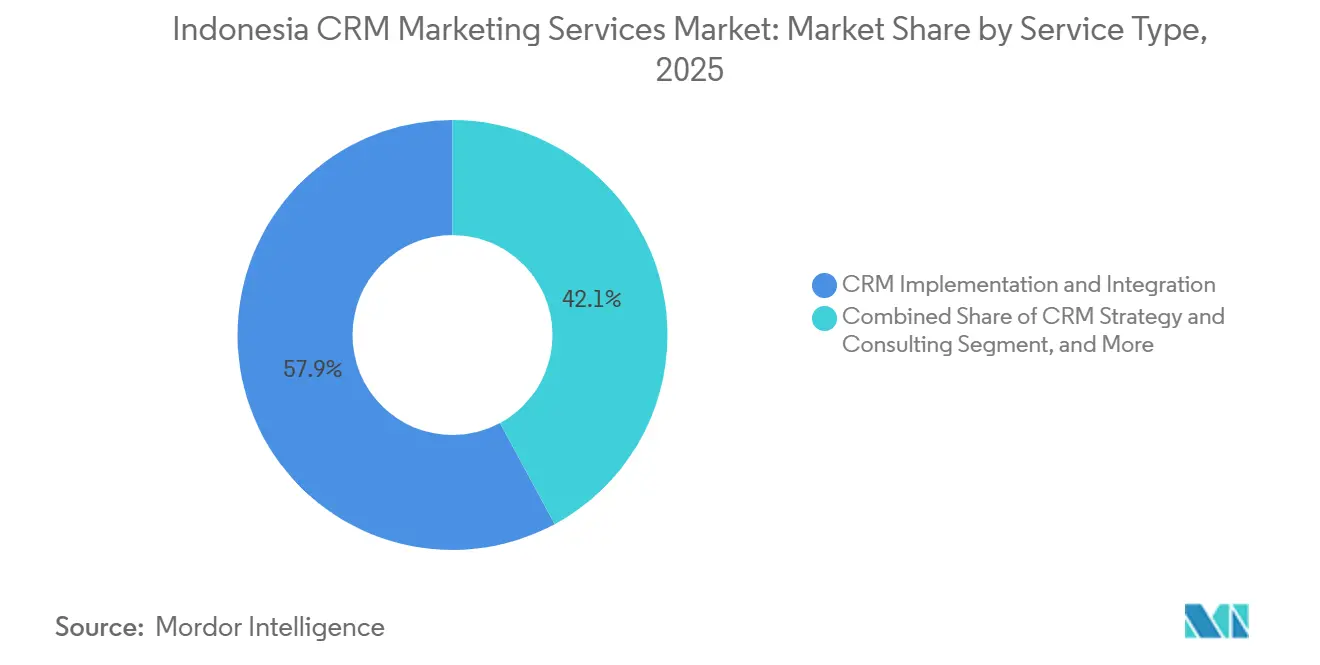
CRM Implementation and Integration accounted for 57.88% of the Indonesia CRM marketing services market in 2025, making it the largest service type by a clear margin. That share reflects the basic structure of the market, where buyers still need substantial hands-on work to configure platforms, connect data sources, and align customer workflows. The service scope is broader than simple system setup because many programs must tie together sales, marketing, service, and commerce functions across separate channels. In the Indonesia CRM marketing services industry, implementation work remains central to revenue even as the software itself becomes easier to access. It also explains why the market continues to favor providers that can deliver architecture, integration, and activation together instead of as separate workstreams.
The dominance of this segment is reinforced by the way customer communication operates in Indonesia. CRM programs often have to connect marketplace activity, internal systems, and messaging channels before businesses can run a consistent engagement strategy. Salesforce’s July 2025 local data residency expansion in Indonesia made advanced marketing and data tools easier to deploy for regulated clients, which supports more complex implementation programs rather than reducing the need for services. At the same time, CRM Managed Services is projected to grow at a 19.05% CAGR through 2031 as earlier deployments move into ongoing optimization, reporting, and performance support. This points to a gradual rebalancing inside the Indonesia CRM marketing services market, where one-time projects still anchor revenue but recurring support becomes more important with each completed rollout. Strategy and consulting, migration and modernization, and training and support remain smaller pools, but they gain relevance as clients consolidate older deployments and seek stronger internal adoption.

By Enterprise Size: Large Enterprises Hold the Core While SMEs Expand Faster
Large Enterprises accounted for 68.71% of the Indonesia CRM marketing services market share in 2025, indicating that revenue remains strongly concentrated in larger accounts. These clients can fund multi-phase rollouts, support longer implementation calendars, and carry the cost of integrating CRM with broader enterprise systems. They are also the most likely buyers of local data residency, advanced analytics, and high-touch managed services. In the Indonesia CRM marketing services market, this keeps large organizations at the center of value creation even as the customer base broadens. The pattern is especially visible in banking, telecom, retail, and public-sector environments, where scale and compliance requirements push projects beyond basic contact management.
Small and Medium Enterprises are projected to grow at a 19.49% CAGR through 2031, making them the fastest-expanding enterprise segment. Their growth is supported by lighter cloud deployment models, shorter implementation cycles, and prebuilt workflows that reduce some of the complexity seen in enterprise programs. Mekari Qontak stated that its platform was designed for full operationalization within 3-4 weeks, indicating that the service model is changing for smaller buyers who need faster results and lower setup friction.[2] This matters because a scalable SME model can expand the reach of the Indonesia CRM marketing services market without requiring the same level of labor intensity as large-account projects. Over time, that mix shift can reduce the market’s dependence on a narrow group of large buyers while still leaving enterprise contracts as the main revenue base.
By Service Application: Acquisition Stays Largest While Personalization Builds Momentum
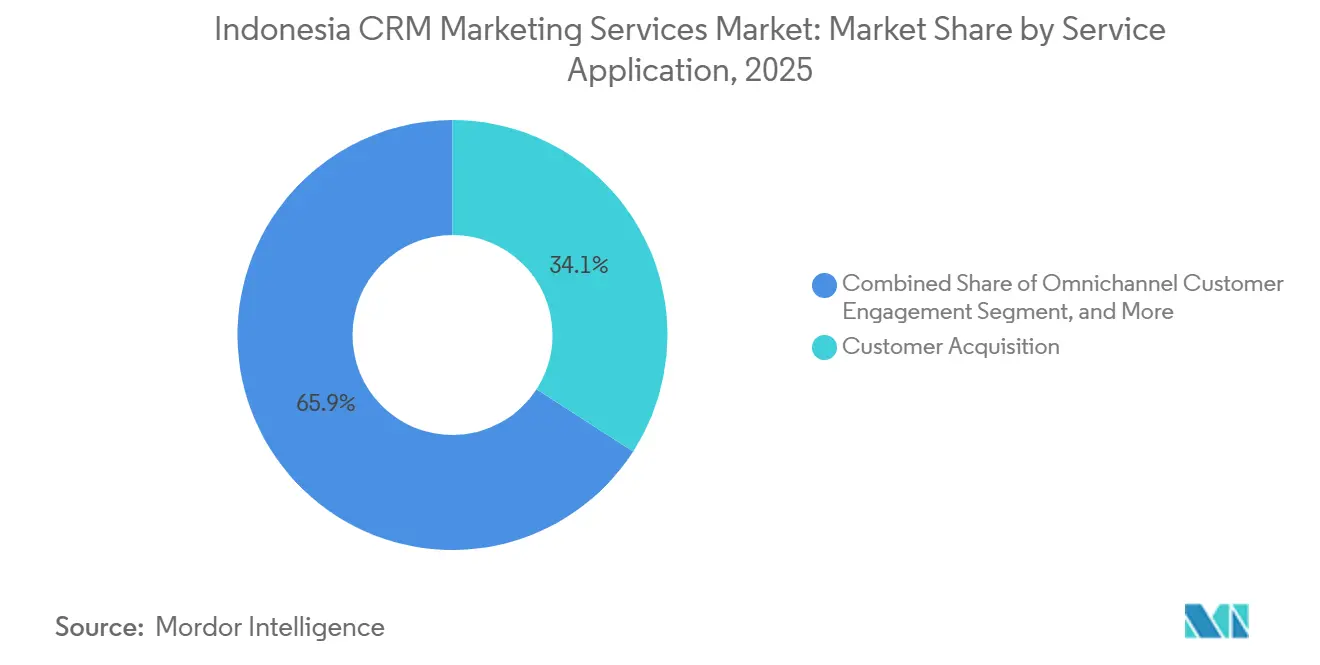
Customer Acquisition accounted for 34.12% of revenue in 2025, which made it the leading service application in the Indonesia CRM marketing services market. This is consistent with a market that is still adding new digital customer relationships across commerce, banking, and service categories. Many deployments are still organized first around lead capture, onboarding, and conversion programs before they mature into broader lifecycle management. The Indonesia CRM marketing services industry, therefore, continues to generate a meaningful share of service demand from first-stage customer growth programs. That starting point keeps acquisition-oriented implementation, campaign setup, and activation work highly relevant for providers.
Personalization Services is projected to grow at a 18.41% CAGR through 2031, signaling the next stage of value creation as customer datasets deepen and become more usable. Once firms have working acquisition flows, the next priority is usually higher repeat engagement, better targeting, and stronger lifetime value. A 2026 study in the Journal of Social Society found that CRM-driven personalization in Indonesian e-commerce contexts increased customer loyalty by 20-40% through AI-driven post-purchase re-engagement. That finding supports the expectation that personalization will take a larger role in the Indonesia CRM marketing services market as platforms and merchants move past early deployment stages. Customer retention and loyalty, campaign management services, marketing automation services, customer analytics and insights, and omnichannel customer engagement remain important adjacent pools that often rise together once acquisition infrastructure is already in place.
By End-User Industry: BFSI Anchors Demand While Retail and E-Commerce Accelerates
BFSI held 35.41% of the Indonesia CRM marketing services market share in 2025, making it the largest end-user industry in the market. Financial institutions have a strong need to unify branch, mobile, call center, and advisory interactions within controlled customer environments. That requirement supports more extensive implementation work, greater attention to workflow governance, and stronger demand for ongoing support. In the Indonesia CRM marketing services market, BFSI also benefits from vendor investment in local data residency and enterprise-grade AI tools. These conditions help explain why banks and related institutions remain anchor accounts for major global platforms and their implementation partners.
The segment also shows how CRM use cases are becoming more operational and intelligent. In April 2026, PT Bank CIMB Niaga, Google Cloud, and Artefact launched relationship manager and contact center AI agents on Google Cloud’s Vertex AI platform to deliver more personalized banking support in Indonesia. Retail and e-commerce are projected to expand at an 18.72% CAGR through 2031 as merchants compete more aggressively on acquisition efficiency, repeat purchases, and cross-channel customer management. The U.S. International Trade Administration’s outlook for Indonesia’s e-commerce and social commerce activity supports that direction by showing continued scale expansion in digital buying environments. Healthcare and life sciences, information technology and telecom, industrial manufacturing, government and public administration, and other end-user industries remain smaller pools, but each adds to the breadth of the Indonesia CRM marketing services market as digital engagement becomes more central to service delivery. Telecom in particular is likely to sustain demand for retention-oriented CRM programs as operators compete for subscriber quality and customer lifetime value.
Geography Analysis
The Indonesia CRM marketing services market remained centered in the Java corridor in 2025, with Greater Jakarta, Surabaya, and Bandung forming the strongest concentration of enterprise demand. These cities combine the largest concentration of banks, large retailers, telecom operators, and implementation partners, which keeps project pipelines deeper than in other parts of the country. The same geography also supports faster deployment because providers can draw on denser partner networks and larger pools of trained delivery talent. That creates a reinforcing cycle in which larger accounts attract more specialized capacity, and specialized capacity attracts more large accounts. As a result, the Java corridor continues to shape pricing, service depth, and competitive positioning across the Indonesia CRM marketing services market.
Outer Java locations, including Sumatra, Kalimantan, Sulawesi, and Eastern Indonesia, remain less penetrated by advanced CRM services. The gap is tied less to demand potential and more to execution limits, especially partner availability and the difficulty of integrating legacy systems in less concentrated delivery markets. At the same time, smaller firms in Tier-2 and Tier-3 cities are becoming more reachable through lighter cloud deployment models and messaging-led customer workflows. This makes the Indonesia CRM marketing services market more scalable than its current revenue concentration might suggest. The U.S. International Trade Administration has highlighted Indonesia’s strong digital commerce base and the country’s weight within Southeast Asia’s online economy, which supports the case for wider geographic diffusion over time.
Geographic expansion will still depend on infrastructure choices made by vendors and service partners. Salesforce’s July 2025 expansion of local data residency in Indonesia supported broader deployment confidence among regulated customers and strengthened the country’s role as a service hub for advanced CRM programs.[3] Localized platforms and faster rollout templates should help providers reach smaller cities without replicating the full cost structure of Jakarta-led enterprise projects. If that model scales well, the Indonesia CRM marketing services market will become less geographically narrow even while Java remains the main revenue center.
Competitive Landscape
The Indonesia CRM marketing services market is fragmented, with global platforms and local specialists competing on different strengths. Salesforce, Microsoft Dynamics 365, HubSpot, Oracle, and SAP hold important positions in larger enterprise environments because they offer broader ecosystems and deeper enterprise functionality. Domestic players such as Mekari Qontak compete more directly on deployment speed, local workflow fit, and messaging-led customer engagement. This leaves buyers with a choice between ecosystem breadth and localization depth rather than a simple price comparison. The competitive balance in the Indonesia CRM marketing services market therefore depends heavily on client size, integration complexity, and compliance expectations.
Several strategic moves since 2025 show how this competition is evolving. Salesforce expanded Hyperforce services in Indonesia in July 2025 to include Agentforce, Data Cloud, Marketing Cloud Next, Tableau Next, and Tableau Cloud, thereby strengthening its position in regulated sectors that require local data residency support. In December 2025, Salesforce also launched Agentforce in Bahasa Indonesia, which lowered adoption friction for local teams across marketing, sales, service, and commerce workflows. Mekari Qontak responded in June 2026 by combining a Customer Data Platform, Agentic AI, and Loyalty Management into a single integrated ecosystem to reduce fragmentation within Indonesian businesses. These moves show that the Indonesia CRM marketing services market is shifting from standalone CRM deployment toward broader customer engagement systems with stronger data and automation layers.
Competition is also moving toward proof of delivery rather than only feature comparison. Buyers want to see how vendors handle disconnected systems, local language execution, and customer workflows that cross messaging, service, and commerce touchpoints. The April 2026 CIMB Niaga deployment with Google Cloud and Artefact provided a visible example of AI-enabled CRM execution in a large Indonesian financial institution. That raises the bar for service providers in the Indonesia CRM marketing services market, especially when competing for enterprise accounts that expect measurable operational outcomes.
Indonesia CRM Marketing Services Industry Leaders
-
Salesforce, Inc.
-
Microsoft Corporation
-
Adobe Inc.
-
SAP SE
-
Oracle Corporation
- *Disclaimer: Major Players sorted in no particular order
Recent Industry Developments
- June 2026: Mekari Qontak announced its evolution into Indonesia's first integrated customer engagement platform, combining a Customer Data Platform (CDP), Agentic AI, and a Loyalty Management system into a single ecosystem. CEO Suwandi Soh stated that Indonesian businesses typically operate four to six disconnected customer management systems simultaneously, and this integration directly addresses that fragmentation, enabling mid-market companies to achieve enterprise-grade personalization at accelerated deployment timelines.
- April 2026: PT Bank CIMB Niaga, Google Cloud, and Artefact launched purpose-built enterprise AI agents in Indonesia, deploying a Relationship Manager AI Agent and a Contact Center AI Agent on Google Cloud's Vertex AI platform. The agents provide real-time, life-stage contextualized advisory to CIMB Niaga's workforce and 394-branch network, with infrastructure hosted in Google Cloud's Jakarta cloud region to maintain compliance with local data residency requirements.
- April 2026: Salesforce reaffirmed Indonesia's strategic importance to its Southeast Asia AI expansion, citing the country's estimated USD 366 billion AI market opportunity and committing to continued Hyperforce infrastructure development, team expansion, and product localization, including Bahasa Indonesia support for Agentforce, as central to its in-country investment thesis.
- January 2026: Zoho Corporation announced its intent to expand data center infrastructure across Southeast Asia, with Indonesia identified as a target location. As of early 2026, Zoho operates 20 global data centers and cited Indonesia's regulatory environment and market growth trajectory as key factors in the planned Southeast Asia expansion.
Indonesia CRM Marketing Services Market Report Scope
The Indonesia CRM Marketing Services Market includes services that help businesses implement and optimize customer relationship management (CRM)-based marketing strategies to improve customer relationships and business performance. These services encompass CRM consulting, platform integration, campaign management, customer analytics, loyalty management, and marketing automation. Rapid digital transformation, growing e-commerce adoption, and increasing demand for personalized customer experiences support the market. These services help organizations enhance customer engagement and maximize marketing return on investment.
The Indonesia CRM Marketing Services Market Report is Segmented by Service Type (CRM Strategy and Consulting, CRM Implementation and Integration, CRM Migration and Modernization, CRM Managed Services, and CRM Training and Support), Enterprise Size (Large Enterprises, and Small and Medium Enterprises), Service Application (Customer Acquisition, Customer Retention and Loyalty, Campaign Management Services, Marketing Automation Services, Customer Analytics and Insights, Omnichannel Customer Engagement, and Personalization Services), and End-user Industry (Banking, Financial Services, and Insurance (BFSI), Healthcare and Life Sciences, Information Technology and Telecom, Retail and E-commerce, Industrial Manufacturing, Government and Public Administration, and Other End-user Industries). The Market Forecasts are Provided in Terms of Value (USD).
| CRM Strategy and Consulting |
| CRM Implementation and Integration |
| CRM Migration and Modernization |
| CRM Managed Services |
| CRM Training and Support |
| Large Enterprises |
| Small and Medium Enterprises |
| Customer Acquisition |
| Customer Retention and Loyalty |
| Campaign Management Services |
| Marketing Automation Services |
| Customer Analytics and Insights |
| Omnichannel Customer Engagement |
| Personalization Services |
| Banking, Financial Services, and Insurance (BFSI) |
| Healthcare and Life Sciences |
| Information Technology and Telecom |
| Retail and E-commerce |
| Industrial Manufacturing |
| Government and Public Administration |
| Other End-user Industries |
| By Service Type | CRM Strategy and Consulting |
| CRM Implementation and Integration | |
| CRM Migration and Modernization | |
| CRM Managed Services | |
| CRM Training and Support | |
| By Enterprise Size | Large Enterprises |
| Small and Medium Enterprises | |
| By Service Application | Customer Acquisition |
| Customer Retention and Loyalty | |
| Campaign Management Services | |
| Marketing Automation Services | |
| Customer Analytics and Insights | |
| Omnichannel Customer Engagement | |
| Personalization Services | |
| By End-user Industry | Banking, Financial Services, and Insurance (BFSI) |
| Healthcare and Life Sciences | |
| Information Technology and Telecom | |
| Retail and E-commerce | |
| Industrial Manufacturing | |
| Government and Public Administration | |
| Other End-user Industries |
Key Questions Answered in the Report
What is the current and forecast value of Indonesia CRM marketing services?
The Indonesia CRM marketing services market size stood at USD 191.80 million in 2026 and is forecast to reach USD 423.75 million by 2031, growing at a 17.18% CAGR over 2026-2031.
Which service type contributes the most revenue in Indonesia CRM marketing services?
CRM Implementation and Integration led the revenue mix with a 57.88% share in 2025 because buyers still need significant setup, integration, and activation work across fragmented systems.
Which customer group is expanding fastest in this space?
Small and Medium Enterprises are projected to grow at a 19.49% CAGR through 2031 as cloud deployment, faster onboarding, and lighter service models reduce adoption barriers.
Why is BFSI the largest end-user segment for CRM marketing services in Indonesia?
BFSI held 35.41% of revenue in 2025 because banks and financial institutions need unified customer records, multi-channel workflows, and stronger governance across branch, mobile, and contact center interactions.
What is driving faster growth in retail and e-commerce CRM demand?
Retail and E-commerce is projected to grow at an 18.72% CAGR through 2031 as merchants need customer acquisition, retention, and personalization tools across marketplaces, social commerce, and owned channels.
How is competition changing among CRM service providers in Indonesia?
Competition is moving toward local data residency, AI-enabled workflows, faster deployment, and integrated customer engagement systems, as shown by Salesforce’s Hyperforce expansion and Mekari Qontak’s June 2026 integrated platform launch.