
America AI Retail Market Size and Share
Market Overview
| Study Period | 2020 - 2031 |
|---|---|
| Market Size (2026) | USD 6.43 Billion |
| Market Size (2031) | USD 12.66 Billion |
| Growth Rate (2026 - 2031) | 14.51 % |
| Fastest Growing Market | South America |
| Largest Market | North America |
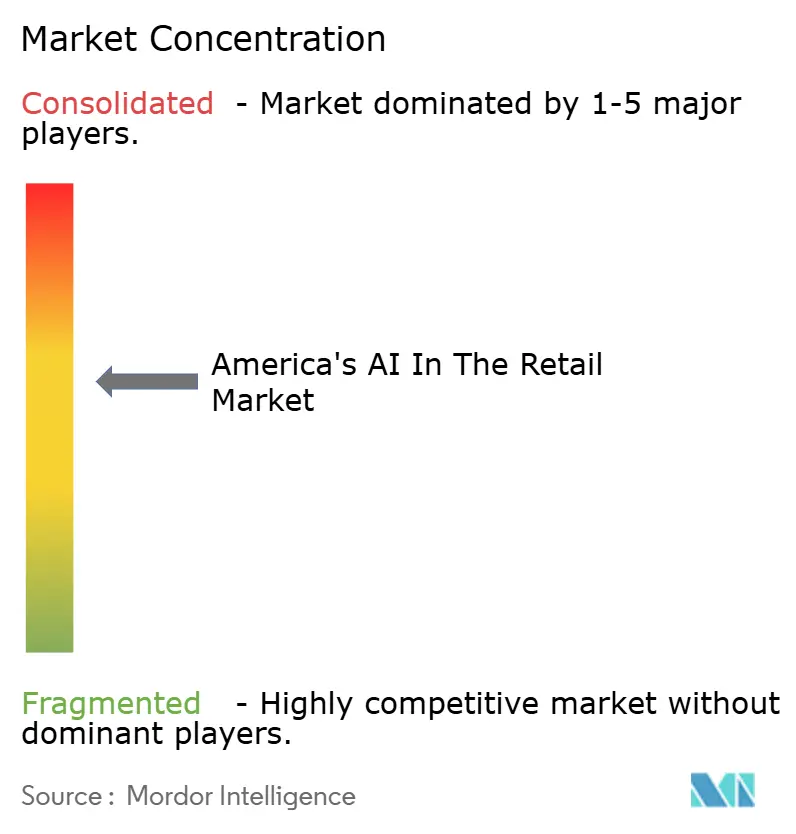
| Market Concentration | Medium |
Major Players *Disclaimer: Major Players sorted in no particular order Image © Mordor Intelligence. Reuse requires attribution under CC BY 4.0. | |

America AI Retail Market Analysis by Mordor Intelligence
The America AI Retail Market reached USD 6.43 billion in 2026 and is projected to grow to USD 12.66 billion by 2031, registering a 14.51% CAGR. This rapid expansion is led by tier-1 retailers that are shifting from pilots to production-scale deployments, embedding agentic AI frameworks across merchandising, supply chain, and customer engagement. GPU and edge-inference innovations are cutting latency for real-time personalization, while unified data platforms are turning omnichannel transaction histories into granular training sets. Vendor competition now centers on end-to-end platforms capable of bundling hardware, models, and orchestration, a dynamic reinforced by hyperscaler alliances with semiconductor leaders. Growth opportunities remain concentrated in pure-play online retail, home improvement applications, and swarm intelligence technologies that coordinate multi-agent decision making. Taken together, these forces position the AI retail market for compound growth as retailers prioritize automation to protect margins amid persistently thin cost structures.
Key Report Takeaways
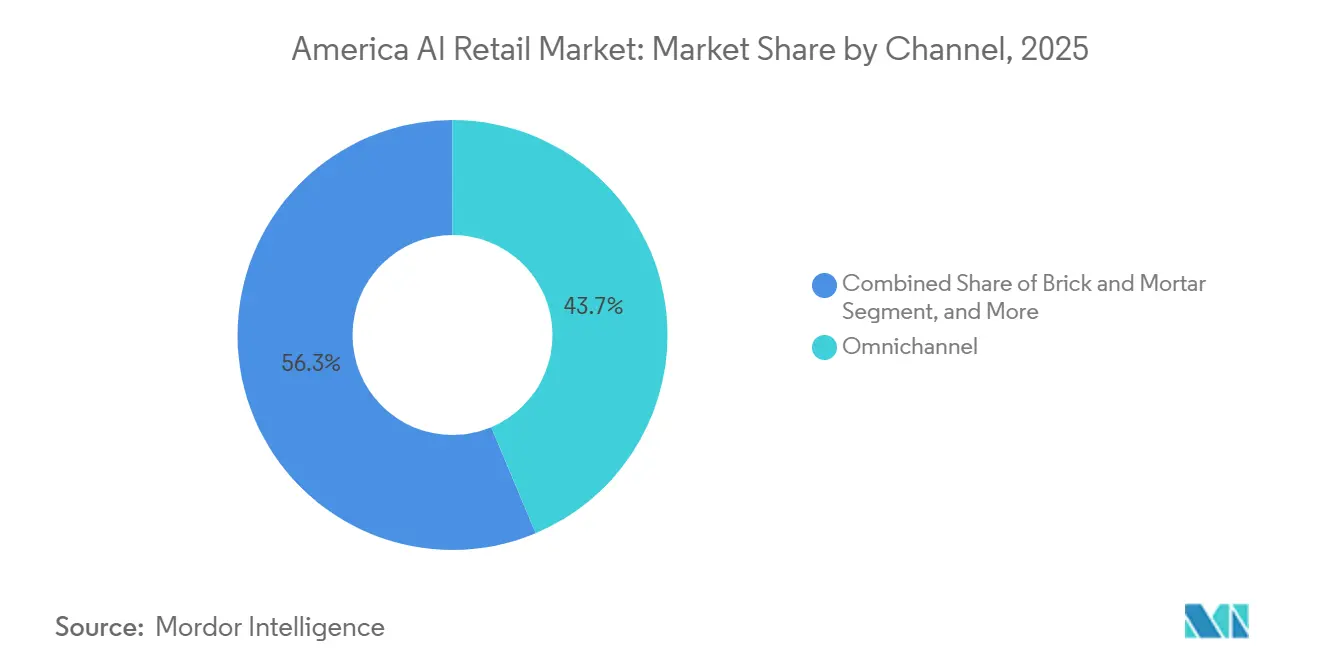
- By channel, omnichannel strategies captured 43.67% of the America AI retail market share in 2025, while pure-play online retailers are expanding at a 15.19% CAGR through 2031.
- By solution, software accounted for 52.89% of 2025 revenue, and service offerings are poised to grow at a 14.92% CAGR as retailers outsource integration complexity.
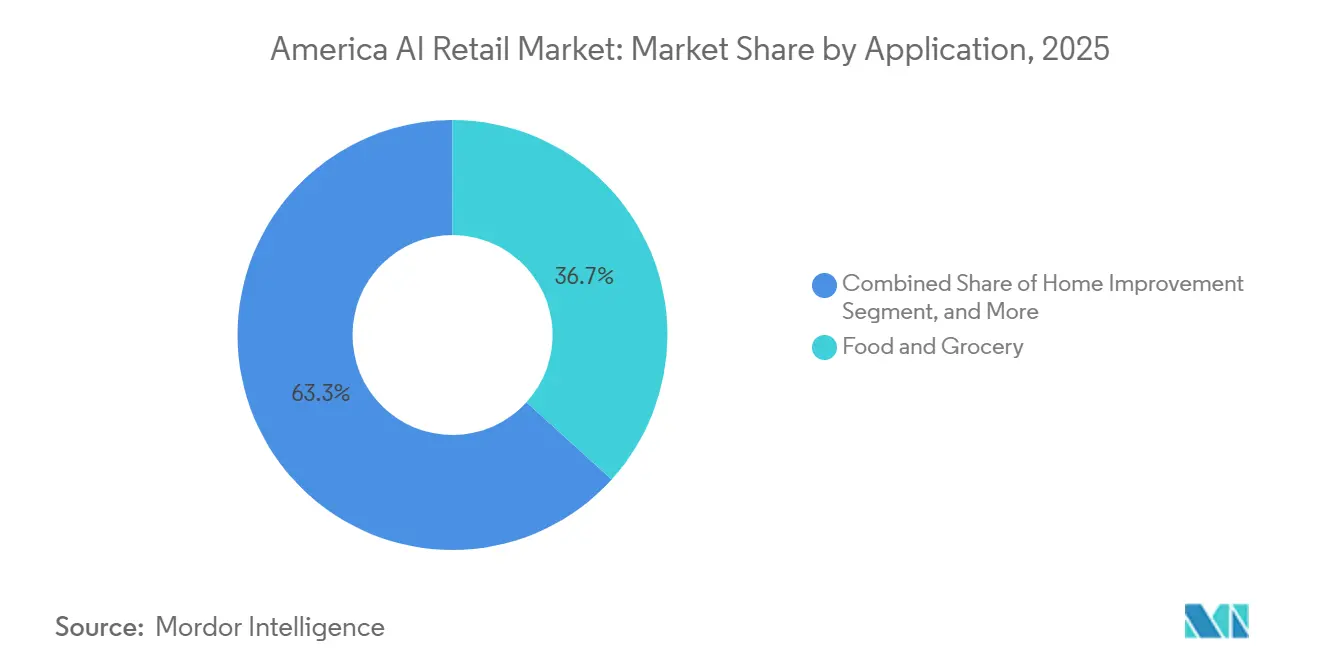
- By application, food and grocery commanded 36.72% of 2025 spending, whereas home improvement is accelerating at a 15.49% CAGR driven by project-planning assistants.
- By technology, machine learning accounted for 47.83% of 2025 deployments, and swarm intelligence is rising at a 15.53% CAGR as retailers pilot multi-agent optimization frameworks.
- By geography, North America accounted for 66.83% of the 2025 market value, while South America led growth with a 15.59% CAGR on the back of cloud-native e-commerce platforms.
Note: Market size and forecast figures in this report are generated using Mordor Intelligence’s proprietary estimation framework, updated with the latest available data and insights as of January 2026.
Market Trends and Insights
Drivers Impact Analysis of America AI Retail Market*
| Driver | (~) % Impact on CAGR Forecast | Geographic Relevance | Impact Timeline |
|---|---|---|---|
| Accelerated GPU and edge-AI hardware innovation | +2.8% | Global, early uptake in North America and major Asia-Pacific metros | Medium term (2-4 years) |
| Omnichannel personalization imperative | +2.5% | North America and Europe, spreading to South America hubs | Short term (≤ 2 years) |
| AI-first operating models among tier-1 retailers | +2.3% | North America, pilots in Brazil and Mexico | Medium term (2-4 years) |
| Supply-chain optimization for last-mile efficiency | +2.1% | Global, acute need in South America and Southeast Asia | Short term (≤ 2 years) |
| Real-time computer-vision loss-prevention systems | +1.9% | North America and Europe | Short term (≤ 2 years) |
| Quantum-inspired inventory optimization pilots | +1.2% | North America and select European retailers | Long term (≥ 4 years) |
| Source: Mordor Intelligence | |||
Accelerated GPU And Edge-AI Hardware Innovation
NVIDIA’s retail blueprints released in January 2025 trimmed model latency to sub-50 milliseconds, enabling real-time personalization at the point of sale without round-tripping data to cloud centers.[1]NVIDIA, “Retail AI Blueprints: Edge Inference for Real-Time Personalization,” blogs.nvidia.com More than 12,000 EGX edge nodes processed 4.2 billion daily inference calls by December 2025, validating at-scale performance. Intel’s Gaudi 3 accelerators, launched in April 2025, delivered 70% of comparable throughput at 55% of the capital outlay, carving space for cost-sensitive regional chains. As hardware footprints proliferate, demand is rising for model-compression and federated-learning tools that protect data-residency requirements while keeping training local. Hardware vendors have responded by packaging silicon, software, and deployment expertise, lowering entry barriers for mid-market adopters and adding momentum to the America AI Retail Market.
Omnichannel Personalization Imperative
Retailers integrating browsing, in-store, and mobile data into unified profiles saw double-digit increases in conversion rates in 2025. Adobe’s real-time CDP processed 18 billion customer events per day, demonstrating that data-rich profiles unlock 2.7-times higher conversion rates when individualized messaging is delivered within 24 hours.[2]Adobe, “Adobe Real-Time Customer Data Platform: Retail Performance 2025,” business.adobe.com Microsoft deepened this trend in June 2025 by embedding Azure OpenAI Service into Dynamics 365 Customer Insights, generating natural-language content tuned to each shopper’s context, a move that trimmed bounce rates by nearly one-third. As retailers merge e-commerce, store operations, and marketing into unified data teams, omnichannel personalization has become a board-level mandate, driving incremental spending that supports the America AI Retail Market.
AI-First Operating Models Among Tier-1 Retailers
Walmart signaled a strategic pivot in January 2026, moving from augmenting decisions to delegating workflows to autonomous agents built on its Wallaby large language model. Pilot results cut manual inventory interventions by 78% and lowered labor cost per transaction by 12%. Such outcomes illustrate the operational leverage of AI-first models. Yet adoption divides the sector: capital-rich leaders advance, while mid-market peers struggle with talent and budget constraints. The spread of AI-first strategies is expected to pull forward platform revenue as laggards pursue managed services, bolstering overall America AI retail market growth.
Supply-Chain Optimization For Last-Mile Efficiency
Last-mile delivery accounts for more than half of e-commerce logistics expenses. AI-driven route densification can reduce those costs by almost one-fifth, according to field data collected across 2025 deployments. Blue Yonder’s Luminate platform integrated traffic, weather, and customer availability to support 97% on-time delivery, up eight percentage points year over year.[3]Blue Yonder, “Blue Yonder Luminate Delivery Performance 2025,” blueyonder.com Symbotic’s swarm-based warehouse robots increased throughput by 35% in Walmart distribution centers, a capability underpinned by a USD 8.35 billion agreement announced in July 2024. These operational efficiencies free working capital, reinforcing spending on end-to-end AI supply-chain suites and sustaining upside for the AI retail market.
Restraints Impact Analysis of America AI Retail Market*
| Restraint | (~) % Impact on CAGR Forecast | Geographic Relevance | Impact Timeline |
|---|---|---|---|
| Shortage of retail-specific data-science talent | -1.8% | Global, most acute in North America and Western Europe | Medium term (2-4 years) |
| Legacy IT integration complexity and costs | -1.6% | North America and Europe, heavier on mid-market chains | Short term (≤ 2 years) |
| Increasing data-privacy and AI-audit regulations | -1.3% | Europe, North America, emerging in South America | Medium term (2-4 years) |
| Sustainability concerns over AI energy footprint | -0.9% | Europe and select North American markets | Long term (≥ 4 years) |
| Source: Mordor Intelligence | |||
Shortage Of Retail-Specific Data-Science Talent
Retailers face a structural talent gap as hybrid expertise in machine learning and merchandising remains scarce. Median salaries for North American AI engineers climbed to USD 185,000 in 2025, yet turnover topped 30% as hyperscalers lured specialists with equity packages. Talent scarcity inflates project budgets, extends timelines, and forces many chains to embrace low-code platforms or managed services. Although retailers sponsor university programs and acquire analytics boutiques, these measures take years to bear fruit, sustaining drag on near-term adoption.
Legacy IT Integration Complexity And Costs
Connecting modern AI platforms to decades-old point-of-sale and enterprise systems can cost more than USD 50 million for national chains. Legacy databases rarely expose real-time APIs, forcing retailers to build middleware that introduces latency and maintenance overhead. Implementation roadmaps stretch beyond 18 months, diverting budgets from customer-facing innovation and discouraging risk-averse boards. Cloud migration promises relief, but operational risks during the cut-over leave many retailers in a transitional limbo, tempering overall AI retail market momentum.
*Our forecasts treat driver/restraint impacts as directional, not additive. The impact forecasts reflect baseline growth, mix effects, and variable interactions.
America AI Retail Market Segment Analysis
By Channel:
Pure-Play Online Retailers Outpace OmnichannelPure-play online operators are forecast to grow at 15.19% through 2031, surpassing the overall America AI retail market CAGR as they exploit flexible infrastructure and rapid experiment cycles to roll out recommendation engines, dynamic pricing, and conversational commerce. Omnichannel retailers accounted for 43.67% of 2025 revenue by leveraging store footprints for click-and-collect services, yet they shoulder heavier integration burdens that slow the rollout of new use cases. The AI retail market size for brick-and-mortar chains continues to expand, but competitive intensity is rising as Amazon’s Just Walk Out setup has been extended to more than 140 North American sites, setting new expectations for frictionless checkout.
Shopify democratized advanced tooling in May 2025 when it launched Magic AI for 2.1 million merchants, compressing the capability gap between small sellers and large e-commerce leaders. Physical retailers are fighting back with edge-AI kiosks that deliver personalized offers in-store; Lowe’s Mylow Companion reduced average visit times by 28% while increasing basket sizes by 17%. As experiential differentiation eclipses pure assortment breadth, data density will determine winners, reinforcing investment in unified-commerce AI stacks and sustaining expansion of the America AI retail market.



By Solution:
Service Growth Reflects Integration DemandSoftware held 52.89% of 2025 revenue, but services are rallying with a 14.92% CAGR through 2031 as retailers outsource architecture design, model tuning, and change management. Enterprises adopting on-premise modules do so to preserve data residency, while mid-market retailers typically favor multitenant clouds. The America AI retail market for managed services is growing as integration complexity and talent shortages are tilting the total cost of ownership toward external providers.
Infosys and Cognizant each report multiyear agreements that bundle platform selection, data migration, and operational analytics. SAP’s Joule assistant automates low-value queries, yet the vendor’s own services arm spends up to 9 months tailoring workflows to each client's unique schema. Salesforce’s 2025 debut of Agentforce follows the same pattern: license revenue is paired with professional services that shoulder configuration tasks. As buyers mature, procurement teams specify time-to-value metrics, turning implementation prowess into a primary differentiator and driving sustained expansion of the service slice of the America AI retail market.
By Application:
Home Improvement Leads Vertical GrowthHome improvement chains are adopting AI at a 15.49% annual pace, eclipsing every other vertical as project guidance tools unlock higher average order values. Food and grocery retained 36.72% of 2025 spending, driven by perpetual demand forecasting and spoilage-mitigation initiatives that protect razor-thin margins. The America AI retail market share for apparel and footwear remained notable, driven by virtual try-on and trend-forecasting engines.
Home Depot’s Magic Apron, rolled out in April 2025, improved cross-sell rates by 19%, demonstrating that generative AI drives incremental spend when tackling complex DIY tasks. Electronics retailers leverage predictive maintenance alerts that cut return rates, while grocers prioritize shelf-scanning vision systems that surface replenishment needs in minutes rather than hours. Vertical adoption velocities correlate with data richness and margin headroom: categories with higher ticket values can justify deeper personalization investments. As retailers refine application-specific blueprints, the America AI retail market size linked to specialized vertical use cases will compound.
By Technology:
Swarm Intelligence Emerges As Fastest-Growing SegmentMachine learning accounted for 47.83% of 2025 technology spend, anchoring core functions such as demand forecasting and segmentation. Swarm intelligence, however, is expanding at 15.53% through 2031, reflecting momentum behind multi-agent systems that optimize interdependent retail decisions. Walmart’s reinforcement-learning framework coordinated pricing, inventory, and fulfillment across 4,700 stores, lifting gross margin by 1.2 percentage points, a clear testament to systemic gains from cross-domain co-optimization.
Natural language processing underpins chatbots that now resolve the majority of routine inquiries, while image and video analytics have crossed the 95% accuracy threshold for product recognition, enabling the confident rollout of autonomous checkout. 2026 announcements from Microsoft bundle vision, language, and reinforcement models into unified orchestration layers, raising the table stakes for point-solution vendors. The convergence of modalities ensures that platform providers capturing high market share can upsell supplementary functions, reinforcing revenue scale in the America AI retail market.
Geography Analysis
North America AI Retail Market
North America retained 66.83% of the 2025 market value, reflecting deep concentrations of hyperscale infrastructure and retail technology specialists. Most large U.S. and Canadian chains have shifted from pilots to production deployment, and although sequential growth is moderating, installed-base expansion continues as retailers broaden use-case portfolios. Mexico follows a similar glide path, with leading grocers layering AI onto omnichannel frameworks and upgrading supply-chain telemetry.
South America AI Retail Market
South America is accelerating at a 15.59% CAGR through 2031, led by cloud-native e-commerce firms that are leapfrogging legacy integrations. Mercado Libre invested USD 2.1 billion in 2025 to expand its AI-enabled logistics hubs, reducing last-mile costs by 18% and boosting conversion rates by 24%. Brazilian retailers such as Magazine Luiza deploy generative chatbots that handle Portuguese inquiries with 91% accuracy, while Argentine conglomerate Cencosud uses Google Cloud models to cut stockouts by nearly one-third.
Europe and the Americas AI Retail Market
Regulatory environments are diverging. The European Union AI Act requires transparency and audit trails, thereby indirectly increasing North American vendors’ compliance costs as they serve global retailers. South American jurisdictions remain largely permissive, allowing rapid rollout of personalization and computer-vision systems. Over the forecast horizon, converging rules are expected, but early movers are capturing data and model advantages that will be difficult for late entrants to replicate, expanding the America AI retail market size in high-growth geographies.
Regulatory Landscape
Across the Americas, AI-in-retail deployments are increasingly shaped by federal-level AI governance activity in the United States and by the need for consistency across multi-state operations. In December 2025, the White House advanced a national policy framework for artificial intelligence aimed at reducing a patchwork of state AI rules, which affects retail use cases such as personalization, dynamic pricing, and computer-vision loss prevention that typically run across multiple jurisdictions.
Regulatory scrutiny is also tightening around consumer protection and model behavior. In July 2026, the US Federal Trade Commission issued a policy statement addressing the suppression of accuracy in AI systems under Section 5 of the FTC Act, reinforcing that AI claims, performance, and disclosures can be assessed under unfair or deceptive practices standards. Separately, the US Department of Commerce opened the April 1 to June 30, 2026 application window for the American AI Exports Program, creating a government-supported pathway for export-ready, full-stack AI offerings that can influence how US-based platform providers package retail AI capabilities for cross-border deployments.
Value Chain Analysis
The America AI retail value chain starts with data generation and capture across stores, e-commerce, and supply chains, then moves through data engineering, model development, deployment, and ongoing operations. Upstream inputs include cloud and data platforms, GPU and edge compute, and sensing layers such as cameras and IoT, which feed unified data environments used for training and real-time inference. The midstream is anchored by hyperscalers and enterprise software providers that supply foundation-model access, orchestration, and integration into commerce, ERP, and CRM workflows, while systems integrators and managed-service providers increasingly handle implementation, monitoring, and change management.
Downstream value is realized in applications such as demand forecasting, replenishment, warehouse automation, customer service, and in-store execution, where retailers operationalize models into daily decisions. Recent ecosystem activity highlights the stack integration trend: Wiliot and Walmart initiated a large-scale ambient IoT rollout with a stated target of 90 million tracking points by end-2026, while retailers such as Carhartt selected RELEX Solutions to unify inventory and supply chain planning and Fabletics worked with Blue Yonder on SaaS planning. Key bottlenecks remain legacy system integration and retail-specific AI talent, pushing more buyers toward packaged platforms and services that shorten deployment cycles and improve governance and observability.
Competitive Landscape
Competition is intensifying as hyperscalers, enterprise software incumbents, and retail-tech specialists vie for overlapping accounts. Amazon Web Services strengthened its position in December 2025 with AgentCore, a framework that simplifies the deployment of autonomous agents. Microsoft partnered with NVIDIA and Anthropic in November 2025 on a USD 45 billion infrastructure build that combines silicon, training clusters, and retail-tuned foundation models. Google Cloud continues to expand its retail-specific accelerators, solidifying its position as a tri-polistic platform.
Enterprise vendors safeguard installed bases by embedding AI into existing ERP and CRM suites. SAP integrates Joule across its retail cloud, while Oracle layers machine learning into merchandising modules. Specialized players such as Blue Yonder focus on deep supply-chain optimization, Symbotic automates warehouses with swarm robotics, and Shopify empowers the long tail of merchants through plug-and-play generative tools. White-space remains in the mid-market, where chains numbering 50-500 stores require turnkey offerings that blend affordability with flexibility. Vendors that align pricing, services, and compliance features for this cohort are positioned to capture incremental share in the America AI retail market.
Intellectual-property intensity is rising. Amazon filed transformer-based patents that combine RFID and vision signals to achieve 99.2% checkout accuracy, while Walmart’s Wallaby model demonstrates a competitive advantage from proprietary datasets. Regulatory compliance, especially around data privacy, is a selection filter increasingly favoring providers that can embed audit functionality at the platform level. As capabilities converge, go-to-market differentiators hinge on speed-to-value, reliable ROI metrics, and the breadth of pre-integrated retail tools.
America AI Retail Industry Leaders
Amazon Web Services Inc.
Microsoft Corporation
Oracle Corporation
Salesforce Inc.
SAP SE
- *Disclaimer: Major Players sorted in no particular order
America AI Retail Market Companies Covered in this Report
- Amazon Web Services Inc.
- Microsoft Corporation
- Google LLC
- IBM Corporation
- SAP SE
- Salesforce Inc.
- Oracle Corporation
- NVIDIA Corporation
- Intel Corporation
- ViSenze Pte Ltd.
- Sentient Technologies Holdings Ltd.
- Sophos Inc.
- Cognizant Technology Solutions
- Infosys Limited
- Walmart Global Tech
- Shopify Inc.
- Blue Yonder Group Inc.
- Symbotic Inc.
- Kroger Technology
- Ocado Group plc

Market Opportunities and Future Outlook
White-space is most visible where retailers need turnkey, production-grade agentic AI that connects safely to inventory, pricing, and fulfillment systems without multi-year integration programs. In May 2026, Amazon Web Services launched an Agentic Shopping Assistant architecture for retailers built on Amazon Bedrock and AgentCore, signaling a commercial push toward reusable agentic commerce patterns rather than bespoke pilots. Microsoft also expanded retail agent enablement via Dynamics 365 Commerce agentic capabilities (including an MCP server for retail business logic), reinforcing demand for agents embedded into established commerce suites.
Operational opportunities are also expanding at the intersection of computer vision, shelf intelligence, and automation in stores and distribution centers. Instacart acquired Arpalus in July 2026 to deepen computer-vision shelf intelligence across its retail technology footprint, while Catalyst Brands partnered with Figure AI in May 2026 to deploy humanoid robotics for sorting and packing at a Reno, Nevada distribution center. These moves align with the report scope where food and grocery and last-mile efficiency remain major spend areas, and where retailers with thinner margins prioritize measurable outcomes such as fewer stockouts, higher on-shelf availability, and reduced labor-intensive interventions. Vendor opportunity is strongest in packaged solutions that combine data readiness, auditability, and integration accelerators for mid-market chains lacking in-house data-science depth, but still need omnichannel-grade personalization and automated supply-chain decisioning.
Recent Industry Developments in America AI Retail Market
- July 2026: Instacart acquired Arpalus to integrate computer-vision shelf-intelligence capabilities into its retail technology stack. The deal strengthens Instacart platforms such as Store View and Caper Carts with deeper real-time shelf analytics. It raises competitive pressure on retail AI vendors focused on on-shelf availability, planogram compliance, and store execution.
- June 2026: Microsoft introduced agentic capabilities for Dynamics 365 Commerce, including a Model Context Protocol (MCP) server that provides retail-specific business logic for agent workflows. The release improves how AI agents connect to commerce processes while keeping guardrails tied to enterprise data and rules. It supports faster rollout of agentic commerce across retailers already standardized on Dynamics 365.
- May 2026: Amazon Web Services announced an Agentic Shopping Assistant architecture for retailers built on Amazon Bedrock, AgentCore, and OpenSearch. The offering packages core components needed for conversational shopping experiences that integrate with product, inventory, and fulfillment information. It broadens access to agentic commerce capabilities for retailers that prefer reference architectures over bespoke builds.


America AI Retail Market Report Scope and Research Methodology
Market Definition and Coverage
This market covers the spending by retailers in the Americas on AI software and AI-related services used to improve selling, marketing, store operations, and supply chain decisions across physical and online retail.
Scope exclusions: Pure hardware-only purchases (for example, standard cameras and servers without AI software) and general IT outsourcing that is not tied to an AI retail use case are not counted.
Segments Covered in This Report
- By Channel
- Omnichannel
- Brick and Mortar
- Pure-Play Online Retailers
- By Solution
- Software
- On Premise
- Cloud
- Service
- Software
- By Application
- Apparel and Footwear
- Food and Grocery
- Electronics and Home Appliances
- Home Improvement
- Other Applications
- By Technology
- Machine Learning
- Natural Language Processing
- Chatbots
- Image and Video Analytics
- Swarm Intelligence
- By Geography
- North America
- United States
- Canada
- Mexico
- South America
- Brazil
- Argentina
- Rest of South America
- North America
Data Sources, Market Sizing, and Validation
Desk Research
Desk work was used to map what is being adopted in retail AI and to keep the model tied to public signals that can be checked. We relied on sources such as the US Census Bureau retail sales series, the US Bureau of Labor Statistics wage and productivity indicators, and OECD digital economy indicators to understand the demand backdrop. To ground the technology side, references were taken from sources such as NIST AI guidance, academic papers indexed in peer reviewed journals, and patent databases that show where AI capabilities are being built.
We also reviewed public company filings and investor presentations from retail and technology ecosystems, along with association websites and reputable business press, to capture pricing logic, adoption timing, and typical deployment patterns. Where needed, a paid subscription for company financials and intelligence and a paid news and financials service were used to cross-check revenues, regional mix, and major contract announcements. The sources listed here are illustrative only, and many other public documents and datasets were also referred to for data collection, validation, and clarification.
Primary Interviews and Surveys
We speak with retail technology buyers, solution providers, channel specialists, and operating leaders across the Americas. Interviews and surveys clarify adoption levels, budgets, use cases, pricing, deployment timing, and gaps in public data. These findings are used to challenge secondary assumptions and reconcile the final Americas estimate.
Distribution of primary research fieldwork respondents
| Company type | Respondent position |
|---|---|
| Top tier: 30% | CXOs: 20% |
| Mid tier: 45% | Functional/Unit leaders: 30% |
| Smaller Players: 25% | Managers: 50% |
Market-Sizing & Forecasting
Sizing started with a top-down build that reconstructs retail AI spend from the addressable retail IT and analytics budget pool in the Americas, and then filters it by AI adoption rates across key retail processes. To keep totals realistic, we ran selective bottom-up checks using sampled vendor and integrator revenue signals, along with simple volume-by-average contract value checks for common use cases.
Key model inputs included retail sales growth and e-commerce penetration, store count and format mix, cloud adoption in retail IT stacks, the share of retailers running computer vision and recommendation engines at scale, and typical annual price progression for software subscriptions and managed services. These variables explain why the market expands even when retail unit growth is modest, since more decisions and workflows are getting automated. Forecasting used scenario analysis supported by a light multivariate regression view, where macro retail demand indicators and digitization signals guide the base case. Interview feedback was then used to set realistic adoption speed and price movement. When bottom-up checks had missing coverage, gaps were handled by applying conservative adoption and pricing ranges to the uncovered retailer cohorts, and then reconciling the result back to the top-down total.
Data Validation & Update Cycle
Outputs were validated through multiple checks so the final numbers remain consistent with observable retail and technology signals. We compared modeled spend shares against independent indicators like cloud and software spending direction, retailer digitization priorities, and publicly announced rollout plans, then reviewed exceptions before sign-off. When a large variance appeared, the relevant assumptions were revisited, and if needed we re-contacted experts to confirm whether the change was real or only a timing issue.
Reports are refreshed annually, and interim updates are made when material events occur, such as major regulatory moves, sharp currency shifts, or a clear step-change in AI deployment patterns. Before delivery, a final review pass is done so the latest public information and primary feedback are reflected in the market size and forecast.
Mordor Intelligence's America AI Retail Market Sizing Compared With Other Published Estimates
Published market values for AI in retail across the Americas can look far apart because each publisher draws the market box differently and also uses different ways to project adoption and pricing. Differences usually show up around what counts as AI spend versus broader retail digitization spend, and whether the number is anchored to a base year or a forward year.
The main gap comes from scope expansion into adjacent categories like general retail analytics, non-AI automation, and hardware-heavy deployments, where Mordor Intelligence counts revenue only when the spend is directly tied to AI software or AI services used in retail use cases, and it is then validated against adoption signals and budget ability to pay.
Benchmark comparison
| Source | Market Size | Gaps in Research Methodology |
|---|---|---|
| Mordor Intelligence | USD 6.43 B (2026) | |
| Global Research Publisher A | USD 8.00 B (2024) | Uses an earlier base year and appears to bundle a wider set of retail AI-adjacent spend, which can lift totals if broader retail digitization programs are counted under AI. |
| Industry Research Publisher B | USD 3.87 B (2024) | Covers only North America, and the scope emphasizes solutions and services in a narrower geography, which can understate an Americas-wide total and shift comparability across years. |
The spread across sources is mostly explained by geography coverage, the year used for the headline value, and how tightly AI-specific revenue is separated from broader retail technology spending. By keeping assumptions tied to clear retail demand signals and then rechecking them with supplier and buyer feedback, the estimate stays repeatable and easier to audit when new adoption evidence appears.


Key Questions Answered in the Report
How large is the AI retail market in the Americas today?
The market reached USD 6.43 billion in 2026 and is forecast to nearly double to USD 12.66 billion by 2031.
Which retail application is growing fastest?
Home improvement is leading growth at a 15.49% CAGR as generative assistants drive higher basket sizes through contextual project guidance.
Why are services growing almost as fast as software?
Retailers are outsourcing integration and change management to address talent shortages and legacy system complexity, lifting service revenue at a 14.92% CAGR.
What technology segment offers the highest upside?
Swarm intelligence is expanding at 15.53% annually because multi-agent coordination yields systemic gains across pricing, inventory, and logistics.
Which geography is the top growth hotspot?
South America leads with a 15.59% CAGR as cloud-native e-commerce firms deploy AI stacks without legacy constraints.
How are mid-market retailers addressing skills gaps?
Many are adopting managed AI platforms that bundle infrastructure, models, and monitoring, reducing the need for in-house data-science teams.
Page last updated on:


 Your data is secure and never sold or shared.


