
AI In Fintech Market Size and Share
Market Overview
| Study Period | 2020 - 2031 |
|---|---|
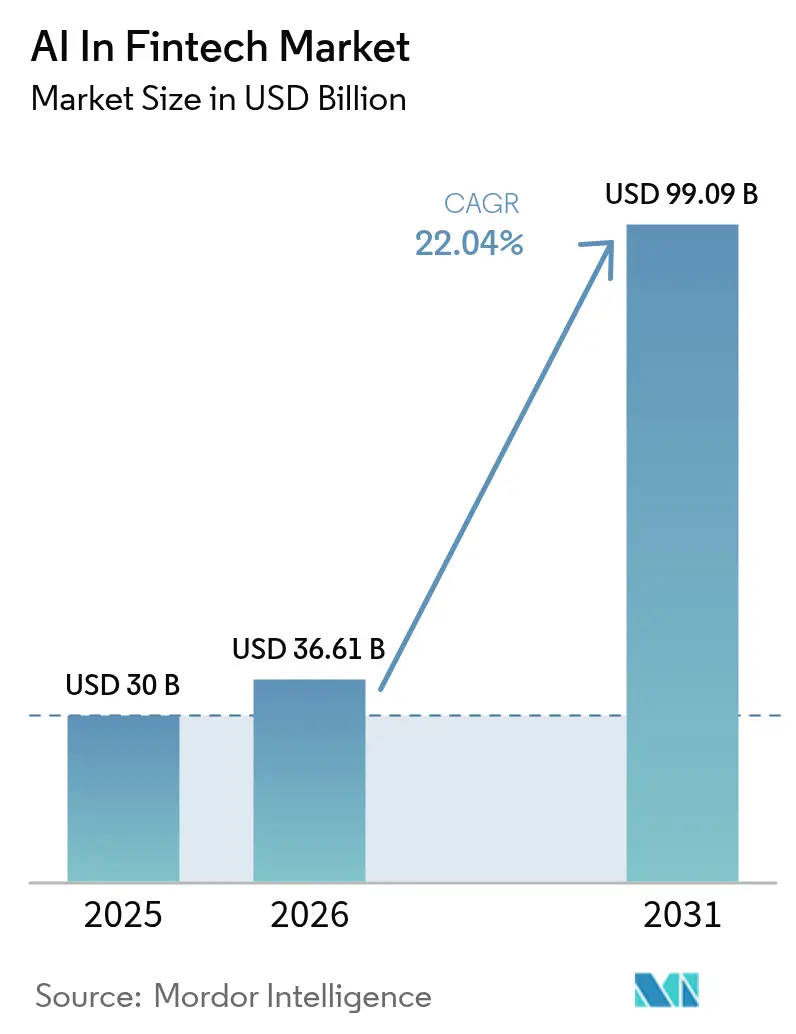
| Market Size (2026) | USD 36.61 Billion |
| Market Size (2031) | USD 99.09 Billion |
| Growth Rate (2026 - 2031) | 22.04 % |
| Fastest Growing Market | Asia-Pacific |
| Largest Market | North America |
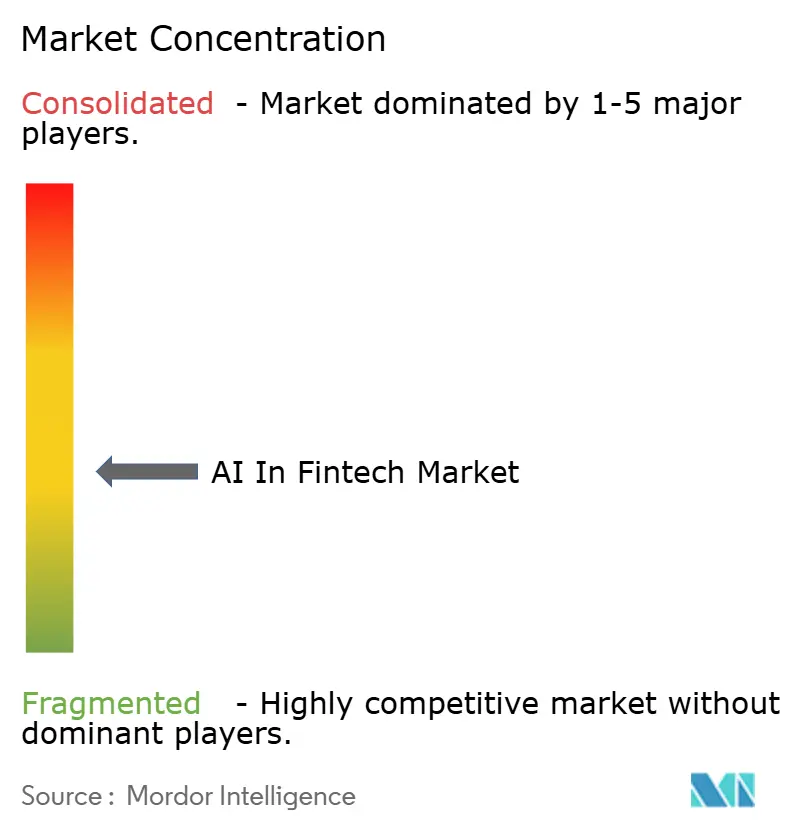
| Market Concentration | Medium |
Major Players *Disclaimer: Major Players sorted in no particular order Image © Mordor Intelligence. Reuse requires attribution under CC BY 4.0. | |
AI In Fintech Market Analysis by Mordor Intelligence
The AI in Fintech market size was valued at USD 30 billion in 2025 and estimated to grow from USD 36.61 billion in 2026 to reach USD 99.09 billion by 2031, at a CAGR of 22.04% during the forecast period (2026-2031).[1]Microsoft, “How Azure AI is redefining financial services productivity,” microsoft.com Growth is being propelled by open-banking mandates that liberate granular customer data, the maturation of real-time payment rails, and cloud-native AI platforms that trim operating costs for mid-tier banks.[2]IBM, “Generative AI in financial services: Accelerating risk model deployment,” ibm.com Generative AI copilots are compressing model-risk-management timelines from months to days, letting institutions release compliant risk models at unprecedented speed. High-frequency payment data, more than USD 9 trillion monthly at institutions such as BNY Mellon, feeds AI engines that sharpen fraud detection and liquidity forecasts. Convergence of these forces sustains a flywheel in which lower total cost of ownership invites wider adoption, and wider adoption produces richer datasets that reinforce model accuracy.
Key report Takeaways
- By component, solutions captured 71.45% of the AI in Fintech market share in 2025; services are advancing at a 27.95% CAGR through 2031.
- By deployment mode, cloud accounted for 81.35% revenue share in 2025 in the AI in Fintech market, while hybrid deployment is expanding at a 27.4% CAGR to 2031.
- By application, fraud and risk management held 30.55% of the AI in Fintech market share in 2025; chatbots and virtual assistants record the fastest 34.8% CAGR to 2031.
- By organization size, large enterprises commanded 87.25% share in 2025 in the AI in Fintech market, whereas SMEs and neo-banks are set to grow at 28.6% CAGR.
- By end-user, retail banking led with 33.75% revenue share in 2025 in the AI in Fintech market; payments and remittances providers are projected to rise at 32.2% CAGR.
- By geography, North America contributed 37.60% revenue share in 2025 in the AI in Fintech market, while Asia-Pacific is poised for a 33.1% CAGR through 2031
Note: Market size and forecast figures in this report are generated using Mordor Intelligence’s proprietary estimation framework, updated with the latest available data and insights as of 2026.
Market Trends and Insights
Drivers Impact Analysis of AI In Fintech Market*
| Driver | (~) % Impact on CAGR Forecast | Geographic Relevance | Impact Timeline |
|---|---|---|---|
| Open banking mandates accelerating AI-led process automation | +4.2% | Europe, North America, key APAC markets | Medium term (2-4 years) |
| Explosion of real-time payments data streams | +5.8% | Global with early gains in North America, APAC | Short term (≤ 2 years) |
| Cloud-native AI platforms lowering TCO | +3.1% | Global with spill-over to emerging markets | Medium term (2-4 years) |
| GenAI copilots slashing model-risk-management cycle times | +2.7% | North America, Europe, advanced APAC | Long term (≥ 4 years) |
| AI-powered ESG scoring unlocking green-finance incentives | +1.9% | Europe, North America, expanding APAC | Long term (≥ 4 years) |
| SME and neo-bank adoption of AI-native models | +2.3% | Global, strongest in APAC and Europe | Short term (≤ 2 years) |
| Source: Mordor Intelligence | |||
Open Banking Mandates Accelerating AI-Led Process Automation
Mandatory data-sharing rules such as PSD3 grant AI engines consistent, permissioned access to multi-institution bank records, enabling real-time credit scoring and hyper-personalized offers. PSD3 went live in 2024, prompting European banks to redesign product origination workflows around API-first architectures that feed machine-learning models with previously siloed datasets. Mid-tier institutions gain competitive parity because compliance investments double as innovation enablers, turning regulatory cost into revenue growth levers. Markets where open-banking adoption exceeds 87% of institutions already display elevated AI service penetration.
Explosion of Real-Time Payments Data Streams
VisaNet +AI processes each authorization with 98% stability prediction accuracy, while its Smarter Settlement Forecast adds seven-day cash-flow projections that shrink liquidity buffers.[3]Visa, “VisaNet +AI elevates authorization accuracy,” visa.com Real-time rails broadcast behavioral signals that batch systems miss, letting AI flag fraud milliseconds after initiation . Surveys show 94% of payments professionals view AI as indispensable for fraud mitigation, and 77% of consumers expect institutions to deploy it. BNY Mellon automated 90% of back-office payment instruction handling, freeing analysts for value-added tasks. Instant data availability also powers live credit decisions based on dynamic cash-flow metrics.
Cloud-Native AI Platforms Lowering TCO for Mid-Tier Financial Institutions
Azure AI lets UBS advisers retrieve investment insight in seconds, cutting research time and boosting client responsiveness. Finova trimmed Azure virtual machines from 1,200 to 100 and held latency steady, proving infrastructure right-sizing potential. JPMorgan Chase, which shifted 70% of workloads to cloud while funding USD 2 billion private facilities, illustrates how hybrid estates sustain sovereignty without sacrificing scale. These models collapse capital expenditure needs, letting regional banks access identical inference performance for a fraction of historic outlays.
GenAI Copilots Slashing Model-Risk-Management Cycle Times
Generative copilots draft model documentation, parse regulatory text, and assemble validation packs in hours, shrinking cycle time by up to 40%. Clearing brokers deploy real-time market-data analysis to pre-empt margin breaches, illustrating practical risk mitigation. Faster approvals translate into quicker deployment of trading or credit models, allowing institutions to monetize transient market windows that slower peers miss
Restraints Impact Analysis of AI In Fintech Market*
| Restraint | (~) % Impact on CAGR Forecast | Geographic Relevance | Impact Timeline |
|---|---|---|---|
| Shortage of domain-specific AI talent | -3.4% | Global, acute in North America and Europe | Short term (≤ 2 years) |
| Fragmented regulatory guidance on AI governance | -2.8% | Global, varies by jurisdiction | Medium term (2-4 years) |
| Rising GPU supply-chain volatility inflating inference costs | -1.6% | Global, concentrated in major data-center hubs | Short term (≤ 2 years) |
| Compliance cost overhead diverting AI budgets | -1.9% | Global, strongest in Europe | Medium term (2-4 years) |
| Source: Mordor Intelligence | |||
Shortage of Domain-Specific AI Talent
Demand for professionals who blend machine-learning mastery with regulatory fluency exceeds supply by 2-4 times, with 74% of employers reporting hiring struggles. European banks note that only 25% have formal GenAI training pipelines, widening capability gaps. Salary premiums of 40-60% over traditional finance roles tilt the playing field toward tech giants and tier-one banks. Mid-tier firms risk stalled deployments as talent scarcity inflates project timelines and costs.
Fragmented Regulatory Guidance on AI Model Governance
The EU AI Act designates high-risk financial systems for stringent oversight, while US and UK rely on sectoral guidance, producing compliance patchworks. Multinationals juggle divergent rules, with only 11% of European banks feeling prepared. Institutions now allocate up to 30% of AI budgets to compliance activities, trimming funds for innovation.
*Our forecasts treat driver/restraint impacts as directional, not additive. The impact forecasts reflect baseline growth, mix effects, and variable interactions.
AI In Fintech Market Segment Analysis
By Component:
Solutions Provide Integrated ValueSolutions generated USD 21.44 billion in 2025, equal to 71.45% of the AI in Fintech market. Enterprises favor platforms that unify fraud analytics, customer support, and governance within a single control plane. FICO’s blockchain-enabled governance suite, which won a 2025 innovation award, illustrates why integrated offerings dominate. The services segment is smaller today but is projected to grow at 27.95% CAGR through 2031 as banks seek advisory partners to configure complex GenAI pipelines and manage the daily swell of 234 regulatory notices.
Consultancies help translate compliance obligations into model design, accelerating time to value. This demand keeps specialized system integrators busy and cements service fees as a predictable revenue stream. As service expertise proliferates, mid-tier firms that once delayed AI adoption due to limited internal skill sets now jump in, broadening the AI in Fintech market customer base.



By Deployment Mode:
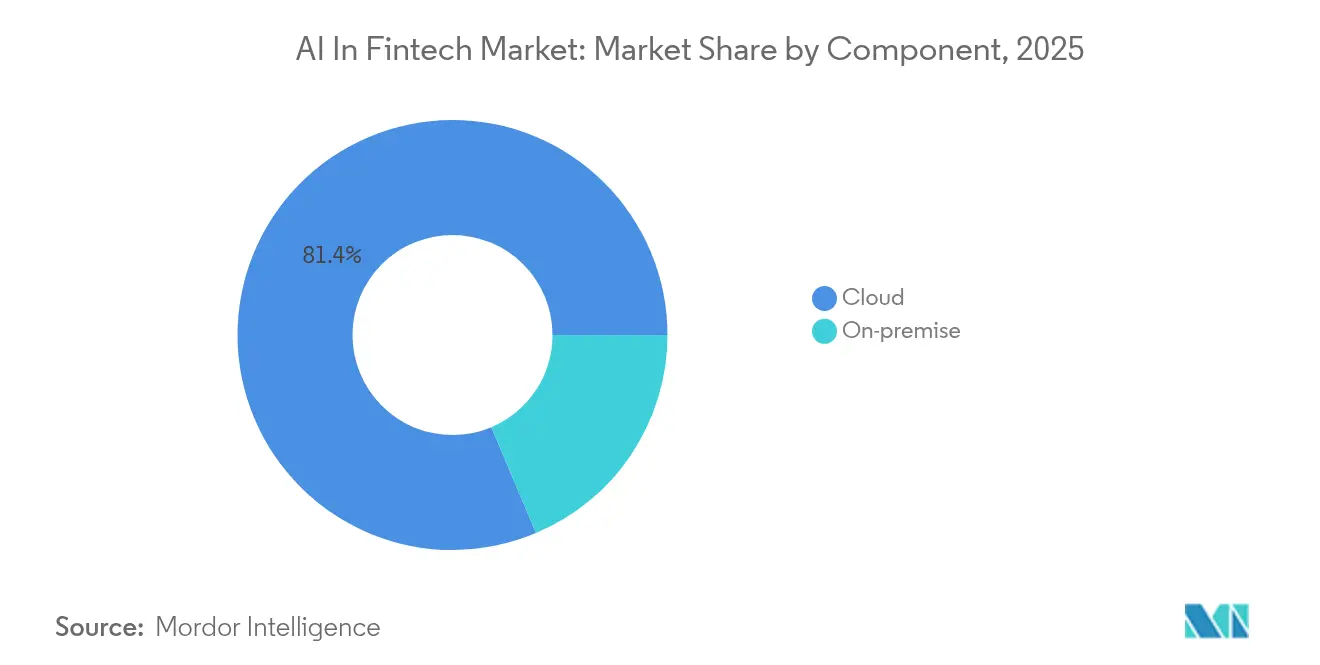
Hybrid Architecture Balances Control and ScaleCloud environments delivered 81.35% of deployment revenues in 2025 on the back of elastic compute that processes massive transaction volumes. JPMorgan Chase’s architecture shows 70% of applications in public cloud while sensitive workloads reside in USD 2 billion private facilities. Hybrid deployments are forecast to advance at 27.4% CAGR as regulators tighten residency rules and banks look to limit exposure to single-vendor outages.
Hybrid models place training pipelines on-premise for sovereignty yet run inference in cloud, unlocking the best of both worlds. This flexibility positions hybrid as a durable choice, particularly in jurisdictions enforcing strict data localization.
By Application:
Conversational Interfaces AccelerateFraud and risk management retained 30.55% of 2025 revenues, confirming the segment’s role as mission-critical. Yapı Kredi’s 98.7% fraud reduction over seven years demonstrates a tangible return. Chatbots and virtual assistants will, however, record the strongest 34.8% CAGR to 2031 as customers demand always-on support. Bank of America’s Erica crossed 2 billion interactions by late 2024, proving that conversational AI boosts engagement.
RegTech tools that parse new rules in real time and auto-update policy frameworks are gaining traction. Credit scoring engines feed on alternative data to approve microloans within minutes. Collectively these trends expand the AI in Fintech market size for software vendors that can bundle multiple use cases under unified governance.
By Organization Size:
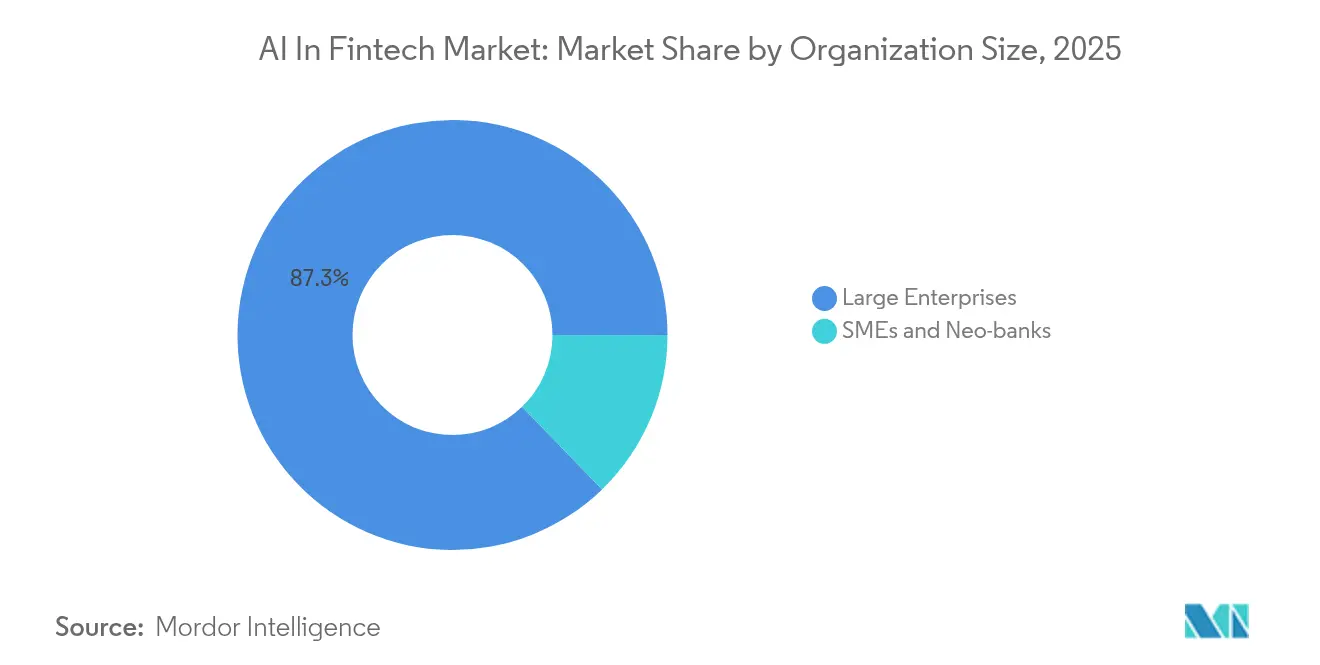
SMEs Capture Cloud LeverageLarge enterprises retained 87.25% revenue share in 2025, reflecting deep budgets and in-house data science. Yet SMEs and neo-banks are slated for 28.6% CAGR thanks to pay-as-you-go cloud subscriptions. Roughly 46% of midsize businesses have either deployed or evaluated AI, focusing on operations and communications.
Neo Financial’s CAD 360 million funding round underlines investor faith in AI-native challengers. Lower entry barriers broaden participation, driving incremental AI in Fintech market growth beyond traditional banking incumbents.
By End-User:
Payments Providers Outpace Retail BanksRetail banking produced 33.75% of 2025 revenues on the strength of branch digitization and personalized advice engines. Payments and remittances providers will post the highest 32.2% CAGR through 2031 as real-time cross-border transfers become ubiquitous. Stripe’s USD 1.1 billion Bridge Network acquisition highlights strategic bets on stablecoin rails and AI-driven compliance.
Insurers automate claims triage, while wealth managers deploy robo-advisers for low-fee portfolios. Together, these shifts enlarge the AI in Fintech market and diversify its customer pool.
Geography Analysis
North America AI in Fintech Market
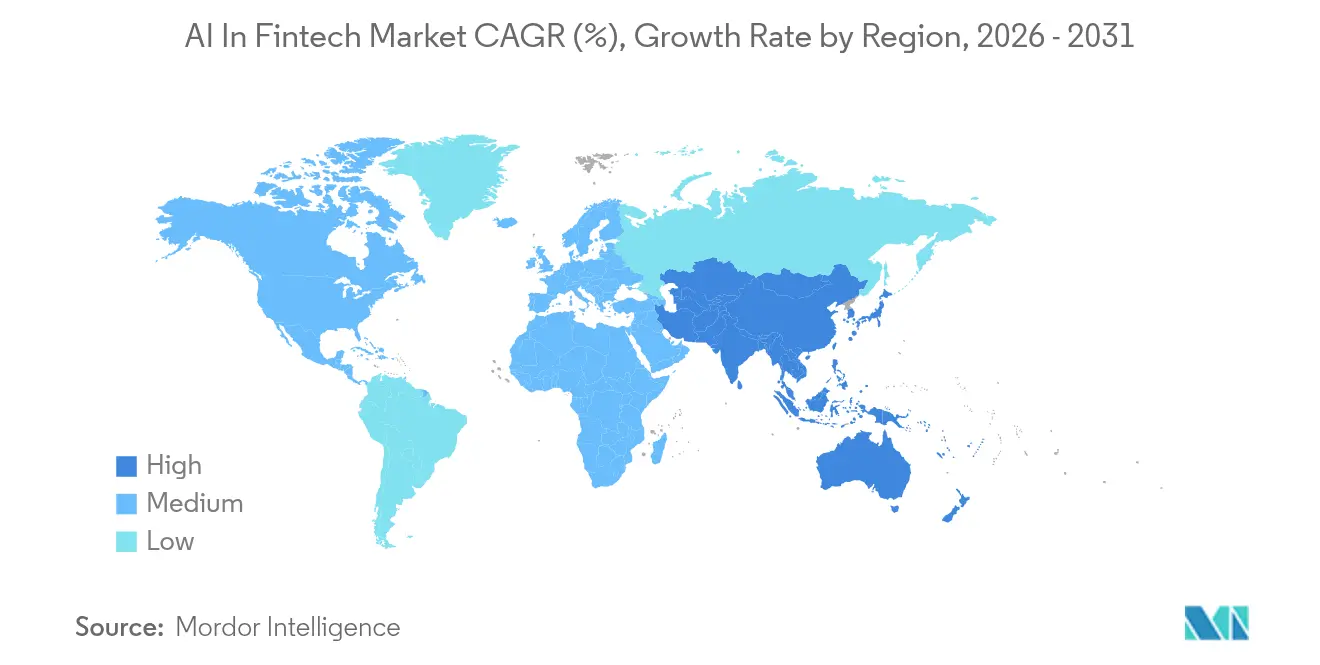
North America held 37.60% revenue share in 2025, supported by a mature financial stack and clear though fragmented regulatory guidance. JPMorgan Chase fields 2,000 AI specialists and over 400 live use cases, underscoring local skill depth. Canada’s challenger banks such as Neo Financial scale AI to underserved segments, and Mexico leverages AI for financial inclusion. Continued public-private investment sustains North America as an innovation laboratory, feeding global best practices back into the AI in Fintech market.
APAC AI in Fintech Market
Asia-Pacific is projected to register the fastest 33.1% CAGR through 2031. China poured USD 2.1 billion into generative AI in 2024 and records 83% enterprise usage, dwarfing western penetration rates. India and Japan extend momentum through inclusive credit and quantitative trading desks that rely on AI engines. The region’s fintech revenue could move from USD 245 billion in 2021 to USD 1.5 trillion by 2030, with 87% of banks planning fintech partnerships. Singapore leads in mobile payments, while Australia and New Zealand expect disproportionate AI value capture relative to GDP.
Europe AI in Fintech Market
Europe demonstrates strong adoption tempered by compliance overhead. The EU AI Act imposes a risk-tier system that elevates governance costs but assures ethical deployment. The UK reports 70% GenAI usage, leveraging post-Brexit agility to tailor banking sandboxes. Germany and France fund AI centers of excellence inside national champions, and the Nordics pilot green-finance scoring frameworks. Eastern markets experiment with AI for cross-border wage remittances, redrawing traditional service boundaries.

Regulatory Landscape
AI governance for financial services is tightening through binding regional rules and supervisory toolkits focused on model governance, third-party risk, and auditability. In the European Union, the EU AI Act (Regulation 2024/1689) establishes a risk-based framework with high-risk obligations that cover financial use cases such as creditworthiness assessment, and its primary application date is anchored to 2 August 2026. In June 2026, the European Parliament adopted the Digital Omnibus on AI measures to simplify requirements, creating near-term uncertainty around specific implementation timelines while keeping compliance planning active for banks and fintech vendors operating across Europe.
Outside the EU, regulators and standard setters are moving toward AI-specific guidance rather than relying solely on legacy model risk management practices. In the United States, a May 2026 presidential action directed federal financial regulators to review and integrate fintech innovation into regulatory frameworks, and Federal Reserve Vice Chair for Supervision Bowman (May 2026) noted that existing model risk management guidance does not map cleanly to generative or agentic AI. Internationally, the Financial Stability Board opened a June 2026 consultation on sound practices for responsible AI adoption in financial institutions, and IOSCO published a supervisory toolkit for AI use in capital markets, reinforcing expectations for governance, disclosure, and outsourcing controls in AI-enabled fintech deployments.
Value Chain Analysis
The AI in fintech value chain starts with data generation and access, including transactional and real-time payments streams, open-banking APIs, customer identity and onboarding data (KYC/KYB), and market and alternative datasets that feed fraud, credit, and personalization models. Upstream, cloud and AI infrastructure providers (compute, storage, accelerators) and model development toolchains (MLOps, monitoring, explainability, model documentation automation) shape delivery, while cybersecurity and software supply chain controls increasingly influence procurement choices for regulated buyers. Midstream participants include fintech solution vendors and domain specialists that package risk analytics, financial crime compliance, and conversational AI into governed platforms, alongside system integrators and consultancies that translate regulatory obligations into model design and controls.
Downstream, banks, insurers, wealth managers, and payments providers operationalize AI through deployment architectures spanning cloud and hybrid environments, with integration layers into core banking and ERP systems for workflows such as supply chain finance, underwriting, and transaction monitoring. Partnerships are a primary distribution and scaling mechanism, illustrated by J.P. Morgan Payments integrating supply chain finance capabilities with Oracle Fusion Cloud for enterprise use cases, and by a Microsoft-led April 2026 trade finance proof-of-concept with ANZ, HSBC, and Lloyds that used AI agents to extract structured data and flag compliance risks aligned with ICC Digital Standards Initiative frameworks. Industry alliances also influence the chain by standardizing and securing dependencies, as seen in FINOS announcing intent in June 2026 to form OSERA to address open-source supply chain resiliency risks amplified by AI-driven vulnerability discovery.
Competitive Landscape
The AI in Fintech market features moderate fragmentation with cloud hyperscalers, domain specialists, and incumbent banks vying for share. Microsoft’s Azure AI, AWS’s Bedrock, and Google Cloud’s Vertex position infrastructure as a gateway product, bundling managed models that shorten build cycles. FICO, SAS, and DataRobot defend niches in decision intelligence and model monitoring, reflected in FICO’s 12 new AI patents secured in March 2025.
Fintech disruptors such as Stripe, Plaid, and Upstart specialize in payments rails, data connectivity, and AI-driven credit, respectively. Stripe’s USD 1.1 billion Bridge purchase signals intent to blend stablecoin settlement with AI compliance screening. Traditional giants including JPMorgan Chase and UBS invest internally, exemplified by UBS co-creating smart assistants with Microsoft to boost advisory productivity.
Talent scarcity intensifies rivalry. Compensation premiums drain smaller firms, prompting creative approaches like university partnerships and internal bootcamps. Vendors able to bundle technology with explainability toolkits gain an edge because regulators scrutinize model bias and audit trails. In this dynamic, alliances between banks and fintechs, such as Fifth Third Bank teaming with Stripe for embedded services, illustrate convergence patterns that continue to reshape the AI in Fintech market.
AI In Fintech Industry Leaders
Intel Corporation
Amazon Web Services, Inc.
International Business Machines Corporation
ComplyAdvantage Ltd.
Microsoft Corporation
- *Disclaimer: Major Players sorted in no particular order
AI In Fintech Market Companies Covered in this Report
- Amazon Web Services, Inc.
- Microsoft Corporation
- International Business Machines Corporation
- Google LLC (Alphabet Inc.)
- Fair Isaac Corporation
- SAS Institute Inc.
- Intel Corporation
- NVIDIA Corporation
- Salesforce, Inc.
- Stripe, Inc.
- Plaid Inc.
- ComplyAdvantage Ltd.
- Onfido Ltd.
- Ripple Labs Inc.
- DataRobot, Inc.
- Upstart Holdings, Inc.
- ZestFinance, Inc.
- Darktrace Limited
- Truera, Inc.
- Active Intelligence Pte Ltd.

Market Opportunities and Future Outlook
Regulatory-grade AI governance and compliance automation is a clear whitespace area as supervisory bodies publish AI-specific guidance and firms redirect effort to documentation, monitoring, and controls. The US Treasury released a Financial Services AI Risk Management Framework in February 2026, and the Financial Stability Board opened a June 2026 consultation on sound practices for responsible AI adoption. Together, these developments increase demand for packaged governance capabilities such as model documentation generation, data lineage, bias testing, continuous monitoring, and third-party risk management. Vendors that embed these controls directly into high-volume workflows, including payments screening, AML transaction monitoring, credit decisions, and customer communications, gain traction as banks standardize procurement around auditable tooling rather than bespoke point solutions.
Agentic AI and real-time decisioning also open production-focused opportunities as institutions move beyond pilots. In April 2026, Cambridge Judge Business School survey findings showed 81% of financial services firms adopting AI, with fintechs leading incumbents in advanced AI adoption (47% vs. 30%), which points to an addressable gap for modernization partners, cloud-native platforms, and explainability-first model operations. Supervisor expectations around agentic controls are becoming more explicit: the Monetary Authority of Singapore released Safeguards for Agentic Finance at Runtime (SAFR) in July 2026, and the UK Government published a Financial Services AI Adoption Plan in July 2026 emphasizing a tech-neutral, outcomes-focused approach. These frameworks support commercial rollout of runtime guardrails, human-in-the-loop control layers, and secure integration patterns for AI agents across customer service, risk, and back-office automation.
Recent Industry Developments in AI In Fintech Market
- June 2026: Intel announced new AI innovations at Computex 2026, including rackscale infrastructure and Xeon 6 processors positioned for enterprise inference and agentic AI workloads. The launch supports higher-throughput, lower-latency model serving that underpins real-time fintech use cases such as fraud detection and compliance screening. It also strengthens the hardware roadmap options for regulated institutions balancing performance with infrastructure standardization.
- December 2025: Sutherland and ComplyAdvantage launched an AI-native unified financial crime compliance solution combining Sutherland digital accelerators with ComplyAdvantage Mesh risk intelligence. The bundled approach targets faster implementation of AML and screening programs across large and mid-tier institutions. It also expands routes to market for compliance AI by pairing a platform vendor with a services-led delivery motion.
- August 2024: Intel and IBM announced a collaboration to provide Intel Gaudi 3 AI accelerators on IBM Cloud to help enterprises scale generative AI with security and performance considerations. The collaboration broadened access to specialized AI compute for regulated workloads without requiring on-premise capital buildouts. For fintech deployments, it widened cloud infrastructure choices for model training and inference under enterprise governance requirements.


AI In Fintech Market Report Scope and Research Methodology
Market Definition and Coverage
This market captures spending on AI software and related services that are bought and used by fintech and financial services teams to automate decisions and workflows such as fraud checks, credit scoring, customer support, compliance monitoring, and portfolio analytics.
Scope exclusions: Purely in-house AI R and D costs that are not commercialized, and general IT outsourcing that is not tied to an AI use case in fintech, are excluded.
Segments Covered in This Report
- By Component
- Solutions
- Services
- By Deployment Mode
- Cloud
- On-premise
- By Application
- Fraud and Risk Management
- Chatbots and Virtual Assistants
- Credit Scoring and Underwriting
- Quantitative and Asset Management
- RegTech and Compliance Analytics
- Others
- By Organization Size
- Large Enterprises
- SMEs and Neo-banks
- By End-user
- Retail Banking
- Insurance
- Investment and Wealth Management
- Payments and Remittances Providers
- Others
- By Geography
- North America
- United States
- Canada
- Mexico
- South America
- Brazil
- Argentina
- Chile
- Rest of South America
- Europe
- Germany
- United Kingdom
- France
- Italy
- Spain
- Rest of Europe
- Asia-Pacific
- China
- India
- Japan
- South Korea
- Malaysia
- Singapore
- Australia
- Rest of Asia-Pacific
- Middle East and Africa
- Middle East
- United Arab Emirates
- Saudi Arabia
- Turkey
- Rest of Middle East
- Africa
- South Africa
- Nigeria
- Rest of Africa
- Middle East
- North America
Data Sources, Market Sizing, and Validation
Desk Research
We start by mapping where AI shows up in financial services value chains, then we collect public indicators that can be tied to demand, supply, and adoption. For grounding, we use sources such as the US SEC filings of listed companies, IMF and World Bank digital finance indicators, BIS publications on payments and financial stability, and OECD or national statistics on ICT and services output.
To make the model usable by year and region, we also review central bank and regulator releases, cybersecurity and fraud reports from official agencies, and peer reviewed journals that quantify AI performance in risk and compliance tasks. Company annual reports, investor decks, and reputed press are used to track product launches and the direction of pricing. Paid subscriptions are used selectively for company financials, patent databases, and shipment level import and export signals where they help clarify scale. The sources listed here are illustrative only, and many other public and paid references were also used for data collection and cross checks.
Primary Interviews and Surveys
Primary work focuses on validating what is actually being deployed and paid for, and how budgets move across fraud, underwriting, servicing, and compliance teams in practice. We speak with buyers, implementation partners, and solution specialists across major regions to confirm adoption timing, typical contract structures, and which workloads are moving from pilots into production. These inputs are then used to tighten assumptions on penetration, renewal behavior, and price progression, especially where desk research sources do not show clear usage depth.
Distribution of primary research fieldwork respondents
| Company type | Respondent position | Region |
|---|---|---|
| Top tier: 39% | CXOs: 14% | APAC: 39% |
| Mid tier: 40% | Functional/Unit leaders: 41% | EMEA: 36% |
| Smaller Players: 21% | Managers: 45% | Americas: 25% |
Market-Sizing & Forecasting
Sizing begins with a top-down demand pool build, starting from fintech and financial services digital spend. We then filter using AI adoption rates by function and the share of workloads where AI is realistically used.
After that, we corroborate totals with selective bottom-up approximations, such as sampled vendor revenue disclosures, channel checks with implementers, and simple ASP times volume builds for common use cases like fraud scoring and virtual assistants.
Key inputs that shape the model include the cloud versus on-premise mix, the number of regulated customer interactions that can be automated, fraud attempt intensity and transaction growth, lending and underwriting volumes, and compliance and AML monitoring workload trends. Since pricing and usage can change quickly, forecasts are built using scenario analysis supported by expert consensus on how model accuracy, regulation, and compute costs are likely to evolve. Where bottom-up signals are missing for smaller providers, we apply scaling factors tied to regional fintech density and buyer budget bands, then re-check that totals still match the demand pool logic.
Data Validation & Update Cycle
Outputs are checked against independent signals such as fintech funding cycles, bank and payment provider technology budgets, and reported software and services revenue mixes. When numbers move sharply by region or application, we re-open the drivers, compare them against interview notes, and run variance checks on adoption and pricing assumptions before sign-off.
The study is refreshed annually, and interim updates are made when material events occur, such as major regulatory shifts or step changes in model deployment patterns. Before delivery, a final analyst pass is completed so the figures reflect the latest available public data and validated assumptions.
Mordor Intelligence's Fintech AI Market Size Compared With Other Published Estimates
Published market sizes for AI in fintech can look far apart because firms choose different cutoffs for what counts as fintech, how they treat adjacent banking AI spending, and which revenue streams are counted as AI versus broader analytics. Timing also matters, since some sources anchor values to older pricing and adoption levels, while others assume faster enterprise rollout.
In practice, the spread usually comes from scope and accounting choices, including whether services are limited to implementation and managed support, or widened to include generic consulting. It also depends on whether cloud AI platform fees are counted as part of the market. In this study, solutions and services are counted only when they are tied to defined fintech AI applications and validated with buyer side adoption checks and deployment mix, which keeps the 2025 value at USD 30.00 B for Mordor Intelligence.
Benchmark comparison
| Source | Market Size | Gaps in Research Methodology |
|---|---|---|
| Mordor Intelligence | USD 30.00 B (2025) | |
| Global Consultancy A | USD 36.96 B (2025) | Uses a broader inclusion set that appears to pull in more financial services AI spend beyond fintech specific buying centers, and it likely applies a higher starting penetration for 2025. |
| Industry Publisher B | USD 21.20 B (2025) | Applies a tighter revenue capture that can undercount services attached to deployment and integration, and it may use more conservative price assumptions for packaged solutions. |
The comparison mainly shows that small scope shifts, especially around what is treated as fintech AI versus wider BFSI AI, can change the total quickly. By keeping application rules explicit and then cross checking penetration and pricing with interviews, the estimate stays traceable to clear demand and spend drivers, and it remains repeatable as inputs update year to year.


Key Questions Answered in the Report
What is the current value of the AI in Fintech market?
The AI in Fintech market is valued at USD 36.61 billion in 2026.
How fast is the AI in Fintech market expected to grow?
It is projected to expand at a 22.04% CAGR, reaching USD 99.09 billion by 2031.
Which application area is growing the quickest?
Chatbots and virtual assistants lead with a 34.8% CAGR through 2031, reflecting rising demand for 24/7 digital support.
Why are hybrid deployments gaining traction?
Hybrid models let institutions keep sensitive data on-premise for compliance while using cloud inference for scale, expanding at 27.4% CAGR.
What regions present the strongest growth outlook?
Asia-Pacific is forecast to grow at 33.1% CAGR, driven by China’s heavy generative AI investment and widespread mobile payment adoption.
How severe is the AI talent shortage in financial services?
Demand for domain-specific AI professionals exceeds supply by as much as fourfold, prompting premium salaries and slower project timelines.
Page last updated on:


 Your data is secure and never sold or shared.


