
Airport Systems Market Size and Share
Market Overview
| Study Period | 2019 - 2030 |
|---|---|
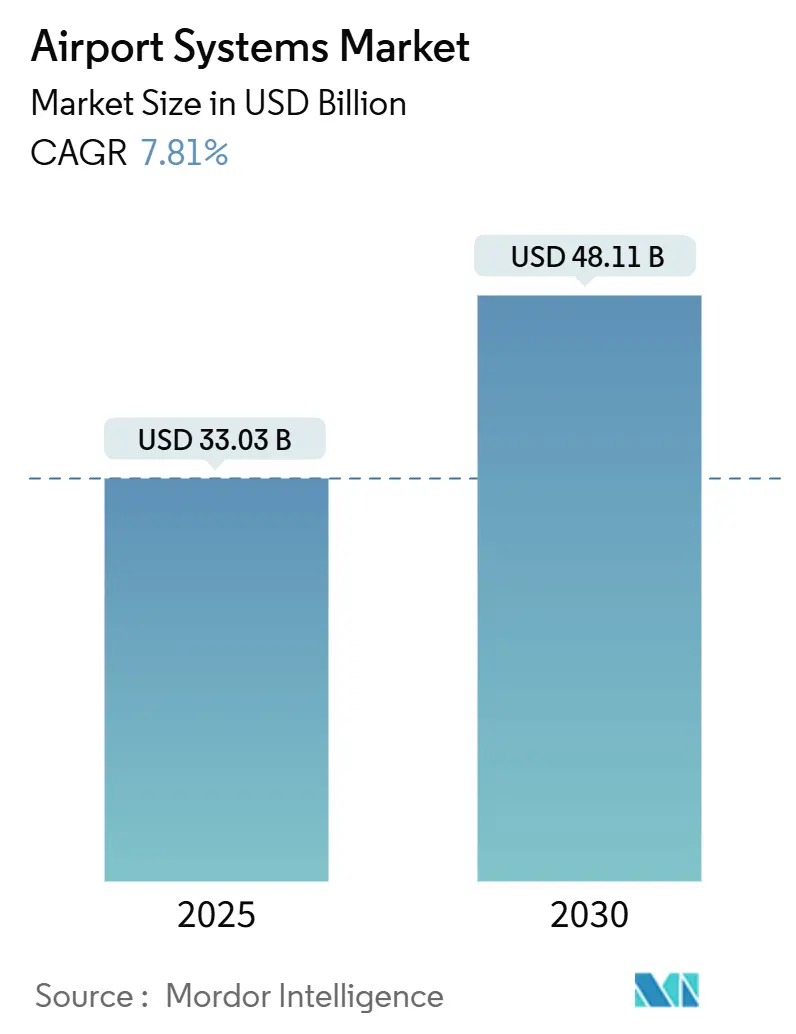
| Market Size (2025) | USD 33.03 Billion |
| Market Size (2030) | USD 48.11 Billion |
| Growth Rate (2025 - 2030) | 7.81 % |
| Fastest Growing Market | Middle East and Africa |
| Largest Market | North America |
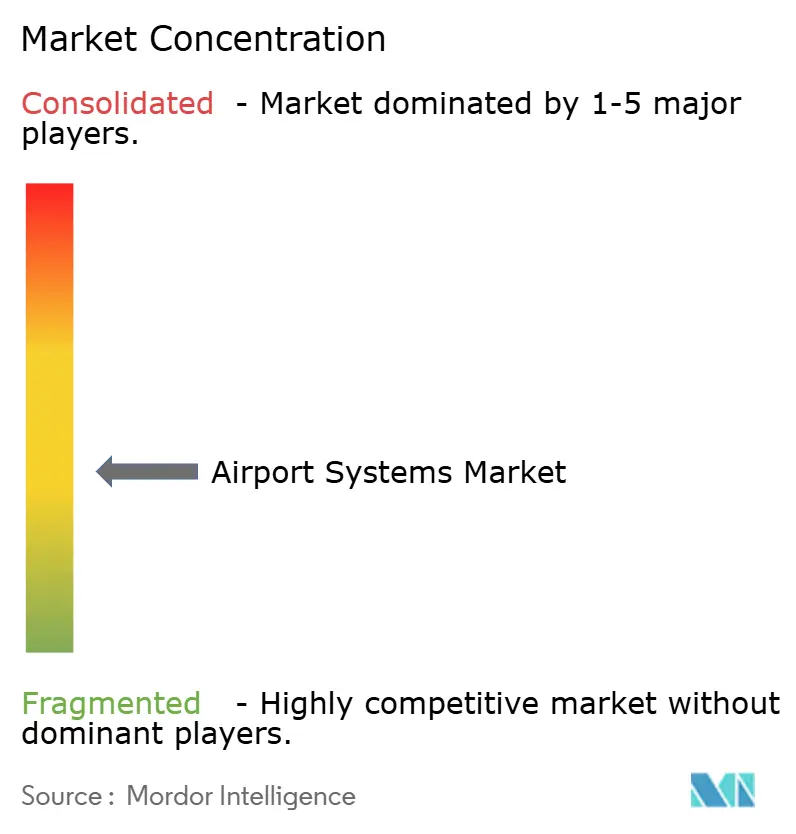
| Market Concentration | Medium |
Major Players *Disclaimer: Major Players sorted in no particular order Image © Mordor Intelligence. Reuse requires attribution under CC BY 4.0. | |
Airport Systems Market Analysis by Mordor Intelligence
The global airport systems market size stood at USD 33.03 billion in 2025 and is forecasted to reach USD 48.11 billion by 2030, advancing at a 7.81% CAGR. Faster digital adoption, post-pandemic traffic recovery, and modernization mandates reinforce investment momentum, especially in high-volume hubs seeking cost-effective operational resilience. Air traffic management (ATM) software remains the highest-value solution layer. At the same time, biometric passenger systems, electric ground-support equipment, and integrated operational platforms contribute to a steady uptick in cross-segment demand. Heightened cybersecurity risk exposure, six-figure capital outlays, and qualified labor shortages moderate near-term expansion but do not alter the long-range trajectory. Airport operators emphasize measurable returns on efficiency and sustainability, creating a fertile landscape for cloud-based, modular offerings that scale across airport sizes.
Key Report Takeaways
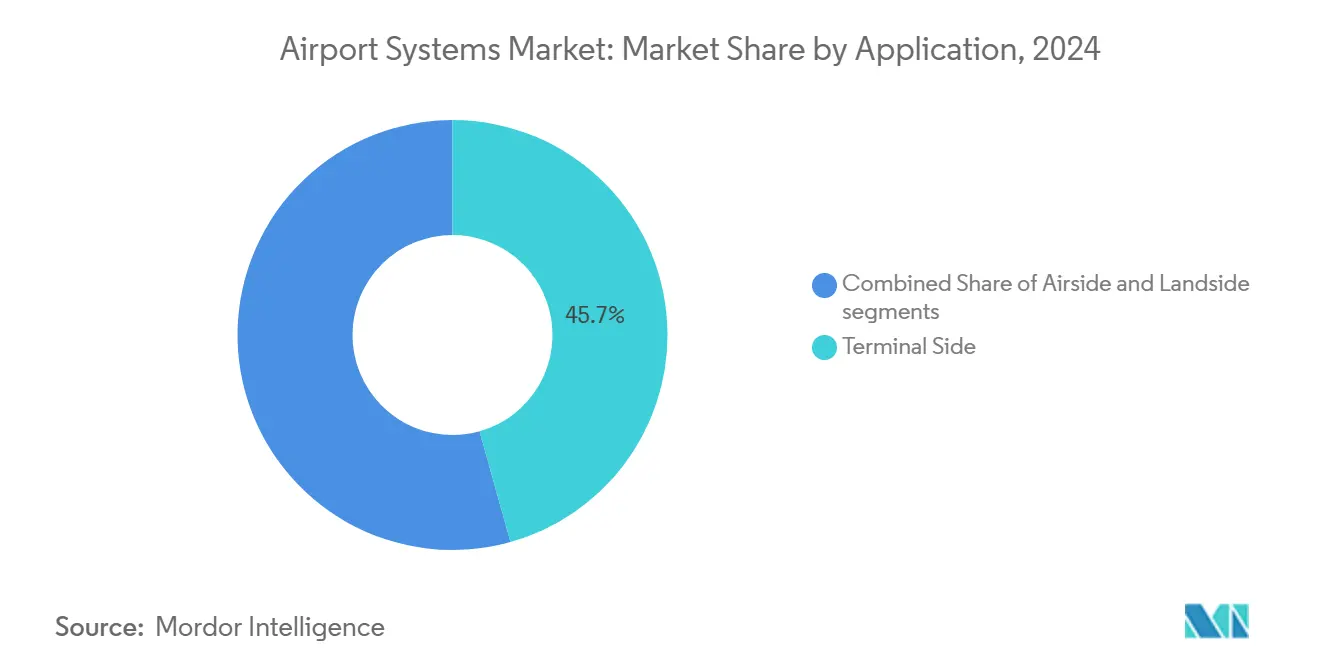
- By application, terminal side systems held 45.65% of 2024 revenue, while airside solutions are projected to expand at an 8.54% CAGR through 2030.
- By implementation, upgrade and modernization projects commanded 52.10% of 2024 spending, whereas new installation workstreams are on course for a 9.20% CAGR over the forecast horizon.
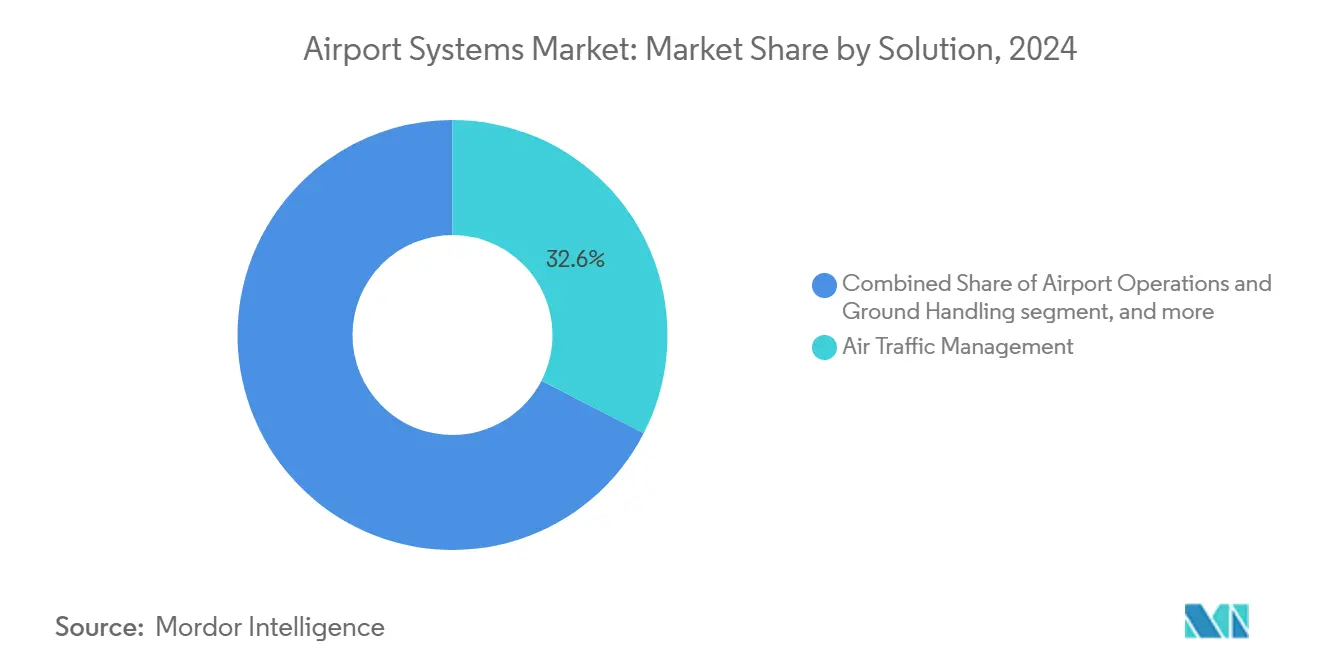
- By solution, air-traffic-management platforms contributed 32.55% of 2024 revenue and are positioned to grow at 10.65% CAGR, the fastest among all solution categories.
- By airport size, large hubs generated 52.40% of the 2024 value, although small facilities are expected to post the highest 9.24% CAGR out to 2030.
- By region, North America accounted for 34.00% of 2024 spending, yet the Middle East and Africa region is primed for a 9.78% CAGR given multiple mega-airport builds and smart city programs.
Note: Market size and forecast figures in this report are generated using Mordor Intelligence’s proprietary estimation framework, updated with the latest available data and insights as of January 2026.
Market Trends and Insights
Drivers Impact Analysis of Airport Systems Market*
| Driver | (~)% Impact on CAGR Forecast | Geographic Relevance | Impact Timeline |
|---|---|---|---|
| Rapid growth in air traffic management (ATM) digitization | 2.1% | Global, with early gains in Europe, North America | Medium term (2-4 years) |
| Rising deployments of self-service and biometric passenger-processing | 1.8% | Global, concentrated in Asia-Pacific, Middle East | Short term (≤ 2 years) |
| Mandated transition to RFID baggage tracking (IATA Res. 753) | 1.2% | Global implementation, led by North America, Europe | Short term (≤ 2 years) |
| Acceleration of electric and autonomous ground support equipment (GSE) | 0.9% | Europe, North America, with spillover to APAC | Medium term (2-4 years) |
| Convergence of airport OT and IT platforms enables predictive operations | 1.4% | Large hub airports globally, concentrated in developed markets | Long term (≥ 4 years) |
| Vertiport build-outs for urban-air-mobility (UAM) flights | 0.4% | North America, Europe, with pilot projects in APAC | Long term (≥ 4 years) |
| Source: Mordor Intelligence | |||
Rapid growth in air-traffic-management digitisation
European air navigation service providers are advancing the 2025 European ATM Master Plan that doubles sector capacity targets from 45 to 97 flights per hour. Spain’s EUR 25 million (USD 29.17 million) SkyNex project links eight countries and controls 12 million annual flights, highlighting the cross-border scale achieved through cooperative procurement. SESAR AI tools now predict congestion an hour in advance rather than 20 minutes, allowing tighter sequencing and reduced emissions.[1]Source: SESAR Joint Undertaking, “AI Solutions to Prevent Air Space Congestion,” sesarju.eu Similar modernization accelerates in North America, where integrators such as Parsons bid for multibillion-dollar NextGen work scopes.[2]Source: Parsons Corporation, “Ready Now to Build Next-Gen ATM,” parsons.com Vendors differentiate on cloud scalability, real-time fusion, and maintenance automation that lower the total cost of ownership across the airport systems market.
Rising deployments of self-service and biometric passenger processing
Thailand’s One ID roll-out installed 1,200 biometric touchpoints across six airports in December 2024, the single largest global deployment. SITA’s Digital Travel Credential removes up to 70% manual checks, placing verified identity tokens on passengers’ smartphones.[3]Source: SITA Press Office, “Aviation Industry Transformation Clearly Reflected in SITA’s Record Results,” sita.aero Dubai International and Berlin Brandenburg demonstrate mature face-recognition corridors that accelerate throughput and sustain border-compliance benchmarks. GDPR requirements shape privacy-by-design architectures that promote edge processing and consent management. Falling camera and compute prices compress payback cycles, spurring second-wave uptake among tier-2 airports in the airport systems market.
Mandated transition to RFID baggage tracking (IATA Res. 753)
Delta Air Lines records 99.9% tracking accuracy across 344 airports after full RFID deployment, validating the resolution's operational benefits. IATA rules obligate tracking at four journey stages, sparking demand for tags, readers, and analytics middleware that collectively slash mishandled-bag incidence by 25% and save airlines USD 2.3 billion annually. Hong Kong and Amsterdam Schiphol integrate RFID data directly with automated sorters for closed-loop reconciliation. In December 2024, SITA partnered with IDEMIA to layer computer vision atop RFID streams, cutting residual error rates further. Implementation costs range from USD 50,000 to 200,000 per airport, fitting within most airport systems' market capital plans.
Acceleration of electric and autonomous ground-support equipment
Hong Kong International and Long Beach airports are shifting from diesel to battery fleets that lower operating costs by 40% and eliminate direct emissions. Carbon-neutral pledges across Europe bring regulatory incentives that speed adoption. Under pilot trials, autonomous baggage tugs and loaders promise further labor-productivity gains, supported by USD 10,000-25,000 charging-station investments that achieve breakeven in three to five years. Telematics and predictive diagnostics bundled with the hardware improve fleet uptime, bolstering the airport systems market share of sustainable-mobility vendors. Implementation momentum grows fastest where fuel costs and regulatory pressure coincide.
Restraints Impact Analysis of Airport Systems Market*
| Restraint | (~)% Impact on CAGR Forecast | Geographic Relevance | Impact Timeline |
|---|---|---|---|
| High capex for integrated airport platforms and long ROI cycles | -1.8% | Global, particularly acute in emerging markets | Medium term (2-4 years) |
| Cyber-security and data-sovereignty compliance pressures | -1.2% | Global, with stringent requirements in Europe, North America | Short term (≤ 2 years) |
| Legacy-system interoperability bottlenecks | -0.9% | Established airports in North America, Europe | Medium term (2-4 years) |
| Skilled-labor shortages in specialised airside systems | -0.7% | Global, most severe in North America, Europe | Long term (≥ 4 years) |
| Source: Mordor Intelligence | |||
High capex for integrated airport platforms and long ROI cycles
Comprehensive digital overhauls frequently surpass USD 100 million for tier-1 hubs, extending payback beyond seven years and deterring cash-strapped operators. Emerging-market airports face higher debt costs and currency risk, amplifying the hurdle. Software-as-a-service (SaaS) contracts smooth spending but remain under-penetrated outside mature economies. Multilateral lenders offset some burden, yet the project disbursement pace can stall procurement. These dynamics slightly temper the otherwise strong growth curve of the airport systems market.
Cyber-security and data-sovereignty compliance pressures
Cyber incidents against airports spiked 600% in 2024, pushing operators toward zero-trust frameworks, micro-segmentation, and always-on monitoring. Europe’s NIS2 and updated US TSA directives impose rigorous audits, increasing project overhead. Sovereign-cloud mandates in some jurisdictions limit vendor pools and prolong tender cycles. Insurance premiums for cyber cover continue to rise, embedding extra cost into the airport systems market.
*Our forecasts treat driver/restraint impacts as directional, not additive. The impact forecasts reflect baseline growth, mix effects, and variable interactions.
Airport Systems Market Segment Analysis
By Application:
Terminal Operations Sustain Revenue LeadershipTerminal systems generated 45.65% of the 2024 airport systems market share, reflecting passenger-experience imperatives that drive biometric gates, retail analytics, and touchless check-in adoption. While smaller today, airside services and modules promise the fastest 8.54% CAGR through 2030 as predictive stand allocation and electric GSE gain traction. Landside tools, such as parking, curbside, and ground-transport integration, continue steadily penetrating North America and Europe. Terminal budgets remain robust because concessions rely on streamlined passenger flow for revenue, aligning operator and airline interests. SITA’s five-year USD value network contract with Heathrow evidences sustained investment appetite. Regulatory stakeholders enforce ICAO Annex 14 and FAA Part 139 standards, reinforcing baseline technology. Therefore, the airport systems market size attributable to terminal upgrades will remain substantial even as airside catch-up accelerates.
Passenger-flow dashboards enable dynamic signage and rate-adaptive retail, increasing non-aeronautical revenue streams. Airlines cooperate on common-use lounge analytics that optimize seating density and service rotation. Airside planners tie stand-allocation engines with live baggage-makeup data to curb apron congestion. Landside platforms deploy license-plate recognition paired with variable-tariff models, monetizing peak-hour curb access. Each integrated workflow strengthens ROI, justifying multiyear framework agreements that underpin the airport systems market.



By Implementation:
Modernization Dominates but New Installs Scale SwiftlyUpgrade and modernization tracks absorbed 52.10% of 2024 spend because most airports favor incremental enhancement over greenfield rebuilds. Retrofitting enables cyber hardening, sensor layering, and analytics dashboards without lengthy terminal closures. Conversely, new installations will clock a brisk 9.20% CAGR as first-time biometric corridors, vertiport links, and electric-vehicle chargers proliferate. Subscription licensing and pay-as-you-grow cloud models lower entry barriers for smaller operators, extending addressable demand in the airport systems market. Kansai Airport’s April 2025 security revamp and TAV Technologies’ October 2024 Benin modernization underscore upgrade and nascent install pathways.
Large modernization mandates often involve phased cutovers of screening, baggage, and network assets that align with peak-season lulls. Smaller airports exploit SaaS dashboards to sidestep hardware capital outlays while complying with emergent cybersecurity edicts. Integrators bundle managed services, monitoring, incident response, and change management, creating sticky recurring revenue streams. Vendors delivering open-API stacks that safeguard backward compatibility stay favored, preserving momentum for the airport systems market.
By Solution:
ATM Platforms Anchor Innovation ThrustATM ecosystems delivered 32.55% revenue in 2024 and will record the swiftest 10.65% CAGR as congestion pressures build. Cloud-oriented flight-data-processing engines ingest multilateration, ADS-B, and weather feeds to refine separation minima. Passenger-processing suites sustain strong uptake, integrating face-recognition, mobile boarding passes, and consent vaults. Security modules converge video analytics with credential management, enabling real-time anomaly flags. Information-and-communication backbones adopt self-healing SD-WAN that cuts switch-over time. Environmental dashboards track energy, water, and carbon, supporting airport-wide net-zero pledges. The EUR 100 million (USD 116.64 million) COOPANS contract for Thales TopSky-ATC One illustrates cross-border economies of scale.
Utility-control modules integrate with smart-grid demand-response, improving resilience and reducing costs. Ground-transport platforms link ride-share, rail, and parking inventory to optimize curbside flow. These layers create a holistic digital twin, placing integrated-suite vendors at the center of the airport systems market.
By Airport Size:
Large Hubs Continue to Spend; Small Airports Gain FlexibilityLarge hubs accounted for 52.40% 2024 revenue, courtesy of sizable, multi-suite contracts that frequently exceed USD 50 million annually. They host centralized command centers that consolidate dozens of workflows, enhancing resilience and insight. Medium airports adopt modular stacks, pacing cash outlays while securing core efficiency levers. Small airports, often handling under five million passengers yearly, will register the fastest 9.24% CAGR owing to SaaS affordability and regulatory funding programs. Cloud subscriptions eliminate hefty hardware capital requirements, widening front-line access to best-practice capabilities and thus elevating overall airport systems market penetration.
Brisbane and Auckland expansions embed technology-first design cues into terminal extensions. Small regional nodes tap shared service-bureau models offered by national ANSPs, implementing advanced ATM modules without duplicate staffing. Vendor roadmaps highlight remote monitoring, predictive maintenance, and cyber-incident response wrappers, ensuring operational compliance across airport sizes.
Geography Analysis
North America Airport Systems Market
North America's 34.00% market share in 2024 was bolstered by federal Airport Improvement Program grants and NextGen ATM outlays. US airports invested USD 32.50 billion in capital programs from 2017 to 2021, allocating roughly 20% to technology. Canadian collaboration within the iTEC Alliance speeds harmonization of flight-data exchange across borders. High cloud maturity underpins adopting zero-touch devices that extend predictive maintenance benefits. Cyber-resilience mandates from TSA Security Directives accelerate zero-trust adoption, locking additional revenue streams for airport systems market suppliers.
MEA Airport Systems Market
Middle East and Africa will post a market-leading 9.78% CAGR as Gulf megaprojects and smart-city blueprints fold airports into integrated mobility ecosystems. Dubai International's biometric express corridors and Abu Dhabi's Cisco smart network upgrade typify the region's technology appetite. Saudi Arabia's NEOM and UAE vertiport grids embed carbon-neutral standards from inception, necessitating advanced energy-management platforms. Sub-Saharan locales leverage mobile-first architectures to sidestep legacy-system constraints, growing the total accessible airport systems market size.
Europe and APAC Airport Systems Market
Europe balances mature infrastructure with forward-looking policy coordination. The 2025 European ATM Master Plan delivers synchronized investment signals. SESAR statistics show a EUR 7 (USD 8.16) return for every euro spent on ATM R&D. Stringent data privacy frameworks catalyze in-terminal consent-management systems and edge processing. Asia-Pacific records robust biometric adoption spurred by Thailand's USD 700 billion aviation scheme and Singapore's airport trajectory. Regional regulators draft unified data governance rules, streamlining cross-border passenger processing. These dynamics diversify growth avenues for the airport systems market across continents.


Competitive Landscape
The airport systems market exhibits moderate fragmentation. Incumbent integrators SITA, Thales, and Honeywell win multi-suite contracts by bundling ATM, passenger, and cyber services into platform deals lasting up to ten years. Competition intensifies in biometrics and AI analytics, where nimble startups deploy cloud-native stacks that integrate via open APIs, often partnering with larger vendors to speed market entry. Procurement committees score bids on security compliance, ROI, and sustainability metrics, heightening barriers for portfolio-narrow providers.
Cybersecurity emerges as a high-margin adjacency: SITA’s Network Access Control service, launched September 2024, tackles the 600% jump in sector cyber incidents and positions the firm for cross-sell across installed bases. AI-centric challengers deliver turnaround prediction, energy optimization, and demand-forecast tools that integrate with incumbent dashboards, earning fee-sharing arrangements. Hardware-only players feel price compression, while software and managed-service lines command high single-digit margins. Privatizing airport management in parts of India, Brazil, and Africa opens new avenues for scale, compelling suppliers to localize support and training curricula.
Strategic mergers remain plausible as integrators seek end-to-end portfolios that satisfy airport preference for one-throat-to-choke accountability. Vendor differentiation leans on proof-of-value pilots, zero-trust certification, and decarbonization road-maps, aligning with evolving buyer criteria in the airport systems market.
Airport Systems Industry Leaders
Thales Group
Honeywell International Inc.
RTX Corporation
Amadeus IT Group, S.A.
SITA N.V.
- *Disclaimer: Major Players sorted in no particular order
Airport Systems Market Companies Covered in this Report
- SITA N.V.
- Thales Group
- Honeywell International Inc.
- RTX Corporation
- Indra Sistemas S.A.
- Amadeus IT Group, S.A.
- Vanderlande Industries B.V.
- BEUMER Group
- Daifuku Co., Ltd.
- ADB SAFEGATE
- NEC Corporation
- Saab AB
- Leonardo S.p.A.
- Robert Bosch GmbH
- TAV Technologies
- Leidos, Inc.

Recent Industry Developments in Airport Systems Market
- September 2025: Thales and Stinville received a contract from CORPAC to implement TopSky - AMHS for enhancing Peru's aeronautical message processing capabilities. This marks their first collaboration with CORPAC in modernizing South American air traffic systems. The contract positions Thales and Stinville to expand their presence in South America's air traffic management market, establishing a foundation for future modernization projects across the region. Implementing TopSky - AMHS demonstrates the growing demand for advanced aviation infrastructure in emerging markets.
- February 2025: Vanderlande won a contract to supply Copenhagen Airport with 20 automated screening lanes featuring central image processing, building on their 2020 Strategic Partnership agreement. This implementation signals rising demand for automated airport security systems. Vanderlande's modular PAX Checkpoint solution enables airports to optimize space utilization and scale operations, strengthening the company's position in the airport security infrastructure market.


Global Airport Systems Market Report Scope
| Airside |
| Terminal Side |
| Landside |
| Upgrade and Modernization |
| New Installation |
| Passenger Processing |
| Airport Operations and Ground Handling |
| Security |
| Information and Communication |
| Utility |
| Environmental |
| Air Traffic Management (ATM) |
| Airport Parking and Ground Transportation |
| Large |
| Medium |
| Small |
| North America | United States | |
| Canada | ||
| Mexico | ||
| Europe | United Kingdom | |
| France | ||
| Germany | ||
| Italy | ||
| Russia | ||
| Rest of Europe | ||
| Asia-Pacific | China | |
| India | ||
| Japan | ||
| South Korea | ||
| Rest of Asia-Pacific | ||
| South America | Brazil | |
| Rest of South America | ||
| Middle East and Africa | Middle East | Saudi Arabia |
| Israel | ||
| United Arab Emirates | ||
| Rest of Middle East | ||
| Africa | South Africa | |
| Rest of Africa | ||
| By Application | Airside | ||
| Terminal Side | |||
| Landside | |||
| By Implementation | Upgrade and Modernization | ||
| New Installation | |||
| By Solution | Passenger Processing | ||
| Airport Operations and Ground Handling | |||
| Security | |||
| Information and Communication | |||
| Utility | |||
| Environmental | |||
| Air Traffic Management (ATM) | |||
| Airport Parking and Ground Transportation | |||
| By Airport Size | Large | ||
| Medium | |||
| Small | |||
| By Geography | North America | United States | |
| Canada | |||
| Mexico | |||
| Europe | United Kingdom | ||
| France | |||
| Germany | |||
| Italy | |||
| Russia | |||
| Rest of Europe | |||
| Asia-Pacific | China | ||
| India | |||
| Japan | |||
| South Korea | |||
| Rest of Asia-Pacific | |||
| South America | Brazil | ||
| Rest of South America | |||
| Middle East and Africa | Middle East | Saudi Arabia | |
| Israel | |||
| United Arab Emirates | |||
| Rest of Middle East | |||
| Africa | South Africa | ||
| Rest of Africa | |||


Key Questions Answered in the Report
What is the projected value of the airport systems market by 2030?
The airport systems market is forecasted to reach USD 48.11 billion by 2030, rising from USD 33.03 billion in 2025.
Which solution category is growing the fastest?
Air traffic management (ATM) platforms are on track for a 10.65% CAGR through 2030.
Which region will expand most quickly?
The Middle East and Africa region is projected to grow at a 9.78% CAGR during 2025-2030.
Why are airports adopting biometric passenger systems?
Biometric touchpoints accelerate throughput, cut manual checks by up to 70%, and improve security compliance.
How are airports addressing rising cybersecurity threats?
Operators deploy zero-trust network architectures, managed detection services, and strict compliance frameworks to mitigate cyber risks.
Page last updated on:


 Your data is secure and never sold or shared.


