
North America Talent Management Software Market Size and Share
Market Overview
| Study Period | 2020 - 2031 |
|---|---|
| Forecast Data Period | 2026 - 2031 |
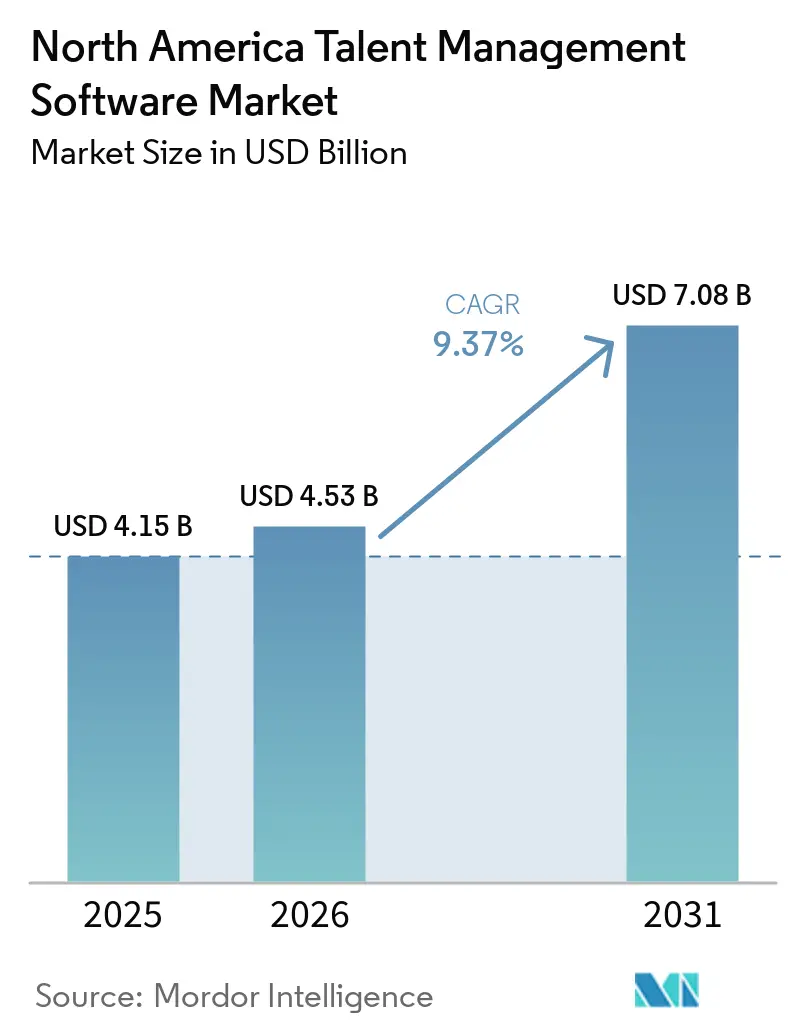
| Base Year Market Size (2025) | USD 4.15 Billion |
| Market Size (2026) | USD 4.53 Billion |
| Market Size (2031) | USD 7.08 Billion |
| Growth Rate (2026 - 2031) | 9.37 % |
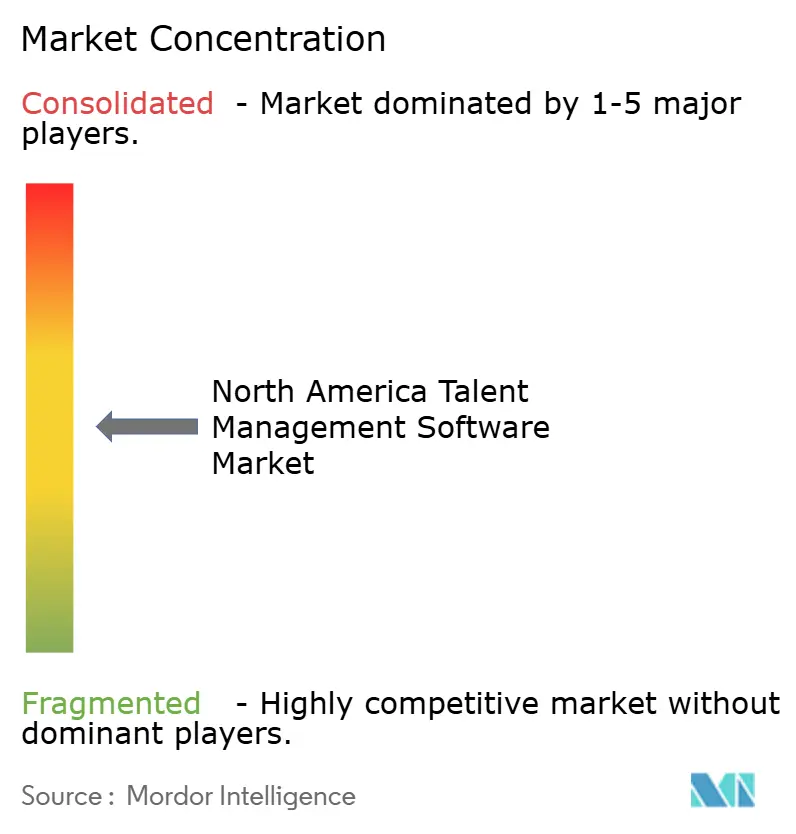
| Market Concentration | Medium |
Major Players *Disclaimer: Major Players sorted in no particular order Image © Mordor Intelligence. Reuse requires attribution under CC BY 4.0. | |
North America Talent Management Software Market Analysis by Mordor Intelligence
The North America talent management software market size is projected to expand from USD 4.15 billion in 2025 and USD 4.53 billion in 2026 to USD 7.08 billion by 2031, registering a CAGR of 9.37% between 2026 and 2031. The market is growing because employers across North America are moving away from periodic HR processes and adopting continuous workflows for hiring, learning, performance, and internal mobility. Skills-based hiring is changing what buyers expect from software, since employers now need better ways to map capabilities, assess workers, and redeploy talent faster across roles. AI is also becoming part of day-to-day HR operations, pushing vendors to embed analytics, prediction, and automation directly into core workflows rather than selling them as separate tools. At the same time, pay transparency rules and related reporting obligations are making talent platforms more important for compliance, not just administration. Even with steady demand, buyers remain cautious when deployments involve legacy payroll and ERP systems, so vendors that can demonstrate fast implementation and measurable value are likely to win a larger share of the North America talent management software market.
Key Report Takeaways
- By component, software accounted for 78.29% of the North America Talent Management Software Market revenue in 2025, while services are projected to grow at a 12.36% CAGR through 2031.
- By application, performance management accounted for 22.39% of revenue in 2025, while learning and development is forecast to expand at 11.15% CAGR through 2031.
- By deployment, on-premise represented 66.21% of the North America Talent Management Software Market revenue in 2025, while cloud is advancing at 12.77% CAGR through 2031.
- By organization size, large enterprises accounted for 63.45% of revenue in 2025, while SMEs are growing at a 12.08% CAGR through 2031.
- By end-use industry, IT and telecommunications led with 24.67% of revenue in 2025, while healthcare and life sciences are projected to record 10.68% CAGR through 2031.
- By region, the United States accounted for 74.25% of the North America Talent Management Software Market revenue in 2025, while Mexico is expected to grow at a 11.55% CAGR through 2031.
Note: Market size and forecast figures in this report are generated using Mordor Intelligence’s proprietary estimation framework, updated with the latest available data and insights as of January 2026.
Market Trends and Insights
Drivers Impact Analysis of North America Talent Management Software Market*
| Driver | (~) % Impact on CAGR Forecast | Geographic Relevance | Impact Timeline |
|---|---|---|---|
| Accelerating Shift toward Skills-Based Hiring in United States Enterprises | +2.5% | United States, with spillover to Canada | Medium term (2-4 years) |
| Rising Adoption of AI-Driven Talent Analytics Platforms | +2.2% | United States and Canada, Mexico emerging | Short term (≤ 2 years) |
| Demand for Unified Cloud Suites amid Hybrid Work Models | +1.8% | United States and Canada | Medium term (2-4 years) |
| Regulatory Push for Pay Transparency and DEI Reporting | +1.2% | United States, with spillover to Canada | Short term (≤ 2 years) |
| Competition for Digital Talent in Canada's Tech Hubs | +0.6% | Canada, especially Toronto, Vancouver, and Montreal | Medium term (2-4 years) |
| Venture Capital Funding Surge for HR Tech Startups | +0.5% | United States and Canada | Short term (≤ 2 years) |
| Source: Mordor Intelligence | |||
Accelerating Shift toward Skills-Based Hiring in United States Enterprises
Skills-based hiring has moved into the mainstream, changing what buyers expect from the North America talent management software market. Employers that shift from degree filters to capability-based screening need structured skills taxonomies, assessment tools, scorecards, and internal mobility functions that older systems were not built to handle. In 2026, Randstad USA stated that competency mapping, structured behavioral assessment, and standardized evaluation processes had become core requirements for effective skills-based hiring programs. As employers make this transition, software demand moves beyond recruiting into learning, talent marketplaces, and continuous gap tracking, which expands wallet share for full-suite vendors. This also raises the bar for product quality, since vendors without strong skills ontologies can be displaced by specialist providers that focus on skills intelligence and internal redeployment.
Rising Adoption of AI-Driven Talent Analytics Platforms
AI-driven analytics has become one of the clearest growth engines in the North America talent management software market. SHRM reported that workplace technology investment reached USD 3.5 billion across 119 deals in H1 2025, up 60% from H1 2024, and it also noted that 70% of large North American companies planned to deploy predictive attrition analytics within 18 months. Demand is focusing on specific use cases, such as internal talent matching, skills inference, and workforce scenario planning, rather than broad experimentation with general AI tools. TechWolf raised USD 42.8 million in June 2024, backed by SAP, Workday Ventures, and ServiceNow Ventures, demonstrating that investors were funding systems that infer employee skills from digital work signals rather than relying solely on self-reported profiles. As a result, vendors that once sold standalone performance or learning products now have a stronger upsell path when they embed predictive analytics into everyday HR workflows.
Demand for Unified Cloud Suites amid Hybrid Work Models
Hybrid work has kept cloud adoption high in the North America talent management software market because employers need a single system that supports distributed workers across locations, devices, and schedules. Fragmented on-premise environments are harder to maintain when recruiting, onboarding, learning, and performance reviews must happen continuously across dispersed teams. iCIMS stated in March 2026 that its Frontline AI release was built for high-volume hiring through SMS, WhatsApp, and web channels, and early adopter results showed up to a 75% reduction in time to fill and up to 10x more hires per recruiter. That kind of mobile-first workflow is difficult to support with older local systems, especially when employers must manage both desk-based staff and frontline workers in one environment. Cloud architecture, therefore, continues to benefit from hybrid work not only by reducing IT overhead but also by enabling faster product updates and a more consistent employee experience.
Regulatory Push for Pay Transparency and DEI Reporting
Regulation is making compliance a stronger buying trigger in the North America talent management software market. Employers operating across multiple U.S. states now need better control over job architecture, compensation ranges, documentation, and audit trails, which increases demand for software that can apply different rules by location and job type. Colorado's Equal Pay for Equal Work Act enforcement data showed cumulative citation fines of USD 841,500 since 2021, and a 2025 enforcement action against DaVita resulted in USD 552,000 in fines before settlement.[1] Those outcomes have shifted many buying decisions away from optional feature upgrades and toward risk reduction. Vendors with built-in compensation analytics, reporting dashboards, and role-based controls are therefore in a better position as compliance requirements widen into broader fairness and reporting obligations.
Restraints Impact Analysis of North America Talent Management Software Market*
| Restraint | (~) % Impact on CAGR Forecast | Geographic Relevance | Impact Timeline |
|---|---|---|---|
| Persistent Data Privacy and Residency Concerns among Large Employers | -1.5% | United States and Canada | Short term (≤ 2 years) |
| Integration Complexities with Legacy Human Capital Management Systems | -1.2% | United States and Canada | Long term (≥ 4 years) |
| Shortage of Implementation Consultants for Mid-Market Firms | -0.8% | United States and Canada | Medium term (2-4 years) |
| Macroeconomic Hiring Freezes Curtailing License Expansions | -0.7% | United States and Canada | Short term (≤ 2 years) |
| Source: Mordor Intelligence | |||
Persistent Data Privacy and Residency Concerns among Large Employers
Privacy obligations remain a major brake on the North America talent management software market, especially when AI tools are used in employment decisions. Large employers are scrutinizing not only their own practices, but also the design and governance controls inside vendor platforms. That matters because screening models, compensation tools, and attrition engines are no longer peripheral features; they now sit at the core of talent workflows and are closely reviewed during procurement. Buyers with operations in both the United States and Canada are also more cautious when cloud contracts raise questions about data residency, audit readiness, or cross-border handling of employee records. This slows adoption most for mid-market and risk-sensitive buyers, even while it strengthens the position of larger vendors that can absorb the cost of certifications and compliance documentation.
Integration Complexities with Legacy Human Capital Management Systems
Legacy integration problems continue to lengthen buying cycles across the North America talent management software market. Large employers often need modern talent applications to work with older payroll, finance, and ERP estates, and that creates friction around data mapping, hierarchy alignment, and transaction timing. Workday said in November 2025 that its acquisition of Pipedream would add more than 3,000 pre-built connectors, which shows how important cross-system connectivity has become in enterprise sales. Vendors that package certified connectors and managed integration support can reduce some of this friction, but the deployment burden remains high where clients run complex multi-vendor stacks. This extends implementation timelines beyond what buyers want and makes cautious customers more likely to phase purchases rather than adopt a full suite at once.
*Our forecasts treat driver/restraint impacts as directional, not additive. The impact forecasts reflect baseline growth, mix effects, and variable interactions.
North America Talent Management Software Market Segment Analysis
By Component:
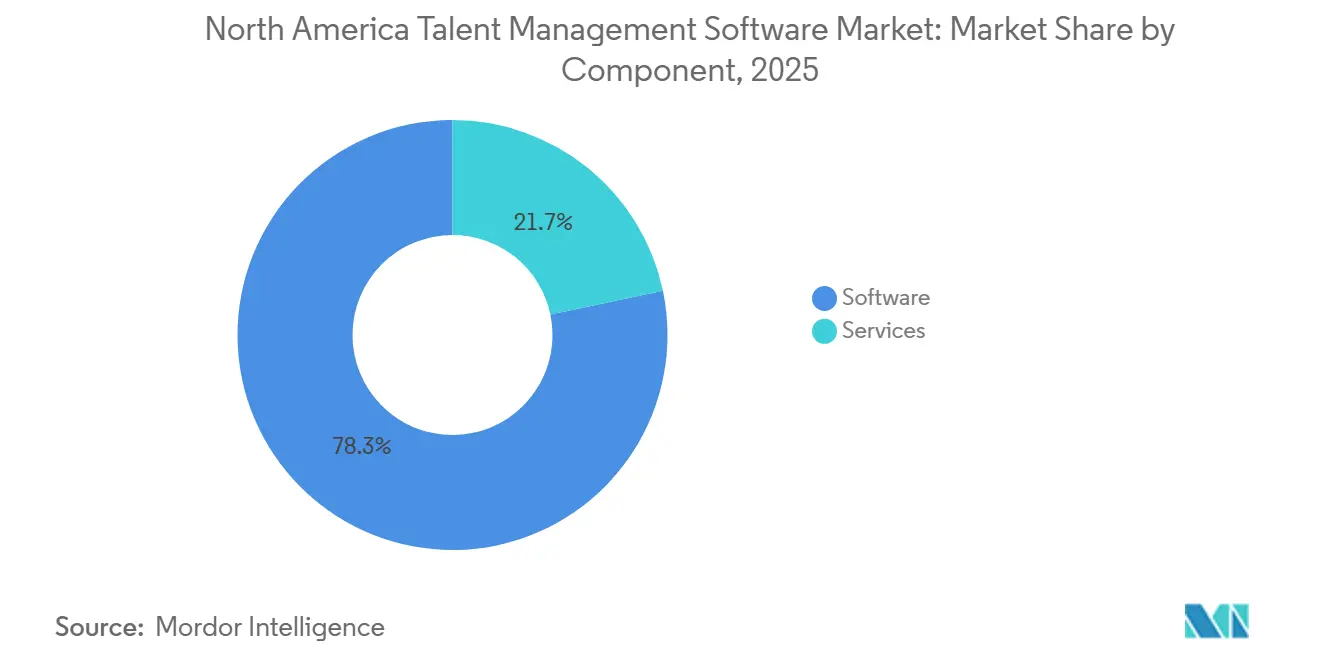
Services Demand Rises as AI Complexity GrowsSoftware accounted for 78.29% of revenue in 2025, which kept licenses for core HCM, recruiting, learning, performance, and compensation at the center of supplier economics. The services segment is the fastest-growing component, with a 12.36% CAGR through 2031, and that gap says a lot about how the North America talent management software market is changing. Buyers are no longer paying only for installation and maintenance; they also need help with AI configuration, model calibration, workflow redesign, and compliance review. This pushes implementation and advisory work into a longer revenue cycle instead of a short project cycle. The North America talent management software market is therefore generating greater post-sale service demand as software becomes more adaptive and more deeply integrated into decision-making.
Workday's Spring 2025 release included more than 350 features and updates, including AI-powered talent rediscovery and personalized preboarding, which shows how quickly product environments are changing for customers. ADP also used its September 2025 Innovation Day to showcase AI tools that can flag payroll anomalies and deliver tailored HR analytics, pointing to a future where some repetitive consulting work can be automated for buyers who stay within one vendor stack. Even so, multi-vendor environments still need human-led configuration and process alignment, which keeps service demand strong in the North America talent management software market. Support work should remain stable, but more of the value is likely to shift toward higher-skill advisory services rather than basic troubleshooting.
By Application:
Performance Management Holds the Largest Base While Learning and Development Expands FasterPerformance management led with a 22.39% share in 2025, which shows that it remains the anchor module for many enterprise deployments. Learning and development is set to grow at a 11.15% CAGR through 2031, making it the fastest-growing application in the North America talent management software market as employers raise spending on AI literacy and digital skill-building. This pattern reflects a simple buying logic: companies often start with performance processes already tied to reviews, compensation, and succession, then expand into learning once they need better internal readiness. In the North America talent management software industry, performance data is also becoming more important for documentation and audit support as reporting obligations widen. That gives performance management a durable role even as faster growth shifts toward learning, reskilling, and adaptive content delivery.
SAP announced in May 2026 that its Workforce Upskilling Assistant would provide personalized micro-learning through collaboration tools and mobile interfaces, which shows how learning is moving closer to the flow of work.[2] Paycom also released its Automated Career and Succession Planning tool in March 2026, linking performance, learning records, and 9-box mapping in a single database. Recruitment remains another active area for AI deployment, with iCIMS reporting up to 10x more hires per recruiter and Eightfold promoting faster interviewing workflows through its AI Interviewer and later interview expansion releases. The wider implication is that application growth is shifting toward products that connect learning, recruiting, and internal mobility rather than keeping them as separate systems.
By Deployment:
Cloud Gains Speed while On-Premise Holds Regulated AccountsOn-premise represented 66.21% of revenue in 2025, which reflected the weight of regulated employers that still prefer local control over employee data and system access. Cloud is growing faster at 12.77% CAGR through 2031, and that is where much of the forward momentum in the North America talent management software market now sits. Large financial services, healthcare, and public sector organizations still maintain on-premise environments because data residency and security reviews slow migration decisions. At the same time, mid-sized firms and first-time buyers are choosing cloud deployments because they want faster rollout, lower internal IT burden, and easier access to new features. This leaves the North America talent management software market with a mixed deployment profile where legacy caution and modernization are both visible at the same time.
ADP announced in November 2025 that it had embedded its WorkForce Software suite across ADP Workforce Now, ADP Lyric HCM, and ADP Global Payroll, creating a unified workforce management platform that spans more than 140 countries. SAP also said in May 2026 that its new Joule AI assistants were designed for all SAP deployment models, including private cloud environments, which shows how vendors are adapting cloud economics to clients that still need tighter infrastructure control. That approach is especially relevant for buyers who want modern AI and automation without sacrificing sovereignty requirements. Cloud should therefore continue to gain share, but private and hybrid delivery models will remain important for regulated accounts through the forecast period.
By Organization Size:
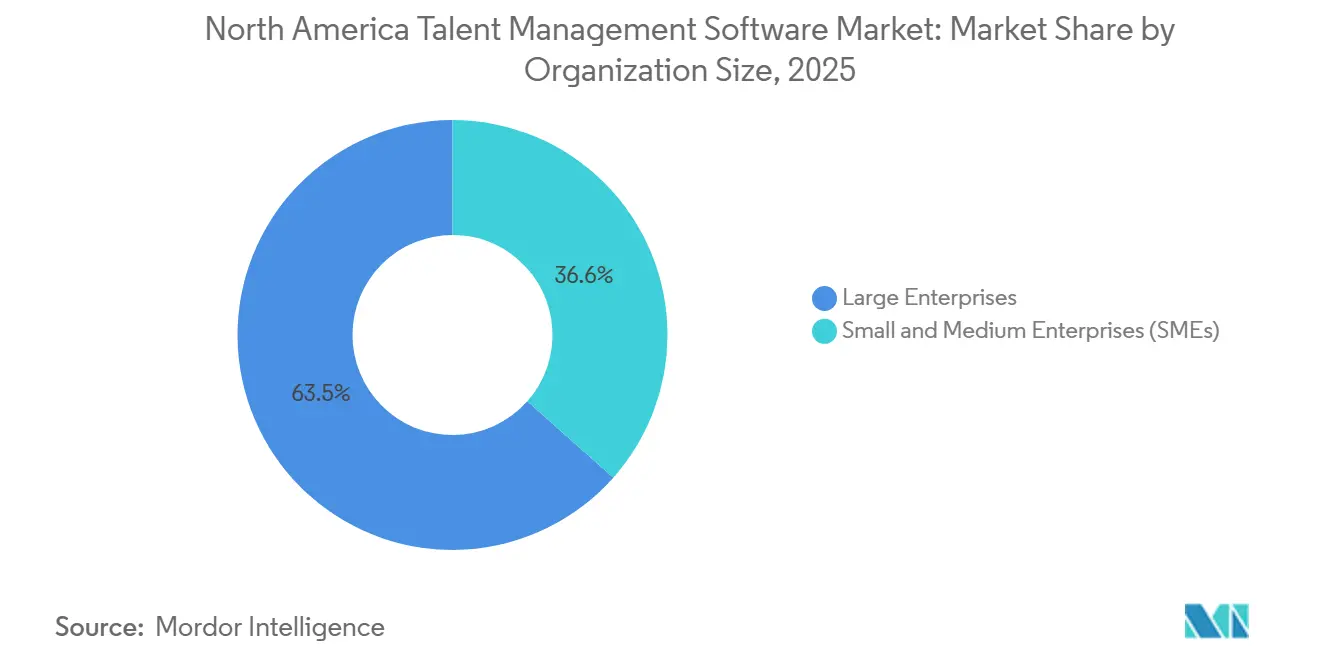
SME Adoption Broadens the Buyer BaseLarge enterprises generated 63.45% of revenue in 2025, supported by multi-year suite contracts and deep installed relationships with Tier 1 vendors. SMEs are expected to expand at 12.08% CAGR through 2031, which makes them the faster-growth buyer group in the North America talent management software market. The main reason is that modular SaaS pricing and pre-built integrations have reduced the cost and effort needed to adopt tools that were once too complex for smaller firms. The North America talent management software industry is also benefiting from AI-enabled configuration and automation, since smaller HR teams feel administrative pressure more quickly than large departments with specialist staff. That makes time-to-value especially important in this segment, favoring vendors that can offer simple packaging without sacrificing core functionality.
UKG launched UKG Pro Talent Marketplace in November 2024, focusing on internal mobility, skills development, and labor gaps, including use cases for hourly and frontline workers common in mid-sized employers. This kind of product design shows why SME demand is rising; buyers want practical tools that solve recruiting, scheduling, and development challenges without a long consulting cycle. Larger enterprises remain important for revenue, but much of their new spending is now tied to module expansion rather than to entirely new platform decisions. That means the next wave of account growth in the North America talent management software market is likely to come from a wider base of smaller employers entering the category with modular cloud suites.
By End-Use Industry:
Healthcare Growth Outpaces the Largest Technology Buyer BaseIT and telecommunications led with 24.67% of revenue in 2025, reflecting the sector's early investment in digital HR tools, intense competition for specialized talent, and frequent need to manage global teams. Healthcare and life sciences is the fastest-growing vertical, with a 10.68% CAGR through 2031, underscoring how strongly retention, credentialing, and scheduling pressures are shaping the North America talent management software market. Hospitals and health systems need better support for shift coverage, workforce visibility, and clinician retention, which makes integrated workforce and talent tools more valuable than stand-alone administrative systems. IT and telecom will remain a large buyer base because rapid headcount changes and AI-related skill competition keep talent visibility high on executive agendas. At the same time, healthcare is closing the gap because staffing problems have become harder to manage with manual processes.
QGenda highlighted expanded use of its workforce management capabilities across healthcare providers, including Mayo Clinic's broader adoption of advanced scheduling and Nebraska Methodist Health System's decision to replace legacy scheduling and time-and-attendance tools. Retail and e-commerce are also increasing investment in frontline hiring and scheduling, and iCIMS said in March 2026 that its frontline recruiting release was designed to improve speed and efficiency across high-volume roles. Manufacturing demand is increasingly tied to digital transformation and skills gap management, while government demand is slower due to stricter compliance and procurement reviews. The result is a North America talent management software market where technology keeps the largest installed base, but healthcare is becoming one of the most important sources of incremental growth.
Geography Analysis
United States Talent Management Software Market
The United States held 74.25% of revenue in 2025, which made it the clear anchor for the North America talent management software market. Its lead rests on the density of technology employers, deeper enterprise software spending, and a regulatory environment that keeps HR systems under constant review. Pay transparency rules across many U.S. jurisdictions have sustained demand for compensation management, job architecture, and reporting capabilities even when broader hiring activity has been uneven. Colorado's enforcement record showed cumulative citation fines totaling USD 841,500 since 2021, giving employers another reason to treat compliance tooling as a priority rather than a discretionary purchase. SHRM also reported that 70% of large North American companies planned to deploy predictive attrition analytics within 18 months, which supports continued demand for advanced AI-enabled modules in the U.S. base.
Canada Talent Management Software Market
Canada remains a smaller but strategically important part of the North America talent management software market. Competition for engineers, data scientists, and AI talent in Toronto, Vancouver, and Montreal keeps interest high in skills mapping, internal mobility, and compensation visibility. Visier announced the next generation of Workforce AI in April 2026, including Guided Workforce Planning and broader integration support, demonstrating that Canada is not only a buyer market but also an innovation hub for regional HR technology.[3] This gives Canada a distinct role in the regional landscape, as product development and enterprise demand reinforce one another.
Mexico Talent Management Software Market
Mexico is the fastest-growing country market, with a projected 11.55% CAGR through 2031, even though it starts from the smallest base in the region. Growth is supported by labor law changes, broader SME digitization, and a buyer base that is still early in its adoption of people analytics and structured learning tools. That leaves meaningful room for applications of recruiting, learning and development, and workforce planning to expand as employers formalize HR processes. Partnerships that connect payroll, recruitment, and finance services are also helping smaller firms adopt more complete platforms without following a traditional enterprise software path. As nearshoring expands cross-border operations, bilingual cloud platforms should see stronger uptake, keeping Mexico important to the next stage of the North America talent management software market.
Competitive Landscape
The North America talent management software market operates through 2 competitive layers that do not always compete in the same way. The enterprise layer is moderately consolidated around SAP SuccessFactors, Workday, and Oracle Fusion Cloud HCM, and these vendors continue to control much of the core infrastructure used by large employers. Their focus has shifted from basic suite selling to deeper platform expansion, as buyers now expect recruiting, learning, analytics, and workflow automation to work together within a single environment. Workday signed a definitive agreement to acquire Sana in September 2025, adding AI-powered search, agents, and adaptive learning to its platform strategy.[4] Workday then signed a definitive agreement to acquire Pipedream in November 2025, bringing more than 3,000 pre-built connectors that strengthened its cross-system automation story.
SAP also moved aggressively in May 2026 by expanding autonomous HCM capabilities, including Joule assistants for payroll, recruiting, onboarding, HR service, and workforce upskilling. These moves matter because they reduce the amount of white space left between core suite vendors and specialist providers. As platform vendors add more embedded AI, clients have fewer reasons to assemble multiple disconnected point solutions. That puts pricing and positioning pressure on smaller firms that compete on only one function.
The specialist layer still matters, and that is one reason the North America talent management software market remains only moderately concentrated overall. Eightfold AI launched TalentForge in May 2026 so enterprises could build custom HR applications on top of its Talent Intelligence layer, which the company said had been trained on 1.6 billion career trajectories. Visier expanded Workforce AI in April 2026 with Guided Workforce Planning and workforce programs, pushing people analytics closer to business planning and action design. Lattice also expanded analytics, AI agent functionality, and Workday and Rippling integrations in its 2026 roadmap, which helps it remain relevant in mixed-vendor environments. This leaves the North America talent management software market with stable leadership at the top, but active competition in talent intelligence, analytics, and hiring workflows, where specialists still have room to differentiate.
North America Talent Management Software Industry Leaders
-
Workday, Inc.
-
Oracle Corporation
-
SAP SE
-
ADP, Inc.
-
UKG Inc.
- *Disclaimer: Major Players sorted in no particular order
North America Talent Management Software Market Companies Covered in this Report
- Workday, Inc.
- Cornerstone OnDemand, Inc.
- Oracle Corporation
- SAP SE
- ADP, Inc.
- Ceridian HCM Holding Inc.
- UKG Inc.
- IBM Corporation
- Microsoft Corporation
- SumTotal Systems, LLC
- Eightfold AI, Inc.
- iCIMS, Inc.
- ClearCompany, Inc.
- Paycom Software, Inc.
- Paylocity Holding Corporation
- BambooHR LLC
- Saba Software LLC
- Gloat, Inc.
- Lever, Inc.
- PeopleFluent, Inc.
- Jobvite, Inc.
- Visier, Inc.
- Greenhouse Software, Inc.
- Lattice, Inc.
- PageUp People Holdings Pty Ltd
Recent Industry Developments in North America Talent Management Software Market
- May 2026: SAP announced autonomous HCM innovations at SAP Sapphire, introducing Joule AI assistants for payroll, recruiting, onboarding, HR services, and workforce upskilling. The company also launched AI-driven workforce planning integrated with SAP Cloud ERP and SAP Fieldglass for continuous workforce-to-finance decision making, and AI-enabled organizational modelling for SAP SuccessFactors Employee Central.
- May 2026: Eightfold AI launched TalentForge at Cultivate 2026, a platform enabling enterprises to build custom HR applications using Eightfold's Talent Intelligence layer, trained on over 1.6 billion career trajectories. The company simultaneously introduced the 360 Interview for its AI Interviewer, combining functional, coding, and language evaluation in a single adaptive session, and the Workforce Readiness product, positioning itself as a talent infrastructure provider rather than a point-solution vendor.
- April 2026: Visier announced the next generation of Visier Workforce AI at its Outsmart conference, introducing Workforce Programs, Guided Workforce Planning, a Glean MCP integration for surfacing governed people data within enterprise AI search tools, and expanded AWS ecosystem connectivity via MCP.
- April 2026: ADP integrated a new AI agent within ADP Global Payroll to automatically identify payroll variances and facilitate remediations before errors occur. The solution is available to enterprise clients in over 40 countries, with mid-market expansion planned for mid-2026, and early adopters reported time savings of up to 30 minutes per payroll cycle.
North America Talent Management Software Market Report Scope
The North America talent management software market caters to recruitment, performance, learning, succession, engagement, and workforce analytics for enterprises in the U.S., Canada, and Mexico. The region stands out for its rapid adoption of SaaS, significant investments in digital HR transformations, and a growing inclination towards AI-driven talent solutions. The market encompasses both standalone talent applications and comprehensive integrated HCM suites. The surge in growth is largely attributed to the adoption of skills-based workforce strategies and advanced analytics.
The North America Talent Management Software Market Report is Segmented by Component (Software, and Services [Professional Services, and Support and Maintenance Services]), Application (Performance Management, Learning and Development, Succession Planning, Compensation Management, Recruitment and Talent Acquisition, Workforce Planning, Employee Engagement and Career Development, and Other Talent Management Applications), Deployment (On-Premise, and Cloud), Organization Size (Large Enterprises, and Small and Medium Enterprises [SMEs]), End-Use Industry (IT and Telecommunications, Banking, Financial Services and Insurance, Healthcare and Life Sciences, Retail and E-Commerce, Manufacturing, Government and Public Sector, and Other End-Use Industries), and Region (United States, Canada, and Mexico). The Market Forecasts are Provided in Terms of Value (USD).
Segmentation Overview
| Software | |
| Services | Professional Services |
| Support and Maintenance Services |
| Performance Management |
| Learning and Development |
| Succession Planning |
| Compensation Management |
| Recruitment and Talent Acquisition |
| Workforce Planning |
| Employee Engagement and Career Development |
| Other Talent Management Applications |
| On-Premise |
| Cloud |
| Large Enterprises |
| Small and Medium Enterprises (SMEs) |
| IT and Telecommunications |
| Banking, Financial Services and Insurance |
| Healthcare and Life Sciences |
| Retail and E-Commerce |
| Manufacturing |
| Government and Public Sector |
| Other End-Use Industries |
| United States |
| Canada |
| Mexico |
| By Component | Software | |
| Services | Professional Services | |
| Support and Maintenance Services | ||
| By Application | Performance Management | |
| Learning and Development | ||
| Succession Planning | ||
| Compensation Management | ||
| Recruitment and Talent Acquisition | ||
| Workforce Planning | ||
| Employee Engagement and Career Development | ||
| Other Talent Management Applications | ||
| By Deployment | On-Premise | |
| Cloud | ||
| By Organization Size | Large Enterprises | |
| Small and Medium Enterprises (SMEs) | ||
| By End-Use Industry | IT and Telecommunications | |
| Banking, Financial Services and Insurance | ||
| Healthcare and Life Sciences | ||
| Retail and E-Commerce | ||
| Manufacturing | ||
| Government and Public Sector | ||
| Other End-Use Industries | ||
| By Region | United States | |
| Canada | ||
| Mexico | ||
Key Questions Answered in the Report
What is the size outlook for the North America talent management software market?
The North America talent management software market size stood at USD 4.53 billion in 2026 and is expected to reach USD 7.08 billion by 2031, growing at a 9.37% CAGR.
Which component is growing faster in talent management software across North America?
Software remained the largest component with 78.29% share in 2025, but services is growing faster at 12.36% CAGR because AI-led deployments need more implementation and advisory support.
Why is learning and development growing faster than other applications?
Learning and development is projected to rise at 11.15% CAGR through 2031 as employers increase spending on AI literacy, digital skills, and continuous workforce readiness.
Why does cloud deployment continue to gain momentum in this region?
Cloud is expanding at 12.77% CAGR because hybrid work, mobile hiring, and faster product updates are harder to support with older on-premise systems.
Which country leads regional demand and which country is growing the fastest?
The United States led with 74.25% share in 2025, while Mexico is the fastest-growing country market with an 11.55% CAGR through 2031.
Which end-use sectors are shaping future demand the most?
IT and telecommunications remained the largest vertical with 24.67% share in 2025, while healthcare and life sciences is growing fastest at 10.68% CAGR as providers push harder on retention, scheduling, and workforce digitization.