
AI In Omics Market Size and Share
Market Overview
| Study Period | 2020 - 2031 |
|---|---|
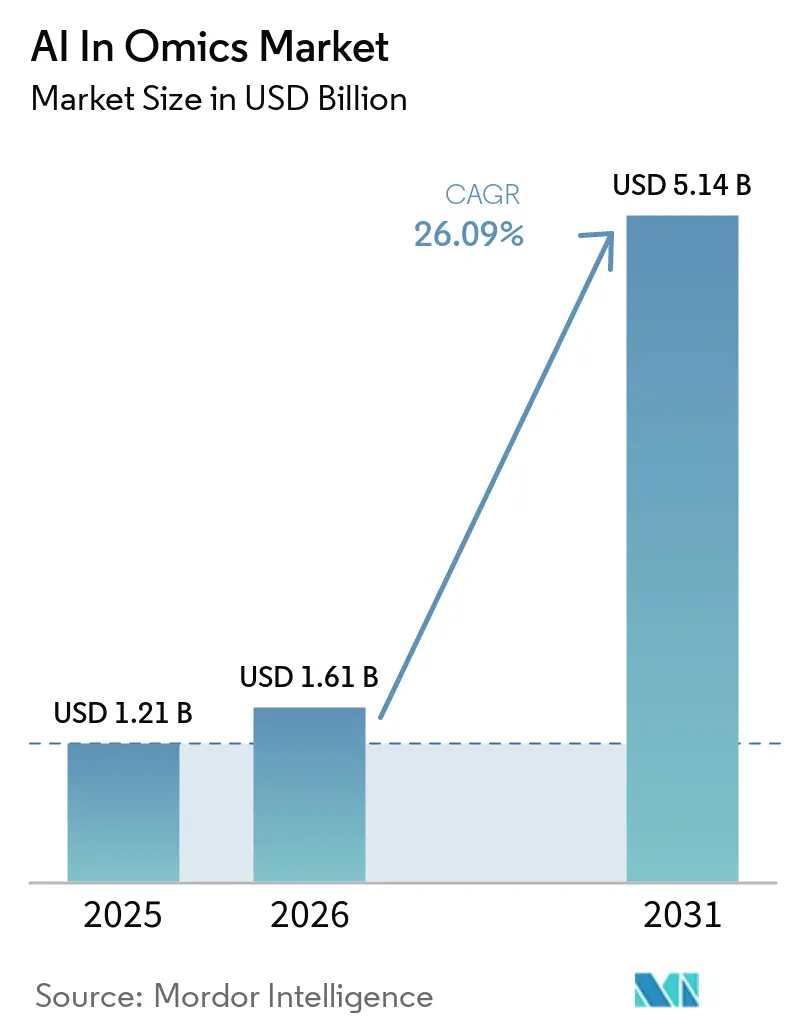
| Market Size (2026) | USD 1.61 Billion |
| Market Size (2031) | USD 5.14 Billion |
| Growth Rate (2026 - 2031) | 26.09 % |
| Fastest Growing Market | Asia-Pacific |
| Largest Market | North America |
| Market Concentration | Medium |
Major Players *Disclaimer: Major Players sorted in no particular order Image © Mordor Intelligence. Reuse requires attribution under CC BY 4.0. | |
AI In Omics Market Analysis by Mordor Intelligence
The AI In Omics Market size was valued at USD 1.21 billion in 2025 and is estimated to grow from USD 1.61 billion in 2026 to reach USD 5.14 billion by 2031, at a CAGR of 26.09% during the forecast period (2026-2031).
The expansion is tied to the rapid growth of layered biological datasets, stronger AI architectures that can process high-dimensional omics inputs, and a clear shift by pharmaceutical companies toward data-led target identification and patient stratification. The AI in omics market is also being shaped by a competitive split between broad workflow platforms and deeper specialist algorithms, which is pushing vendors to connect sequencing, analytics, and interpretation more tightly. At the same time, fragmented data ownership across academic groups, hospitals, and corporate biobanks still limits the completeness of training datasets and slows model development. Annotation quality remains another check on near-term scaling because atlas-level projects still need large volumes of reliable cell labeling before newer foundation models can learn from them effectively. Even with those limits, the AI in omics market is building cumulative value because each additional patient record can improve predictive performance and make participation more attractive for the next contributor.
Key Report Takeaways
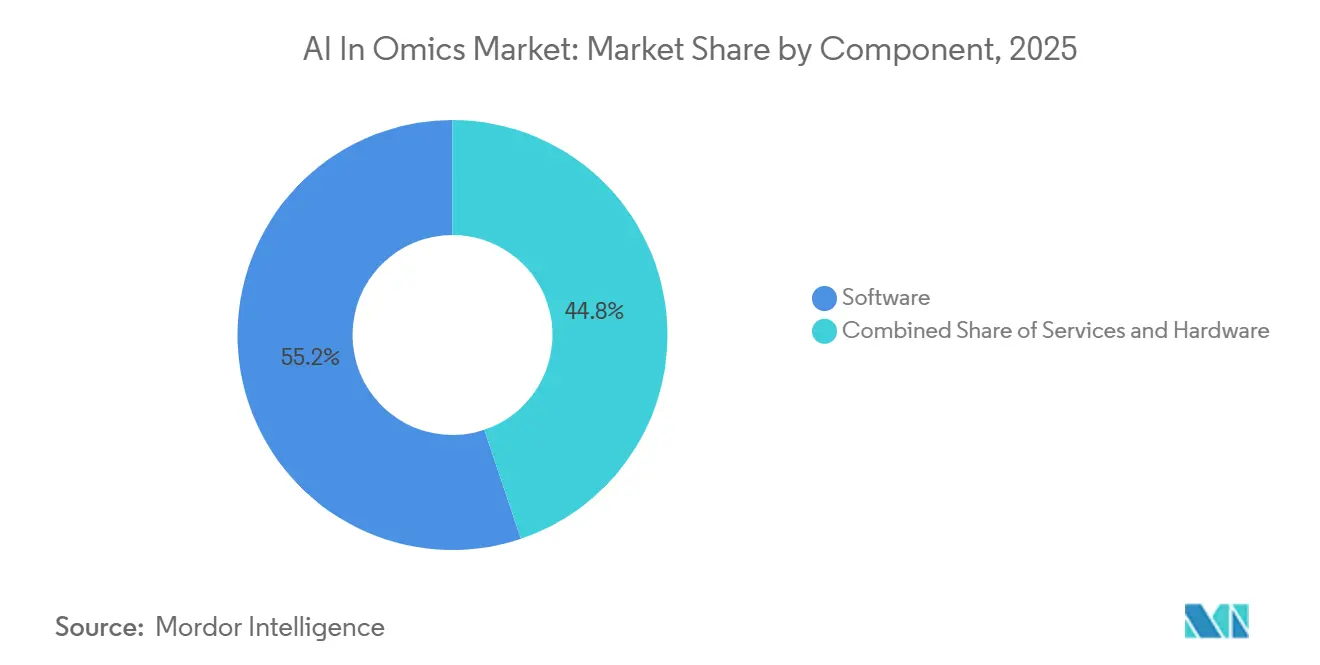
- By component, software held 55.2% of revenue in 2025, while services is projected to grow at 34.9% CAGR through 2031.
- By omics type, genomics accounted for 35.2% of revenue in 2025, while it is also forecast to record the fastest growth at 40.1% CAGR through 2031.
- By AI technology, machine learning captured 39.3% of revenue in 2025, while natural language processing is expected to expand at 32.2% CAGR through 2031.
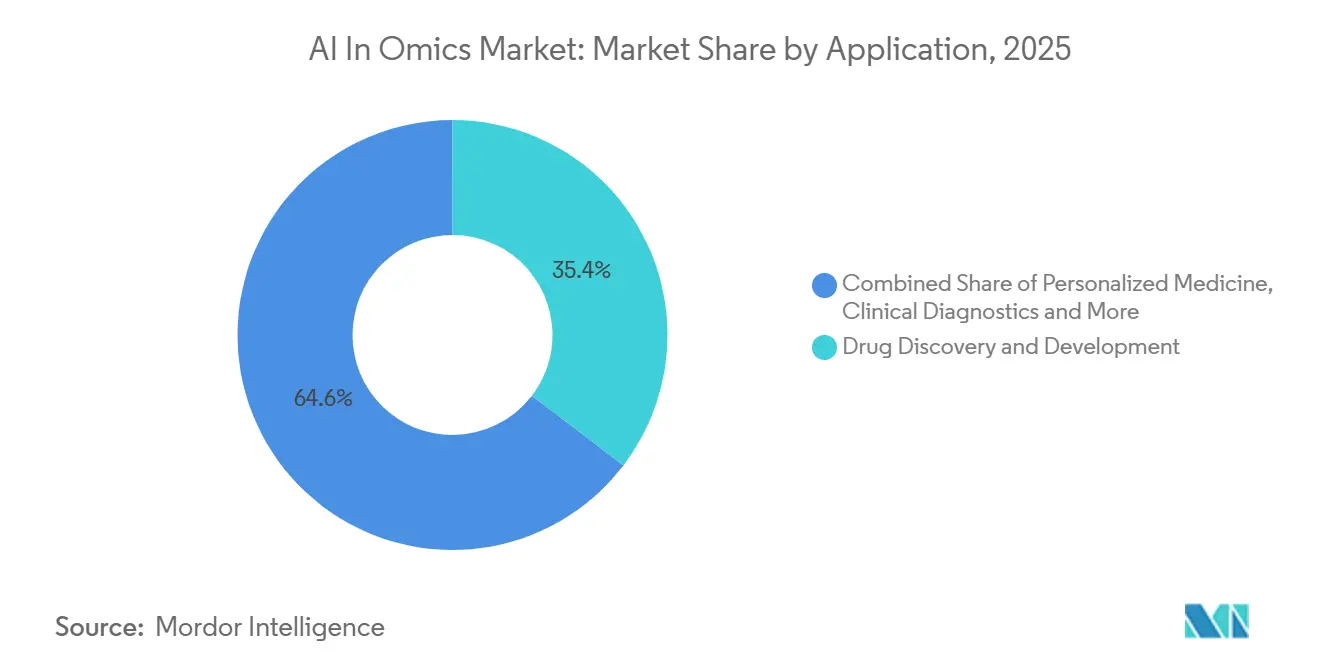
- By application, drug discovery and development represented 35.4% of revenue in 2025, while precision medicine is projected to grow at 36.3% CAGR through 2031.
- By end user, pharmaceutical and biotechnology companies held 45.8% of the AI in omics market share in 2025, while academic and research institutes are set to grow at 35.5% CAGR through 2031.
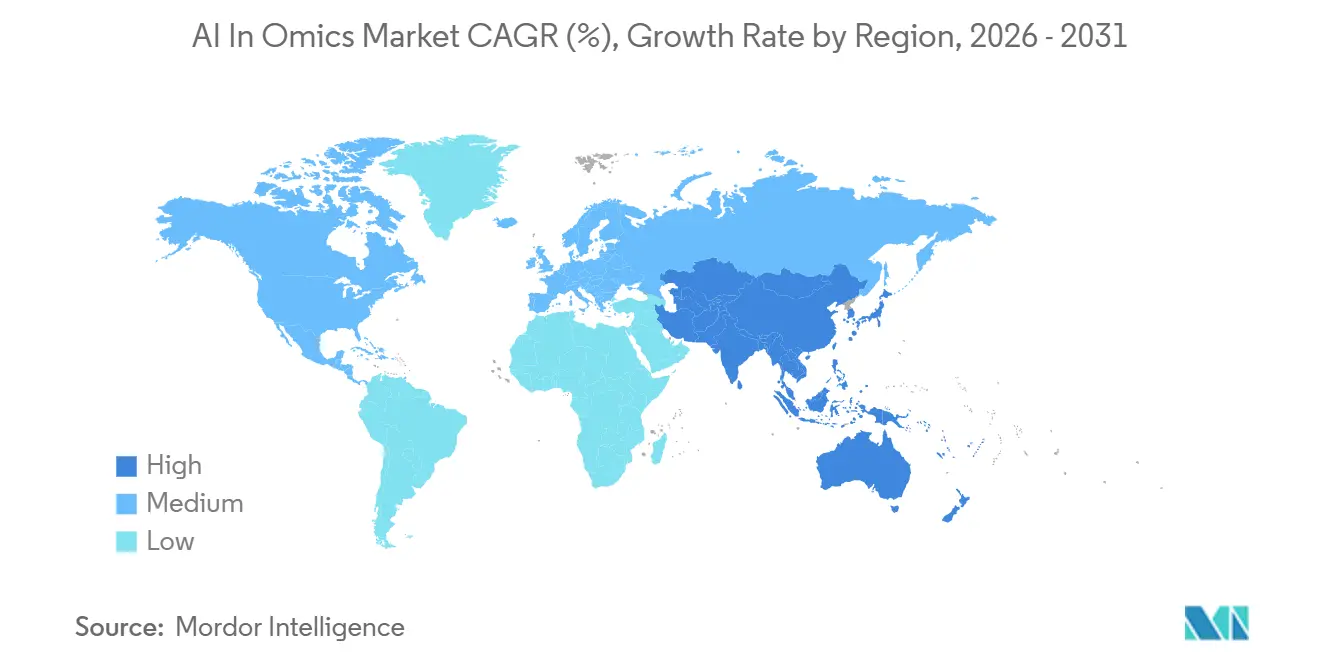
- By geography, North America accounted for 38.2% of revenue in 2025, while Asia-Pacific is forecast to record the fastest growth at 37.4% CAGR through 2031.
Note: Market size and forecast figures in this report are generated using Mordor Intelligence’s proprietary estimation framework, updated with the latest available data and insights as of January 2026.
Market Trends and Insights
Drivers Impact Analysis of AI In Omics Market*
| Driver | (~) % Impact on CAGR Forecast | Geographic Relevance | Impact Timeline |
|---|---|---|---|
| Precision Medicine Adoption In Oncology And Rare Disease Workflows | +5.3% | Global, concentrated in North America and EU | Medium term (2-4 years) |
| Rising Omics Data Volumes And Complexity | +4.7% | Global | Short term (≤ 2 years) |
| AI-Enabled Target And Biomarker Discovery Acceleration | +5.8% | North America and Europe, spill-over to APAC core | Medium term (2-4 years) |
| Expansion Of Clinical Multiomic Assays And Companion Diagnostics | +3.9% | North America, expanding to EU and APAC | Medium term (2-4 years) |
| Billion-Cell Atlas Programs Expanding Training Corpora | +2.4% | North America, spill-over to EU | Long term (≥ 4 years) |
| Federated Clinico-Omics Environments Enabling Model Development | +2.8% | EU, APAC, North America | Long term (≥ 4 years) |
| Source: Mordor Intelligence | |||
Precision Medicine Adoption Reshaping Drug Development Economics
Precision oncology and rare disease workflows are moving molecular profiling closer to the center of therapeutic selection, which is changing how clinical teams decide where to place time, capital, and trial resources in the AI in omics market. That shift matters because multi-omics models can help narrow patient groups earlier, which supports better alignment between biological signal, trial design, and downstream treatment response. Tempus AI's Lens platform shows that this model is scaling commercially, with Data and Applications revenue reaching USD 316.4 million in 2025, up 30.9% year over year. Tempus also reported total 2025 revenue of USD 1.3 billion, which indicates that AI-linked clinical and data services are moving beyond isolated pilot work and into repeatable operating models. As these workflows move earlier in development, disease-specific pathway findings can be reused across related programs, which improves the commercial return on each curated dataset. That is helping the AI in omics market attract spending from drug discovery groups, translational researchers, and clinically focused software vendors at the same time.
Rising Omics Data Volumes Straining Legacy Analytical Infrastructure
Rising data volumes remain a basic growth engine for the AI in omics market because multi-layer biological datasets are becoming too large and too complex for many legacy analytical stacks. Modern projects rarely work with one modality in isolation, so sequence, expression, protein, phenotype, and clinical context often need to be processed together inside the same computational environment. That creates pressure not just on storage, but also on preprocessing, harmonization, inference speed, validation tracking, and retraining capacity as new records continue to arrive. NVIDIA states that Parabricks can deliver more than 100 times faster whole-genome analysis at 50% lower compute cost than CPU workflows, which shows why accelerated and cloud-ready pipelines are gaining favor. Once an institution commits to that stack, migration becomes harder because data models, validation routines, and user habits become tied to the platform architecture. This is why the AI in omics market is moving away from stand-alone tools and toward integrated environments that combine compute, analytics, and workflow management in a single layer.
AI Compressing the Biomarker-to-Clinical-Trial Pipeline
The AI in omics market is also benefiting from a shorter path between biomarker discovery, patient selection, and clinical testing, which has long been one of the hardest bottlenecks in translational medicine. Cancer Cell reported that contrastive learning on multi-omics datasets improved patient selection in a retrospective analysis and reduced survival risk by 15% versus the original Phase III trial population. The same study noted that validated predictive biomarkers are linked to a twofold higher approval likelihood, even as many oncology programs still fail in development. That changes the economics of discovery because companies can direct capital toward better-matched patient subsets earlier, instead of learning those boundaries only after costly late-stage work. It also raises the value of longitudinal proprietary datasets, since repeat measurements improve both biomarker confidence and model generalizability across cohorts. As a result, the AI in omics market is favoring firms that combine unique data access, clinical context, and deployable modeling systems rather than those that only offer general analytics.
Companion Diagnostics Embedding AI Omics Into Regulatory Workflows
The expansion of clinical multiomic assays is turning the AI in omics market into a more regulated and more reimbursable operating space, which changes what kinds of vendors can scale. The U.S. Food and Drug Administration approved Guardant360 CDx as a companion diagnostic for Eli Lilly's Inluriyo in September 2025, which marked the test's sixth companion diagnostic claim[1]. The agency also cleared the Oncomine Dx Express Test in July 2025 as a companion diagnostic for sunvozertinib. Its Predetermined Change Control Plan is important because it creates a structured route for in-market updates to AI-driven variant-calling software without requiring a full reset of the validation approach. That lowers some operational friction for established vendors that already have quality systems, documentation processes, and post-market monitoring in place. In the AI in omics market, this increasingly favors companies that can pair assay performance with compliant software maintenance and evidence-backed update cycles.
Restraints Impact Analysis of AI In Omics Market*
| Restraint | (~) % Impact on CAGR Forecast | Geographic Relevance | Impact Timeline |
|---|---|---|---|
| Data Privacy, Consent, And Cybersecurity Constraints | -3.6% | Global, most acute in EU and US | Short term (≤ 2 years) |
| Multiomics Data Standardization And Interoperability Gaps | -2.4% | Global, most pronounced in APAC and emerging markets | Medium term (2-4 years) |
| EU AI Act And EHDS Compliance Burden | -2.1% | EU primary, indirect impact on global players | Medium term (2-4 years) |
| Atlas-Scale Annotation And Label Quality Bottlenecks | -1.5% | Global | Long term (≥ 4 years) |
| Source: Mordor Intelligence | |||
Data Privacy and Consent Constraints Fragmenting Training Datasets
Data privacy and consent rules keep the AI in omics market from using all of the data it generates, even when the scientific value of those records is high. Whole-genome sequences cannot be de-identified as easily as many other clinical records, so institutions still face strict governance expectations around access, storage, linkage, and secondary use. The European Commission states that the EHDS Regulation entered into force in March 2026 and covers secondary use of genomic, proteomic, transcriptomic, metabolomic, and epigenomic data, but national Health Data Access Bodies will only become operational over time[2]. That means near-term access remains uneven, with local consent rules, legal reviews, and security requirements still slowing multi-site dataset assembly. The hardest-to-access material often includes underrepresented ancestry groups, which can deepen bias when models are trained on narrower and less representative cohorts. Federated learning can help the AI in omics market reduce central data transfer, but it still depends on shared governance, compatible workflows, and reliable coordination across institutions.
Multiomics Data Standardization Constraining Cross-Platform Interoperability
Standardization gaps are another drag on the AI in omics market because multi-omics products depend on data that can move cleanly across laboratories, platforms, and analytical settings. Scientific Reports found that an assessment of 10,109 public omics datasets across 16 data types showed biological meta-information remained highly heterogeneous and non-standardized. The same fragmentation is especially difficult in proteomics and metabolomics, where platform choices, sample preparation methods, and normalization practices create strong batch effects that can weaken model transferability. Vendors therefore spend heavily on internal harmonization layers before they can train, benchmark, and validate models at scale across different cohorts. Those steps increase development cost and extend timelines, which is a heavier burden for smaller suppliers that do not have broad informatics teams or long implementation cycles. In the AI in omics market, interoperability is therefore a direct limit on commercialization speed rather than only a technical inconvenience.
*Our forecasts treat driver/restraint impacts as directional, not additive. The impact forecasts reflect baseline growth, mix effects, and variable interactions.
AI In Omics Market Segment Analysis
By Component:
Services Capturing Value as AI Complexity ScalesSoftware accounted for 55.2% of 2025 revenue, which kept it as the largest component in the AI in omics market and reflected the strength of platform-led commercialization. That lead came from cloud-based environments that combine prebuilt pipelines, curated knowledge layers, compute access, and visualization tools into one operating system for omics analysis. For many users, this reduces the need to build internal infrastructure before beginning multi-omics work, which makes adoption easier for teams that have data but limited engineering capacity. It also shortens time to use because analysts can move from raw files to interpretation inside a single workflow instead of stitching together multiple tools. Hardware remained the smallest component because more analytical workloads are now being separated from local instrumentation and shifted into scalable remote environments.
Services are projected to grow at 34.9% CAGR through 2031, which makes them the fastest-expanding component of the AI in omics market size and shows where incremental value creation is moving. Demand is shifting toward custom model development, bioinformatics consulting, workflow management, and long-cycle data integration support as projects become harder to standardize across institutions and use cases. QIAGEN said its Digital Insights business delivered double-digit constant-exchange-rate growth in FY2025 and that the company plans at least 14 AI-enabled applications by 2028. That matters because the AI in omics industry is creating recurring service demand around software cores, especially where users need validation, retraining, regulatory documentation, and workflow tuning after initial deployment. As AI tools move deeper into regulated and clinically linked settings, external support becomes less optional and more embedded in the day-to-day operating model.

By Omics Type:
Genomics Anchoring the Stack With Expanding Multi-Layer DepthGenomics held 35.2% of revenue in 2025 and is forecast to expand at 40.1% CAGR through 2031, which means it leads both scale and growth in the AI in omics market. That position reflects its role as the base layer for most multi-omics workflows, since genomic sequence often serves as the starting frame for linking downstream expression, protein, and phenotype signals. Population-scale sequencing and the wider use of biobank-linked research continue to enlarge the training base available for model development, which reinforces genomics as the most commercially central omics layer. Transcriptomics and proteomics are gaining ground as complementary layers because they add functional context that sequence data alone cannot provide in clinical and drug development settings. Metabolomics and epigenomics remain smaller in revenue, but research interest keeps rising because both layers help explain phenotypic variability that sequence changes do not fully capture on their own.
The AI in omics market still centers on genomics because new multimodal models usually begin with sequence data and then attach other biological layers as the context widens. NVIDIA said Evo 2 is a 40-billion parameter genomic foundation model trained on 8.85 trillion nucleotides from more than 128,000 genomes. That scale supports the view that genomic sequence is becoming the primary substrate for larger biological foundation models that can later absorb transcriptomic, proteomic, and clinical context. Within the AI in omics industry, this keeps genomics at the center of product design, long-horizon model training, and data licensing priorities across the value chain. It also means suppliers that already control high-quality genomic workflows hold an important starting advantage as broader multi-omics platforms continue to evolve.
By AI Technology:
Machine Learning Dominates, NLP Emerging as Strategic DifferentiatorMachine learning accounted for 39.3% of 2025 revenue, making it the largest AI technology segment in the AI in omics market and underscoring how established these methods already are in operational use. Its lead came from variant calling, biomarker discovery, patient stratification, and related tasks where production workflows have already been validated and adopted by laboratories and research teams. Deep learning has strengthened that position in settings where pattern recognition matters more than manually engineered features, especially as datasets become larger and less tractable for simpler approaches. Computer vision and data mining remain smaller revenue pools, but spatial omics is steadily making image-linked analysis more important in both research and translational use. As the mix of data types broadens, technology leadership is becoming less about one algorithm class and more about how well each method fits the evidence structure of a given workflow.
Natural language processing is projected to grow at 32.2% CAGR through 2031, the fastest rate among AI technology groups in the AI in omics market and a sign that text-heavy evidence layers are becoming more commercially relevant. A large share of usable context on variants, drug-gene interactions, disease mechanisms, and trial eligibility still sits inside unstructured literature, regulatory material, and clinical notes rather than neat analytical tables. DBCLS reported in May 2026 that Japan's ChatTogoVar outperformed GPT-4o for genomic variant interpretation in a study published in Human Genome Variation. That matters because stronger retrieval and interpretation of text can expand the evidence available to downstream molecular models without waiting for entirely new wet-lab data generation. In practical terms, NLP is becoming a differentiator for vendors that want to offer interpretable, clinically useful outputs instead of only predictive scores.
By Application:
Drug Discovery Leads, Precision Medicine AcceleratingDrug discovery and development represented 35.4% of 2025 revenue, which made it the largest application in the AI in omics market and kept pharmaceutical R&D at the center of spending. The segment remains large because drug developers were early adopters of multi-omics analytics, and they continue to use these tools to improve target selection, biomarker strategy, and trial design. Tempus reported USD 316.4 million in 2025 Data and Applications revenue, which shows the scale of demand for data-linked analytical platforms that support research and development programs. Clinical diagnostics, biomarker discovery, and target identification make up the rest of the application mix, and each benefits when patient stratification becomes more precise and easier to operationalize. As long as R&D productivity remains a central concern, discovery programs are likely to keep absorbing a large share of commercial spending across platform and services vendors.
Precision medicine is forecast to expand at 36.3% CAGR through 2031, the fastest pace among applications in the AI in omics market and a sign that molecular profiling is moving into wider clinical use. This reflects a move beyond late-stage oncology use toward earlier and broader workflows in oncology and other disease areas where molecular context can guide care more directly. Tempus said in early 2026 that its pan-cancer HRD algorithm uses RNA expression data to identify patients who may benefit from PARP inhibitors beyond traditional DNA-only testing. That kind of approach raises the value of existing datasets because it broadens patient selection without requiring entirely new rounds of sample collection. Over time, this should keep pushing clinical demand toward tools that can combine molecular detail, explainability, and deployment-ready software inside the same offering.
By End User:
Pharma Anchors Revenue, Academia Drives Model DevelopmentPharmaceutical and biotechnology companies captured 45.8% of 2025 revenue, which gave them the largest place in the AI in omics market and reflected their role as the main buyers of data-rich analytical solutions. Their lead comes from the pressure to shorten development timelines, improve target quality, reduce failed trial spending, and build stronger biomarker strategies earlier in the pipeline. These buyers also have the budgets to license multi-omics data, deploy integrated platforms, and validate outputs in settings that often require higher standards of traceability and documentation. Hospitals and clinical laboratories form the next layer of demand because growing genomic testing volumes are linking day-to-day care more closely with the data pipelines that feed model training and refinement. That clinical link matters because routine sequencing and liquid biopsy workflows can keep refreshing real-world evidence for both commercial and academic users.
Academic and research institutes are projected to grow at 35.5% CAGR through 2031, the fastest pace among end users in the AI in omics market and a sign that model development capacity is spreading beyond commercial buyers. Germany's MoReHealth Niedersachsen initiative launched in 2025 as a EUR 3 million (USD 3.49 million) multi-omics program integrating AI-supported tools across 4 institutions. This shows that public research funding is building coordinated data-generation networks instead of isolated laboratory projects, which supports larger and more reusable datasets over time. In the AI in omics industry, that academic growth strengthens the supply of training data, validation cohorts, and translational partnerships that commercial vendors later depend on. Contract research organizations remained the smallest end-user segment, but their role is still increasing where sponsors want model development, validation, and assay support bundled into one external engagement.
Geography Analysis
North America AI in Omics Market
North America held 38.2% of the AI in omics market share in 2025, which made it the largest regional revenue pool and reflected the concentration of sequencing infrastructure, AI talent, and pharmaceutical research spending in one ecosystem. The United States drives that lead because clinical genomics networks, data-oriented software firms, academic medical centers, and large drug developers are already deeply connected. Tempus reported USD 1.3 billion in 2025 revenue, up 83.4% year over year, which illustrates the commercialization scale that the U.S. environment can support when clinical data, analytics, and payer familiarity line up. The U.S. Food and Drug Administration's 2025 companion diagnostic decisions also showed that AI-linked molecular tests can move through recognizable regulatory paths when evidence packages are strong. That combination of infrastructure depth, reimbursement familiarity, and regulatory experience keeps North America ahead in deployment speed across the AI in omics market.
Europe AI in Omics Market
Europe remains a major region in the AI in omics market, even as its policy structure both enables longer-term data use and raises near-term compliance costs for many participants. The European Commission states that the EHDS Regulation entered into force in March 2026 and covers secondary use of genomic, proteomic, transcriptomic, metabolomic, and epigenomic data. Germany's genomDE model project had integrated more than 5,000 patients by autumn 2024 and targets 100,000 whole-genome sequences over 5 years[3]. These programs should expand the region's usable data base over time, but the operational burden of the EU AI Act and related governance steps still favors better-established vendors.
APAC, South America and MEA AI in Omics Market
Asia-Pacific is projected to grow at 37.4% CAGR, which gives it the fastest regional expansion in the AI in omics market size through 2031 and points to rising momentum in government-backed genomics and digital health programs. That pace reflects efforts across major Asian economies to build local sequencing capacity, strengthen clinical data systems, and reduce dependence on Western ancestry-biased training sets. Japan also shows active translation of language models into genomics, with DBCLS reporting in 2026 that ChatTogoVar outperformed GPT-4o in genomic variant interpretation. South America and the Middle East and Africa remain smaller today, but better healthcare infrastructure and growing startup activity should gradually widen future adoption opportunities.
Competitive Landscape
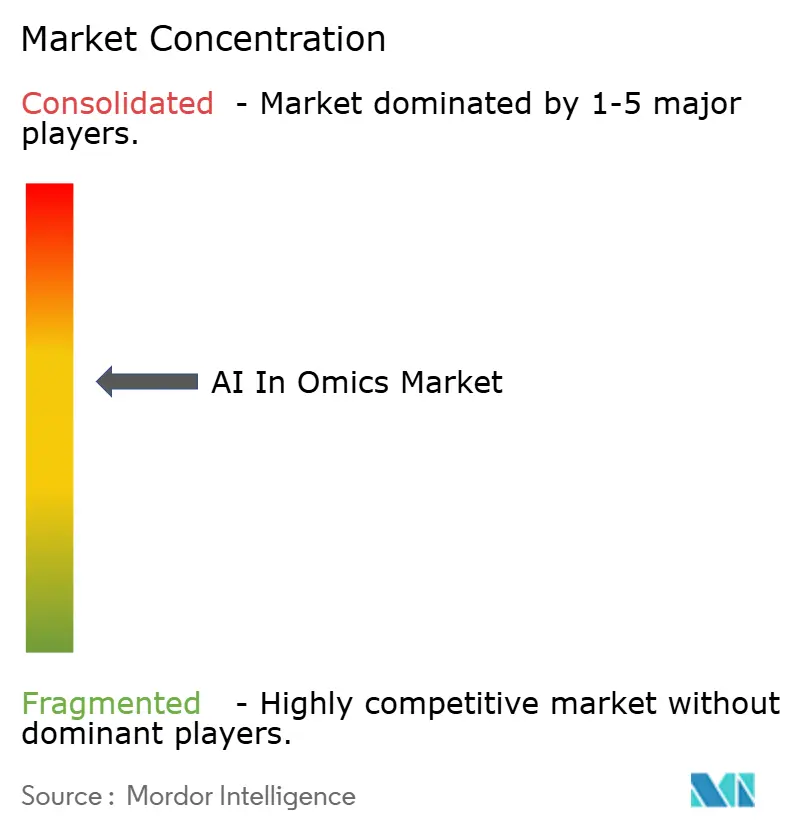
The AI in omics market is moderately consolidated at the platform level but remains fragmented across narrower application niches, which creates a market structure where scale matters but specialization still wins in many use cases. Large workflow-oriented companies such as Illumina, Thermo Fisher Scientific, QIAGEN, and NVIDIA compete on integration, throughput, infrastructure reach, and the ability to connect data generation with downstream analysis. AI-native firms such as Tempus AI and SOPHiA GENETICS compete more on model depth, multimodal data assets, and clinical interpretation quality, especially where decision support and regulated deployment matter most. This split means no single company controls the full stack, even though a limited set of firms anchor the most scalable platforms and the most reusable analytical environments. The strongest strategic direction is vertical integration, with vendors trying to reduce handoff points between sequencing, computation, interpretation, and clinical or research action.
Tempus has strengthened that model in 2026 through collaborations and product expansion that connect proprietary data assets to practical clinical and research workflows. In April 2026, Tempus and the University of Southern California announced a strategic collaboration to advance AI-driven precision medicine. Tempus also highlighted its pan-cancer HRD algorithm and continued growth in its Data and Applications business, which shows an effort to deepen both the product layer and the evidence layer at the same time. These moves matter in the AI in omics market because they tie software performance to proprietary clinical context rather than only to stand-alone analysis tools.
Other leading companies are also building broader control points around the AI in omics market. Illumina said in February 2026 that it was bringing AI-guided exploration to multiomics analysis, which supports its push to connect sequencing output more closely with downstream interpretation. QIAGEN said in March 2026 that its Digital Insights business was growing at a double-digit constant-exchange-rate pace and that at least 14 AI-enabled applications are planned by 2028. NVIDIA continues to position BioNeMo as a foundational layer for life sciences model development, which allows it to capture value at the compute and model infrastructure level rather than only in finished applications.
AI In Omics Industry Leaders
-
Agilent Technologies
-
Illumina, Inc.
-
QIAGEN
-
Tempus AI
-
Thermo Fisher Scientific
- *Disclaimer: Major Players sorted in no particular order
AI In Omics Market Companies Covered in this Report
- 10x Genomics
- Agilent Technologies
- Amazon Web Services
- BGI
- Bruker
- Deep Genomics
- DNAnexus
- DNAstack
- Elucidata
- Roche
- Fabric Genomics
- Illumina
- Lifebit
- NVIDIA
- Oxford Nanopore Technologies
- PacBio
- QIAGEN
- SOPHiA GENETICS
- Tempus AI
- Thermo Fisher Scientific
Recent Industry Developments in AI In Omics Market
- May 2026: Tempus AI expanded its partnership with Bristol Myers Squibb to enhance clinical trial designs and improve regulatory success in solid tumor oncology and neuroscience. This builds on its collaborations with Merck, Daiichi Sankyo, and Gilead in 2026.
- May 2026: SOPHiA GENETICS partnered with Synnovis to introduce AI-powered liquid biopsy tests for lung and breast cancer patients in the UK under NHS England's blood-test-first program. The initiative aims to conduct 7,000 tests annually, covering about one-third of England's ctDNA tests.
- April 2026: Illumina launched DRAGEN v4.5, a machine-learning tool that reduces FFPE-related false positives by over 90% for single nucleotide variants and 87% for indels. It supports the Billion Cell Atlas and new TruPath Genome and 5-base epigenomics assays.
Global AI In Omics Market Report Scope
As per the scope of the report, AI in Omics refers to the application of artificial intelligence techniques to analyze and interpret large-scale biological data generated from omics technologies. Omics encompasses fields like genomics, proteomics, transcriptomics, metabolomics, and more, which involve comprehensive profiling of molecules within biological systems.
The segmentation for the AI in Omics market is categorized by component, omics type, AI technology, application, end user, and geography. By component, the market is divided into software, hardware, and services. By omics type, it includes genomics, transcriptomics, proteomics, metabolomics, and epigenomics. By AI technology, the segmentation covers machine learning, deep learning, natural language processing, computer vision, and data mining. By application, it encompasses drug discovery and development, clinical diagnostics, precision medicine, biomarker discovery, and target identification and validation. By end user, the market is segmented into pharmaceutical and biotechnology companies, academic and research institutes, hospitals and clinical laboratories, and contract research organizations. By geography, the market is analyzed across North America, Europe, Asia-Pacific, the Middle East and Africa, and South America. The market report also covers the estimated market sizes and trends for 17 countries across major regions globally. For each segment, the market size and forecast are provided in terms of value (USD).
Segmentation Overview
| Software |
| Hardware |
| Services |
| Genomics |
| Transcriptomics |
| Proteomics |
| Metabolomics |
| Epigenomics |
| Machine Learning |
| Deep Learning |
| Natural Language Processing |
| Computer Vision |
| Data Mining |
| Drug Discovery & Development |
| Clinical Diagnostics |
| Precision Medicine |
| Biomarker Discovery |
| Target Identification & Validation |
| Pharmaceutical & Biotechnology Companies |
| Academic & Research Institutes |
| Hospitals & Clinical Laboratories |
| Contract Research Organizations |
| North America | United States |
| Canada | |
| Mexico | |
| Europe | Germany |
| United Kingdom | |
| France | |
| Italy | |
| Spain | |
| Rest of Europe | |
| Asia-Pacific | China |
| India | |
| Japan | |
| South Korea | |
| Australia | |
| Rest of Asia-Pacific | |
| Middle East and Africa | GCC |
| South Africa | |
| Rest of Middle East and Africa | |
| South America | Brazil |
| Argentina | |
| Rest of South America |
| By Component | Software | |
| Hardware | ||
| Services | ||
| By Omics Type | Genomics | |
| Transcriptomics | ||
| Proteomics | ||
| Metabolomics | ||
| Epigenomics | ||
| By AI Technology | Machine Learning | |
| Deep Learning | ||
| Natural Language Processing | ||
| Computer Vision | ||
| Data Mining | ||
| By Application | Drug Discovery & Development | |
| Clinical Diagnostics | ||
| Precision Medicine | ||
| Biomarker Discovery | ||
| Target Identification & Validation | ||
| By End User | Pharmaceutical & Biotechnology Companies | |
| Academic & Research Institutes | ||
| Hospitals & Clinical Laboratories | ||
| Contract Research Organizations | ||
| By Geography | North America | United States |
| Canada | ||
| Mexico | ||
| Europe | Germany | |
| United Kingdom | ||
| France | ||
| Italy | ||
| Spain | ||
| Rest of Europe | ||
| Asia-Pacific | China | |
| India | ||
| Japan | ||
| South Korea | ||
| Australia | ||
| Rest of Asia-Pacific | ||
| Middle East and Africa | GCC | |
| South Africa | ||
| Rest of Middle East and Africa | ||
| South America | Brazil | |
| Argentina | ||
| Rest of South America | ||
Key Questions Answered in the Report
What is the 2026 value of the AI in omics market?
The AI in omics market stands at USD 1.61 billion in 2026 and is projected to reach USD 5.14 billion by 2031 at a 26.09% CAGR.
Which component is growing fastest in AI in omics?
Services is the fastest-growing component, with a projected 34.9% CAGR through 2031, driven by demand for custom models, bioinformatics support, and validation work.
Why does genomics lead this space?
Genomics led with 35.2% share in 2025 and is also the fastest-growing omics type at 40.1% CAGR through 2031 because it serves as the base layer for most multi-omics workflows.
Which application area brings in the most revenue?
Drug discovery and development was the largest application in 2025 with a 35.4% share because pharmaceutical companies remain the earliest and largest buyers of AI-enabled omics tools.
Which region is expanding the fastest?
Asia-Pacific is projected to grow at 37.4% CAGR through 2031, supported by sequencing investment, digital health programs, and growing interest in locally relevant training datasets.
What is the biggest adoption challenge?
Data privacy, consent, cybersecurity, and weak multi-omics standardization remain the biggest constraints because they limit dataset access, slow cross-site collaboration, and raise validation costs.