
Market Overview
| Study Period | 2021 - 2031 |
|---|---|
| Forecast Data Period | 2026 - 2031 |
| Base Year Market Size (2025) | USD 0.85 Billion |
| Market Size (2026) | USD 0.92 Billion |
| Market Size (2031) | USD 1.35 Billion |
| Growth Rate (2026 - 2031) | 8.01% CAGR |
| Market Concentration | Medium |
Major Players *Disclaimer: Major Players sorted in no particular order Image © Mordor Intelligence. Reuse requires attribution under CC BY 4.0. | |
Hong Kong Cybersecurity Market Analysis by Mordor Intelligence
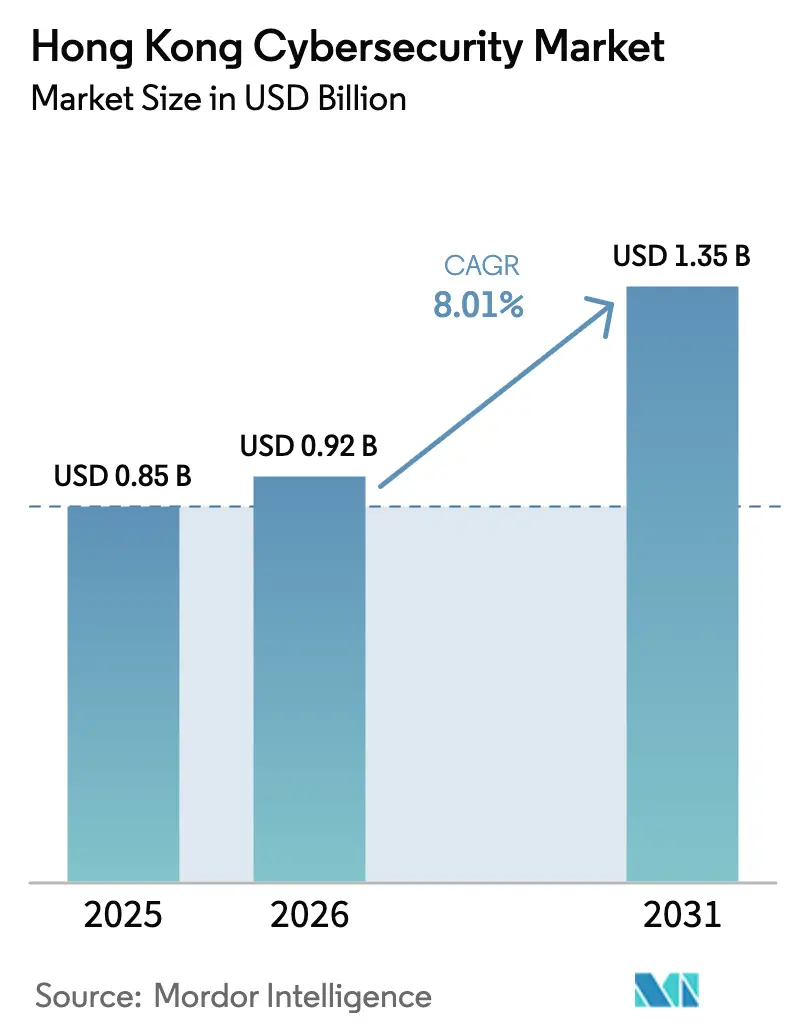
Hong Kong cybersecurity market size in 2026 is estimated at USD 0.92 billion, growing from 2025 value of USD 0.85 billion with 2031 projections showing USD 1.35 billion, growing at 8.01% CAGR over 2026-2031. Heightened regulatory scrutiny, especially the Protection of Critical Infrastructures (Computer Systems) Ordinance enacted in March 2025, is pivoting budget allocations from discretionary tools to mandated risk-assessment and incident-response capabilities. Escalating attack volumes, exemplified by 12,536 incidents logged by HKCERT in 2024, keep threat visibility top of mind while cross-border data-flow pressures encourage demand for data-loss-prevention platforms [1]Hong Kong Computer Emergency Response Team, “Cyber Security Outlook 2025,” hkcert.org. Enterprises that once favored single-purpose appliances now seek integrated platforms to rein in tool sprawl, and capital-efficient SMEs accelerate adoption of managed detection services that offset bilingual talent shortages. Strategic public funding of USD 24 billion for the technology economy, paired with more than 4,200 active startups, strengthens local innovation pipelines and fosters partnerships between global vendors and territorial specialists.
Key Report Takeaways
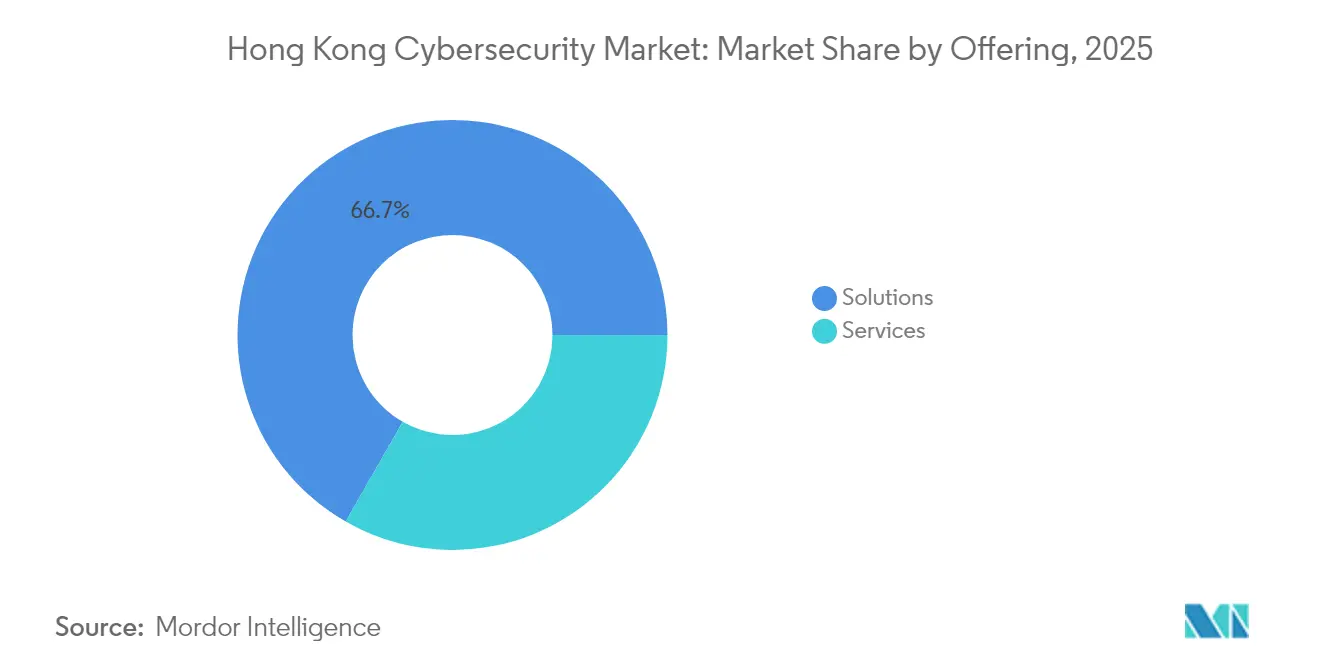
- By offering, Solutions led with 66.72% Hong Kong cybersecurity market share in 2025, whereas Managed Services is forecast to advance at an 11.02% CAGR through 2031.
- By deployment mode, On-Premise implementations accounted for 73.92% of the Hong Kong cybersecurity market size in 2025; cloud-delivered security is expanding at a 12.14% CAGR.
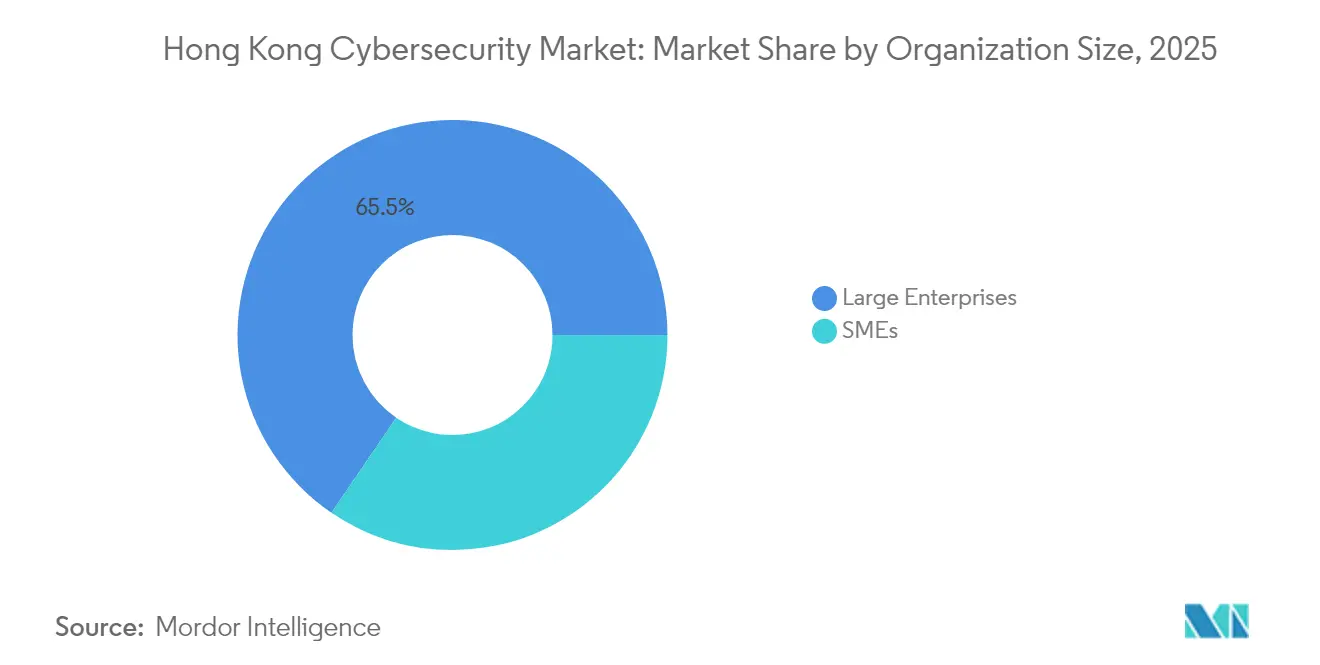
- By organization size, Large Enterprises held 65.48% revenue share in 2025, while SMEs record the fastest 12.93% CAGR to 2031.
- By end-user vertical, BFSI captured 28.12% revenue in 2025; Healthcare is projected to grow the quickest at 14.12% through 2031.
Note: Market size and forecast figures in this report are generated using Mordor Intelligence’s proprietary estimation framework, updated with the latest available data and insights as of 2026.
Hong Kong Cybersecurity Market Trends and Insights
Drivers Impact Analysis*
| Driver | (~) % Impact on CAGR Forecast | Geographic Relevance | Impact Timeline |
|---|---|---|---|
| Compliance with PDPO amendments and critical-infrastructure law | +2.1% | Hong Kong, Greater Bay Area | Short term (≤ 2 years) |
| Smart City Blueprint 2.0 investment | +1.8% | Hong Kong, New Territories | Medium term (2-4 years) |
| Virtual banking and FinTech surge | +1.6% | Hong Kong, ASEAN corridors | Short term (≤ 2 years) |
| Hybrid and multi-cloud adoption | +1.4% | Hong Kong with mainland integration | Medium term (2-4 years) |
| Cross-border data-transfer scrutiny | +1.2% | Hong Kong–mainland corridor | Long term (≥ 4 years) |
| Government USD 24 billion tech-economy investment | +1.0% | Hong Kong | Long term (≥ 4 years) |
| Source: Mordor Intelligence | |||
Mandatory Compliance with Hong Kong PDPO Amendments and Sector-specific Regulations Accelerating Security Spend
The 2025 Critical Infrastructures Ordinance imposes statutory obligations that cover risk assessments, incident disclosure, and formation of security management units. Non-compliance can jeopardize operating licences, which pushes boards to approve accelerated procurement cycles for governance-driven solutions. Vendors that demonstrate audit-ready reporting functions and bilingual support gain preferred-bidder status. Large enterprises re-evaluate fragmented tool stacks in favour of platforms that integrate vulnerability, asset, and compliance dashboards. The law also stimulates professional-services demand as organizations seek external validation of control maturity. Perceived regulatory leadership differentiates the Hong Kong cybersecurity market from regional peers, making compliance posture a competitive advantage in foreign-direct-investment decisions.
Hong Kong Smart City Blueprint 2.0 Driving Critical-Infrastructure Cybersecurity Investments
The USD 24 billion technology allocation earmarks funds for IoT-centric public services such as smart lampposts, e-mobility charging stations, and intelligent traffic control. Each new sensor node enlarges the attack surface, prompting utilities to procure operational-technology (OT) security gateways and real-time anomaly-detection software. Public tenders now require secure-by-design credentials, pushing integrators to embed encryption at chip level. Multi-vendor ecosystems demand centralized visibility to reconcile disparate device protocols, fostering uptake of AI-driven security orchestration platforms. The initiative ties vendor performance metrics to citizen-data protection benchmarks, thereby raising the bar for privacy-enhancing technologies. Blueprint deadlines through 2030 ensure sustained demand for life-cycle services ranging from threat-modelling to penetration testing [2]Alex Yi, “Smart City Blueprint 2.0 Funding Details,” hkcert.org.
Rapid Surge in FinTech and Virtual Banking Requiring Robust Security Architectures
Eight virtual banks serve a digitally native clientele, processing high-volume micro-transactions via API ecosystems. Continuous KYC verification and behavioural fraud analytics become critical because regulatory sandboxes still require real-time oversight. Cloud-native architectures bring agility but expose misconfiguration risks, so banks deploy continuous compliance scanners tailored to HKMA guidelines. Payment tokens traversing multiple jurisdictions heighten cryptographic-key management complexity, accelerating demand for hardware security modules delivered as service. FinTech scale-up cycles favour modular security components that adapt without re-engineering underlying apps. Established vendors bundle threat-intelligence feeds tuned to financial malware trends, creating cross-sell synergies into insurance and wealth-management sub-segments.
Hybrid/Multi-Cloud Adoption Boosting Demand for Cloud-Native Security Platforms
Pandemic-era remote-work policies normalised SaaS usage, but data-residency clauses compel enterprises to juggle international and mainland-hosted clouds. Configuration-drift across providers causes visibility gaps that legacy firewalls cannot bridge, fuelling interest in cloud-security-posture-management (CSPM) suites. CISOs pivot from tool counts to coverage metrics, favouring platforms able to unify identity, workload, and data-classification telemetry. Automated policy enforcement reduces manual review cycles and mitigates bilingual talent shortages. Large retailers extend zero-trust policies to branch stores via secure-access service edge (SASE) nodes for consistent user experience. Continuous encryption-key management across sovereign clouds positions the Hong Kong cybersecurity industry for specialist service growth.
Cross-Border Data-Transfer Scrutiny Fueling Data-Loss-Prevention Solutions
Data transfers between Hong Kong and mainland partners must satisfy PRC residency rules while preserving international client confidentiality. Enterprises implement granular content-inspection engines that auto-classify records by jurisdictional sensitivity. Inline tokenisation protects customer identifiers during analytics workflows hosted outside the territory. Legal teams demand audit trails that map every cross-border packet to policy outcomes, improving dispute-resolution readiness. Vendors partner with telcos to embed DLP at network edge elements, reducing latency for financial transactions. The resulting controls create replicable blueprints for other Greater Bay Area jurisdictions, bolstering export prospects for Hong Kong-engineered compliance tools.
Restraints Impact Analysis*
| Restraint | (~) % Impact on CAGR Forecast | Geographic Relevance | Impact Timeline |
|---|---|---|---|
| Bilingual cybersecurity talent shortage | -1.3% | Hong Kong, regional competition | Long term (≥ 4 years) |
| Legacy systems within public sector | -0.9% | Hong Kong government agencies | Medium term (2-4 years) |
| High cost of threat-intelligence services for SMEs | -0.7% | Hong Kong SMEs | Short term (≤ 2 years) |
| Fragmented OT security guidance | -0.5% | Critical-infrastructure operators | Medium term (2-4 years) |
| Source: Mordor Intelligence | |||
Severe Shortage of Bilingual Cybersecurity Talent
Fluency in Cantonese, Mandarin, and English is prerequisite for many security roles because compliance documentation, vendor consoles, and regulatory submissions span these languages. Scarcity inflates salaries by more than 30% over regional averages, straining mid-tier enterprise budgets. University programmes graduate fewer than 400 cybersecurity majors yearly, far below estimated demand. Visa processing delays make it hard to import foreign specialists, so firms outsource monitoring to managed security service providers (MSSPs). Dependence on external SOCs raises vendor-lock risks and limits bespoke policy tuning. Government upskilling grants alleviate entry-level gaps yet do not bridge senior-architect shortages, prolonging project timelines.
Persistent Legacy Systems Within Public Sector Hindering Modernisation
Mainframe-based workflows inside tax, immigration, and transport agencies resist integration with modern endpoint telemetry. Middleware customization inflates project overhead and introduces uncatchable code paths that attackers exploit. Procurement rules prioritize proven suppliers, hampering pilot adoption of innovative zero-trust fabric. Downtime tolerance is low due to citizen-service mandates, so agencies favour incremental patching over transformative re-platforming. Budget cycles tied to legislative approval add another layer of delay. These factors collectively curb large-scale upgrades, postponing realization of full-spectrum cyber resilience.
*Our forecasts treat driver/restraint impacts as directional, not additive. The impact forecasts reflect baseline growth, mix effects, and variable interactions.
Segment Analysis
By Offering: Solutions Dominance Drives Market Foundation
Solutions generated USD 567.12 million in 2025, equal to 66.72% Hong Kong cybersecurity market share, as enterprises sought unified control planes covering network, endpoint, and application domains. Application-security toolkits gain favour among FinTech platforms that run continuous deployment pipelines, while cloud-security gateways underpin SaaS adoption in professional-services firms. Endpoint detection and response adoption increases after HKCERT traced 45% of last year’s incidents to compromised laptops and smartphones. Data-security suites that combine tokenization with format-preserving encryption see heightened demand within healthcare providers following widely publicized breaches.
Managed Services is forecast to record an 11.02% CAGR to 2031, raising its revenue from USD 314.06 million in 2026 to more than USD 529.66 million by the end of the decade. MSSPs bundle threat hunting, incident response, and compliance reporting to offset end-user talent shortages, especially among SMEs. Large banks co-source security operations to gain 24/7 coverage without incurring additional headcount, while cloud-native MSSPs use automation to keep margins healthy. Professional services revenue grows steadily as new regulations require third-party audits of risk postures. Vendors that combine advisory, solution resale, and managed services position themselves as one-stop shops, securing multi-year contracts that dampen churn.



By Deployment Mode: On-Premises Preference Meets Cloud Acceleration
On-Premises deployments contributed 73.92% revenue in 2025 because financial institutions remain wary of sensitive-data exfiltration and prefer direct hardware control aligned with regional data-residency statutes. Banks invest in high-density next-generation firewalls and on-prem key-management appliances to meet intraday settlement latency targets. Costly real-estate and power-density constraints motivate appliance consolidation, spurring interest in unified threat-management devices that combine firewall, IPS, and DDoS mitigation functions.
Cloud-delivered protections are poised for a 12.14% CAGR, expanding from USD 248.6 million in 2026 to almost USD 441.2 million by 2031. SMEs gravitate toward SaaS security because operating-expense models avoid upfront capital investments. Continuous feature updates allow quick alignment with evolving PDPO clauses, which is critical as regulators may issue guidelines with short compliance windows. Hybrid architectures gain traction inside conglomerates that offload non-customer-identifiable workloads to public clouds while retaining crown-jewel data on private clouds housed in local co-location facilities. This blend drives procurement of CASB, CSPM, and container-security modules that secure workloads irrespective of hosting venue.
By Organization Size: Enterprise Leadership Faces SME Disruption
Large Enterprises commanded 65.48% revenue in 2025, equivalent to almost USD 556.58 million within the Hong Kong cybersecurity market. Their global connectivity mandates premium threat feeds, sandboxing, and red-team exercises. Multinational insurers integrate security-scorecard outputs into vendor-risk programmes, expanding demand for third party-risk monitoring tools. Enterprise footprints extend into mainland subsidiaries, requiring bilingual dashboards that reconcile PRC and Hong Kong compliance artefacts. Budget resilience allows experimentation with AI-driven detection engines, accelerating proof-of-concept cycles.
SMEs will see the briskest 12.93% CAGR, enlarging their collective spending from USD 331.32 million in 2026 to beyond USD 608.5 million in 2031. Government subsidies such as Cyberport’s Digital Transformation Support Pilot reimburse up to 50% of eligible cybersecurity spend, lowering adoption barriers. Vendor product teams strip back feature saturation to offer simplified consoles that busy SMB owners can master in days. Bundled endpoint, email, and backup protection delivered via subscription resonates with retailers and micro-exporters that lack dedicated IT staff. Channel partners that pair cybersecurity with managed infrastructure win share because SMEs prefer single invoices for all technology services.
By End-User Vertical: BFSI Dominance Meets Healthcare Innovation
The BFSI community generated 28.12% of overall revenue, translating to USD 239.02 million in 2025, underscoring its centrality to the Hong Kong cybersecurity market size. Trading houses deploy ultra-low-latency packet inspection appliances to protect algorithmic strategies, while insurers focus on identity-proofing technologies that reduce synthetic-identity fraud. The Hong Kong Monetary Authority’s virtual-banking framework obliges continuous security-posture reporting, which fuels demand for automated compliance dashboards. FinTech firms embed runtime-application-self-protection (RASP) inside mobile apps to guard against overlay attacks that bypass two-factor authentication.
Healthcare spending is forecast to rise at 14.12% CAGR, elevating its outlay from USD 63.91 million in 2026 to nearly USD 123.7 million by 2031. Hospitals digitise radiology workflows and telehealth portals, increasing exposure of personally identifiable patient data. After several high-profile breaches, the Department of Health mandates encryption of data at rest and in transit, making tokenisation platforms standard. Connected medical devices demand network segmentation along clinical engineering corridors, introducing opportunities for OT-oriented micro-segmentation vendors. Research labs handling genomic data adopt privacy-preserving computation to enable cross-institution collaboration without revealing raw datasets.
Geography Analysis
Hong Kong is both a demand centre and an export springboard, making the Hong Kong cybersecurity market a regional bellwether for Greater Bay security innovation. The city’s dense fibre footprint enables MSSPs to operate latency-sensitive SOC services, which attract multinational corporations seeking consistent regional coverage. Integration with Shenzhen supply-chain partners forces enterprises to adopt policy engines capable of distinguishing data flows subject to PRC Cybersecurity Law from those governed by PDPO standards, thereby elevating DLP and encryption spending.
Physical constraints drive operators to vertical data-centre designs, which in turn heighten emphasis on airflow-aware rack-level fire-suppression and environmental monitoring as part of holistic security postures. Proximity to regional subsea cable landing stations bolsters Hong Kong’s appeal for global cloud providers, which strengthens the case for sovereignty-aligned cloud-security controls. Time-zone overlap with Tokyo and Singapore allows security teams to leverage follow-the-sun monitoring models that reduce incident-response gaps.
Cross-border collaboration directives within the Greater Bay Area elevate adoption of secure-collaboration SaaS that embeds data classification at object level. Government negotiations on mutual recognition of e-signatures introduce new demand for cryptographic interoperability testing. Investors view Hong Kong’s predictable common-law framework as risk mitigating compared with mainland markets, which encourages long-term cyber-infrastructure bets. The resulting capital inflow supports local RandD hubs focused on post-quantum encryption and AI-based anomaly detection.
Regulatory Landscape
Hong Kong’s cybersecurity regime tightened as the Protection of Critical Infrastructures (Computer Systems) Ordinance (Cap. 653) came into effect on January 1, 2026, shifting compliance from guidance-led practices to statutory obligations for designated critical infrastructure operators. The Office of the Commissioner of Critical Infrastructure (Computer-system Security) was established on the same date, creating a central enforcement and coordination focal point alongside sector designated authorities such as the Hong Kong Monetary Authority (HKMA) and the Communications Authority (CA).
A Code of Practice issued on January 1, 2026 sets baseline requirements for protecting critical computer systems and ties implementation to recognized frameworks and standards, including ISO/IEC 27001, NIST 800-30, and GB/T 22080. Alongside this, the Personal Data (Privacy) Ordinance (PDPO) remains central to security controls around personal data handling, reinforcing demand for auditable governance, incident handling, and controls that support cross-border data-transfer scrutiny.
Value Chain Analysis
The Hong Kong cybersecurity value chain begins with global and regional technology suppliers providing core security software and appliances across identity, endpoint, network, and cloud security. Local distributors and value-added resellers then package licensing with deployment support and bilingual enablement.
Systems integrators and telco-led providers operationalize these tools into enterprise architectures, while MSSPs provide day-to-day monitoring, threat hunting, and incident response for organizations constrained by bilingual talent shortages. HKCERT functions as a hub for threat intelligence and incident information sharing, which shapes the detection content, playbooks, and awareness programs used by both vendors and customers. As critical infrastructure rules tighten governance and supplier assurance, operators increasingly flow security requirements to third parties through contractual terms and confidentiality agreements. For SMEs, go-to-market is bolstered by vetted provider ecosystems such as the Cybersecurity Service Providers Connect Programme, which lists 21 service providers spanning assessment, managed services, internet security, and training.
Competitive Landscape
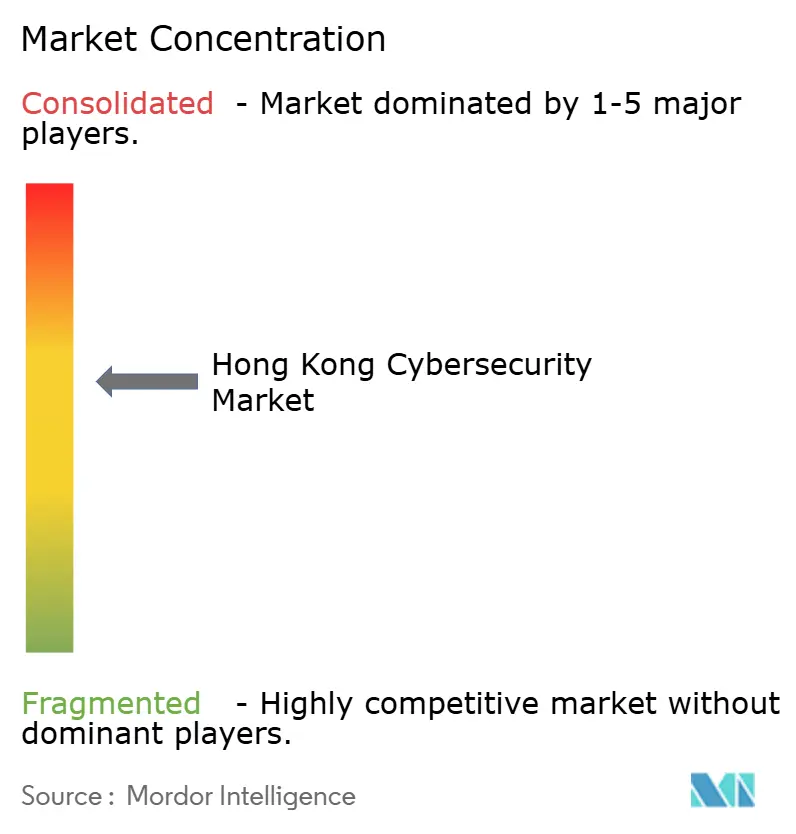
The vendor ecosystem is moderately fragmented, with the top five providers accounting for roughly 42% of the Hong Kong cybersecurity market. Global leaders such as Palo Alto Networks and Fortinet bundle subscriptions spanning firewall, SD-WAN, and cloud-security modules, winning large-enterprise renewals through platform breadth. Local champion HKT Trust differentiates with bilingual SOC analysts and tight integration with its fixed-line and 5G networks, securing municipal and SME contracts.
Strategic alliances emerge as vendors race to add regulatory functions. CITIC Telecom CPC launched its ICT-MiiND framework that layers AI pentesting over managed connectivity, appealing to manufacturers that want single-supplier simplicity. Meanwhile, Blackpanda focuses on incident-response retainers, and its USD 6.7 million Series A financing underwrites expansion of digital-forensics capacity that complements preventive-control vendors[3]Blackpanda Pte Ltd, “Series A Funding Press Release,” blackpanda.com . Cloud-security start-ups capitalize on niche opportunities such as container hardening for DevSecOps pipelines, but consolidation looms as customers demand broader coverage.
Pricing power tilts toward vendors offering integrated suites because buyers value tool-chain reduction. However, compliance specialization creates a viable lane for boutique consultancies that translate legislation into control frameworks. Channel partners encompassing telcos, global integrators, and value-added resellers negotiate revenue-sharing deals tied to recurring licenses. Market entry barriers remain moderate given open procurement in the private sector, yet public-sector certification requirements advantage incumbents with proven track records.
Hong Kong Cybersecurity Industry Leaders
IBM Corporation
Digitpol
Rackspace Technology
Maximus
Edvance International Holdings Limited
- *Disclaimer: Major Players sorted in no particular order

Market Opportunities and Future Outlook
Regulation-led operationalization creates room for compliance-ready offerings that cut manual governance effort, especially as organizations move from spreadsheet-based GRC toward automated platforms with auditable workflows. The January 1, 2026 Code of Practice under the Protection of Critical Infrastructures (Computer Systems) Ordinance also increases demand for repeatable assessment, risk management, and incident-response workflows that map to the baseline requirements and recognized standards, supporting growth across professional services, managed services, and integrated risk management toolsets.
SME-focused delivery remains a practical path to expansion, supported by named public programs that reduce discovery and selection friction, including Digital Policy Office (DPO) and HKCERT initiatives such as the Cybersecurity Service Providers Connect Programme. Market signals also point to capacity gaps that favor outsourced models, with HKCERT reporting indicating nearly 30% of enterprises lack dedicated cybersecurity personnel, which strengthens demand for managed detection and response and retainer-based incident response. AI-themed enablement efforts, including the Secure AI@Work Enablement Campaign and an AI x Cybersecurity Challenge scheduled for the second half of 2026, broaden vendor opportunities to package AI security literacy, secure-by-design controls, and practical implementation services for business users.
Recent Industry Developments
- June 2026: Edvance International Holdings Limited, FY2026 annual results released, signaling continued demand for cybersecurity solutions. The earnings signal supports market optimism for HK cybersecurity growth and validates Edvance's expansion in the local ecosystem, reinforcing its positioning as a key integrator for enterprises seeking robust defense capabilities in Hong Kong.
- June 2026: Edvance International Holdings Limited - Reported annual results for FY2026, noting continued demand for cybersecurity solutions. The results underscore sustained buyer interest in comprehensive security offerings and help cement Edvance’s role in converting demand into scalable deployments across the HK market.
- April 2026: Edvance International Holdings Limited, Launched AI Cybersecurity Tech Hub to coordinate AI-driven defense, crowdsourced intelligence, and attack simulations. The initiative expands Edvance's platform strategy and positions the company to integrate AI driven security with incident simulation for the Hong Kong market.


Research Methodology Framework and Report Scope
Market Definition and Coverage
This market covers spending in Hong Kong on cybersecurity solutions and services that help organizations prevent, detect, and respond to digital threats across IT environments, including cloud and on-premise setups, with revenue measured in USD.
Scope exclusions: We exclude general IT hardware refresh, non-security consulting that is not tied to cyber risk reduction, and pure telecom connectivity charges.
Segmentation Overview
- By Offering
- Solutions
- Application Security
- Cloud Security
- Data Security
- Identity and Access Management
- Infrastructure Protection
- Integrated Risk Management
- Network Security Equipment
- Endpoint Security
- Other Solutions
- Services
- Professional Services
- Managed Services
- Solutions
- By Deployment Mode
- On-Premise
- Cloud
- By Organization Size
- SMEs
- Large Enterprises
- By End-User Vertical
- BFSI
- Healthcare
- IT and Telecom
- Industrial and Defense
- Retail
- Energy and Utilities
- Manufacturing
- Others
Data Sources, Market Sizing, and Validation
Desk Research
Desk research was used to set the Hong Kong context and keep the sizing assumptions linked to public signals that can be checked. We reviewed official and non-paywalled sources such as the Office of the Privacy Commissioner for Personal Data (guidance and enforcement summaries), HKCERT publications (alerts and annual outlook coverage), Hong Kong Monetary Authority circulars and supervisory expectations that influence cyber controls in banking, and Hong Kong government statistics releases that track ICT and digital economy activity.
To understand how revenues are packaged and recognized, we also screened company annual reports, public financial statements, investor presentations, association websites, and reputed press coverage of major incidents and regulations. Paid subscriptions for company financials and intelligence, news and financials, patent databases, and public tenders were used selectively to confirm product focus areas and to sense-check deal momentum, without relying on any single dataset. The desk sources listed here are illustrative only, and we used many other public documents and datasets to collect, validate, and clarify inputs.
Primary Interviews and Surveys
Primary work focused on validating what Hong Kong buyers actually purchase, how budgets are split between solutions and services, and how cloud adoption changes the security scope. We spoke with a mix of demand-side and supply-side participants, including CISOs and IT security managers, managed service providers, systems integrators, and security-focused channel partners, so gaps from desk findings could be closed and assumptions could be stress-tested.
Distribution of primary research fieldwork respondents
| Company type | Respondent position | Region |
|---|---|---|
| Top tier: 36% | CXOs: 17% | |
| Mid tier: 43% | Functional/Unit leaders: 35% | |
| Smaller Players: 21% | Managers: 48% |
Market-Sizing & Forecasting
Sizing starts with a top-down build, where Hong Kong ICT and enterprise spend signals are converted into a cybersecurity demand pool using penetration and budget-share assumptions validated through interviews. The model is then broken into buyer environments that consistently drive security spend, and the totals are checked using selective bottom-up approximations, such as sampled ASP x deployment volumes for common controls, partner channel checks, and roll-ups from a curated set of supplier disclosures where revenue is clearly attributable.
In this market, several inputs tend to drive the biggest shifts: cloud migration intensity in Hong Kong enterprises, regulatory and compliance pressure (including privacy and sector guidelines), incident and attack reporting signals that affect urgency, the mix shift toward managed security services, and typical contract duration and renewal behavior that affects revenue timing. Forecasting uses scenario analysis supported by variable-level expectations gathered in primary discussions, where we test a base case and adjustment cases tied to macro IT spend, cloud adoption pace, and threat-led budget reprioritization. When supplier-level detail is missing, we use conservative ranges for attach rates and service bundling, then narrow them through channel feedback before finalizing the totals.
Data Validation & Update Cycle
Validation is done through cross-checks between the modeled market value and independent signals that should move in the same direction, such as changes in ICT budgets, reported incident volumes, and managed service adoption. We also run variance checks across vertical demand patterns and look for abnormal jumps that could indicate double counting between software and services, followed by an internal review before sign-off.
The report is refreshed annually, and interim updates are triggered when material events change the demand outlook, such as major regulatory actions or shifts in enterprise cloud policy. Before delivery, we complete a fresh analyst pass to incorporate the latest public releases and interview learnings, so clients receive an updated view.
Mordor Intelligence's Hong Kong Cybersecurity Market Size Compared Against Other Published Estimates
Published market sizes for Hong Kong cybersecurity can differ even when the topic name looks the same, because the counted revenue pool is not always defined in the same way. Differences typically come from what is treated as cybersecurity versus adjacent IT work, how services are recognized over contract periods, and whether an estimate is refreshed after new policy or incident signals.
The table shows a tight spread for 2026, and then a wider spread as the horizon extends. Some sources use longer-range uplift assumptions or include a wider set of security-adjacent items, and in Mordor Intelligence's model the 2026 value is built around cybersecurity solutions and services revenue in Hong Kong, excluding general IT outsourcing that is not directly tied to security controls.
Benchmark comparison
| Source | Market Size | Gaps in Research Methodology |
|---|---|---|
| Mordor Intelligence | USD 0.92 B (2026) | |
| Global Consultancy A | USD 0.97 B (2026) | Uses a broader inclusion set that appears to blend security programs with adjacent IT risk services and hardware refresh, which can lift the counted spend when cloud projects are bundled with security work. |
| Industry Publisher B | USD 1.05 B (2026) | Applies higher near-term budget uplift assumptions from threat headlines without clearly reconciling them to Hong Kong enterprise ICT spend capacity, and currency timing and contract revenue recognition are not fully explained. |
Looking across the three figures, most of the difference is explained by scope boundaries and how growth is applied to services-heavy spending, where multi-year contracts can shift revenue between years. Our checks keep the final number traceable to observable demand signals, which also makes updates easier when regulations or incident patterns change.


Key Questions Answered in the Report
What is the current size of the Hong Kong cybersecurity market?
The Hong Kong cybersecurity market size is USD 0.92 billion in 2026 and is forecast to grow at an 8.01% CAGR to USD 1.35 billion by 2031.
Which offering category leads spending in Hong Kong?
Solutions account for 66.72% market share in 2025, driven by demand for integrated platforms that simplify compliance and threat management.
Why are managed security services growing quickly?
A shortage of bilingual cybersecurity professionals pushes organizations, especially SMEs, to outsource monitoring and incident response, propelling managed services at an 11.02% CAGR.
How does new regulation influence cybersecurity investment?
The Critical Infrastructures Ordinance mandates risk assessments and incident reporting, compelling companies to accelerate purchase of governance-ready security tools.
Which vertical will grow the fastest through 2031?
Healthcare is projected to expand at 14.12% CAGR as hospitals digitize records and comply with stricter patient-data protection requirements.
What deployment approach is gaining traction among SMEs?
Cloud-delivered security is rising at a 12.14% CAGR because subscription models lower upfront costs and simplify management for resource-constrained firms.
Page last updated on:






