
Cyber Resilience and Business Continuity Market Size and Share
Market Overview
| Study Period | 2020 - 2031 |
|---|---|
| Market Size (2026) | USD 10.47 Billion |
| Market Size (2031) | USD 20.75 Billion |
| Growth Rate (2026 - 2031) | 14.66 % |
| Fastest Growing Market | Asia-Pacific |
| Largest Market | North America |
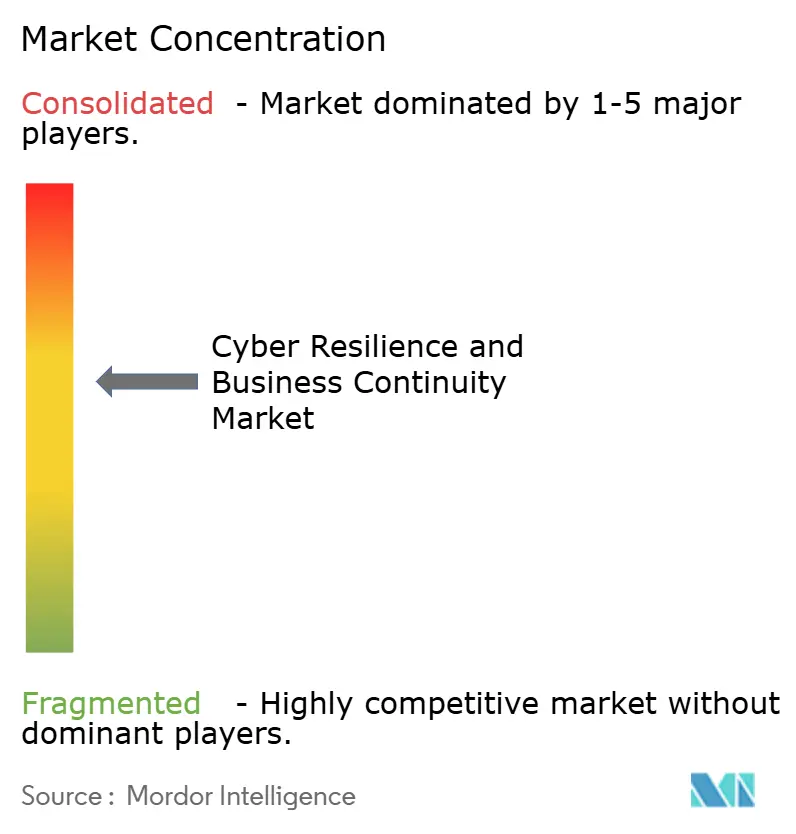
| Market Concentration | Medium |
Major Players *Disclaimer: Major Players sorted in no particular order Image © Mordor Intelligence. Reuse requires attribution under CC BY 4.0. | |
Cyber Resilience and Business Continuity Market Analysis by Mordor Intelligence
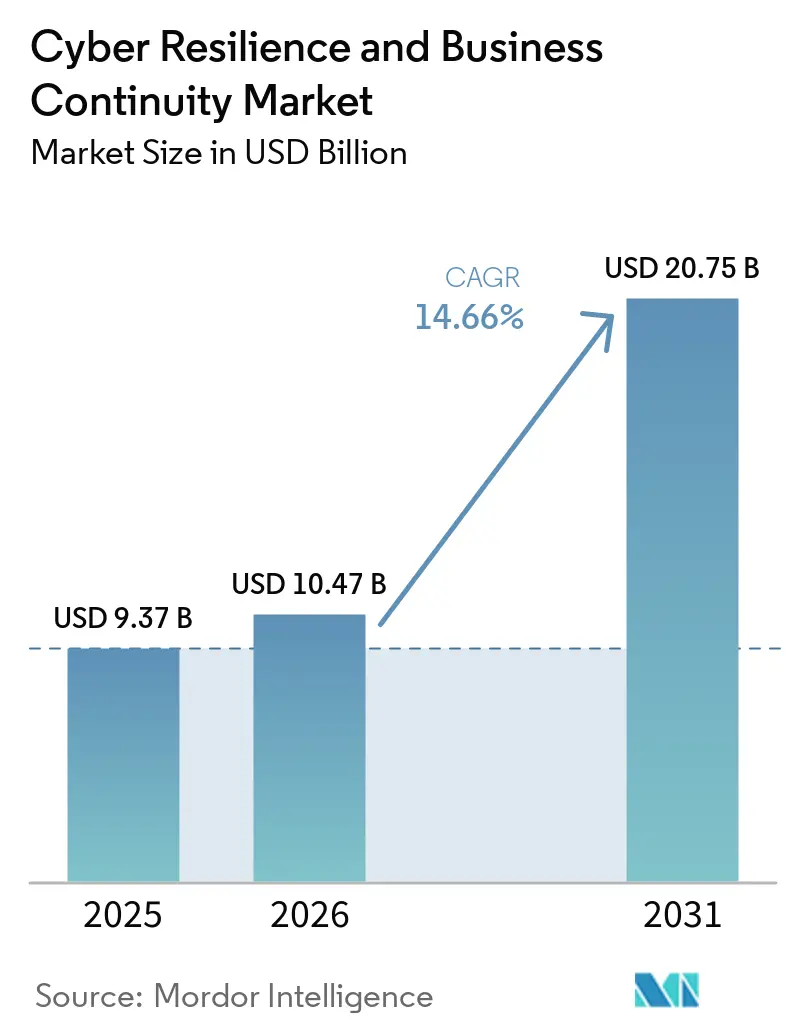
The cyber resilience and business continuity market size is projected to be USD 9.37 billion in 2025, USD 10.47 billion in 2026, and reach USD 20.75 billion by 2031, growing at a CAGR of 14.66% from 2026 to 2031. The cyber resilience and business continuity market is expanding because enterprise operations now depend more heavily on cloud platforms and SaaS tools, which can narrow recovery paths when a disruption affects multiple systems simultaneously. Regulatory requirements are also changing procurement behavior, as organizations now need tested and documented continuity plans that can withstand audits and supervisory reviews. Attack methods are becoming faster and more automated, which leaves less time to detect, contain, and restore business operations after a cyber event. This shift is pushing resilience spending into broader capital allocation discussions because downtime now directly affects revenue continuity, margin protection, and customer confidence. Vendor strategy is also moving in response, with a stronger emphasis on integrated platforms, managed delivery, and measurable recovery outcomes that appeal to both technology teams and financial decision-makers.
Key Report Takeaways
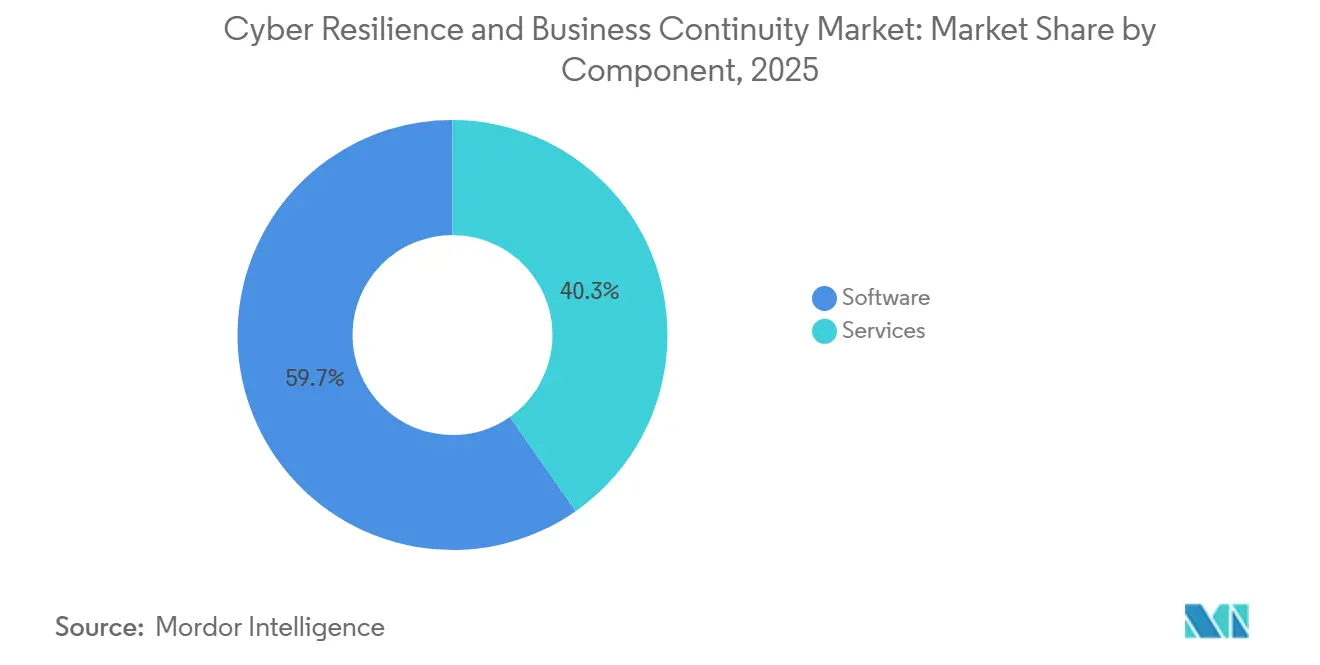
- By component, software held 59.72% share of the cyber resilience and business continuity market revenue in 2025, while services are projected to expand at a 15.71% CAGR through 2031.
- By deployment, cloud-based deployments held 52.84% of the cyber resilience and business continuity market share in 2025, while hybrid deployments are projected to expand at a 15.82% CAGR through 2031.
- By enterprise size, large enterprises held 58.03% of revenue in 2025, while small and medium enterprises are projected to grow at a 15.93% CAGR through 2031.
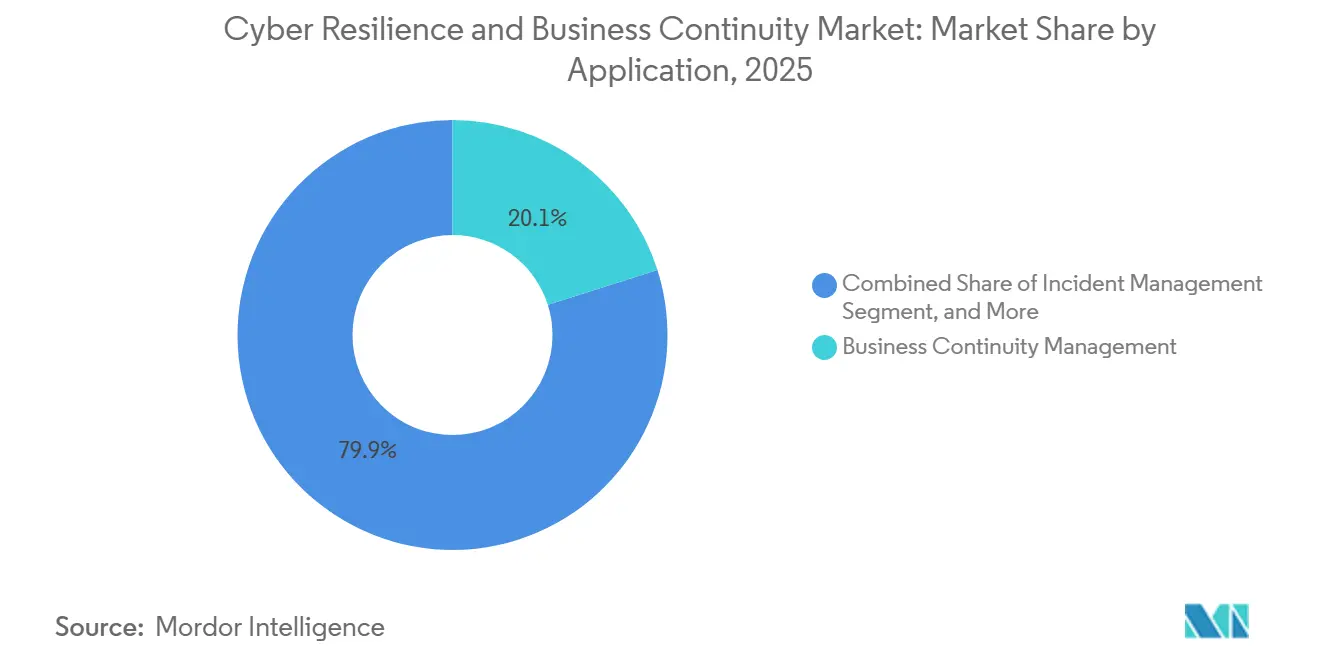
- By application, business continuity management accounted for 20.18% share of the cyber resilience and business continuity market in 2025, while incident management is projected to expand at a 16.04% CAGR through 2031.
- By end-user industry, BFSI held 16.09% of revenue in 2025, while healthcare and life sciences are projected to grow at a 16.15% CAGR through 2031.
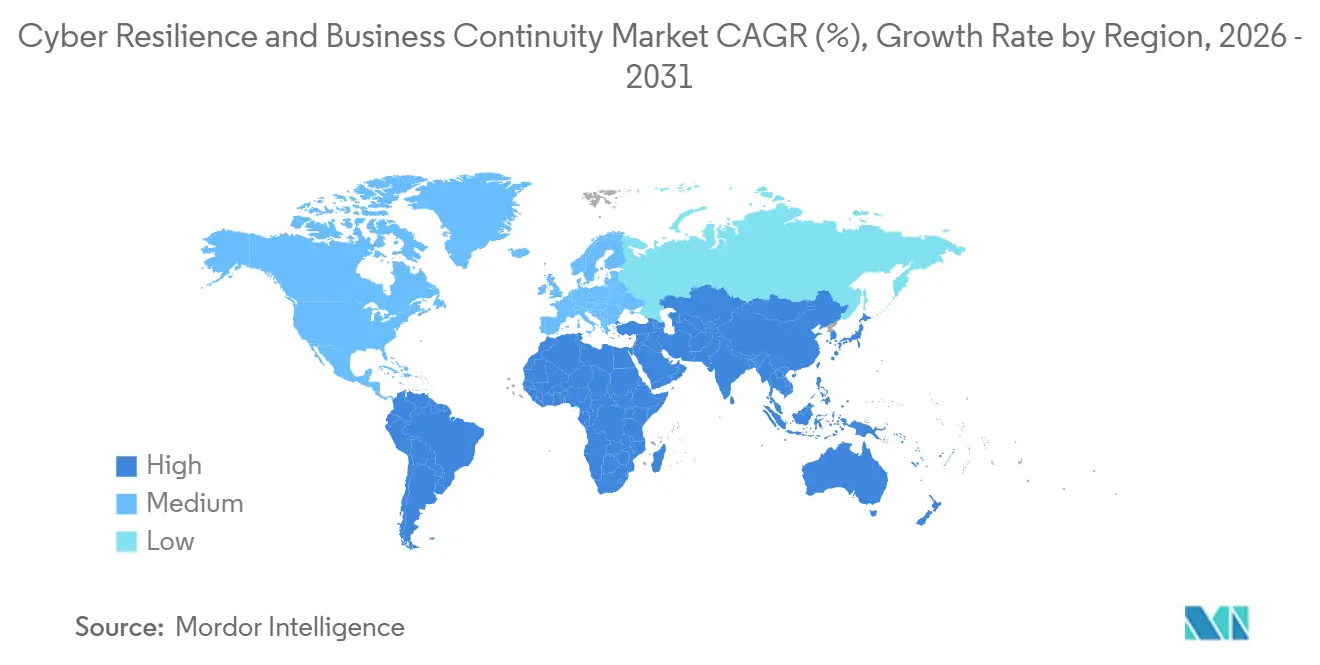
- By geography, North America held 31.07% share of the cyber resilience and business continuity market in 2025, while Asia-Pacific projected to grow at a 17.12% CAGR remained the fastest-growing regional segment through 2031.
Note: Market size and forecast figures in this report are generated using Mordor Intelligence’s proprietary estimation framework, updated with the latest available data and insights as of January 2026.
Global Cyber Resilience and Business Continuity Market Trends and Insights
Drivers Impact Analysis*
| Driver | (~) % Impact on CAGR Forecast | Geographic Relevance | Impact Timeline |
|---|---|---|---|
| Rising Ransomware Recovery Budget Allocation | +3.5% | Global | Short term (≤ 2 years) |
| Regulatory Pressure for Tested Recovery and Continuity Plans | +2.8% | North America and EU, spill-over to APAC | Medium term (2-4 years) |
| Cloud and SaaS Dependency Requiring Continuous Recovery Readiness | +2.2% | Global | Short term (≤ 2 years) |
| Board-Level Focus on Operational Downtime Losses | +1.8% | Global, particularly North America and APAC | Short term (≤ 2 years) |
| Cyber Insurance Underwriting Requirements for Resilience Controls | +1.5% | North America and EU | Medium term (2-4 years) |
| AI-Enabled Incident Orchestration and Response Automation | +1.2% | Global, early gains in North America and APAC | Long term (≥ 4 years) |
| Source: Mordor Intelligence | |||
Rising Ransomware Recovery Budget Allocation
The cyber resilience and business continuity market is gaining direct support from ransomware recovery budgets because many organizations now treat recovery readiness as a financial safeguard rather than a technical add-on. IBM reported that the average all-in cost of a ransomware or extortion incident reached USD 5.08 million in 2025, providing boards with a clear reference point for downtime, remediation, and regulatory exposure.[1]IBM Security, “Cost of a Data Breach Report 2025,” IBM, ibm.com Veeam found that 94% of organizations increased their ransomware recovery budgets, indicating how quickly budget planning has shifted toward preparedness and restoration capabilities. Sophos also showed that organizations with uncompromised backups reduced median recovery costs to USD 375,000, compared with USD 3 million when backups were compromised, which sharpened the economic case for stronger backup architecture and isolation practices. The cyber resilience and business continuity market is also benefiting, as threat actors now target backup repositories early in the attack chain, making immutable storage, clean recovery points, and recovery verification more important than backup volume alone. This pattern is changing buyer expectations, as organizations now want proof that recovery assets can withstand an attack and restore operations under hostile conditions rather than in a clean-lab environment.
Regulatory Pressure for Tested Recovery and Continuity Plans
The cyber resilience and business continuity market is also rising as tested recovery plans are becoming a compliance requirement across more sectors and regions. The European Union Digital Operational Resilience Act became enforceable for financial entities on January 17, 2025, and it requires documented ICT business continuity policies, tested disaster recovery plans, and rapid incident notification after major disruptions.[2]European Commission, “Regulation (EU) 2022/2554 on Digital Operational Resilience for the Financial Sector,” European Commission, europa.eu The NIS2 Directive is expanding similar obligations across critical sectors, pushing many organizations to move beyond static continuity documents into systems that support evidence, testing records, and cross-functional coordination. SANS reported in 2026 that 95% of organizations said regulatory frameworks now shape cybersecurity staffing decisions, up from 40% in 2025, indicating that compliance pressure is influencing both hiring and platform investment. The cyber resilience and business continuity market is therefore seeing shorter procurement cycles in regulated industries, as buyers need systems that can demonstrate tested readiness rather than just policy intent. This also favors vendors that can align operational workflows with established standards and supervisory expectations, especially in financial services, healthcare, and critical infrastructure.
Cloud And SaaS Dependency Requiring Continuous Recovery Readiness
The cyber resilience and business continuity market is further supported by the spread of cloud and SaaS environments, because service concentration raises the operational impact of a single failure. Disaster Recovery Journal found in 2026 that 94% of respondents relied on enterprise SaaS tools and 93% included SaaS in their disaster recovery planning, which confirms how deeply business operations now depend on platforms outside direct enterprise control.[3]Disaster Recovery Journal, “The State of Disaster Recovery Preparedness 2026,” Disaster Recovery Journal, drj.com Spanning reported in 2025 that only 35% of organizations could actually recover from a downtime event within hours, while 60% believed they could, revealing a significant confidence gap between perceived readiness and tested capability. The cyber resilience and business continuity market is gaining from this gap because traditional recovery planning was built around infrastructure that organizations owned, while SaaS disruptions involve service layers, identity states, and configuration controls that customers cannot restore on their own. Buyers are therefore looking for platforms that combine backup, orchestration, validation, and runbook execution rather than offering a narrow point-in-time restore function. That demand is especially strong in organizations that run key workflows in Microsoft 365, Salesforce, Google Workspace, and similar systems, where even brief outages can halt core business activity.
Board-Level Focus on Operational Downtime Losses
The cyber resilience and business continuity market is now discussed more often in financial terms, because downtime is visible to boards as a revenue and valuation issue. Splunk reported in 2026 that unplanned downtime cost Global 2000 companies an average of USD 300 million annually and that a single material incident was associated with an average 3.4% decline in stock price.[4]Splunk, “The Hidden Costs of Downtime 2026,” Splunk, splunk.com The same study showed that cybersecurity-related events accounted for 32% of downtime causes, which tied resilience spending directly to a material share of operational disruption rather than to an isolated technology concern. The cyber resilience and business continuity market is benefiting from widening purchasing authority, which now includes finance teams, audit committees, and boards seeking clearer recovery metrics and loss scenarios. This is changing what wins deals, because vendors increasingly need to show measurable recovery outcomes, executive dashboards, and evidence that business services can be restored in a controlled sequence. It also helps explain why resilience budgets are being framed as protection for earnings stability and customer continuity rather than as a discretionary software line item.
Restraints Impact Analysis*
| Restraint | (~) % Impact on CAGR Forecast | Geographic Relevance | Impact Timeline |
|---|---|---|---|
| High Integration Complexity Across Legacy and Modern Security Stacks | -1.1% | Global, most acute in BFSI and healthcare sectors | Medium term (2-4 years) |
| Shortage of Skilled Resilience, Recovery, and Incident Response Talent | -0.9% | Global | Long term (≥ 4 years) |
| Budget Friction in Mid-Market and SME Adoption | -0.7% | Emerging markets, APAC, South America | Medium term (2-4 years) |
| Limited Recovery Testing Discipline in Low-Maturity Organizations | -0.5% | Global, most acute in South America and MEA | Medium term (2-4 years) |
| Source: Mordor Intelligence | |||
High Integration Complexity Across Legacy and Modern Security Stacks
The cyber resilience and business continuity market still faces friction due to integration complexity, as many enterprises operate large mixes of legacy tools, cloud systems, and specialized security products. IBM and Palo Alto Networks found in early 2025 that organizations managed an average of 83 security solutions from 29 vendors, underscoring the scale of the fragmentation many recovery teams must navigate during a live incident. Versa Networks reported in 2026 that 73% of organizations had a critical project delayed or derailed by integration complexity, and 35% reported a security breach linked to gaps between networking and security tools. In the cyber resilience and business continuity market, this matters because recovery success depends on clean data flows between backup systems, identity tools, incident workflows, communications platforms, and production environments. Integration work often slows deployments in BFSI, healthcare, and other legacy-heavy sectors, where replacing incumbent systems can raise operational and audit concerns. As organizations add more automation and AI tooling, the need for reliable interoperability becomes even more important, because a failed connection during a crisis can disrupt the entire restoration sequence.
Shortage of Skilled Resilience, Recovery, and Incident Response Talent
The cyber resilience and business continuity market is also constrained by a shortage of people who can combine recovery engineering, incident command, and cross-functional crisis coordination. SANS and GIAC reported in 2026 that 60% of organizations viewed skills gaps as a bigger challenge than headcount shortfalls, and 27% linked security breaches directly to workforce capability deficits. The same research showed that 47% of organizations experienced slower incident response due to skills shortfalls, and that 55% took 6 months or longer to fill senior roles with more than 15 years of relevant experience. Fortinet added in 2026 that 60% of organizations struggled to find talent with AI-specific security experience, a challenge that is especially important as both attackers and defenders increasingly use automation. The cyber resilience and business continuity market is responding with more managed services, partner-led delivery, and simplified workflows that reduce the dependence on scarce internal specialists. This talent gap is also one reason services are growing faster, as many organizations would rather outsource continuous readiness than build a mature resilience function from scratch.
*Our forecasts treat driver/restraint impacts as directional, not additive. The impact forecasts reflect baseline growth, mix effects, and variable interactions.
Segment Analysis
By Component: Software Platforms Anchor The Enterprise Resilience Stack
Software accounted for 59.72% of the cyber resilience and business continuity market in 2025, indicating that buyers continue to favor platforms that bring recovery orchestration, reporting, and compliance tracking into a single operating layer. This preference has strengthened as organizations seek to reduce tool sprawl and make recovery actions easier to coordinate during complex incidents. Software-led buying also reflects product maturity, because many current platforms automate policy setup, clean recovery point identification, and failover sequencing more effectively than earlier backup products. The cyber resilience and business continuity market for software remained the core revenue base in 2025, while services are projected to expand at a 15.71% CAGR from 2026 to 2031 as buyers seek outside help with design, testing, and day-to-day operations. That combination shows that customers are not strictly choosing between software and services, because many want a strong platform paired with managed delivery where internal capacity is limited.
Services are gaining momentum because mid-market companies, public-sector users, and lean IT teams often need recovery expertise they cannot maintain in-house continuously. The cyber resilience and business continuity market is therefore rewarding vendors that combine recurring platform revenue with advisory support, managed backup, and execution support for recovery. Veeam’s May 2026 launch of the DataAI Command Platform demonstrated how software vendors are broadening their role by integrating resilience, AI governance, and data trust infrastructure into a single offering. Acronis, Arcserve, Datto, and Unitrends still address distinct parts of this segment, but buyer attention is shifting toward verifiable recovery outcomes rather than narrow feature lists. Over time, the strongest positions are likely to remain with vendors that can support both the complexity of large enterprises and channel-driven mid-market delivery without creating separate operating models for each customer tier.


By Deployment: Hybrid Architectures Bridge Regulated Environments And Cloud Agility
Cloud-based deployment accounted for 52.84% of the cyber resilience and business continuity market in 2025, reflecting strong demand for faster provisioning, lower infrastructure overhead, and subscription-led adoption. The cyber resilience and business continuity market share in cloud deployments also benefited from the fact that many organizations preferred to avoid large upfront hardware cycles while still improving recovery coverage. Even so, hybrid deployment is projected to grow at a 15.82% CAGR through 2031, as many organizations cannot rely on a single environment for regulated workloads and business-critical systems. Healthcare, financial services, and critical infrastructure users often need architectures that span on-premises vaults, private environments, and public cloud restoration targets simultaneously. This makes hybrid models a practical choice for buyers who need both data residency control and flexible recovery execution.
The cyber resilience and business continuity market is seeing hybrid adoption rise because the real issue is not where data sits, but how quickly business services can return across connected environments. Organizations with air-gapped industrial settings, defense-linked operations, or long data retention rules still maintain on-premises assets, but increasingly connect them to cloud-based recovery orchestration. Disaster Recovery as a Service has become more relevant in this context because it provides organizations with a secondary recovery environment without the cost of a fully duplicated data center. Zerto’s focus on continuous data protection and very low recovery point objectives fits this need, especially for latency-sensitive applications that cannot tolerate large data loss windows. The Spanning 2025 findings on the gap between perceived and actual recovery speed also underline that deployment choice alone does not create readiness, because tested orchestration and rehearsal remain essential. As a result, buyers are beginning to evaluate deployment models through the lens of verified recovery performance rather than cloud preference alone.
By Enterprise Size: SME Growth Reshapes Channel Economics
Large enterprises held 58.03% of the cyber resilience and business continuity market in 2025, because they spend more per account on software, managed services, testing environments, and internal program governance. These organizations also moved earlier into enterprise-grade resilience platforms and typically maintain dedicated teams that can oversee recovery planning, validation, and executive reporting. At the same time, small and medium enterprises are projected to grow at a 15.93% CAGR through 2031, making them the fastest-expanding customer segment in the cyber resilience and business continuity market. This shift reflects lower platform entry costs, stronger managed service provider coverage, heavier ransomware pressure on smaller firms, and insurance requirements that now make basic resilience controls harder to avoid. Sophos reported that SMBs with 100 to 250 employees faced an average recovery cost of USD 638,536 per ransomware incident in 2025, excluding ransom payments, underscoring why even smaller companies now see tested recovery as a business survival issue.
The cyber resilience and business continuity market is changing structurally because SME demand is largely routed through partners rather than through direct sales alone. That makes channel depth, multi-tenant management, white-label reporting, and simple pricing very important for vendors that want to scale in this tier. Large enterprises continue to deepen their programs through cleanroom recovery labs, advanced anomaly detection in backup data, and stronger executive oversight, which keep average deal sizes high and extend sales cycles. Specialized providers such as Recovery Point Systems and Castellan Solutions appeal to complex enterprise accounts by offering continuous assessments, managed recovery support, and reporting that addresses both operational and governance needs. By contrast, SMEs usually prioritize speed, ease of deployment, and insurer-aligned evidence generation over the broadest feature set. This split means vendors need different delivery motions across enterprise sizes, even when the underlying need for restoration speed and continuity of service is similar.
By Application: Incident Management Surges As Static Plans Prove Insufficient
Business continuity management accounted for 20.18% of the cyber resilience and business continuity market in 2025, which confirmed its role as the broadest foundational application area across industries. That position was built over many years through business impact analysis, recovery time planning, tabletop exercises, and continuity documentation that gave organizations a formal structure for disruption response. Disaster recovery and cyber recovery continue to sit close to BCM in procurement decisions, because buyers increasingly want technical restoration and organizational response workflows to operate together. Incident management is projected to grow at a 16.04% CAGR through 2031, reflecting a growing recognition that static plans break down when events move quickly and involve multiple systems, stakeholders, and external partners simultaneously. The cyber resilience and business continuity market is therefore shifting from document-centered programs toward execution-centered platforms that help teams assign tasks, escalate issues, and monitor restoration progress in real time.
The remaining application areas continue to expand as organizations seek to reduce the separation between planning, response, governance, and communications. Crisis communication and emergency notification are gaining more attention, where customer messaging, employee safety, and executive visibility must move in parallel with technical recovery. Operational resilience management is growing, especially in regulated financial settings, where supervisors expect organizations to demonstrate that critical services can remain available during disruptions, rather than merely confirm that policies exist. Risk and resilience management platforms, including solutions from Riskonnect and LogicManager, are being used to connect cyber risk with financial exposure, enabling boards to evaluate resilience spending more consistently. Compliance and governance management tools are also gaining ground because manual tracking across multiple frameworks has become difficult to sustain at scale. Business impact analysis and recovery planning remain essential, but buyers increasingly want these functions connected to live response workflows so that plans stay current and usable when pressure is highest.

By End-User Industry: Healthcare Accelerates As BFSI Sets The Benchmark
BFSI held 16.09% of the cyber resilience and business continuity market in 2025, which reflected a long history of mandated recovery investment, strong supervisory oversight, and formal continuity testing practices. Financial institutions have spent years building mature recovery time objectives, incident escalation rules, and validated runbooks, which give the sector a deeper institutional base than most other end-user groups. Healthcare and life sciences are projected to grow at a 16.15% CAGR through 2031, making them the fastest-growing vertical in the cyber resilience and business continuity market. The FBI’s 2025 IC3 report identified healthcare and public health as the most frequently targeted critical infrastructure sector, with 460 ransomware attacks and 182 data breaches, underscoring the urgency of clinical continuity and recovery readiness. The Joint Commission and the American Hospital Association also launched a Cyber Resilience Readiness Program in May 2026, signaling that resilience expectations in healthcare are moving further into institutional standards and operational practices.
The cyber resilience and business continuity market remains broad across other industries, but each vertical approaches continuity through a different operational lens. Information technology and telecom companies remain important buyers because they both use resilience platforms internally and package related services for customers across cloud and connectivity environments. Retail and e-commerce continue to invest because disruptions to payment systems, digital storefronts, and supply chain applications can lead to immediate revenue losses and customer churn. Industrial manufacturing faces a different challenge, since downtime can affect safety, production output, and operational technology environments that were not originally designed for modern cyber recovery patterns. Government and public-sector demand is becoming more stable as national cybersecurity strategies in several countries are increasingly setting minimum resilience expectations for essential public services. Across these end-user groups, the sectors moving fastest are those in which downtime directly affects financial operations, patient care, public service continuity, or physical production.
Geography Analysis
North America held 31.07% of the cyber resilience and business continuity market in 2025, making it the largest regional segment by a wide margin. The United States remained the main spending center because large enterprises face a mix of disclosure rules, insurance scrutiny, and shareholder pressure that makes downtime and cyber recovery hard to treat as a narrow IT issue. The cyber resilience and business continuity market in the region also benefits from strong demand in BFSI, healthcare, and government, where continuity programs are already embedded in operating models and compliance processes. Splunk reported in 2026 that Global 2000 companies lost an average of USD 300 million annually to unplanned downtime and saw an average 3.4% stock price decline after a material incident, which helps explain why resilience budgets receive board-level attention in this region. Canada and Mexico add to regional demand, especially where cross-border business exposure and regulatory alignment with the United States encourage stronger continuity controls.
Europe remained the second-largest regional market for cyber resilience and business continuity, and its demand profile is increasingly shaped by rules requiring evidence, testing, and formal incident handling. DORA has been in force since January 2025 and continues to shape spending by financial entities that need documented ICT continuity plans, tested recovery procedures, and time-bound disruption reporting. NIS2 is expanding similar obligations across critical sectors, pushing organizations to replace manual continuity documentation with tools that support coordination, evidence capture, and oversight. Germany, the United Kingdom, France, Italy, and Spain remain important national markets because they combine large regulated sectors with stronger enforcement expectations and more mature supplier ecosystems.
Asia-Pacific, projected to grow at a 17.12% CAGR, is the fastest-growing regional segment in the cyber resilience and business continuity market, driven by cloud adoption, rising ransomware incidents, and a greater need to protect digital operations across large enterprises and mid-market organizations. Japan’s domestic cybersecurity market reached JPY 1.9471 trillion, which was equivalent to USD 12.99 billion at the 2025 average exchange rate of JPY 149.9 per USD, and this growth was tied in part to enterprises treating cybersecurity as a foundation for business continuity planning. Marsh reported that ransomware attacks in Japan rose 40% in the first half of 2025 compared with 2024, and that cyber insurance claims in Japan rose 57% from 2022 to 2024, indicating how quickly disruption risk is translating into spending decisions. India, South Korea, China, and Australia each contribute to regional growth through their own mix of cloud expansion, compliance expectations, and data control requirements. South America remains an emerging opportunity, led by larger enterprises in financial services and retail, but budget constraints and legacy integration issues continue to slow adoption in parts of the region. The Middle East and Africa are also growing from a smaller base, with Saudi Arabia and the UAE investing in critical infrastructure resilience, while South Africa anchors a significant share of African demand.

Competitive Landscape
The cyber resilience and business continuity market remains moderately consolidated, with one cluster focused on technical recovery and data protection and another focused on governance, planning, and continuity management. Rubrik, Cohesity, Commvault, and Veeam stand out in the technical recovery layer, while Fusion Risk Management, Riskonnect, Castellan Solutions, and LogicManager are more visible in governance, risk, and BCM workflows. This split matters because many enterprises still assemble resilience capabilities across separate platforms rather than buying a single product that spans backup, recovery, incident response, continuity management, and compliance evidence. The cyber resilience and business continuity market, therefore, still has a meaningful gap between technical restoration and operational resilience governance, which is shaping product roadmaps, alliances, and acquisition activity. It also explains why buyers often compare vendors on both recovery depth and business process coordination, even when the suppliers started from very different product foundations.
Strategic moves in 2026 show how quickly vendors are trying to close that gap. Cohesity announced Cohesity Maestro in June 2026, which allows cyber resilience actions to be accessed through the Model Context Protocol and external AI agents without requiring the traditional platform interface. Rubrik introduced Autonomous Business Recovery for Cloud Applications in June 2026, focusing on restoring cloud applications across data, network, identity, and configuration layers at machine speed. Veeam launched the DataAI Command Platform in May 2026, expanding its role beyond backup and recovery to include AI governance and data trust infrastructure. These examples show that differentiation is moving toward orchestration, automation, and greater confidence in recovery across broader enterprise data environments.
Partnership and ecosystem strategy is becoming just as important as product depth in the cyber resilience and business continuity market. Commvault extended Clumio’s cloud-native resilience capabilities to Google Cloud Storage in April 2026, thereby strengthening its appeal for AI and analytics workloads that require cloud-based recovery support. Sophos and Rubrik reached general availability for Microsoft 365 backup and recovery in June 2026, which expanded the reach of cyber resilience capabilities to a broader managed security customer base. Tech Mahindra and Rubrik also announced a joint Cyber Recovery as a Service offering in March 2026, which highlighted the growing role of service partners in scaling recovery capabilities for global enterprises. Specialized players such as Semperis and Everbridge continue to hold defensible positions in identity resilience and crisis communication, indicating that full-platform vendors still face limits in some specialized use cases. Procurement filters such as ISO 22301 alignment also remain important, especially where continuity teams and risk managers need formal standards support alongside technical capability.
Cyber Resilience and Business Continuity Industry Leaders
Cohesity, Inc.
Rubrik, Inc.
Commvault Systems, Inc.
Veeam Software Group GmbH
Druva Inc.
- *Disclaimer: Major Players sorted in no particular order

Recent Industry Developments
- June 2026: Cohesity announced Cohesity Maestro, enabling the full Cohesity Data Cloud, including cyber resilience operations, autonomous agents, real-time telemetry, and AI-powered enterprise search, to be natively accessible through the Model Context Protocol. The capability allows enterprises to drive cyber resilience actions through external AI agents without requiring any Cohesity interface, establishing a new headless architecture category in cyber recovery with no prior equivalent in the market.
- June 2026: Rubrik unveiled Autonomous Business Recovery for Cloud Applications at Rubrik FORWARD, an agentic cyber resilience solution that recovers cloud applications from data to network, identity, and configurations at machine speed. The offering, currently in private preview, targets organizations needing to rebuild a minimum viable business posture automatically following a cyber incident.
- June 2026: Sophos and Rubrik achieved general availability of Sophos Backup and Recovery Powered by Rubrik Cyber Resilience, delivering Microsoft 365 backup and rapid recovery capabilities to Sophos customers globally through the Sophos Central platform. The integration, which originated from a strategic partnership announced in August 2025, brings cyber resilience capabilities directly into managed detection and response customer workflows at scale.
- April 2026: Veeam Software launched the DataAI Command Platform at VeeamON NYC, creating a unified data and AI trust infrastructure built on its acquisition of Securiti AI. The platform delivers agentic AI governance, data security posture management, and recovery orchestration for over 550,000 customers in 150-plus countries, covering 77% of the Global 2000.


Global Cyber Resilience and Business Continuity Market Report Scope
The Cyber Resilience and Business Continuity market comprises solutions and services that help organizations withstand, recover from, and adapt to cyber incidents, operational disruptions, and crises while ensuring the continuity of critical business functions. These platforms integrate disaster recovery, incident management, crisis communication, operational resilience, compliance, and governance frameworks to minimize downtime, protect sensitive data, and maintain trust in digital operations. Driven by the rising frequency of cyberattacks, growing reliance on digital infrastructure, and regulatory requirements for risk management and resilience planning, industries such as BFSI, healthcare, IT, manufacturing, retail, and government are adopting these solutions to strengthen preparedness, reduce financial and reputational risks, and ensure uninterrupted operations. The core objective of this market is to provide adaptive, intelligence-driven strategies and tools that safeguard digital assets, maintain operational resilience, and ensure business continuity amid evolving cyber threats and crises.
The Cyber Resilience and Business Continuity market report is segmented by Component (Software and Services), Deployment (Cloud, On-Premises, and Hybrid), Enterprise Size (Large Enterprises, and Small and Medium Enterprises), Application (Business Continuity Management, Disaster Recovery and Cyber Recovery, Incident Management, Crisis Communication and Emergency Notification, Operational Resilience Management, Risk and Resilience Management, Compliance and Governance Management, Business Impact Analysis and Recovery Planning), End-user Industry (BFSI, Healthcare and Life Sciences, Information Technology and Telecom, Retail and E-commerce, Industrial Manufacturing, Government and Public Sector, and Other End-user Industries), and Geography (North America, South America, Europe, Asia-Pacific, Middle East, and Africa). The Market Forecasts are Provided in Terms of Value (USD).
| Software |
| Services |
| Cloud |
| On-Premises |
| Hybrid |
| Large Enterprises |
| Small and Medium Enterprises |
| Business Continuity Management |
| Disaster Recovery and Cyber Recovery |
| Incident Management |
| Crisis Communication and Emergency Notification |
| Operational Resilience Management |
| Risk and Resilience Management |
| Compliance and Governance Management |
| Business Impact Analysis and Recovery Planning |
| BFSI |
| Healthcare and Life Sciences |
| Information Technology and Telecom |
| Retail and E-commerce |
| Industrial Manufacturing |
| Government and Public Sector |
| Other End-user Industries |
| North America | United States | |
| Canada | ||
| Mexico | ||
| South America | Brazil | |
| Argentina | ||
| Rest of South America | ||
| Europe | Germany | |
| United Kingdom | ||
| France | ||
| Italy | ||
| Spain | ||
| Russia | ||
| Rest of Europe | ||
| Asia-Pacific | China | |
| India | ||
| Japan | ||
| South Korea | ||
| Australia | ||
| Rest of Asia-Pacific | ||
| Middle East and Africa | Middle East | Saudi Arabia |
| United Arab Emirates | ||
| Rest of Middle East | ||
| Africa | South Africa | |
| Nigeria | ||
| Rest of Africa | ||
| By Component | Software | ||
| Services | |||
| By Deployment | Cloud | ||
| On-Premises | |||
| Hybrid | |||
| By Enterprise Size | Large Enterprises | ||
| Small and Medium Enterprises | |||
| By Application | Business Continuity Management | ||
| Disaster Recovery and Cyber Recovery | |||
| Incident Management | |||
| Crisis Communication and Emergency Notification | |||
| Operational Resilience Management | |||
| Risk and Resilience Management | |||
| Compliance and Governance Management | |||
| Business Impact Analysis and Recovery Planning | |||
| By End-user Industry | BFSI | ||
| Healthcare and Life Sciences | |||
| Information Technology and Telecom | |||
| Retail and E-commerce | |||
| Industrial Manufacturing | |||
| Government and Public Sector | |||
| Other End-user Industries | |||
| By Geography | North America | United States | |
| Canada | |||
| Mexico | |||
| South America | Brazil | ||
| Argentina | |||
| Rest of South America | |||
| Europe | Germany | ||
| United Kingdom | |||
| France | |||
| Italy | |||
| Spain | |||
| Russia | |||
| Rest of Europe | |||
| Asia-Pacific | China | ||
| India | |||
| Japan | |||
| South Korea | |||
| Australia | |||
| Rest of Asia-Pacific | |||
| Middle East and Africa | Middle East | Saudi Arabia | |
| United Arab Emirates | |||
| Rest of Middle East | |||
| Africa | South Africa | ||
| Nigeria | |||
| Rest of Africa | |||


Key Questions Answered in the Report
What is the 2026 size of the cyber resilience and business continuity space?
The cyber resilience and business continuity market size stands at USD 10.47 billion in 2026 and is forecast to reach USD 20.75 billion by 2031 at a 14.66% CAGR.
What is driving growth in cyber resilience and business continuity solutions?
Growth is being supported by higher ransomware recovery spending, stricter regulatory requirements, rising cloud and SaaS dependency, and stronger board focus on downtime losses.
Which component leads spending in this field?
Software led with 59.72% of revenue in 2025, reflecting enterprise demand for integrated platforms that combine orchestration, reporting, and compliance support.
Which deployment model is expanding the fastest?
Hybrid deployment is projected to grow at a 15.82% CAGR through 2031, because many organizations need to bridge regulated on-premises environments with cloud recovery targets.
Which customer group is growing the fastest?
Small and medium enterprises are projected to grow at a 15.93% CAGR through 2031, driven by lower platform costs, stronger partner delivery, and rising ransomware and insurance pressure.
Which end-user sector is seeing the fastest expansion?
Healthcare and life sciences are projected to grow at a 16.15% CAGR through 2031, supported by high attack frequency and the growing need to protect clinical continuity during cyber events.
Page last updated on:





