
Market Overview
| Study Period | 2020 - 2031 |
|---|---|
| Forecast Data Period | 2026 - 2031 |
| Historical Data Period | 2020 - 2024 |
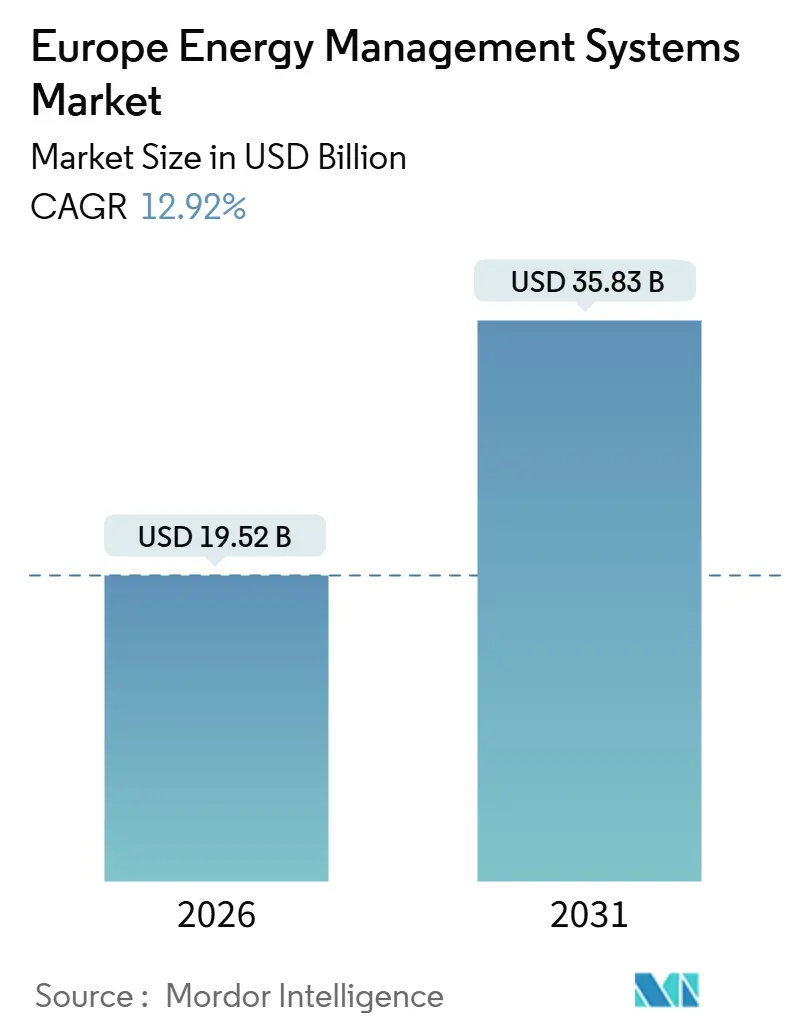
| Market Size (2026) | USD 19.52 Billion |
| Market Size (2031) | USD 35.83 Billion |
| Growth Rate (2026 - 2031) | 12.92 % |
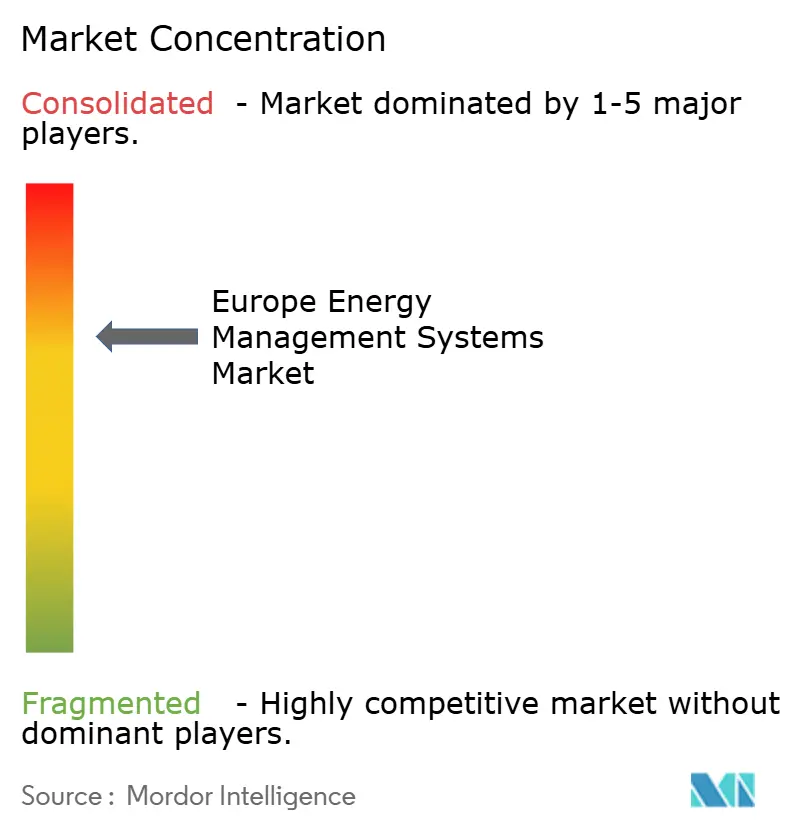
| Market Concentration | Medium |
Major Players *Disclaimer: Major Players sorted in no particular order Image © Mordor Intelligence. Reuse requires attribution under CC BY 4.0. | |
Europe Energy Management Systems Market Analysis by Mordor Intelligence
The Europe energy management systems market size is USD 19.52 billion in 2026 and is projected to reach USD 35.83 billion by 2031, translating into a 12.92% CAGR over the period. The upward trajectory is anchored by binding EU efficiency mandates, surging corporate net-zero pledges, and a rapid shift toward AI-enabled optimization that turns real-time load data into actionable insights. Heightened investment in smart-grid infrastructure, large-scale smart-meter rollouts, and the growing appeal of demand-response revenues strengthen the expansion path, while software-defined architectures lower entry costs for smaller enterprises. Competitive dynamics remain intense as hardware incumbents defend their installed bases against cloud-native challengers courting clients seeking vendor-agnostic solutions. Early adopters in Germany, France, and the Nordics are achieving double-digit efficiency gains, creating proven business cases that are now rippling across Southern and Eastern Europe.
Key Report Takeaways
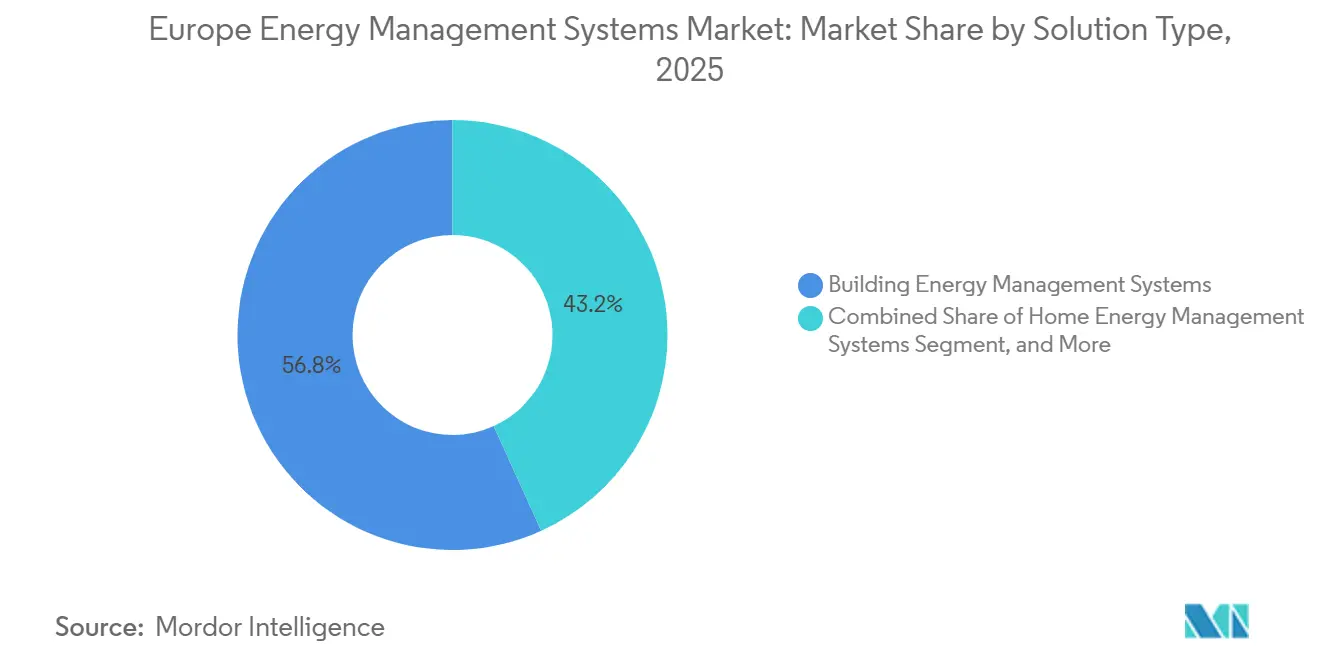
- By solution type, building energy management systems led with 56.78% of the Europe energy management systems market share in 2025, while home energy management systems are forecast to expand at a 13.89% CAGR through 2031.
- By component, hardware accounted for 47.93% of spending in 2025, but software is expected to advance at a 13.66% CAGR through 2031.
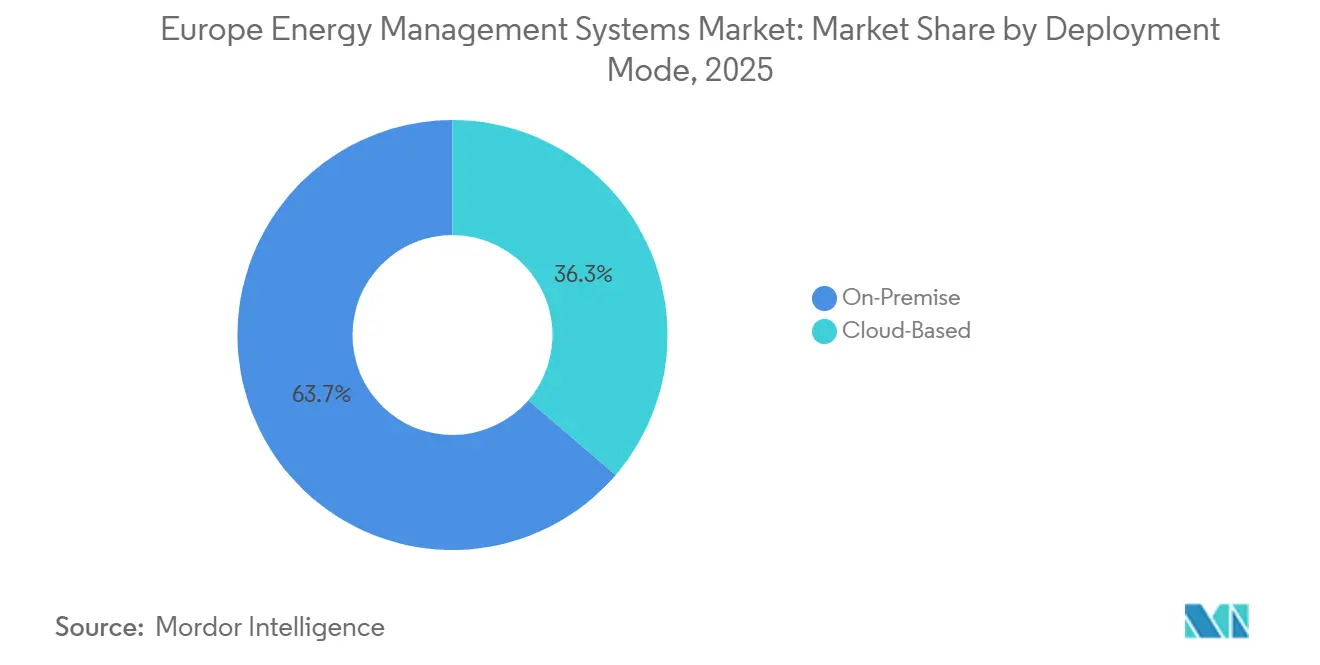
- By deployment mode, on-premises installations accounted for 63.71% of the Europe energy management systems market share in 2025, whereas cloud-based platforms are projected to grow at a 13.47% CAGR through 2031.
- By end user, commercial and retail sites accounted for 39.63% of the Europe energy management systems market share in 2025, yet the residential segment is poised for the fastest 14.11% CAGR over the forecast period.
- By country, Germany captured 25.71% of regional revenue in 2025, while Spain is set to post the highest CAGR of 14.67% through 2031.
Note: Market size and forecast figures in this report are generated using Mordor Intelligence’s proprietary estimation framework, updated with the latest available data and insights as of January 2026.
Market Trends and Insights
Drivers Impact Analysis of Europe Energy Management Systems Market*
| Driver | (~) % Impact on CAGR Forecast | Geographic Relevance | Impact Timeline |
|---|---|---|---|
| Growing Deployment of Smart-Grid Infrastructure | +2.3% | Germany, France, Nordics, Benelux, Spain | Medium term (2-4 years) |
| EU Fit-for-55 Energy-Efficiency Mandates | +3.1% | All member states, strongest in Germany, France, Italy | Short term (≤ 2 years) |
| Corporate Net-Zero Targets Accelerating EMS Adoption | +2.0% | United Kingdom, Germany, Nordics, Southern Europe | Medium term (2-4 years) |
| Building-Level AI and ML Optimization of HVAC Loads | +1.8% | Germany, France, United Kingdom, Spain, Italy | Long term (≥ 4 years) |
| Rise of Flexibility Markets and Demand-Response Revenues | +1.5% | Spain, Germany, France, Italy, Nordics | Medium term (2-4 years) |
| Edge-to-Cloud Cybersecurity Toolkits Reducing Project Risk | +1.3% | Pan-European, pivotal for industry and healthcare | Short term (≤ 2 years) |
| Source: Mordor Intelligence | |||
Growing Deployment of Smart-Grid Infrastructure
European transmission and distribution operators have earmarked EUR 584 billion for grid upgrades this decade, allocating nearly 40% to digital technologies that turn passive meters into intelligent endpoints.[1]ENTSO-E, “Ten-Year Network Development Plan 2024,” entsoe.eu Germany’s goal to install 50 million smart meters by 2032, combined with France’s completed Linky rollout, provides a granular data backbone that enables energy management platforms to optimize loads in 15-minute increments and synchronize with wholesale market price signals. Nordic utilities already coordinate EMS with district-heating loops, trimming peak demand by up to 12%. These successes validate business cases elsewhere, encouraging Spain and Benelux network operators to fast-track advanced metering. As two-way communication matures, buildings equipped with EMS shift from energy takers to grid assets, capturing new revenue streams from balancing and capacity markets.
EU Fit-for-55 Energy-Efficiency Mandates
Directive 2023/1791 requires enterprises that use more than 85 TJ annually to install certified energy management systems, instantly expanding the mandatory addressable base to roughly 12,000 industrial facilities.[2]European Commission, “Energy Efficiency Directive (EU) 2023/1791,” energy.ec.europa.eu The revised buildings directive slashes the HVAC threshold to 290 kW, adding millions of square meters of retail, hospitality, and office space to the compliance roster. Member states transposed the rules into national codes at record speed. Germany’s Gebäudeenergiegesetz, France’s Décret Tertiaire, and Spain’s Real Decreto 390/2021 each impose aggressive retrofit schedules backed by escalating fines. Because penalties outweigh project paybacks, chief financial officers now classify EMS spending as regulatory capital rather than a discretionary outlay, accelerating procurement cycles from years to quarters.
Corporate Net-Zero Targets Accelerating EMS Adoption
More than 1,400 European firms have validated science-based emissions pathways, and electricity purchases represent up to half of their footprints.[3]Science Based Targets initiative, “Companies Taking Action,” sciencebasedtargets.org EMS platforms provide real-time telemetry that CFOs need to keep production output steady while staying within annual carbon budgets. Surveys show 68% of finance chiefs now rank efficiency investments above other green projects due to quick returns and lower technology risk. Pharmaceutical cleanrooms, automotive paint lines, and grocery refrigeration aisles have already documented double-digit electricity cuts within 18 months of deployment, reinforcing internal confidence in further rollouts and spurring peer benchmarking across sectors.
Building-Level AI and ML Optimization of HVAC Loads
HVAC accounts for 40-60% of commercial energy use, making it fertile ground for machine-learning optimization. Cloud-hosted engines ingest weather forecasts, occupancy trends, and equipment telemetry to recalibrate setpoints every few minutes, routinely shaving 8-15% from electricity bills. Edge computing now embeds inference chips directly in controllers, letting buildings self-tune even if cloud links go down. Early pilots in premium offices, hospitals, and data centers demonstrate consistent savings, but legacy hardware in smaller properties still poses integration hurdles. Vendors respond with retrofit kits that translate proprietary field protocols into open APIs, narrowing the performance gap between blue-chip flagships and mass-market adopters.
Restraints Impact Analysis of Europe Energy Management Systems Market*
| Restraint | (~) % Impact on CAGR Forecast | Geographic Relevance | Impact Timeline |
|---|---|---|---|
| Fragmented Country-Level Building Codes | -1.2% | Entire region, most acute in Southern and Eastern Europe | Medium term (2-4 years) |
| Skill-Set Shortage for Advanced Analytics | -0.9% | Germany, France, United Kingdom, Nordics | Long term (≥ 4 years) |
| Interoperability Gaps Across Legacy BMS Protocols | -0.7% | Italy, Spain, United Kingdom, older stock | Medium term (2-4 years) |
| Inflation-Driven Capex Deferrals in SMEs | -0.8% | Spain, Italy, Central Europe | Short term (≤ 2 years) |
| Source: Mordor Intelligence | |||
Fragmented Country-Level Building Codes
While EU directives set high-level goals, each member state specifies its own technical test points, sensor densities, and inspection cadences, creating 27 parallel compliance tracks. Vendors must customize firmware and documentation to satisfy divergent national norms, adding as much as 30% to integration costs and 18 months to go-to-market timelines. Smaller suppliers struggle most, effectively ceding pan-regional deals to large incumbents that can absorb the overhead. Harmonization efforts are underway, but until a common rulebook emerges, deployment speed in Southern and Eastern Europe will lag behind that of the core markets of Germany and France.
Skill-Set Shortage for Advanced Analytics
Machine-learning tools unlock the next wave of savings, but they demand talent versed in time-series modeling, thermodynamics, and cloud orchestration. Europe is short roughly 150,000 such specialists, and energy firms compete head-to-head with finance and tech for recruits. Facilities managers steeped in mechanical systems often lack Python or TensorFlow expertise, forcing vendors to bundle managed services, which drives up the total cost of ownership. National training programs and university curricula will eventually fill the gap, yet most will not graduate cohorts before 2027, constraining near-term scaling.
*Our forecasts treat driver/restraint impacts as directional, not additive. The impact forecasts reflect baseline growth, mix effects, and variable interactions.
Europe Energy Management Systems Market Segment Analysis
By Solution Type:
Residential HEMS Gains MomentumThe Europe energy management systems market generated its highest revenue from building energy management systems in 2025, capturing 56.78% of total revenue, thanks to decades-old installations in offices, factories, and hospitals. Growth, however, is tilting toward home energy management systems, which boast a 13.89% forecast CAGR as heat-pump subsidies proliferate and dynamic tariffs create lucrative arbitrage windows for households. Europe installed more than 3 million new residential heat pumps in 2024, and smart meters now cover over 70% of dwellings in several member states, providing HEMS with the data granularity needed for automated load shifting.
Momentum builds further because the Energy Performance of Buildings Directive requires a smart-readiness label for every new home from 2027. Platforms such as Schneider Electric’s Wiser Home already equip half a million European residences with predictive scheduling that cuts gas use by up to 12%. Industrial EMS solutions, while slower-growing, remain critical for heavy-process sectors where energy equals 30-40% of operating costs. Niche categories, including data-center power optimization, round out the mix, underscoring how the Europe energy management systems market continues to diversify across building classes and use cases.



By Component:
Software Outpaces Hardware GrowthHardware controlled 47.93% of component revenue in 2025, covering sensors, gateways, and actuators that form the nervous system of an EMS. Software, however, is the star performer with a projected 13.66% CAGR, propelled by cloud analytics that monetize anonymized multi-site datasets and enable subscription pricing. Digital twins, portfolio dashboards, and open APIs that sync with BIM and ERP suites transform raw data into executive-ready KPIs. Vendors now preload edge controllers with flexible compute blocks that host local AI models, blending real-time control with cloud-level insight for resilience and bandwidth savings.
Services revenue holds steady as integrators bundle design, commissioning, and analytics management, yet self-service portals and automated device discovery are slowly compressing margins. The shift toward code-heavy value propositions mirrors broader Industry 4.0 trends, ensuring that software will continue to expand its share of the Europe energy management systems market even as hardware upgrades roll out.
By Deployment Mode:
Cloud Architectures Gain ShareOn-premises implementations accounted for 63.71% of the market in 2025, reflecting historical preferences for isolated networks and direct control. Cloud deployments, advancing at a 13.47% CAGR, cut upfront spending and deliver evergreen feature updates without local server maintenance. ISO 27001-certified hyperscale data centers now exceed the cyber-compliance thresholds that once favored air-gapped designs, opening doors even in rigorously regulated verticals such as pharmaceuticals and healthcare.
Hybrid frameworks blend edge gateways for sub-second control with cloud analytics for fleet-wide benchmarking, matching Germany’s data-residency rules while preserving cross-site learning loops. The European Data Act, effective in 2025, further boosts adoption by mandating data portability, reducing lock-in concerns, and prompting multi-tenant property managers to migrate legacy on-premises stacks to the cloud.
By End-User:
Residential Segment Leads GrowthCommercial and retail facilities dominated demand in 2025, with a 39.63% share, driven by office landlords seeking LEED, BREEAM, and WELL certifications and by supermarket chains optimizing refrigeration systems. The residential slice is forecast to register the fastest CAGR of 14.11%, supported by smart-meter saturation, renewable self-consumption schemes, and app-centric user experiences that resonate with tech-savvy homeowners. France’s MaPrimeRénov grants and Spain’s 40% heat-pump subsidy catalyze consumer uptake, while United Kingdom households prepare for Future Homes Standard requirements that effectively embed HEMS at the construction stage.
Industrial plants, healthcare campuses, and public institutions round out the user landscape, each driven by sector-specific mandates and incentives. Industrial players exploit EMS to synchronize energy with production cycles and to bid flexibility into capacity markets, whereas hospitals value continuous compliance with temperature and humidity. Government buildings leverage EMS to showcase fiscal prudence and meet climate targets, underscoring the multifaceted appeal of the Europe energy management systems market across stakeholder groups.
Geography Analysis
Germany and Spain Energy Management Systems Market
Germany’s leadership stems from the Energiewende framework, which mandates 4-year industrial audits and demands automation in non-residential buildings above 290 kW of HVAC. Manufacturing, which accounts for 28% of the nation’s power consumption, has documented 9-13% energy savings by leveraging EMS to coordinate motor drives and chillers. Spain’s emergence as the fastest-growing economy correlates with renewables delivering 60% of its 2025 electricity mix; EMS orchestrate load shifting and battery dispatch to counterbalance intermittent wind and solar output.
United Kingdom and France Energy Management Systems Market
The United Kingdom’s Future Homes Standard compels builders to slash residential carbon footprints by 75%, driving HEMS integration with heat pumps and rooftop PV as the default. France confronts a building stock in which 60% predates modern energy-efficiency codes; the MaPrimeRénov program funnels billions into insulation, heating upgrades, and EMS retrofits, unlocking large-scale savings potential.
Broader European Markets
Italy grapples with a post-Superbonus hangover that briefly cooled residential demand, yet scaled-back tax deductions still fund 65% of EMS retrofit costs, and new loan-bundling models keep pipelines active. Nordic nations exploit advanced district-heating networks, deploying EMS to manage thermal tanks that soak up surplus wind energy and release it on peak winter evenings, lifting overall system efficiency by nearly 18%. In Benelux markets, which are dense and highly interconnected, firms explore price-arbitrage algorithms that capitalize on cross-border wholesale differentials. Central Europe, fueled by the European Investment Bank’s modernization line, accelerates public-building retrofits, inching closer to Western performance benchmarks.

Regulatory Landscape
EU policy is tightening compliance around metering, controls, and energy performance reporting, which is pushing EMS from a cost-saving tool toward a compliance-driven mechanism. Under the Energy Efficiency Directive (EU) 2023/1791, member states must transpose rules by 11 October 2025, including requirements tied to energy audits and the use of energy management systems aligned with international standards. The directive also establishes thresholds that bring large energy consumers and parts of the public sector into scope.
Buildings policy is raising the minimum digital-control baseline as well. Directive (EU) 2024/1275 expands requirements for building automation and control systems in non-residential buildings where technically and economically feasible, and from 29 May 2026 it introduces requirements for smart control systems in new residential buildings and those undergoing major renovations (where feasible) for space heating, cooling, and hot water. On the electricity retail side, Commission Implementing Regulation (EU) 2026/855, adopted 14 April 2026, sets interoperability requirements and data access procedures supporting faster customer switching (24-hour target), which reinforces the need for interoperable EMS architectures and secure data exchange.
Value Chain Analysis
The value chain covers sensing and control hardware (meters, submeters, sensors, gateways, controllers, actuators), connectivity and protocols, and software layers for data ingestion, device management, analytics, optimization, and digital twins. Delivery channels across Europe also include system integrators, ESCOs, utilities, and OEM service arms. Compliance and performance verification bring in audit and certification workflows aligned with EN ISO 50001 and EN 16247-1, and buyers increasingly bundle software subscriptions and managed analytics into multi-year service contracts rather than treating EMS as a one-off capex project.
Interoperability and grid-facing readiness are becoming gating factors across the chain. EU DSO Entity work on supply-chain resilience highlights the cost and lead-time burden of non-harmonized technical requirements for grid technologies, while the Horizon Europe INDEPENDENT project (IDOP) targets standard-compliant Customer EMS and Aggregator EMS interoperability across large vendor ecosystems that include dozens of EMS and smart appliance suppliers. Commercial collaborations, such as Kaluza and ENGIE for distributed asset optimization and TotalEnergies with Emerson’s Aspen Technology for industrial data infrastructure, further point to tighter integration between operational data fabrics and EMS optimization capabilities.
Competitive Landscape
The Europe energy management systems market is moderately fragmented. The top five manufacturers, Schneider Electric, Siemens, Honeywell, ABB, and Johnson Controls, collectively account for roughly 40-45% of 2025 revenue. These incumbents leverage massive installed bases and long-standing maintenance contracts to upsell cloud analytics and machine-learning add-ons. Software-native players, exemplified by C3.ai, mCloud, and Veritone, court customers with hardware-agnostic platforms that integrate via open APIs, sidestepping proprietary gateways. Utilities and energy-service companies such as Enel X and ENGIE Digital bundle EMS within broader demand-response aggregation offerings, winning clients who prefer outcome-based contracts over capital purchases.
Patent filings under the European Patent Office’s G06Q 50/06 class jumped 22% between 2023 and 2025, showcasing intense R&D around HVAC reinforcement learning, blockchain-verified energy trades, and OT cybersecurity. The small and medium enterprise segment remains white space; firms with annual energy bills below EUR 500,000 often lack expertise to tune algorithms, encouraging disruptors to offer turnkey packages with pre-configured vertical templates. Edge computing accelerates by embedding inference engines in field controllers, delivering millisecond response times vital for motor-drive optimization on factory floors.
Regulation also shapes competition. Platforms achieving IEC 62443 and ISO 27001 certifications enjoy fast-track procurement in regulated sectors, while the forthcoming Cyber Resilience Act will elevate conformity thresholds and may limit smaller vendors unable to finance third-party audits. Overall, rivalry centers on balancing cybersecurity assurances, open-system flexibility, and demonstrable ROI, setting a dynamic backdrop for the energy management systems market through 2031.
Europe Energy Management Systems Industry Leaders
Schneider Electric SE
Siemens AG
Honeywell International Inc.
ABB Ltd
Johnson Controls International plc
- *Disclaimer: Major Players sorted in no particular order
Europe Energy Management Systems Market Companies Covered in this Report
- Schneider Electric SE
- Siemens AG
- Honeywell International Inc.
- ABB Ltd.
- Johnson Controls International plc
- Panasonic Holdings Corporation
- Enel X S.r.l.
- Uplight Inc.
- SAP SE
- British Gas Services Limited
- Green Energy Options Ltd.
- Efergy Technologies SL
- Cisco Systems Inc.
- IBM Corporation
- Eaton Corporation plc
- Rockwell Automation Inc.
- ENGIE Digital
- Landis+Gyr AG
- Delta Electronics Inc.
- Trane Technologies plc
- C3.ai Inc.
- GridPoint Inc.
- mCloud Technologies Corp.
- Veritone Inc.

Market Opportunities and Future Outlook
Compliance-led adoption is creating a whitespace for standardized, audit-ready EMS deployments for energy-intensive enterprises and multi-site portfolios working through the Energy Efficiency Directive (EU) 2023/1791 and national transpositions. Vendors that package EN ISO 50001-aligned workflows, automated evidence trails, and portfolio dashboards can reduce the internal burden of audits and ongoing performance reporting, especially where fragmented country-level building codes add to documentation and commissioning complexity.
Interoperable flexibility enablement is another near-term opportunity area, since EMS value increasingly depends on participation in demand response and aggregated flexibility programs rather than standalone savings. The European Commission-backed INDEPENDENT project and its interoperability-focused platform work (CEMS and AEMS integration) offers a concrete indication of where buyer requirements are heading, including standardized data models, secure exchange, and integration across legacy building systems, smart appliances, and aggregators. Project demonstrations such as Trineflex, which showcases modular AI-enabled EMS across multiple industrial applications integrating on-site renewables, storage, and load shifting, also highlight demand for solutions that combine energy optimization with distributed energy resource orchestration and actionable controls beyond monitoring.
Recent Industry Developments in Europe Energy Management Systems Market
- July 2026: ABB announced a strategic minority investment in Gridcog to strengthen capabilities in energy modeling and optimization for distributed energy resources and microgrids. The move expands ABBs software-led toolkit around planning and operational analytics, aligning EMS deployments with DER-heavy sites that need tighter forecasting, scenario analysis, and controls integration.
- June 2026: Johnson Controls launched Metasys 16.0 with updated building automation capabilities that include integrated energy analytics, peak load management, and enhanced cybersecurity features. The release reinforces the shift toward BMS platforms that embed EMS functions and security controls into the core stack, supporting customers that need continuous monitoring and control across high-performance environments.
- April 2024: Directive (EU) 2024/1275 was adopted as the revised Energy Performance of Buildings framework, strengthening requirements connected to building automation and smart controls across parts of the building stock. The policy direction increases the addressable base for EMS-enabled controls in both non-residential buildings and, through later applicability provisions, new residential buildings and major renovations where smart control systems are feasible.


Europe Energy Management Systems Market Report Scope and Research Methodology
Market Definition and Coverage
For this study, the Europe energy management systems market is defined as revenues earned from hardware, software, and related services used to monitor, control, and optimize energy use in buildings, homes, and industrial facilities across Europe.
Scope exclusions: We exclude stand-alone utility SCADA platforms and wholesale energy-trading applications, even if they touch energy data.
Segments Covered in This Report
- By Solution Type
- Building Energy Management Systems
- Home Energy Management Systems
- Industrial Energy Management Systems
- Other Solution Types
- By Component
- Hardware
- Software
- Services
- By Deployment Mode
- On-Premise
- Cloud-Based
- By End-User
- Commercial and Retail
- Residential
- Industrial Facilities
- Healthcare
- Other End-Users
- By Country
- United Kingdom
- Germany
- France
- Italy
- Spain
- Benelux
- Nordics
- Rest of Europe
Data Sources, Market Sizing, and Validation
Desk Research
Desk research started with aligning the market boundary and building a country view for Europe, followed by collecting public indicators that explain EMS demand. We referred to sources such as Eurostat energy balance statistics, EU directives and policy trackers (including energy efficiency and building performance rules), national energy agency publications, and technical standards bodies that influence metering and building controls.
To convert these signals into market inputs, we also reviewed company annual reports and investor presentations, association websites for building automation and smart energy, and reputable press coverage for project pipelines and adoption stories. For cross-checking company scale and corporate actions, we used our paid subscriptions for company financials and news intelligence, plus patent databases to sanity-check technology diffusion. These examples are not exhaustive, and many other public and paid sources were also used for data collection, validation, and clarification.
Primary Interviews and Surveys
Primary work focused on validating what buyers actually purchase in Europe and how pricing is moving, since EMS deals can vary by site size, integration depth, and service add-ons. We spoke with a mix of solution providers, system integrators, facility operators, and industrial energy managers across major European markets, and we revisited conversations when desk inputs showed unusual jumps or drops.
These discussions helped fill gaps around typical contract mix (hardware vs software vs services), cloud deployment share, and how energy price volatility and compliance timelines are affecting decision cycles.
Distribution of primary research fieldwork respondents
| Company type | Respondent position |
|---|---|
| Top tier: 29% | CXOs: 14% |
| Mid tier: 51% | Functional/Unit leaders: 37% |
| Smaller Players: 20% | Managers: 49% |
Market-Sizing & Forecasting
Sizing used a top-down and bottom-up approach, where Europe demand was reconstructed from the addressable building and industrial energy-use footprint, then filtered through EMS adoption and spending intensity by country. The model was then cross-checked with selective bottom-up approximations, such as sampled deal values, typical annual software and service fees per site, and channel checks on project volumes, which helped correct overstatement in smaller countries.
Inputs used in the model included electricity and gas price trends by country, non-residential floor space and new build or retrofit activity, industrial output trends for energy-intensive sectors, penetration of smart meters and building controls, and the typical share of spending that sits in services versus software after commissioning. For the forecast, scenario analysis was used so that faster and slower paths can be tested based on energy price normalization, compliance deadlines, and the pace of cloud migration. Where data was thin, gaps were handled by using peer-country analogs and then re-validating with primary inputs before finalizing totals.
Data Validation & Update Cycle
Model outputs were checked against independent signals such as country energy consumption patterns, investment cycles in building upgrades, and reported revenue direction from relevant supplier groups. When a segment-level result moved too far from these signals, assumptions were reopened and the supporting sources were re-read, followed by targeted re-contact with interviewees to confirm what changed.
Each report goes through multi-step internal review, including a second analyst pass for variance checks and a final sign-off review for logic and math consistency. Reports are refreshed annually, and interim updates are made when material policy changes, pricing shifts, or major deployment trends show up in the market. Before delivery, we run a last update pass so clients receive the latest view.
Mordor Intelligence's Europe Energy Management Systems Market Market Sizing Compared With Other Published Estimates
Different published market sizes for Europe energy management systems can look far apart because the scope and timing choices are not the same, even when the market name is identical. Common causes include whether utility-side platforms get counted, how services are treated, which countries are included, and how the currency conversion year is handled.
In this study, the refresh cycle and the currency timing were treated as first-order choices, and average selling price logic was re-checked against recent deal structures before final totals were locked, which is why the numbers line up tightly with near-term demand signals for Mordor Intelligence.
Benchmark comparison
| Source | Market Size | Gaps in Research Methodology |
|---|---|---|
| Mordor Intelligence | USD 19.52 B (2026) | |
| Regional Consultancy A | USD 14.90 B (2024) | Uses an earlier base year and may include broader solution buckets like utility billing and customer information systems, which can shift totals, and it is not always clear how multi-year service revenues are recognized. |
| Trade Journal B | USD 14.01 B (2024) | Tends to anchor on component splits and country groupings that can undercount managed services and integration-heavy deployments, and the currency conversion timing can differ from the year in which contracts were priced. |
The spread across the three figures mainly comes from base-year selection, what gets counted alongside EMS (especially utility-adjacent software), and how services and currency are treated. By keeping the scope tied to facility-level EMS revenues and checking pricing and contract mix during updates, the final view stays easier to trace back to clear inputs and repeatable steps.


Key Questions Answered in the Report
How large is the Europe energy management systems market in 2026?
The market is valued at USD 19.52 billion in 2026 and is forecast to climb to USD 35.83 billion by 2031.
What CAGR is projected for Europe through 2031?
The Europe energy management systems market is expected to register a 12.92% CAGR over 2026-2031.
Which solution type commands the largest share today?
Building energy management systems led the region with a 56.78% revenue share in 2025.
Which segment will grow fastest over the forecast period?
Home energy management systems are projected to post the quickest 13.89% CAGR through 2031.
Which country will see the highest growth?
Spain is forecast to grow at a 14.67% CAGR, outpacing all other European markets through 2031.
Why are cloud deployments gaining traction?
Certified hyperscale platforms now meet strict cyber-compliance rules, cut capital outlay, and enable machine-learning upgrades, driving a 13.47% CAGR for cloud architectures.
Page last updated on:


 Your data is secure and never sold or shared.


