
Bicycle Market Analysis by Mordor Intelligence
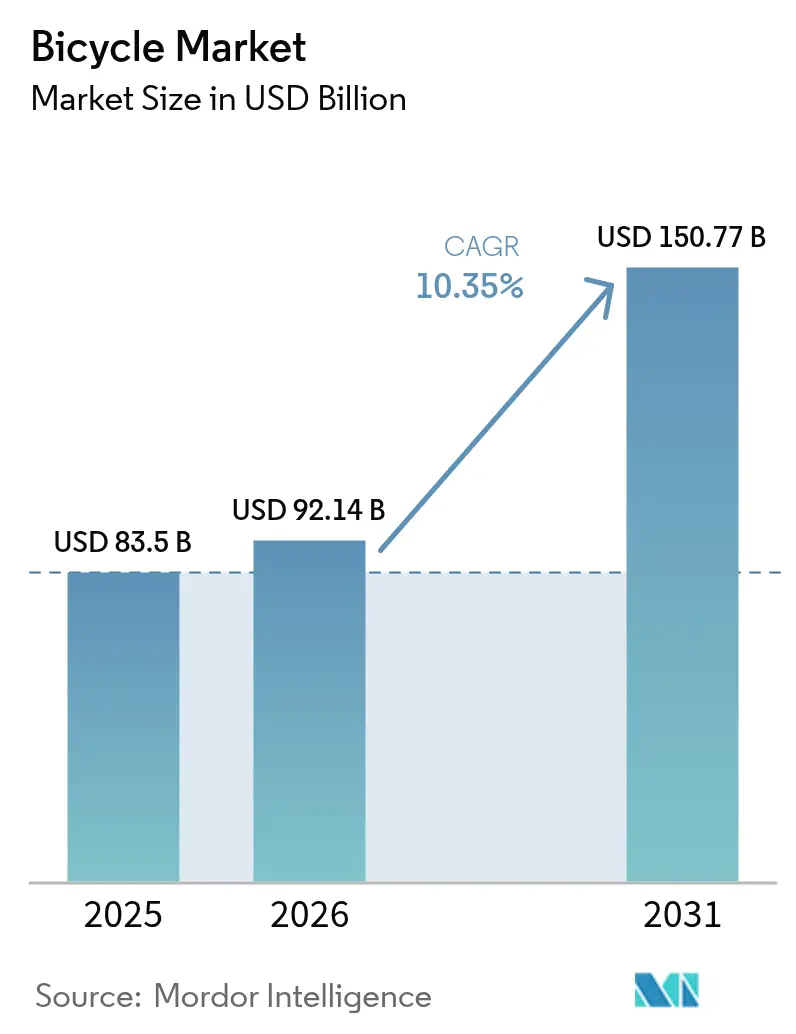
The bicycle market size is expected to grow from USD 92.14 billion in 2026 to USD 101.7 billion in 2027 and is forecast to reach USD 162.1 billion by 2032 at 9.78% CAGR over 2027-2032.
Congestion and fitness-related riding support purchase occasions, while subsidies connect city and cargo e-bikes with Slovenian buyers. The Iran conflict began with US and Israeli strikes in Iran in February 2026, alongside shipping attacks around the Strait of Hormuz. Higher US gasoline prices strengthen the case for bicycle commuting where congestion already slows car trips. Suppliers address these uses through specialized models, low-emission aluminum sourcing and local contact alongside digital selling. Growth depends on converting riding interest into purchases despite transit alternatives, authenticity concerns and e-bike acquisition costs.
Key Report Takeaways
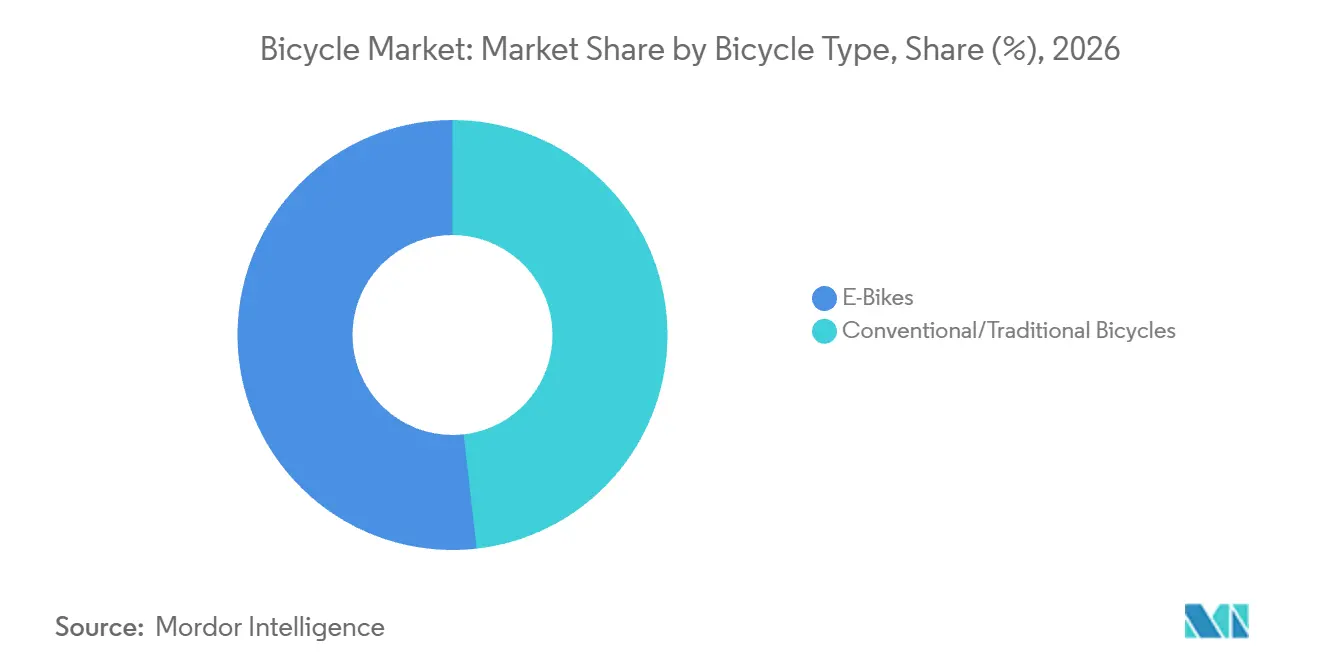
- By bicycle type, e-bikes led with a 51.79% bicycle market share in 2026 and are forecast to be the fastest-growing segment at a 12.05% CAGR over 2027-2032.
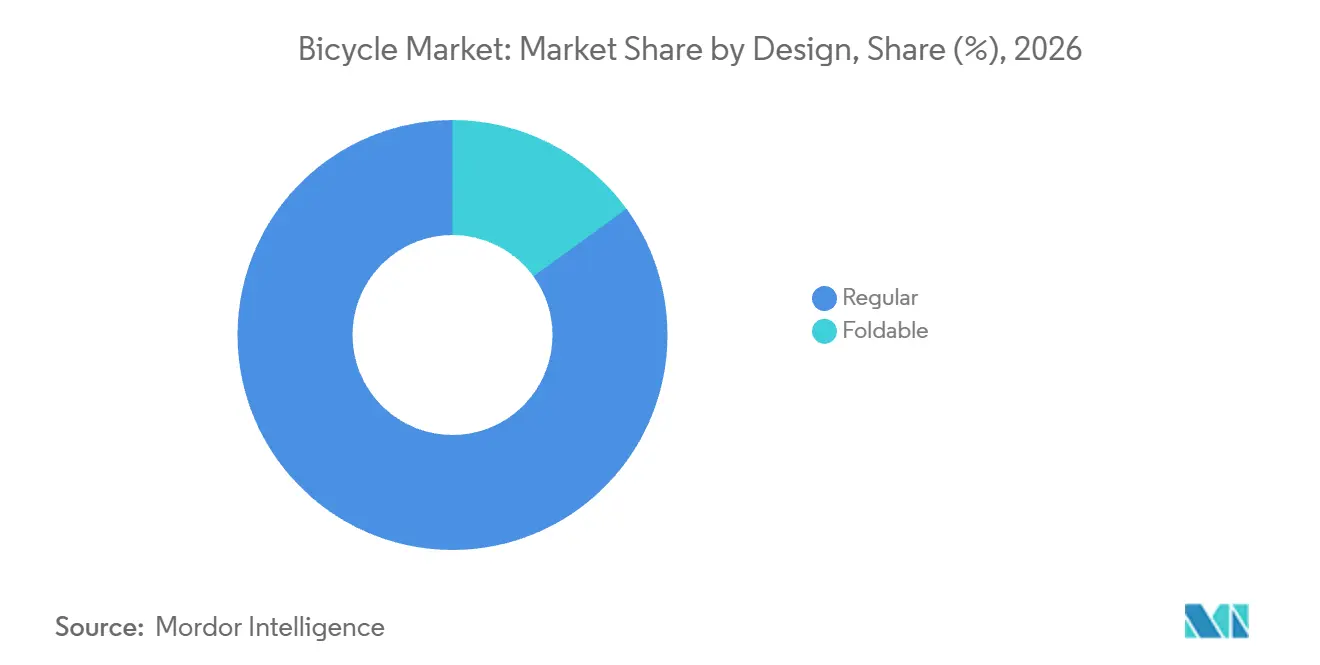
- Regular designs held an 84.99% share of the bicycle market size in 2026, while foldable bicycles are forecast to be the fastest-growing segment at a 10.72% CAGR over 2027-2032.
- Activity demand was led by road/city bicycles with 31.36% of revenue in 2026, whereas hybrid bicycles are forecast to grow fastest at an 11.2% CAGR over 2027-2032.
- In the price range breakdown, mass/budget bicycles led with 57.33% of revenue in 2026 and premium/luxury bicycles are forecast to grow fastest at a 12% CAGR over 2027-2032.
- Adults were the largest end-user group, with 69.72% of revenue in 2026, while kids' bicycles are forecast to be the fastest-growing segment at a 10% CAGR over 2027-2032.
- Among distribution channels, offline sales led with 80.07% of revenue in 2026 and online channels are forecast to grow fastest at a 12.8% CAGR over 2027-2032.
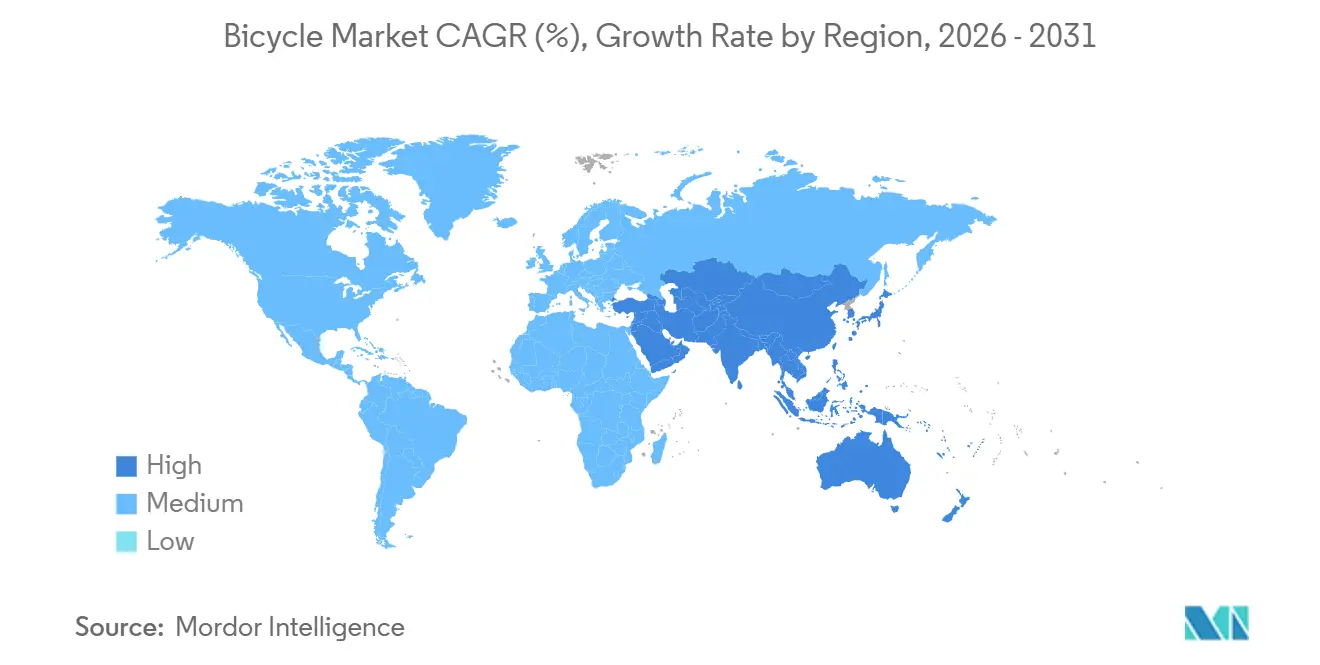
- Geographically, Asia-Pacific led with 48.82% of revenue in 2026 and is forecast to grow fastest at a 12.4% CAGR over 2027-2032.
Note: Market numbers in this report are based on Mordor Intelligence's proprietary estimation framework, which combines nine months of actuals with Q4 projections for base year 2026.
Market Trends and Insights
Drivers Impact Analysis of Bicycle Market*
| Driver | (~) % Impact on CAGR Forecast | Geographic Relevance | Impact Timeline |
|---|---|---|---|
| Urban congestion boosts bicycle usage for daily commute | +3.6% | United States and Canada | Long term (≥ 4 years) |
| Fitness trends increase popularity of cycling activities | +3.1% | Europe, including Germany | Long term (≥ 4 years) |
| Government support encourages eco-friendly transportation methods | +2.8% | Europe, including Slovenia | Medium term (2-4 years) |
| Environmental awareness and sustainability drives bicycle usage among consumers | +2.2% | France, United Kingdom, Germany, Italy, Poland and Spain | Long term (≥ 4 years) |
| Workplace wellness programs encourage employee bicycle usage | +0.9% | Europe, including Switzerland | Medium term (2-4 years) |
| Rising fuel prices make bicycles cost-effective alternatives | +0.7% | The United States | Short term (≤ 2 years) |
| Source: Mordor Intelligence | |||
Urban congestion boosts bicycle usage for daily commute
Congested commutes create a demand case for bicycles that can serve a useful part of a daily journey. TomTom measured 79 hours of annual rush-hour traffic delay in Chicago in 2025, up 5 hours 6 minutes from 2024. Its coverage included metropolitan and central-city roads, including fast roads and highways. Toronto's 1,660-response cycling survey, conducted from November 5, 2025, through January 9, 2026, found that 5% of respondents used bikes or e-bikes as their primary commuting mode. Another 39.6% said they combined cycling with public transit at least sometimes. Mixed bicycle-transit journeys give commuter-bike suppliers a route to relevance without requiring the bicycle to replace the entire commute.
Fitness trends increase popularity of cycling activities
Fitness-related demand creates a clearer selling opportunity when a riding motivation connects with a specific intended bicycle purchase. In Germany's 2025 Cycling Monitor, 62% of respondents who cycled more often than in childhood or youth cited health motives for the increase. Most respondents, however, reported cycling less often than in their younger years. Separately, 14% of 598 purchase or lease planners named a sports bike among the types they expected to acquire in the following 12 months. The survey covered German residents aged 14 to 69, and the purchase question allowed multiple bicycle types. Sports-bike purchase plans therefore provide a more concrete commercial target than treating every health-motivated rider as a prospective purchaser.
Government support encourages eco-friendly transportation methods
Purchase subsidies reduce the acquisition burden and can make a bicycle's transport function easier for a buyer to fund. Slovenia's Ministry of Infrastructure and Energy subsidized purchases of more than 18,000 city and cargo e-bikes over 3 years through August 2026.[1] Borzen administers the subsidy application call. The ministry said the subsidies contributed to more frequent commuting to work by more sustainable means. Because the reported subsidy applies to city and cargo e-bikes, its commercial pull is concentrated among suppliers of those two formats.
Environmental awareness and sustainability drives bicycle usage among consumers
Environmental concerns can strengthen the appeal of bicycles when riders connect everyday travel choices with their desired environmental footprint. In OpinionWay's June 2025 survey for Decathlon, 64% of bicycle users aged 18 to 28 across France, the United Kingdom, Germany, Italy, Poland, and Spain cited reducing their environmental footprint among their cycling motivations. The surveyed population included people who cycled only rarely. For suppliers addressing these young riders, the opportunity is to connect that motivation with a bicycle's intended everyday use. The sampled riders aged 18 to 28 in those 6 European countries provide a defined audience for sustainability-led positioning.
Restraints Impact Analysis of Bicycle Market*
| Restraint | (~) % Impact on CAGR Forecast | Geographic Relevance | Impact Timeline |
|---|---|---|---|
| Availability of substitute like bikes, and other faster transport modes discourages the use of bicycle | -1.4% | Europe, including France | Medium term (2-4 years) |
| Presence of counterfeit bicycles hinders market growth | -1.1% | China, Europe and North America | Medium term (2-4 years) |
| High e-bike cost restricts wider adoption globally | -0.6% | The United Kingdom | Short term (≤ 2 years) |
| Poor road conditions in rural areas hinder smooth bicycle experience | -0.4% | North America, Europe and Asia-Pacific | Long term (≥ 4 years) |
| Source: Mordor Intelligence | |||
Availability of substitute like bikes, and other faster transport modes discourages the use of bicycle
Access to an established commuting alternative can weaken the case for acquiring a bicycle specifically for the journey to work or study. A study published in 2025 of students at 17 institutions in Lyon, France, found that public-transport season-ticket possession reduced the modeled likelihood of bicycle commuting. The substitution effect was stronger for shared bicycles than for privately owned bicycles. The model also identified residential location, shared-bike accessibility and home-campus distance as strong influences on active travel choice. Private-bicycle sellers serving those Lyon students therefore face an alternative commuting option that can weaken the use case for ownership, even though substitution was stronger for shared bicycles.
Presence of counterfeit bicycles hinders market growth
Authenticity uncertainty can complicate a bicycle purchase even when the buyer has already chosen a preferred brand. Specialized Bicycle Components Inc. says that uncertainty over whether a new bicycle is an authentic Specialized product can make buying it stressful. For legitimate sellers, this adds a task of establishing the complete bicycle's identity before its riding characteristics can carry the purchase decision. In 2025, Specialized raised concerns with AliExpress, which shared information with Chinese law enforcement in an investigation that shut down 2 facilities producing counterfeit frames and parts. Enforcement against an illicit component producer does not itself resolve the separate authenticity question facing the buyer of a complete branded bicycle.
*Our forecasts treat driver/restraint impacts as directional, not additive. The impact forecasts reflect baseline growth, mix effects, and variable interactions.
Bicycle Market Segment Analysis
By Bicycle Type:
Electric Scale Supports a Broadening OfferE-bikes accounted for a 51.79% share of the bicycle market size in 2026 and are forecast to grow at a 12.05% CAGR over 2027-2032, making them the largest segment and fastest-growing segment by bicycle type. Around 2 million e-bikes were sold in Germany in 2025. That annual volume supports treating electric bicycles as a core offering, with an established sales base around which producers and retailers can organize their businesses. For suppliers, the opportunity combines serving that operating scale with deciding which electric model range can justify the next purchase.
German e-bike sales also rose around 2% in the first half of 2026 compared with the first half of 2025. Conventional bicycles had a distinct purchase audience in Germany's 2025 Cycling Monitor, with 26% of potential buyers selecting them for a planned purchase or lease in the following 12 months. That stated preference gives a conventional offer a separate commercial purpose alongside electric growth. Retailers can address the choice through distinct electric and conventional model ranges, allowing each type to compete on the riding purpose the prospective buyer intends it to serve.

By Design:
Regular Frames Lead While Folding Adds Riding ScopeRegular bicycles were the largest design segment, accounting for 84.99% of revenue in 2026. For a commuter who can store a full-size bicycle at home and work, the buying decision can center on riding position and carrying needs. A recreational rider may prioritize handling on the intended route while using the same broad frame format. Regular design can therefore span distinct buyer requirements, allowing suppliers to specialize their offers by riding task within the largest design segment.
Foldable bicycles are forecast to be the fastest-growing segment at a 10.72% CAGR over 2027-2032. Brompton Bicycle Ltd sold 6,707 G Line folding gravel bikes in the year ended March 31, 2025, representing 9% of its bicycle sales by volume. Its gravel orientation supplies a distinct recreational application within a foldable product. Folding can address handling of the bicycle between rides, while the riding category gives it a defined activity. The model launched in autumn 2024 in the United Kingdom and Europe, so its contribution by March 2025 shows that recreational specialization can establish a sales base within a folding range.
By Activity:
City Use and Mixed Terrain Create Different Buying CasesRoad/city bicycles represented a 31.36% bicycle market share in 2026, making them the largest activity segment. Smovengo, INDIGO Group's wholly owned subsidiary, reported 148 million kilometers covered by its Vélib' Métropole network in 2025. The urban bicycle-hire program operated 1,500 stations in 70 towns of Greater Paris. Electrically assisted bicycles made up 40% of its 20,500-bicycle fleet, placing assisted and conventional city bicycles within the same urban hire network.
Hybrid bicycles are forecast to be the fastest-growing segment at an 11.2% CAGR over 2027-2032. Radvance Cayman Limited's draft, incomplete and subject-to-change listing application reported TENWAYS Group distributor sales of 5,878 hybrid e-bikes in the 9 months ended September 30, 2025, versus 5,703 in the same period of 2024. The group defined these bicycles by trekking and mountain-biking features for paved and mixed terrain. The buyer gains an e-bike specified for paved travel and light off-road riding, so the supplier can organize its offer around varied routes rather than one terrain.
By Price Range:
Budget Discipline and Premium Mix Support Distinct ValueMass/budget bicycles were the largest price segment, accounting for 57.33% of revenue in 2026. Russia's budget road bicycle segment recorded 10% year-on-year volume expansion in 2025. That result supplies a specific road-riding case for an affordable range, where expanding unit demand makes entry-level bicycles commercially relevant in their own right. For suppliers serving this buyer, the opportunity is to retain a road bicycle at the accessible end of the range rather than depending entirely on customers trading up to premium models.
Premium/luxury bicycles are forecast to be the fastest-growing segment at a 12% CAGR over 2027-2032. For the year ended March 31, 2025, Brompton reported an increase in average revenue per bike as consumer interest shifted toward more expensive premium models. Its total bicycle sales volume fell during the period, while the more expensive mix helped offset lost revenue. For premium suppliers, this distinguishes earning more from each bicycle from the separate task of selling more bicycles. Differentiation can therefore protect the value of the complete-bicycle offer even when unit volume falls.
By End User:
Adult Participation and Youth Specialization Support DemandAdults accounted for 69.72% of revenue in 2026, making them the largest end-user segment. Sport England reported that about 6.1 million adults aged 16 and older in England cycled for leisure or sport at least twice in a 28-day period during November 2024-November 2025. That recurring recreational audience supports an activity-focused adult offer even without a rise in the participation base. Participation was broadly unchanged over the prior couple of years. For adult leisure suppliers, this stable participation base makes replacement and changes in riding needs a more relevant buying case than assuming an influx of new cyclists.
Kids' bicycles are forecast to be the fastest-growing segment at a 10% CAGR over 2027-2032. In 2025, woom, a manufacturer of bikes for children and teenagers, sold 390,000 bikes.[2] That company scale illustrates a specialist commercial route serving young riders across more than one age group. For a buyer choosing for a young rider, the bicycle can be judged against the rider's age stage and the kind of riding it is meant for. A youth-focused manufacturer can build substantial sales without adding adult bicycles, as woom's volume illustrates.
By Distribution Channel:
Physical Transactions Coexist with Marketplace ReachOffline channels were the largest distribution segment, accounting for 80.07% of revenue in 2026. Bricks-and-mortar specialist retailers accounted for 67.4% of bicycle and e-bike distribution-channel sales in Germany in 2025. Separately, 47% of respondents aged 14 to 69 in Germany's 2025 Cycling Monitor said their most recently purchased bicycle came from a local specialist shop. For brands choosing a German sales route, the specialist shop connects a substantial measured sales channel with the place many surveyed riders made their last purchase.
Online channels are forecast to be the fastest-growing segment at a 12.8% CAGR over 2027-2032. Aliança Bike's 2026 survey of 308 Brazilian bicycle retailers, covering 2025 activity, found that more than 48% of retailers selling online used Mercado Livre. For a shop already selling digitally, marketplace access provides a route for presenting its bicycle range to a prospective buyer. Because the more than 48% share concerns retailers already selling online, marketplace use extends an existing shop's reach rather than describing a separate online-only channel.
Geography Analysis
Asia-Pacific Bicycle Market
Asia-Pacific held a 48.82% bicycle market share in 2026 and is forecast to be the fastest-growing region at a 12.4% CAGR over 2027-2032. China's bicycle sector produced 110.8 million bicycles in 2025, up 11.3% from 2024, and exported nearly 48.94 million bicycles, up 2.4% over the same period. More than 12.5 million electric bicycles were sold through China's trade-in policy in 2025. The policy channel provides a defined replacement occasion for complete electric bicycles. China's production base can serve both international distribution and domestic replacement, so the commercial opportunity depends on the route to the buyer rather than factory output alone.
In Europe, Canyon opened a Munich store in March 2025 that combined its online sales with in-person test rides and direct purchases. In North America, Canyon launched its first US Experience Partner at Pedalers Fork in Calabasas, California, in 2025, providing demonstrations, advice, sizing and service. Canada had a distinct commuting audience, with 244,000 Canadians mainly using a bicycle to reach work in 2025. Canyon's Munich store and Calabasas partner show how a direct brand can add local contact through its own retail outlet or an established local operator.
South America's rail-linked cycling use case included Trensurb's Porto Alegre metropolitan service in Brazil, whose 2025 guide permitted one clean, nonmotorized bicycle per rider. Its specified off-peak weekday windows and 5:00 a.m. to 11:00 p.m. weekend and holiday hours made boarding time a condition of that combined journey. The Middle East and Africa region has an education-access application in Ghana, where Ghana TVET Service, Trans-Saharan Industries and the Ministry of Education launched a bicycle program on May 6, 2026. The program aimed to improve learners' access to technical and vocational institutions in underserved areas of Ghana. The program launched with 100 locally assembled bicycles donated by Trans-Saharan Industries to learners in 10 schools in northern Ghana, so its bicycle supply came through an industry donor rather than retail purchase.
Regulatory Framework and Outlook
Selected jurisdictions are compared from the perspective of manufacturers and sellers of complete bicycles, including electric models where the rule applies. Product-safety requirements affect the bicycle supplied, while road-use classifications and equipment duties affect the proposition offered to its buyer. The commercial comparison weighs a workable route to compliance against the need to adapt products or selling conditions as policy changes.
Regulatory Table of Bicycle Market
| Decision factor | United States | Germany | China | Brazil | South Africa |
|---|---|---|---|---|---|
| Primary authority | Consumer Product Safety Commission | Federal-state market-surveillance authorities | State Administration for Market Regulation and Ministry of Industry and Information Technology | State traffic authorities such as Detran-RR | Traffic authorities within their jurisdictions |
| Key instruments or direction | 16 CFR Part 1512; June 2026 e-bike battery and electrical-system safety proposal | Bicycle-standard references under Decision (EU) 2026/901; Regulation (EU) 2023/988 | Mandatory electric-bicycle standard GB 17761-2024 | CONTRAN Resolution 996/2023 | National Road Traffic Regulations, regulation 192(3); adopted power-assist classification amendment awaiting commencement |
| Commercial effect | Covered conventional bicycles and certain e-bikes must meet mandatory safety requirements | Relevant published standards support a safety presumption for the risks they cover | Covered e-bikes face fire-retardancy and producer quality-control requirements | Qualifying e-bikes up to 1,000 watts and 32 kilometers per hour avoid registration, licensing, plates and driver licenses; rider safety equipment required | Yellow or white pedal, pedal-arm or spoke reflectors or reflective material required at night or when light or weather prevents road users being clearly visible at 150 meters |
| Current policy attractiveness | Medium | Medium | Medium | High | Medium |
| Future direction of policy attractiveness | Hardening | No change | No change | No change | No change |
| Source: Mordor Intelligence | |||||
The United States rates Medium for mandatory bicycle-safety compliance and Hardening because the June 2026 battery and electrical-system proposal remained proposed in October 2026. Germany rates Medium for product-safety duties with a standards-based safety presumption for covered risks, and No change reflects that compliance route and the transition for specified older references through October 27, 2027. China rates Medium for mandatory fire-retardancy and quality-control duties and No change after its completed sales transition, whereas Brazil rates High and No change for qualifying-e-bike registration exemptions with rider safety-equipment duties. South Africa rates Medium for conditional reflector duties and No change because the operative baseline continues pending a proclaimed start for the adopted motor-vehicle classification of power-assisted pedal cycles, whose exception requires pedals, an integral engine or motor, mass of no more than 30 kilograms, design speed not exceeding 25 kilometers per hour and compliance with prescribed requirements.
Value Chain Stages
The value chain compares complete-bicycle manufacturing, retail distribution and the service capability supporting bicycle use. Decathlon SE manufactures and retails bicycles in Europe, placing production and selling roles within one business. Trek Bicycle Corporation manufactures bicycle frames and sets sourcing requirements for its production partners, illustrating the manufacturer's role in defining upstream material requirements.
Value Chain Analysis Table of Bicycle Market
| Primary activity | Key participants | Value capture | Bottleneck | Resilience response |
|---|---|---|---|---|
| Complete-bicycle manufacturing | Bicycle manufacturers such as Trek Bicycle Corporation and Decathlon SE | Complete-bicycle sales | Material specifications narrow eligible sourcing choices | Qualify alternative sources against the same specifications |
| Retail distribution | Bicycle retailers such as Decathlon SE | End-user bicycle sales | Matching local selling capacity to the bicycles offered | Coordinate model availability with the outlets serving those riders |
| Service support | Bicycle service networks such as Trek Bicycle Corporation's retailer network | Bundled service revenue and subsequent repair fees | Service access depends on the reach of capable local providers | Connect the sale with a named service outlet |
| Source: Mordor Intelligence | ||||
Decathlon combines 2 company-owned factories in France and China and 125 suppliers with European bicycle retailing, bringing factory output and finished-bicycle sales into one business. Trek's worldwide network of more than 6,000 retailers helps customers choose bicycles and keep them running, placing service access within the retail relationship. A seller linking the sale to that support can retain a customer relationship after delivery.
Competitive Landscape
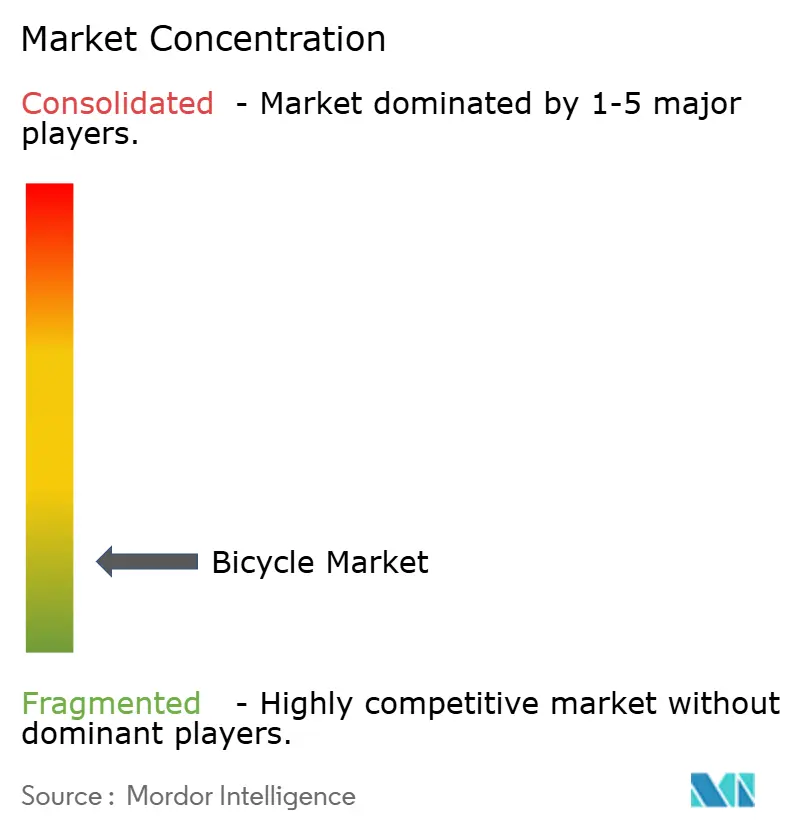
Competition spans multi-brand operations and bicycle manufacturers, including Accell Group B.V. and Trek Bicycle Corporation. Pon Holdings BV participates through Pon.Bike's worldwide brand portfolio, while Giant Manufacturing Co. Ltd manufactures bicycles and e-bikes. Specialized Bicycle Components Inc. sells bicycles, including electric models. In April 2026, Accell reported completion of its One Accell integration and streamlining of operations and distribution over the preceding 2 years. Portfolio groups such as Accell and Pon.Bike sit alongside manufacturers such as Giant and Specialized that lead with their own names, while Trek sells under the Trek, Electra and Diamant brands.
Trek's material sourcing shows a manufacturer setting requirements for its upstream aluminum partners before the bicycle is built. By October 2025, Trek reported that nearly every Trek aluminum frame used aluminum meeting its low-emission sourcing standard, which reduced the footprint of some frames by up to 70%.[3] Pon.Bike's offering combines bicycles with parts, accessories, leasing and subscriptions, with brands sold worldwide and operations primarily in Europe and the Americas. These strategies engage different counterparties, with sourcing requirements directed at production partners and leasing or subscriptions directed at consumers, employers and employees.
Accell's April 2026 update reported improved order intake as market conditions stabilized. The company described early recovery signs in road, gravel, urban and cargo categories. Accell attributed the improved order intake to positive dealer and rider feedback combined with those early recovery signs. The scheduled EU battery duty makes ready removal and replacement of batteries and individual cells by independent professionals a design requirement throughout a qualifying e-bike's lifetime. For Giant and Specialized, whose ranges include e-bikes, any such model placed on the EU market needs a battery design that supports this independent professional service.
Bicycle Industry Leaders
-
Accell Group B.V.
-
Trek Bicycle Corporation
-
Pon Holdings BV
-
Giant Manufacturing Co. Ltd
-
Specialized Bicycle Components Inc.
- *Disclaimer: Major Players sorted in no particular order
Bicycle Market Companies Covered in this Report
- Accell Group B.V.
- Trek Bicycle Corporation
- Pon Holdings BV
- Giant Manufacturing Co. Ltd
- Specialized Bicycle Components Inc.
- Shimano Inc.
- Scott Sports SA
- Merida Industry Co. Ltd
- Stryder Cycle Private Limited
- Cycles Devinci inc.
- Pending System GmbH & Co. KG
- Brompton Bicycle Ltd
- Decathlon SE
- Rad Life Mobility Inc.
- Riese & Müller GmbH
- ZEG Zweirad-Einkaufs-Genossenschaft eG
- Yadea Group Holdings Ltd
- Canyon Bicycles GmbH
- Hero Cycles Limited
- Ribble Cycles
Key Opportunities for Market Participants
The opportunities compare product readiness for a scheduled battery obligation with access to buyers supported by open purchase incentives. These routes require different commercial responses because a product requirement governs eligibility for sale, while an incentive affects the purchase terms. The EU obligation applies from February 18, 2027, to products placed on its market incorporating light means of transport batteries, reaching qualifying e-bikes wherever they are made. An effective offer must connect the qualifying bicycle with the buyer's specific policy conditions.
Market Opportunities Table of Bicycle Market
| Opportunity | Why now | Buyer / lead segment | Recommended play | Main barrier | Likely beneficiaries |
|---|---|---|---|---|---|
| Professionally replaceable e-bike battery designs | EU light means of transport battery and cell replacement requirements apply from February 18, 2027 | E-bike buyers in the EU | Offer complete bicycles whose batteries and individual cells are readily removable and replaceable by independent professionals | Validating the bicycle and battery-pack design for professional replacement | E-bike manufacturers with qualifying designs |
| Voucher-linked regional e-bike sales | Tri-Region registration opened July 6, 2026, and remains open for the program duration, expected at least into 2027 | Eligible residents in designated Arkansas and Oklahoma counties | Serve selected voucher recipients through participating retailers | Computerized random selection makes individual awards uncertain | Participating retailers supplying qualifying e-bikes |
| Time-limited incentive-linked purchases in Greece | Applications covering electric bicycle purchases run through December 31, 2026, or earlier budget exhaustion | Eligible electric-bicycle buyers in Greece | Align qualifying purchases and applications with the remaining program window | Finite funding can close applications before the final date | Suppliers and retailers of qualifying electric bicycles |
| Source: Mordor Intelligence | |||||
Professional battery replacement offers the clearest product-development opening because it concerns the bicycle's supportability throughout its lifetime. Incentive-linked selling instead requires a route from an eligible buyer to a qualifying purchase, with uncertain awards or limited funds constraining conversion. Separating these decisions lets manufacturers address the scheduled design obligation while retailers pursue the shorter purchase windows.
Recent Industry Developments in Bicycle Market
- Oct 2026: Bridgestone Cycle announced a refreshed Crossfire Junior mountain bike for planned release in Japan in late October 2026.
- Jun 2026: CPSC proposed safety requirements for lithium-ion batteries and electrical systems in e-bikes and other micromobility products.
- May 2026: Swapfiets acquired premium e-bike subscription operator Dance on May 18, 2026, combining their subscription services into a fleet of more than 75,000 e-bikes across 45 cities.
Bicycle Market Report Scope and Research Methodology
Market Definition and Coverage
The global bicycle market measures annual end-user revenue from complete bicycles sold through online and offline channels worldwide. It covers conventional and electric bicycles across designs, riding activities, price ranges, users, and regions.
Scope exclusions: Standalone bicycle parts and accessories, standalone bicycle repair services, and motorcycles, mopeds, and motorized scooters are excluded.
Segments Covered in This Report
- By Bicycle Type
- E-Bikes
- Conventional/Traditional Bicycles
- By Design
- Regular
- Foldable
- By Activity
- Road/ City
- Mountain Terrain (MTB)
- Hybrid
- Others
- By Price Range
- Mass/Budget
- Premium/Luxury
- By End User
- Adults
- Kids
- By Distribution Channel
- Online Channels
- Offline Channels
- By Geography
- North America
- United States
- Canada
- Mexico
- Rest of North America
- Europe
- Germany
- United Kingdom
- Italy
- France
- Spain
- Netherlands
- Poland
- Belgium
- Sweden
- Rest of Europe
- Asia-Pacific
- China
- India
- Japan
- Australia
- Indonesia
- South Korea
- Thailand
- Singapore
- Rest of Asia-Pacific
- South America
- Brazil
- Argentina
- Colombia
- Chile
- Peru
- Rest of South America
- Middle East and Africa
- South Africa
- Saudi Arabia
- United Arab Emirates
- Nigeria
- Egypt
- Morocco
- Turkey
- Rest of Middle East and Africa
- North America
Data Sources, Market Sizing, and Validation
Desk Research
Secondary research draws on sources such as Eurostat's bicycle trade statistics and PRODCOM production data, the UK Department for Transport's National Travel Survey, and Statistics Canada's Households and the Environment Survey. Trade values and quantities, factory output, and household cycling behavior provide distinct checks on supply, channel flows, and demand, while serving as indicators rather than direct measures of global end-user revenue.
Company filings, annual reports, investor materials, and reputable business press can add product mix, selling channel, pricing, production, and demand context, with reported figures checked against official trade and production series where definitions align. These sources are illustrative and are not exhaustive, and further sources inform collection, validation and clarification.
Primary Interviews and Surveys
A primary research design can draw on interviews and structured surveys with bicycle manufacturers, brand owners, importers, distributors, specialist retailers, online sellers, and market analysts, including commercial leaders and staff responsible for product, sales, and regional operations. Questions test secondary findings on complete bicycle transactions, channel mix, price tiers, e-bike adoption, and regional demand, and clarify the basis and period behind estimates. Where evidence is missing or inconsistent, analysts identify the gap, seek clarification from relevant respondents, and triangulate results against company disclosures, trade data, and other independent indicators.
Distribution of primary research fieldwork respondents
| Company type | Respondent position | Region |
|---|---|---|
| Top tier: 30% | CXOs: 20% | APAC: 45% |
| Mid tier: 50% | Functional/Unit leaders: 35% | EMEA: 30% |
| Smaller Players: 20% | Managers: 45% | Americas: 25% |
Market-Sizing & Forecasting
The model estimates global annual revenue from complete bicycle sales using a top-down market build, then checks selected totals with supplier roll-ups and sampled average selling price times unit volume. Indicators include bicycle production and trade flows to frame available supply, unit sales and average selling prices to estimate revenue, e-bike and conventional mix to reflect product value, online versus offline sales to assign channel shares, and household cycling and commuting measures to assess demand. Segment and regional shares are derived from aligned company, trade, and market evidence, with product and channel splits checked against totals. Forecasts use scenario analysis around income and urban mobility conditions, bicycle and e-bike pricing, electrification mix, distribution shifts, and infrastructure or purchase policies. Analysts can test multivariable regression or time-series methods when consistent historical series exist. Primary respondents can challenge variable-level assumptions, while unsupported or conflicting inputs are triangulated against independent indicators and handled through explicit ranges or adjusted assumptions.
Data Validation & Update Cycle
Analysts triangulate company disclosures, trade and production statistics, market estimates, and demand indicators, then check totals, growth rates, shares, units, and annual movements for anomalies and unexplained variance. A reviewer traces exceptions to source definitions and periods, and analysts resolve them through a source check or targeted respondent re-contact before sign-off. The dataset is refreshed annually, reviewed between cycles when material market or policy events affect demand or supply, and given a fresh pre-delivery check for source updates, calculations, and consistency.
Mordor Intelligence's Bicycle Market Size Compared Against Other Published Estimates
Published estimates can differ in the transactions and products they count and the inputs used to model demand. The global bicycle market measures annual end-user revenue from complete bicycles sold through online and offline channels worldwide.
Key Gap Drivers include the study's defined coverage and market-specific modeling choices. Indicators include bicycle production and trade flows to frame available supply, unit sales and average selling prices to estimate revenue, e-bike and conventional mix to reflect product value, online versus offline sales to assign channel shares, and household cycling and commuting measures to assess demand.
Benchmark comparison
| Source | Market Size | Gaps in Research Methodology |
|---|---|---|
| Mordor Intelligence | USD 101.7 B (2027) | |
| Global Consultancy A | USD 72.7 B (2026) | At its 2026 base, this estimate is 28.5% below this report's 2027 value of USD 101.7 B, 1 year later. Its published value is for the earlier measurement year, which can contribute to a lower estimate than a later-year market figure. |
| Global Consultancy B | USD 92.3 B (2026) | At its 2026 base, this estimate is 9.2% below this report's 2027 value of USD 101.7 B, 1 year later. Its published value is for the earlier measurement year, which can contribute to a lower estimate than a later-year market figure. |
Mordor Intelligence's analysts triangulate company disclosures, trade and production statistics, market estimates, and demand indicators, then check totals, growth rates, shares, units, and annual movements for anomalies and unexplained variance.
Key Questions Answered in the Report
What is the bicycle market size outlook?
The size is expected to reach USD 101.7 billion in 2027 and USD 162.1 billion by 2032, with a 9.78% CAGR over 2027-2032.
What supports demand for complete bicycles?
Congestion, fitness uses and purchase support create distinct demand occasions. Slovenia subsidized more than 18,000 city and cargo e-bike purchases over 3 years through August 2026.
Which bicycle type leads revenue?
E-bikes led with 51.79% of revenue in 2026 and are forecast to grow at a 12.05% CAGR over 2027-2032.
Which companies compete in complete bicycles?
Major participants include Accell Group B.V., Trek Bicycle Corporation, Pon Holdings BV through Pon.Bike, Giant Manufacturing Co. Ltd and Specialized Bicycle Components Inc.
What constrains e-bike adoption?
Specialized says uncertainty about authenticity can make buying a new Specialized-branded bicycle stressful, a concern that also applies to its e-bikes.
Which region leads bicycle revenue and growth?
Asia-Pacific led with 48.82% of revenue in 2026 and is forecast to grow fastest at a 12.4% CAGR over 2027-2032.