
Wireless Connectivity Chipset Market Size and Share
Market Overview
| Study Period | 2020 - 2031 |
|---|---|
| Market Size (2026) | USD 10.04 Billion |
| Market Size (2031) | USD 14.57 Billion |
| Growth Rate (2026 - 2031) | 7.72 % |
| Fastest Growing Market | Asia-Pacific |
| Largest Market | Asia-Pacific |
| Market Concentration | Medium |
Major Players *Disclaimer: Major Players sorted in no particular order Image © Mordor Intelligence. Reuse requires attribution under CC BY 4.0. | |
Wireless Connectivity Chipset Market Analysis by Mordor Intelligence
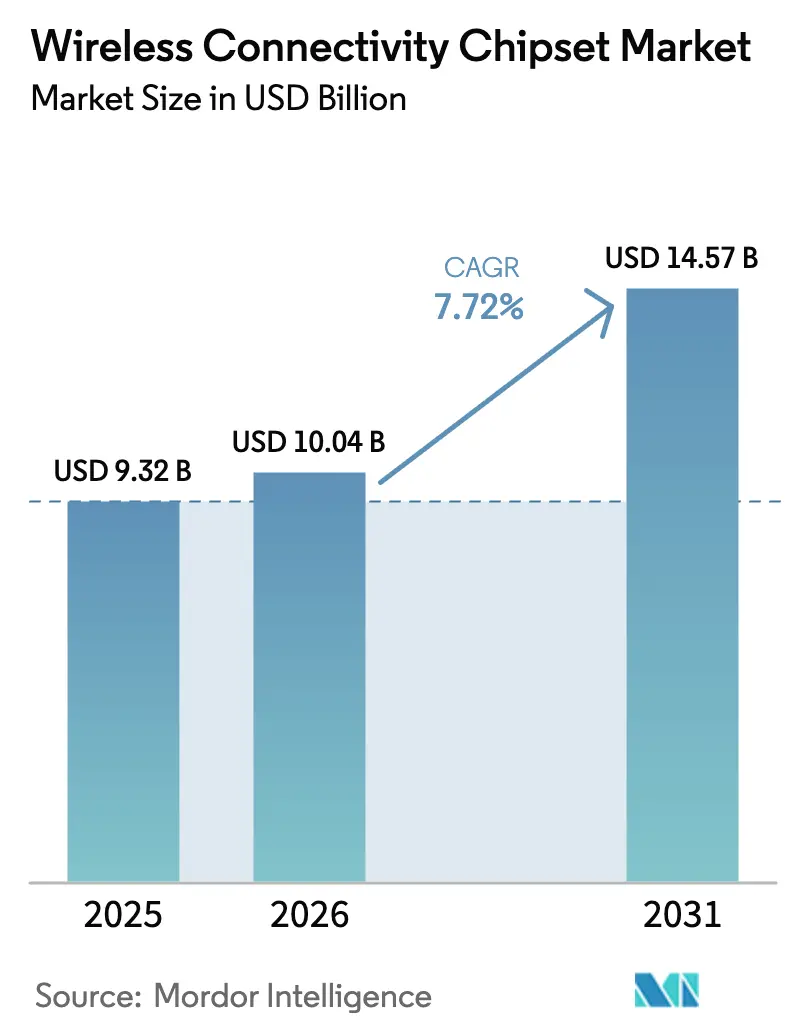
The wireless connectivity chipset market size is expected to grow from USD 9.32 billion in 2025 to USD 10.04 billion in 2026 and is forecast to reach USD 14.57 billion by 2031 at 7.72% CAGR over 2026-2031. This steady rise reflects the rapid integration of multi-protocol functionality into single-chip solutions, the increasing demand for edge-AI processing, and the surge in automotive telematics design wins. Device makers in consumer electronics, industrial automation, and mobility are converging around combo SoC platforms that lower bill-of-materials costs and shorten design cycles. In parallel, vendor consolidation and scale-driven cost reductions are reshaping competitive dynamics as suppliers race to incorporate neural-processing accelerators and meet new cybersecurity mandates, such as WPA3 and ISO 21434.
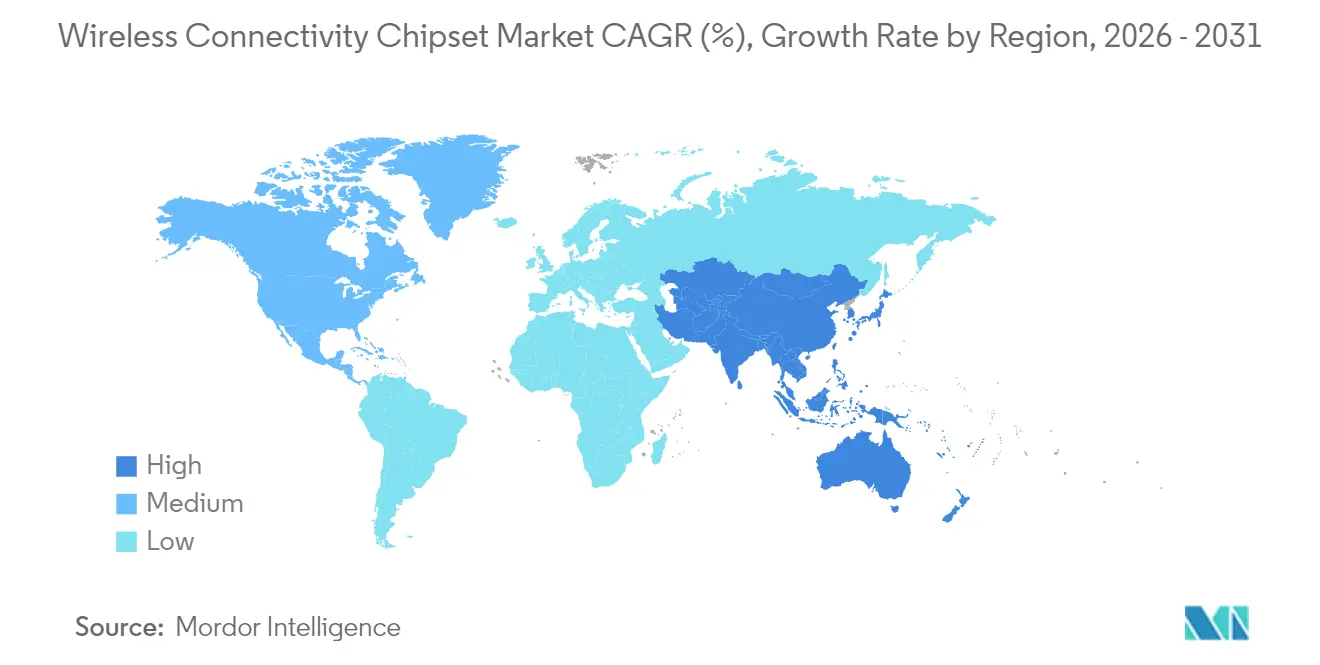
Asia-Pacific maintained a 57.30% revenue share in 2024 and is expanding at an 11.37% CAGR through 2030, buoyed by China’s large-volume IoT manufacturing clusters and Japan’s connected-vehicle innovations. Wi-Fi + Bluetooth combo silicon captured 80.30% of 2024 revenue, illustrating the market’s pivot toward integration. Low-power wireless ICs, optimized for extended battery life in IoT nodes, represent the fastest-growing product type at 9.38% CAGR. While consumer electronics still account for 52.90% of total shipments, automotive telematics and V2X endpoints are advancing at a 10.98% CAGR, signaling mobility’s growing pull on chipset roadmaps.
Key Report Takeaways
- By type, Wi-Fi + Bluetooth combo solutions held 79.62% of wireless connectivity chipset market share in 2025; low-power wireless ICs are set to post the highest 9.02% CAGR through 2031.
- By technology, Wi-Fi 5 dominated with 62.35% revenue contribution in 2025, whereas Wi-Fi 7 is forecast to grow at 9.18% CAGR between 2026-2031.
- By application, consumer electronics commanded 52.15% share of the wireless connectivity chipset market size in 2025 and automotive telematics is projected to expand at a 10.52% CAGR to 2031.
- By device category, smartphones and tablets accounted for 45.10% deployments in 2025, while automotive control units will register the fastest 10.17% CAGR through 2031.
- By geography, Asia-Pacific contributed 56.65% revenue in 2025; it will also record the quickest 10.96% CAGR over the forecast horizon.
Note: Market size and forecast figures in this report are generated using Mordor Intelligence’s proprietary estimation framework, updated with the latest available data and insights as of 2026.
Market Trends and Insights
Drivers Impact Analysis of Wireless Connectivity Chipset Market*
| Driver | (~) % Impact on CAGR Forecast | Geographic Relevance | Impact Timeline |
|---|---|---|---|
| Surging IoT-device volumes across consumer and industrial sectors | +1.80% | Global, with APAC leading deployment density | Medium term (2-4 years) |
| Accelerated roll-out of Wi-Fi 6/6E/7 and Bluetooth 5.x/LE Audio | +1.50% | North America and Europe early adoption, APAC volume scaling | Short term (≤ 2 years) |
| Growth of automotive 5G/ C-V2X telematics design-wins | +1.20% | Global, with China and EU regulatory leadership | Long term (≥ 4 years) |
| Edge-AI demand for combo SoCs with integrated neural accelerators | +1.00% | North America and APAC technology centers | Medium term (2-4 years) |
| Subsidised smart-home programs and green-building regulations | +0.80% | EU and North America policy-driven markets | Long term (≥ 4 years) |
| Vendor consolidation unlocking scale-driven cost declines | +0.70% | Global supply chain optimization | Short term (≤ 2 years) |
| Source: Mordor Intelligence | |||
Surging IoT-device volumes across consumer and industrial sectors
Factory automation now specifies deterministic wireless plus traditional Wi-Fi/Bluetooth in the same die, enabling mission-critical sensor loops that previously relied on wired links.[1]Industrial Internet Consortium, “Industrial Connectivity Framework Release,” iiconsortium.org Smart-home shipments topped 1.4 billion units in 2024; each gadget embeds at least one wireless chipset, accelerating scale economies. Vendors therefore pursue unified reference designs that cater to both consumer and industrial firmware stacks, compressing development expense while widening addressable markets.
Accelerated roll-out of Wi-Fi 6/6E/7 and Bluetooth 5.x/LE Audio
Wi-Fi 7’s multi-link operation simultaneously spans 2.4, 5, and 6 GHz, creating new throughput and latency benchmarks that pull advanced RF front-ends into mainstream client devices.[2]Wi-Fi Alliance, “Wi-Fi CERTIFIED 7 Program Launches,” wi-fi.org Enterprises are refreshing access-point fleets to Wi-Fi 6E, monetizing 6 GHz spectrum for congestion-free high-density campuses. Bluetooth LE Audio’s LC3 codec, meanwhile, prompts head-unit redesigns in vehicles to offer multi-stream playback and hearing-aid compatibility, raising DSP requirements inside connectivity SoCs.
Growth of automotive 5G / C-V2X telematics design-wins
China fielded more than 200,000 C-V2X-equipped vehicles across major metro corridors in 2024, accelerating chipset design activity.[3]China Society of Automotive Engineers, “C-V2X Deployment Accelerates Across Major Cities,” sae-china.org European OEMs now mandate C-V2X readiness on new platforms, while U.S. infrastructure pilots broaden. These programs elevate the need for integrated safety isolation, secure boot, and functional-safety diagnostics directly in the radio silicon, favoring incumbents with robust automotive IP libraries.
Edge-AI demand for combo SoCs with integrated neural accelerators
Video doorbells, smart cameras, and industrial vision nodes increasingly require on-device inference to preserve privacy and trim backhaul fees. Connectivity vendors are embedding small TOPS-class NPUs next to Wi-Fi/Bluetooth radios, shrinking system BOM by removing a discrete AI coprocessor.[4]IEEE Computer Society, “Edge AI Processing in Connectivity SoCs,” computer.org Balancing heat, cost, and RF coexistence drives new layout techniques and encourages migration to 6 nm and below.
Restraints Impact Analysis of Wireless Connectivity Chipset Market*
| Restraint | (~) % Impact on CAGR Forecast | Geographic Relevance | Impact Timeline |
|---|---|---|---|
| Intensifying RF-spectrum congestion in 2.4 GHz ISM band | -0.90% | Global, with urban density hotspots most affected | Short term (≤ 2 years) |
| Persistent supply-chain lead-time volatility for advanced nodes | -1.10% | Global semiconductor manufacturing constraints | Medium term (2-4 years) |
| Rising cybersecurity-compliance costs (WPA3, ISO 21434, Matter) | -0.70% | Global regulatory requirements with regional variations | Long term (≥ 4 years) |
| Inter-stack interoperability gaps slowing multi-protocol adoption | -0.60% | Global technology integration challenges | Medium term (2-4 years) |
| Source: Mordor Intelligence | |||
Intensifying RF-spectrum congestion in the 2.4 GHz ISM band
Bluetooth and Wi-Fi signals collide in dense apartment blocks, pushing vendors to implement agile channel hopping and coexistence firmware. Industrial sites deploying hundreds of sensors per floor report retries that sap battery life, nudging migration toward 5 GHz and 6 GHz but adding BOM cost for tri-band front-ends.[5]FCC Office of Engineering and Technology, “RF Spectrum Congestion Analysis 2024,” fcc.gov
Persistent supply-chain lead-time volatility for advanced nodes
Limited 6 nm/7 nm capacity means connectivity parts share wafer starts with flagship mobile processors; allocation favors higher ASP segments. Lead times stretch past 30 weeks, delaying automotive ECU releases and raising buffer-stock burdens for OEMs.[6]Semiconductor Industry Association, “Global Semiconductor Sales Report Q3 2024,” semiconductors.org
*Our forecasts treat driver/restraint impacts as directional, not additive. The impact forecasts reflect baseline growth, mix effects, and variable interactions.
Wireless Connectivity Chipset Market Segment Analysis
By Type:
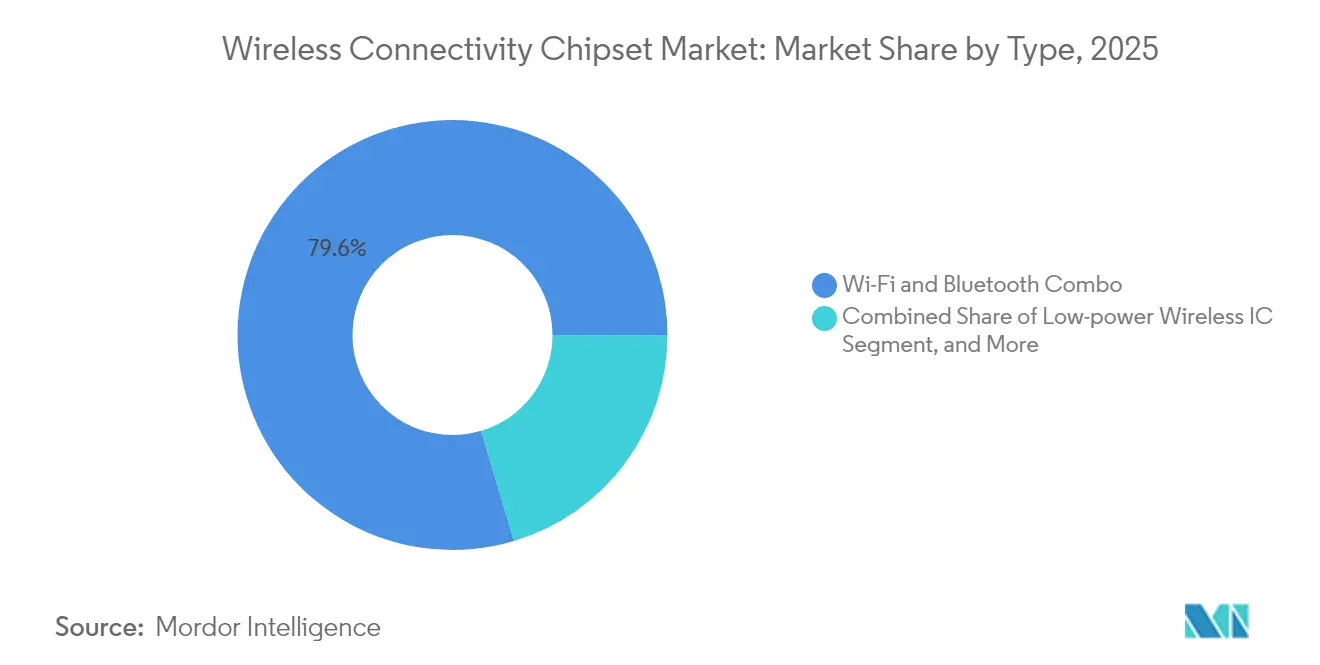
Combo Solutions Drive Integration EfficiencyWi-Fi + Bluetooth combo silicon captured 79.62% wireless connectivity chipset market share in 2025. Low-power wireless ICs, although smaller today, are expected to post a 9.02% CAGR as battery-operated IoT nodes scale. Combo designs shrink PCB area and streamline certifications, letting appliance and wearables vendors ship global SKUs with uniform RF behavior.
The appetite for combo SoCs also stems from smart-home ecosystems adopting Matter, which prescribes concurrent Wi-Fi and Thread/BLE for commissioning and control. Integrating both radios into one SoC eliminates extra crystal oscillators and power rails, lowering USD cost targets for sub-USD 5 smart plugs.



By Technology Standard:
Wi-Fi 7 Emergence Accelerates Performance MigrationLegacy Wi-Fi 5 still accounts for 62.35% of revenue, given its low ASPs and broad certification base, but Wi-Fi 7 chipsets will experience a 9.18% CAGR as multi-gigabit mesh and cloud gaming drive demand. Automotive infotainment is already skipping Wi-Fi 6 in favor of Wi-Fi 6E, which is 6 GHz-enabled, for interference-free back-seat streaming.
Bluetooth LE Audio is ramping up on true-wireless earbuds and infotainment, replacing classic A2DP headsets. Vendors differentiating on multipoint or Auracast broadcast features bundle new baseband logic and memory, lifting silicon content per unit.
By End-user Application:
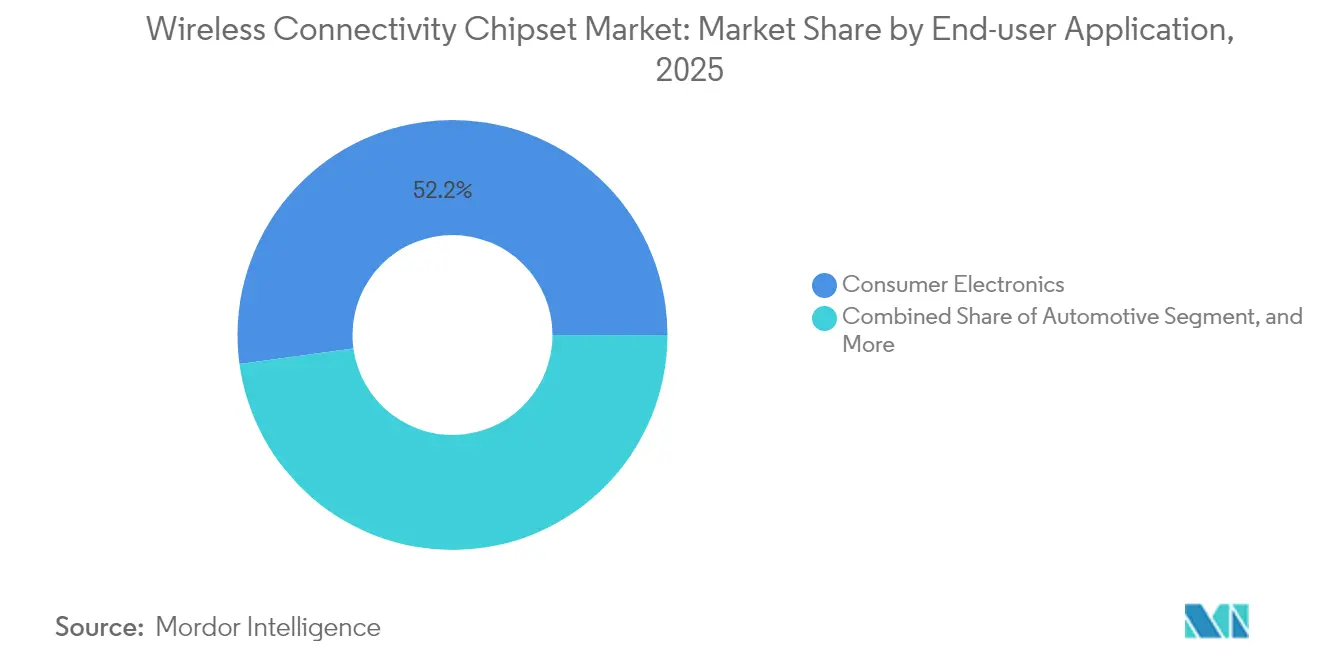
Automotive Connectivity Transforms Market DynamicsConsumer electronics accounted for 52.15% of 2025 revenue; however, automotive telematics and V2X endpoints are expected to expand at a 10.52% CAGR, outpacing all other verticals. Electric-vehicle charging piles now require Wi-Fi for the billing back-end and PLC for grid handshakes on a single board, adding socket opportunities.
Industrial automation customers pursue deterministic wireless backbones to phase out fieldbus wiring. Connectivity silicon with time-sensitive networking extensions, therefore, gains traction in PLC controllers and robot arms.
By Device Category:
Automotive Control Units Drive Next-Generation ConnectivitySmartphones and tablets currently represent 45.10% of installations, yet automotive control units are expected to enjoy a 10.17% CAGR. Software-defined vehicles rely on over-the-air updates and high-bandwidth sensor fusion, which require dual Wi-Fi plus 5G radios on zonal gateways. Vendors that harden combo chipsets for an ambient temperature range of –40 °C to 125 °C and AEC-Q100 Grade 1 qualification are prioritized first.
Wearables and hearables add ultra-low-power sub-GHz telemetry for continuous health monitoring, fuelling innovation in dual-radio minidies that pair BLE with proprietary 915 MHz backhaul.
Geography Analysis
APAC Wireless Connectivity Chipset Market
Asia-Pacific delivered 56.65% of 2025 revenue, benefitting from China’s IoT manufacturing clusters and Japan’s connected-car R&D leadership. Government smart-city pilots drove over 500 million device activations last year. South Korea’s 5G URLLC trials underpin industrial private networks that prefer Wi-Fi 7 back-ups. India’s rural broadband schemes adopt combo chipsets in low-cost CPE, albeit with strict price caps.
North America Wireless Connectivity Chipset Market
North America ranks second as early Wi-Fi 6E and Wi-Fi 7 enterprise roll-outs amplify chipset refresh cycles. The FCC’s release of the full 1.2 GHz to 6 GHz band accelerated orders for tri-band access points. Canada’s critical-infrastructure projects demand FIPS-certified silicon, while Mexico’s near-shoring boom pushes automotive tier-1s to localize connectivity module lines.
Europe Wireless Connectivity Chipset Market
Europe’s market grows steadily under sustainability and cyber-resilience mandates. The EU Cyber Resilience Act compels hardware-root-of-trust and SBOM features inside connectivity silicon, rewarding suppliers with security IP portfolios. Germany’s Industrie 4.0 labs are piloting Wi-Fi 7 deterministic scheduling, whereas the U.K. is pursuing sovereign chip design grants post-Brexit.

Regulatory Landscape
Wireless connectivity chipsets are shaped by radio-type approvals, short-range device (SRD) rules, and security-driven ecosystem requirements, which in turn influence chipset feature sets and OEM time-to-market. In the United States, evolving certification expectations around next-generation Wi-Fi have increased the emphasis on interoperability and conformance evidence for devices entering the market, reinforcing the need for tightly integrated Wi-Fi/Bluetooth platforms and mature certification support across reference designs.
Across the Americas, certification and homologation frameworks are shifting in ways that change compliance workflows for connectivity-enabled products. Examples cited in 2026 updates include SRD certification changes in Chile and a new telecom equipment homologation framework in Argentina (with a defined effective date later in 2026), while Mexico moved to a new telecommunications regulatory structure in late 2025. These changes affect how module makers and device OEMs plan test campaigns, documentation, and multi-country SKU strategies, and they feed into chipset vendor support for pre-certification, including regulatory test modes.
Value Chain Analysis
The value chain runs from RF and baseband IP development to foundry wafer fabrication at advanced nodes, followed by packaging and test, and then integration by module makers and OEMs into end devices such as smartphones, routers/APs, PCs, and automotive control units. Leading chipset vendors differentiate through platform integration (combo Wi-Fi/Bluetooth, plus optional UWB and security blocks), software stacks, and certification-ready reference designs, while upstream steps that remain critical include RF front-end sourcing, advanced-node capacity access, and high-volume test capability.
Supply allocation and manufacturing strategy also influence availability and lead times, especially for Wi-Fi 7-class parts and high-volume networking platforms. Evidence highlights multi-foundry approaches, for example MediaTek using multiple manufacturing partners, and the role of ecosystem leverage where large networking OEM demand can translate into priority allocation from major suppliers, tightening supply for smaller OEMs. Downstream, connectivity chipsets typically move through module and platform ecosystems, including Qualcomm connectivity tied into the Snapdragon platform and Intel connectivity positioned within the Intel Evo PC ecosystem, which shapes design-in cycles and encourages vendors to bundle firmware, drivers, and interoperability tooling alongside silicon.
Competitive Landscape
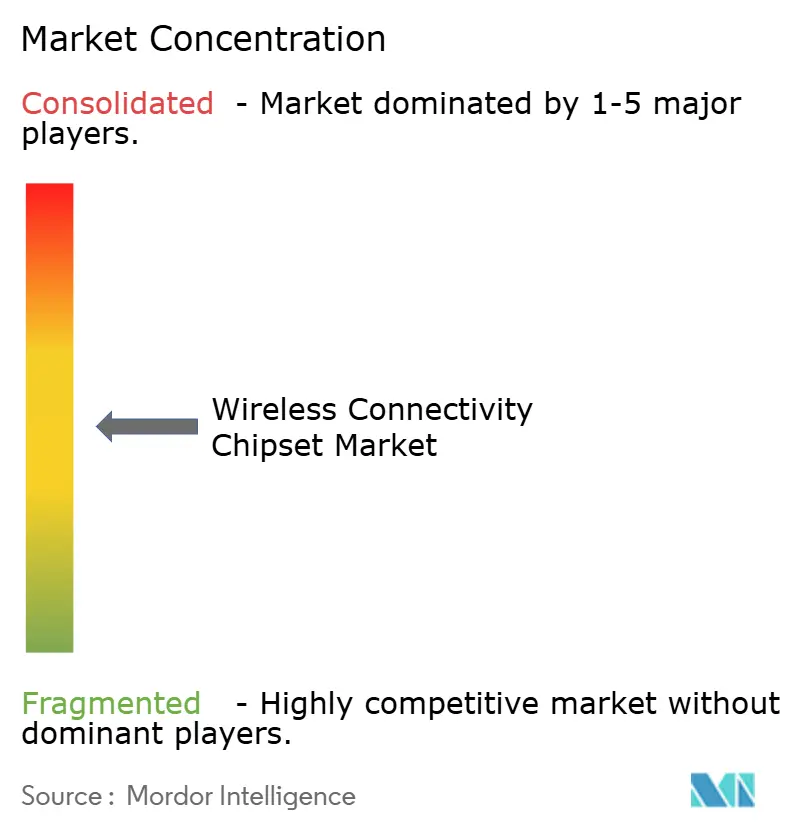
Moderate consolidation characterizes the sector as scale benefits intensify at sub-7 nm. Broadcom, Qualcomm, MediaTek, and NXP leverage multi-protocol roadmaps, along with automotive-grade variants, to protect their gross margins. Smaller specialists pivot to niche domains such as satellite IoT or ultra-wideband-plus-BLE co-packaging, often licensing digital basebands from incumbents.
Technology leadership hinges on compute-connectivity fusion. FastConnect 7900 and comparable platforms embed NPU blocks to satisfy edge-video analytics, boosting ASPs but raising thermals. Patent portfolios around multi-link operation, spatial-stream management, and secure key storage shield incumbents from fast followers. Partnerships with TSMC or Samsung Foundry secure premium node access, buffering supply shocks.
White-space remains in automotive safety-certified radios meeting ISO 26262 ASIL-B/C. Early movers bundle dual CAN, Gigabit Ethernet, and Wi-Fi 7 on the same die, offering zonal ECU makers a one-vendor BOM. Extended-temperature industrial SoCs with BLE 5.4 plus 802.15.4 sidebands attract PLC vendors seeking wired-to-wireless migration paths.
Wireless Connectivity Chipset Industry Leaders
Broadcom Inc.
Qualcomm Incorporated
Intel Corporation
Texas Instruments Incorporated
MediaTek Inc.
- *Disclaimer: Major Players sorted in no particular order
Wireless Connectivity Chipset Market Companies Covered in this Report
- Broadcom Inc.
- Qualcomm Technologies Inc.
- MediaTek Inc.
- Intel Corporation
- Texas Instruments Incorporated
- STMicroelectronics N.V.
- NXP Semiconductors N.V.
- ON Semiconductor Corporation
- Infineon Technologies AG
- Microchip Technology Inc.
- Qorvo Inc.
- Skyworks Solutions Inc.
- HiSilicon Technologies Co., Ltd.
- UNISOC (Shanghai) Technologies Co., Ltd.
- Nordic Semiconductor ASA
- Silicon Laboratories Inc.
- Realtek Semiconductor Corp.
- Espressif Systems (Shanghai) Co., Ltd.
- Marvell Technology, Inc.
- Cypress Semiconductor

Market Opportunities and Future Outlook
A whitespace is emerging for compliance-ready, multi-standard connectivity silicon that reduces OEM certification burden while aligning with new interoperability and security expectations. Heightened Wi-Fi 7 entry requirements and ecosystem mandates are pushing device makers toward integrated SoC platforms that combine Wi-Fi, Bluetooth, and security features in a single reference design, creating a clear use case for vendors that can provide robust software, test modes, and region-specific certification support across end markets.
Supply-chain variability is also creating openings for suppliers that can offer predictable lead times and alternative sourcing. For Wi-Fi 7 access-point silicon, reported lead-time differences between competing platforms have become a procurement and design-choice lever for service-provider and networking OEM programs, reinforcing the value of scalable capacity and second-source strategies. Separately, vendor roadmaps that merge connectivity with on-device compute are expanding the addressable market beyond handsets into IoT, automotive, and enterprise infrastructure, supported by named strategic revenue targets disclosed by Qualcomm for non-handset categories (automotive and IoT) that depend on connectivity attach and platform expansion.
Recent Industry Developments in Wireless Connectivity Chipset Market
- June 2026: onsemi announced a definitive agreement to acquire Synaptics, incorporating the latter’s wireless connectivity portfolio and edge AI compute franchise to expand into intelligent systems. The deal expands intelligent systems portfolio across automotive and industrial markets and reflects ongoing consolidation in wireless connectivity and edge AI capability.
- May 2026: Broadcom Inc. announced a collaboration with Samsung Electronics to integrate the Broadcom BCM6776 Wi-Fi 8 System-on-Chip with Samsung’s B1320 5G Modem in a fixed wireless access reference platform. The partnership strengthens Broadcom-Samsung collaboration and accelerates Wi-Fi 8 deployment in service-provider gateways.
- April 2026: Broadcom Inc. launched the fourth wave of Wi-Fi 8 chipsets including BCM67142 and BCM67192 and an optimized 10G PON chip BCM68565 for mass-market residential gateways. The release advances Broadcom leadership in home networking platforms and improves BOM efficiency.


Wireless Connectivity Chipset Market Report Scope and Research Methodology
Market Definition and Coverage
This market is defined as revenues earned from selling wireless connectivity chipsets used to add short-range wireless links inside devices, such as Wi-Fi and Bluetooth connectivity, across consumer, industrial, automotive, and other equipment.
Scope exclusions: We exclude antennas, finished connectivity modules, and device-level connectivity services, and we also exclude cellular baseband modem chipsets unless they are part of a defined connectivity chipset bundle.
Segments Covered in This Report
- By Type
- Wi-Fi Standalone
- Bluetooth Standalone
- Wi-Fi and Bluetooth Combo
- Low-power Wireless IC (BLE, Zigbee, UWB)
- By Technology Standard
- Wi-Fi 4 (802.11n)
- Wi-Fi 5 (802.11ac)
- Wi-Fi 6 / 6E (802.11ax)
- Wi-Fi 7 (802.11be)
- Bluetooth Classic
- Bluetooth Low-Energy 5.x
- By End-user Application
- Consumer Electronics
- Enterprise Infrastructure
- Mobile Handsets
- Automotive (Telematics, V2X, Infotainment)
- Industrial and IIoT
- Others (Healthcare, Wearables, Smart-City)
- By Device Category
- Smartphones and Tablets
- PCs and Laptops
- Smart-Home / IoT Nodes
- Networking Infrastructure (Routers, APs)
- Wearables and Hearables
- Automotive Control Units
- By Geography
- North America
- United States
- Canada
- Mexico
- South America
- Brazil
- Argentina
- Rest of South America
- Europe
- Germany
- United Kingdom
- France
- Italy
- Spain
- Russia
- Rest of Europe
- Asia-Pacific
- China
- Japan
- India
- South Korea
- Rest of Asia-Pacific
- Middle East and Africa
- Middle East
- Saudi Arabia
- United Arab Emirates
- Turkey
- Rest of Middle East
- Africa
- South Africa
- Nigeria
- Rest of Africa
- Middle East
- North America
Data Sources, Market Sizing, and Validation
Desk Research
Desk research starts by setting a clear device and chipset definition, then building a fact base around demand drivers and standards adoption. We referenced open sources such as ITU and OECD connectivity statistics, FCC spectrum and Wi-Fi policy releases, IEEE 802.11 public standard documentation, Bluetooth SIG public specification updates, and national customs trade statistics, using electronics subcategories to sanity check hardware flows.
We also reviewed public company filings and investor presentations to understand product positioning, end-market exposure, and pricing commentary. Reputed press and association updates were used to time standard transitions like Wi-Fi 6E and Wi-Fi 7. Where needed, paid subscriptions were used for company financials and intelligence, news and financials, and patent databases to validate roadmaps and cross-check the pace of new-generation rollouts. The sources listed above are illustrative and not exhaustive, since many other public and internal references were also used for data collection, validation, and research clarification.
Primary Interviews and Surveys
Primary work was used to turn desk findings into workable sizing inputs, especially chipset attach rates by device type, typical ASP ranges by Wi-Fi generation and Bluetooth features, and the timing of design-win ramps. We spoke with a mix of chipset ecosystem participants and downstream device stakeholders across major regions, so assumptions on integration, replacement cycles, and mix shift could be checked and corrected before final sizing.
Distribution of primary research fieldwork respondents
| Company type | Respondent position | Region |
|---|---|---|
| Top tier: 35% | CXOs: 13% | APAC: 44% |
| Mid tier: 51% | Functional/Unit leaders: 35% | EMEA: 30% |
| Smaller Players: 14% | Managers: 52% | Americas: 26% |
Market-Sizing & Forecasting
Sizing was built using a top-down demand pool reconstruction, where device shipment outlooks and connectivity penetration rates were applied by major device families, then converted into chipset revenues using standard specific ASP bands. To keep the model grounded, results were corroborated with selective bottom-up approximations, such as supplier revenue roll ups from public disclosures, channel checks on common combo chipset price points, and sampled unit volumes in high-use categories like routers, TVs, wearables, and industrial gateways.
Key inputs used in the model include Wi-Fi generation mix (including the shift toward Wi-Fi 6E and Wi-Fi 7), Bluetooth Low Energy adoption in wearables and peripherals, multi-protocol combo attach rates, device replacement cycles, and wafer cost-driven price movement that influences ASP progression. When direct unit signals were limited for smaller device niches, gaps were handled by using proxy penetration curves from similar form factors, then pressure testing them using interview feedback.
Forecasting used scenario analysis supported by a light multivariate regression layer, where shipments, standard transition speed, and broader electronics demand indicators were varied to reflect realistic downside and upside paths. Final projections were normalized so the implied chipsets per device stayed consistent with plausible design patterns and BOM constraints.
Data Validation & Update Cycle
Outputs were validated through multiple checks that compare the implied chipset demand against independent signals, including device shipment totals, standard adoption milestones, and public revenue disclosures from relevant parts of the value chain. When an outlier appeared, assumptions were revisited, and follow-up outreach was triggered to confirm whether the issue came from mix shift, pricing, or an end-market timing change.
Before sign-off, the model and narrative go through multi-step analyst reviews so calculations, units, and currency handling are consistent across countries and years. Reports are refreshed annually, and interim updates are made when material events occur, such as sharp pricing resets, major standard adoption step changes, or supply disruptions. Right before delivery, a final analyst pass is completed so clients receive the most current view.
Mordor Intelligence's Wireless Connectivity Chipset Market Sizing Compared With Other Published Estimates
Published market values often differ in this space because some studies mix chipsets with modules, or they include wider wireless silicon that goes beyond Wi-Fi and Bluetooth, which shifts the total quickly. Differences also show up when one publisher uses shipment-led math and another leans on revenue roll ups, which then depends heavily on the pricing curve selected.
The main gap comes from whether module revenue and integrated connectivity inside larger processors are counted. Where only standalone wireless connectivity chipset revenues are included, ASP progression is refreshed by Wi-Fi generation mix and combo adoption checks, which is the modeling discipline applied by Mordor Intelligence.
Benchmark comparison
| Source | Market Size | Gaps in Research Methodology |
|---|---|---|
| Mordor Intelligence | USD 9.32 B (2025) | |
| Trade Journal A | USD 11.00 B (2024) | Often presented as Wi-Fi chipset revenue only and explicitly excludes Wi-Fi integrated mobile processors, which creates a different technology scope and a year base that does not translate directly to multi-protocol chipset totals. |
| Industry Publisher B | USD 4.60 B (2024) | Commonly built from a narrow type list and may lean on shipment frameworks with simplified pricing, which can understate revenues when combo connectivity and newer standard generations command higher ASPs. |
Across the two external figures, the biggest drivers are scope alignment and how ASPs are updated during standard transitions, rather than small math differences. With clearly stated inclusions, device-linked demand checks, and repeatable steps, the sizing is easier to reconcile and maintain in future refreshes.


Key Questions Answered in the Report
How large will wireless connectivity chipset revenue become by 2031?
The market is projected to reach USD 14.57 billion in 2031, reflecting an 7.72% CAGR between 2026 and 2031.
Which region will contribute the fastest incremental revenue?
Asia-Pacific posts the quickest 10.96% CAGR, powered by China's high-volume IoT production and Japan's connected-vehicle roll-outs.
What product class ships in the highest volumes today?
Wi-Fi + Bluetooth combo solutions hold 79.62% of 2025 revenue and remain the default architecture for most consumer and industrial devices.
Which end-use segment shows the strongest growth momentum?
Automotive telematics and V2X modules expand at a 10.52% CAGR as vehicle platforms embed multi-gigabit wireless links and edge-AI processing.
What technology migration is driving higher average selling prices?
The shift from Wi-Fi 5 toward Wi-Fi 6E and Wi-Fi 7, combined with adoption of Bluetooth LE Audio, lifts silicon content and premium ASPs.
How is advanced-node capacity risk influencing vendor strategy?
Ongoing 6 nm/7 nm supply tightness pushes suppliers to secure multi-foundry agreements and invest in additional in-house capacity to limit lead-time shocks.
Page last updated on:





