
Vitamin E Market Size and Share
Market Overview
| Study Period | 2021 - 2031 |
|---|---|
| Market Size (2026) | USD 3.22 Billion |
| Market Size (2031) | USD 4.26 Billion |
| Growth Rate (2026 - 2031) | 5.78 % |
| Fastest Growing Market | Europe |
| Largest Market | Asia Pacific |
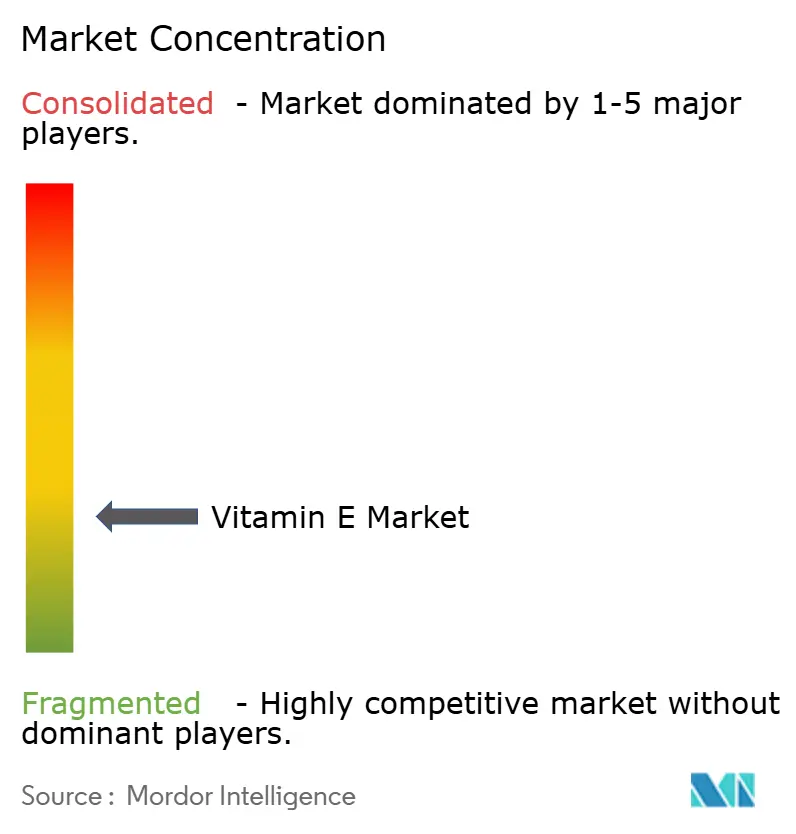
| Market Concentration | Low |
Major Players
*Disclaimer: Major Players sorted in no particular order Image © Mordor Intelligence. Reuse requires attribution under CC BY 4.0. |
|
Vitamin E Market Analysis by Mordor Intelligence
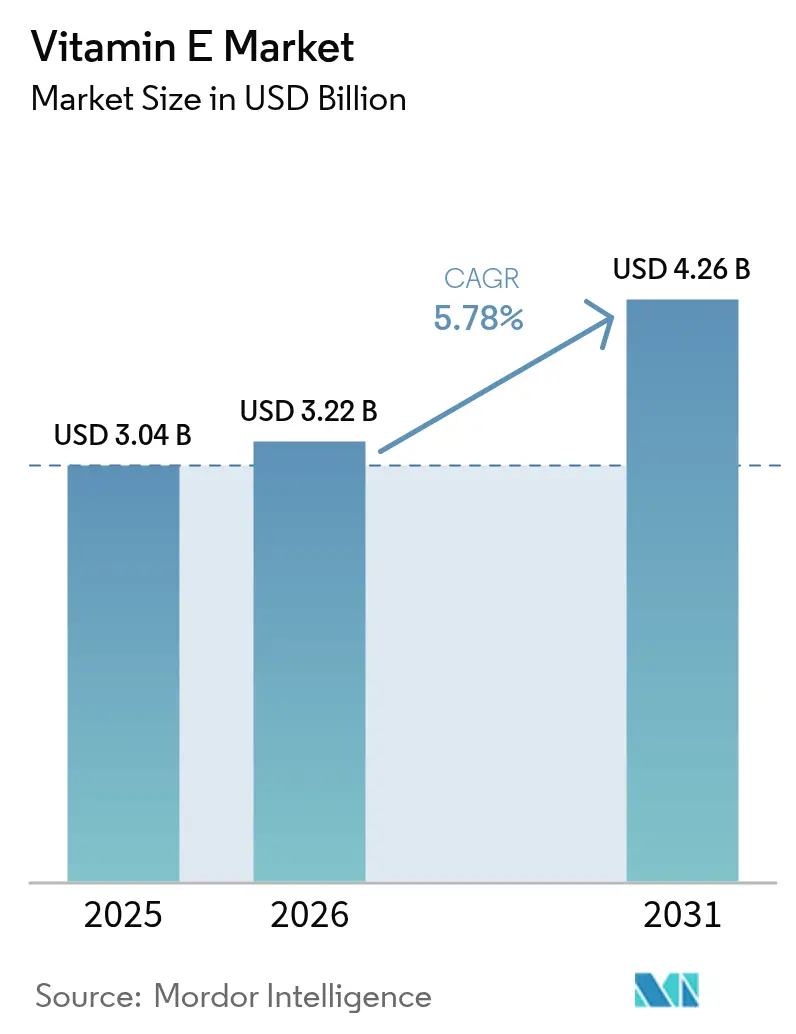
Vitamin E market size in 2026 is estimated at USD 3.22 billion, growing from 2025 value of USD 3.04 billion with 2031 projections showing USD 4.26 billion, growing at 5.78% CAGR over 2026-2031. The market growth stems from increased consumer awareness of vitamin E's health benefits, including its antioxidant properties, immune system support, and skin health benefits, driving demand in dietary supplements and functional foods. The market has seen a shift toward plant-based vitamin E sources, such as sunflower, soybean, and safflower oils, aligning with consumer preference for natural and clean-label products. The cosmetics and personal care industry's incorporation of vitamin E for its moisturizing and anti-aging properties has contributed to market expansion. The fortification of foods and beverages with essential nutrients has created opportunities in functional food segments. The market growth is further supported by urbanization, higher disposable incomes, and increased health awareness in emerging economies, particularly in the Asia-Pacific region.
Key Report Takeaways
- By ingredient type, natural vitamin E led with 57.80% revenue share in 2025; it is projected to expand at a 6.02% CAGR through 2031.
- By application, dietary supplements held 47.10% of the vitamin E market share in 2025, while cosmetics and personal care are forecast to advance at a 6.18% CAGR to 2031.
- By form, oil captured 60.10% of the vitamin E market size in 2025 and remains the fastest-growing form at a 6.01% CAGR over the outlook period.
- By geography, Asia-Pacific commanded 41.40% share of the vitamin E market in 2025; Europe records the highest projected CAGR at 7.79% between 2026 and 2031.
Note: Market size and forecast figures in this report are generated using Mordor Intelligence’s proprietary estimation framework, updated with the latest available data and insights as of 2026.
Market Trends and Insights
Drivers Impact Analysis of Vitamin E Market*
| Driver | (~) % Impact on CAGR Forecast | Geographic Relevance | Impact Timeline |
|---|---|---|---|
| Growing aging population driving demand for dietary supplements | +1.2% | Global, with concentration in North America and Europe | Long term (≥ 4 years) |
| Increasing consumer awareness about preventive healthcare and nutritional supplements | +0.9% | Global, strongest in developed markets | Medium term (2-4 years) |
| Expanding demand from pharmaceutical industry for vitamin E-based medications | +0.7% | North America and Europe, expanding to Asia-Pacific | Medium term (2-4 years) |
| Shift toward clean label products accelerates demand for natural-sourced vitamin E | +1.1% | Europe and North America, spreading globally | Long term (≥ 4 years) |
| Widening use of vitamin E in animal feed for livestock health and productivity | +0.8% | Global, with strongest growth in Asia-Pacific and South America | Medium term (2-4 years) |
| Surging private label manufacturing boosts ingredient-level demand | +0.6% | North America and Europe, expanding to emerging markets | Short term (≤ 2 years) |
| Source: Mordor Intelligence | |||
Growing Aging Population Driving Demand for Dietary Supplements
The global demographic shift toward an aging population influences the consumption patterns of vitamin E (tocopherols and tocotrienols), as adults over 65 require increased antioxidant supplementation to combat age-related oxidative stress. The Food and Drug Administration (FDA)'s classification of tocopherols as generally safe substances under 21 CFR 182.3890 establishes regulatory compliance parameters for supplement manufacturers. This regulatory framework facilitates the development of vitamin E formulations specifically designed for the aging demographic. The demographic transition generates consistent market demand that persists beyond economic cycles, positioning vitamin E supplementation as a stable growth category in the nutraceuticals market. According to World Bank data, the United States population aged 65 and over increased from 16.92% in 2022 to 17.43% in 2023, strengthening the demand for vitamin E supplementation products [1]Source: World Bank, "Age distribution in the United States", databank.worldbank.org.
Increasing Consumer Awareness about Preventive Healthcare and Nutritional Supplements
Growing awareness of micronutrient deficiencies through consumer education and digital health platforms has increased recognition of vitamin E deficiency symptoms, including skin problems, vision issues, and immune system impairment. The Philippines' implementation of vitamin classification guidelines, which set vitamin E limits at 536 mg per day, demonstrates regulatory adaptation to increased consumer demand for fortified foods and supplements. These regulations provide opportunities for manufacturers to develop formulations that optimize dosages while maintaining safety standards. The increased focus on preventive healthcare, driven by pandemic-related health awareness, has established vitamin E as an essential ingredient in wellness products.
Expanding Demand from Pharmaceutical Industry for Vitamin E-Based Medications
The pharmaceutical industry's growing demand is driving the global Vitamin E market growth. Vitamin E's antioxidant, anti-inflammatory, and immune-enhancing properties make it essential in pharmaceutical formulations. The pharmaceutical industry uses Vitamin E in medications for cardiovascular diseases, neurodegenerative disorders, immune system deficiencies, skin disorders, and cancer treatments. In dermatological applications, particularly for acne treatment, Vitamin E has gained significant importance. According to the American Academy of Dermatology Association, acne affects up to 50 million Americans annually, making it the most common skin condition in the United States[2]Source: American Academy of Dermatology Association, "Skin Conditions by the Numbers", www.aad.org. The pharmaceutical industry incorporates Vitamin E based on clinical evidence demonstrating its effectiveness in reducing oxidative stress, which is crucial in treating acne and chronic inflammatory diseases. Additionally, consumer preferences for medications with therapeutic and skin-nourishing properties have encouraged pharmaceutical manufacturers to include Vitamin E in their dermatological products.
Shift Toward Clean Label Products Accelerates Demand for Natural-Sourced Vitamin E
Natural vitamin E, specifically d-alpha tocopherol, demonstrates superior bioavailability and enhanced tissue retention characteristics compared to synthetic alternatives, which significantly influences market sourcing preferences in the clean label segment. The compound's molecular structure and biological efficacy contribute to its increased market demand across nutritional applications. BASF introduced natural-based products for personal care, including biodegradable styling polymers and sustainable ingredients, aligning with environmental goals. In Indonesia, palm oil supply chain developments focus on integrating smallholder farmers and implementing sustainable production methods. While natural vitamin E maintains premium pricing in the market, it creates substantial opportunities for producers with integrated sustainable sourcing capabilities.
Restraints Impact Analysis of Vitamin E Market*
| Restraint | (~) % Impact on CAGR Forecast | Geographic Relevance | Impact Timeline |
|---|---|---|---|
| High production costs and raw material price volatility affect market profitability | -0.8% | Global, particularly affecting smaller producers | Short term (≤ 2 years) |
| Stringent regulatory norms slow down global product approvals | -0.5% | Europe and North America, expanding globally | Medium term (2-4 years) |
| High quality and certification standards limit market access for small and new Entrants | -0.4% | Global, most restrictive in developed markets | Long term (≥ 4 years) |
| Limited availability of raw materials | -0.6% | Global, acute in regions dependent on palm oil imports | Medium term (2-4 years) |
| Source: Mordor Intelligence | |||
High Production Costs and Raw Material Price Volatility Affect Market Profitability
The high production costs associated with extracting and processing Vitamin E, particularly from natural sources, significantly constrain the global Vitamin E market's growth and profitability. The extraction of natural Vitamin E from vegetable oils (soybean, sunflower, wheat germ, and safflower) requires complex processes of extraction, purification, and stabilization, which increase operational and manufacturing expenses. Raw material price volatility further compounds these costs, influenced by climatic changes, geopolitical instability, supply chain disruptions, and varying agricultural yields. For example, droughts in major soybean-producing regions like Brazil or the United States can reduce supply substantially, increasing prices of tocopherol-rich oils. Additionally, China's carbon reduction targets (aiming for carbon neutrality by 2060) have resulted in temporary shutdowns of energy-intensive industries, including chemical and pharmaceutical manufacturing, affecting the supply of intermediates needed for Vitamin E production.
Stringent Regulatory Norms slow down Global Product Approvals
The Food and Drug Administration (FDA)'s revised draft guidance for dietary supplements mandates comprehensive safety notifications for new dietary ingredients, increasing regulatory complexity across major markets. The European regulatory framework adds further requirements through clean label standards and sustainability mandates, requiring detailed documentation of ingredient sourcing and production processes. In infant formula manufacturing, specific regulations under 21 CFR Part 107 require vitamin E content of 0.7 International Units per gram of linoleic acid, creating strict formulation requirements [3]Source: Food and Drug Administration (FDA), "Audit Standards Comparison to the Infant Formula Regulation", www.fda.gov. These regulatory requirements benefit established companies with robust regulatory compliance departments while creating entry barriers for smaller innovative firms, especially in pharmaceutical and infant nutrition markets.
*Our forecasts treat driver/restraint impacts as directional, not additive. The impact forecasts reflect baseline growth, mix effects, and variable interactions.
Vitamin E Market Segment Analysis
By Ingredient Type:
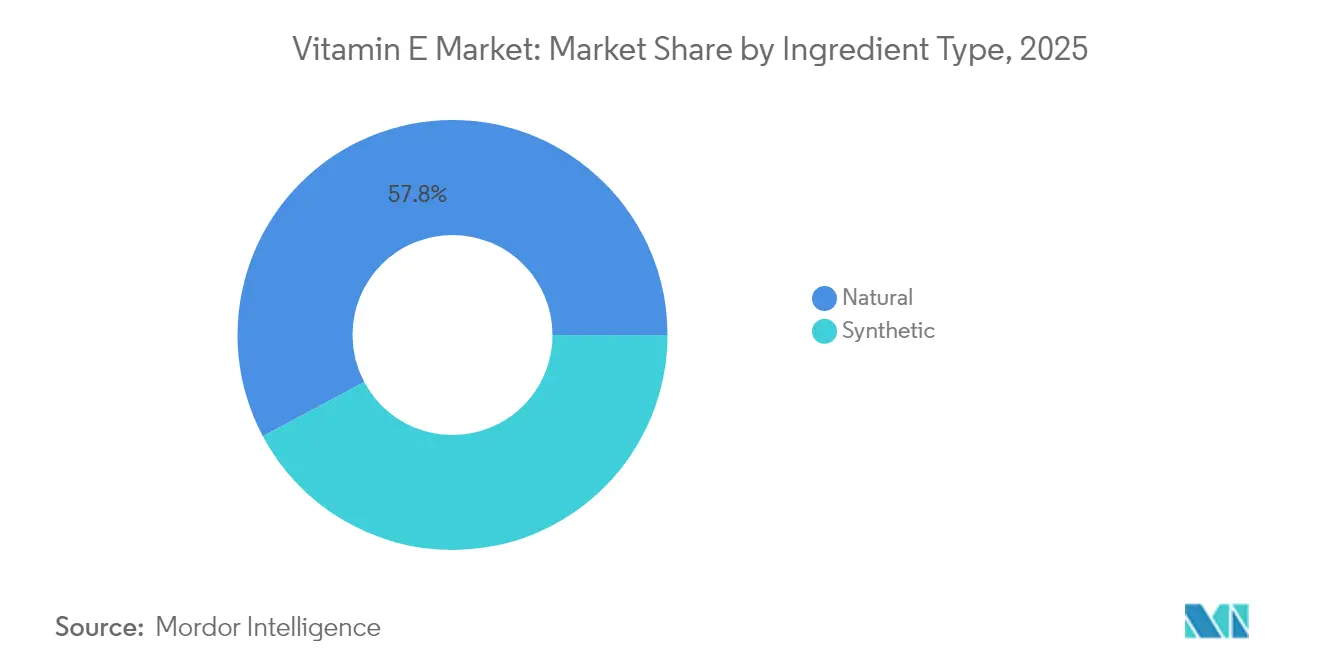
Natural Premium Drives Market EvolutionNatural vitamin E holds 57.80% of the market share in 2025, as consumers increasingly choose bioavailable d-alpha tocopherol over synthetic alternatives. The natural segment is projected to grow at 6.02% CAGR during 2026-2031, supported by clean label trends and regulatory support for natural ingredients. The higher tissue retention and bioactivity of natural vitamin E support its premium pricing, especially in dietary supplements and cosmetics, where efficacy influences purchasing decisions. While synthetic vitamin E retains cost advantages in feed applications, it faces challenges from sustainability requirements and increased consumer awareness about bioavailability differences.
Natural vitamin E manufacturers are strengthening supply chain transparency and implementing sustainable sourcing practices to serve premium market segments. The development of improved extraction technologies and biofortification methods is increasing natural vitamin E yields from oilseed crops, which may reduce production costs while preserving quality benefits. Synthetic vitamin E manufacturers are implementing process improvements and cost reduction measures, but encounter difficulties in markets where natural origin is a key consumer requirement. This creates distinct market segments for natural and synthetic forms, each with unique growth patterns and profit potential.



By Application:
Dietary Supplements Lead While Cosmetics AccelerateDietary supplements dominate the global vitamin E market, holding 47.10% of the market share in 2025. The aging global population and increased focus on preventive healthcare drive the demand for antioxidant supplementation. Consumer awareness of vitamin E's health benefits, including free radical neutralization, immune system support, and chronic disease risk reduction, contributes to sustained market growth. The segment's expansion is supported by the increased prevalence of lifestyle diseases and greater accessibility to dietary supplements across developed and developing markets.
The cosmetics and personal care segment is expected to grow at a compound annual growth rate (CAGR) of 6.18% through 2031. This growth stems from vitamin E's demonstrated benefits in protecting skin lipids from oxidation and enhancing skin barrier function. The segment's expansion is further supported by vitamin E's role in improving cosmetic product stability. The rise of clean beauty trends and increased demand for natural antioxidant ingredients drive vitamin E's integration into skincare, haircare, and anti-aging formulations.
By Form:
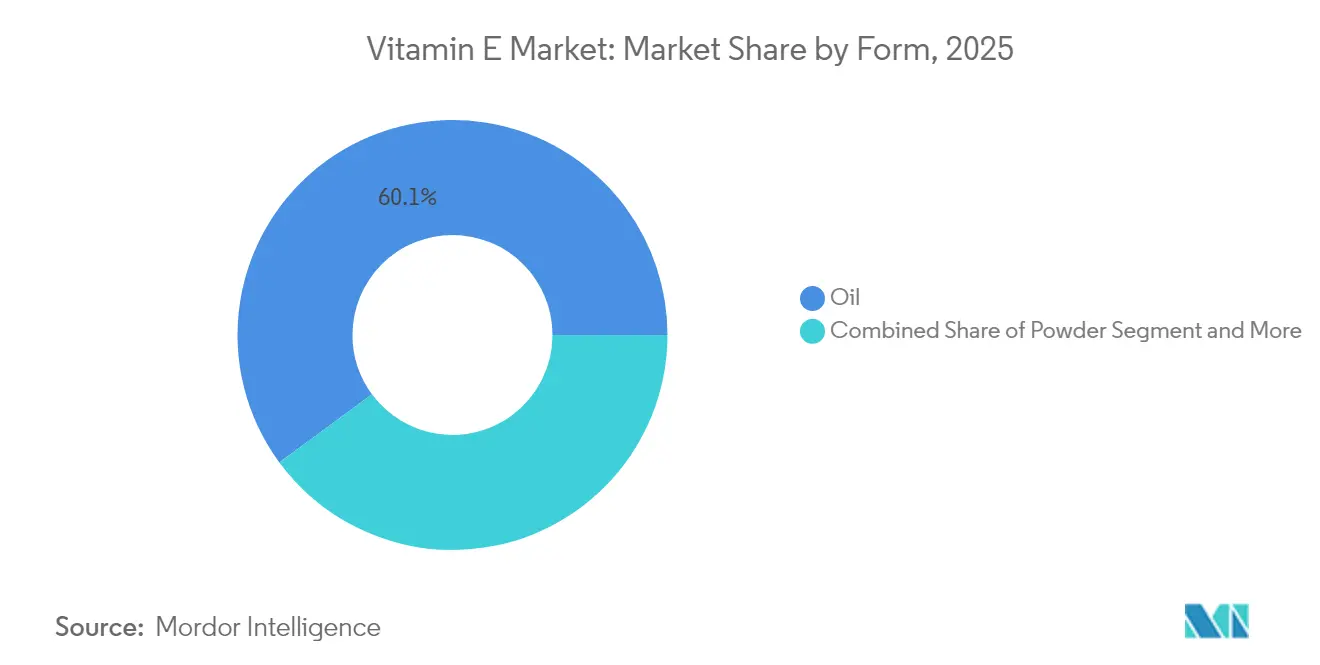
Oil Dominance Reflects Versatility AdvantagesOil-based vitamin E formulations maintain market dominance with a 60.10% share in 2025 and a projected CAGR of 6.01% through 2031, attributed to their superior stability and versatility across food and cosmetic applications. The oil form's inherent compatibility with lipid-based delivery systems enhances its effectiveness in premium supplement formulations and cosmetic products, where skin penetration and stability are essential performance requirements, while powder formulations address specific market requirements for water solubility and distinct processing characteristics, particularly in functional foods and beverage fortification.
The market segmentation reflects the evolution of application requirements, with oil forms maintaining advantages in traditional uses due to simpler manufacturing processes, while powder innovations target emerging applications in water-based systems and specialized delivery formats through advanced encapsulation technologies, including electrohydrodynamic techniques that enable controlled release and enhanced stability. Manufacturing efficiency considerations favor oil production, while powder forms command premium pricing in specialized applications requiring enhanced functionality or processing convenience, demonstrating the complementary nature of both formulations in meeting diverse market needs.
Geography Analysis
APAC Vitamin E Market
Asia-Pacific holds 41.40% of the global vitamin E market in 2025, primarily due to its position as the world's largest palm oil producer and manufacturing hub for natural and synthetic vitamin E. The region's advantages in raw material access and production capacity strengthen its position in both domestic and export markets. China's 14th Five-Year Plan (2021-2025) promotes national nutrition and functional food industries, supporting vitamin E supplementation to address aging-related diseases and oxidative stress. Indonesia's palm oil supply chain developments, including corporate farming models for smallholder integration, improve the sustainability of natural vitamin E feedstock supply. The region maintains manufacturing capabilities across the value chain, from raw material processing to finished product formulation.
Europe Vitamin E Market
Europe exhibits the highest growth rate at 7.79% CAGR during 2026-2031, supported by strict regulations that favor natural ingredients and premium products. The region's clean label requirements and sustainability standards create opportunities for vitamin E suppliers who meet traceability and environmental criteria. BASF's production facilities in Germany and Denmark support the region's premium markets, while their transition to 100% renewable electricity demonstrates environmental commitment. The European market's preference for natural and sustainable ingredients enables suppliers to maintain higher margins despite increased regulatory compliance costs.
North America Vitamin E Market
North America maintains a significant market position through established dietary supplement and functional food distribution channels. The Food and Drug Administration (FDA)'s regulatory framework for dietary supplements and food fortification provides market stability while enabling product differentiation through health claims. The region's informed consumer base creates demand for premium formulations and innovative delivery systems, expanding vitamin E applications beyond basic commodities.


Regulatory Landscape
Vitamin E ingredients are handled under different rule sets depending on end use (food, supplements, infant nutrition, cosmetics, or feed) and the jurisdiction. In the United States, commonly used forms such as tocopherol acetate and alpha-tocopherol acid succinate are shown in FDA CFSAN listings for substances added to food, and they sit within the broader 21 CFR Parts 170-186 framework for food ingredients. Supplement pathways add additional scrutiny around safety notifications for new dietary ingredients. Infant nutrition has tighter compositional requirements, with 21 CFR Part 107 specifying minimum vitamin E content relative to linoleic acid, which directly shapes formulation and quality-control programs for premix and finished-formula manufacturers.
In the European Union, Regulation (EC) No 1333/2008 governs food additive use, while EFSA continues its re-evaluation program for additives authorized before 20 January 2009, which can update conditions of use and documentation expectations for vitamin E derivatives. EFSA issued a scientific opinion on 01 August 2025 on the safety of d-alpha-tocopheryl polyethylene glycol-1000 succinate (vitamin E TPGS) as a food additive, and on 01 February 2026 the EFSA FEEDAP panel assessed renewal of authorization for tocopherol extracts as feed additives (1b306/1b307). This separation between food-additive evaluations and feed-additive renewals under Regulation (EC) No 1831/2003 means manufacturers typically need to manage separate regulatory dossiers and labeling claims across applications.
Value Chain Analysis
The vitamin E value chain relies on two production routes, which translate into different cost structures and risk points. The natural route starts with oilseed cultivation and vegetable-oil refining, where tocopherols are recovered from refining byproducts such as deodorizer distillates. After purification, standardization (mixed tocopherols, concentrates), and conversion into application-specific derivatives (for example, acetates or succinates), the ingredient is supplied to formulators in supplements, functional foods, cosmetics, infant nutrition, and feed. The synthetic route depends on chemical intermediates, notably TMHQ and isophytol, followed by synthesis, purification, stabilization, and downstream blending and encapsulation into oil or powder forms suited to customer processes.
Manufacturing concentration and upstream feedstock availability are the key bottlenecks. China represents a large share of global production, which increases exposure to policy, energy, and logistics disruptions. On the synthetic side, constraints on key precursors (such as citral) can tighten availability and raise procurement complexity, while on the natural side the outlook is linked to vegetable-oil refining throughput and the pricing of tocopherol-rich oils. Distribution typically moves from global ingredient producers and regional blenders to finished-goods manufacturers, with quality assurance (specifications, traceability, and application-specific compliance for food vs feed) acting as a gating step for new suppliers and smaller entrants.
Competitive Landscape
The vitamin E market demonstrates moderate fragmentation. Major global companies such as BASF SE, DSM-Firmenich NV, Archer-Daniels-Midland Company, Wilmar International Limited, and Merck KGaA operate alongside regional players and natural ingredient suppliers. The market's fragmentation stems from diverse application requirements and geographic distribution, with varying competitive advantages across segments.
Companies establish market differentiation through technological advancement and sustainable practices. This includes implementing advanced production methods, developing sophisticated formulation capabilities, and ensuring supply chain transparency. BASF's development of its Eco Balanced portfolio and implementation of renewable electricity in United States facilities exemplifies the industry's shift toward environmentally conscious operations. Additionally, vertical integration strategies in natural vitamin E production enable companies to maintain control over raw material costs and quality assurance processes.
The vitamin E market's cyclical nature and potential supply chain vulnerabilities necessitate robust operational strategies. Companies with diversified production capacity and established risk management systems maintain competitive advantages over those dependent on single-source supply chains. This operational resilience becomes particularly significant during production disruptions, enabling companies to maintain a consistent market supply and meet customer demands effectively.
Vitamin E Industry Leaders
-
BASF SE
-
DSM-Firmenich NV
-
Archer-Daniels-Midland Company
-
Wilmar International Limited
-
Merck KGaA
- *Disclaimer: Major Players sorted in no particular order
Vitamin E Market Companies Covered in this Report
- BASF SE
- DSM-Firmenich NV
- Archer-Daniels-Midland Company
- Wilmar International Limited
- Merck KGaA
- Nagase Group
- Jilin Beisha Pharmaceutical Co., Ltd.
- Btsa Biotecnologias Aplicadas SL
- Aryan Food Ingredients
- Orah Nutrichem Pvt. Ltd.
- Matrix Life Science Private Limited
- KLK Oleo
- Matrix Fine Sciences
- Shandong Luwei Pharmacy Limited Company
- Botanic Healthcare Pvt. Ltd.
- Riken Vitamin Co., Ltd.
- Vance Group Ltd.
- ExcelVite Sdn. Bhd.
- Zhejiang Medicine Co., Ltd.
- Fenchem Biotek

Market Opportunities and Future Outlook
A near-term opportunity is emerging around reliability-driven supply repositioning and customer qualification programs after capacity and supply disruptions, particularly for standardized vitamin E derivatives used across nutrition and feed. BASF has an active investment program at Ludwigshafen to increase annual vitamin E acetate capacity by 10% by 2027, and the removal of force majeure for multiple vitamin products (including vitamin E items) in August 2025 supports re-contracting and reformulation work for manufacturers that had shifted to alternate sources during constrained periods.
A second opportunity is linked to changes in the natural tocopherol supply base and to downstream demand for differentiated delivery formats. Industry-reported discontinuation of natural tocopherol production by Cargill (2026) points to space for other suppliers to step into North American natural tocopherol demand and secure or optimize access to deodorizer distillate streams. At the same time, food and supplement developers have more options for expanding vitamin E inclusion into water-based and heat-processed products, supported by published research in 2024-2026 on nanoemulsions and Pickering-emulsion microencapsulation approaches that improve stability during processing (including high-temperature exposure) and enable higher loading levels, which can support broader use across functional foods, powders, and specialized premixes where oxidation control and handling performance affect adoption.
Recent Industry Developments in Vitamin E Market
- May 2026: Archer-Daniels-Midland Company highlighted tocopherols (vitamin E) and natural antioxidants as a growth priority to move further into health-oriented, higher-value ingredients. The strategic emphasis leverages ADM's oilseed processing footprint to scale natural-sourced tocopherol solutions and deepen customer integration beyond commodity positioning.
- August 2025: BASF lifted force majeure for multiple animal and human nutrition products, including Vitamin E-Acetate 98% and DL-alpha-Tocopherol, effective August 7, 2025. Restored normal supply conditions supported customer re-qualification and contracting cycles after a period of constrained availability in key vitamin categories.
- August 2024: BASF declared force majeure for selected vitamin A, vitamin E, and carotenoid products following a fire incident at its Ludwigshafen site. The event tightened availability for vitamin E derivatives across nutrition value chains and accelerated sourcing diversification and inventory risk management for supplement, premix, and feed customers.


Vitamin E Market Report Scope and Research Methodology
Market Definition and Coverage
This market covers the value of vitamin E ingredients sold into end uses such as food fortification, supplements, cosmetics, infant nutrition, and animal feed, across all major regions. It includes both natural and synthetic vitamin E (tocopherols and tocotrienols) in commercially traded forms.
Scope exclusions: Excludes unprocessed oilseeds, crude deodorizer distillate streams, and finished multivitamin products where vitamin E is only one bundled component.
Segments Covered in This Report
-
By Ingredient Type
- Natural
- Synthetic
-
By Application
- Functional Foods and Beverages
- Dietary Supplements
- Cosmetics and Personal Care
- Infant Nutrition
- Animal Feed
- Others
-
By Form
- Oil
- Powder
- Others
-
By Geography
-
North America
- United States
- Canada
- Mexico
- Rest of North America
-
Europe
- Germany
- United Kingdom
- Italy
- France
- Spain
- Netherlands
- Poland
- Belgium
- Sweden
- Rest of Europe
-
Asia-Pacific
- China
- India
- Japan
- Australia
- Indonesia
- South Korea
- Thailand
- Singapore
- Rest of Asia-Pacific
-
South America
- Brazil
- Argentina
- Colombia
- Chile
- Peru
- Rest of South America
-
Middle East and Africa
- South Africa
- Saudi Arabia
- United Arab Emirates
- Nigeria
- Egypt
- Morocco
- Turkey
- Rest of Middle East and Africa
-
North America
Data Sources, Market Sizing, and Validation
Desk Research
Desk research was used to set the factual base for the model and to keep assumptions realistic when interview inputs differed by region. We relied on public sources such as food additive and labeling rules from regulators, trade statistics for vegetable oils and related derivatives from customs portals, and agriculture output series from FAO.
We also reviewed scientific literature (for example, journals that cover vitamin stability and formulation practices) to understand how demand shifts by form, such as oil versus powder. Company filings, investor presentations, and reputable press were used to track capacity additions and product mix statements. Where needed, paid subscriptions were used only for company financial intelligence, patent lookups, and shipment level import and export checks. This list is illustrative, and many other sources were also referred to for data collection, validation, and clarification.
Primary Interviews and Surveys
Primary interviews and surveys were done with ingredient suppliers, formulators, distributors, and downstream buyers across food, nutraceutical, personal care, and feed value chains. These discussions were used to narrow price ranges, confirm form and application splits, and assess substitution between natural and synthetic, then we cross-checked regional demand signals and made quick re-contacts when a large variance appeared.
Distribution of primary research fieldwork respondents
| Company type | Respondent position | Region |
|---|---|---|
| Top tier: 29% | CXOs: 12% | APAC: 45% |
| Mid tier: 55% | Functional/Unit leaders: 32% | EMEA: 37% |
| Smaller Players: 16% | Managers: 56% | Americas: 18% |
Market-Sizing & Forecasting
Sizing starts with a top-down build where we reconstruct demand using application-level consumption signals and trade-linked supply availability for vitamin E ingredients, then reconcile the totals by region. When the model is stress-tested, we apply selective bottom-up approximations, such as sampled supplier revenues by product line, distributor channel checks, and an ASP times volume sense check for key forms.
Key inputs used in the model include the split of natural versus synthetic vitamin E, form mix (oil, powder, and others), and application shares across supplements, cosmetics, functional foods, infant nutrition, and animal feed. Price assumptions are guided by interview based ranges, then adjusted for product grade and typical contract timing. Regional weighting is supported by indicators such as processed food output, supplement category growth, and personal care manufacturing trends, which keep the demand pool tied to real usage.
For forecasting, we typically apply scenario analysis with a light multivariate structure, where the main drivers are updated annually based on expert expectations for end use growth, substitution rates, and pricing progression. Where bottom-up inputs are incomplete for smaller countries, we fill gaps using regional benchmarks and per-capita consumption proxies, then review those assumptions in follow-up calls before finalizing totals.
Data Validation & Update Cycle
Outputs are checked against multiple independent signals, including regional trade direction, known capacity changes, and whether the implied consumption trends align with what buyers report. When an outlier appears, we revisit the relevant assumptions and re-validate the input through additional outreach and desk checks.
Before sign-off, the model goes through a step-by-step analyst review where calculations are replicated and variances are explained in plain terms. The report is refreshed annually, and interim updates are made when material events occur, such as a major capacity shift or a sharp change in raw material availability. Right before delivery, a final pass is done so clients receive the most current view available at that time.
Mordor Intelligence's Vitamin E Market Size Versus Other Published Estimates
Published vitamin E market values often vary because teams do not count the same products, and they also choose different base years and pricing approaches. Differences can also come from how the natural versus synthetic split is treated and whether feed and infant nutrition demand is included fully.
The gap usually comes down to scope and counting logic, then it shows up in the final number. Some estimates lean heavily on high-purity nutraceutical demand and keep food and feed smaller, while others apply broader ingredient pricing or longer forecast windows that smooth out near-term cycles. Currency conversion timing and how fast assumptions are refreshed can also move the stated market size even when the underlying demand trend is similar.
Benchmark comparison
| Source | Market Size | Gaps in Research Methodology |
|---|---|---|
| Mordor Intelligence | USD 3.22 B (2026) | |
| Global Consultancy A | USD 1.52 B (2025) | Uses a 2024 base year setup and tends to emphasize high-purity ingredient revenue tied to supplements and pharma, which can undercount broader application pools like animal feed and infant nutrition and applies a different price realization mix. |
| Industry Publisher B | USD 2.70 B (2025) | Uses a longer horizon and a different starting year, and its application mapping can aggregate forms and grades, which shifts ASP assumptions and may treat natural and synthetic value capture differently across regions. |
The table shows a clear spread across 2025 and 2026 figures, and in Mordor Intelligence's model the vitamin E value is counted as ingredient revenue across natural and synthetic types, across oil and powder forms, and across food, supplements, cosmetics, infant nutrition, and feed end uses. Once scope is aligned and prices are tied back to typical grade and application mix, the remaining differences mostly come from base year choice and how quickly assumptions get updated after demand or supply shifts.


Key Questions Answered in the Report
What is the current size of the vitamin E market and how fast is it growing?
The vitamin E market is valued at USD 3.22 billion in 2026 and is projected to reach USD 4.26 billion by 2031, registering a 5.78% CAGR over the 2026-2031 forecast period.
Which ingredient type holds the largest share in the vitamin E market?
Natural d-alpha-tocopherol leads with 57.80% revenue share in 2025 and is expanding at a 6.02% CAGR as clean-label preferences rise.
Why is Europe the fastest-growing region for vitamin E?
Strict clean-label rules and consumer willingness to pay premiums for sustainably sourced ingredients drive Europe’s 7.79% CAGR outlook.
Which application segment is advancing the fastest?
Cosmetics and personal care, supported by vitamin E’s antioxidant benefits, is forecast to grow at a 6.18% CAGR through 2031.
Page last updated on:


 Your data is secure and never sold or shared.


