
US Crawler Earthmoving Machines Market Size and Share
Market Overview
| Study Period | 2019 - 2031 |
|---|---|
| Forecast Data Period | 2026 - 2031 |
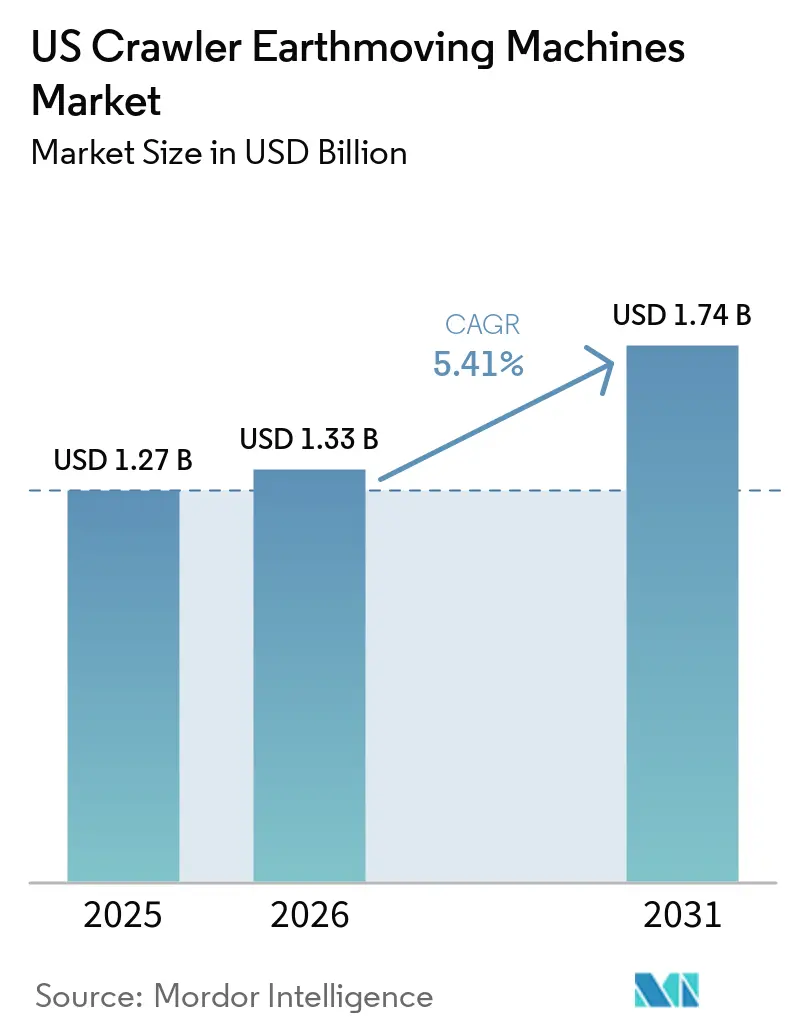
| Base Year Market Size (2025) | USD 1.27 Billion |
| Market Size (2026) | USD 1.33 Billion |
| Market Size (2031) | USD 1.74 Billion |
| Growth Rate (2026 - 2031) | 5.41 % |
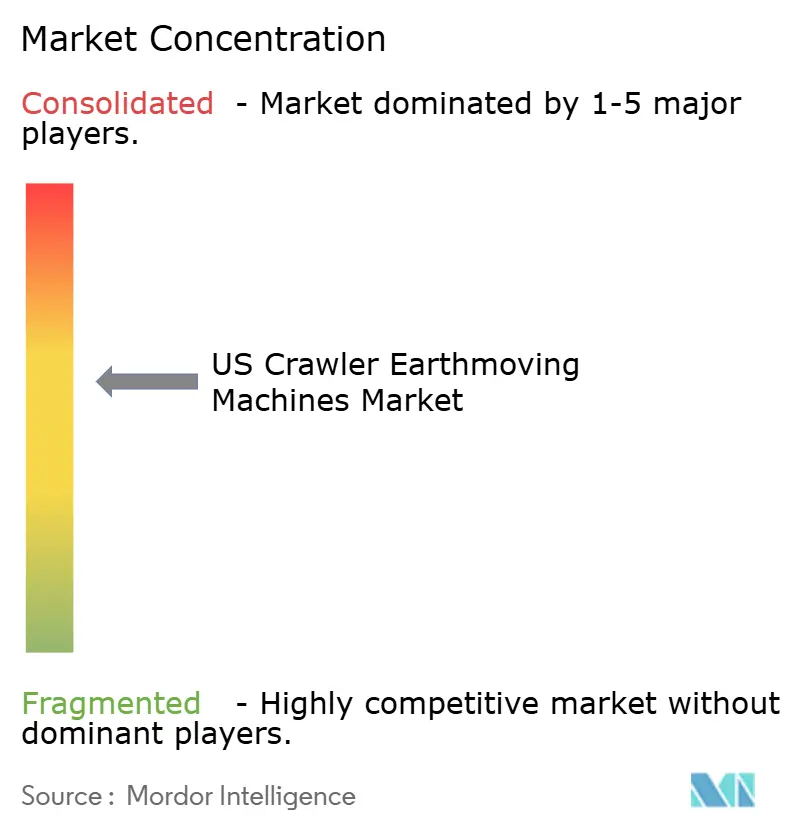
| Market Concentration | Medium |
Major Players *Disclaimer: Major Players sorted in no particular order Image © Mordor Intelligence. Reuse requires attribution under CC BY 4.0. | |
US Crawler Earthmoving Machines Market Analysis by Mordor Intelligence
The US crawler earthmoving machines market size was valued at USD 1.27 billion in 2025, is estimated at USD 1.33 billion in 2026, and is projected to reach USD 1.74 billion by 2031, at a CAGR of 5.41% during the forecast period (2026-2031). Federal infrastructure appropriations under the Infrastructure Investment and Jobs Act and the Inflation Reduction Act are funneling close to USD 21 billion each year into highway and bridge programs, creating a long-tail pipeline of public-works contracts that strengthen replacement cycles for crawler excavators and bulldozers. At the same time, contractors are gravitating toward compact tracked loaders that can maneuver on tight residential lots and urban renewal sites, a trend reinforced by the reinstated 100% bonus depreciation for sub-100 HP machines placed in service after January 2025. Electrification is gathering pace as California’s Advanced Clean Fleets rule spurs early adoption of hybrid and battery-electric excavators, even though ICE platforms continue to dominate high-duty-cycle segments such as mining and quarrying. Rental penetration is climbing to record levels because labor scarcity, higher financing costs, and volatile award timing under federal grant programs tilt the acquisition decision toward short-term leases with embedded training and telematics support.
Key Report Takeaways
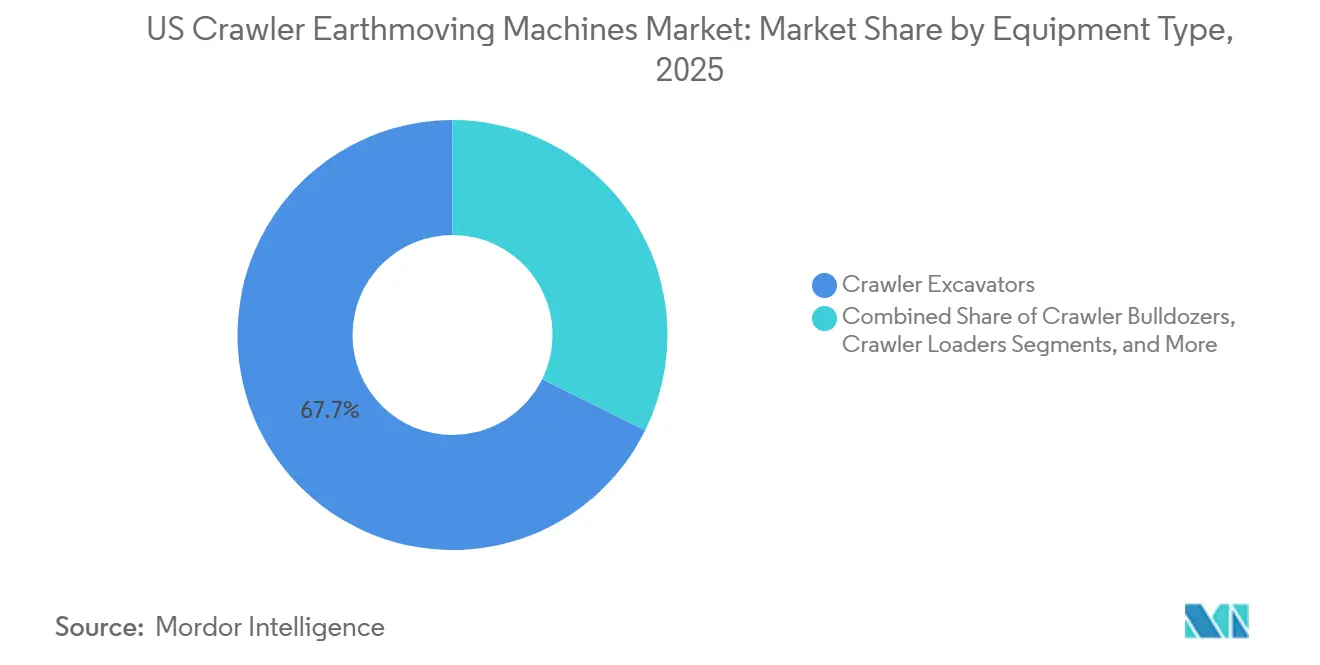
- By equipment type, crawler excavators led with 67.73% of the US crawler earthmoving machine market share in 2025, whereas compact tracked loaders expand at 6.43% CAGR.
- By propulsion, electrified and hybrid units are forecast to expand at a 6.45% CAGR through 2031, outpacing diesel platforms even though the latter still hold an 83.31% share.
- By engine power, the below-100 HP segment is projected to post a 7.48% CAGR, the fastest among power classes, while the 100-200 HP band retained 47.26% share in 2025.
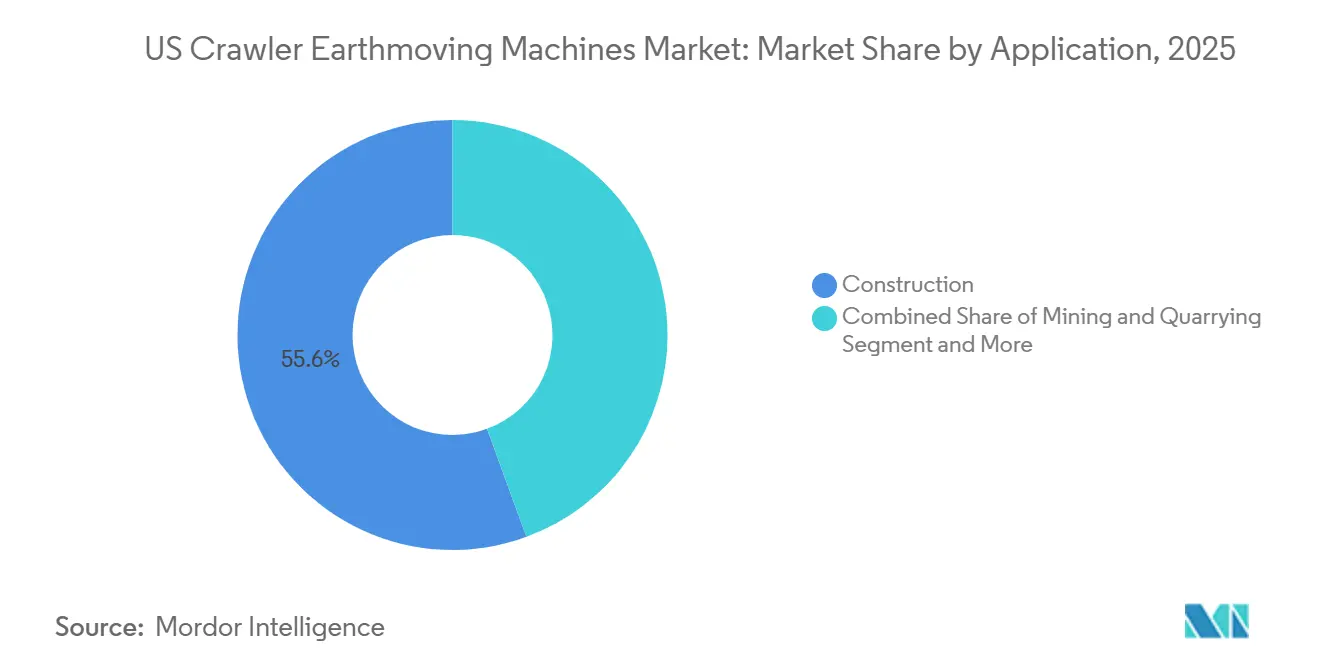
- By application, construction accounted for a 55.64% share of the US crawler earthmoving machine market size in 2025 and is advancing at a 6.51% CAGR through 2031.
- By distribution channel, authorized dealers controlled 73.35% of 2025 revenue, but rentals and leasing are growing at a 7.53% CAGR on the back of tax and liquidity advantages.
Note: Market size and forecast figures in this report are generated using Mordor Intelligence’s proprietary estimation framework, updated with the latest available data and insights as of January 2026.
United states contributes to a system defined not by any single country or region but by the interaction of many. The global crawler earthmoving machines market data by Mordor Intelligence represents that combined structure.
US Crawler Earthmoving Machines Market Trends and Insights
Drivers Impact Analysis*
| Driver | (~) % Impact on CAGR Forecast | Geographic Relevance | Impact Timeline |
|---|---|---|---|
| Boom in federal infrastructure funding | +1.2% | National, with concentration in states receiving FHWA formula funds | Medium term (2-4 years) |
| Labor scarcity driving equipment-rental penetration | +1.0% | National, acute in Sun Belt and Mountain West | Short term (≤ 2 years) |
| Rise of electrified and hybrid excavator models | +0.8% | National, early adoption in California and Northeast due to state-level emission rules | Long term (≥ 4 years) |
| Accelerated urban-renewal projects | +0.6% | Midwest and Southeast metros (Knoxville, Dubuque, similar) | Medium term (2-4 years) |
| Digitized job-site management and telematics integration | +0.5% | National, led by large contractors and fleet operators | Medium term (2-4 years) |
| Forestry wildfire-mitigation incentives | +0.4% | Western states (California, Oregon, Washington, Montana, Idaho) | Short term (≤ 2 years) |
| Source: Mordor Intelligence | |||
Boom in Federal Infrastructure Funding (IIJA, IRA)
Federal formula allocations are channeling significant annual investments into highway spending. However, as of early 2026, a substantial portion of this total authorization remains untouched. This scenario not only locks in multi-year visibility for prime contractors but also casts a spotlight on the US crawler earthmoving machine market[1]“Apportionment of Funds for Federal-Aid Highways,” Federal Highway Administration, fhwa.dot.gov . Complementing this financial foundation, the BUILD and RAISE grant schemes are directing funds into multimodal hubs situated in secondary cities. This initiative broadens the market for compact excavators and loaders. Meanwhile, delayed obligation cycles are squeezing machine orders into tight timeframes. This trend not only heightens quarterly shipment volatility but also maintains surges in demand, which rental fleets are poised to meet. In a shift, public-sector buyers are leaning towards leasing rather than outright purchases. This strategy helps them sidestep the burden of depreciating assets on municipal balance sheets, consequently boosting rental penetration. In response, OEMs are strategically positioning their inventory close to major DOT districts, ensuring they're ready for last-minute orders.
Labor Scarcity Driving Equipment-Rental Penetration
By the end of the decade, a significant portion of the construction workforce is expected to retire, leaving contractors in search of skilled operators. BLS.GOV. To address this skills gap, rental companies are now offering bundled services that combine operator training with telematics dashboards, making machine control and compliance more straightforward. With rising interest rates, mid-tier credit applicants are seeing lease quotes becoming increasingly expensive—the balance is tipping towards renting rather than buying. This shift is particularly pronounced among smaller firms that don't have access to captive finance programs. In light of these trends, the American Rental Association is predicting record-high rental penetration in the coming years, aligning with the channel's steady growth trajectory over the forecast period [2]“Equipment Rental Revenue Forecast 2026,” American Rental Association, ararental.org .
Rise of Electrified and Hybrid Excavator Models
In the mid-2020s, Volvo CE and Komatsu unveiled hybrid excavators offering significant fuel savings and notable carbon reductions. This shift in the total-cost-of-ownership equation comes even before considering the DEF and SCR expenses associated with Tier-4 diesel units. California's recent mandate for select municipal fleets to adopt zero-emission purchases serves as the primary demand catalyst. However, a fragmented charging infrastructure hampers a nationwide rollout. With advancements in battery pack modularity, contractors can now perform mid-shift swaps or utilize overnight depot charging. This innovation ensures smaller urban contractors remain productive, even in idling-restriction zones. As lithium-ion cell costs continue to decline and DC fast-charging networks are set up along major corridors, hybrids are on track to capture a larger market share. This is especially true as the industry edges closer to achieving cost parity in the coming years.
Accelerated Urban-Renewal Projects in Tier-2 US Cities
Knoxville, Dubuque, and other similar metros are increasingly securing a larger share of RAISE and BUILD grants. These grants, amounting to significant funding, are being funneled into projects like pedestrian bridges, multimodal corridors, and downtown streetscapes, all slated for completion within the next few years. However, these tight timelines are putting pressure on local equipment pools. As a solution, city agencies are turning to rental sub-100 HP machines, which can easily navigate narrow rights-of-way without causing lane closures. This need for compact machinery is reflected in the steady growth of the compact tracked loader market, supported by a notable increase in newly financed units over the past year. Additionally, municipalities are benefiting from lower daily rates, allowing them to maximize their budgets. At the same time, OEMs are seizing the opportunity to introduce telematic-enabled compact models, which provide real-time reports on utilization and maintenance status to centrally managed fleets.
Restraints Impact Analysis*
| Restraint | (~) % Impact on CAGR Forecast | Geographic Relevance | Impact Timeline |
|---|---|---|---|
| Steep increases in equipment-financing rates | -0.9% | National, acute for small and mid-sized contractors | Short term (≤ 2 years) |
| Volatile steel prices impacting OEM margins | -0.7% | National, exacerbated by tariff policy | Short term (≤ 2 years) |
| Tight Tier-4 emission-compliance costs for OEMs | -0.6% | National, with EPA enforcement focus | Medium term (2-4 years) |
| Supply-chain fragility for hydraulic components | -0.4% | National, sourcing concentrated in Europe and Asia | Short term (≤ 2 years) |
| Source: Mordor Intelligence | |||
Steep Increases in Equipment-Financing Rates Post-2023
By mid-2023, the Federal Reserve raised its benchmark rate significantly, effectively doubling borrowing costs compared to a couple of years prior. This increase added substantial costs to the monthly lease of high-value equipment like crawler excavators. Small contractors, lacking investment-grade credit, now face higher lease quotes, making short-term rentals a more viable option or forcing delays in fleet upgrades. This trend is reflected in a notable decline in new-business volume reported by the Equipment Leasing and Finance Association during the first half of 2025. Meanwhile, OEMs introduced zero-percent promotions on compact models, extending through late 2025. While this approach supports sales volumes, it puts pressure on dealer margins and raises concerns about its long-term viability once rate subsidies are removed.
Volatile Steel Prices Impacting OEM Margins
Hot-rolled coil prices fluctuated between USD 700 and USD 1,200 per short ton in 2025, reflecting tariff adjustments and spike-and-plunge demand swings in the automotive and energy sectors. OEMs partially pass through surcharges, yet contracts with state DOTs often fix equipment cost baselines months before delivery, squeezing profitability when procurement timelines elongate. Fabricators adapt by dual-sourcing plate and employing variable-thickness designs that trim raw-steel weight without sacrificing structural integrity, but engineering lead times lengthen as a result.
*Our forecasts treat driver/restraint impacts as directional, not additive. The impact forecasts reflect baseline growth, mix effects, and variable interactions.
Segment Analysis
By Equipment Type: Excavators Dominate, Compact Loaders Surge
Crawler excavators generated 67.73% of 2025 revenue in the US crawler earthmoving machine market, supported by their utility in trenching, mass excavation, and demolition. Compact tracked loaders, however, are on course for a 6.43% CAGR between 2026 and 2031, reflecting a structural pivot toward infill housing and urban renewal that favors smaller footprints and turf-friendly undercarriages.
Vacuum from fleet turnover in the heavy-duty bulldozer arena funnels incremental sales to excavator-mounted grade-control attachments, an upsell path that OEMs monetize through proprietary 3D machine-control software. Telecommunications trenching tied to the BEAD program also buttresses the “Others” category, where specialty machines and attachments see a demand uptick amid the USD 42.45 billion rural broadband rollout.



By Propulsion: ICE Leads, Electrification Accelerates
Internal combustion engines retained 83.31% share in 2025, yet electric and hybrid models are forecast to post a 6.45% CAGR through 2031, steadily enlarging their slice of the US crawler earthmoving machine market. Volvo CE’s five-model hybrid line delivers 20% fuel savings, while Komatsu’s regenerative swing harness lifts productivity 15%, tilting operating-expense math in favor of hybrids despite upfront price premiums. California’s zero-emission procurement rule, effective 2024, fast-tracks coastal adoption, whereas heartland states await broader charging networks before committing to fleet-wide electrification.
Diesel machines still dominate quarrying and long-haul earthmoving due to superior energy density and refueling convenience, and Tier-4 hardware bumps fuel efficiency 3%-6% compared with Tier 3. Nevertheless, battery-pack modularity and falling cell costs are closing the economics gap faster than previously modeled, especially in the sub-6-ton mini-excavator class, where daily duty cycles rarely exceed eight hours. As hybrid penetration rises, OEMs gain a recurring revenue stream from software unlocks that optimize power-split algorithms and battery health monitoring, reinforcing after-sales stickiness across the US crawler earthmoving machine market.
By Engine Power Output: Mid-Range Dominates, Compact Segment Accelerates
Machines rated 100-200 HP commanded 47.26% of 2025 turnover, with versatility across road-building, utilities, and forestry. The below-100 HP cohort, however, is on track for a 7.48% CAGR to 2031, buoyed by the One Big Beautiful Bill Act’s 100% bonus depreciation that slashes after-tax acquisition cost by roughly 21% for C-corporations. The same provision allows rental firms to scale fleets quickly, reinforcing their leadership in compact categories within the US crawler earthmoving machine market.
OEM product roadmaps now prioritize short-tail swing excavators in the 140-160 HP bracket for urban demolition, while 400 HP-plus wheel loaders cater to aggregate yards feeding IIJA highway builds. Compact buyers remain price sensitive, often declining bundled telematics subscriptions, so dealers experiment with à-la-carte data packages to retain analytics revenue. Mid-range and heavy units, by contrast, achieve higher telematics attach rates, letting fleet operators slash idle time and right-size equipment on multi-site contracts.
By Application: Construction Leads, Forestry Gains Traction
Construction accounted for 55.64% of sales in 2025 and is projected to expand at a CAGR of 6.51% through 2031. Sustained IIJA highway awards will support demand for construction-related products and services, while renovation activity across urban cores will further contribute to segment growth.
Mining and quarrying stay relatively stable despite coal’s secular decline, as aggregate demand for concrete and asphalt feeds interstate-widening and port-expansion projects. Agriculture remains a niche but profitable market for compact excavators with precision grade control that outperform tractor-mounted implements during tile drainage installation. Broadband trenching joins the “Others” bucket, pulling demand for micro-trenching attachments that slot into compact loaders already present on subdivision sites.
By Distribution Channel: Dealers Dominate, Rentals Surge
Full-service dealers captured 73.35% of 2025 revenue by leveraging OEM-backed credit, field service, and parts inventories, yet rentals and leasing are on a 7.53% CAGR trajectory. The American Rental Association expects market value to reach USD 82.6 billion in 2026, reflecting a record 60% penetration rate, well above the 2019 baseline of 65% of contractors renting at least one unit annually.
OEMs court mega-fleets with direct-sale portals for attachments and wear parts, a pilot move that pressures dealer mark-ups but expands total lifecycle value across the US crawler earthmoving machine market. Meanwhile, Hitachi’s re-entry into North American rentals underscores growing competition among lessors; fleet owners exploit bonus depreciation to expand inventories, then optimize utilization through telematics that highlight idle assets within a 50-mile radius, cutting dead-head moves and raising return on invested capital.
Geography Analysis
Western states are allocating a substantial share of USDA disaster supplements to wildfire mitigation, particularly hazard-tree removal and slope stabilization, with programs expected to continue for the foreseeable future. This allocation is increasing demand for grapple-equipped crawler excavators and compact loaders, which can operate on rugged terrain while maintaining ground pressure below forest management thresholds. California has rapidly adopted hybrid and battery-electric platforms, driven by the Advanced Clean Fleets rule. This shift has created a distinct two-tier propulsion landscape in the US crawler earthmoving machine market. Meanwhile, the IIJA’s coastal infrastructure initiative is funding port-backed dredging and quay wall upgrades, supporting demand for crawler cranes in Seattle, Tacoma, and Portland.
The Sun Belt is experiencing the fastest population growth, resulting in increased housing starts, particularly on smaller lots. Consequently, compact tracked loaders are gaining traction in Texas, Arizona, Florida, and Georgia, where rental penetration is high. To mitigate tariff-related challenges, OEMs such as JCB and Sakai are localizing assembly operations. However, labor shortages remain particularly acute in Nevada, Utah, and Colorado. In response, rental companies are expanding their service offerings by bundling operator training and autonomy-ready modules, creating incremental revenue opportunities across the US crawler earthmoving machine market.
Demand in the Midwest and Northeast continues to rise, driven primarily by bridge rehabilitation projects and aggregate production. These applications rely heavily on mid-range wheel loaders and excavators used in quarries. In urban markets such as New York and Massachusetts, compact equipment is gaining momentum as space constraints and stringent noise ordinances accelerate the adoption of electric mini machines. Volvo CE’s expansion in Shippensburg is increasing the Mid-Atlantic supply of hybrid crawler equipment while leveraging its proximity to East Coast ports to streamline inbound component logistics. Additionally, growing telematics adoption along the Boston-Washington corridor is enabling contractors to manage mixed fleets more efficiently across diverse urban projects, while supporting software revenue growth for OEMs.
The crawler earthmoving machines market is analyzed by Mordor Intelligence across multiple other geographies, with in-depth regional assessments available for Europe. This is complemented by country-specific insights for Indonesia, Thailand, Philippines, Singapore, Australia, South Korea, and Saudi Arabia, reflecting various localized market behavior and policy environments' coverage.
Competitive Landscape
In the US crawler earthmoving machine market, Caterpillar, Komatsu, and John Deere collectively hold a significant share. This moderate concentration opens the door for price-driven incursions from competitors like SANY, LiuGong, and XCMG, particularly at the compact end. In response, these incumbents are bolstering their offerings with advanced technologies. For instance, Caterpillar is set to roll out its Level 4 autonomy in the near future, leveraging insights from an extensive volume of autonomous haulage data. Meanwhile, Doosan Bobcat is making waves with its debut of collision-warning AI and modular batteries at CES, establishing a new technological benchmark. Further solidifying the industry's shift, Volvo CE has invested heavily in upgrading its Shippensburg plant, enhancing its hybrid and electric capabilities. This positions the facility as a pivotal East Coast hub, especially as battery logistics evolve.
Strategic maneuvers in the industry highlight a focus on captive finance, ensuring aftermarket parts spending, and predictive maintenance to minimize downtime. There's also a push towards modular electrification platforms, primed for future battery retrofits. Smaller players like Sunward and Takeuchi are carving a niche in the rental channel, promoting longer service intervals and standardized components. This strategy significantly reduces inventory carrying costs for fleet owners. However, the expenses tied to EPA Tier-4 Final certification act as a formidable barrier, hastening industry consolidation. A case in point is CNH Industrial's tighter integration of Case Construction Equipment, signaling a strategic shift towards emission-compliant product lines and hybrid R&D, setting a higher entry bar for newcomers.
Attachment specialists are honing in on forestry-specific implements, especially those aligned with hazard-mitigation budgets. Simultaneously, autonomy software vendors are partnering with OEMs, retrofitting older machines with GPS grade control. This collaboration not only extends the life of legacy equipment but also shortens replacement cycles. While price competition heats up in the sub-100 HP segment, true market leadership is determined by factors like dealer service density, financing capabilities, and data-driven uptime guarantees. These elements collectively work to lower the total cost of ownership for fleet managers.
US Crawler Earthmoving Machines Industry Leaders
Caterpillar Inc.
Komatsu Ltd.
John Deere
Volvo CE
Hitachi Construction Machinery
- *Disclaimer: Major Players sorted in no particular order

Recent Industry Developments
- August 2026: Komatsu announced the reopening of its company-owned branch in Redding, California, expanding its presence in Northern California. As the company’s northernmost branch in the state, the location serves as a strategic hub for construction and forestry operations across the region.
- March 2026: Kubota officially introduced and launched the SVL110-3 compact track loader at the CONEXPO-CON/AGG 2026 trade show in Las Vegas. The launch showcased Kubota’s latest compact track loader offering to construction industry professionals, equipment dealers, and other attendees at one of North America’s largest construction trade shows.
- June 2025: Volvo Construction Equipment (Volvo CE) is investing USD 261 million globally to expand crawler excavator production and address supply chain risks. Shippensburg, Pennsylvania, is one of the sites planned for expansion, and production will start in 2026.
- June 2025: CASE Construction Equipment launches the CX380E crawler excavator in North America at 268 HP and 37,700 kg operating weight.


US Crawler Earthmoving Machines Market Report Scope
The scope of the report includes Equipment Type (Crawler Excavators, Crawler Bulldozers, and More), Propulsion (Internal Combustion Engine and Electric and Hybrid), Engine Power Output (Below 100 HP, 100-200 HP, and More), Application (Construction and More), and Distribution Channel (Direct OEM Sales and More). The Market Forecasts are Provided in Terms of Value (USD) and Volume (Units).
| Crawler Excavators |
| Crawler Bulldozers |
| Crawler Loaders |
| Crawler Cranes and Pipe-layers |
| Compact Tracked Loaders and Skid-steers |
| Others (Trencher, Drill Rig, etc.) |
| Internal Combustion Engine (ICE) |
| Electric and Hybrid |
| Below 100 HP |
| 100-200 HP |
| 201-400 HP |
| Above 400 HP |
| Construction |
| Mining and Quarrying |
| Agriculture and Forestry |
| Others |
| Direct OEM Sales |
| Authorized Dealers |
| Rental and Leasing Firms |
| By Equipment Type | Crawler Excavators |
| Crawler Bulldozers | |
| Crawler Loaders | |
| Crawler Cranes and Pipe-layers | |
| Compact Tracked Loaders and Skid-steers | |
| Others (Trencher, Drill Rig, etc.) | |
| By Propulsion | Internal Combustion Engine (ICE) |
| Electric and Hybrid | |
| By Engine Power Output | Below 100 HP |
| 100-200 HP | |
| 201-400 HP | |
| Above 400 HP | |
| By Application | Construction |
| Mining and Quarrying | |
| Agriculture and Forestry | |
| Others | |
| By Distribution Channel | Direct OEM Sales |
| Authorized Dealers | |
| Rental and Leasing Firms |


Key Questions Answered in the Report
How large is the US crawler earthmoving machine market in 2026?
The market is estimated at USD 1.33 billion in 2026 with a 5.41% CAGR outlook toward 2031.
Which equipment category is growing the fastest?
Compact tracked loaders and skid-steers are projected to grow at a 6.43% CAGR between 2026 and 2031.
What is driving rental demand for crawler equipment?
Labor shortages, higher financing rates, and 100% bonus depreciation under the 2025 tax law favor short-term rentals with training bundles.
How quickly are hybrid and electric excavators gaining share?
Electrified and hybrid units are forecast to post a 6.45% CAGR through 2031, outpacing diesel, although ICE remains dominant today.
Which regions show the strongest demand growth?
The Sun Belt and Western wildfire-affected states lead growth due to population in-migration and disaster-mitigation funding commitments.
What impact do Tier-4 Final rules have on equipment costs?
Emission-control hardware adds 10%-25% to diesel power-train costs, motivating some buyers to explore hybrid alternatives and pushing OEMs toward modular electrification.
Page last updated on:


 Your data is secure and never sold or shared.


