
Europe Crawler Earthmoving Machines Market Size and Share
Market Overview
| Study Period | 2019 - 2031 |
|---|---|
| Forecast Data Period | 2026 - 2031 |
| Base Year Market Size (2025) | USD 18.85 Billion |
| Market Size (2026) | USD 19.91 Billion |
| Market Size (2031) | USD 26.24 Billion |
| Growth Rate (2026 - 2031) | 5.67 % |
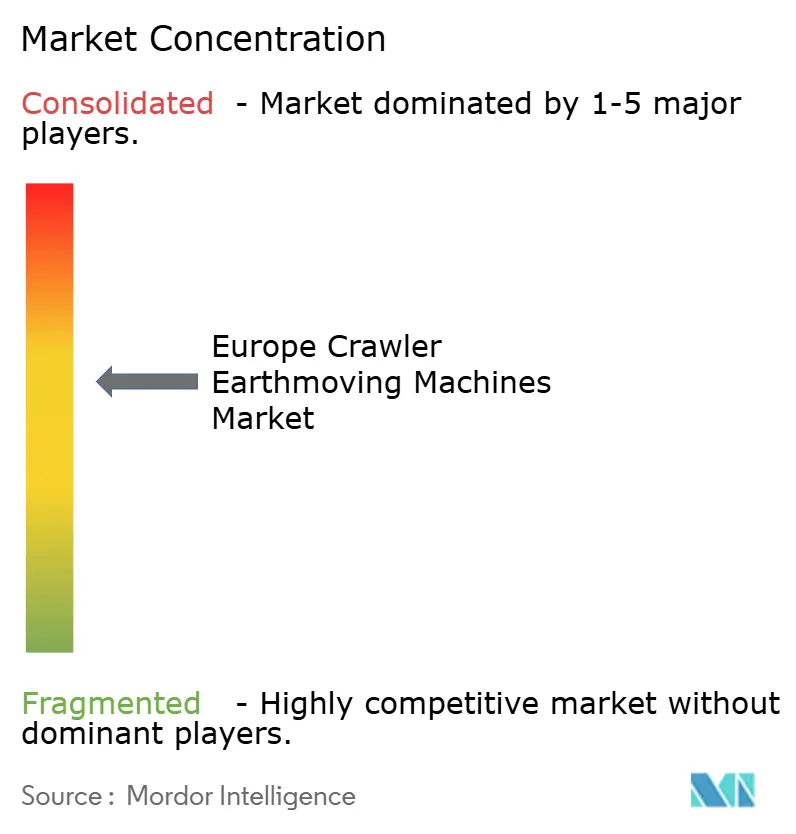
| Market Concentration | Medium |
Major Players *Disclaimer: Major Players sorted in no particular order Image © Mordor Intelligence. Reuse requires attribution under CC BY 4.0. | |
Europe Crawler Earthmoving Machines Market Analysis by Mordor Intelligence
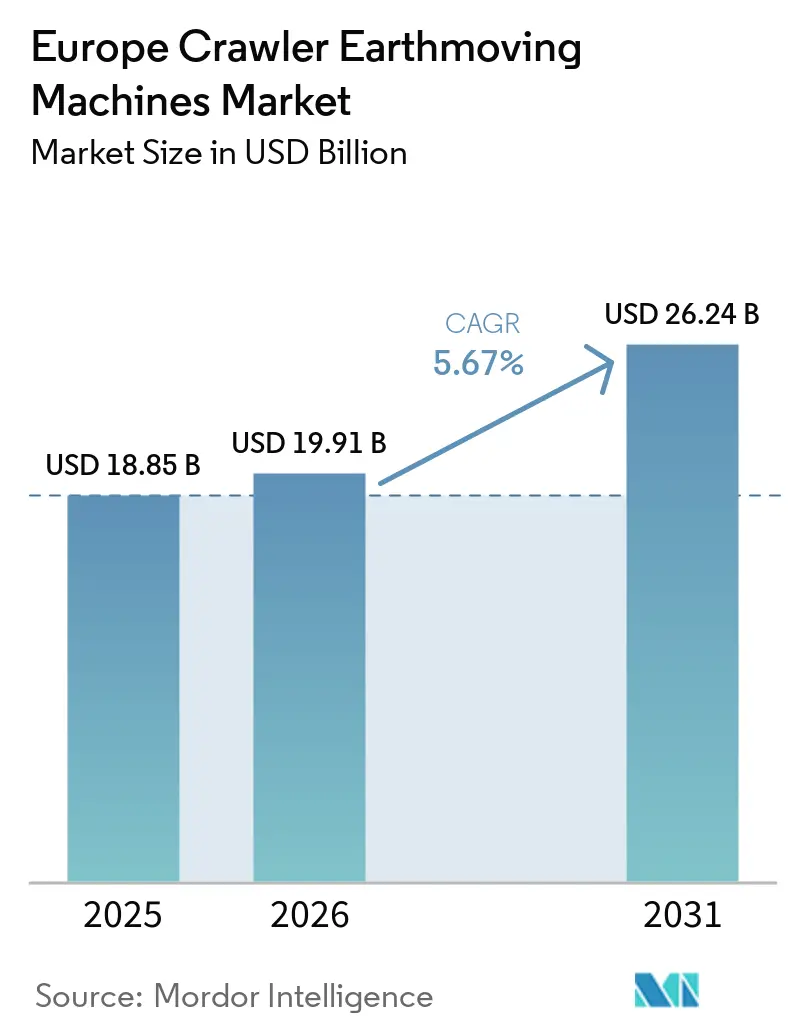
The European crawler earthmoving machines market size was valued at USD 18.85 billion in 2025 and is estimated at USD 19.91 billion in 2026, and is projected to reach USD 26.24 billion by 2031, growing at a CAGR of 5.67% from 2026 through 2031. The growth path reflects a structural pivot from post-pandemic recovery toward sustained infrastructure investment in Germany, France, Poland, and the Czech Republic, with rental fleets widening access to Stage V-compliant and electric units. Fleet replacement accelerates as pre-2019 machines hit end-of-life, while electrification incentives such as the Netherlands’ SSEB subsidy lower the total cost of ownership for zero-emission models. Mid-range 201-400 HP crawlers remain the workhorse of highway and rail upgrades, yet compact tracked loaders are posting the fastest volume gains as cities prioritize equipment with a sub-15-tonne footprint for selective demolition and utility works. OEM launches of telematics-ready models consolidate after-sales revenue streams and shorten service cycles, enabling contractors to reduce downtime by almost half and cut fuel use by one-quarter.
Key Report Takeaways
- By equipment type, crawler excavators led with 41.27% of the European crawler earthmoving machine market share in 2025, and compact tracked loaders are projected to expand at a 5.69% CAGR between 2026 and 2031.
- By propulsion, internal-combustion units accounted for a 77.83% share in 2025, while electric and hybrid crawlers registered the highest projected CAGR at 5.73% through 2031.
- By engine power output, the 201-400 HP band held a 35.47% share of the European crawler earthmoving machine market size in 2025, whereas sub-100 HP machines advanced at a 5.72% CAGR to 2031.
- By application, construction captured a 31.28% share in 2025 and is advancing at a 5.77% CAGR through 2031.
- By distribution channel, authorized dealers retained a 45.47% share in 2025, yet rental advances at a 5.79% CAGR through 2031.
- By geography, Germany captured a 28.87% share in 2025, while the United Kingdom is advancing at a 6.73% CAGR through 2031.
Note: Market size and forecast figures in this report are generated using Mordor Intelligence’s proprietary estimation framework, updated with the latest available data and insights as of January 2026.
Proportional positioning is established by comparing regional contributions against the global total, including that of Europe. The crawler earthmoving machines market share in our global report expresses these relative weights.
Europe Crawler Earthmoving Machines Market Trends and Insights
Drivers Impact Analysis*
| Driver | (~) % Impact on CAGR Forecast | Geographic Relevance | Impact Timeline |
|---|---|---|---|
| Construction-Sector Stimulus Under EU Recovery Fund | +1.2% | Germany, France, Poland, Czech Republic, with spillover to Netherlands, Belgium, Austria | Medium term (2-4 years) |
| Accelerated Replacement of Ageing Crawler Fleets | +0.9% | Global, with concentration in Western Europe (Germany, France, United Kingdom, Italy, Spain) | Short term (≤ 2 years) |
| Expansion of Rental & Leasing Fleets Driven by Asset-light Contractor Strategies | +0.8% | United Kingdom, Germany, France, Nordic countries, expanding to Eastern Europe | Long term (≥ 4 years) |
| Stage V and Electrification Incentives | +0.7% | Netherlands, Germany, Nordic countries (Sweden, Norway, Finland), France | Medium term (2-4 years) |
| Digital-Twin and Telematics OPEX Savings | +0.5% | Western Europe core (Germany, United Kingdom, France, Netherlands), early adoption in Nordics | Long term (≥ 4 years) |
| Surge In Deconstruction and Circular-Demolition Projects | +0.4% | Urban centers across Spain, France, Belgium, Germany, Czech Republic, with EU-wide mandate influence | Long term (≥ 4 years) |
| Source: Mordor Intelligence | |||
Construction-Sector Stimulus Under EU Recovery Fund
Germany's Strategic Infrastructure Fund, with a substantial budget, has allocated a significant portion for transport networks until the end of the decade. This move is set to spur a consistent demand for medium- to heavy-duty excavators and high-powered bulldozers. Meanwhile, Poland is implementing a large-scale initiative over the next few years, and the Czech Republic is advancing a major modernization effort, both of which broaden the opportunity further east. France, through its "France 2030" initiative, is directing considerable funding, promoting the adoption of Stage V and electric fleets in bustling urban areas. While large excavators are reaping the rewards from highway and rail contracts, compact tracked loaders are finding their niche in municipal streets. In Germany, rental utilization rates for medium-sized excavators have reached high levels, indicating a tight capacity even as OEM output climbs.
Accelerated Replacement of Aging Crawler Fleets
In recent years, the enforcement of Stage V regulations created a backlog of pre-compliant units, which are now beyond their typical life cycles. In the mid-2020s, UK auction volumes experienced a noticeable increase, highlighting a brisk turnover. Western contractors are opting for telematics-enabled models that integrate with enterprise resource planning systems, achieving a significant reduction in downtime. On the other hand, Eastern European firms are extending the lifespan of their Tier III-A crawlers. They are importing used machines from Germany and France at discounted rates. This strategy not only postpones the need for new-unit purchases but also boosts the secondary market.
Expansion of Rental & Leasing Fleets Driven by Asset-Light Contractor Strategies
The rental distribution channel, holding a significant share of crawler shipments, is on a rapid ascent, projected to grow at a notable compound annual growth rate until 2031. This surge is largely driven by contractors reallocating capital towards labor and materials amidst a pronounced skills shortage. Companies like Boels and Cramo are extending their fleet's lifespan to several years, leveraging telematics analytics to optimize usage per unit. Meanwhile, subsidized electric crawlers, flitting between various short-term projects, boast a utilization rate that is considerably higher than owner-operated diesel counterparts.
Stage V and Electrification Incentives
Stage V engines add EUR 15,000-25,000 (approximately USD 17,542.88 to USD 29,238.12) to machines above 130 kW, accelerating total cost of ownership calculations that now increasingly favor electric crawlers. The Netherlands’ SSEB program offsets up to EUR 90,000 (approximately USD 105,241.05) per zero-emission unit. Hitachi’s ZX135-7EB and Komatsu’s PC20E series entered European rental fleets during 2025 [1]. Yet grid readiness lags: a Swedish study shows that charging 15 heavy machines can overload regional substations, spotlighting the EUR 40 billion (USD 46.78 billion) grid-upgrade bill that Europe must close by 2040.
Restraints Impact Analysis*
| Restraint | (~) % Impact on CAGR Forecast | Geographic Relevance | Impact Timeline |
|---|---|---|---|
| High Upfront CAPEX and Tighter Credit | -0.6% | Eastern Europe (Poland, Czech Republic, Romania), Southern Europe (Spain, Portugal, Greece), small contractors across all regions | Short term (≤ 2 years) |
| Raw-Material and Component Supply Volatility | -0.5% | Global, with acute pressure in Germany, Italy, France due to steel import quotas and CBAM implementation | Medium term (2-4 years) |
| ESG-Linked Cost of Owning Diesel Fleets | -0.4% | Western Europe (Germany, France, United Kingdom, Netherlands, Nordic countries) with stringent ESG disclosure mandates | Medium term (2-4 years) |
| Scarcity of Fast-Charging for More Than 20-Tonne Crawlers | -0.3% | Nordic countries, Netherlands, Germany (early electric adopters), urban centers with grid constraints | Long term (≥ 4 years) |
| Source: Mordor Intelligence | |||
High Upfront CAPEX and Tighter Credit
In Europe, a 20-tonne Stage V crawler excavator is priced within a moderate range. In contrast, its electric counterpart is significantly more expensive. This price disparity extends the payback period for buyers to several years, particularly when policy rates keep financing spreads elevated. Furthermore, banks in Poland and the Czech Republic are now requiring substantially higher down payments compared to the norm in Western Europe. This has resulted in a distinct two-tier landscape among buyers.
Raw-Material and Component Supply Volatility
As of March 2026, hot-rolled coil prices hover around EUR 700 per tonne, buoyed by surging natural gas prices and the implementation of the Carbon Border Adjustment Mechanism. Meanwhile, semiconductor lead times have significantly increased compared to pre-pandemic norms. This extension has elongated OEM delivery windows considerably and slashed gross margins by a notable margin.
*Our forecasts treat driver/restraint impacts as directional, not additive. The impact forecasts reflect baseline growth, mix effects, and variable interactions.
Segment Analysis
By Equipment Type: Excavators Lead, Compact Loaders Surge
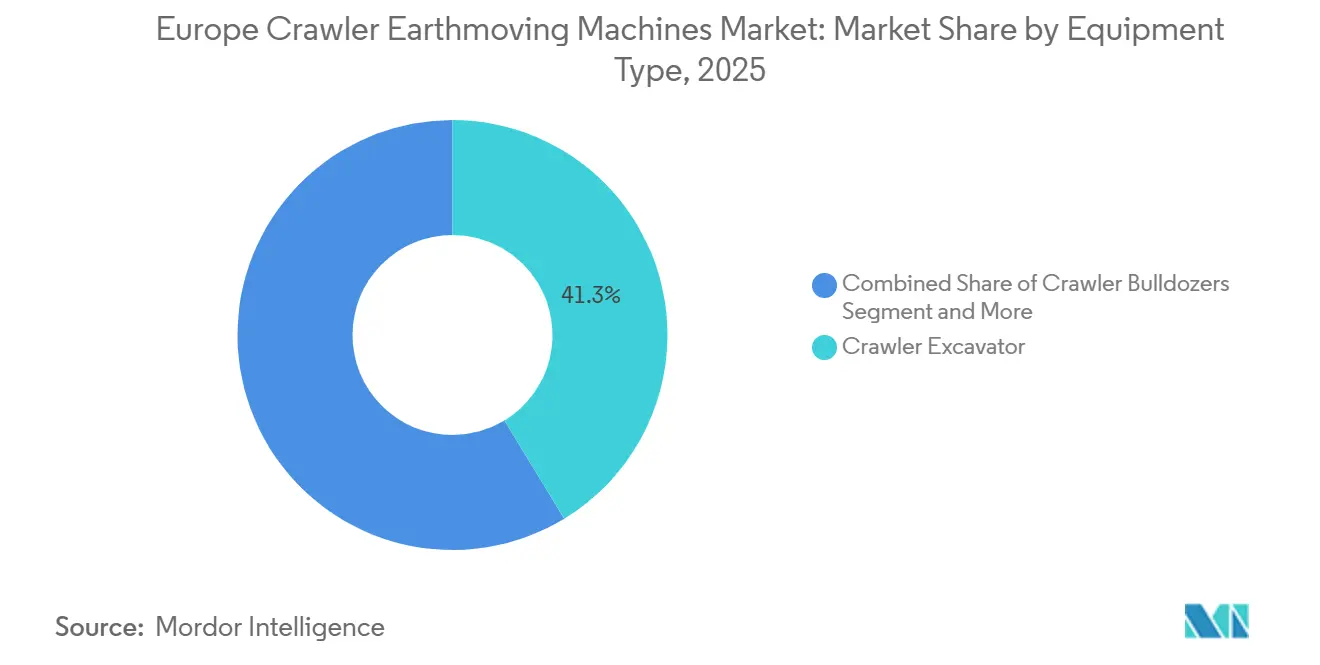
Crawler excavators delivered 41.27% of the European crawler earthmoving machine market size in 2025, fueled by Germany’s and Poland’s highway and rail pipelines. Compact tracked loaders grew fastest at a 5.69% CAGR, serving tight urban sites and selective demolition contracts. Urban densification favors machines under 3 tonnes and less than 1.5 meters wide that skirt congestion restrictions. Heavy bulldozers and crawler loaders remain indispensable in quarry development and large-scale grading, yet collectively occupy under one-fifth of total demand. Electrification reshapes this mix: loaders with <50 kWh batteries align with 10 kW on-site supply, while 30-tonne excavators remain diesel-based until grid capacity expands.
Electrification’s early payoffs appear in rental fleets piloting Hitachi’s 13.5-tonne ZX135-7EB and Komatsu’s 2-3.3-tonne PC E-series. These units cut energy bills by 40% and meet zero-emission worksite rules in Amsterdam and Oslo. Large excavators serve civil-works packages yet must adapt to Stage V aftertreatment costs that erode diesel capex advantages. Specialty crawlers such as cranes account for less than one-tenth of shipments, concentrated in wind-farm tower assembly and pipeline laying that fluctuate with energy project timelines.

By Propulsion: ICE Dominates, Electrification Accelerates
Internal-combustion engines commanded a 77.83% share in 2025, anchored by established fuel logistics and eight-hour duty cycles, but electric and hybrid crawlers post a 5.73% CAGR to 2031. Subsidies of up to EUR 90,000 (approximately USD 105,252.7) per zero-emission unit in the Netherlands compress payback to five years.
Hybrid systems bridge infrastructure gaps by pairing diesel engines with regenerative motors that trim fuel use by 15-20%. Yet hybrids bring EUR 50,000-80,000 (approximately USD 58,471.7 to 93,554.8) premiums and dual-powertrain complexity, so uptake concentrates among fleets exceeding 50 machines that can spread maintenance overhead across high utilization rates.
By Engine Power Output: Mid-Range Leads, Compact Surges
Crawlers rated 201-400 HP formed 35.47% of 2025 shipments, matching the horsepower needs of 20-30 tonne excavators on highway sites. Sub-100 HP units grow the quickest at 5.72% CAGR, synchronized with compact loader demand in schools, hospitals, and telecom trenching, where low ground pressure is critical.
Above-400 HP crawlers represent under 15% of volume and stay diesel-centric because battery packs above 600 kWh remain impractical. Mid-range classes face squeezing from nimble electrics stealing light-duty tasks and heavy diesel crawlers retaining deep-dig applications.
By Application: Construction Dominates, Circular Economy Emerges
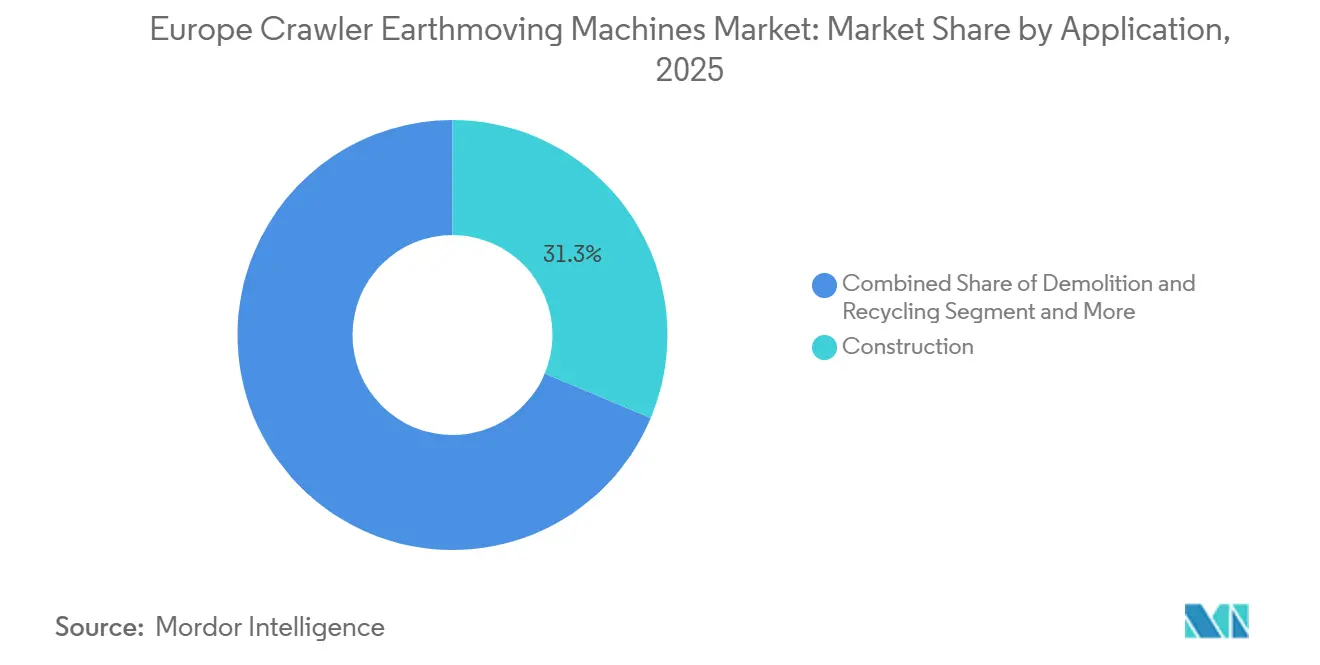
Construction secured a 31.28% share in 2025 and will pace the European crawler earthmoving machine market at a 5.77% CAGR to 2031, anchored by Germany’s EUR 93 billion (approximately USD 108.75 billion) transport spend and France’s urban decarbonization push. Mining and quarrying demand grows more slowly as permitting hurdles weigh on new pits.
Deconstruction climbs on EU waste-recycling mandates, placing compact electrics with precision attachments in the spotlight. Municipal utility contractors and landscapers form a growing “other” segment, keen on low-noise electric crawlers that operate within residential curfews.
By Distribution Channel: Dealers Lead, Rental Accelerates
Authorized dealers retained a 45.47% share in 2025, yet rental advances grew at 5.79% CAGR as contractors tap utilization-based models to sidestep high financing costs. Direct OEM sales serve megaproject operators buying fleets above 50 units, but level off at roughly one-quarter share.
Rental companies tap subsidy pools and roll Stage V or electric units from site to site, capturing life-cycle profits in parts, telematics, and operator training while dealers respond with blended rent-to-own packages.
Geography Analysis
Germany captured a 28.87% share in 2025; Europe's powerhouse is set to invest heavily through the end of the decade in transport corridors, favoring medium-to-large excavators and high-powered bulldozers. Following closely, France allocates substantial funding under its "France 2030" initiative, spotlighting zero-emission fleets for urban renewal in Paris. The United Kingdom recorded significant crawler sales in the mid-decade and is advancing at a 6.73% CAGR through 2031, yet faces a looming labor deficit projected to grow considerably in the coming years. To counter this, strategies like telematics and rentals are being emphasized. In the Nordics, while electrification pilots are underway, studies caution that charging multiple heavy machines could strain a notable portion of regional substations [2].
Eastern Europe, buoyed by EU cohesion funds, is outpacing its counterparts with strong growth. However, stringent lending terms are nudging smaller firms towards used imports. Southern Europe grapples with inflation in steel and components, elongating OEM lead times. Yet, Spain's push for renewable-energy infrastructure is bolstering the demand for crawler cranes. In Russia, the landscape is shifting; while Western OEMs have retreated, Chinese giants like XCMG and Zoomlion are stepping in, meeting the residual demand from their plants in Germany and Hungary, and slashing delivery times to just a short period.
In the Benelux and Alpine regions, high per-capita crawler density is evident, thanks to advanced infrastructure and stringent emission regulations promoting early electric adoption. The Netherlands' SSEB grants are making zero-emission crawlers a financially sound choice for rental fleets, especially those juggling multiple short-term city projects. Meanwhile, Ireland and Portugal, buoyed by tourism infrastructure, are seeing steady growth, but face challenges with capital scarcity and a limited rental market.
Mordor Intelligence examines the crawler earthmoving machines market across diverse other regional markets as well, offering granular country-level perspectives for Indonesia, United States, Thailand, Philippines, Singapore, Australia, South Korea, and Saudi Arabia and more.
Competitive Landscape
In 2025, top global leaders Caterpillar, Komatsu, Liebherr, Volvo Construction Equipment, and Hitachi held a significant combined share, indicating a moderately concentrated market. In 2026, Volvo plans to strengthen its vertical integration by acquiring Swecon through a substantial investment and opening an excavator plant in Eskilstuna, significantly reducing lead times. Meanwhile, Liebherr and Kubota are expected to enter into a supply agreement to co-brand wheeled excavators from 2026 onward, expanding their product portfolios without requiring a full greenfield investment.
Chinese competitors are intensifying their expansion into Europe. At Bauma 2025, Zoomlion showcased an extensive model range and expanded its German factory. Similarly, XCMG is opening a training hub in Düsseldorf and launching a European leasing division offering flexible terms. However, despite these aggressive initiatives, SANY achieved only marginal sales growth in Europe during the first half of 2025, as contractors continue to prioritize robust service networks and telematics systems. ESG-linked financing is also intensifying competition. Heidelberg Materials is expected to raise a substantial green bond for low-carbon equipment, providing an advantage to OEMs with established electric equipment roadmaps.
Telematics platforms secure highly lucrative recurring revenue streams by locking customers into proprietary data clouds. Caterpillar’s Product Link and Komatsu’s Komtrax have played an instrumental role in reducing unplanned downtime, creating substantial switching costs. Hybrid propulsion currently bridges the gap for vehicles in higher weight categories, while suppliers offering genset-battery combinations are establishing a niche until grid capacity expands.
Europe Crawler Earthmoving Machines Industry Leaders
-
Caterpillar Inc.
-
Komatsu Ltd.
-
Liebherr-International AG
-
Volvo Construction Equipment AB
-
Hitachi Construction Machinery Co., Ltd.
- *Disclaimer: Major Players sorted in no particular order
Recent Industry Developments
- June 2026: Liebherr introduced the R 915, R 917, and R 920 Compact G8 crawler excavators. The company designed these short-swing-radius machines for networked urban jobsites with limited space and restricted access.
- April 2025: Kubota agreed with Liebherr to source 9 t and 11 t wheeled excavators for the European launch in 2026 to capture infrastructure-led demand.
- March 2025: SANY Group launched the ST230V compact track loader specifically for infrastructure projects in Europe and North America. The loader offers maximum maneuverability in confined spaces.
Europe Crawler Earthmoving Machines Market Report Scope
The scope of the report includes Equipment Type (Crawler Excavators, Crawler Bulldozers, Crawler Loaders, Crawler Cranes and Pipe-layers, Compact Tracked Loaders and Skid-steers, and Others (Trencher, Drill Rig, etc.)), Propulsion (Internal Combustion Engine and Electric and Hybrid), Engine Power Output (Below 100 HP, 100-200 HP, 201-400 HP, and Above 400 HP), Application (Construction, Mining and Quarrying, Agriculture and Forestry, and Others), Distribution Channel (Direct OEM Sales, Authorized Dealers, and Rental and Leasing Firms), and Country(Germany, France, United Kingdom, Italy, Spain, Russia, Netherlands, Sweden, Norway, Finland, Poland, Czech Republic, Austria, Switzerland, Belgium, Denmark, Ireland, Portugal, and Greece). The Market Forecasts are Provided in Terms of Value (USD) and Volume (Units).
| Crawler Excavators |
| Crawler Bulldozers |
| Crawler Loaders |
| Crawler Cranes and Pipe-layers |
| Compact Tracked Loaders and Skid-steers |
| Others (Trencher, Drill Rig, etc.) |
| Internal Combustion Engine (ICE) |
| Electric and Hybrid |
| Below 100 HP |
| 100-200 HP |
| 201-400 HP |
| Above 400 HP |
| Construction |
| Mining and Quarrying |
| Agriculture and Forestry |
| Others |
| Direct OEM Sales |
| Authorized Dealers |
| Rental and Leasing Firms |
| Germany |
| France |
| United Kingdom |
| Italy |
| Spain |
| Russia |
| Netherlands |
| Sweden |
| Norway |
| Finland |
| Poland |
| Czech Republic |
| Austria |
| Switzerland |
| Belgium |
| Denmark |
| Ireland |
| Portugal |
| Greece |
| By Equipment Type | Crawler Excavators |
| Crawler Bulldozers | |
| Crawler Loaders | |
| Crawler Cranes and Pipe-layers | |
| Compact Tracked Loaders and Skid-steers | |
| Others (Trencher, Drill Rig, etc.) | |
| By Propulsion | Internal Combustion Engine (ICE) |
| Electric and Hybrid | |
| By Engine Power Output | Below 100 HP |
| 100-200 HP | |
| 201-400 HP | |
| Above 400 HP | |
| By Application | Construction |
| Mining and Quarrying | |
| Agriculture and Forestry | |
| Others | |
| By Distribution Channel | Direct OEM Sales |
| Authorized Dealers | |
| Rental and Leasing Firms | |
| By Country | Germany |
| France | |
| United Kingdom | |
| Italy | |
| Spain | |
| Russia | |
| Netherlands | |
| Sweden | |
| Norway | |
| Finland | |
| Poland | |
| Czech Republic | |
| Austria | |
| Switzerland | |
| Belgium | |
| Denmark | |
| Ireland | |
| Portugal | |
| Greece |
Key Questions Answered in the Report
What revenue level do crawler earthmoving machines reach in Europe in 2026?
Sales stand at USD 19.91 billion in 2026.
Which equipment category currently ships the most units?
Crawler excavators hold the top spot with a 41.27% share of 2025 demand.
How quickly will compact tracked loaders advance over the forecast period?
Shipments rise at a 5.69% CAGR between 2026-2031.
Why is the rental channel so pivotal for contractors?
Rental already covers 45.47% of deliveries and grows the fastest, giving firms equipment access without heavy capital outlay.
How sizable is the shift toward electric and hybrid powertrains?
While diesel keeps 77.83% share in 2025, electric and hybrid variants expand at a 5.73% CAGR to 2031, fueled by subsidies such as the Dutch SSEB.
Which national spending plans underpin long-term equipment demand?
Germany’s EUR 93 billion (approximately USD 108.7 billion) transport fund, France’s EUR 54 billion (approximately USD 63.1 billion) “France 2030,” and Poland’s EUR 76 billion (approximately USD 88.8 billion) program headline the pipeline.