
Indonesia Crawler Earthmoving Machines Market Size and Share
Market Overview
| Study Period | 2019 - 2031 |
|---|---|
| Forecast Data Period | 2026 - 2031 |
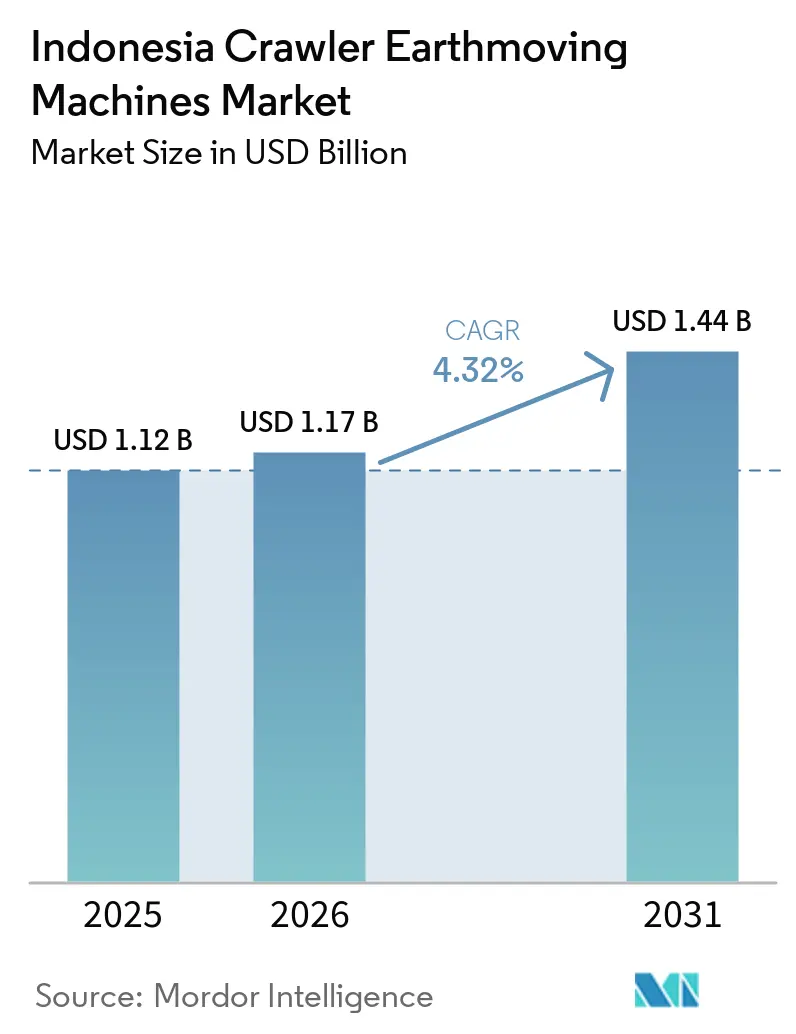
| Base Year Market Size (2025) | USD 1.12 Billion |
| Market Size (2026) | USD 1.17 Billion |
| Market Size (2031) | USD 1.44 Billion |
| Growth Rate (2026 - 2031) | 4.32 % |
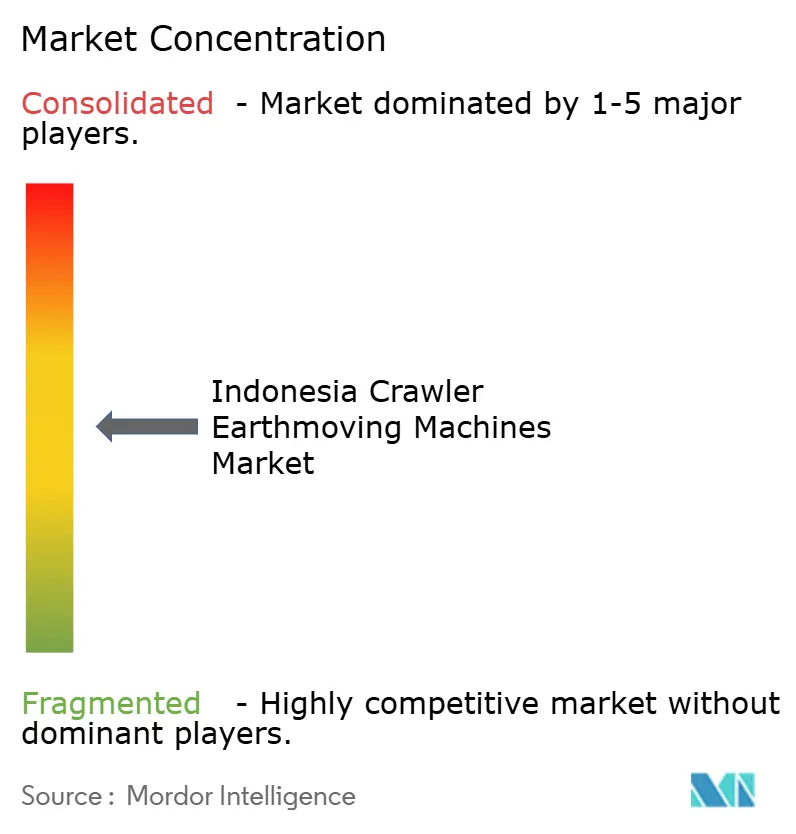
| Market Concentration | Medium |
Major Players
*Disclaimer: Major Players sorted in no particular order Image © Mordor Intelligence. Reuse requires attribution under CC BY 4.0. |
|
Indonesia Crawler Earthmoving Machines Market Analysis by Mordor Intelligence
The Indonesian crawler earthmoving machines market size was valued at USD 1.12 billion in 2025 and is estimated to grow from USD 1.17 billion in 2026 to reach USD 1.44 billion by 2031, at a CAGR of 4.32% over 2026-2031. Public spending has undergone a sharp re-prioritization, shaping the growth path. The budget allocates funds for only a limited expansion of new toll roads. In contrast, a significant amount is directed towards the Nusantara capital build-out, and a hefty commitment is anchored in the Masela LNG megaproject [1]"Abadi LNG Project in Masela Block, Indonesia Commences FEED", Inpex Corporation, inpex.com. While mine-site investments counterbalance the subdued road pipeline, Vale Indonesia has secured substantial funding for nickel deposits. Simultaneously, CNGR Advanced Material has set aside resources to bolster its downstream capacity. This surge in investments underscores a sustained demand for high-horsepower excavators and bulldozers. Under a presidential regulation, tight carbon-allocation ceilings are steering contractors towards fuel-efficient tracked machines. Furthermore, as evidenced by LiuGong’s West Karawang plant and Volvo’s inaugural electric delivery, battery-electric units are poised to capture a larger share of the market. The competitive landscape remains fierce, with Chinese brands now able to deliver machines quickly at a price discount. This pricing strategy pressures incumbents, compelling them to rely on telematics-driven uptime guarantees and bundled financing as defensive measures to maintain their market share.
Key Report Takeaways
- By equipment type, excavators led with 53.82% of Indonesia's crawler earthmoving machines market share in 2025, while bulldozers are forecast to record the fastest 7.76% CAGR to 2031.
- By propulsion, internal-combustion engines accounted for 86.43% share of the Indonesian crawler earthmoving machines market size in 2025; battery-electric units are projected to expand at an 8.42% CAGR through 2031.
- By distribution channel, dealer and distributor networks captured 68.63% revenue share in 2025, whereas direct sales are poised for the highest 7.47% CAGR over the forecast period.
- By end-use industry, construction accounted for 62.73% of 2025 demand, but mining and quarrying are expected to grow the fastest, at a 7.34% CAGR through 2031.
Note: Market size and forecast figures in this report are generated using Mordor Intelligence’s proprietary estimation framework, updated with the latest available data and insights as of January 2026.
Worldwide, activity is shaped by contributions from multiple countries and regions, with Indonesia representing one among them. The global report on crawler earthmoving machines market by Mordor Intelligence reflects how these countries and regional layers combine into a single system.
Indonesia Crawler Earthmoving Machines Market Trends and Insights
Drivers Impact Analysis*
| Driver | (~) % Impact on CAGR Forecast | Geographic Relevance | Impact Timeline |
|---|---|---|---|
| Infra Pipeline | +1.8% | East Kalimantan primary, Java secondary | Long term (≥ 4 years) |
| Mine Expansions | +1.2% | Sulawesi core, spill-over to Kalimantan | Medium term (2-4 years) |
| Urbanization Projects | +0.9% | Greater Jakarta, Surabaya, Medan metro areas | Medium term (2-4 years) |
| Dealer-Credit and Rental | +0.6% | National, with early gains in Jakarta, Surabaya | Short term (≤ 2 years) |
| Telematics-Enabled Predictive Maintenance | +0.4% | Mining regions first, construction sites follow | Medium term (2-4 years) |
| Carbon-Pricing Drives | +0.3% | National, accelerated in urban areas | Long term (≥ 4 years |
| Source: Mordor Intelligence | |||
Massive Public-Sector Infrastructure Pipeline
Nusantara has earmarked a significant budget, while a new phase recently commenced with additional allocations for earthworks [2]“Nusantara Progress Update January 2024,”, Nusantara Capital Authority, iglc.net. Despite a reduction in overall toll-road expansions, the industry's shift towards concentrated megaprojects has sustained a robust demand for large excavators and bulldozers, essential for continuous operation on compact sites. Meikarta's ambitious housing units under the 3 Million Homes Program, spearheading the vertical-housing initiative, further amplify demand for tracked equipment suited to deep foundation work. The completion of the Java gas pipeline underscored the importance of heavy trenching machines and established a benchmark for the upcoming civil packages of Masela LNG. Collectively, these ventures have counterbalanced a decline in highway expenditures, ensuring a steady order pipeline for high-capacity crawler equipment.
Accelerated Nickel and Copper Mine Expansions
Vale Indonesia secured financing commitments exceeding significant amounts, while CNGR garnered substantial funding, highlighting a prolonged mining cycle intricately linked to EV supply chains. Even with a downward revision to the RKAB production quota, Indonesia is poised to boost its nickel output to a high level. Achieving this will necessitate aggressive overburden removal, utilizing excavators designed for heavy-duty cycles. While policy-driven supply discipline has injected short-term volatility, downstream mandates, coupled with multi-billion-dollar HPAL projects, ensure robust equipment demand extending well beyond the forecast horizon.
Rapid Urbanization Fueling Real-Estate Projects
Mortgage lending in Balikpapan experienced growth, Meikarta launched new towers, and PT KAI's Manggarai project introduced additional units. These developments exemplify a trend in vertical construction, where excavation and compaction activities are concentrated within limited footprints. As construction cost indices rise, contractors face squeezed margins. In response, many are turning to telematics, successfully reducing idle time on projects like the Karangjoang-Kariangau toll road. Such efficiencies lead to increased utilization rates for mid-size crawler excavators.
OEM Dealer-Credit and Rental Penetration
KB Bank and United Tractors have formed a credit alliance, unlocking significant tailored financing. However, down-payment requirements still pose challenges for SMEs, leading to an uptick in rentals. Chinese OEMs are further driving this trend, offering lease-to-own packages that ensure machines transition from factory to site quickly. With the growth of rental fleets, telematics-driven service contracts have emerged as the key tool for customer retention. This shift is not only altering dealer economics but also speeding up direct sales, often sidestepping traditional intermediaries.
Restraints Impact Analysis*
| Restraint | (~) % Impact on CAGR Forecast | Geographic Relevance | Impact Timeline |
|---|---|---|---|
| Commodity Price Volatility | -1.4% | Mining regions, particularly Sulawesi and Kalimantan | Short term (≤ 2 years) |
| SME Financing Gap | -0.8% | National, acute in outer islands | Medium term (2-4 years) |
| Operator Shortage | -0.6% | National, severe in remote mining areas | Long term (≥ 4 years) |
| EV-Parts Duty Uncertainty | -0.4% | National, affecting electrification timeline | Medium term (2-4 years) |
| Source: Mordor Intelligence | |||
Commodity-Price Volatility Suppresses Capex Cycles
The heavy equipment sales declined, likely due to fluctuations in coal and nickel prices. During downturns, smaller contractors often struggle to service equipment loans, leading them to liquidate crawler assets. This action not only shrinks the pool of used-machine values but also highlights the market's volatility. In response, tier-one miners are increasingly opting for versatile excavator-dozer combinations, allowing them to redeploy across different ore bodies. However, their overall spending remains closely tied to commodity price forecasts. Meanwhile, OEMs are strategically diversifying into construction rentals, a move that aligns their demand more with government budgets than with export earnings.
Shortage of Certified Machine Operators
In Indonesia, a small percentage of the construction workforce possesses competency certificates, and there's a notable lack of awareness regarding legal requirements. The most pronounced shortfall is observed at remote mining sites in Papua and Kalimantan. As a result, firms are either importing operators or settling for diminished productivity from trainees. While vocational centers have limited crawler simulators, this constraint limits the number of graduates each year, even though there's a strong interest in certification. Due to this skills gap, the industry struggles to fully harness advanced electro-hydraulic controls and semi-autonomous functions. Although government TVET reforms have introduced green-construction curricula, the industry anticipates tangible results only in the long term. In response, OEMs are rolling out on-site training modules and teleoperation packages, enabling seasoned Java operators to remotely control machines at far-flung mines.
*Our forecasts treat driver/restraint impacts as directional, not additive. The impact forecasts reflect baseline growth, mix effects, and variable interactions.
Segment Analysis
By Equipment Type: Excavators Set the Pace in Mining and Infrastructure
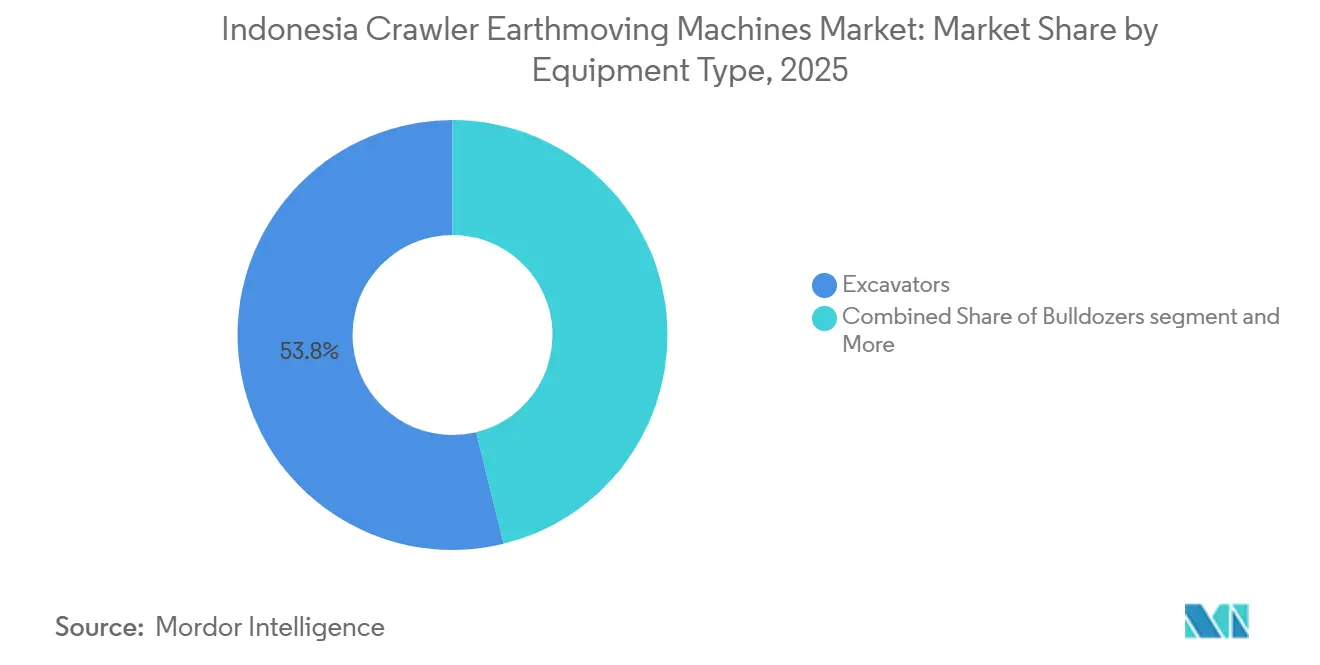
Excavators still held 53.82% of Indonesia's crawler earthmoving machine market share in 2025 because they are used for overburden removal at nickel pits, trenching for the Java gas pipeline, and foundation work for the 3 Million Homes towers. Bulldozers are projected to post a 7.76% CAGR through 2031 as food-estate projects, IKN site grading, and early-stage Masela LNG earthworks drive demand for high-drawbar-pull machines. Dozer advances are tied to Presidential Regulation No. 110/2025, which caps carbon allocations and pushes operators to retire fuel-hungry scrapers in favor of electro-hydraulic D8- to D10-class units that lower emissions by up to 10% per load cycle.
OEM innovation centers on electric mini-excavators for emissions-sensitive urban pockets and high-horsepower dozers with remote blade control for mining benches. Import tariffs on undercarriage assemblies keep the economics of localization favorable for the domestic fabrication of frames and track groups. Rental fleets skew toward 30-ton excavators because they balance transportability with broad job applicability, minimizing idle days. Meanwhile, mining firms acquire 70-ton-and-above models outright, leveraging longer payback horizons associated with long-life ore bodies. This dichotomy sustains tiered demand across weight classes within the Indonesian crawler earthmoving machines market.



By Propulsion: ICE Dominance Meets Regulatory Pressure
Internal-combustion engines held 86.43% share of the Indonesian crawler earthmoving machines market in 2025 due to mature fueling networks and familiarity among operators. Tier 3 and Tier 4 interim engines remain prevalent, though carbon pricing since 2022 has introduced direct operating-cost penalties, sharpening interest in alternative powertrains. Battery-electric units exhibit an 8.42% CAGR, led by 20-ton excavators inside emission-restricted urban zones. However, uncertainty around import duties on traction batteries hinders upfront affordability, leading some contractors to defer purchases until policy clarity emerges. Hybrid systems occupy the middle ground by offering 15–20% fuel savings without a charging infrastructure.
State-owned utilities plan to build pilot charging yards at Nusantara to service crawler equipment during shift breaks, signaling future scalability. OEMs such as Komatsu and Hyundai propose swappable battery packs to mitigate charging downtimes on remote mining benches. Even so, long-cycle jobs in Kalimantan’s overburden removal still favor diesel due to its higher energy density and faster refueling speed. Therefore, the Indonesian crawler earthmoving machines market size is expected to remain ICE-heavy through 2030, with electrification proceeding first in regulated urban clusters.
By Distribution Channel: Dealers Anchor After-Sales Reach
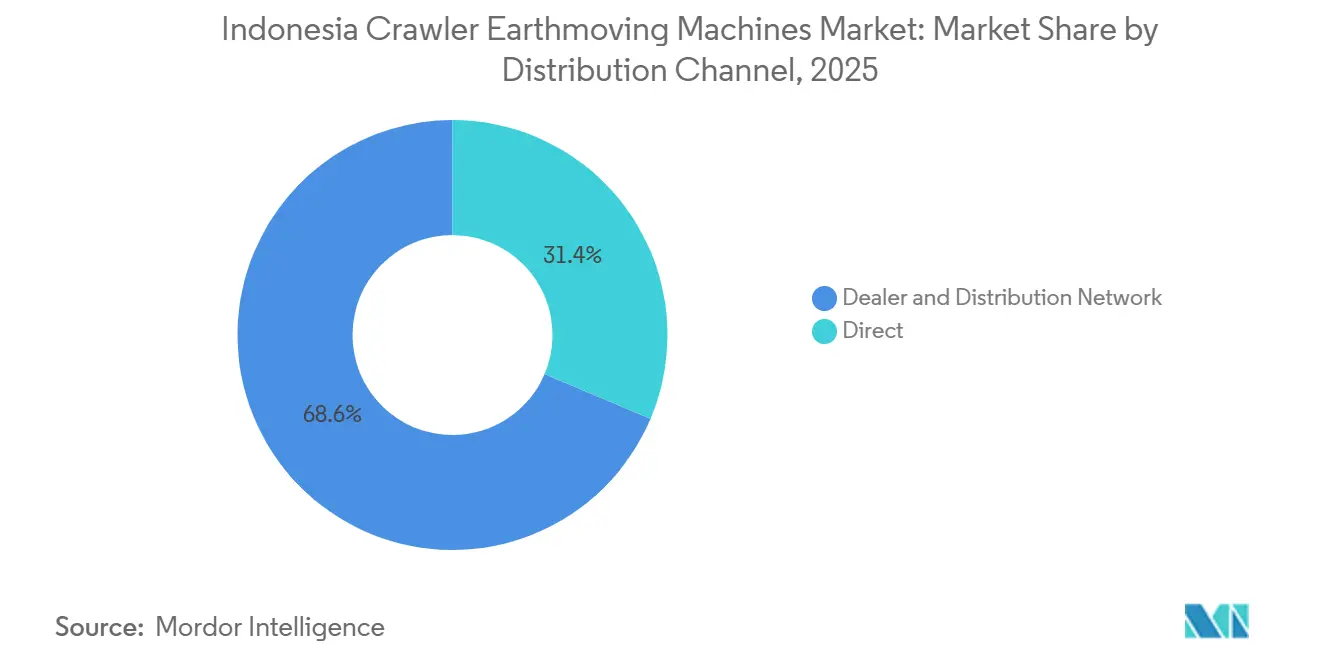
Dealer networks captured 68.63% share in 2025 because Indonesia’s most islands require localized parts depots and rapid technician dispatch. Flagship dealers in Jakarta, Surabaya, and Balikpapan stock critical undercarriage components and hydraulic pumps, cutting downtime for fleet owners. Direct sales grow at 7.47% CAGR as large miners negotiate factory-spec fleets bundled with telematics dashboards and long-term maintenance contracts. OEM e-commerce portals allow contractors to order wear parts online and schedule service calls, yet field support still routes through regional dealers for final execution.
Digital platforms now integrate machine data feeds, enabling dealers to propose predictive maintenance kits before failures occur. This enhances parts revenue and cements dealer value, especially in remote eastern provinces. Fleet customers increasingly sign availability-guarantee agreements under which dealers incur penalties for extended downtime, incentivizing proactive service. Taken together, hybrid distribution models position both channels to scale alongside the Indonesian crawler earthmoving machines market.
By End-Use Industry: Construction Leads While Mining Accelerates
Construction projects generated a 62.73% share of the Indonesian crawler earthmoving machines market size in 2025, with steady workstreams from road building, airports, housing, and industrial parks. Government-backed PPP structures reduce payment risk, encouraging contractors to refresh fleets regularly. Mining and quarrying post a 7.34% CAGR as nickel, copper, and gold expansions crowd order books for large crawler excavators and bulk dozers. The segment also demands specialized slope stabilization and tailings-pond equipment, widening SKU requirements.
Oil and gas pipeline installations contribute consistent yet niche crawler purchases for trenching and right-of-way clearing in Sumatra and Kalimantan. Plantation agriculture uses mid-size dozers for land preparation on palm oil estates, while forestry concessions use crawler harvesters on steep terrain. As downstream processing zones proliferate, combined industrial-construction complexes will further blur the line between traditional end-use categories, enlarging the Indonesian crawler earthmoving machines market over the outlook period.
Geography Analysis
Java represents the most significant regional slice of the Indonesian crawler earthmoving machines market in 2025, as Greater Jakarta alone absorbs dozens of rail, highway, and high-rise projects each year. Contractors in West Java maintain the nation’s densest rental fleets, ensuring quick swaps that keep project schedules on target. Sumatra follows owing to coal logistics corridors and palm plantation expansions that require robust earthmoving for roadbeds and drainage canals. However, Kalimantan shows the fastest growth for 2026-2031 due to the colossal Nusantara land-development program, which spans greenfield drainage, grading, and embankment works across multiple phases.
Sulawesi’s spotlight rises as PT Vale, Tsingshan, and Huayou intensify nickel-processing clusters around Morowali and Pomalaa, necessitating continuous overburden removal and site leveling. Papua hosts low-volume yet high-value demand tied to the Grasberg underground ramp-up and potential Wabu gold mine development. Market penetration on the Maluku and Nusa Tenggara islands remains thin because limited logistics infrastructure inflates equipment support costs. Nonetheless, new maritime highway links and port upgrades promise to improve accessibility, unlocking latent crawler requirements. The geographic spread underscores Indonesia’s policy shift from Java-centric to archipelagic development, broadening the Indonesia crawler earthmoving machines market base over the forecast horizon.
Mordor Intelligence provides coverage of the crawler earthmoving machines market across other key regional markets, including Europe, each with their regulatory frameworks and demand patterns. Detailed country-level analysis extends to Philippines, Singapore, United States, Thailand, Australia, South Korea, and Saudi Arabia incorporating local coverage and market participation, as required.
Competitive Landscape
Global OEMs dominate Indonesia through a blend of local assembly, deep dealer roots, and incremental technology localization. Caterpillar operates plants in Jakarta and Batam that produce key crawler models tailored for tropical conditions, including reinforced cooling systems for 40 °C ambient temperatures. Komatsu leverages its Gresik factory to supply 20- and 30-ton excavators under the CKD scheme, reducing import duties and shortening lead times. Hitachi Construction Machinery Indonesia assembles ZX-series excavators with locally fabricated undercarriages, catering to both domestic buyers and ASEAN exports.
Pricing rivalry intensifies in the mid-range excavator segment, where Chinese entrants seek market share through aggressive financing. Yet after-sales depth and residual value keep premium brands in a strong position. United Tractors, Trakindo Utama, and Intraco Penta anchor parts distribution, operator training, and certified rebuild programs, creating high switching costs for fleet owners. As Indonesian carbon policy stiffens, players offering electric and hybrid portfolios plus charging ecosystems are expected to edge ahead in the Indonesian crawler earthmoving machines market.
Indonesia Crawler Earthmoving Machines Industry Leaders
-
Komatsu Ltd.
-
Caterpillar Inc.
-
Hitachi Construction Machinery
-
SANY
-
Volvo CE
- *Disclaimer: Major Players sorted in no particular order

Recent Industry Developments
- July 2026: PT Hexindo Adiperkasa Tbk officially launched the WIXIM Series, a new lineup of construction equipment supported by LANDCROS and designed to provide practical, reliable, and value-driven solutions for customers. The WIXIM lineup includes the WZW series wheel loaders and WZD series bulldozers, which are designed to handle a wide range of applications. The lineup comprises the WZW140B-G, WZW220B-G, WZD170B-G/WZD170BM-G, and WZD250B-F/WZD250BM-F models.
- March 2025: Volvo Construction Equipment (Volvo CE), in collaboration with its Indonesian dealer, introduced the New Generation EC210 Excavator, showcasing its cutting-edge technology, robust construction, reliable components, and boosted productivity.


Indonesia Crawler Earthmoving Machines Market Report Scope
The Indonesian crawler earthmoving machines market report is segmented by equipment type (excavators, bulldozers, graders, dump trucks, skid-steer loaders, and others), propulsion (internal-combustion engine, hybrid, and battery-electric), distribution channel (direct, dealer and distributor network), end-use industry (construction, mining and quarrying, oil and gas infrastructure, and others), and geography. The market forecasts are provided in terms of value (USD) and volume (units).
| Excavators |
| Bulldozers |
| Graders |
| Dump Trucks |
| Skid-Steer Loaders and Others |
| Internal-Combustion Engine |
| Hybrid |
| Battery-Electric |
| Direct |
| Dealer and Distributor Network |
| Construction |
| Mining and Quarrying |
| Oil and Gas Infrastructure |
| Others (Agriculture, Forestry) |
| By Equipment Type | Excavators |
| Bulldozers | |
| Graders | |
| Dump Trucks | |
| Skid-Steer Loaders and Others | |
| By Propulsion | Internal-Combustion Engine |
| Hybrid | |
| Battery-Electric | |
| By Distribution Channel | Direct |
| Dealer and Distributor Network | |
| By End-Use Industry | Construction |
| Mining and Quarrying | |
| Oil and Gas Infrastructure | |
| Others (Agriculture, Forestry) |


Key Questions Answered in the Report
How large will crawler earthmoving equipment sales in Indonesia be by 2031?
Shipments are expected to generate about USD 1.44 billion in 2031, up from USD 1.17 billion in 2026, reflecting a 4.32% CAGR.
Which equipment type holds the largest share of crawler machines sold in Indonesia?
Excavators lead with 53.82% market share due to their versatility in mining and construction.
Which end-use sector is expanding quickest for crawler equipment?
Mining and quarrying applications are growing at a 7.34% CAGR due to Indonesia’s nickel and copper expansions.
How are Indonesian dealers supporting SME contractors?
Dealers offer lease-to-own and rental programs that lower upfront costs and include bundled maintenance services.
Page last updated on:


 Your data is secure and never sold or shared.


