
Thailand Crawler Earthmoving Machines Market Size and Share
Market Overview
| Study Period | 2019 - 2031 |
|---|---|
| Forecast Data Period | 2026 - 2031 |
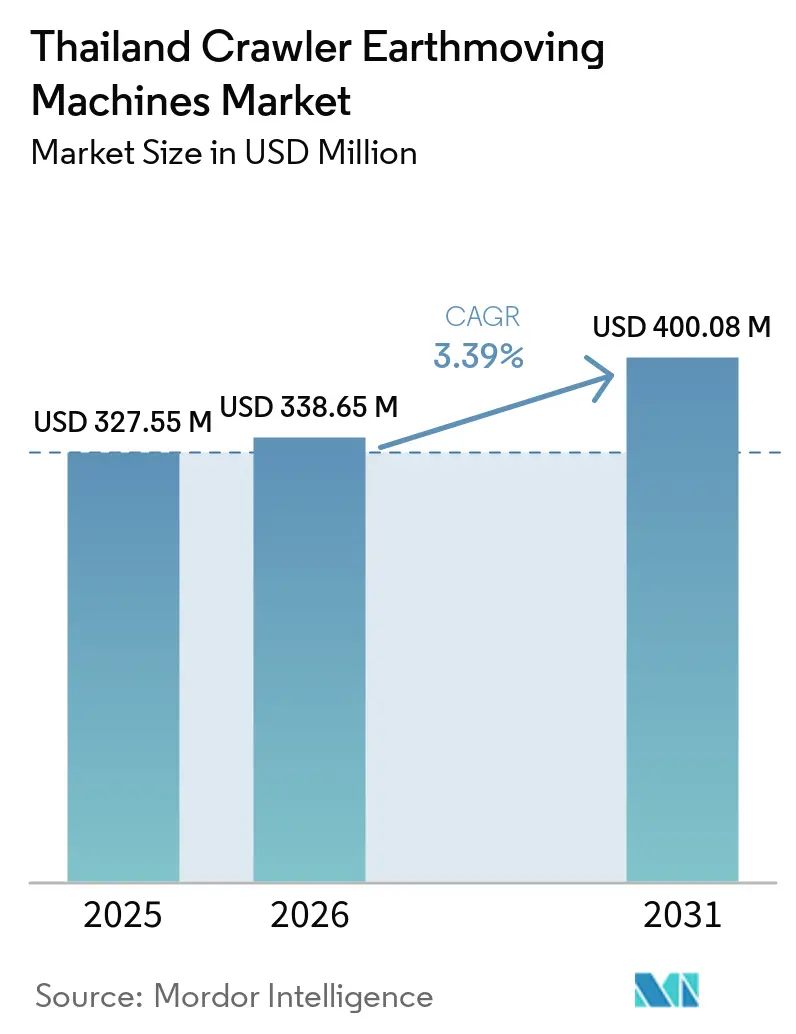
| Base Year Market Size (2025) | USD 327.55 Million |
| Market Size (2026) | USD 338.65 Million |
| Market Size (2031) | USD 400.08 Million |
| Growth Rate (2026 - 2031) | 3.39 % |
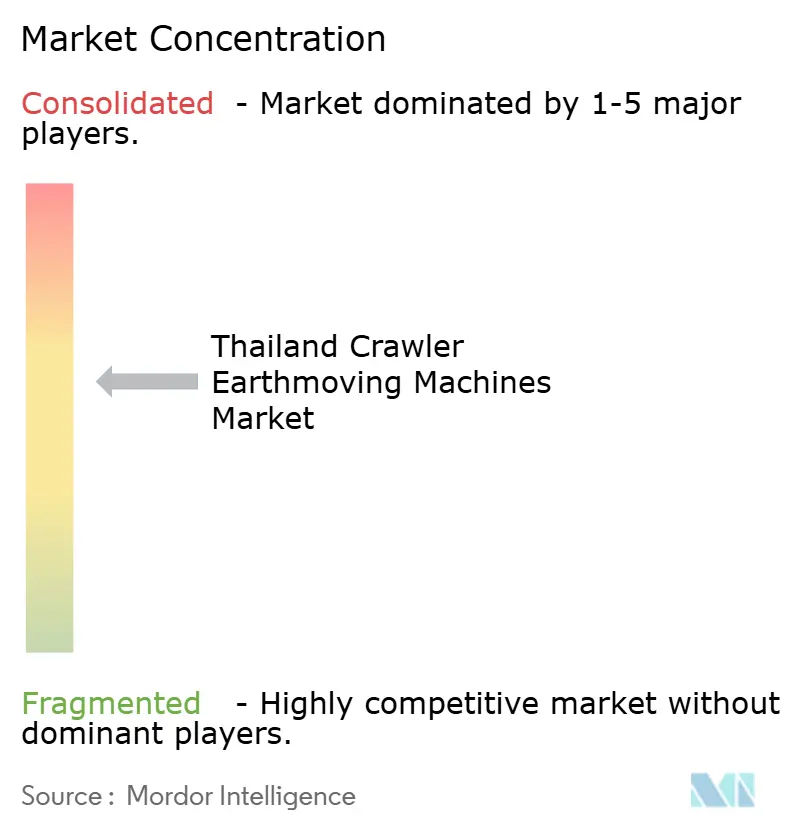
| Market Concentration | Medium |
Major Players *Disclaimer: Major Players sorted in no particular order Image © Mordor Intelligence. Reuse requires attribution under CC BY 4.0. | |
Thailand Crawler Earthmoving Machines Market Analysis by Mordor Intelligence
The Thailand crawler earthmoving machines market size was valued at USD 327.55 million in 2025 and is estimated at USD 338.65 million in 2026, and is projected to reach USD 400.08 million by 2031 at a 3.39% CAGR over 2026-2031. The market is transitioning from stimulus-driven construction to sustained infrastructure rollouts under the Eastern Economic Corridor (EEC). Carbon taxation and advanced emission regulations are also prompting fleet owners to adopt newer, more fuel-efficient models. Public sector construction activity grew significantly in the recent quarter; however, many contractors are replacing existing units rather than expanding their fleets, as diesel costs now include a carbon levy. Electrification is gaining momentum, with U Power expected to begin shipping battery-swappable heavy trucks to Thai logistics fleets in the near term. This development will provide proof of concept for the deployment of depot-based electric crawlers. Compact tracked loaders are also benefiting from modular industrial park developments, such as the large-scale Smart Park, where equipment with low ground pressure is mandatory.
Key Report Takeaways
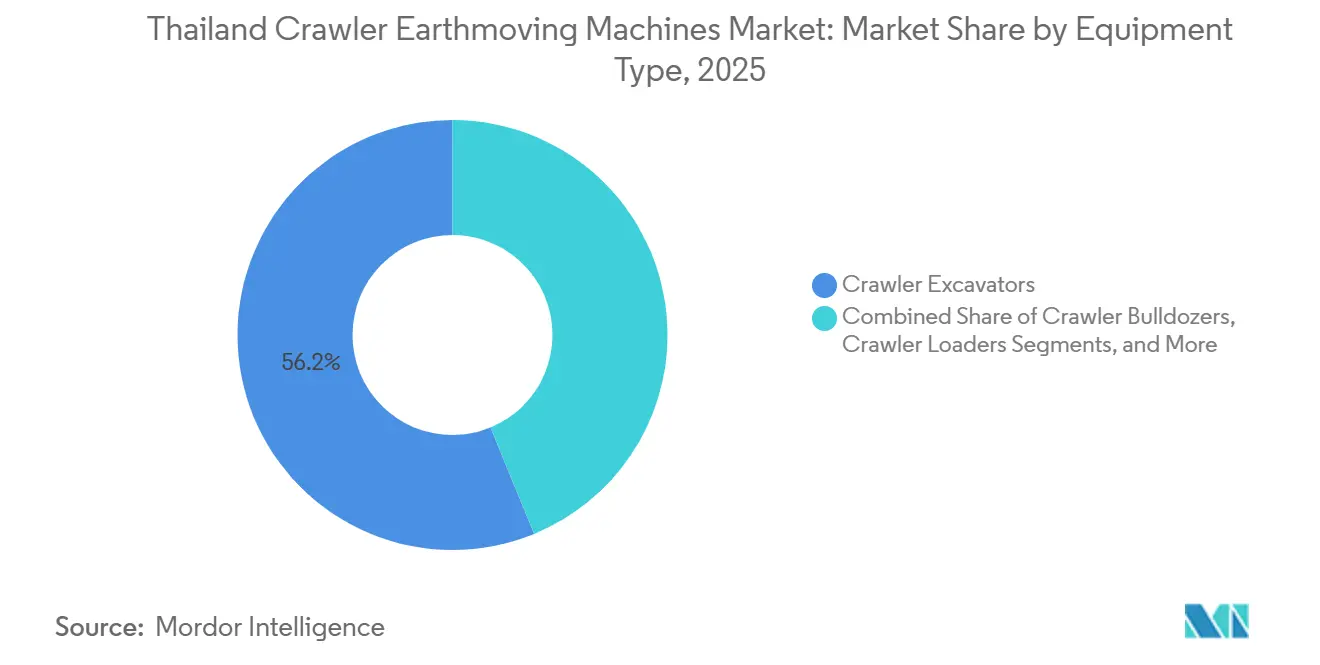
- By equipment type, crawler excavators led with 56.17% of the crawler earthmoving machine market share in 2025, while compact tracked loaders and skid-steers are projected to expand at a 4.41% CAGR through 2031.
- By propulsion, internal-combustion units held an 87.71% share of the crawler earthmoving machine market size in 2025, whereas electric and hybrid variants are expected to grow at a 4.44% CAGR over 2026-2031.
- By engine power, the 201-400 hp band accounted for 42.36% of 2025 sales, while sub-100 hp machines are forecast to post the fastest 4.47% CAGR to 2031.
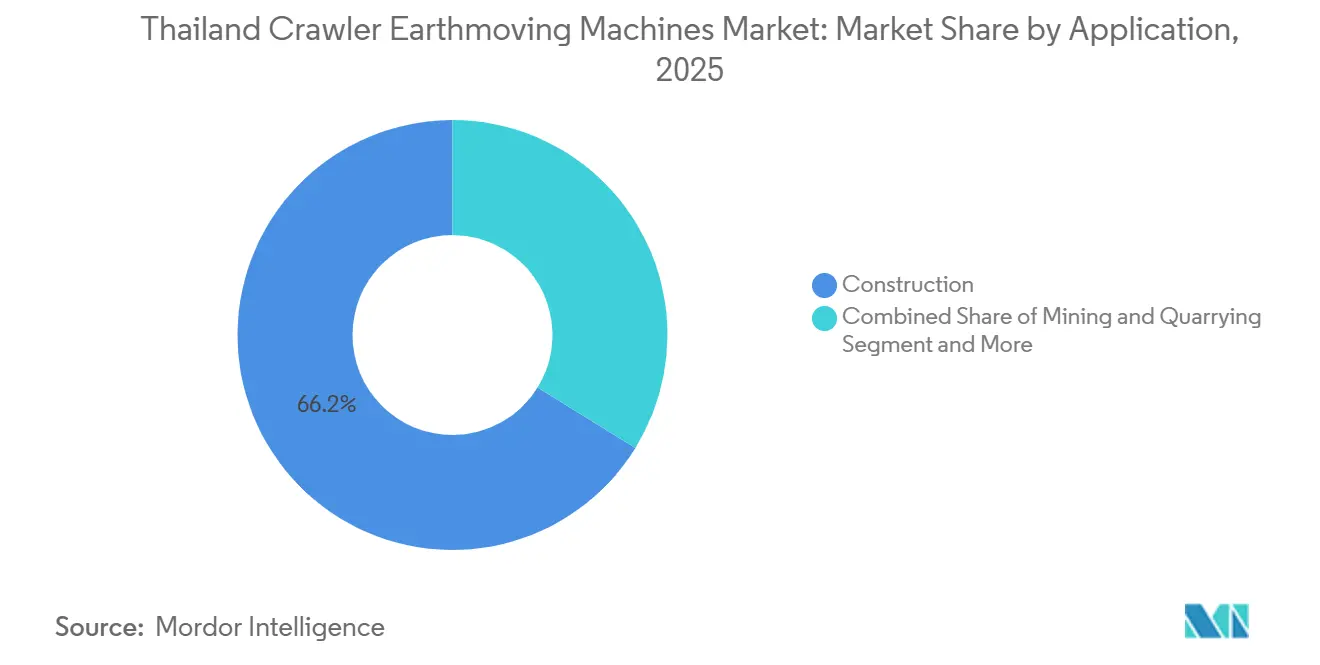
- By application, construction commanded 66.17% of the crawler earthmoving machine market size in 2025 and is advancing at a 4.49% CAGR through 2031.
- By distribution channel, authorized dealers captured 47.83% of 2025 revenue, whereas rental and leasing is the fastest-growing channel at a 4.53% CAGR.
Note: Market size and forecast figures in this report are generated using Mordor Intelligence’s proprietary estimation framework, updated with the latest available data and insights as of January 2026.
Global valuation is built by aggregating outputs from multiple countries and regions, with Thailand being one of the contributors. Our global crawler earthmoving machines market size represents that cumulative total.
Thailand Crawler Earthmoving Machines Market Trends and Insights
Drivers Impact Analysis*
| Driver | (~) % Impact on CAGR Forecast | Geographic Relevance | Impact Timeline |
|---|---|---|---|
| Infrastructure build-out under Thailand's Eastern Economic Corridor plan | +0.9% | National, with early gains in Rayong, Chonburi, Chachoengsao | Medium term (2-4 years) |
| Accelerated replacement of ageing crawler fleets for safety and efficiency | +0.7% | National | Short term (≤ 2 years) |
| Electrification incentives and Stage V emission mandates | +0.5% | National, with pilot deployments in EEC | Medium term (2-4 years) |
| Emergence of modular industrial parks needing low-ground-pressure crawlers | +0.4% | EEC core (Rayong, Chonburi), spill-over to Prachinburi | Long term (≥ 4 years) |
| Digital twins and telematics-driven OPEX savings | +0.3% | National, with early adoption in large rental fleets | Short term (≤ 2 years) |
| Surge in deconstruction and circular-demolition projects | +0.2% | Bangkok Metropolitan Region, expanding to provincial capitals | Medium term (2-4 years) |
| Source: Mordor Intelligence | |||
Infrastructure Build-Out Under Thailand's Eastern Economic Corridor Plan
Throughout the forecast period, the EEC Office has allocated a significant budget to projects across road, rail, and port infrastructure. These investments ensure sustained demand for crawler excavators, bulldozers, and loaders. Public procurement has reached substantial levels. In addition, local-content mandates, which require the majority of materials and steel to be sourced domestically, benefit OEMs with assembly operations in Thailand. Major projects, including large-scale city developments and industrial parks, require specialized low-ground-pressure equipment for use on reclaimed land. Logistics companies operating within the corridor are also adopting battery-swapping trucks to transport materials. This trend indicates growing demand for electric crawler loaders, particularly as high-capacity charging clusters are installed. Toward the latter part of the forecast period, the anticipated Climate Change Act is expected to introduce carbon-pricing mandates, encouraging contractors to adopt Stage V-compliant or fully zero-emission machinery.
Accelerated Replacement of Aging Crawler Fleets for Safety and Efficiency
Thailand implemented Euro V standards under TIS 3046-2563, introducing a CO₂ levy on diesel excise. The surcharge significantly increases annual fuel expenses for mid-sized crawler excavators with high fuel consumption. In February 2025, Volvo launched its new Stage V EC210 model, which delivers a notable reduction in fuel consumption. These models also include telematics-backed uptime guarantees, increasing their appeal among rental companies. For example, Aktio ordered several units in the first half of 2025. Additionally, features such as hose-burst check valves in JCB's 540-140 HiViz handler improve safety and lower insurance premiums, encouraging faster fleet replacement cycles.
Electrification Incentives and Stage V Emission Mandates
EGAT is opening its EleX Eco Charging Sphere in 2025 inside the EEC Digital zone, powered by rooftop solar and equipped with Kempower 300 kW chargers that support mixed commercial fleets [1]“EleX Eco Charging Sphere Fact Sheet,” Electricity Generating Authority of Thailand, egat.co.th . U Power, SAIC Hongyan, and Dutch UNEX EV have signed to deploy 4,200 battery-swappable heavy trucks plus 1,000 units for Whale Logistics Group, with first deliveries due April 2026, offering a three-minute swap model that crawler depots could replicate [2]“Battery Swap Strategic Cooperation in Thailand,” U Power Technology, upowertech.com. Electric mining trucks ordered from XCMG under a USD 14 million deal with O.C.R. show that quarry operators will pay an upfront premium when battery-as-a-service financing offsets capex. However, the shortage of 500 kW-plus chargers still restricts >20 ton crawler adoption outside the EEC.
Emergence of Modular Industrial Parks Needing Low-Ground-Pressure Crawlers
Smart Park and EEC City are advancing modular construction by limiting ground pressure to 0.5 kg/cm². Compact tracked loaders, such as Yanmar’s SMARTASSIST Remote, feature telematics that help contractors maintain just-in-time schedules by proactively identifying maintenance requirements. CASE’s forestry-specific CX130C crawlers demonstrate how OEMs design specialized undercarriages for soft terrain while maintaining strong breakout forces for heavy lifting. Quarry expansions by Siam City Cement in Chonburi and Suphanburi increasingly use long-reach, low-ground-pressure crawlers to remove overburden efficiently.
Restraints Impact Analysis*
| Restraint | (~) % Impact on CAGR Forecast | Geographic Relevance | Impact Timeline |
|---|---|---|---|
| High upfront CAPEX and tightening credit | -0.6% | National | Short term (≤ 2 years) |
| Raw-material and component supply volatility | -0.4% | National, with acute pressure in steel-intensive segments | Medium term (2-4 years) |
| ESG-linked cost of ownership for diesel units | -0.3% | National, with early enforcement in EEC and Bangkok | Medium term (2-4 years) |
| Scarcity of fast-charging infrastructure for above 20-ton crawlers | -0.2% | National, with infrastructure gaps outside EEC | Long term (≥ 4 years) |
| Source: Mordor Intelligence | |||
High Upfront CAPEX and Tightening Credit
Imported crawlers face an MFN tariff at a moderate rate. Additionally, they are impacted by fluctuating steel prices. For instance, hot-rolled coil imports experienced a significant surge recently, with a forecasted rebound expected in the near future. While financing options from OEM captives, like Komatsu Bangkok Leasing, offer comprehensive coverage at a competitive flat rate, many SMEs are now leaning towards rentals to conserve cash. Furthermore, carbon tax surcharges on diesel diminish the traditional price advantage of combustion machines, steering buyers towards either second-hand or rented units.
Raw-Material and Component Supply Volatility
In 2024, domestic plate-mill utilization in Thailand remained significantly low, despite the nation relying heavily on imports to meet its steel requirements. Starting in 2026, alignment with the EU's Carbon Border Adjustment Mechanism is expected to increase the embedded cost of imported steel by a notable margin. Meanwhile, ongoing semiconductor shortages are delaying deliveries of Stage V engines. As fuel levies continue to rise, some buyers are choosing to extend the lifespan of their older pre-Euro V machines, postponing new purchases as a result.
*Our forecasts treat driver/restraint impacts as directional, not additive. The impact forecasts reflect baseline growth, mix effects, and variable interactions.
Segment Analysis
By Equipment Type: Excavators, Anchor, Compacts, Accelerate
Crawler excavators retained a 56.17% slice of the crawler earthmoving machine market share in 2025, due to their versatility across road, rail, and quarry jobs. The segment remains profitable because replacement demand tracks the Stage V compliance deadline. Yet compact tracked loaders and skid-steers are climbing fastest at a 4.41% CAGR through 2031 as modular parks in Smart Park and EEC City specify ground pressures under 0.5 kg/cm². The crawler earthmoving machine market size for compact types is therefore expanding off a small base, aided by JCB’s 4.8-5.7 t midi excavators that offer 9% higher tear-out force and Safe Lift monitoring. Conversely, crawler cranes grow only when port and airport phases move to heavy-lift stages.
Growth momentum also comes from deep-foundation rigs introduced by Liebherr (LB 35.1, LRB 19) for high-rise cores within the EEC. Fleet owners are diversifying, as shown by Aktio’s 2025 order for 13 Volvo EW145B wheeled excavators to plug mid-size rental gaps. Chinese brands such as SANY already dominate crane rentals but now pursue excavator share using digital after-sales tools.



By Propulsion: Diesel Dominates, Electrification Pivots
Internal-combustion machines still account for 87.71% of revenue because operators lean on existing diesel depots, yet their share is eroding every year. The crawler earthmoving machine market size for electric and hybrid crawlers is predicted to rise at a 4.44% CAGR, spurred by battery-swap ecosystems being piloted by U Power and Whale Logistics.
Battery-as-a-service financing from XCMG Leasing trims upfront premiums, and EGAT’s solar-backed charging hubs reinforce viability for <20 t units. Hybrid drivetrains fill the transition niche by delivering up to 15% fuel savings without charging downtime.
By Engine Power Output: Mid-Range Leads, Compacts Surge
Mid-range 201-400 hp models control 42.36% of 2025 sales because they match the bucket sizes required for rail embankment and port works. However, below-100 hp crawlers post the highest 4.47% CAGR as forestry, agriculture, and tight urban sites adopt lighter machines.
The crawler earthmoving machine market size for sub-100 hp equipment will therefore outpace population growth within the forecast window. CASE’s 98 hp CX130C Forestry model illustrates the shift, while carbon levies accelerate right-sizing away from >400 hp units whose fuel surcharges can exceed THB 38,000 (approx USD 1,155.44) a year.
By Application: Construction Dominates, Mining Expands
Construction absorbs 66.17% of 2025 demand and will keep a 4.49% CAGR through 2031 as EEC projects include runways, berths, and dual-track rail lines. Quarrying demand remains smaller but is rising steadily, supported by Siam City Cement’s new granite sites.
In Bangkok, circular-demolition projects are increasingly opting for compact electric tools, designed to seamlessly fit within mid-rise buildings slated for deconstruction. These tools are particularly advantageous due to their ability to operate efficiently in confined spaces, reducing the environmental impact and noise levels typically associated with traditional demolition methods. Additionally, the use of compact electric tools aligns with the growing emphasis on sustainable construction practices, as they contribute to minimizing waste and improving energy efficiency during demolition processes.
By Distribution Channel: Dealers Lead, Rentals Accelerate
While authorized dealers command a 47.83% share of the revenue pie, it's the rental segment that's making waves, boasting a swift 4.53% CAGR. This surge is largely attributed to SMEs opting to defer capital expenditures, especially amid fluctuating steel prices. In a strategic move to strengthen its market presence, Leadway Heavy Machinery has rolled out a network of 15 branches, representing globally recognized brands Hitachi and CASE. Not to be outdone, Zoomlion has expanded its footprint by establishing its eighth service center in Phitsanulok, strategically targeting lucrative contracts along the provincial motorway.
In today's competitive landscape, telemetry-enhanced uptime guarantees have emerged as a key differentiator, offering significant value to customers. Komatsu, for instance, is setting the bar high by promising 95% equipment availability, backed by penalty credits for any shortfall, ensuring reliability and customer satisfaction.
Geography Analysis
In the EEC's heart, Rayong, Chonburi, and Chachoengsao are witnessing a surge in crawler demand, with numerous government projects currently underway. At Smart Park's reclaimed plots, low-ground-pressure crawlers take the lead, while heavy excavators are busy with Laem Chabang Port's Phase 3 caissons. In Bangkok, demolition activities are bustling, with permits issued for projects amounting to a significant portion of new constructions. This uptick has driven rentals for compact tracked loaders, especially those equipped with crusher buckets.
As new motorways and dual-track rail corridors emerge, they tap into local limestone quarries, causing a spill-over effect in the northern and northeastern provinces. Meanwhile, Zoomlion has established a service hub in Phitsanulok, and Leadway's expansion into Lampang and Khon Kaen is streamlining parts lead times, enhancing uptime beyond Bangkok. In the central provinces, Siam City Cement's quarries in Suphanburi and Chonburi are utilizing excavators with high horsepower and long-reach capabilities for overburden stripping.
Phuket, a southern tourism hotspot, is turning to smaller crawlers for hotel refurbishments and aquaculture ponds. Historically, these projects have leaned on imported second-hand Sumitomo units. Beyond its borders, Thailand's distributors are trans-shipping new machinery to neighboring countries like Cambodia, Laos, Myanmar, and Vietnam. Notably, Sumitomo is eyeing Thailand as a pivotal logistics hub for the Mekong region. With the impending Climate Change Act, EEC and Bangkok are set to feel the first impacts, leading to a quicker adoption of electric crawlers. In contrast, diesel remains the fuel of choice in provinces where charging stations for high-capacity equipment are few and far between.
Coverage of the crawler earthmoving machines market by Mordor Intelligence spans a wide geographic footprint, with regional analysis available for Europe, alongside detailed country-level intelligence for Singapore, Australia, Indonesia, United States, Philippines, South Korea, and Saudi Arabia, each shaped by local operating conditions.
Competitive Landscape
The crawler earthmoving machine market exhibits moderate fragmentation. Japanese and European players, including Komatsu, Hitachi, Volvo CE, and Liebherr, contend with aggressive Chinese competitors like SANY, XCMG, and Zoomlion. These Chinese firms leverage competitive pricing alongside advanced digital service ecosystems. SANY has already secured a significant share of crane placements in Thailand, while XCMG showcased its financial strength with a notable deal for electric mining trucks. The landscape is shifting with dealer consolidations: Leadway has become the exclusive dealer for both Hitachi and CASE, operating a substantial network of outlets and a dedicated team of service engineers to dominate the aftermarket parts segment.
Technology is emerging as the pivotal battleground. Platforms like Komatsu's SMARTASSIST, JCB's LiveLink, and CASE's SiteConnect offer predictive maintenance, effectively minimizing downtime. Liebherr's MyLiebherr platform introduces 3D lift planning, enabling rental companies to expedite job pricing and asset turnover. While Develon's Concept-X autonomous site garners attention in Thailand, local trials are pending grid enhancements.
Regulations promoting a circular economy are emerging as a potential game-changer. OEMs are proactively engaging in take-back and remanufacturing initiatives, positioning themselves ahead of the Draft Circular Economy Promotion Act set to debut in 2027. Additionally, battery-swap agreements, especially those incorporating leasing, are becoming a key differentiator. Such moves are particularly appealing to operators aiming to mitigate risks associated with electric crawler adoption in the Eastern Economic Corridor (EEC).
Thailand Crawler Earthmoving Machines Industry Leaders
Caterpillar Inc.
Komatsu Ltd.
Hitachi Construction Machinery Co., Ltd.
Volvo Construction Equipment AB
XCMG Group
- *Disclaimer: Major Players sorted in no particular order

Recent Industry Developments
- July 2026: Bangkok Komatsu Sales Co., Ltd. (BKS), the sole authorized distributor of Komatsu construction machinery in Thailand for more than 70 years under the Siam Motors Group, recently launched the all-new Komatsu PC200-11M2 and PC210-11M2 20-ton hydraulic excavators.
- January 2026: CNH Industrial (Thailand) Ltd. appointed Leadway Heavy Machinery Co., Ltd. as the new authorized dealer for CASE Road Construction Equipment in Thailand. Through this appointment, Leadway Heavy Machinery will represent and distribute CASE Road Construction Equipment across the Thai market.
- May 2025: Volvo Construction Equipment and its dealer, Chairatchakarn Bangkok (CHAB), secured a landmark agreement to supply 13 EW145B Prime wheeled excavators to Aktio (Thailand) Co., Ltd., a leading rental company. The agreement marked Aktio’s first purchase of Volvo machines and the largest wheeled excavator order placed by a single buyer in Thailand in 2025.
- May 2025: Shantui delivered its SE550LC crawler excavator to a Thai mine, marking a milestone in eco-friendly heavy-duty deployment.


Thailand Crawler Earthmoving Machines Market Report Scope
The scope of the report includes the equipment type (Crawler Excavators, Crawler Bulldozers, Crawler Loaders, Crawler Cranes and Pipe-layers, Compact Tracked Loaders and Skid-steers, and Others (Trencher, Drill Rig, etc.)), Propulsion (Internal Combustion Engine and Electric and Hybrid), Engine Power Output (Below 100 HP, 100-200 HP, 201-400 HP, and Above 400 HP), Application (Construction, Mining and Quarrying, Agriculture and Forestry, and Others), and Distribution Channel (Direct OEM Sales, Authorized Dealers, and Rental and Leasing Firms). Market Forecasts are Provided in Terms of Value (USD) and Volume (Units).
| Crawler Excavators |
| Crawler Bulldozers |
| Crawler Loaders |
| Crawler Cranes and Pipe-layers |
| Compact Tracked Loaders and Skid-steers |
| Others (Trencher, Drill Rig, etc.) |
| Internal Combustion Engine (ICE) |
| Electric and Hybrid |
| Below 100 HP |
| 100-200 HP |
| 201-400 HP |
| Above 400 HP |
| Construction |
| Mining and Quarrying |
| Agriculture and Forestry |
| Others |
| Direct OEM Sales |
| Authorized Dealers |
| Rental and Leasing Firms |
| By Equipment Type | Crawler Excavators |
| Crawler Bulldozers | |
| Crawler Loaders | |
| Crawler Cranes and Pipe-layers | |
| Compact Tracked Loaders and Skid-steers | |
| Others (Trencher, Drill Rig, etc.) | |
| By Propulsion | Internal Combustion Engine (ICE) |
| Electric and Hybrid | |
| By Engine Power Output | Below 100 HP |
| 100-200 HP | |
| 201-400 HP | |
| Above 400 HP | |
| By Application | Construction |
| Mining and Quarrying | |
| Agriculture and Forestry | |
| Others | |
| By Distribution Channel | Direct OEM Sales |
| Authorized Dealers | |
| Rental and Leasing Firms |


Key Questions Answered in the Report
What is the current value of Thailand’s crawler earthmoving machine market?
The market is estimated at USD 338.65 million in 2026 and is projected to reach USD 400.08 Million by 2031.
How fast will the market grow through 2031?
It is projected to register a CAGR of 3.39% during the forecast period, 2026–2031, supported by sustained demand and ongoing market developments.
Which equipment type leads sales and is the fastest growing?
Crawler excavators held 56.17% of 2025 revenue whereas compact tracked loaders and skid-steers are projected to expand at a 4.41% CAGR through 2031.
Where is demand geographically concentrated?
Rayong, Chonburi, and Chachoengsao provinces inside the Eastern Economic Corridor drive most sales.
What is the biggest hurdle to electric crawler adoption?
The lack of 500 kW fast-charging stations for machines above 20 tons outside the EEC limits uptake.
Which sales channel is expanding fastest?
The rental and leasing are growing at a CAGR of 4.53%, driven by SMEs that seek flexible access to equipment and assets while preserving cash flow and avoiding substantial upfront capital expenditures.
Page last updated on:


 Your data is secure and never sold or shared.


