
Singapore Crawler Earthmoving Machines Market Size and Share
Market Overview
| Study Period | 2019 - 2031 |
|---|---|
| Forecast Data Period | 2026 - 2031 |
| Base Year Market Size (2025) | USD 522.76 Million |
| Market Size (2026) | USD 555.96 Million |
| Market Size (2031) | USD 756.36 Million |
| Growth Rate (2026 - 2031) | 6.35 % |
| Market Concentration | Medium |
Major Players *Disclaimer: Major Players sorted in no particular order Image © Mordor Intelligence. Reuse requires attribution under CC BY 4.0. | |
Singapore Crawler Earthmoving Machines Market Analysis by Mordor Intelligence
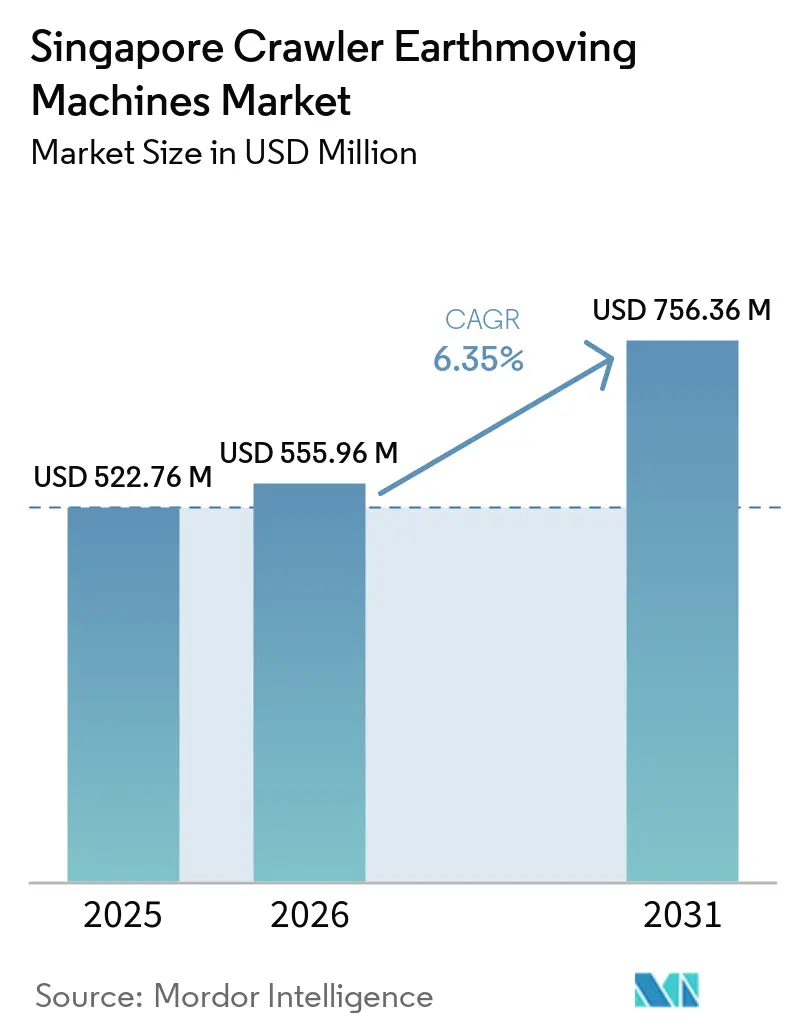
The Singapore crawler earthmoving machines market size was valued at USD 522.76 million in 2025 and is estimated to grow from USD 555.96 million in 2026 to reach USD 756.36 million by 2031, at a CAGR of 6.35% during the forecast period (2026-2031). Rising public-sector infrastructure spending, tightening emission rules, and the digitalization of fleet management together underpin steady equipment demand. Government grants that offset the incremental cost of battery-electric crawlers, coupled with the National Environment Agency’s Stage V limits, are accelerating the shift away from conventional diesel units. Contractors are also favoring machines that ship with factory-installed telematics, because predictive maintenance and remote diagnostics cut downtime and support higher rental utilization. In parallel, coastal-protection works and the Tuas Port build-out are creating specialized use cases for autonomous-ready excavators that can operate safely in reclaimed-land environments.
Key Report Takeaways
- By equipment type, crawler excavators led with 46.62% of the Singapore crawler earthmoving machines market share in 2025, while compact tracked loaders and skid-steers are projected to expand at a 9.75% CAGR through 2031.
- By propulsion, diesel platforms held a 67.84% of the Singapore crawler earthmoving machines market share in 2025, yet battery-electric units are forecast to grow at a 29.52% CAGR through 2031.
- By engine power output, the 100-to-200 HP bracket accounted for 42.36% of the Singapore crawler earthmoving machines market share in 2025, whereas sub-100 HP machines are set to grow at an 11.42% CAGR over the same horizon.
- By application, earthmoving and grading accounted for 38.49% of the Singapore crawler earthmoving machines market share in 2025, while demolition and recycling will register the fastest CAGR at 10.44% through 2031.
- By end-user, construction accounted for 44.17% of the Singapore crawler earthmoving machines market share in 2025, yet municipal services are expected to post a 10.05% CAGR through 2031.
- By distribution channel, authorized dealers accounted for 55.42% of the Singapore crawler earthmoving machines market share in 2025, but online and digital marketplaces are projected to grow at a 13.58% CAGR through 2031.
Note: Market size and forecast figures in this report are generated using Mordor Intelligence’s proprietary estimation framework, updated with the latest available data and insights as of January 2026.
Future direction is shaped by developments occurring across multiple countries and regions, with Singapore contributing to the overall trajectory. The outlook on worldwide crawler earthmoving machines market reflects how these are expected to evolve collectively.
Singapore Crawler Earthmoving Machines Market Trends and Insights
Drivers Impact Analysis*
| Driver | (~) % Impact on CAGR Forecast | Geographic Relevance | Impact Timeline |
|---|---|---|---|
| Public-Private Funding | +1.8% | West Region (Tuas, Jurong) | Medium term (2-4 years) |
| Green Plan 2030 Infrastructure Pipeline | +1.5% | Central Region, East Region (Changi, Marine Parade) | Long term (≥ 4 years) |
| Telematics-Driven OPEX Savings | +1.2% | Island-wide, with early adoption in Central Region | Short term (≤ 2 years) |
| Electrification Incentives and Emission Mandates | +1.0% | Island-wide | Medium term (2-4 years) |
| Deconstruction and Circular-Demolition Projects | +0.6% | Central Region, North-East Region (Bidadari, Tengah) | Short term (≤ 2 years) |
| Aging National Construction-Fleet | +0.5% | Island-wide | Medium term (2-4 years) |
| Source: Mordor Intelligence | |||
Public-Private Funding of Autonomous Tuas Port Logistics
Tuas Megaport is rolling out more than 200 autonomous vehicles that require crawler platforms capable of seamless machine-to-machine communication[1]. OEMs are responding by embedding remote diagnostic modules and ISO 15143-3-compliant data protocols into mid-range excavators. Field pilots show double-digit improvements in uptime because predictive analytics reduce unplanned service stops. Rental fleets view these gains as a path to justify premium day rates. As additional port phases come online, demand should focus on factory-ready autonomous kits rather than aftermarket retrofits.
Singapore Green Plan 2030 Infrastructure Pipeline
The Green Plan allocates multi-year funding to coastal protection works and the expansion of the Changi Water Reclamation Plant[2]. Such projects favor crawler excavators rated for corrosive, marine-adjacent environments. Contractors holding long-term maintenance contracts now specify zero-emission or Stage V-compliant machinery. Compact tracked loaders proved their worth during the Sentosa Sensoryscape redevelopment, where strict noise limits barred the use of larger diesel equipment. Long-duration pipelines give OEMs the confidence to introduce subscription-based battery-leasing models that reduce contractors’ upfront capital outlay.
Digital Twins and Telematics-Driven OPEX Savings
OEM telematics suites now ship standard on most new crawlers, capturing fuel burn, oil temperature, and track wear. When paired with 3-D digital twins, contractors report double-digit reductions in idle time and maintenance expense. Government co-funding of telematics hardware covers up to 70% of the installed cost. Insurance carriers have begun rewarding geofenced fleets with lower premiums, broadening the value proposition beyond mere operational efficiency. As data monetization matures, dealers see software subscriptions overtaking parts sales in the long run for profitability.
Electrification Incentives and Stage V Emission Mandates
The Heavy Vehicle Electrification Scheme offers per-unit grants that narrow the lifetime cost gap between battery-electric and diesel crawlers[3]. Simultaneously, Stage V rules add both hardware complexity and price to new diesel machines. This carrot-and-stick approach has triggered a measurable pivot toward electric mid-range excavators capable of one-shift runtime. Fast-charging subsidies, though capped, reward first movers by locking in lower operating expenses. In effect, electrification is moving from lighthouse projects to mainstream fleet-renewal programs.
Restraints Impact Analysis*
| Restraint | (~) % Impact on CAGR Forecast | Geographic Relevance | Impact Timeline |
|---|---|---|---|
| High CAPEX and Tightening Credit | -1.2% | Island-wide, acute in Central Region | Short term (≤ 2 years) |
| Component-Supply Volatility | -0.9% | Island-wide | Medium term (2-4 years) |
| Scarcity of Fast-Charging Infrastructure | -0.7% | West Region (Tuas), East Region (Changi) | Medium term (2-4 years) |
| ESG-Linked Cost of Ownership | -0.5% | Island-wide, early impact in Central Region | Long term (≥ 4 years) |
| Source: Mordor Intelligence | |||
High Upfront CAPEX and Tightening Credit
Electric crawlers currently cost significantly more than diesel equivalents, placing pressure on contractors with thin margins. Elevated benchmark lending rates have driven up leasing costs, prompting some fleets to extend replacement cycles. Although grants defray a portion of the delta, subsidies seldom cover the entire premium. Smaller firms consequently gravitate toward rental agreements rather than outright purchases. Near-term demand, therefore, hinges on easing in the credit market.
Raw-Material and Component-Supply Volatility
Price swings in steel, copper, and battery minerals compress OEM margins and lengthen delivery lead times. Semiconductor shortages still ripple through telematics control units, forcing revisions to build schedules. Contractors now draft price-escalation clauses into fixed-price tenders, complicating public-works procurement. While regional trade flowing through Singapore keeps logistics lanes robust, imported content exposes the value chain to freight-rate volatility.
*Our forecasts treat driver/restraint impacts as directional, not additive. The impact forecasts reflect baseline growth, mix effects, and variable interactions.
Segment Analysis
By Equipment Type: Excavators Dominate While Compact Loaders Gain
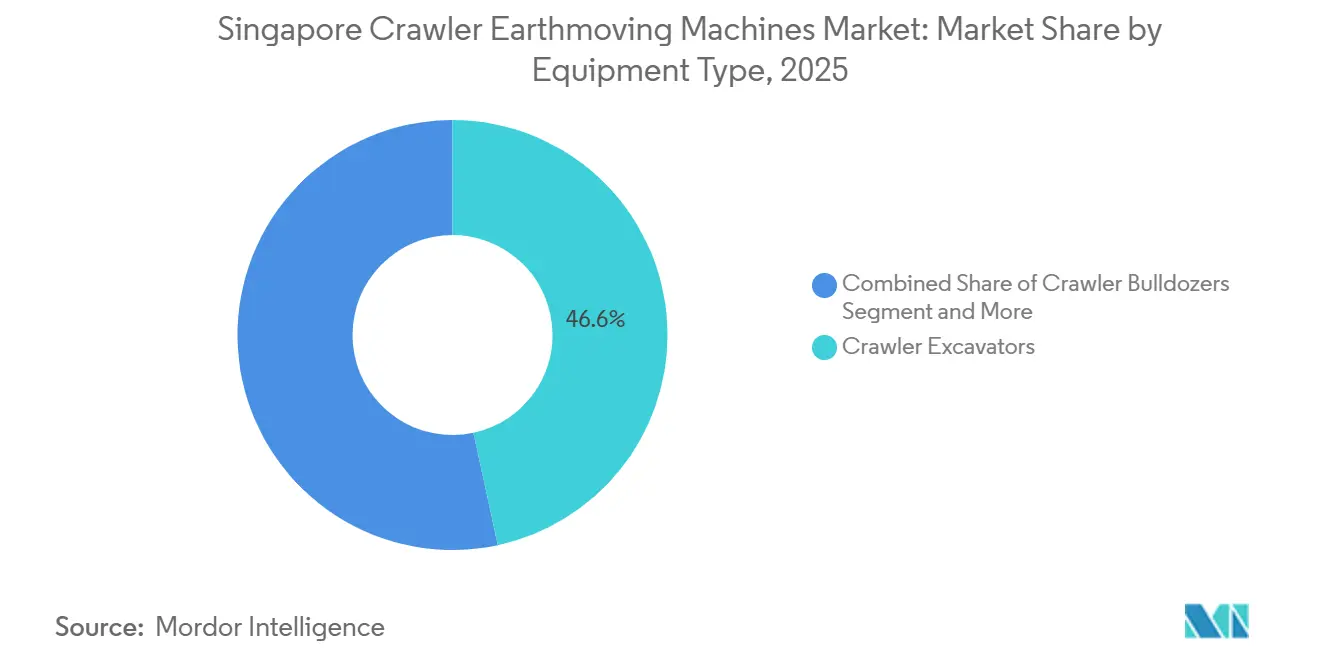
Crawler excavators held the highest 46.62% Singapore crawler earthmoving machines market share in 2025. They remain the workhorses for bulk earthmoving, grading, and marine reclamation duties that define national infrastructure projects. In contrast, compact tracked loaders and skid-steers are slated to record the fastest 9.75% CAGR, propelled by demolition mandates that reward low-emission, small-footprint machines. Contractors appreciate that tracked loaders can swap between buckets, breakers, and mulchers in minutes, raising utilization without adding headcount. Rental companies, sensing this versatility, are enlarging loader fleets to capture rising short-term demand.
Compact loaders also align with Singapore’s move toward vertical redevelopment, where basements and narrow corridors limit turning radii. Leading OEMs now ship electric loader models that comply with Stage V noise thresholds and qualify for electrification grants. Conversely, crawler bulldozers occupy niche use cases in coastal-protection berms. Crawler cranes and pipe-layers, although critical for port phases, transact in low volumes and seldom affect headline growth. The upshot is a segmented landscape: excavators ensure baseline revenue, while compact loaders inject the momentum that propels the Singapore crawler earthmoving machines market forward.

By Propulsion: Diesel Still Leads but Electric Accelerates
Diesel platforms retained the dominant 67.84% market share of Singapore crawler earthmoving machines in 2025. Even so, battery-electric models are forecast to post the fastest CAGR at 29.52% as incentives kick in. Stage V compliance costs have narrowed diesel's price advantage, making the switch more palatable for fleet owners who value silent, zero-tailpipe operation on urban job sites. Hybrid diesel-electric variants offer a bridging solution but risk regulatory obsolescence as full-electric runtimes improve.
OEM roadmaps now emphasize modular battery packs and grid-connect options that suit Singapore’s dense charging network plans. Diesel remains indispensable for 24/7 dredging and heavy grading, yet electric alternatives are carving out a share in shift-based municipal work. The propulsion mix reflects a transitional equilibrium: diesel currently anchors market volume. At the same time, electric power provides the growth pathway that will reshape the Singapore crawler earthmoving machines market over the next decade.
By Engine Power Output: Mid-Range Commands While Sub-100 HP Surges
Machines rated 100-to-200 HP led 2025 sales with a 42.36% share of the Singapore crawler earthmoving machines market, owing to their fit with 15-to-25-ton excavators common on public works sites. Sub-100 HP equipment, however, is projected to log the fastest 11.42% CAGR, driven by compact urban redevelopment projects and the Housing and Development Board’s estate programs. This bracket’s lighter machines can be trailered behind standard trucks, avoiding the cost of heavy-haul permits.
Fleet managers value that sub-100 HP electric loaders meet both emission and noise caps without after-treatment fluid logistics. Higher-power bands above 400 HP primarily serve port reclamation and specialized lift jobs, leaving them exposed to cyclical project timing. Consequently, mid-range units stabilize revenue streams, but growth momentum clearly tilts toward the compact end, aligning with land-scarcity realities and the economics of electrification in the Singapore crawler earthmoving machines market.
By Application: Earthmoving Anchors, Demolition Rises
Earthmoving and grading retained the largest 38.49% share of the Singapore crawler earthmoving machines market in 2025, mirroring the nation’s ongoing land formation and drainage work. Demolition and recycling will expand at the briskest 10.44% CAGR under a 99% material-recovery mandate that elevates selective deconstruction methods. Contractors now treat old structures as resource banks, deploying crawler excavators with high-precision shears that boost salvage value.
Earthmoving projects, typically multi-year and publicly funded, underpin predictable equipment utilization. Demolition jobs, though shorter, demand specialized attachments, spawning ancillary after-sales revenue for dealers. This complementary dynamic means both segments reinforce overall market resilience: earthmoving delivers scale, while demolition injects agile growth into the Singapore crawler earthmoving machines market.
By End-User: Construction Holds Sway, Municipal Services Quicken
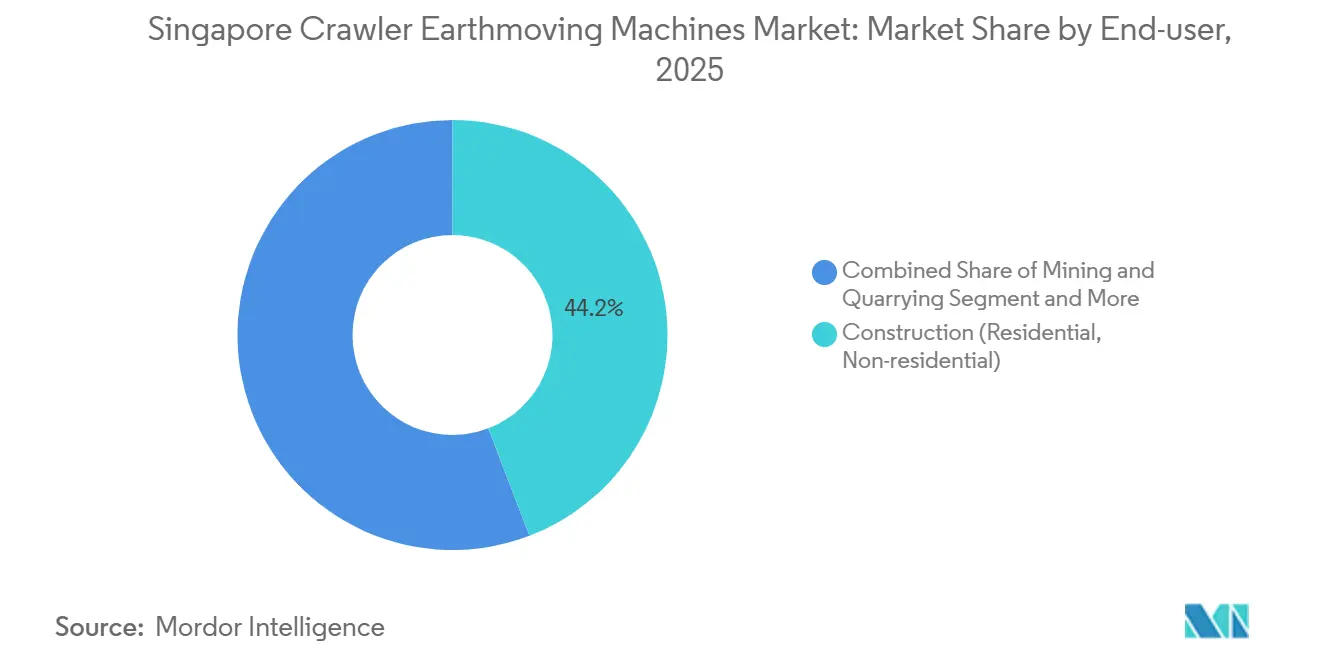
Construction accounted for 44.17% of 2025 revenue, establishing its role as the primary volume anchor for the Singapore crawler earthmoving machines market. Municipal services, led by water-utilities maintenance and waste-management facilities, are expected to show the fastest 10.05% CAGR as agencies embed low-carbon procurement rules. These end users rely on battery-electric compact crawlers to work safely inside treatment plant enclosures.
Commercial port operators, industrial parks, and energy-infrastructure builders absorb the balance but exhibit lumpy demand tied to milestone projects. Contractors bid municipal tenders with fleet-wide sustainability scorecards, further stimulating electric adoption. Hence, while private construction preserves headline scale, public utilities steer next-leg growth across the Singapore crawler earthmoving machines market.
By Distribution Channel: Dealers Still First, Marketplaces Disrupt
Authorized dealers accounted for a 55.42% share of the Singapore crawler earthmoving machines market in 2025, driven by parts availability and bundled service contracts. At the same time, online and digital marketplaces are expected to grow rapidly at a 13.58% CAGR, as contractors increasingly appreciate transparent pricing and the ability to compare specifications instantly. To adapt, dealers are adding e-commerce portals and subscription maintenance services, narrowing the gap between traditional and digital channels.
Large rental firms exploit digital bidding platforms to bulk-purchase OEM lots, pressuring dealer margins but broadening fleet access for smaller contractors. Direct OEM sales target mega-projects that warrant factory customization. The distribution tapestry, therefore, shifts from a dealer-centric model toward a hybrid approach that blends physical touchpoints with digital convenience, redrawing value-capture routes within the Singapore crawler earthmoving machines market.
Geography Analysis
Regional equipment needs closely align with Singapore’s land-use master plan. The Central Region’s dense redevelopment corridors demand compact tracked loaders that comply with strict noise and emissions ceilings. Contractors here often combine battery-electric powertrains with telematics to secure green-building credits. The West Region, anchored by Tuas Port and Jurong industrial clusters, gravitates toward mid- and high-power crawlers equipped for autonomous operations and 24-hour shifts. Coastal protection works in the East Region employ corrosion-resistant excavators designed for saline soils and tidal cycles.
Northern planning areas, including the emerging Tengah and Bidadari estates, lean heavily on sub-100 HP electric mini-excavators that fit tight basement geometries. Spillover work from Malaysia’s Iskandar development occasionally diverts rental fleets across the strait, yet differing emission standards hamper seamless interchange. Island-wide, Stage V enforcement and vehicle-electrification grants apply uniformly. Uptake, however, is fastest in districts where public-sector contracts specify zero-emission machinery as a tender prerequisite.
Singapore’s limited landmass means projects cycle rapidly from build to rebuild, fueling a steady demolition cadence that keeps demand for attachments high in mature districts. Regional dealer depots in Tuas, Kallang, and Changi enable four-hour parts delivery, an uptime imperative for contractors facing liquidated damages clauses. Manufacturers unable to offer such service density struggle to gain market penetration despite competitive equipment pricing.
Analysis of the crawler earthmoving machines market by Mordor Intelligence spans multiple other regional evaluations across Europe, supported by country-level insights for South Korea, Indonesia, United States, Thailand, Philippines, Australia, and Saudi Arabia, wherein local market conditions keep varying from one country to another.
Competitive Landscape
The Singapore crawler earthmoving machine market shows moderate concentration. Caterpillar, Komatsu, Volvo Construction Equipment, Hitachi Construction Machinery, and Liebherr make up the top tier, yet none lead. Incumbents are racing to differentiate through proprietary telematics ecosystems that lock customers into data-driven maintenance programs. Recent dealer agreements now bundle five-year software licenses with new crawler purchases, shifting revenue toward recurring service.
Electric-first challengers, including compact-loader specialists, are capturing share in the fast-growing sub-100 HP bracket by leveraging the Land Transport Authority’s subsidies. Chinese brands attempt entry with aggressive financing but must still prove parts availability and resilience to risk-averse contractors. Rental giants use purchasing scale to extract volume discounts, indirectly shaping OEM product roadmaps toward telematics-enabled, low-maintenance platforms that optimize fleet utilization.
Strategic partnerships dominate competitive chess moves. Komatsu’s collaboration with automation firms positions it well for Tuas Port phases, while Caterpillar’s digital-transformation alliances open avenues for software cross-selling. Meanwhile, Liebherr’s early launch of a battery-electric mid-range excavator demonstrates a commitment to delivering Stage V compliance and grant eligibility in one package. Competitive dynamics thus pivot less on hydraulic horsepower and more on the breadth of integrated services, data analytics, financing, and uptime guarantees surrounding each machine in the Singapore crawler earthmoving machines market.
Singapore Crawler Earthmoving Machines Industry Leaders
-
Caterpillar Inc.
-
Komatsu Ltd.
-
Volvo Construction Equipment
-
Hitachi Construction Machinery Co., Ltd.
-
Liebherr-International AG
- *Disclaimer: Major Players sorted in no particular order

Recent Industry Developments
- March 2026: SANY Group introduced a range of heavy- and medium-sized crawler excavators equipped with the ROOTPILOT 3D machine control system. The technology eliminates the need for manual jobsite staking and includes dedicated auxiliary hydraulic “rotate circuits” that operate independently of the main hydraulic flow. This configuration enables high-flow attachments to operate efficiently in confined subterranean environments in Singapore without reducing multi-function performance.
- January 2026: Hitachi Construction Machinery rolled out grid-connected dual-mode excavators that switch seamlessly between cable and battery power, targeting 24-hour port applications.
- March 2025: Volvo Construction Equipment showcased a full electric lineup, including the compact ECR25 Electric, at BuildTech Asia, underscoring growing contractor appetite for zero-emission machines.
Singapore Crawler Earthmoving Machines Market Report Scope
The Singapore Crawler Earthmoving Machines market is analyzed across equipment type, propulsion, engine power output, application, end-user, and distribution channel.
By Equipment Type, the market is segmented into Crawler Excavators, Crawler Bulldozers, Crawler Loaders, Crawler Cranes and Piling Rigs, Compact Tracked Loaders, and Others (Trencher, Drill Rigs, etc.). By Propulsion, the market is segmented into Diesel (Stage IIIa–V), Hybrid Diesel-Electric, Battery-Electric, and Hydrogen Fuel-cell (Pilot/Prototype). By Engine Power Output, the market is segmented into Less than 100 HP, 100 to 200 HP, 201 to 400 HP, and More than 400 HP. By Application, the market is segmented into Earthmoving and Grading, Demolition and Recycling, Forestry and Agriculture, Mining and Quarrying, Pipeline and Energy Infrastructure, and Rental Fleet Operations. By End-user, the market is segmented into Construction (Residential, Commercial, and Infrastructure), Mining and Quarrying, Oil and Gas Infrastructure, Industrial and Logistics, Municipal Services, and Agriculture and Forestry. By Distribution Channel, the market is segmented into Direct OEM Sales, Authorized Dealers, Rental and Leasing Firms, and Online/Digital Marketplaces.
Market forecasts are provided in terms of Value (USD) and Volume (Units).
| Crawler Excavators |
| Crawler Bulldozers |
| Crawler Loaders |
| Crawler Cranes and Pipe-layers |
| Compact Tracked Loaders and Skid-steers |
| Others (Trencher, Drill Rig, etc.) |
| Diesel (Stage III-V) |
| Hybrid Diesel-Electric |
| Battery-Electric |
| Hydrogen Fuel-cell (Pilot) |
| Less than 100 HP |
| 100 to 200 HP |
| 201 to 400 HP |
| More than 400 HP |
| Earthmoving and Grading |
| Demolition and Recycling |
| Forestry and Agriculture |
| Mining and Quarrying |
| Pipeline and Energy Infrastructure |
| Rental Fleet Operations |
| Construction (Residential, Non-residential) |
| Mining and Quarrying |
| Oil and Gas Infrastructure |
| Industrial and Logistics Parks |
| Municipal Services |
| Agriculture and Forestry |
| Direct OEM Sales |
| Authorised Dealers |
| Rental and Leasing Firms |
| Online/Digital Marketplaces |
| By Equipment Type | Crawler Excavators |
| Crawler Bulldozers | |
| Crawler Loaders | |
| Crawler Cranes and Pipe-layers | |
| Compact Tracked Loaders and Skid-steers | |
| Others (Trencher, Drill Rig, etc.) | |
| By Propulsion | Diesel (Stage III-V) |
| Hybrid Diesel-Electric | |
| Battery-Electric | |
| Hydrogen Fuel-cell (Pilot) | |
| By Engine Power Output | Less than 100 HP |
| 100 to 200 HP | |
| 201 to 400 HP | |
| More than 400 HP | |
| By Application | Earthmoving and Grading |
| Demolition and Recycling | |
| Forestry and Agriculture | |
| Mining and Quarrying | |
| Pipeline and Energy Infrastructure | |
| Rental Fleet Operations | |
| By End-user | Construction (Residential, Non-residential) |
| Mining and Quarrying | |
| Oil and Gas Infrastructure | |
| Industrial and Logistics Parks | |
| Municipal Services | |
| Agriculture and Forestry | |
| By Distribution Channel | Direct OEM Sales |
| Authorised Dealers | |
| Rental and Leasing Firms | |
| Online/Digital Marketplaces |
Key Questions Answered in the Report
What is the forecasted CAGR for the Singapore crawler earthmoving machines market to 2031?
The Singapore crawler earthmoving machines market was valued at USD 522.76 million in 2025 and is projected to grow at a CAGR of 6.35% during the forecast period, 2026–2031.
Which equipment type currently holds the largest share in Singapore?
Crawler excavators account for 46.62% of revenue in 2025.
Which segment shows the fastest growth in propulsion?
Battery-electric crawlers are expected to advance at a 29.52% CAGR through 2031.
Why are compact tracked loaders gaining popularity?
Municipal demolition mandates and tight urban sites favor their small footprint and 9.75% forecast CAGR through 2031.