
Australia Crawler Earthmoving Machines Market Size and Share
Market Overview
| Study Period | 2019 - 2031 |
|---|---|
| Forecast Data Period | 2026 - 2031 |
| Base Year Market Size (2025) | USD 1.49 Billion |
| Market Size (2026) | USD 1.57 Billion |
| Market Size (2031) | USD 2.01 Billion |
| Growth Rate (2026 - 2031) | 5.09 % |
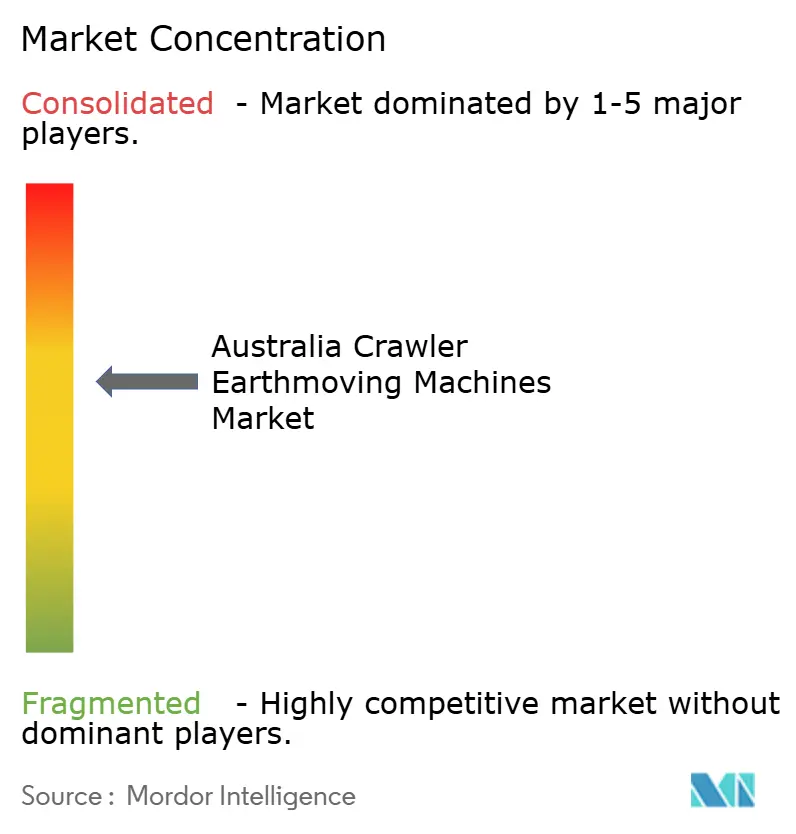
| Market Concentration | Medium |
Major Players
*Disclaimer: Major Players sorted in no particular order Image © Mordor Intelligence. Reuse requires attribution under CC BY 4.0. |
|
Australia Crawler Earthmoving Machines Market Analysis by Mordor Intelligence
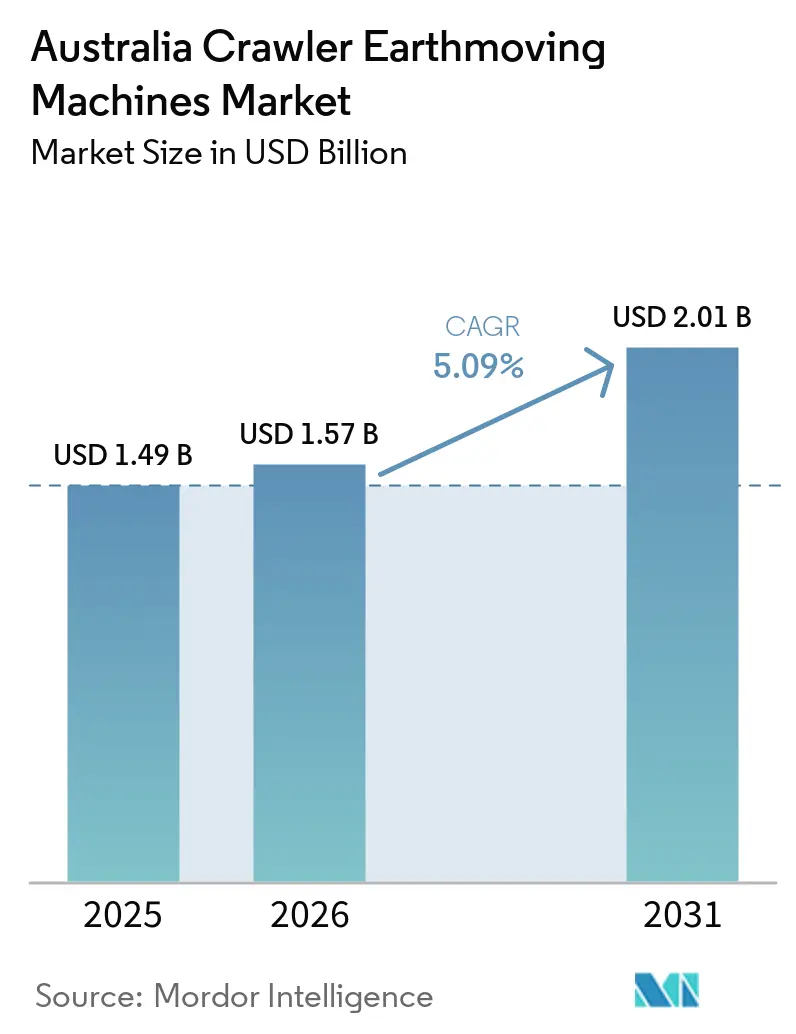
The Australia crawler earthmoving machines market is expected to grow from USD 1.49 billion in 2025 to USD 1.57 billion in 2026 and reach USD 2.01 billion by 2031, registering a CAGR of 5.09% during the forecast period (2026-2031). Government-funded infrastructure pipelines, a rebound in mining capital expenditure, and broader fleet replacement cycles are combining to keep order backlogs firm. Contractors prefer tracked machines because they handle variable soil conditions and meet newer rollover-protection rules that took effect in 2025. Rental companies are scaling inventories of mid-size excavators and compact tracked loaders, as many small builders rent rather than buy to protect cash flow. Electric and hybrid variants are still a niche, but gain visibility through large mining pilots that aim to cut Scope 1 emissions and long-term fuel exposure.
Key Report Takeaways
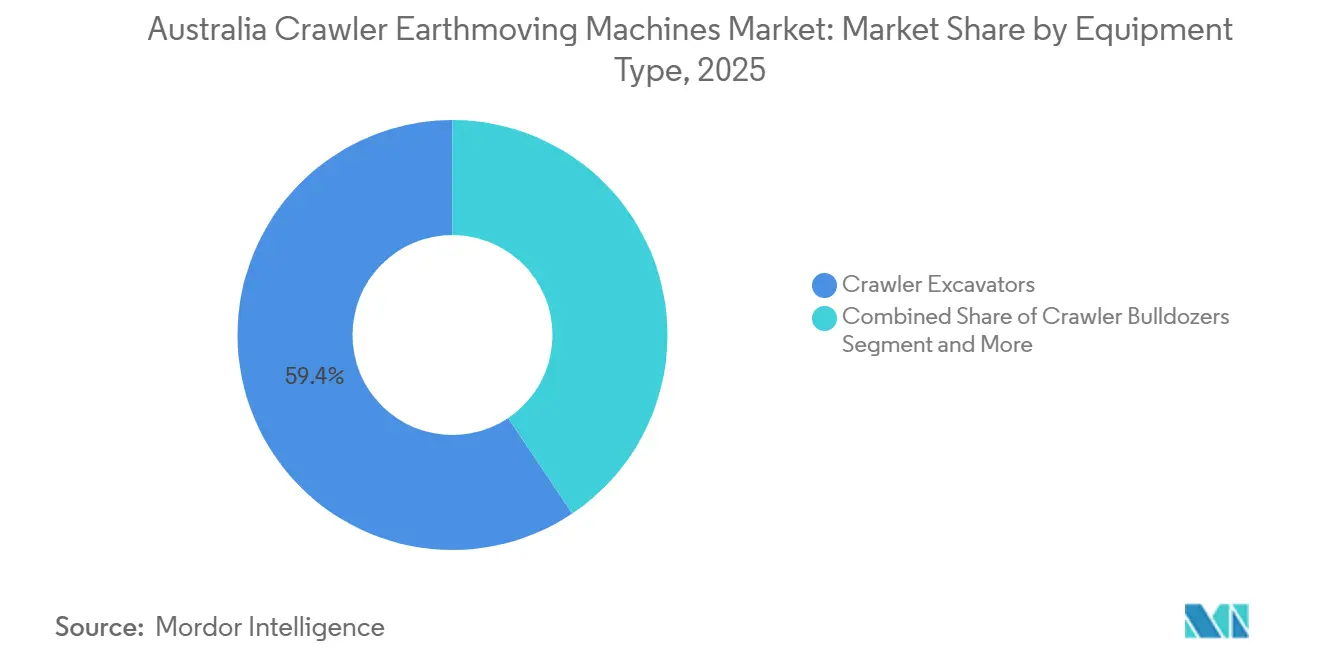
- By equipment type, crawler excavators led with 59.44% of the Australian crawler earthmoving machines market share in 2025, while compact tracked loaders and skid-steers posted the fastest CAGR at 6.73% through 2031.
- By propulsion, internal-combustion machines retained 93.16% share while electric-and-hybrid crawlers recorded the highest 14.46% CAGR for the period.
- By engine power, the 100-200 HP category captured the largest share at 42.65% in 2025, whereas units below 100 HP advanced at 6.07%.
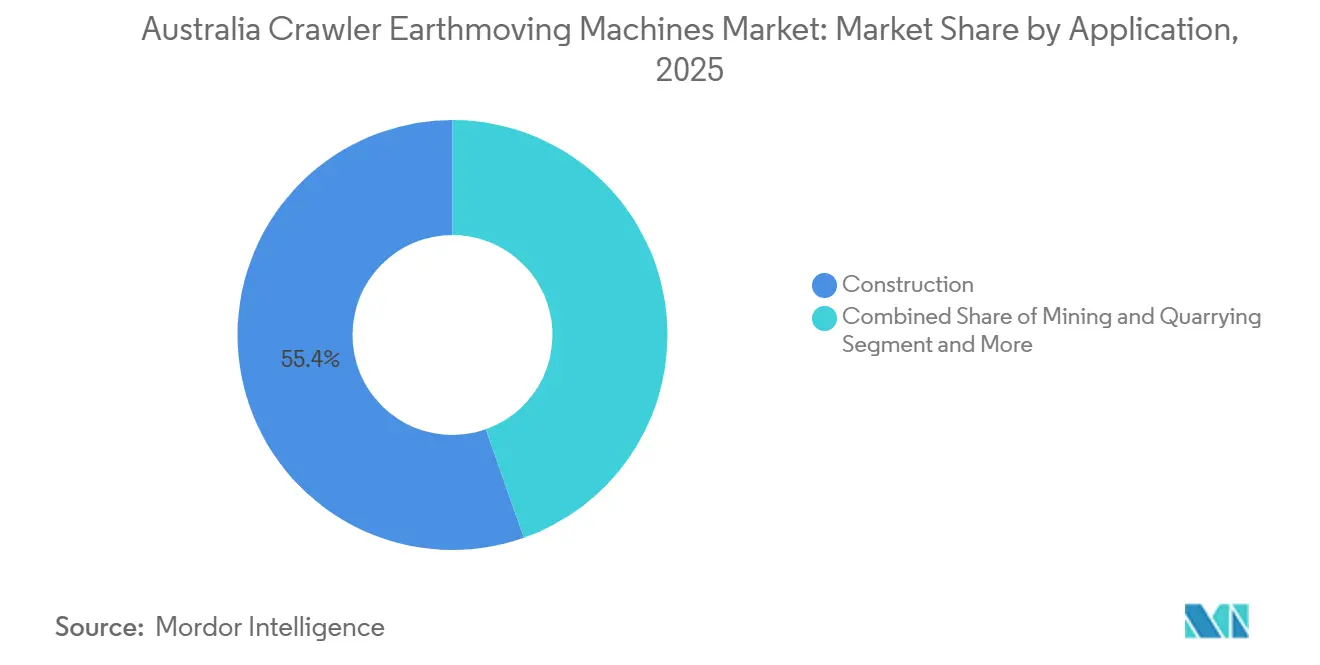
- By application, construction activities accounted for 55.42% in 2025, while mining registered the fastest CAGR at 6.65% through 2031.
- By distribution channel, authorized dealers accounted for 59.25% of 2025 revenue; rental and leasing expanded at a 7.44% CAGR through 2031.
Note: Market size and forecast figures in this report are generated using Mordor Intelligence’s proprietary estimation framework, updated with the latest available data and insights as of January 2026.
Australia operates as part of an interconnected international environment rather than as a self-contained country level unit. The crawler earthmoving machines market research by Mordor Intelligence places together all major developments across the globe within that wider frame.
Australia Crawler Earthmoving Machines Market Trends and Insights
Drivers Impact Analysis*
| Driver | (~) % Impact on CAGR Forecast | Geographic Relevance | Impact Timeline |
|---|---|---|---|
| Mining CAPEX Upswing | +1.8% | Western Australia, Queensland | Medium term (2-4 years) |
| Rebound in Public Infrastructure Spending | +1.3% | New South Wales, Victoria, Queensland | Short term (≤ 2 years) |
| Accelerated Replacement of Ageing Fleets | +0.9% | National (all states) | Medium term (2-4 years) |
| Electrification Incentives and Emission Mandates | +0.7% | Western Australia, New South Wales, Victoria | Long term (≥ 4 years) |
| Telematics-Driven OPEX Savings | +0.5% | National (mining-intensive states: WA, QLD, NSW) | Medium term (2-4 years) |
| Surge in Circular-Demolition Projects | +0.3% | New South Wales, Victoria | Short term (≤ 2 years) |
| Source: Mordor Intelligence | |||
Mining CAPEX Upswing in WA and QLD Iron-Ore/Lithium Projects
Western Australia and Queensland channel the bulk of fresh mining investment as iron-ore producers extend pit life and lithium developers lock in battery-supply deals. Crawler excavators with high breakout force remain indispensable for stripping overburden and feeding autonomous haulage fleets. Lithium price swings have not curtailed exploration outlays, keeping tracked drill-rig demand steady. Autonomy-ready dozers and graders that maintain haul roads integrate seamlessly into mine-wide control networks. Lead times of roughly 2 years between capital approval and machine delivery spread demand over several budget cycles, cushioning OEMs against near-term commodity dips.
Rebound in Public Infrastructure Spending Post-COVID Stimulus
The federal 2025-26 Budget earmarked significant funds for transport corridors, water utilities, and renewable-energy connectors[1]"2025–26 Federal Budget released", The Department of Infrastructure, Transport, Regional Development, Communications, Sport and the Arts, www.infrastructure.gov.au. Crawler excavators dominate early earth-moving phases, whereas compact tracked loaders excel in tight urban jobs such as trenching for buried cables. Surging data-center builds also require tracked machines for site leveling and service trench work. Because civil projects front-load earthworks, crawler demand peaks in the first 18 months of execution. Once paving and structures begin, demand shifts toward wheeled equipment, compressing the revenue window for tracked fleets.
Accelerated Replacement of Ageing Crawler Fleets for Safety and Efficiency
Updated national standards on rollover and falling-object protection oblige contractors to retire machines lacking compliant cabins. Refurbishment often costs more than half the price of a new unit, yet still fails to deliver telematics or hybrid drivetrains. Predictive-maintenance software bundled with new crawlers has proven to slash unscheduled downtime, creating a performance gap older fleets cannot bridge. Insurance underwriters increasingly link premiums to compliance certifications, indirectly nudging fleet owners to modernize.
Electrification Incentives and Stage V Emission Mandates
Federal and state grants cover portions of battery-electric heavy-equipment trials, nudging miners and some urban contractors toward early adoption. High-profile pilot orders help validate business cases, even though charging infrastructure for machines weighing more than 20 tonnes remains scarce. Lack of a hard Stage V equivalent keeps diesel viable, yet operators anticipate tighter caps and factor a regulatory premium into long-range fleet plans. Hybrid models that recover swing energy offer a bridging solution, providing significant fuel savings without requiring grid upgrades. ESG-oriented investors monitor Scope 1 emissions, increasing pressure on large miners to experiment with zero-emission crawlers.
Restraints Impact Analysis*
| Restraint | (~) % Impact on CAGR Forecast | Geographic Relevance | Impact Timeline |
|---|---|---|---|
| High CAPEX and Tightening Credit | -0.8% | National (all states) | Short term (≤ 2 years) |
| Scarcity of Fast-Charging Infrastructure | -0.6% | Western Australia, Queensland, Northern Territory | Long term (≥ 4 years) |
| Raw-Material Supply Volatility | -0.4% | National (all states) | Medium term (2-4 years) |
| ESG-Linked Cost of Ownership | -0.3% | Western Australia, Queensland | Long term (≥ 4 years) |
| Source: Mordor Intelligence | |||
High Upfront CAPEX and Tightening Credit
A 4.35% policy rate translates into equipment-finance charges near 8%, straining contractor cash flows[2]"Reserve Bank of Australia (RBA) increased the cash rate from 4.10% to 4.35%", Aperto Finance ABN, aperto.com.au. Smaller builders extend service intervals or pivot to rentals, dulling short-run machine orders. Interest expense can add a sizable premium over five-year loan horizons, undermining the total-cost-of-ownership advantages of new models. OEM-backed captive financing softens the blow for large accounts but leaves mid-tier buyers exposed. A potential rate-cut cycle later in the decade could unlock pent-up fleet renewal, yet visibility remains low.
Scarcity of Fast-Charging Infrastructure for Above 20-Ton Crawlers
Electric crawlers in the 20-tonne-plus bracket need megawatt-class charging, a capability rare in remote mine camps. Bespoke battery-storage systems raise project complexity and cost, limiting uptake to well-capitalized operators. Voltage-specification fragmentation across OEMs deters third-party charger investment. Pilot projects proceed, but commercial deployment hinges on grid upgrades unlikely before the next decade. Until then, diesel and hybrid drivetrains retain dominance in high-duty cycles.
*Our forecasts treat driver/restraint impacts as directional, not additive. The impact forecasts reflect baseline growth, mix effects, and variable interactions.
Segment Analysis
By Equipment Type: Excavators Anchor, Compact Loaders Accelerate
Crawler excavators secured the largest 59.44% revenue slice of the Australian crawler earthmoving machines market in 2025, a share rooted in their versatility across high-volume mining cuts and precision urban demolition. Their dominance persists because swing-radius optimization and quick-coupler adoption let operators pivot between rock buckets and hydraulic hammers with minimal downtime. Demand also benefits from new emission-compliant cabins that lower operator fatigue. Product launches now favor incremental hydraulic-efficiency tweaks over wholesale architecture changes, signaling a mature but indispensable category.
Compact tracked loaders and skid-steers represent the fastest-growing subsegment, advancing at a 6.73% CAGR through 2031. Growth stems from booming data center construction and underground utility trenching in congested metro corridors. Contractors prize their low ground pressure and ability to enter standard door widths. Attachment ecosystems, from augers to brush cutters, expand jobsite flexibility, reinforcing cross-rental utilization. The category’s sharp growth also draws newer Chinese brands that compete aggressively on upfront pricing while promising comparable uptime.



By Propulsion: ICE Dominance Meets Electric Disruption
Internal-combustion variants controlled 93.16% share of the Australia crawler earthmoving machines market in 2025, reflecting diesel’s unbeatable energy density and fast refuelling. Operators in remote regions routinely favor proven Tier-3 engines owing to fuel logistics and mechanic familiarity. Regulatory agencies have yet to impose Stage V limits on off-road equipment, delaying a mandatory technology pivot. OEMs thus focus on after-treatment upgrades and automatic idle-shutdown systems to secure incremental efficiency gains.
Electric and hybrid models register the quickest 14.46% CAGR, albeit from a low installed base. Flagship pilots in Pilbara iron-ore pits validate heavy-duty battery packs paired with regenerative-braking circuits. Hybrid excavators that store swing-motor energy in capacitors deliver notable fuel savings without demanding grid upgrades. State grants under EV-fleet schemes further sweeten early adoption for municipal projects. Yet limited high-power charging keeps full electrics concentrated in controlled environments such as underground mines, positioning hybrids as a near-term bridge.
By Engine Power Output: Mid-Range Machines Dominate, Compact Segment Surges
The 100-200 HP class captured the largest 42.65% share of the Australian crawler earthmoving machine market, offering a balanced mix of digging depth and transport-weight compliance. Contractors count on these mid-range units to move effortlessly between civil sites and small open-pit operations. Improved hydrostatic transmissions translate into smoother roading without trailers in some territories. Dealer service packages bundle telematics subscriptions that reduce unplanned downtime and protect residual value.
Units below 100 HP clock the highest CAGR at 6.07%, powered by urban densification and landscaping contracts. Their light footprint allows them to operate on drainage easements and residential backyards where heavier crawlers would cause rutting. Battery-electric mini-excavators attract councils keen on low-noise public-park maintenance. Demand also benefits from do-it-yourself rental programs that allow small builders to pick up machines on utility trailers. OEMs offer rapid-charging options that can top up batteries during lunch breaks.
By Application: Construction Leads, Mining Accelerates
Construction maintained the largest 55.42% share of the Australian crawler earthmoving machines market in 2025, as transport-corridor earthworks and data-center pads consumed vast soil volumes. Mid-size excavators dominate road-base preparation, while compact tracked loaders handle cable trenches under tight footpath margins. Public-sector spending pipelines schedule fresh works through at least 2027, ensuring visible demand continuity. Jobsite digital-twin mandates make telematics-ready crawlers preferred for progress audits.
Mining carries the quickest 6.65% CAGR through the outlook thanks to iron-ore and lithium projects clustered in resource-rich states. High-horsepower dozers maintain haul-road geometry essential for autonomous truck fleets. Hybrid propulsion interest rises where underground ventilation restrictions penalize diesel particulates. Equipment orders closely track commodity forward-price curves, though multi-year project durations temper volatility. OEMs bundle on-site technician residencies to secure 24/7 uptime for critical machines.
By Distribution Channel: Dealers Dominate as Rental Gains Momentum
Authorized dealers delivered the leading 59.25% revenue share by leveraging dense service and parts networks. Long-term maintenance contracts and operator-training programs deepen customer stickiness well past warranty expiration. Exclusive regional deals grant dealers pricing leeway while keeping grey-market imports to a minimum. Their finance arms spread asset costs over predictable payment schedules, appealing to mid-size contractors.
Rental and leasing options enjoy the fastest 7.44% CAGR as interest-rate pressure redirects buyers toward usage-based models. Large fleet owners frequently refresh their inventories, so renters gain access to the latest technology without capital lock-in. Predictable monthly hire fees align with project billing milestones, improving cash forecasting. Rental firms also shoulder compliance checks, a boon for small builders wary of new safety standards. Electrified crawlers penetrate the market fastest through rental fleets, where utilization helps recover higher sticker prices.
Geography Analysis
Western Australia and Queensland anchor national demand because mining projects in iron ore, lithium, and copper require heavy excavators and dozers for overburden removal. Fleet orders linked to mine-life extensions keep workshop backlogs healthy even when spot prices dip. Large operators pilot autonomous, zero-emission machines, making the region a proving ground for cutting-edge propulsion and remote operations software. Dealer footprints in Perth and Brisbane expand technician headcounts to support 24/7 mine-site service contracts. Geographic supply-chain constraints prompt miners to carry critical spares on-site, boosting dealer parts revenue.
New South Wales and Victoria dominate construction-led demand, with megaprojects such as Sydney Metro extensions and Melbourne’s suburban rail loop requiring deep excavation work. Compact tracked loaders thrive on inner-city jobs where access widths are narrow, and vibration limits are strict. Data-center site preparation multiplies the number of crawler hire days as tech firms race to expand cloud capacity. Municipal noise bylaws encourage electric minis on overnight shifts, accelerating adoption in dense residential zones. State incentive programs for clean fleets further tilt procurement toward hybrid models among council contractors.
South Australia, Tasmania and the Northern Territory present smaller volumes yet strategic pockets of opportunity. Renewable-energy transmission corridors and hydroelectric refurbishments demand tracked carriers capable of operating on remote, soft ground. The Northern Territory’s bauxite and manganese pits deploy ultra-class excavators whose parts logistics rely on Darwin port access. Seasonal cyclone exposure forces rental houses to stock extra units for rapid rebuilds once floodwaters recede. Although absolute machine counts lag eastern states, high hours-per-unit elevate aftermarket sales, sustaining dealer profitability across lean project calendars.
The crawler earthmoving machines market is assessed by Mordor Intelligence through a multi-layered geographic lens, covering other regions such as Europe, along with detailed country-level analysis for Indonesia, Thailand, United States, Philippines, Singapore, South Korea, and Saudi Arabia.
Competitive Landscape
Market concentration sits at a moderate level as the top five OEMs, Caterpillar, Komatsu, Volvo Construction Equipment, Hitachi Construction Machinery, and Liebherr, control the bulk of the national fleet counts but leave share open for aggressive Chinese entrants. Incumbents lock customers into proprietary telematics and grade-control ecosystems that raise switching costs over the lifecycle of equipment. Komatsu’s intelligent Machine Control 3.0 provides auto-dig features that novice operators master quickly, reducing training budgets and rework. Volvo highlights safety with obstacle-detection systems that meet plant risk assessment frameworks.
Chinese brands such as SANY and Zoomlion widen their footprint through multi-state dealer alliances that promise parts within 24 hours for key models. Competitive pricing appeals to cost-sensitive civil contractors. Early electric-crawler prototypes from XCMG enter pilot service on solar-farm builds, allowing newcomers to differentiate beyond price. Dealers calibrate stocking strategies as warranty costs stabilize and customer confidence rises.
Rental majors Coates and Emeco influence technology adoption by bulk-purchasing crawlers that meet utilization metrics and residual-value projections. Their decisions on battery-electric pilots give OEMs invaluable runtime data while sparing smaller contractors capital risk. Because telematics grant lessor–lessee transparency on machine abuse, rental agreements increasingly require operators to upload shift reports. Over time, the feedback loop between rental telemetry and OEM R&D accelerates updates, cementing rental firms as pivotal gatekeepers for innovation.
Australia Crawler Earthmoving Machines Industry Leaders
-
Caterpillar Inc.
-
Komatsu Ltd.
-
Hitachi Construction Machinery Co., Ltd.
-
Volvo Construction Equipment AB
-
Liebherr-International AG
- *Disclaimer: Major Players sorted in no particular order

Recent Industry Developments
- July 2025: Volvo Construction Equipment launched six crawler excavator models (EC210-EC360) in Australia featuring engine-pump optimization claiming up to 15% lower fuel use compared with earlier diesel units
- May 2025: Select Plant Australia deployed Western Australia’s first 250-ton electric crawler crane on the Swan River Crossings project, advancing zero-emission lifting capacity.
- April 2025: A D65EXi dozer expanded an Australian contractor’s Komatsu fleet to 23 units, positioning the firm to tackle Hunter Region subdivisions and remediation programs.


Australia Crawler Earthmoving Machines Market Report Scope
The Australia Crawler Earthmoving Machines market is analyzed across equipment type, propulsion, engine power output, application, and distribution channel.
By Equipment Type, the market is segmented into Crawler Excavators, Crawler Bulldozers, Crawler Loaders, Crawler Cranes, Compact Tracked Loaders, and Others (Trenchers, Drill Rigs, etc.). By Propulsion, the market is segmented into Internal Combustion Engine (Diesel/Gasoline) and Electric and Hybrid. By Engine Power Output, the market is segmented into Below 100 HP, 100–200 HP, 201–400 HP, and Above 400 HP. By Application, the market is segmented into Construction, Mining and Quarrying, Agriculture, and Others. By Distribution Channel, the market is segmented into Direct OEM Sales, Authorized Dealers, and Rental and Leasing.
Market forecasts are provided in terms of Value (USD) and Volume (Units).
| Crawler Excavators |
| Crawler Bulldozers |
| Crawler Loaders |
| Crawler Cranes and Pipe-layers |
| Compact Tracked Loaders and Skid-steers |
| Others (Trencher, Drill Rig, etc.) |
| Internal Combustion Engine (ICE) |
| Electric and Hybrid |
| Below 100 HP |
| 100-200 HP |
| 201-400 HP |
| Above 400 HP |
| Construction |
| Mining and Quarrying |
| Agriculture and Forestry |
| Others |
| Direct OEM Sales |
| Authorized Dealers |
| Rental and Leasing Firms |
| By Equipment Type | Crawler Excavators |
| Crawler Bulldozers | |
| Crawler Loaders | |
| Crawler Cranes and Pipe-layers | |
| Compact Tracked Loaders and Skid-steers | |
| Others (Trencher, Drill Rig, etc.) | |
| By Propulsion | Internal Combustion Engine (ICE) |
| Electric and Hybrid | |
| By Engine Power Output | Below 100 HP |
| 100-200 HP | |
| 201-400 HP | |
| Above 400 HP | |
| By Application | Construction |
| Mining and Quarrying | |
| Agriculture and Forestry | |
| Others | |
| By Distribution Channel | Direct OEM Sales |
| Authorized Dealers | |
| Rental and Leasing Firms |


Key Questions Answered in the Report
How large is the Australia crawler earthmoving machines market in 2026?
Australia crawler earthmoving machines market is expected to grow at USD 1.57 billion in 2026 and is projected to reach USD 2.01 billion by 2031.
Which equipment type dominates national demand?
Crawler excavators hold the top 59.44% share due to their versatility across mining and construction.
What is the fastest-growing application segment?
Mining records the highest 6.65% CAGR through 2031 as iron-ore and lithium investments expand.
Why are rental and leasing channels gaining popularity?
Elevated interest rates make hiring equipment more cost-effective than purchasing, driving a 7.44% CAGR for rental firms.
Page last updated on:


 Your data is secure and never sold or shared.


