
Philippines Crawler Earthmoving Machines Market Size and Share
Market Overview
| Study Period | 2019 - 2031 |
|---|---|
| Forecast Data Period | 2026 - 2031 |
| Base Year Market Size (2025) | USD 295.12 Million |
| Market Size (2026) | USD 307.57 Million |
| Market Size (2031) | USD 378.19 Million |
| Growth Rate (2026 - 2031) | 4.22 % |
| Market Concentration | Medium |
Major Players *Disclaimer: Major Players sorted in no particular order Image © Mordor Intelligence. Reuse requires attribution under CC BY 4.0. | |
Philippines Crawler Earthmoving Machines Market Analysis by Mordor Intelligence
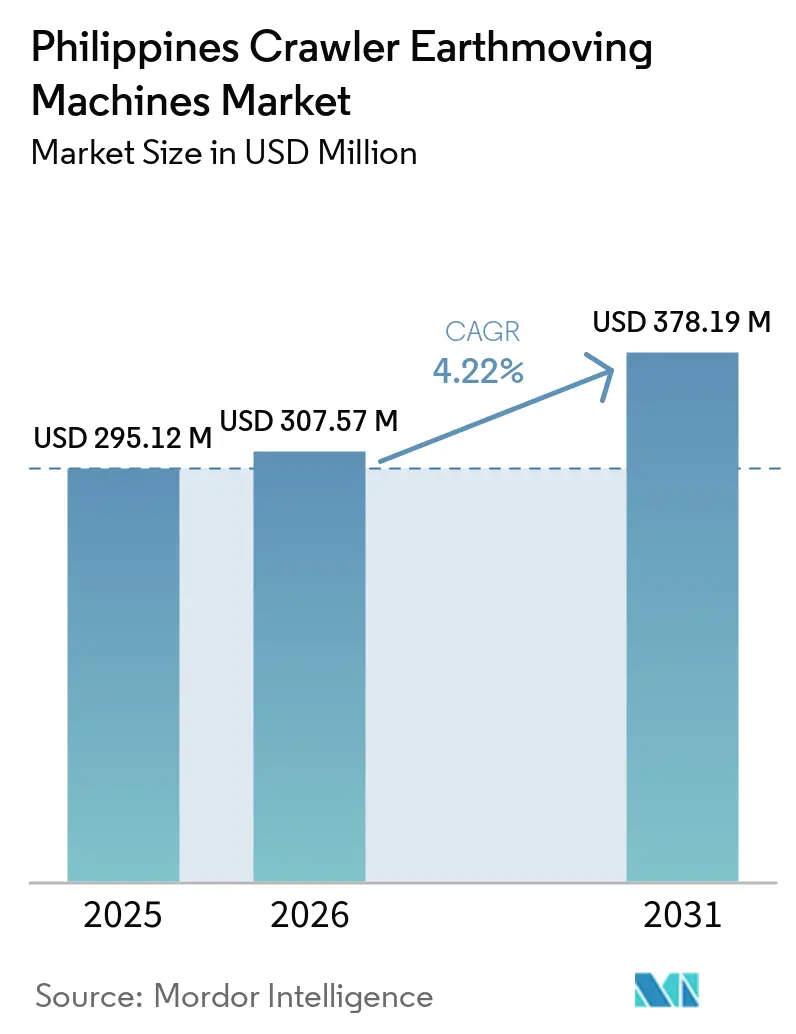
The Philippines crawler earthmoving machines market size was valued at USD 295.12 million in 2025 and is expected to reach USD 307.57 million in 2026 and USD 378.19 million by 2031, registering a 4.22% CAGR between 2026 and 2031. Ongoing public works outlays, gradual fleet renewal, and the first wave of Euro 5/V emission rules keep demand on a steady, not explosive, trajectory. Contractor preference for versatile mid-range excavators, the rise of pay-per-use rental models, and mounting ESG compliance pressures collectively shape procurement strategies. Chinese OEMs intensify price-based rivalry, yet entrenched dealer networks of incumbent brands protect service margins. Electrification remains a niche, but clear regulatory signals are beginning to shorten decision cycles for hybrid pilot projects.
Key Report Takeaways
- By equipment type, crawler excavators led with 55.12% of the Philippines crawler earthmoving machines market share in 2025, while compact tracked loaders and skid-steers are forecast to expand at a 4.93% CAGR through 2031.
- By propulsion, internal-combustion units retained 96.91% of the Philippines crawler earthmoving machines market share in 2025; electric and hybrid models are projected to post a 22.02% CAGR to 2031.
- By engine power, the 201–400 HP band captured 39.61% of the Philippines crawler earthmoving machines market share in 2025; sub-100 HP crawlers are forecast to expand at a 5.18% CAGR through 2031.
- By application, construction commanded 74.94% of the Philippines crawler earthmoving machines market share in 2025, whereas mining and quarrying is set to advance at a 6.42% CAGR to 2031.
- By distribution channel, authorized dealers held 49.76% of the Philippines crawler earthmoving machines market share in 2025; rental and leasing firms are anticipated to rise at an 8.05% CAGR over 2026-2031.
Note: Market size and forecast figures in this report are generated using Mordor Intelligence’s proprietary estimation framework, updated with the latest available data and insights as of January 2026.
Competitive positioning in Philippines includes both locally based firms and those operating across multiple regions. The market landscape in the global crawler earthmoving machines industry research shows how these players are arranged internationally.
Philippines Crawler Earthmoving Machines Market Trends and Insights
Drivers Impact Analysis*
| Driver | (%) Impact on CAGR Forecast | Geographic Relevance | Impact Timeline |
|---|---|---|---|
| Build Better More (BBM) Infrastructure Pipeline | +1.8% | Metro Manila, Central Luzon, Western Visayas, Caraga, Northern Mindanao | Medium term (2-4 years) |
| Mining and Quarrying Projects | +0.9% | Surigao del Norte, Davao del Sur, South Cotabato, Zamboanga del Norte | Medium term (2-4 years) |
| Replacement of Aging Crawler Fleets | +0.7% | National, with concentration in Metro Manila, Cebu, Davao | Short term (≤ 2 years) |
| Electrification Incentives and Emission Mandates | +0.5% | National, early adoption in Metro Manila, Calabarzon | Long term (≥ 4 years) |
| Telematics-Driven OPEX Savings | +0.2% | Metro Manila, Cebu, Davao, Cagayan de Oro | Medium term (2-4 years) |
| Deconstruction and Circular-Demolition Projects | +0.1% | Metro Manila, Calabarzon, Central Visayas | Medium term (2-4 years) |
| Source: Mordor Intelligence | |||
Government-backed Build Better More (BBM) Infrastructure Pipeline
Dozens of flagship bridges, expressways, and flood-control assets drive continuous crawler deployment cycles, especially around foundation excavation and embankment works. Multilateral financing cushions domestic budget cuts, but slower disbursement can leave machines idle at partially completed sites, reducing fleet utilization. Rental firms benefit because contractors prefer cost-flexible agreements while awaiting notice-to-proceed milestones. Steady urban migration ensures that secondary-city road upgrades remain on the docket, cementing long-run equipment demand even if mega-projects stagger.
Revival of Large-Scale Mining and Quarrying Projects in Mindanao
The commissioning of a major copper-gold project in Surigao del Norte opened a multi-year crawler-replacement pipeline tied to demanding open-pit cycles[1]. Harsh laterite conditions accelerate undercarriage wear, compelling owners to budget for shorter rebuild intervals. Uncertainties around global nickel pricing heighten procurement caution, yet mandated rehabilitation bonds bind operators to maintaining productive fleets. Provincial road upgrades linked to mine logistics further lift localized construction demand, creating a secondary pull for mid-range excavators.
Accelerated Replacement of Aging Crawler Fleets for Safety and Efficiency
Stricter occupational safety inspections, a draft heavy-equipment registry, and wider adoption of telematics expose the inefficiencies of pre-2015 machines. Contractors increasingly benchmark hourly fuel burn and downtime against rental alternatives, often finding that continued maintenance of legacy units erodes bid competitiveness. The availability of certified pre-owned imports tempers outright new purchases but still fuels turnover momentum. Software-driven predictive maintenance packages bundled by major dealers tilt life-cycle math in favor of modern models.
Electrification Incentives and Stage V Emission Mandates
Draft Euro 5/V rules for non-road mobile machinery are pushing OEMs to accelerate the introduction of compliant products. While electric crawlers face infrastructure gaps, hybrids demonstrate measurable fuel savings that help owners meet ESG scorecards on multilaterally funded projects. Import-duty exemptions for cleaner drivetrains shorten payback windows, yet sticker-price premiums keep adoption in the pilot stage. Contractors willing to self-install DC fast chargers gain early reputational advantages on sustainability tenders.
Restraints Impact Analysis*
| Restraint | (%) Impact on CAGR Forecast | Geographic Relevance | Impact Timeline |
|---|---|---|---|
| High CAPEX and Tightening Credit | -0.6% | National, acute in Visayas, Mindanao provinces | Short term (≤ 2 years) |
| Component Supply Volatility | -0.4% | National, import-dependent supply chains | Medium term (2-4 years) |
| Fast-Charging Infrastructure Scarcity | -0.2% | Metro Manila, Cebu, Davao | Long term (≥ 4 years) |
| Cost of Ownership for Diesel Units | -0.1% | National, multilateral-funded projects | Long term (≥ 4 years) |
| Source: Mordor Intelligence | |||
High Upfront CAPEX and Tightening Credit
6-figure price tags for mid-range excavators collide with stricter loan-to-value ratios, forcing many contractors to turn to rentals[2]. Monetary easing trims headline interest rates, but collateral requirements stay high, challenging small builders. Leasing provides an off-balance-sheet option, though effective rates still erode thin project margins. Until liquidity conditions improve, asset-light operating models continue to gain ground, reshaping dealer revenue toward parts and service.
Raw-Material and Component Supply Volatility
Steel price swings coincide with freight bottlenecks, muting potential savings for local assemblers. Semiconductor and battery supply chains remain exposed to geopolitical shifts, producing delivery lead times well beyond pre-pandemic norms. Peso depreciation adds further cost creep for imported components, eroding dealer pricing flexibility. Localization efforts stay marginal, so currency and logistics shocks remain baked into procurement planning.
*Our forecasts treat driver/restraint impacts as directional, not additive. The impact forecasts reflect baseline growth, mix effects, and variable interactions.
Segment Analysis
By Equipment Type: Excavators Hold the Lion’s Share
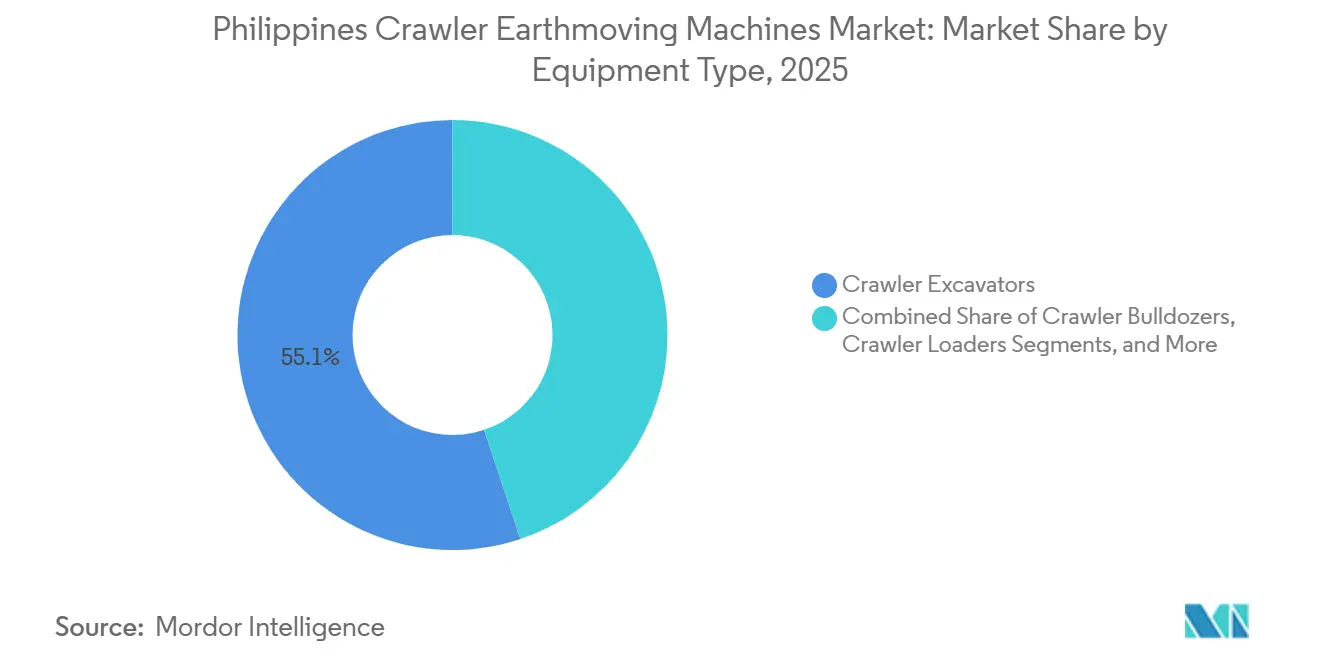
Crawler excavators accounted for 55.12% of the Philippines crawler earthmoving machine market share in 2025, reflecting their ability to handle digging, grading, and demolition without frequent tool changes. Compact tracked loaders and skid-steers are projected to post the fastest 4.93% CAGR because tight urban job sites reward machines with small footprints and high maneuverability. Contractors value excavators as multipurpose “anchor” assets that keep fleet sizes lean. Their compatibility with quick-attach couplers reduces downtime, resulting in predictable daily utilization. OEMs therefore prioritize excavator upgrades when introducing digital monitoring or low-emission options.
Demand for compact tracked loaders rises when redevelopment displaces large equipment from congested business districts. Rental firms increasingly stock these loaders to court short-term projects that lack room for full-sized crawlers. Meanwhile, excavators maintain dominance in bridge foundations and open-cut drainage because no other crawler variant offers comparable reach and stability. Dealers bundle attachments such as breakers and grapples with new excavator purchases to underscore the platform’s versatility. Together, the two segments illustrate how flexibility, rather than raw power, shapes procurement choices in the Philippines.

By Propulsion: Diesel Still Rules, Hybrids Advance
Internal-combustion crawlers retained a commanding 96.91% market share in the Philippines crawler earthmoving machines market in 2025, supported by the nationwide diesel supply chain and mechanics' familiarity. Electric and hybrid models are anticipated to register a rapid 22.02% CAGR as contractors test lower-emission alternatives ahead of the incoming Euro 5/V rules. Fleet managers continue to favor diesel because refueling infrastructure is available even at remote job sites. However, hybrid drivetrains deliver tangible fuel savings during stop-and-go cycles, attracting interest among cost-sensitive bidders. Regulatory clarity gives hybrids an extra push by reducing compliance uncertainty around particulate limits.
Dealer service teams invest in high-voltage training to prepare for a gradual rise in hybrid maintenance calls. Financing partners also craft leasing packages that spread the premium on hybrid units over longer contracts. Diesel platforms remain standard on projects with round-the-clock duty cycles where downtime penalties are steep. Even so, early adopters of hybrids gain reputational benefits in government tenders that score highly on environmental criteria. Over time, those soft advantages may erode diesel’s historic lock-in despite its logistical edge.
By Engine Power Output: Mid-Range Dominance, Compact Momentum
Machines rated at 201-400 HP captured 39.61% of the Philippines crawler earthmoving machine market share in 2025 because their balance of digging force and ease of transport suits most infrastructure tasks. Sub-100 HP crawlers are forecast to expand at a 5.18% CAGR as municipalities and farm cooperatives seek equipment that can navigate narrow access roads without heavy hauling permits. Mid-range units excel on bridge approaches and highway cuts where neither super-heavy nor ultra-light machines perform efficiently. Contractors appreciate that these crawlers can move between jobs on standard trailers, keeping mobilization costs predictable. Parts availability for engines in this band further cements their popularity.
Compact models under 100 HP appeal to rental fleets targeting short-duration trenching, landscaping, and disaster-response assignments. Their lower ground pressure reduces the need for site remediation after project completion, saving owners time and money. Upskilled operators quickly transition from skid-steers to these smaller crawlers, shortening learning curves for new hires. Meanwhile, high-horsepower machines remain specialized, so they experience lower turnover and limited dealer stocking. The divergence underscores how diverse Philippine terrain encourages distinct power-band sweet spots rather than a one-size-fits-all approach.
By Application: Construction Leads, Mining Picks Up
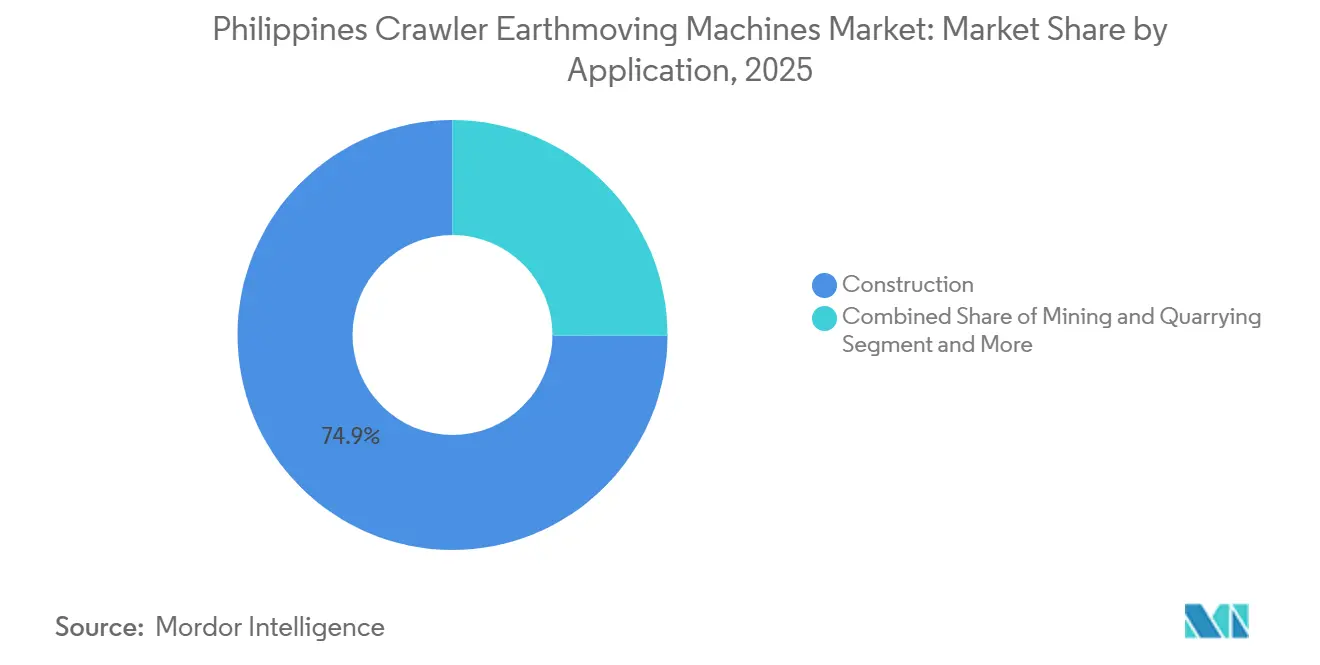
Construction activities accounted for 74.94% of the Philippines crawler earthmoving machine market share in 2025, as bridges, expressways, and mixed-use developments require earthmoving at every project phase. Mining and quarrying are projected to advance at a 6.42% CAGR as new metal projects restart equipment procurement after years of dormancy. Public works timelines ensure steady crawler utilization across multiple regions, giving contractors confidence to renew fleets. Building codes that favor flood-mitigation works also sustain demand for excavation. In contrast, agricultural and forestry uses remain seasonal, keeping their contribution comparatively modest.
Large infrastructure packages often bundle roadworks with drainage and slope stabilization, all of which rely heavily on construction-class crawlers. Mining projects, once operational, generate continuous requirements for stripping, haul-road maintenance, and tailings management, supporting the faster growth outlook. Contractors serving both sectors deploy modular fleets to shift assets between civil and resource jobs as schedules dictate. Overlaps in attachment preferences further blur lines, since breakers and rippers see service on both mine overburden and roadbed preparation. The two segments together illustrate how cyclical and countercyclical drivers can coexist within one equipment park.
By Distribution Channel: Dealers First, Rentals Rising
Authorized dealers held 49.76% of the Philippines crawler earthmoving machines market share in 2025 because warranty coverage, certified parts, and factory training remain decisive for contractors bidding on government projects. Rental and leasing firms are expected to grow at an 8.05% CAGR as builders shift fixed costs to variable expenses amid tighter bank lending. Dealers leverage their branch networks to provide rapid field repairs, an advantage that helps preserve their leadership position. They also bundle telematics subscriptions to strengthen customer retention beyond the initial sale. Nevertheless, shifting risk from ownership to usage is a trend that shows no sign of slowing.
Rental houses diversify fleets with certified pre-owned imports to offer lower daily rates than dealers can match with new stock. Contractors favor rentals when project pipelines are uncertain, avoiding depreciation hits if bid volumes soften. Leasing companies craft step-payment schedules tied to progress billings, further easing contractor cash flow. Dealers respond by introducing their own rental arms, effectively merging channels and blurring competitive lines. The evolving mix demonstrates how financing innovation can be as important as mechanical innovation in shaping demand for crawlers.
Geography Analysis
Metro Manila, Central Luzon, and Calabarzon remain the prime corridors for crawler deployments, benefiting from port access, concentrated contractor bases, and a dense concentration of flagship projects. Regional spillovers favor Western Visayas, where the Panay–Guimaras–Negros bridge system supports multi-year equipment mobilizations. Central Visayas follows close behind, anchored by the fourth Mandaue–Mactan crossing, which sustains demand for excavators in the foundation and approach-road phases.
Mindanao provinces, notably Caraga and Davao, are positioned for above-average growth, driven by the commissioning of a copper-gold mine and parallel nickel laterite operations. Provincial road upgrades tied to mine logistics feed secondary demand for sub-100 HP crawlers suited to feeder-road grading. The government aims to climate-proof disaster-prone bridges, dispersing smaller pockets of demand across Luzon's highlands and the low-lying Visayan islands.
Enforcement capacity for the forthcoming Euro 5/V rules differs by region. Metro Manila and Cebu are likely to implement inspections promptly, nudging fleets toward compliant models sooner, whereas remote areas may see delayed rollouts. These disparities influence dealer stocking strategies, with compliant inventory prioritized for urban hubs and legacy inventory cleared into peripheral markets ahead of the 2027 cutoff.
Mordor Intelligence tracks the crawler earthmoving machines market across other major regions such as Europe, with additional country-level coverage spanning Australia, South Korea, Indonesia, United States, Thailand, Singapore, and Saudi Arabia, each reflecting localized structural drivers, restraints and more.
Competitive Landscape
Caterpillar, Komatsu, Hitachi Construction Machinery, Sumitomo, and SANY collectively control the majority of 2025 sales while leaving meaningful share for regional distributors. Monark Equipment’s multi-branch footprint offers same-day parts in Metro Manila, reinforcing Caterpillar’s premium positioning. Komatsu taps Southeast Asian joint-venture warehousing to backstop Philippine service, while SANY undercuts on price but wrestles with parts lag beyond Luzon.
Telematics is the current battleground. Incumbents bundle data platforms to lock in maintenance contracts, whereas price-led entrants keep connectivity optional, opening space for third-party fleet-management providers. Dealers reply to rising rental uptake by rolling out certified-used programs that hedge residual-value risk and maintain brand touchpoints.
Regulatory moves on emissions reset product-line roadmaps. Early launches of Stage V-ready excavators position first movers to win replacement cycles in stricter regions. Simultaneously, large rental houses import lightly used Japanese units at discounts to bulk up fleets, pressuring new-unit margins. A draft national equipment registry favors scale players who can absorb compliance overhead, likely accelerating distributor consolidation.
Philippines Crawler Earthmoving Machines Industry Leaders
-
Caterpillar Inc.
-
Komatsu Ltd.
-
Hitachi Construction Machinery Co., Ltd.
-
Sumitomo Construction Machinery
-
SANY Group
- *Disclaimer: Major Players sorted in no particular order

Recent Industry Developments
- March 2026: Liebherr showcased the PR 736 G8 crawler dozer, equipped with advanced Operator Assistance Systems, at CONEXPO 2026. The machine highlighted Liebherr’s focus on improving operator efficiency, precision, and productivity in earthmoving applications.
- January 2026: Liebherr introduced upgrades to its Generation 8 crawler excavator range, incorporating Liebherr Power Efficiency as a standard feature to enhance machine efficiency and optimize operating performance.
- June 2025: T1 Rentals became the first local provider to offer the SANY SCE1500TB telescopic crawler crane, expanding access to specialized lifting equipment for local construction and infrastructure projects.
Philippines Crawler Earthmoving Machines Market Report Scope
The Philippines crawler earthmoving market is analyzed across equipment type, propulsion, engine power output, application, and distribution channel.
By Equipment Type, the market is segmented into Crawler Excavator, Crawler Bulldozer, Crawler Loader, Crawler Crane, Compact Track Loader, and Others (Trencher, etc.). By Propulsion, the market is segmented into Internal Combustion Engine and Electric/Hybrid. By Engine Power Output, the market is segmented into Below 100 HP, 100 to 200 HP, 201 to 400 HP, and Above 400 HP. By Application, the market is segmented into Construction, Mining and Quarrying, Agriculture and Forestry, and Others. By Distribution Channel, the market is segmented into Direct OEM Sales, Authorized Dealers, and Rental and Used Equipment.
Market forecasts are provided in terms of Value (USD) and Volume (Units).
| Crawler Excavators |
| Crawler Bulldozers |
| Crawler Loaders |
| Crawler Cranes and Pipe-layers |
| Compact Tracked Loaders and Skid-steers |
| Others (Trencher, Drill Rig, etc.) |
| Internal Combustion Engine (ICE) |
| Electric and Hybrid |
| Below 100 HP |
| 100 to 200 HP |
| 201 to 400 HP |
| Above 400 HP |
| Construction |
| Mining and Quarrying |
| Agriculture and Forestry |
| Others |
| Direct OEM Sales |
| Authorized Dealers |
| Rental and Leasing Firms |
| By Equipment Type | Crawler Excavators |
| Crawler Bulldozers | |
| Crawler Loaders | |
| Crawler Cranes and Pipe-layers | |
| Compact Tracked Loaders and Skid-steers | |
| Others (Trencher, Drill Rig, etc.) | |
| By Propulsion | Internal Combustion Engine (ICE) |
| Electric and Hybrid | |
| By Engine Power Output | Below 100 HP |
| 100 to 200 HP | |
| 201 to 400 HP | |
| Above 400 HP | |
| By Application | Construction |
| Mining and Quarrying | |
| Agriculture and Forestry | |
| Others | |
| By Distribution Channel | Direct OEM Sales |
| Authorized Dealers | |
| Rental and Leasing Firms |
Key Questions Answered in the Report
How large is the Philippines crawler earthmoving machines market in 2026?
It is valued at about USD 307.57 million in 2026 and is forecasted to reach USD 378.19 million by 2031.
What CAGR is expected for crawler earthmoving machines sold in the Philippines?
The market is projected to register a CAGR of 4.22% during 2026-2031.
Which equipment type holds the biggest share?
Crawler excavators lead, with 55.12% of 2025 sales revenue.
Which propulsion technology is growing fastest?
Electric and hybrid crawlers, advancing at 22.02% CAGR to 2031.