
United States Turning Centers Market Size and Share
Market Overview
| Study Period | 2020 - 2031 |
|---|---|
| Forecast Data Period | 2026 - 2031 |
| Base Year Market Size (2025) | USD 3.20 Billion |
| Market Size (2026) | USD 3.40 Billion |
| Market Size (2031) | USD 4.5 Billion |
| Growth Rate (2026 - 2031) | 5.77 % |
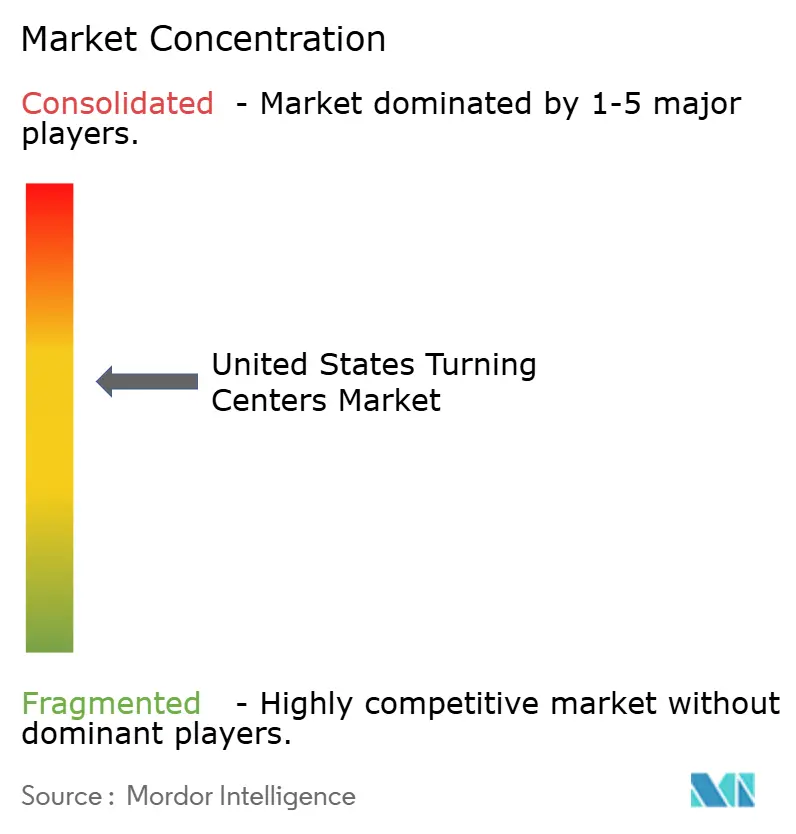
| Market Concentration | Medium |
Major Players *Disclaimer: Major Players sorted in no particular order Image © Mordor Intelligence. Reuse requires attribution under CC BY 4.0. | |
United States Turning Centers Market Analysis by Mordor Intelligence
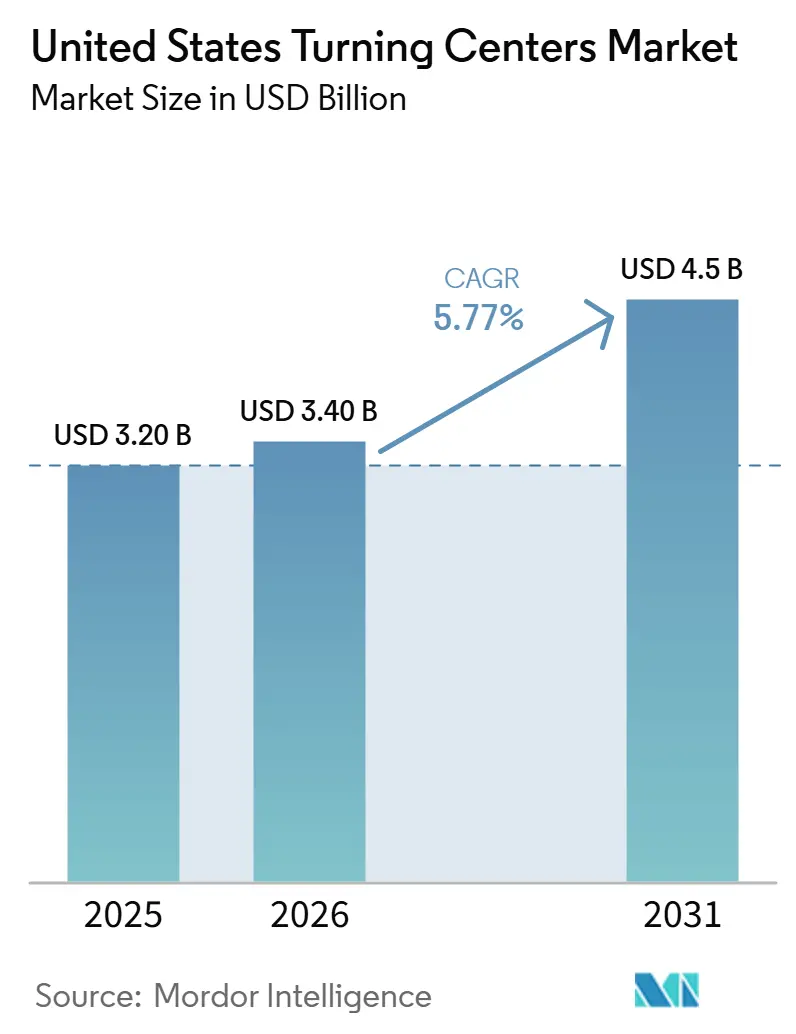
The United States Turning Centers Market size is expected to grow from USD 3.20 billion in 2025 to USD 3.40 billion in 2026 and is forecast to reach USD 4.5 billion by 2031 at 5.77% CAGR over 2026-2031.
Federal policy support has materially changed the investment landscape for the United States turning centers market, as the IRA, the CHIPS and Science Act, and the Infrastructure Investment and Jobs Act have supported a broad pipeline of factory construction and equipment spending across manufacturing. Construction of domestic factories more than doubled after 2021, and private manufacturing investment remains at its strongest level in decades, underscoring the sustained need to expand manufacturing capacity across semiconductor, electronics, and industrial equipment programs. Defense procurement is also reinforcing demand, as the FY2026 budget request includes USD 961.6 billion in total defense spending and USD 640.7 million for metalworking development, certification, and production infrastructure. At the same time, the submarine industrial base alone is backed by nearly USD 5.7 billion. EV and battery investments add another source of orders as StarPlus Energy advances battery plants in Indiana under a USD 7.54 billion DOE loan and Rivian moves forward with a new Georgia facility that expands the pipeline for precision-machined shafts, housings, and related components. At the same time, elevated borrowing costs, tariff-driven input pressures, and ongoing import competition from Japanese and Korean OEMs are keeping procurement decisions selective, pushing the United States turning centers market toward suppliers that combine automation capabilities, domestic assembly, and compliance readiness.
Key Report Takeaways
- By product type, horizontal turning centers led with 46% of the United States turning centers market size in 2025, while multi-tasking turning centers are forecast to expand at a 6.8% CAGR through 2031.
- By axis configuration, 4-axis systems held 48.5% of the United States turning centers market share in 2025, while 5-axis and above recorded the highest projected CAGR at 7.9% through 2031.
- By automation type, fully automatic CNC turning centers accounted for 68% of the market in 2025 and also posted the fastest projected CAGR at 6.2% through 2031.
- By end-user industry, aerospace and defense captured 40.5% share in 2025, while medical devices and surgical instruments are forecast to grow at an 8.5% CAGR through 2031.
Note: Market size and forecast figures in this report are generated using Mordor Intelligence’s proprietary estimation framework, updated with the latest available data and insights as of January 2026.
United States Turning Centers Market Trends and Insights
Drivers Impact Analysis*
| Driver | (~) % Impact on CAGR Forecast | Geographic Relevance | Impact Timeline |
|---|---|---|---|
| IRA, CHIPS Act, and Infrastructure Act Driving USD 2 Trillion in Manufacturing Investments | +1.8% | National, with concentrated gains in Arizona, Texas, Ohio, Indiana, and Kentucky | Long term (≥ 4 years) |
| Aerospace and Defense Budget Expansion Boosting Multi-Axis Turning Center Demand | +1.3% | National, with early concentration in California, Texas, Connecticut, and Alabama | Medium term (2-4 years) |
| Automotive Reshoring and EV Gigafactory Investments Increasing Need for Turning Center Cells | +1.0% | Midwest and Southeast manufacturing belt, with spillover to Georgia and Tennessee | Medium term (2-4 years) |
| Buy American and Domestic Content Mandates Shaping Defense Procurement | +0.8% | National, strongest in federally funded defense and infrastructure corridors | Long term (≥ 4 years) |
| Nearshoring from Mexico Fueling Cross-Border Turning Center Investments | +0.5% | Texas, Arizona, New Mexico, and California | Medium term (2-4 years) |
| Section 232 Tariffs Elevating Prices for Domestic and Allied OEM Machine Tools | +0.4% | National, with acute pressure in steel-intensive Midwest machining clusters | Short term (≤ 2 years) |
| Source: Mordor Intelligence | |||
IRA, CHIPS Act, and Infrastructure Act Driving USD 2 Trillion in Manufacturing Investments
The strongest structural support for the United States turning centers market comes from the combined effect of the IRA, the CHIPS and Science Act, and the Infrastructure Investment and Jobs Act. The Department of Commerce stated that factory construction more than doubled between 2021 and 2024, and manufacturing investment remained stronger than many forecasters expected over the same period.[1]U.S. Department of Commerce, “Biden-Harris Administration Announces CHIPS Incentives Award with Intel,” U.S. Department of Commerce, commerce.gov The CHIPS Program Office has already committed more than USD 19 billion in proposed incentives across 20 states, helping catalyze more than USD 450 billion in private investment in semiconductor and electronics. Each new fabrication facility increases demand for turning centers used in process equipment manufacturing, service tooling, and maintenance machining, which gives the United States turning centers market a longer demand cycle than one-time construction spending alone would suggest. The same pattern is visible in battery and EV supply chains, where large-scale plant buildouts are moving into equipment installation and production ramp-up phases that need repeatable CNC turning capacity.[2]U.S. Department of Energy, “LPO Announces USD 7.54 Billion Loan to StarPlus Energy to Construct Lithium-Ion Battery Factories in Indiana,” U.S. Department of Energy, energy.gov
Aerospace and Defense Budget Expansion Boosting Multi-Axis Turning Center Demand
Defense spending is one of the clearest near-term demand supports for the United States turning centers market. The FY2026 Department of Defense budget request totals USD 961.6 billion. It includes nearly USD 5.7 billion for the submarine industrial base, as well as USD 640.7 million for metalworking development, certification, and modernization of production infrastructure. The FY2025 weapons procurement request of USD 310.7 billion also reinforces a multi-year production pipeline across aircraft, naval platforms, and advanced weapons systems. Components such as submarine hull rings, turbine discs, landing gear parts, and propulsion hardware still rely on qualified multi-axis turning operations, and current standards do not allow those requirements to shift away at scale. Congressional attention is also increasing, as the House Armed Services Committee called for a report on the United States machine tool industrial base and foreign dependencies, pointing to a procurement environment that increasingly favors domestic capacity and domestic assembly.[3]U.S. Congress House Armed Services Committee, “H. Rept. 119-231 Streamlining Procurement for Effective Execution and Delivery and National Defense Authorization Act for Fiscal Year 2026,” Congress.gov, congress.gov
Automotive Reshoring and EV Gigafactory Investments Increasing Need for Turning Center Cells
Automotive reshoring and EV investment are creating a new layer of demand for the United States turning centers market. Battery module housings, rotor shafts, inverter parts, and related assemblies require consistent tolerances and short cycle times, which are well-suited to automated CNC turning cells. The Department of Energy backed StarPlus Energy with a USD 7.54 billion loan for 2 lithium-ion battery plants in Kokomo, Indiana, and manufacturing equipment installation is underway through 2026. Rivian also reached Phase 1 general construction for its Georgia facility in the first half of 2026 and is targeting substantial manufacturing completion in late 2026 and early 2027. These projects matter before full production begins because tooling and machine procurement usually occur well ahead of ramp-up, which means turning center orders tied to 2027 and 2028 output are already entering the buying cycle in 2026.
Buy American and Domestic Content Mandates Shaping Defense Procurement
Domestic content rules are reshaping how buyers assess suppliers in the United States turning centers market. GSA guidance raised the domestic content threshold to 65% in 2026 and will move it to 75% by 2029 under the phased rule. Federal Acquisition Regulation Part 25 also applies price preference penalties to foreign end products that do not meet the domestic content test, with penalties reaching 30% for large businesses. This changes the competitive position of imported turning centers in federal and defense-linked purchasing channels because compliance now affects effective cost rather than just list price. Suppliers with United States assembly, local sourcing, and established service operations are therefore in a stronger position as procurement teams place more weight on supply chain resilience and domestic qualification.
Restraints Impact Analysis*
| Restraint | (~) % Impact on CAGR Forecast | Geographic Relevance | Impact Timeline |
|---|---|---|---|
| Intense Import Competition from Japanese and Korean OEMs in Mid-Market Turning Centers | -1.1% | National, most acute in Midwest job shop clusters and Texas energy machining hubs | Medium term (2-4 years) |
| Impact of Elevated Interest Rates on Payback Periods and CapEx Decisions | -0.8% | National, felt most acutely by small-to-mid-size job shops | Short term (≤ 2 years) |
| Skilled CNC Operator and Programmer Shortage Affecting Turning Center Deployment | -0.5% | National, acute in Ohio, Michigan, and Pennsylvania | Long term (≥ 4 years) |
| Long Lead Times for High-Specification Turning Centers from Japanese and European OEMs | -0.3% | National, especially disruptive for aerospace and medical tier-1 suppliers | Medium term (2-4 years) |
| Source: Mordor Intelligence | |||
Intense Import Competition from Japanese and Korean OEMs in Mid-Market Turning Centers
Import competition remains one of the main limits on pricing strength in the United States turning centers market. Japanese and Korean OEMs continue to target the USD 200,000 to USD 600,000 mid-market range with feature-rich CNC turning centers that are difficult for domestic manufacturers to match on price. USTR data showed that Japan held a USD 57 billion goods trade surplus with the United States in 2024, while Korea's goods trade surplus with the United States stood at USD 56.4 billion in 2025, and machinery remained an important export category in both cases. In March 2026, USTR specifically named machine tools in its Section 301 investigations related to structural excess capacity, noting that global manufacturing capacity utilization remained below 76%, which is still below the level considered healthy for balanced pricing. Until those investigations produce concrete trade actions, United States buyers are likely to continue seeing competitively priced imports that keep pressure on domestic and European suppliers in higher-volume categories.
Impact of Elevated Interest Rates on Payback Periods and CapEx Decisions
Financing conditions are still slowing replacement purchases in the United States turning centers market. The Federal Reserve kept the reserve balance rate at 3.65% as of the January 2026 FOMC meeting. That rate environment extends the payback period for machine tools financed by smaller job shops. Federal Reserve G.17 data showed manufacturing capacity utilization at 75.4% in April 2026, which remained below the long-run average of 79.5%, further weakening the case for some discretionary equipment purchases. The Beige Book for February 2026 reported that capital expenditures had paused or were expected to remain subdued in several manufacturing districts because of uncertainty. Large greenfield investments are still supporting orders, but smaller precision machining shops remain more exposed because they have less balance sheet flexibility and less room to absorb elevated financing costs.
*Our forecasts treat driver/restraint impacts as directional, not additive. The impact forecasts reflect baseline growth, mix effects, and variable interactions.
Segment Analysis
By Product Type: Multi-Tasking Formats Gain Alongside Horizontal Dominance
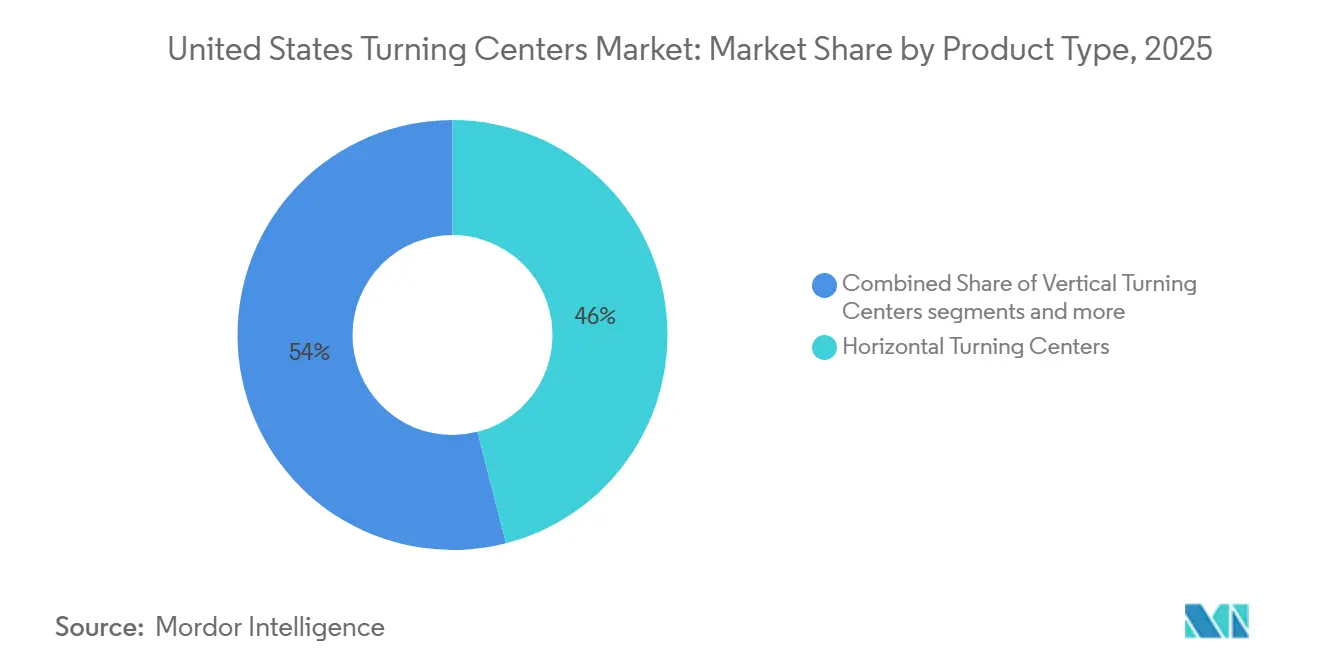
Horizontal turning centers held 46% of the United States' turning centers market share in 2025, maintaining their leading product position. Their scale reflects their continued role in high-volume cylindrical part production across automotive drivetrains, hydraulic components, and oil-and-gas tubular applications. The broad tooling ecosystem for horizontal systems also supports their position, as shops can scale automation with bar feeders, gantry loaders, and established programming routines without major process disruption. Vertical turning centers remained important for large-diameter disc and ring parts, especially in energy and heavy industrial settings where footprint efficiency and part handling matter.
Multi-tasking turning centers are expected to record the fastest growth at a 6.8% CAGR through 2031 in the United States turning centers market size for this product class. Aerospace, medical, and semiconductor equipment producers are moving toward these platforms because they reduce setups and lower in-process inventory for more complex components. The Department of Defense's focus on metalworking modernization is reinforcing this shift because suppliers are under pressure to increase output per setup without expanding floor space at the same pace. Swiss-type and inverted vertical formats will remain more specialized, but they still serve micro-component and precision applications where tolerance demands are too specific for broader standardization.



By Axis Configuration: 5-Axis and Above Accelerates Against an Established 4-Axis Base
4-axis configurations accounted for 48.5% of the United States turning centers market in 2025, which made them the largest axis category. These systems meet the needs of many automotive, industrial machinery, and energy applications that require driven-tool capability but do not yet justify full 5-axis programming complexity. The 3-axis segment still has a place in high-volume commodity turning for fittings, fasteners, and similar parts where added-axis capability does not yield an adequate return. This leaves 4-axis platforms as the practical middle ground for a wide installed base.
5-axis and above systems are forecast to expand at a 7.9% CAGR through 2031, which makes them the fastest-growing axis segment in the United States turning centers market. Demand is driven by aerospace structures, turbine parts, orthopedic implants, and other geometries that require simultaneous multi-axis interpolation within a single clamping. The FY2026 defense budget includes a USD 20.3 billion science and technology allocation that supports advanced manufacturing prototypes and hybrid subtractive capability, which raises qualification standards across parts of the supplier base. NIST and Manufacturing USA programs also continue to lower adoption barriers for mid-sized shops through technology transfer and programming support, helping expand the addressable base for 5-axis turning systems.
By Automation Type: Fully Automatic CNC Consolidates the Majority Position
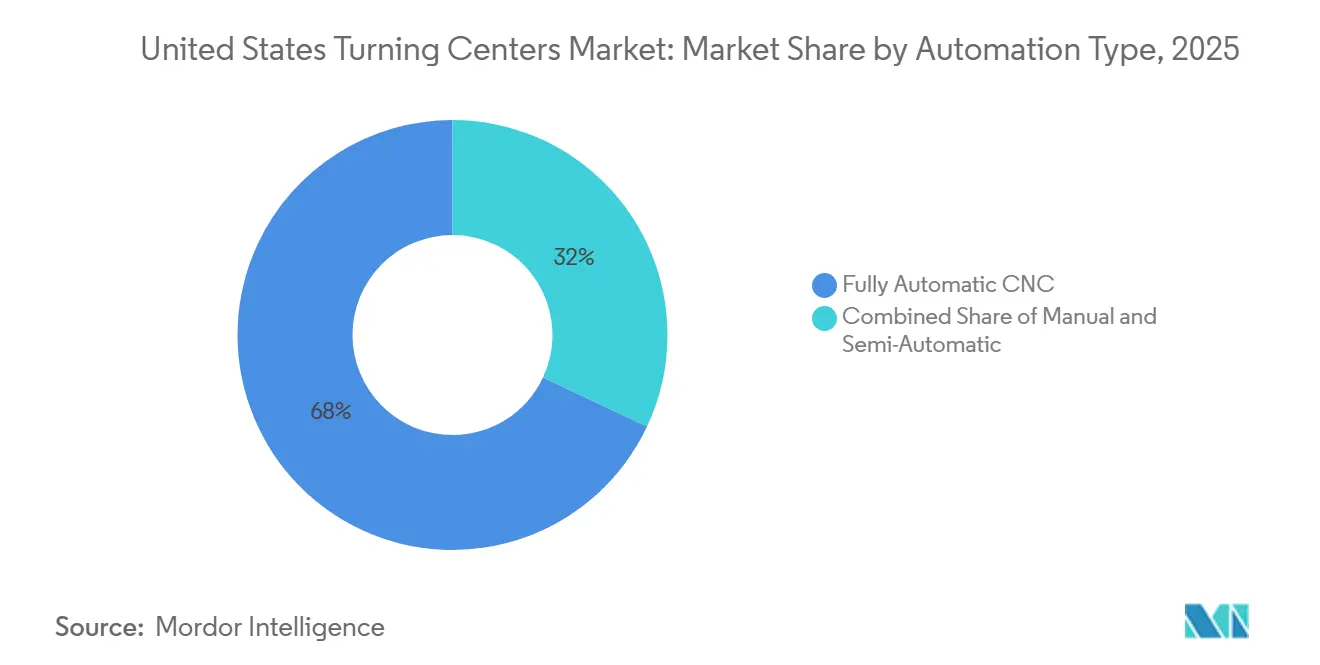
Fully automatic CNC turning centers captured 68% of the market in 2025, giving them a clear lead by automation type. That same segment is also expected to grow at a 6.2% CAGR through 2031, showing that automation is now the baseline expectation for most volume-oriented applications in the United States turning centers market. The United States turning centers market for fully automatic CNC equipment continues to benefit from a labor environment in which manufacturers need higher output per operator and more stable unattended operation. The Bureau of Labor Statistics expects 29,500 average annual openings for machinists from 2024 to 2034, and much of that need is tied to replacement rather than new labor supply, which supports the case for automation.
Semi-automatic turning centers still serve low-volume, high-mix shops where flexibility matters more than maximum throughput. Manual turning centers remain relevant mainly in maintenance, repair, and overhaul settings, where legacy work practices persist. Federal Reserve district commentary noted sustained demand tied to medical devices and data centers, and those end uses typically favor repeatable CNC systems with strong precision control. At the same time, the rise of automated machinery is increasing demand for industrial machinery mechanics and maintenance workers, indicating that automation changes labor needs rather than eliminating them.
By End-User Industry: Aerospace Leads with Medical Devices, the Fastest Mover
Aerospace and defense accounted for 40.5% of the United States turning centers market share in 2025, which made it the largest end-user group. That position reflects the large number of precision-turned parts used in aircraft structures, propulsion systems, missile assemblies, and naval platforms. The FY2026 procurement budget of USD 205.2 billion supports aircraft, submarines, and weapons programs that will continue driving turning center demand across both primes and sub-tier machining facilities. Automotive and commercial vehicles remain the second major demand block because EV platform changes are increasing the need for multi-axis machining of shafts, housings, and redesigned drivetrain components.
Medical devices and surgical instruments are projected to grow at an 8.5% CAGR through 2031, making them the fastest-growing end-user segment in the United States turning centers market. FDA 510(k) clearances remain active in 2026, and the cleared pipeline continues to include implants and instruments that depend on precision machining. Complex implant geometries and demanding surface finish standards are pushing buyers in this segment toward high-specification 5-axis and multi-tasking equipment. Oil and gas, electrical and electronics, and semiconductor equipment will also remain meaningful demand areas, with semiconductor-related turning needs likely to strengthen later in the forecast period as fab construction moves into tooling, replacement, and maintenance cycles.
Geography Analysis
The United States turning centers market remains geographically dispersed, but demand is concentrated in established industrial corridors rather than evenly spread across the country. The Midwest continues to hold the deepest installed base because Ohio, Michigan, Indiana, Illinois, and Wisconsin combine long-standing automotive, heavy equipment, and precision machining capacity. Federal Reserve district commentary pointed to sustained activity in fabricated metals, automotive demand, and machinery orders, which aligns with continuing capital equipment investment across this region. Midwest demand is also being bolstered by battery investment, as StarPlus Energy is building 2 Indiana plants under a USD 7.54 billion DOE loan, and a DOE battery supply chain analysis identifies the Midwest as a primary manufacturing cluster with strong supporting infrastructure. This regional depth gives the Midwest a durable position in the United States turning centers market even as newer regions expand faster.
The South and Southeast are the fastest-growing installation corridors in the United States turning centers market because this region combines aerospace production, automotive assembly, defense programs, and new EV plants. Alabama, South Carolina, Tennessee, Kentucky, and Georgia are all benefiting from greenfield and brownfield investments in aircraft, defense systems, and vehicle production. Rivian began Phase 1 general construction in Georgia in the first half of 2026, adding another source of future demand for automated machining cells. Texas is a particularly important node because it combines semiconductor expansion with energy-related machining demand, and Texas Instruments received up to USD 1.61 billion in CHIPS incentive funding for new facilities in Texas and Utah. This mix of industrial end uses broadens the customer base and makes the South more resilient to slowdowns in any single sector.
The Southwest and West Coast exhibit distinct yet equally important demand patterns within the United States turning centers market. Arizona has become a semiconductor manufacturing hub after TSMC committed more than USD 65 billion to 3 fabs in Phoenix and secured a USD 6.6 billion CHIPS award, which supports downstream demand for process equipment machining. California remains central because Haas Automation anchors domestic production in Oxnard, and the state still has a dense aerospace and defense machining base tied to Southern California contractors. New England and selected Atlantic states are smaller in total volume. Still, they remain important for specialized medical and submarine-related work, especially as the Navy's shipbuilding request of USD 47.4 billion supports activity in Virginia and Connecticut.
Competitive Landscape
The United States turning centers market is moderately consolidated at the high end and more fragmented in the mid-market. Haas Automation remains the leading domestic OEM because its California manufacturing base supports domestic content positioning and shortens the distance between production, service, and federal compliance needs. Japanese and German OEMs still hold strong positions in high-specification multi-tasking and 5-axis systems, where buyers place more value on tolerances, process integration, and established programming libraries. This leaves the competitive field split between domestic strength in value-oriented and compliance-sensitive buying, and overseas strength in premium performance categories. The United States turning centers market is therefore being shaped by who can combine machine capability with service density, automation support, and domestic supply chain credibility.
Competition in 2026 is shifting toward complete automation cells rather than stand-alone machine sales. OEMs that can integrate robotic loading, probing, control software, and factory connectivity are in a stronger position because buyers want fewer handoffs and faster commissioning. DMG MORI illustrated this direction in January 2026 when it introduced the CTX 450 4A with dual tool carriers, Magnescale position measurement, and integrated cooling as standard features for small and mid-sized manufacturers. Okuma followed in April 2026 with the MULTUS U1000 and U2000, which brought 5-axis simultaneous machining into an 8.2 m² footprint and reinforced the move toward compact, high-complexity systems. Mazak also pushed this direction in 2025 through new multi-tasking and high-volume turning launches that targeted EV, aerospace, and precision production requirements.
White-space opportunities are opening where domestic content rules intersect with automation integration. Mid-tier Korean and Taiwanese suppliers without strong United States assembly or service footprints may find it harder to compete in defense-proximate procurement channels even if their pricing is attractive. Section 301 investigations against Japan and Korea also add a layer of tariff risk that could influence sourcing choices and future assembly decisions. At the same time, congressional and procurement scrutiny of foreign dependencies is likely to keep favoring suppliers that can demonstrate durable United States manufacturing and support capabilities.
United States Turning Centers Industry Leaders
Haas Automation
Mazak Corporation
DMG MORI
Okuma Corporation
DN Solutions
- *Disclaimer: Major Players sorted in no particular order

Recent Industry Developments
- April 2026: Okuma launched the MULTUS U1000 and MULTUS U2000 multi-tasking turning centers, offering 5-axis simultaneous machining in a standard 8.2 m² footprint. The machines target aerospace, energy, and precision-engineering applications in the United States market and are positioned to address the trend toward compact, high-complexity machining.
- March 2026: USTR initiated Section 301 investigations against Japan, Korea, and 14 other economies for structural excess capacity in machine tools, machinery, and related sectors. The investigations, which include public hearings scheduled for May 2026, could result in tariff actions that significantly alter the competitive balance between imported and domestically sourced turning centers.
- January 2026: DMG MORI premiered the CTX 450 4A universal turning center, featuring up to 36 tool positions on 2 tool carriers, Magnescale position measurement, and 6 µm positioning accuracy. The launch targets small- and medium-sized manufacturers that require high precision across the aerospace and medical segments.
- January 2026: The United States Department of Commerce announced a historic trade and investment agreement with Taiwan, committing at least USD 250 billion in direct investments from Taiwanese semiconductor and technology enterprises in the United States manufacturing capacity, triggering demand for precision turning centers used in semiconductor process equipment.


United States Turning Centers Market Report Scope
The United States Turning Centers Market Report is Segmented by Product Type (Horizontal Turning Centers, Vertical Turning Centers, and More), by Axis Configuration (3-Axis, 4-Axis, 5-Axis and Above), by Automation Type (Manual, Semi-Automatic, and More), and by End-User Industry (Automotive and Commercial Vehicles, Aerospace & Defense, and More). The Market Forecasts are Provided in Terms of Value (USD) and Volume (Units).
| Horizontal Turning Centers |
| Vertical Turning Centers |
| Multi-Tasking Turning Centers |
| Others |
| 3-Axis |
| 4-Axis |
| 5-Axis and Above |
| Manual |
| Semi-Automatic |
| Fully Automatic CNC |
| Automotive and Commercial Vehicles |
| Aerospace & Defense |
| Medical Devices and Surgical Instruments |
| Oil, Gas, and Energy |
| Electrical, Electronics and Semiconductor Equipment |
| General Industrial Machinery |
| Others |
| By Product Type | Horizontal Turning Centers |
| Vertical Turning Centers | |
| Multi-Tasking Turning Centers | |
| Others | |
| By Axis Configuration | 3-Axis |
| 4-Axis | |
| 5-Axis and Above | |
| By Automation Type | Manual |
| Semi-Automatic | |
| Fully Automatic CNC | |
| By End-User Industry | Automotive and Commercial Vehicles |
| Aerospace & Defense | |
| Medical Devices and Surgical Instruments | |
| Oil, Gas, and Energy | |
| Electrical, Electronics and Semiconductor Equipment | |
| General Industrial Machinery | |
| Others |


Key Questions Answered in the Report
What is the expected value of the United States turning centers by 2031?
The market is projected to reach USD 4.5 billion by 2031, up from USD 3.4 billion in 2026, with a 5.77% CAGR over 2026-2031.
Which product type currently leads demand for turning centers in the United States?
Horizontal turning centers led in 2025 with a 46% share because they remain the standard choice for high-volume cylindrical part production across automotive, hydraulics, and energy applications.
Which end-use area is expanding fastest for turning center demand?
Medical devices and surgical instruments are projected to grow at a 8.5% CAGR through 2031, driven by increasing implant complexity and stringent precision requirements.
Why is defense spending important for turning center sales in the United States?
Defense programs support long-cycle demand for multi-axis machining, and the FY2026 budget includes USD 961.6 billion in total spending with USD 640.7 million directed to metalworking development and production infrastructure.
What is pushing more buyers toward fully automatic CNC turning centers?
Labor availability remains tight, and fully automatic CNC systems improve output per operator while supporting lights-out or reduced-staffing production.
Which regions are seeing the strongest installation momentum?
The Midwest remains the largest installed base, while the South and Southeast are seeing the fastest new-installation momentum driven by aerospace, automotive, EV, and semiconductor investments.
Page last updated on:





