
China Turning Centers Market Size and Share
Market Overview
| Study Period | 2020 - 2031 |
|---|---|
| Forecast Data Period | 2026 - 2031 |
| Base Year Market Size (2025) | USD 8.5 Billion |
| Market Size (2026) | USD 8.90 Billion |
| Market Size (2031) | USD 11.80 Billion |
| Growth Rate (2026 - 2031) | 5.80 % |
| Market Concentration | Low |
Major Players *Disclaimer: Major Players sorted in no particular order Image © Mordor Intelligence. Reuse requires attribution under CC BY 4.0. | |
China Turning Centers Market Analysis by Mordor Intelligence
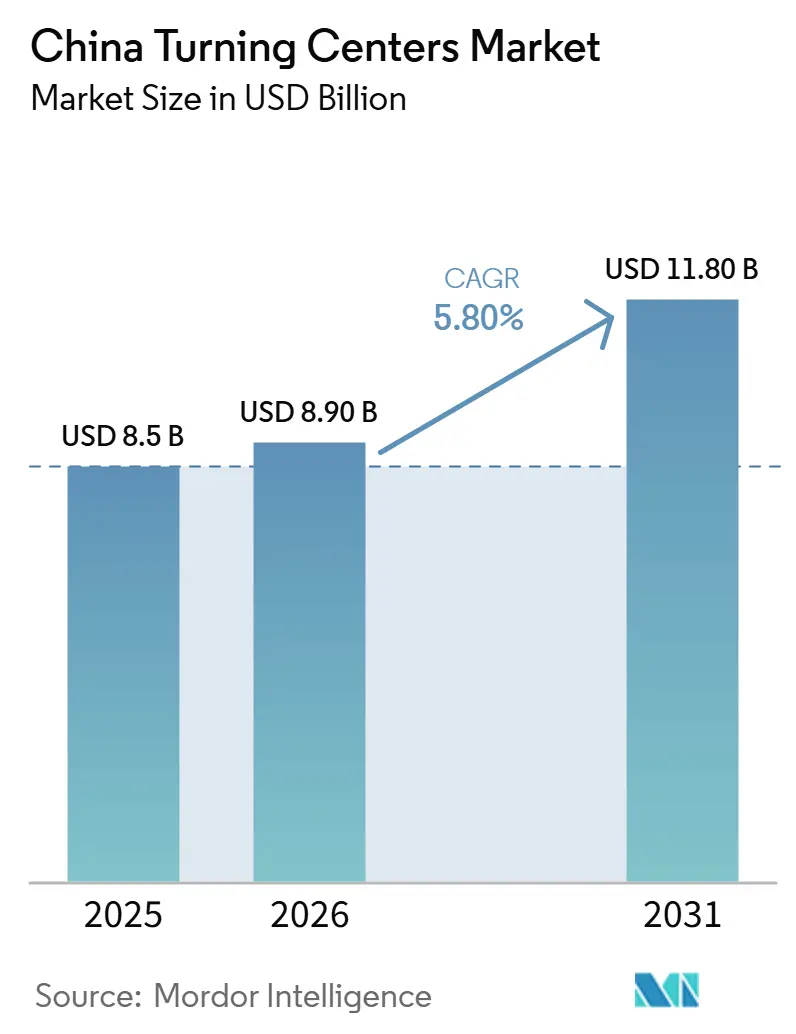
The China Turning Centers Market size is projected to be USD 8.5 billion in 2025, USD 8.90 billion in 2026, and reach USD 11.80 billion by 2031, growing at a CAGR of 5.80% from 2026 to 2031.
China remains the world’s largest single-country turning center demand base, and the China turning centers market continues to benefit from national industrial priorities that place high-end equipment, robotics, aerospace, and intelligent new energy vehicles at the center of the next manufacturing cycle. The 15th Five-Year Plan for 2026 to 2030 stated that China’s emerging pillar sectors are expected to exceed CNY 10 trillion (USD 1.4 trillion), which supports sustained equipment investment across the China turning centers market over the rest of the decade. The demand base is also supported by manufacturing scale, with China’s manufacturing output exceeding USD 4.6 trillion in 2024, which keeps procurement volumes for machine tools high across automotive, electronics, robotics, and general industrial production. The China turning centers market is also being reshaped by stronger EV precision requirements, higher aerospace machining complexity, and a rapidly expanding robot component base, which together are moving demand toward faster, more capable, and more automated configurations. At the same time, the China turning centers market still shows a split structure, with domestic suppliers stronger in mid-range machines while Japanese and German OEMs remain more entrenched in premium applications, leaving room for domestic upgrading, selective import substitution, and wider use of automation-led productivity gains.
Key Report Takeaways
- By product type, horizontal turning centers led with 50.2% share in 2025, while multi-tasking turning centers are forecast to expand at an 8.1% CAGR through 2031.
- By axis configuration, 3-axis machines held 54.5% share in 2025, while 5-axis and above configurations are projected to record the highest CAGR at 9.2% through 2031.
- By automation type, the fully automatic CNC segment held 58% of the China turning centers market share in 2025 and is also projected to post the fastest CAGR of 7.5% through 2031.
- By end-user industry, automotive and commercial vehicles accounted for 42% of the China turning centers market size in 2025, while electrical, electronics, and semiconductor equipment is advancing at an 8.8% CAGR through 2031.
Note: Market size and forecast figures in this report are generated using Mordor Intelligence’s proprietary estimation framework, updated with the latest available data and insights as of January 2026.
China Turning Centers Market Trends and Insights
Drivers Impact Analysis*
| Driver | (~) % Impact on CAGR Forecast | Geographic Relevance | Impact Timeline |
|---|---|---|---|
| Rising Demand for Precision Turning Centers in EV Production | +1.4% | National, concentrated in the Yangtze River Delta, Pearl River Delta, and the Chengdu EV clusters. | Short term (≤ 2 years) |
| Impact of Made in China 2025 and Successor Policies | +1.2% | National, with the strongest policy pull in the Beijing-Tianjin-Hebei corridor and the Yangtze River Delta | Medium term (2-4 years) |
| High-End Turning Centers and Import Substitution Mandate | +0.9% | National, with early gains in Shenyang, Wuhan, and Chongqing industrial manufacturing bases | Medium term (2-4 years) |
| Robotics and Automation Boosting Structural Component Demand | +0.8% | National, concentrated in Shenzhen, Shanghai, and Changchun robotics manufacturing clusters. | Medium term (2-4 years) |
| SME Modernization in Yangtze and Pearl River Delta Clusters | +0.7% | Yangtze River Delta and Pearl River Delta | Short term (≤ 2 years) |
| Aerospace Turning Center Orders Driven by COMAC C919 and AVIC Programs | +0.5% | Xi’an, Shanghai, Chengdu, and Harbin aerospace manufacturing bases | Long term (≥ 4 years) |
| Source: Mordor Intelligence | |||
Rising Demand for Precision Turning Centers in EV Production
China’s EV production surge is changing machining requirements across the China turning centers market, as standard-tolerance equipment is insufficient for a growing share of drivetrain and structural work. China produced 16.63 million EVs in 2025, up 29% year over year, and EVs accounted for 47.9% of total new vehicle sales, sharply boosting demand for precision-turned shafts, rotor housings, and gearbox components required by local manufacturers.[1]Association for Manufacturing Technology, “International News From the Field, China Posts Record Auto and Machine Tool Output,” AMT Online, amtonline.org These parts often require better surface finish and higher repeatability, which shifts buyer preference within the China turning centers market toward high-speed horizontal platforms and higher-performance CNC systems. The move toward integrated die-cast battery enclosures and unified structural castings is also widening demand for large-diameter turning capabilities. These thin-wall-turning applications support vertical turning center demand rather than just conventional shaft work. This means the EV cycle is raising demand across multiple product categories in the China turning centers market, broadening the addressable opportunity for suppliers that can cover multiple machining formats. The long investment horizon is further supported by the 15th Five-Year Plan, which lists intelligent connected new energy vehicles among the strategic emerging industries that will continue to receive policy backing through 2030.
Impact of Made in China 2025 and Successor Policies
The policy legacy of Made in China 2025 continues to shape the China turning centers market, though its effects are not evenly distributed across the value chain. The MFAT review noted that China achieved its strongest gains where upstream inputs were under domestic control, especially in EVs, solar, and industrial robotics. At the same time, high-end machine tools remained a mixed area with continued foreign capability advantages at the top tier.[2]New Zealand Ministry of Foreign Affairs and Trade, “Made in China 2025, From Assembly Line to Advanced Manufacturing,” MFAT Market Reports, mfat.govt.nz That pattern matters for the China turning centers market because it confirms that policy support can lift local scale and mid-range localization without immediately closing the precision gap in aerospace, semiconductor, and medical applications. The 15th Five-Year Plan kept the same direction by pushing AI-enabled manufacturing, green production, and deeper technological localization, while also calling for annual growth of at least 7% in nationwide R&D spending through 2030. A second effect is that manufacturers upgrading to smarter, cleaner, and more digitalized production lines are more likely to replace older machines with configurations that support better software integration, process stability, and unattended operation. As a result, the China turning centers market is being supported not only by direct output growth, but also by a policy-led rise in quality expectations for the equipment installed on factory floors.
High-End Turning Centers and Import Substitution Mandate
Import substitution is becoming more visible in the China turning centers market. However, the process is still uneven because the top end of the machine stack is harder to localize than the mid-range. The MFAT assessment found that domestic low-end CNC self-sufficiency had already been achieved and mid-range localization had improved materially. Yet, premium machine tool capability remained an area where foreign OEMs still held a significant edge. AMT reported that imported turning machines reached USD 400 million in 2025, which shows that demanding applications across the Chinese turning centers market still rely on external suppliers for performance, reliability, or qualification reasons. The CAE study also showed that restrictions on five-axis linkage functionality in Japanese CNC exports forced Chinese developers to create independent code paths without reference implementations, which raises the technical burden of catching up in advanced controller software.[3]Chen Xuedong et al., “Ten-Year Achievements and Future Prospects of High-End CNC Machine Tool and Robot Industries,” Strategic Study of Chinese Academy of Engineering, engineering.org.cn That pressure is accelerating local R&D and shortening the distance to acceptable domestic alternatives in some tiers. Yet, it also lengthens the path to full parity in the most precision-sensitive turning workloads. This leaves the China turning centers market in a transition phase where localized capability is rising. Still, the premium segment remains more dependent on foreign technology than overall shipment volumes may suggest.
Robotics and Automation Boosting Structural Component Demand
China’s industrial robot base is creating a distinct new layer of demand in the China turning centers market, as robot parts require different tolerances and machining strategies than many standard industrial components. China installed around 295,000 industrial robots in 2024, representing roughly 54% of global installations, and domestic robot makers captured a majority share of the Chinese market for the first time that year. Harmonic drive elements, joint housings, and actuator shafts demand tighter tolerances, better concentricity, and greater multi-axis capability, which is driving buyers in the China turning centers market toward turn-mill and higher-axis machines. The robot supply chain is also more fragmented than the automotive supply chain, so demand is spread across many specialist component makers rather than a narrow set of very large OEM plants. That fragmentation matters because it broadens the customer base for first-time upgrades into advanced turning technology, especially among SMEs that need better precision without fully reworking their production model. The policy backdrop remains supportive as well, since robotics is named as a strategic industry in the 15th Five-Year Plan, which supports continued equipment spending and higher-specification component manufacturing through 2030.
Restraints Impact Analysis*
| Restraint | (~) % Impact on CAGR Forecast | Geographic Relevance | Impact Timeline |
|---|---|---|---|
| Reliance on Imported Controllers Despite Domestic Options | -0.8% | National, most acute in aerospace, semiconductor, and medical device production centers | Long term (≥ 4 years) |
| Margin Compression Due to Domestic Price Wars and Overcapacity | -0.7% | National, most severe in the Yangtze River Delta and Pearl River Delta standard CNC segments | Short term (≤ 2 years) |
| Quality Perception Gap in High-Precision Work vs. Japanese and German OEMs | -0.5% | National, concentrated in aerospace, semiconductor, and medical device end-user segments. | Medium term (2-4 years) |
| Skilled CNC Operator and CAM Programmer Shortage Impacting Utilization | -0.4% | National, most acute in inland manufacturing bases and Northeastern industrial clusters | Short term (≤ 2 years) |
| Source: Mordor Intelligence | |||
Reliance on Imported Controllers Despite Domestic Options
A major constraint in the China turning centers market is that controller localization has not advanced at the same pace as machine assembly or mid-range mechanical capability. Yet, the high-end controller layer for five-axis turning, aerospace cells, and semiconductor equipment still relies heavily on foreign suppliers. Imported CNC control systems reached USD 1.05 billion in 2025, according to the Ministry of Industry and Information Technology (MIIT), indicating that advanced workloads are still driving demand for external technology even as localization efforts continue across the broader machine tool base. The CAE study explains part of the gap, noting that software restrictions on five-axis linkage functions forced domestic developers to build independent code paths, which slows validation and raises the time needed to reach trusted performance in critical use cases. This creates a practical ceiling for some buyers in the China turning centers market, because machine procurement can be localized more quickly than the controller and software stack that support the most demanding operations. Until domestic control systems prove stronger long-run reliability in complex turning environments, this dependency will continue to limit adoption in the highest-value end uses.
Margin Compression Due to Domestic Price Wars and Overcapacity
Overcapacity in standard CNC equipment remains a structural drag on the China turning centers market, as intense price competition makes it harder for manufacturers to fund the upgrades needed to move into higher-value applications. The Springer Nature study described this pattern as a middle-technology trap, in which Chinese machine tool makers achieved a strong market share but remained less competitive in complex applications where margins are more defensible. That dynamic matters because the same price pressure that helps domestic suppliers win share in standard machines also reduces the cash available for higher-end software, precision components, and long-cycle product development. The MFAT review also pointed to China’s anti-innovation push, reflecting official recognition that excessive intra-industry price competition is damaging innovation quality and industrial profitability. In practical terms, the China turning centers market can expand in unit terms while still leaving many domestic players financially constrained in premium product development. That gap between scale and profitability is one reason local manufacturers continue to dominate broader volume bands, while foreign suppliers retain an edge in the most demanding turning-center applications.
*Our forecasts treat driver/restraint impacts as directional, not additive. The impact forecasts reflect baseline growth, mix effects, and variable interactions.
Segment Analysis
By Product Type: Multi-Tasking Configurations Command Premium Demand
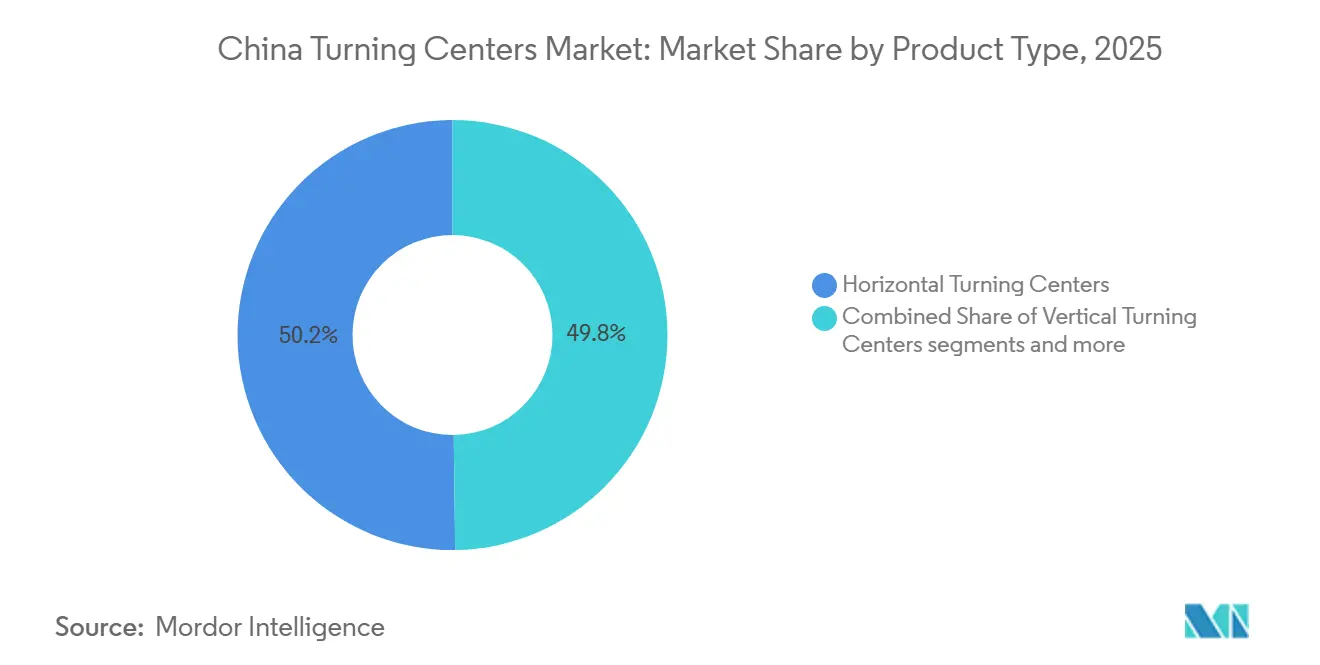
Horizontal turning centers held a 50.2% share in 2025, keeping them at the center of the China turning centers market, as high-volume automotive, general industrial, and EV shaft production still favors established platforms with large tooling ecosystems. Their leadership reflects a manufacturing structure that remains heavily weighted toward shafts, bushings, rotors, and other parts that benefit from efficient linear workflows, familiar setups, and lower capital intensity. This also means the installed base continues to reinforce future purchases, since many buyers prefer to expand around existing tooling, operator familiarity, and maintenance practices rather than redesign the entire cell. In the China turning centers industry, the installed base creates inertia that supports horizontal demand even as more advanced formats gain traction in higher-value work. The product type mix, therefore, remains broad, but the dominant role of horizontal machines is still tied to practical production economics rather than only price.
Vertical turning centers continue to serve large-diameter and heavy-workpiece applications, where gravity-assisted holding, setup stability, and workpiece access remain important for manufacturers handling housings, frame parts, and larger structural elements. Their relevance is increasing in areas such as large EV enclosures, energy equipment, and aerospace frame machining, where part size and dimensional control matter as much as cutting speed. Multi-tasking turning centers are the fastest-growing product segment, with the China turning centers market size for this segment projected to expand at an 8.1% CAGR through 2031, because buyers increasingly want turning, milling, and drilling completed in a single setup. That demand shift is strongest where part complexity is rising, especially in aerospace, semiconductor equipment, and robot structural components, making setup reduction and tolerance consistency more valuable than in standard-volume work. The others segment, which includes Swiss-type turning centers and specialized lathes, remains smaller but is gaining importance in medical and miniature precision applications where surface quality, contamination control, and micro-part repeatability carry outsized weight.
Horizontal machines also benefit from the broadest service support base, which matters in the China turning centers market because uptime and quick toolchain replacement are often more important to SMEs than top-tier sophistication. Vertical machines offer a narrower but durable role, since their value lies in specific part geometries that cannot be handled as efficiently on horizontal equipment. Multi-tasking systems are pulling more capital toward premium configurations because they reduce multiple setups, lower handling losses, and support better process control in complex part families. This leaves product-type demand more polarized, with horizontal machines anchoring volume while multitasking platforms capture a rising share of strategic investment.



By Axis Configuration: 5-Axis Growth Reshapes the Market Spectrum
3-axis configurations held a 54.5% share in 2025, indicating that the China turning centers market still relies on a large installed base of conventional CNC capacity used in standard automotive, industrial, and SME production lines. These machines remain attractive because they offer workable productivity, lower acquisition costs, easier programming, and a simpler maintenance profile for manufacturers that do not need advanced surface path control. Their share also reflects the fact that a large portion of the China turning centers market is still tied to everyday production needs where complexity remains moderate, and cycle economics favor simpler formats. In the China turning centers industry, this gives 3-axis machines a durable role even when the premium part of the market is moving much faster. Four-axis machines continue to fill the space between cost-sensitive standard turning and high-end multi-surface machining, especially for buyers who need better productivity for eccentric work but want to avoid the cost jump into a five-axis platform.
Five-axis and above configurations are the fastest-growing axis segment, and the China turning centers market for this segment is projected to expand at a 9.2% CAGR through 2031 as aerospace, medical, and semiconductor work demand greater geometric control and fewer setups. The CAE study’s discussion of five-axis software constraints also shows why this tier remains strategically important, as controller-level capability becomes just as important as mechanical hardware when buyers evaluate complex turning operations. As a result, the axis mix in the China turning centers market is likely to remain broad. Still, the value pool is steadily moving upward toward higher-axis machines that can support premium end-user requirements.
The shift toward five-axis equipment also changes buying behavior, since procurement increasingly includes software compatibility, simulation accuracy, and long-run support rather than only spindle or structure specifications. Four-axis machines will retain a useful transitional role, especially in mid-tier automotive parts and selected general industrial programs where part families are expanding but budgets remain controlled. The largest opportunities, therefore, lie at both ends of the axis spectrum, with 3-axis machines sustaining broad demand and five-axis equipment driving the strongest upgrade spending. That split captures the current structure of the China turning centers market more accurately than a simple narrative of one format replacing another.
By Automation Type: Fully Automatic CNC Consolidates Market Leadership
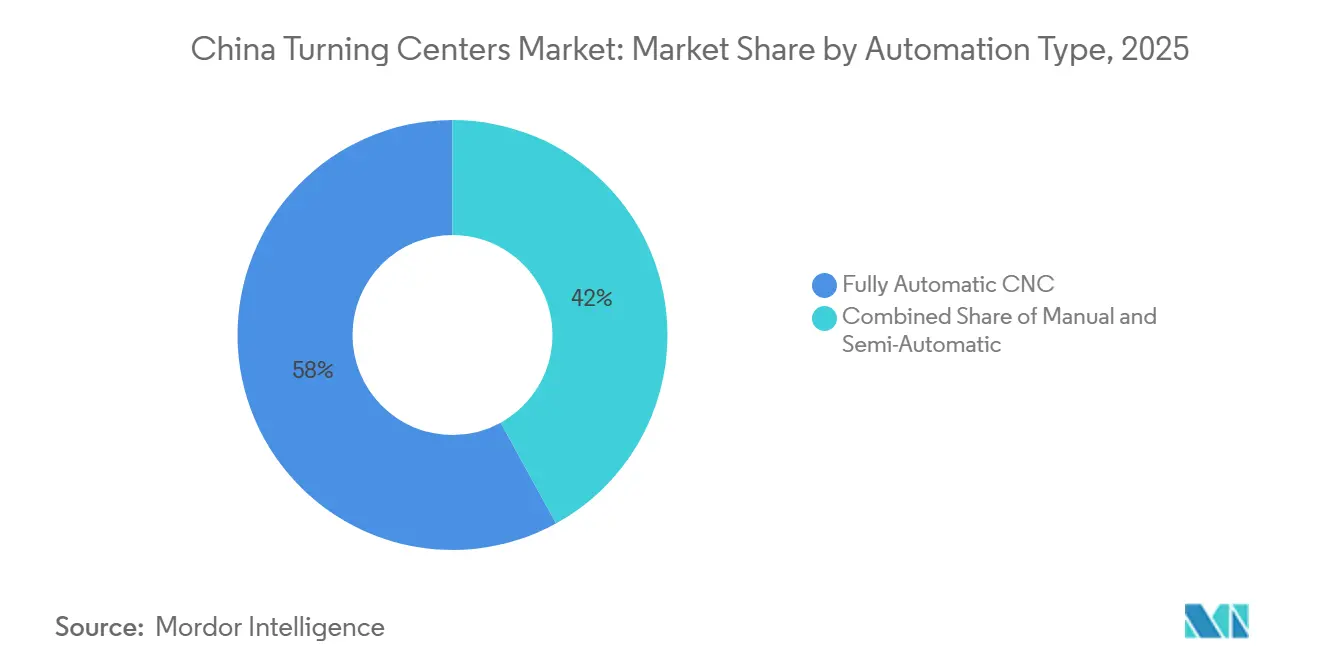
Fully automatic CNC configurations held a 58% share in 2025 and are also the fastest-growing automation tier, with a 7.5% CAGR through 2031, indicating that the China turning centers market is still in an active automation buildout phase rather than a stable, mature phase. This dual position reflects downstream pull from EV, electronics, robotics, and other precision manufacturing lines that increasingly require lights-out readiness, stronger repeatability, and reduced manual intervention. The appeal is especially strong when throughput targets are rising, and labor availability is tight, because unattended or near-unattended production can improve machine utilization without proportionate staffing growth. In the China turning centers market, automation has become a strategic purchasing factor rather than a simple optional add-on for high-end factories. The result is a widening gap between machines that provide only basic CNC control and those that support more stable automated production with lower handling variation.
Semi-automatic configurations still have an important place, particularly among SMEs managing high-mix, low-volume work, where operator intervention remains useful and full automation may not yield an immediate return. Manual turning is continuing to lose relevance in production environments where consistency, traceability, and labor economics are becoming increasingly demanding. However, it remains present in smaller workshops and certain repair-oriented applications. The broader trend still favors full CNC automation because it aligns with the production volumes of large OEM supply chains and the productivity needs of smaller firms trying to protect margins. The China turning centers market, therefore, shows a clear automation ladder. Still, the center of investment is moving steadily toward fully automatic CNC systems that can support higher precision, stronger process control, and more predictable output quality.
Automation is also affecting how buyers compare machines, because the decision increasingly includes software integration, spindle monitoring, setup repeatability, and compatibility with broader digital workflows. Semi-automatic formats remain commercially relevant because they allow staged upgrades without forcing immediate changes in labor organization or plant layout. Fully automatic CNC platforms, however, are setting the new benchmark in the China turning centers market because they align with the operating model now expected in advanced manufacturing clusters. That is why this segment combines present leadership with continued above-average growth.
By End-User Industry: Automotive Leads While Semiconductor Electronics Accelerates
Automotive and commercial vehicles held 42% of the China turning centers market share in 2025, confirming that the China turning centers market still accounts for most of its volume, driven by the country’s deep vehicle manufacturing base. China produced 34.53 million vehicles in 2025, and that scale continues to anchor demand for drivetrain, powertrain, chassis, and related component machining across a broad network of OEMs and suppliers. Even within this leading segment, the internal mix is changing because conventional internal combustion engine demand is no longer the sole driver of turning workloads. EV motor shafts, rotor cores, and gearbox housings are playing a larger role and often require tighter tolerance control than older mainstream programs. That means the automotive base remains large in the China turning centers market, but the specification level inside that base is gradually moving upward.
Aerospace and defense remain a prestige segment where quality thresholds are high, and machine qualification can be more important than unit volume, which keeps premium foreign and top domestic offerings more relevant than in standard industrial categories. Electrical, electronics, and semiconductor equipment is the fastest-growing end-user segment, with an 8.8% CAGR through 2031, because AI server infrastructure, advanced packaging equipment, and precision electronics all require fine-tuning for parts that standard machining setups do not always handle well. Medical devices and surgical instruments remain smaller in volume but structurally premium, as process cleanliness, material-handling discipline, and micro-level repeatability raise the entry threshold for suppliers. Oil, gas, energy, general industrial machinery, and other end uses round out the China turning centers market, providing a diversified demand base that reduces dependence on any one vertical cycle.
This diversification is a core strength because it allows China turning centers market to absorb weaker conditions in one area without losing its broader equipment spending base. Automotive leads because of scale, while electronics and semiconductor-linked demand lead because of their faster rise in precision intensity. Aerospace stays important because it shapes the upper end of machine capability and supplier positioning. Together, those patterns explain why end-user demand in the China turning centers market is both broad and increasingly quality-driven.
Geography Analysis
The China turning centers market is organized around the country’s main industrial corridors, and the Yangtze River Delta remains the largest production and consumption cluster for metal-cutting machine tools. Zhejiang Province ranked first in national metal-cutting machine tool production in the first half of 2024, while the broader Yangtze River Delta functioned as the main hub for automotive Tier 1 suppliers, consumer electronics manufacturers, and precision parts machining operations. That concentration gives the China turning centers market a strong base in Zhejiang, Jiangsu, Shanghai, and Anhui because equipment demand is supported by dense downstream manufacturing and established supplier networks. The region also benefits from a high concentration of CNC system providers, tooling specialists, and industrial software support, which reduces switching friction for buyers upgrading machine capability. As a result, the Yangtze River Delta remains the most important anchor region for both supply and demand in the China turning centers market.
The Pearl River Delta is the second major cluster, and its role is becoming more important as high-end manufacturing in Guangdong continues to scale up. Guangdong’s high-end equipment manufacturing generated CNY 390.6 billion (USD 55.78 billion) in revenue and CNY 18.9 billion (USD 2.69 billion) in profits in 2024, indicating that the province has both industrial breadth and growing economic weight in advanced manufacturing segments. Guangzhou, Shenzhen, Foshan, and Dongguan support the China turning centers market through electronics, automation equipment, EV-linked production, and a wide base of specialist part makers. The region’s strength is not just in output size, since its mix of export-oriented manufacturing and fast product iteration creates steady demand for machines that can handle shorter changeovers and tighter tolerances. This keeps the Pearl River Delta closely tied to the faster-moving and more specification-sensitive side of the China turning centers market.
Northeastern China remains important for heavy-duty turning center production, especially in Liaoning around Shenyang and Dalian, where large-format machines serve energy equipment, heavy machinery, and other large-bore applications. Southwest and western corridors centered on Chengdu, Xi’an, and Chongqing are the main aerospace and defense machining bases, and they continue to shape the premium end of the China turning centers market through demand for complex structural part manufacturing. The 15th Five-Year Plan’s designation of aerospace as a strategic emerging industry supports continued capital spending across these inland manufacturing bases through 2031. Taken together, these regional patterns show that the China turning centers market is not led by one uniform national demand pool, but by several specialized clusters with distinct product, end-user, and capability needs.
Competitive Landscape
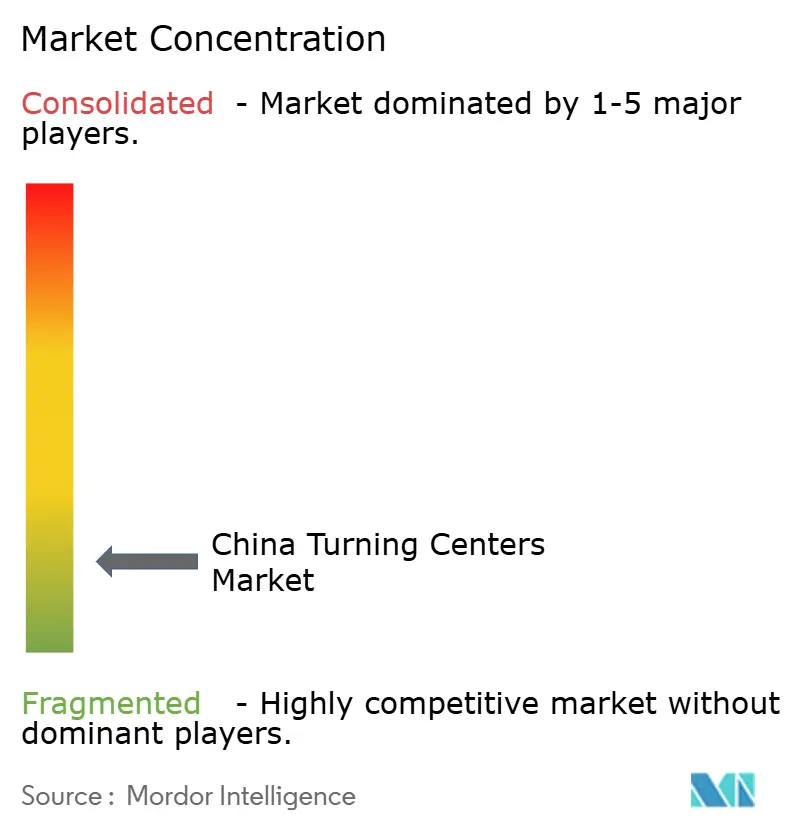
The China turning centers market remains fragmented, with a clear two-tier structure that separates domestic champions from foreign OEMs across different capability bands. Domestic manufacturers such as SMTCL, Ningbo Haitian Precision, DMTG, and Qinchuan Machine Tool are stronger in mid-range and standard turning center categories, where price, local service reach, and application familiarity matter most. Foreign OEMs such as DMG MORI, Mazak, and Okuma continue to hold stronger positions in premium five-axis and multi-tasking applications linked to aerospace, semiconductor equipment, and medical device production. This split remains visible in trade flows, as Japan and Germany together accounted for USD 5.91 billion of China’s USD 10.3 billion in total machine tool imports in 2025, with inflows concentrated in higher-value equipment categories. The competitive picture in the China turning centers market is therefore less about one group replacing the other immediately, and more about domestic suppliers climbing the value stack. At the same time, foreign brands maintain competitive advantages in the most technically demanding positions.
Domestic competition is driven by localization, price discipline, service access, and gradual capability improvement rather than by a single dominant player. Haitian’s opening of the Haitian Machinery Global Application Center in Ningbo in April 2026 is a good example, as the facility combines application display, joint innovation, process validation, solution incubation, training, and brand collaboration in one location, thereby strengthening its customer engagement model beyond machine sales alone. Haitian also used regional trade events in 2026 to position its flagship five-axis vertical machining and CNC turning systems around automotive and aerospace demand clusters, showing that domestic suppliers are linking product marketing more directly to specialized manufacturing corridors. That matters in the China turning centers market because buyers increasingly expect process support, training, and application validation alongside equipment delivery. It also suggests that domestic firms are trying to narrow the gap with foreign OEMs not only through price, but through stronger process integration and regional solution support.
Foreign OEMs are responding by doubling down on performance positioning and long-term research partnerships. DMG MORI launched the NLX 2500|1250 2nd Generation in September 2025, featuring high positioning accuracy and continuous operation stability, aimed at EV, aircraft, space, and semiconductor applications, reinforcing the premium strategy that foreign suppliers continue to pursue in the China turning centers market. In March 2026, DMG MORI and the University of Tokyo announced the Machining Transformation Research Center, focused on manufacturing efficiency, energy reduction, and solutions to labor shortages for future production needs. These moves show that foreign players are defending their edge through technology depth, research partnerships, and strong application credibility rather than competing directly on volume pricing. The result is a China turning center market where strategic differentiation is becoming increasingly important, even as fragmentation remains evident across the broader supplier base.
China Turning Centers Industry Leaders
Shenyang Machine Tool Co.(SMTCL)
DMG MORI
Mazak Corporation
Ningbo Haitian Precision Machinery
DN Solutions
- *Disclaimer: Major Players sorted in no particular order

Recent Industry Developments
- April 2026: Haitian Group officially opened the Haitian Machinery Global Application Center at its Ningbo headquarters during the 2026 Factory Open Week, marking the company’s 60th anniversary. The 10,000-square-meter center integrates six functions: application display, joint innovation, process validation, solution incubation, training, and brand collaboration.
- March 2026: DMG MORI and the University of Tokyo announced the establishment of the Machining Transformation Research Center within the Graduate School of Engineering, effective April 1, 2026. The center addresses CNC manufacturing efficiency, energy reduction, and labor shortage solutions oriented toward 2050 manufacturing requirements.


China Turning Centers Market Report Scope
The China Turning Centers Market Report is Segmented by Product Type (Horizontal Turning Centers, Vertical Turning Centers, and More), by Axis Configuration (3-Axis, 4-Axis, and More), by Automation Type (Manual, Semi-Automatic, and More), and by End-User Industry (Automotive, Aerospace & Defense, Medical Devices and Surgical Instruments, and More). The Market Forecasts are Provided in Terms of Value (USD) and Volume (Units).
| Horizontal Turning Centers |
| Vertical Turning Centers |
| Multi-Tasking Turning Centers |
| Others |
| 3-Axis |
| 4-Axis |
| 5-Axis and Above |
| Manual |
| Semi-Automatic |
| Fully Automatic CNC |
| Automotive and Commercial Vehicles |
| Aerospace & Defense |
| Medical Devices and Surgical Instruments |
| Oil, Gas, and Energy |
| Electrical, Electronics and Semiconductor Equipment |
| General Industrial Machinery |
| Others |
| By Product Type | Horizontal Turning Centers |
| Vertical Turning Centers | |
| Multi-Tasking Turning Centers | |
| Others | |
| By Axis Configuration | 3-Axis |
| 4-Axis | |
| 5-Axis and Above | |
| By Automation Type | Manual |
| Semi-Automatic | |
| Fully Automatic CNC | |
| By End-User Industry | Automotive and Commercial Vehicles |
| Aerospace & Defense | |
| Medical Devices and Surgical Instruments | |
| Oil, Gas, and Energy | |
| Electrical, Electronics and Semiconductor Equipment | |
| General Industrial Machinery | |
| Others |


Key Questions Answered in the Report
What is the 2031 outlook for China turning centers?
The China turning centers market is projected to reach USD 11.8 billion by 2031 from USD 8.9 billion in 2026, at a 5.8% CAGR over 2026 to 2031.
Which product type leads demand in China?
Horizontal turning centers led with 50.2% share in 2025 because automotive, industrial, and EV shaft production still rely heavily on familiar, cost-efficient horizontal platforms.
Which configuration is growing the fastest?
Five-axis and above configurations are projected to grow at a 9.2% CAGR through 2031 as aerospace, medical, and semiconductor parts require fewer setups and tighter geometry control.
Why is EV production so important for turning center demand in China?
China produced 16.63 million EVs in 2025, which boosted demand for precision turning of motor shafts, rotor housings, gearbox parts, and larger structural components.
Which end-user segment is the largest, and which is the fastest-growing?
Automotive and commercial vehicles held 42% share in 2025, while electrical, electronics, and semiconductor equipment is projected to grow at an 8.8% CAGR through 2031.
Page last updated on:





