
United States Magnet Free Electric Axle System Market Size and Share
Market Overview
| Study Period | 2019 - 2031 |
|---|---|
| Forecast Data Period | 2026 - 2031 |
| Base Year Market Size (2025) | USD 1.27 Billion |
| Market Size (2026) | USD 1.46 Billion |
| Market Size (2031) | USD 2.9 Billion |
| Growth Rate (2026 - 2031) | 14.76 % |
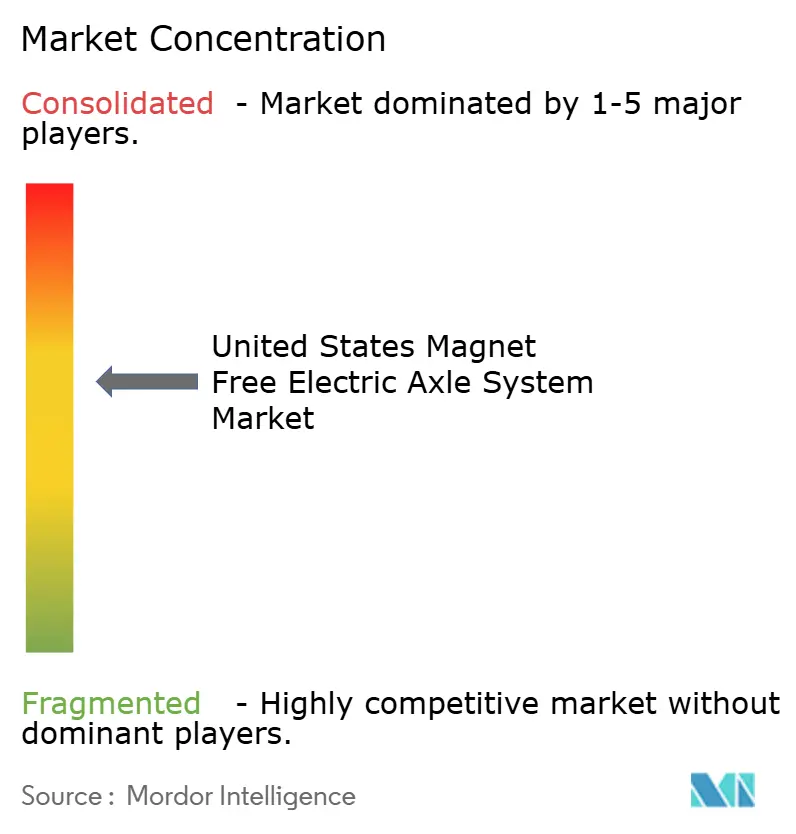
| Market Concentration | Medium |
Major Players
*Disclaimer: Major Players sorted in no particular order Image © Mordor Intelligence. Reuse requires attribution under CC BY 4.0. |
|
United States Magnet Free Electric Axle System Market Analysis by Mordor Intelligence
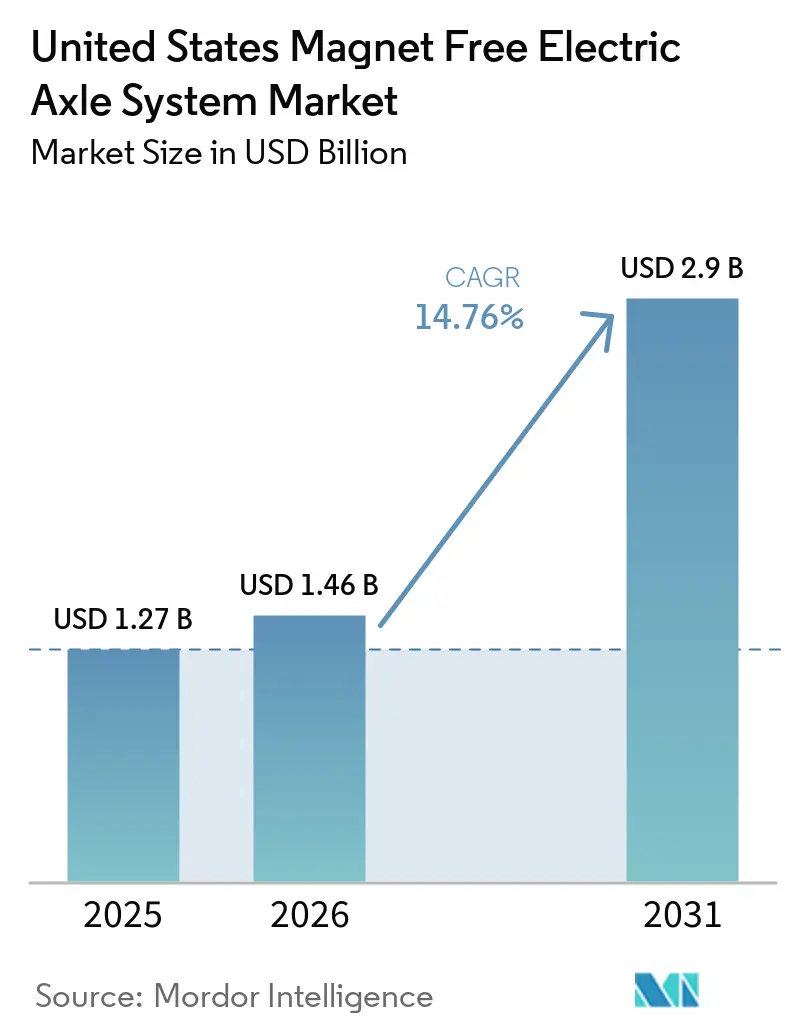
The United States magnet free electric axle system market size was valued at USD 1.27 billion in 2025 and is estimated to grow from USD 1.46 billion in 2026 to reach USD 2.9 billion by 2031, at a CAGR of 14.76% during the forecast period (2026-2031). Driven by surging rare-earth prices, federal manufacturing incentives, and defense procurement mandates, the industry is pivoting from neodymium-based permanent magnets to alternatives such as externally excited synchronous motors (EESM), induction motors, and switched reluctance motors (SRM). Due to production tax credits, which offer financial benefits, and investment credits that cover a percentage of eligible capital expenditures, domestic e-axle assembly plants are seeing shortened payback periods. Neodymium oxide prices have risen sharply, prompting OEMs to be wary of relying on supply chains dominated by China. In response, tier-one suppliers are rolling out high-voltage, silicon-carbide-inverter e-axles. These innovative e-axles integrate the motor, gearbox, and inverter into a single housing, slashing the parts count and cutting weight compared to traditional discrete assemblies.
Key Report Takeaways
- By motor type, induction motors led with 44.56% of the United States magnet free electric axle system market share in 2025, while externally excited synchronous motors are projected to post the fastest 17.42% CAGR through 2031.
- By drive type, fully electric drive configurations accounted for 61.28% of the United States magnet free electric axle system market size in 2025 and are set to expand at a 19.07% CAGR over 2026-2031.
- By e-axle configuration, integrated designs captured 48.13% share in 2025 and will advance at the highest CAGR of 19.14% to 2031.
- By vehicle type, passenger cars held 76.21% share in 2025, while commercial vehicles will register the quickest 15.03% CAGR during 2026-2031.
Note: Market size and forecast figures in this report are generated using Mordor Intelligence’s proprietary estimation framework, updated with the latest available data and insights as of January 2026.
Competitive positioning in United states includes both locally based firms and those operating across multiple regions. The market landscape in the global magnet free electric axle system industry research shows how these players are arranged internationally.
United States Magnet Free Electric Axle System Market Trends and Insights
Drivers Impact Analysis*
| Driver | (~)% Impact on CAGR Forecast | Geographic Relevance | Impact Timeline |
|---|---|---|---|
| IRA Credits Boost E-Axle Production | +3.2% | United States | Short term (≤ 2 years) |
| OEM Push to Cut Rare-Earth Volatility | +2.8% | United States | Medium term (2-4 years) |
| Torque-Density Gains in EESM and SRM | +2.1% | United States | Medium term (2-4 years) |
| DOE Funds Non-Rare-Earth Motors | +1.9% | United States | Long term (≥ 4 years) |
| Defense Mandates Non-Rare-Earth Powertrains | +1.4% | United States | Long term (≥ 4 years) |
| Copper-Coil Costs Drop on Wire-Rod Glut | +1.2% | United States | Short term (≤ 2 years) |
| Source: Mordor Intelligence | |||
IRA Tax Credits Accelerating Domestic E-Axle Production
Due to the 30% reduction in capital outlays from Section 45X and Section 48C credits, ZF has pledged a USD 500 million investment to broaden its operations in Gray Court, South Carolina [1]"ZF Plans $500 Million Investment", ZF AG, zf.com. This expansion will focus on establishing future magnet free e-axle production lines, which are expected to play a significant role in advancing electric vehicle technology. Concurrently, General Motors is channeling a hefty USD 4 billion into its Orion plant [2]"GM to invest $4 billion in its U.S. manufacturing plants", General Motors, gm.com. This investment aims to transform the facility into a hub for electric truck production, with operations scheduled to commence in 2026.
OEM Drive to Eliminate Rare-Earth Price Volatility
Prices for neodymium and praseodymium oxides surged significantly, more than doubling to reach a notable high. This price increase highlighted the growing challenges in sourcing rare-earth materials, which are critical for various industries, including electric vehicles. The rising costs underscored the volatility of the rare-earth market, driven by supply chain constraints and increasing demand. In response to these challenges, Tesla and BMW unveiled plans to phase out rare-earth magnets from their upcoming drive units. This strategic move aims to reduce dependency on these materials, mitigate supply chain risks, and align with sustainability goals by exploring alternative technologies for electric vehicle components.
Rapid Torque-Density Gains in EESM and SRM Designs
Schaeffler's tests showed that its optimized EESM rotors generated higher torque compared to comparable permanent-magnet units. While this confirms torque parity, it's noted that efficiency trails slightly. The results underscore EESM technology's promise in delivering competitive torque, while also pinpointing efficiency enhancements needed to rival or exceed permanent-magnet units. Furthermore, these insights highlight advancements in rotor design, bolstering the case for EESM systems as a credible alternative in high-torque applications.
DOE R&D Funding for Beyond-Rare-Earth-Magnet (BREM) Motors
CorePower Magnetics, backed by a Department of Energy grant, is on a mission to achieve high power density without relying on rare-earth elements. This financial boost could fast-track the commercial launch of EESM (Externally Excited Synchronous Motors) and SRM (Switched Reluctance Motors) by multiple years. The grant will support the development and scaling of these technologies, which aim to deliver efficient, sustainable solutions across applications, including renewable energy systems and electric vehicles.
Restraints Impact Analysis*
| Restraint | (~)% Impact on CAGR Forecast | Geographic Relevance | Impact Timeline |
|---|---|---|---|
| Efficiency Gap vs. Latest IPM Motors | -2.4% | United States | Medium term (2-4 years) |
| High Up-Front Re-Tooling CAPEX for Tier-1s | -1.8% | United States | Short term (≤ 2 years) |
| Rotor Heat-Dissipation Limits in High-Power SRM | -1.5% | United States | Medium term (2-4 years) |
| Limited Domestic Precision-Lamination Supply Base | -1.2% | United States | Long term (≥ 4 years) |
| Source: Mordor Intelligence | |||
Efficiency Gap vs. Latest IPM Motors
Engineering Reports highlighted that during WLTP class-3 cycles, induction designs faced greater total losses than their IPM motor counterparts. This disparity results in a narrower range, as higher losses in induction designs increase energy consumption, thereby reducing the vehicle's overall efficiency and performance. Additionally, the reduced range limits the practicality of induction-equipped vehicles, making them less competitive in applications where range is a critical factor.
High Up-Front Re-Tooling CAPEX for Tier-1 Suppliers
ZF has expanded its operations in Gray Court, establishing a stronger presence in the region and showcasing its commitment to advancing production capabilities. Meanwhile, GM has made a significant investment in the Lockport stator project, aiming to bolster its manufacturing processes and align with evolving industry demands. This underscores the reality that moving towards magnet free production frequently requires the installation of entirely new winding and lamination lines, rather than merely retrofitting the lines already in place. These developments highlight the growing focus on innovation and infrastructure upgrades to meet the needs of the transitioning automotive market.
*Our forecasts treat driver/restraint impacts as directional, not additive. The impact forecasts reflect baseline growth, mix effects, and variable interactions.
Segment Analysis
By Motor Type: Induction Scale vs. EESM Momentum
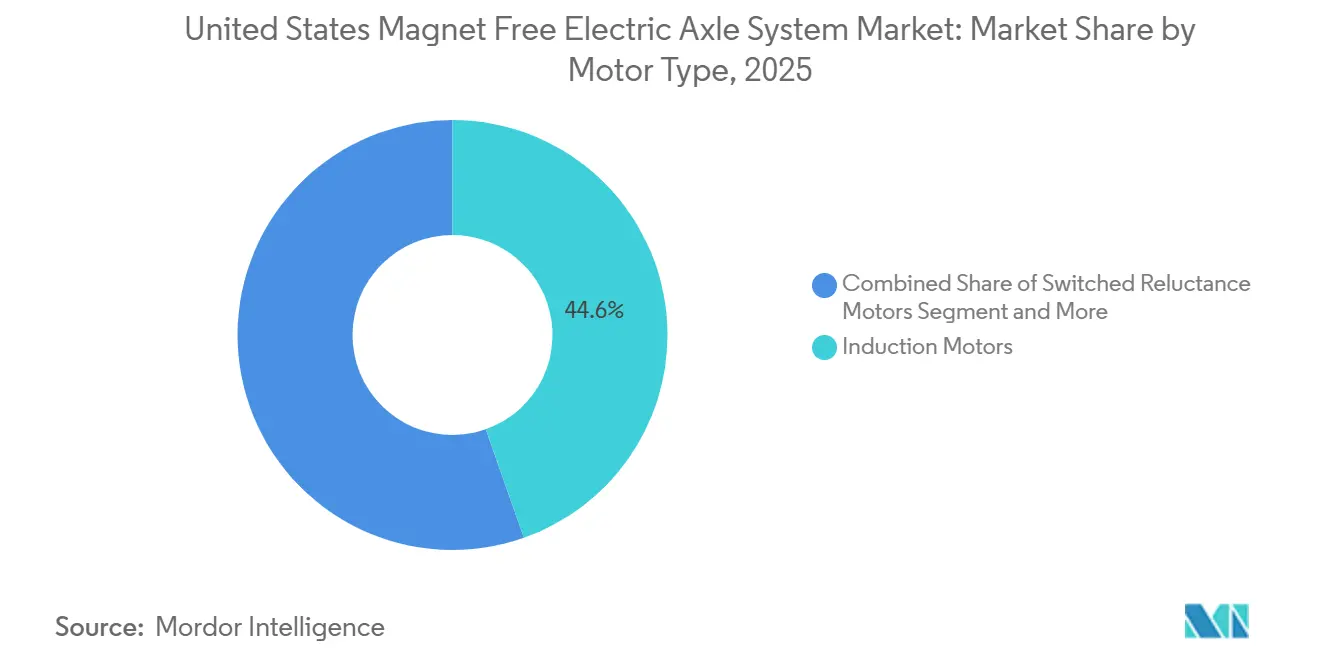
Induction motors accounted for 44.56% of the United States magnet free electric axle system market share in 2025, buoyed by Tesla’s front-axle strategy and BorgWarner’s 800-V integrated drive module slated for 2029 launch. Externally excited synchronous motors will expand at a 17.42% CAGR through 2031. Driven by Valeo-Mahle's systems and BMW's high-volume Steyr program, externally excited synchronous motors are set to grow significantly. While still a niche, switched reluctance motors offer substantial savings in bill-of-materials costs, making them appealing to cost-sensitive fleets.
Induction designs utilize mature casting techniques, boast robust thermal pathways, and notably contain no rare-earth materials. A teardown of Munro's Model Y unveiled machined copper rotors. These rotors enhance thermal conductivity but cost more than cast aluminum. Mahle's brushless excitation demonstrates that EESM can eliminate slip losses and adjust field current for optimal efficiency across varying speeds. Meanwhile, DOE-backed initiatives are targeting a reduction of SRM's torque ripple, a move that could broaden its market appeal from forklifts to mainstream EVs.



By Drive Type: Fully Electric Platforms Dominate
Fully electric drive systems held 61.28% of the United States magnet free electric axle system market in 2025 and will grow at a 19.07% CAGR through 2031 as battery costs fall and charging networks densify. Ford's Louisville platform, GM's Orion truck plant, and Rivian's R2 line are all prioritizing battery electric vehicles (BEVs). While plug-in hybrids still play a role, as seen with Allison's eGen Flex used in transit buses for their extended range, their demand for new e-axles is dwindling.
Federal clean-vehicle credits, along with additional state incentives like Michigan's union bonus, are tilting the total cost of ownership (TCO) in favor of BEVs. The added complexity of plug-in hybrids not only increases weight but also maintenance needs. Meanwhile, parallel hybrids aren't attracting new investments. Fleet operators are experiencing significantly lower service costs compared to diesel, further bolstering the shift towards BEVs.
By E-Axle Configuration: Integration Builds Momentum
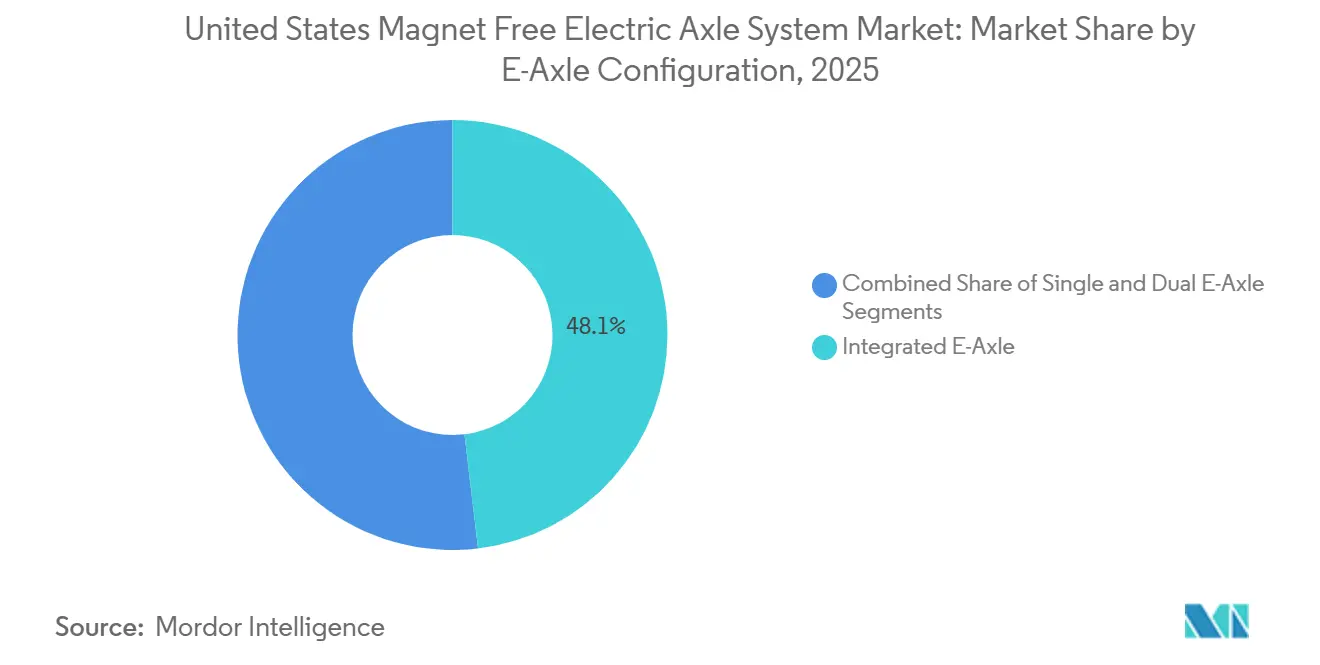
Integrated e-axles captured 48.13% share in 2025 and will post a 19.14% CAGR, reflecting packaging efficiency. ZF integrates SC-inverters, twin motors, and a three-speed gearbox into its AxTrax 2 Dual, achieving peak axle torque. Cummins' 14Xe simplifies chassis adoption by retaining legacy axle interfaces, while Bosch expands its eAxle offering, scaling across both 400-V and 800-V platforms.
By integrating housings, the need for external HV cabling diminishes, and the parts count decreases significantly, resulting in cost savings per unit. While single e-axles cater to front-drive compacts, dual units provide AWD torque vectoring, ideal for premium SUVs and pickups, albeit with added weight. Silicon-carbide inverters boost efficiency and support continuous output, all within traditional axle dimensions.
By Vehicle Type: Passenger Cars Lead, Commercial Vehicles Accelerate
Passenger cars dominated with a 76.21% share in 2025, yet commercial vehicles will grow at a 15.03% CAGR as EPA Phase 3 GHG limits push fleets to electrify. Allison's eGen Power delivers high power output and is used in refuse trucks. Meanwhile, Parker Hannifin's GVM310 is designed for Class 6-8 vehicles. Fleet Total Cost of Ownership (TCO) studies indicate significant maintenance savings. Additionally, Illinois' REV credits have successfully attracted Lion Electric's bus manufacturing plant.
Light commercial vans are now using single-axle, moderate-power units for last-mile deliveries. In contrast, medium trucks are opting for dual motors or multispeed systems to optimize performance on both grades and highways. Buses, on the other hand, favor three-speed integrated axles, such as ZF's AxTrax, to efficiently navigate stop-and-start routes. While passenger car sales growth is tapering off as market penetration approaches a notable level, commercial segments are emerging as the next significant volume opportunity.
Geography Analysis
Federal incentives are channeling investments into traditional auto hubs in Michigan, Ohio, South Carolina, and Illinois. In Michigan, a rebate complements the federal credit, allowing consumers to benefit significantly per battery electric vehicle (BEV). This financial boost is pivotal for Ford’s BlueOval Battery Park and GM’s Orion truck conversions. Meanwhile, Illinois’ REV legislation, offering payroll withholding credits and long-term utility tax relief, has successfully attracted Rivian’s supplier park and Lion Electric’s bus factory, creating numerous jobs.
South Carolina's strategic port proximity and right-to-work labor policies have incentivized ZF’s expansion of its e-axle facility in Gray Court. In Texas, MP Materials has established its Fort Worth Independence magnet plant, bolstered by state and local incentives. New York’s Lockport stator line is now catering to GM platforms throughout the Midwest, while imports of thin-gauge laminations from Mexico and Germany persist until U.S. precision-stamping capabilities are fully developed.
In Georgia, Tennessee, and Kentucky, burgeoning battery-cell gigafactories are enticing nearby e-axle assembly setups. This strategy not only curtails logistics costs but also ensures compliance with IRA's domestic-content mandates. These concerted state initiatives are reshaping supply chains domestically, marking a significant shift from a decade of component off-shoring.
Mordor Intelligence tracks the magnet free electric axle system market across other major regions such as Europe, with additional country-level coverage spanning China, Japan, India, and South Korea, each reflecting localized structural drivers, restraints and more.
Competitive Landscape
The market remains moderately fragmented, with the top suppliers—BorgWarner, ZF, Magna, Dana, and American Axle & Manufacturing—holding a significant share. Vertically integrated automakers, including Tesla, GM, and Ford, produce motors and inverters in-house. Meanwhile, emerging players like REE Automotive and Rockit Motors are targeting niche programs with their magnet free corner modules [3]“Corner Module Manufacturing Update 2026,”, REE Automotive, ree.auto. BorgWarner’s induction module, developed for an undisclosed North American OEM, indicates a broader industry shift towards magnet free solutions across various price bands. In a strategic move, Valeo acquired a stake in Siemens’ eAutomotive, bolstering its high-voltage expertise and clinching multiple platform wins.
Today's technological battleground features silicon-carbide inverter integration, three-speed transmissions tailored for heavy trucks, and cutting-edge thermal management. Suppliers are racing to align with stringent standards like ISO-26262 ASIL-D and IP6K9K. Collaborations are on the rise: Valeo and Mahle are teaming up on an EESM; Niron Magnetics is partnering with the Department of Energy on iron-nitride technology; and Dana is collaborating with the US Army to develop rare-earth-free drive sprockets.
Manufacturing scale is pivotal for cost advantages; ZF’s Gray Court line offers a cost edge over smaller competitors. Control over intellectual property is crucial, prompting giants like Tesla and GM to internalize power electronics. Additionally, retrofit kits for legacy trucks are emerging as a lucrative opportunity, enabling fleets to sidestep the expense of full vehicle replacements.
United States Magnet Free Electric Axle System Industry Leaders
-
BorgWarner Inc.
-
Dana Incorporated
-
American Axle & Manufacturing Holdings, Inc.
-
ZF Friedrichshafen AG
-
Magna International Inc.
- *Disclaimer: Major Players sorted in no particular order

Recent Industry Developments
- November 2025: BorgWarner, in collaboration with the Department of Energy's Oak Ridge National Laboratory (ORNL), announced its victory at the R&D 100 Awards for developing a rotary-transformer-based wireless excitation system tailored for electrically excited synchronous motors (EESM). This innovative technology is applicable to both passenger and commercial vehicles.
- October 2025: In a significant move, Niron Magnetics has teamed up with Stellantis to pioneer a new wave of electric motor designs for the automotive sector, utilizing magnets devoid of rare-earth elements. Niron's innovative Iron Nitride magnets, crafted from the readily available iron and atmospheric nitrogen, challenge the conventional reliance on rare-earth-based magnets. This shift not only taps into resources abundant in the U.S. and worldwide but also diminishes the industry's reliance on foreign-dominated supply chains.


United States Magnet Free Electric Axle System Market Report Scope
The United States magnet free electric axle system market report is segmented by motor type (externally excited synchronous motors, induction motors, and switched reluctance motors), drive type (fully electric drive, hybrid drive, and plug-in hybrid drive), e-axle configuration (single e-axle, dual e-axle, and integrated e-axle), and vehicle type (passenger cars and commercial vehicles). The market forecasts are provided in terms of value (USD).
| Externally Excited Synchronous Motors |
| Induction Motors |
| Switched Reluctance Motors |
| Fully Electric Drive |
| Hybrid Drive |
| Plug-in Hybrid Drive |
| Single E-Axle |
| Dual E-Axle |
| Integrated E-Axle |
| Passenger Cars | Hatchbacks |
| Sedans | |
| SUV and MUVs | |
| Commercial Vehicles | Light Commercial Vehicles |
| Medium and Heavy Commercial Vehicles | |
| Buses and Coaches |
| By Motor Type | Externally Excited Synchronous Motors | |
| Induction Motors | ||
| Switched Reluctance Motors | ||
| By Drive Type | Fully Electric Drive | |
| Hybrid Drive | ||
| Plug-in Hybrid Drive | ||
| By E-Axle Configuration | Single E-Axle | |
| Dual E-Axle | ||
| Integrated E-Axle | ||
| By Vehicle Type | Passenger Cars | Hatchbacks |
| Sedans | ||
| SUV and MUVs | ||
| Commercial Vehicles | Light Commercial Vehicles | |
| Medium and Heavy Commercial Vehicles | ||
| Buses and Coaches | ||


Key Questions Answered in the Report
What is the size and growth outlook for the U.S. magnet free electric axle market?
The market stood at USD 1.46 billion in 2026 and is projected to reach USD 2.90 billion by 2031, advancing at a 14.76% CAGR.
Which motor technology is expanding the fastest in magnet free e-axles?
Externally excited synchronous motors are forecast to grow at a 17.42% CAGR through 2031, the highest among all magnet-free motor types.
Which motor type leads sales today?
Induction motors hold 44.56% market share on the back of mature supply chains and low cost.
Why are OEMs moving away from rare-earth magnets?
Price volatility, export restrictions, and Section 45X credits make magnet-free designs more resilient and financially attractive.
Page last updated on:





