
Japan Magnet Free Electric Axle System Market Size and Share
Market Overview
| Study Period | 2019 - 2031 |
|---|---|
| Forecast Data Period | 2026 - 2031 |
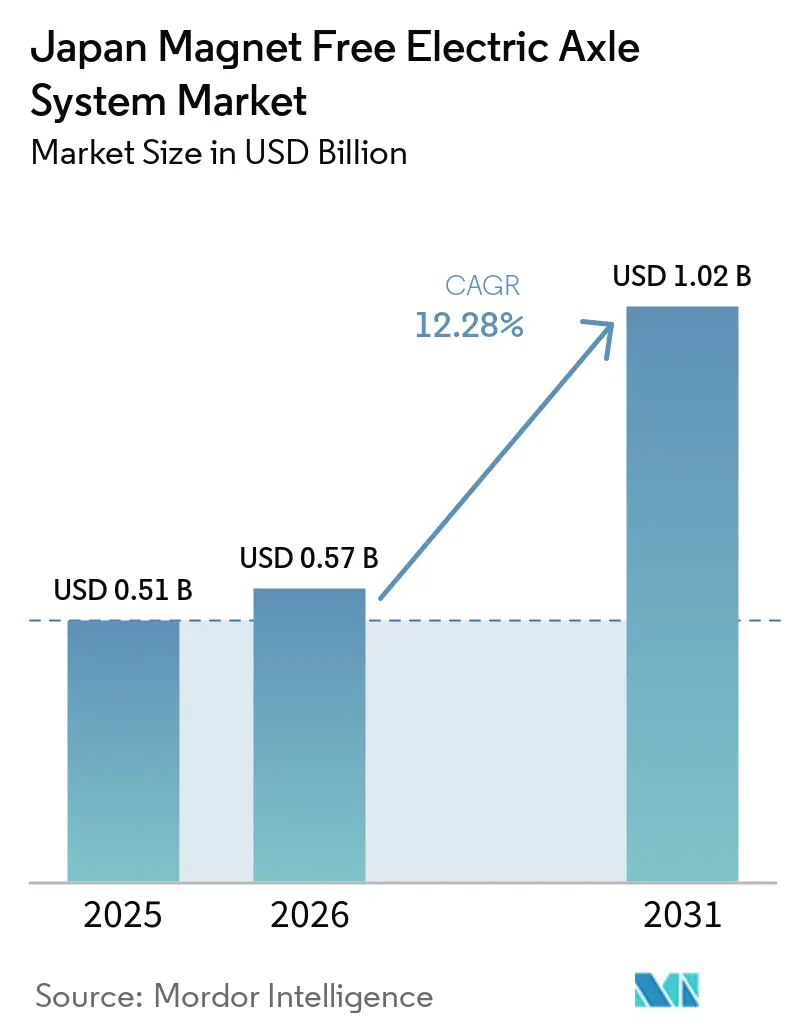
| Base Year Market Size (2025) | USD 0.51 Billion |
| Market Size (2026) | USD 0.57 Billion |
| Market Size (2031) | USD 1.02 Billion |
| Growth Rate (2026 - 2031) | 12.28 % |
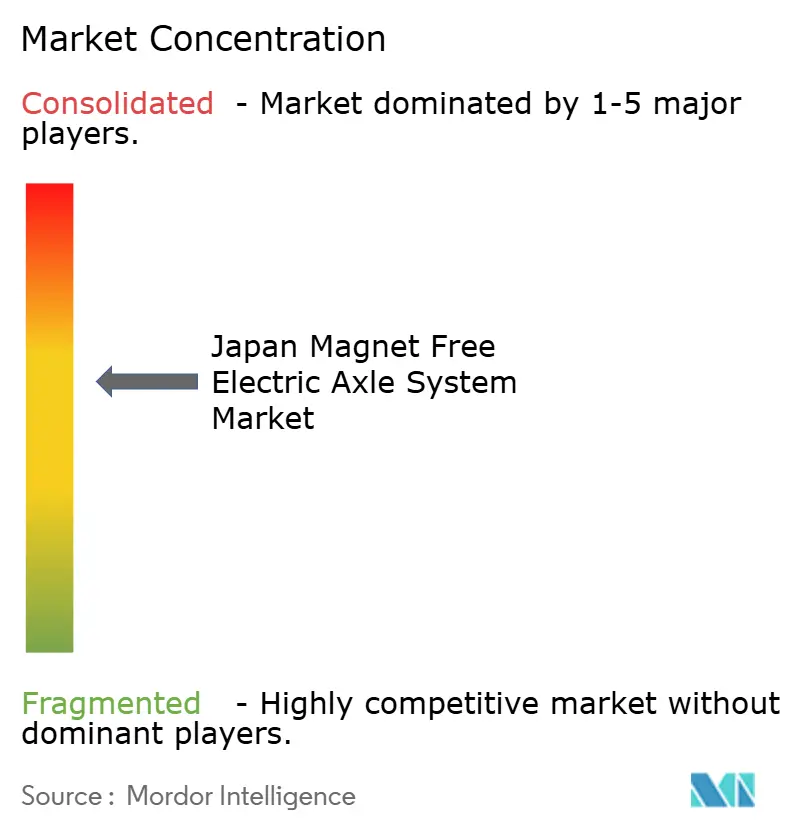
| Market Concentration | Medium |
Major Players *Disclaimer: Major Players sorted in no particular order Image © Mordor Intelligence. Reuse requires attribution under CC BY 4.0. | |
Japan Magnet Free Electric Axle System Market Analysis by Mordor Intelligence
The Japan Magnet Free Electric Axle System market size was valued at USD 0.51 billion in 2025, and is projected to grow from USD 0.57 billion in 2026 to USD 1.02 billion by 2031, registering a 12.28% CAGR between 2026 and 2031. Persistent concerns over rare-earth security, the wider roll-out of silicon-carbide (SiC) inverters, and revised national incentives that favor battery-electric drivetrains are jointly accelerating demand. OEM preference is shifting toward magnet-free motor topologies, chiefly externally excited synchronous motors (EESMs) and switched-reluctance motors (SRMs), as a hedge against price spikes in neodymium following China’s 2023 export-control measures. Magnet-free e-axles also complement Japan’s 800 V platform roadmap, as higher switching frequencies disproportionately benefit from SiC’s efficiency gains. In passenger cars, compact integrated e-axle modules reduce packaging volume by about 30% versus discrete motor-inverter layouts. In contrast, in commercial vehicles, the torque benefits of dual e-axle configurations support payload retention above 4,000 Nm.
Key Report Takeaways
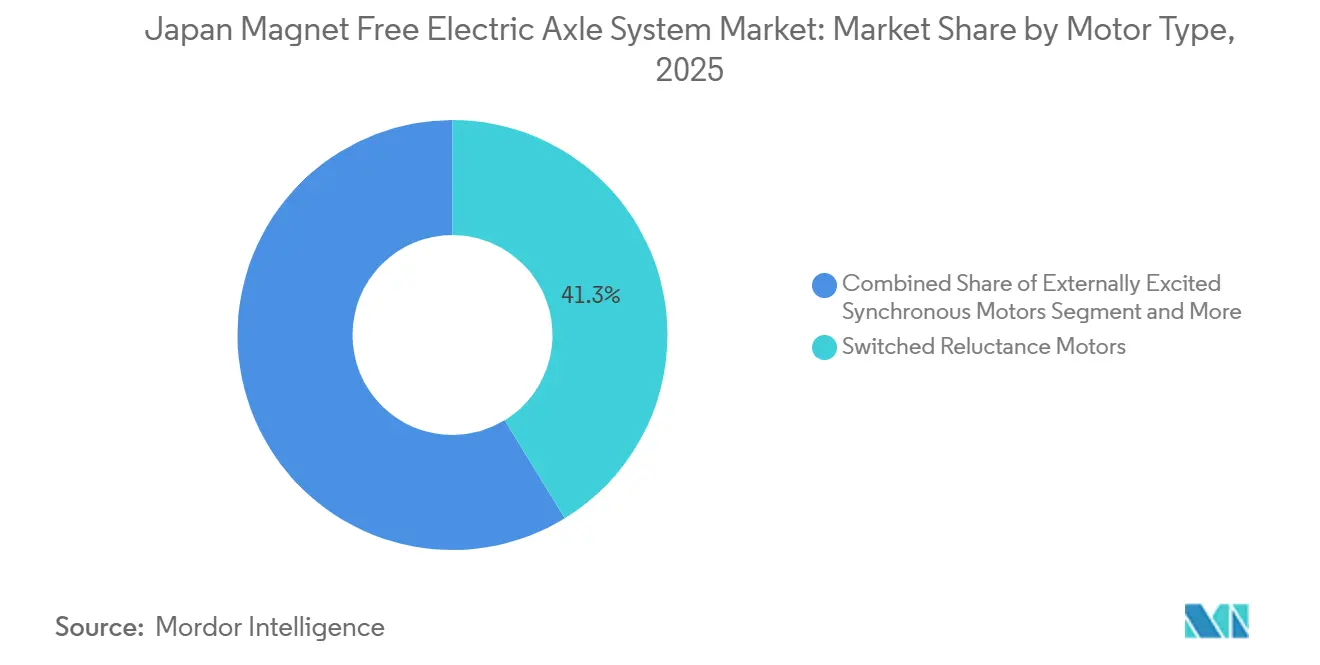
- By motor type, switched-reluctance motors led with 41.25% share in the Japan Magnet Free Electric Axle System market in 2025, while externally excited synchronous motors are forecasted to record the fastest CAGR at 13.55% through 2031.
- By drive type, fully electric drive accounted for 64.11% of the Japan Magnet Free Electric Axle System market share in 2025 and is set to grow at a 16.74% CAGR through 2031.
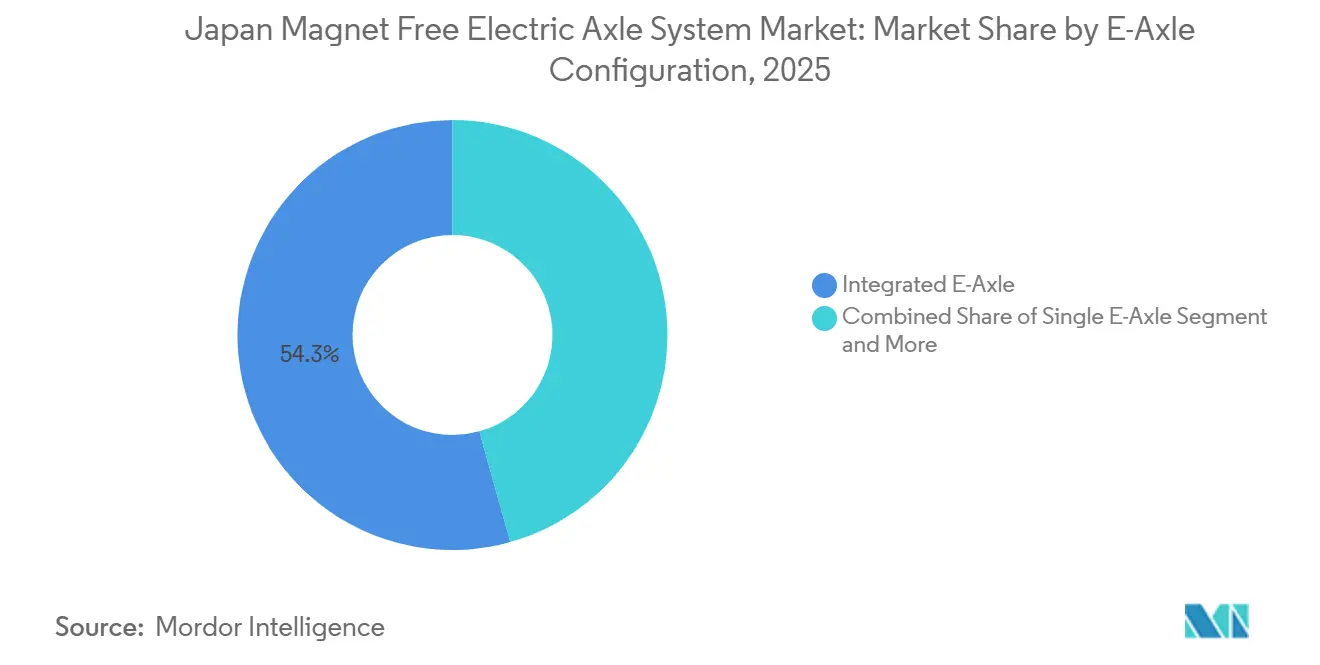
- By e-axle configuration, integrated e-axles accounted for 54.33% of the Japan Magnet Free Electric Axle System market share in 2025, while the dual e-axle setups are projected to grow at a 15.42% CAGR through 2031.
- By vehicle type, passenger cars accounted for 68.04% of the Japan Magnet Free Electric Axle System market share in 2025, while commercial vehicles are projected to post a 14.68% CAGR between 2026 and 2031.
Note: Market size and forecast figures in this report are generated using Mordor Intelligence’s proprietary estimation framework, updated with the latest available data and insights as of January 2026.
Japan contributes to a system defined not by any single country or region but by the interaction of many. The global magnet free electric axle system market data by Mordor Intelligence represents that combined structure.
Japan Magnet Free Electric Axle System Market Trends and Insights
Drivers Impact Analysis*
| Driver | (~) % Impact on CAGR Forecast | Geographic Relevance | Impact Timeline |
|---|---|---|---|
| Shift to Rare-Earth Risk Mitigation | +3.2% | National, spill-over to ASEAN supply chains | Medium term (2-4 years) |
| Incentives for 100% xEV Sales by 2035 | +2.8% | National, early gains in Tokyo, Aichi | Long term (≥ 4 years) |
| Integration Synergies with SiC Inverters | +2.5% | National, concentrated in OEM R&D hubs | Medium term (2-4 years) |
| Corporate-Average Fuel-Economy Tightening | +1.9% | National | Medium term (2-4 years) |
| Ramp-Up of Domestic SiC Capacity | +1.4% | National, manufacturing in Aichi, Fukuoka | Short term (≤ 2 years) |
| Weight-Saving Benefits vs. Architectures | +0.5% | National, premium segment focus | Long term (≥ 4 years) |
| Source: Mordor Intelligence | |||
OEM Shift to Rare-Earth Risk Mitigation After 2023 Nd Price Spike
In 2024, neodymium spot prices increased significantly due to China’s export licensing rules introduced in 2023. This development pressured OEM margins and prompted Japanese suppliers to accelerate the adoption of non-magnet architectures. Both BluE Nexus and Nidec have announced plans to launch magnet-free platforms starting in 2027. Schaeffler’s contactless-excited e-axle projects 8-12% cost savings above 150 kW, illustrating why OEMs are doubling down on alternative topologies [1]“EESM Technology Brief,” Schaeffler Group, schaeffler.com.
Government Incentives for 100% xEV Sales by 2035
The April 2026 subsidy revision raised battery-electric caps to JPY 1.3 million, boosting purchase affordability in metropolitan prefectures [2]“Clean Energy Vehicle Subsidy Revision 2026,” Ministry of Economy, Trade and Industry, meti.go.jp. Simultaneously, fuel-cell incentives were trimmed, realigning policy toward plug-in architectures. Higher grants, coupled with increased subsidies for fast chargers, strengthened program certainty for suppliers in the Japan Magnet Free Electric Axle System market.
Integration Synergies with SiC Inverters in 800 V Platforms
DENSO's REVOSIC SiC inverter, integrated into BluE Nexus e-axles, significantly reduces switching losses compared to traditional silicon IGBT units. This innovation improves real-world highway range. Additionally, while EESM and SRM motor controls typically require high-frequency switching, the low capacitance of SiC technology minimizes thermal budgets, enhancing the competitiveness of magnet-free systems.
Corporate-Average Fuel-Economy (CAFE) Tightening from 2028
Japan has established a fuel-efficiency target for 2030, replacing the older credit-flexibility system. The integration of magnet-free e-axles in hybrid vehicles plays a crucial role in helping manufacturers meet interim milestones while addressing challenges related to the volatility of rare-earth materials. This strategic approach allows OEMs to align with CAFE regulations without an immediate reliance on fully electric vehicle production, providing a balanced pathway toward long-term sustainability goals.
Restraints Impact Analysis*
| Restraint | (~) % Impact on CAGR Forecast | Geographic Relevance | Impact Timeline |
|---|---|---|---|
| Slow Charging-Station Roll-Out | -1.8% | National, acute in Hokkaido, Shikoku, Kyushu | Medium term (2-4 years) |
| Cost Premium vs. PM E-Axles | -1.5% | National | Short term (≤ 2 years) |
| Lack of Local Tier-2 Supply | -0.9% | National, supply gap in Kyushu, Tōhoku | Medium term (2-4 years) |
| NVH Levels vs. PM Motors | -0.6% | National, premium segment sensitivity | Long term (≥ 4 years) |
| Source: Mordor Intelligence | |||
Slow Charging-Station Roll-Out Outside Tōkai and Kantō Corridors
While Tokyo and Aichi benefit from a well-established network of fast chargers, rural areas continue to face significant infrastructure gaps. This disparity has created challenges for the adoption of Battery Electric Vehicles (BEVs), which in turn affects the demand for e-axle shipments. Although the Ministry of Land, Infrastructure, Transport and Tourism (MLIT) has increased subsidies for fast chargers in fiscal 2025, the economic feasibility of installing private chargers remains a barrier in regions such as Hokkaido, Shikoku, and Kyushu. The lack of sufficient charging infrastructure in these areas underscores the need for further policy and industry efforts to bridge the gap.
Higher Upfront Cost Premium Versus PM E-Axles Until Economies of Scale Achieved (Pre-2027)
EESM packages with lower power outputs continue to face a cost premium compared to other e-axle technologies. The inclusion of advanced excitation hardware and the limited production scale of certain electronic components largely drives this premium. However, initiatives under the Green Innovation Fund program are expected to gradually reduce this cost disparity over the coming years. By advancing technology and scaling production, the program aims to make these packages more competitive in the market, potentially narrowing the cost gap significantly by the end of the decade.
*Our forecasts treat driver/restraint impacts as directional, not additive. The impact forecasts reflect baseline growth, mix effects, and variable interactions.
Segment Analysis
By Motor Type: EESM Gains as Rare-Earth Hedging Accelerates
Switched reluctance motors (SRM) captured 41.25% of the Japan Magnet Free Electric Axle System market share in 2025, yet externally excited synchronous motors (EESM) are forecast for the quickest 13.55% CAGR as price parity with PM motors emerges above 120 kW. Below that threshold, the Japan Magnet Free Electric Axle System market size premium persists until SiC supply expansion drives inverter cost declines. Torque-dense 220-350 kW iBEE modules from Valeo-MAHLE are scheduled for 2027 series production, bringing premium-segment magnet-free options. Induction motors, although magnet-free, lag in power density and remain niche for high-power SUVs.
Integrating SRM with asymmetric converters significantly increases per-unit production costs. Over the years, advancements in EESM technology, particularly its contactless rotor excitation, have completely removed the dependency on magnets. This innovation has enabled field-weakening capabilities, expanded the constant-power speed range, and contributed to noticeable improvements in hybrid vehicle fuel efficiency.



By Drive Type: Fully Electric Platforms Leverage Subsidy Revisions
Fully electric drives accounted for 64.11% of the Japan magnet-free electric axle system market in 2025 and are expected to register a CAGR of 16.74% during the forecast period. Policy developments, including the incentive increase implemented in April 2026, and the growing availability of urban fast-charging infrastructure, support this growth. These factors are accelerating the adoption of fully electric vehicles, positioning them as a preferred option for consumers seeking sustainable and efficient transportation. The expanding charging network is particularly important in reducing range anxiety and further encouraging the transition to electric mobility.
Hybrid and plug-in hybrid variants continue to maintain their appeal, especially among cost-conscious buyers. These variants benefit from shared e-axle modules, which help manufacturers optimize development costs. Additionally, the use of EESM technology, with its adjustable excitation, offers a broader load profile than PM motors. This feature enables plug-in hybrid electric vehicles to meet evolving regulatory standards, such as the new CAFE thresholds, without increasing dependency on rare-earth materials. Such advancements highlight the ongoing innovation in the hybrid and plug-in hybrid segment, ensuring their relevance in the evolving automotive landscape.
By E-Axle Configuration: Integrated Designs Dominate Compact Segments
Integrated e-axles captured 54.33% of the Japan Magnet Free Electric Axle System market share in 2025, largely due to their ability to save space in passenger cars. These systems are becoming increasingly popular as automakers prioritize compact and efficient designs to meet evolving consumer preferences. Their integration into vehicles not only optimizes space but also enhances overall performance, making them a preferred choice for manufacturers aiming to stay competitive in the market.
Dual e-axles will rise fastest at 15.42% CAGR, particularly among heavy-duty fleets. The adoption of twin units is driven by the need for advanced torque-vectoring capabilities that improve vehicle handling and efficiency. Additionally, single-axle retrofits are emerging as a practical solution for delivery trucks, offering a cost-effective approach to electrification. This trend is particularly relevant in regions like Japan, where light-duty fleets are substantial, and there is a growing demand for economical and sustainable electrification solutions.
By Vehicle Type: Commercial Fleets Accelerate Electrification
Passenger cars accounted for 68.04% of the Japan Magnet Free Electric Axle System market share in 2025, yet the commercial category will grow more quickly at a 14.68% CAGR. This growth is supported by advancements in heavy-truck programs, including those introduced by leading manufacturers. These programs are driving innovation and adoption in the commercial fleet sector, particularly as companies prioritize sustainability and efficiency in their operations.
Fuel-cell trucks continue to rely on e-axle architectures, which play a crucial role in the development of both battery and hydrogen-powered vehicles. This reliance ensures that suppliers specializing in magnet-free solutions remain integral to the evolving landscape of electrification. As the industry progresses, the commercial vehicle segment is expected to significantly contribute to the broader adoption of electric and hydrogen technologies, shaping the future of transportation.
Geography Analysis
Aichi and the broader Tōkai corridor lead in manufacturing scale, R&D investments, and test-track access. They accounted for a significant portion of the magnet-free e-axle output in 2025 and dominated the Japan Magnet-Free Electric Axle System Market. In Toyota City, BluE Nexus operates integration lines, while DENSO focuses on SiC inverter assembly in the nearby cities of Anjō and Kariya. This concentration offers the region unmatched vertical integration benefits.
The Kantō prefectures—Tokyo, Kanagawa, and Saitama—boast the densest public fast-charging grid, elevating urban adoption rates well above the national average. The proximity of R&D centers to charging clusters accelerates validation cycles for 800 V architectures. Consequently, the Tōkai-Kantō region collectively secured a dominant market share for Japan's Magnet-Free Electric Axle System in 2025.
Hokkaido, Shikoku, and Kyushu lag behind metropolitan areas in charger density, increasing BEV trip-planning time. Although fiscal 2025 subsidies for chargers rated at 150 kW or higher are increasing, private operators continue to prioritize the higher-utilization Tōmei and Meishin expressways. This gap encourages regional fleets to adopt fuel-cell trucks, such as Hino’s Profia Z, which enable rapid refueling regardless of charger availability. E-axle suppliers are therefore offering compact integrated modules for urban centers and high-torque dual units for rural logistics.
Policy is also widening the technological divide between northern and southern Japan. The Green Innovation Fund supports silicon carbide (SiC) wafer production in Fukuoka and Kumamoto, while METI has designated Fukushima, Hyogo, and Fukuoka as hydrogen “priority regions.” The initiative targets substantial deployment of commercial hydrogen refueling stations by 2030, supporting fuel-cell e-axle demand where BEV fast charging remains limited. Magnet-free suppliers can benefit from Kyushu’s lower labor costs and Tōkai’s design ecosystem, with this dual-hub strategy projected to increase national production to significant annual levels by 2028.
The magnet free electric axle system market is analyzed by Mordor Intelligence across multiple other geographies, with in-depth regional assessments available for Europe. This is complemented by country-specific insights for South Korea, China, India, and United States, reflecting various localized market behavior and policy environments' coverage.
Competitive Landscape
BluE Nexus leads current awards by integrating SiC inverters, motors, and transaxles into the Toyota bZ4X, Subaru Solterra, Lexus RZ, Suzuki e-VITARA, and Isuzu D-MAX EV, thereby controlling the largest share of the Japan Magnet Free Electric Axle System market in the 150-170 kW class. Its proximity to Toyota’s Motomachi plant enables it to validate hardware in shorter design cycles, compressing time-to-market by about 15% compared with stand-alone tier-1 rivals.
Nidec aims to capture a significant share of the global e-axle market by 2030. In 2028, it plans to launch a magnet-free Gen 4 platform, offering notable improvements in torque density and noise reduction compared to its Gen 2 model. Schaeffler's portfolio is already competitively positioned for SUV and light-truck programs, particularly if rare-earth prices remain unstable. In 2024, Valeo and MAHLE validated their iBEE prototype. Their collaboration combines MAHLE's contactless transmitter with Valeo's inverter stack, achieving a significantly lower carbon footprint than permanent-magnet motors. Meanwhile, BorgWarner secured awards for its induction-motor iDM, which is designed to appeal to OEMs prioritizing full magnet elimination for premium pickups and SUVs.
Opportunities exist in retrofitting and addressing gaps in the tier-2 semiconductor market. Companies like Yamato Mobility, IAT, and SBS have demonstrated demand for drop-in e-axle kits, offering a cost-effective alternative to new vehicles. However, domestic suppliers still rely on imports for key components used in switched-reluctance motors, thereby extending lead times. Kyushu's new SiC fabs, expected to be operational by 2027, could localize this electronics chain, enabling tighter cost control and improved supply security. As cost and component disparities narrow, competitive intensity is expected to increase, potentially impacting gross margins for the leading players.
Japan Magnet Free Electric Axle System Industry Leaders
Nidec Corporation
ZF Friedrichshafen AG
BorgWarner Inc.
Dana Inc.
GKN Automotive
- *Disclaimer: Major Players sorted in no particular order

Recent Industry Developments
- October 2025: Astemo unveiled a rare-earth-free, oil-cooled motor for next-generation software-defined vehicles at the Japan Mobility Show 2025.
- September 2025: Nidec showcased a high-performance, magnet-free e-axle ready for mass production at the Techno-Frontier motor expo in Tokyo.
- December 2024: MAHLE and Valeo completed prototype validation of the iBEE 220–350 kW magnet-free electric axle system, targeting a 50% reduction in lifecycle CO₂ emissions.
- October 2024: Valeo and MAHLE signed a joint development agreement to commercialize iBEE, combining MAHLE’s contactless transmitter technology with Valeo’s inverter expertise.


Japan Magnet Free Electric Axle System Market Report Scope
The scope includes segmentation by motor type (externally excited synchronous motors, induction motors, and switched reluctance motors), drive type (fully electric drive, hybrid drive, and plug-in hybrid drive), e-axle configuration (single e-axle, dual e-axle, and integrated e-axle), and vehicle type (passenger cars [hatchbacks, sedans, and SUVs and MUVs], and commercial vehicles [light commercial vehicles, medium and heavy commercial vehicles, and buses and coaches]). Market size and growth forecasts are presented in USD by value.
| Externally Excited Synchronous Motors (EESM) |
| Induction Motors |
| Switched Reluctance Motors |
| Fully Electric Drive |
| Hybrid Drive |
| Plug-in Hybrid Drive |
| Single E-Axle |
| Dual E-Axle |
| Integrated E-Axle |
| Passenger Cars | Hatchbacks |
| Sedans | |
| Sport Utility Vehicles (SUVs) | |
| Multi-Purpose Vehicles (MPVs) | |
| Commercial Vehicles | Light Commercial Vehicles |
| Medium and Heavy Commercial Vehicles | |
| Buses and Coaches |
| By Motor Type | Externally Excited Synchronous Motors (EESM) | |
| Induction Motors | ||
| Switched Reluctance Motors | ||
| By Drive Type | Fully Electric Drive | |
| Hybrid Drive | ||
| Plug-in Hybrid Drive | ||
| By E-Axle Configuration | Single E-Axle | |
| Dual E-Axle | ||
| Integrated E-Axle | ||
| By Vehicle Type | Passenger Cars | Hatchbacks |
| Sedans | ||
| Sport Utility Vehicles (SUVs) | ||
| Multi-Purpose Vehicles (MPVs) | ||
| Commercial Vehicles | Light Commercial Vehicles | |
| Medium and Heavy Commercial Vehicles | ||
| Buses and Coaches | ||


Key Questions Answered in the Report
What is the current market size and growth rate of the Japan magnet-free electric axle system market?
The Japan Magnet Free Electric Axle System market size was valued at USD 0.51 billion in 2025, and is projected to grow from USD 0.57 billion in 2026 to USD 1.02 billion by 2031, registering a 12.28% CAGR between 2026 and 2031.
Which motor technology will expand the quickest through 2031?
Externally excited synchronous motors (EESM) are expected to log the fastest 13.55% CAGR as OEMs seek rare-earth-free designs that still deliver high power density.
Why are commercial-vehicle fleets adopting magnet-free e-axles faster than passenger cars?
Fleet operators value lower lifetime fuel costs and easier CAFE compliance; programs such as Hino’s Profia Z fuel-cell truck and Isuzu’s D-MAX EV showcase dual e-axle layouts that meet heavy-duty torque needs while avoiding rare-earth exposure.
How will SiC inverters affect cost parity with permanent-magnet units?
Domestic 300 mm SiC wafer lines backed by the Green Innovation Fund are forecast to shave 25–30% off inverter costs by 2027, narrowing the total system premium for magnet-free e-axles to under 10% by 2028.
Page last updated on:





