
China Magnet Free Electric Axle System Market Size and Share
Market Overview
| Study Period | 2019 - 2031 |
|---|---|
| Forecast Data Period | 2026 - 2031 |
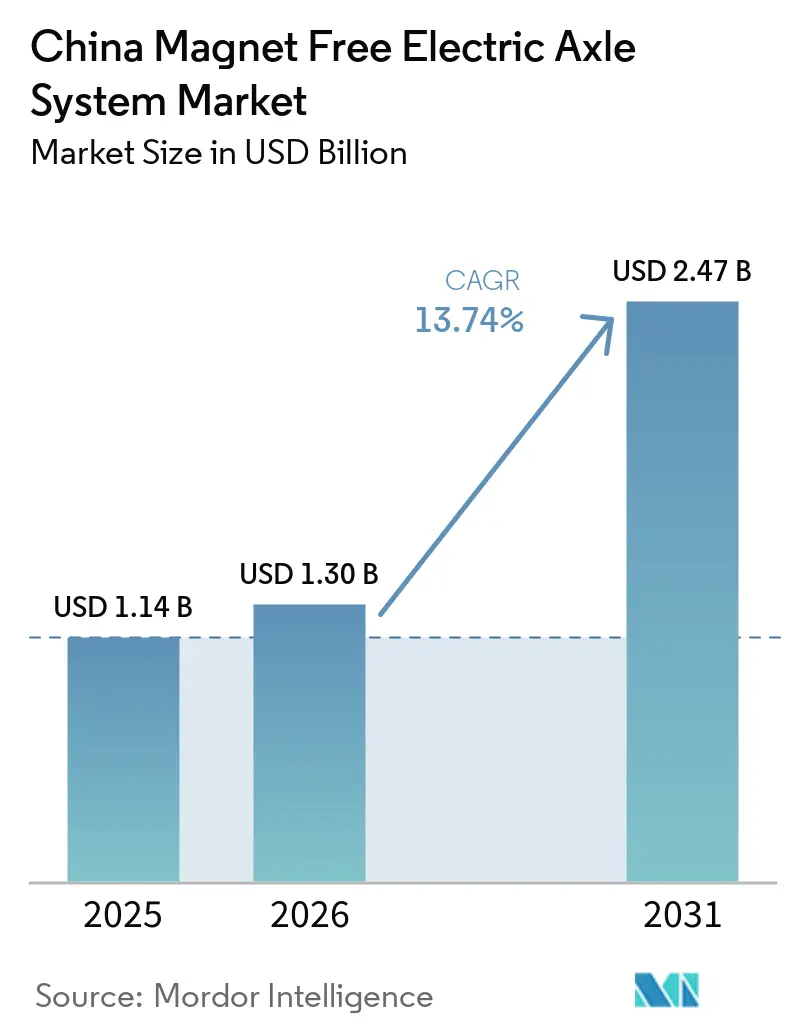
| Base Year Market Size (2025) | USD 1.14 Billion |
| Market Size (2026) | USD 1.30 Billion |
| Market Size (2031) | USD 2.47 Billion |
| Growth Rate (2026 - 2031) | 13.74 % |
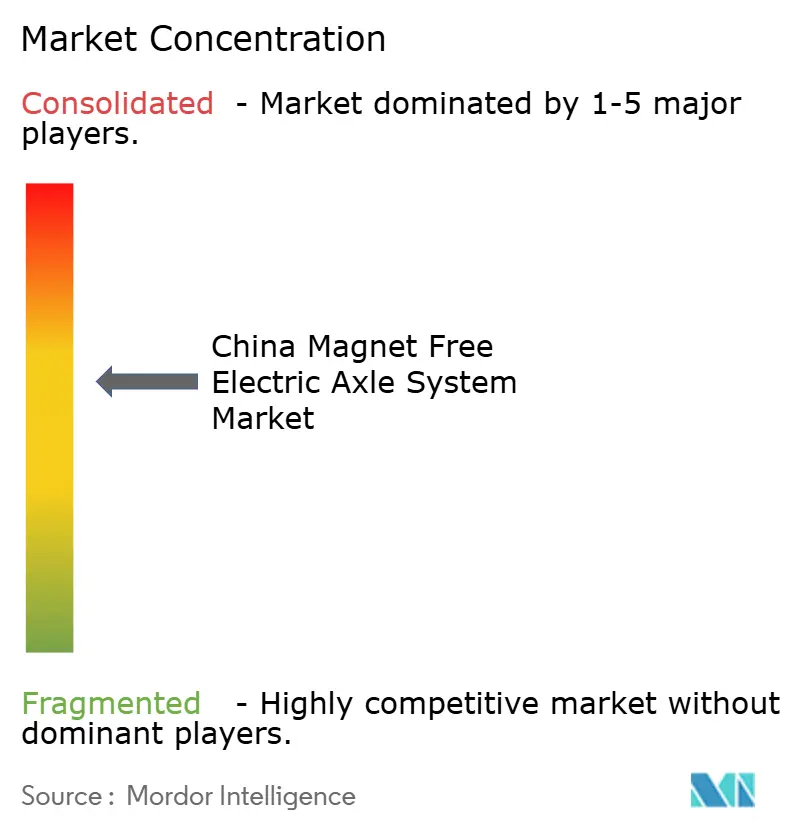
| Market Concentration | Medium |
Major Players
*Disclaimer: Major Players sorted in no particular order Image © Mordor Intelligence. Reuse requires attribution under CC BY 4.0. |
|
China Magnet Free Electric Axle System Market Analysis by Mordor Intelligence
The China magnet free electric axle system market size was valued at USD 1.14 billion in 2025 and is estimated at USD 1.30 billion in 2026, and is projected to reach USD 2.47 billion by 2031, growing at a CAGR of 13.74% from 2026 to 2031. Demand rises as policymakers push automakers to decouple from rare-earth inputs, a shift amplified by the 105% jump in neodymium-praseodymium oxide prices between January and April 2026. Supply-chain sovereignty now shapes drivetrain selection more than peak torque density, prompting original-equipment manufacturers (OEMs) to favor induction, switched-reluctance (SR), and externally excited synchronous motors. Silicon-carbide (SiC) inverter availability is improving after Tiancheng Semiconductor’s 14-inch wafer breakthrough, trimming cost barriers and letting SR control algorithms run at higher switching frequencies. Integrated e-axle designs that combine motor, inverter, and gearbox inside a shared housing are gaining traction because they shrink assembly time, ease thermal budgeting on 800-volt platforms, and help automakers meet mandatory carbon-footprint disclosures
Key Report Takeaways
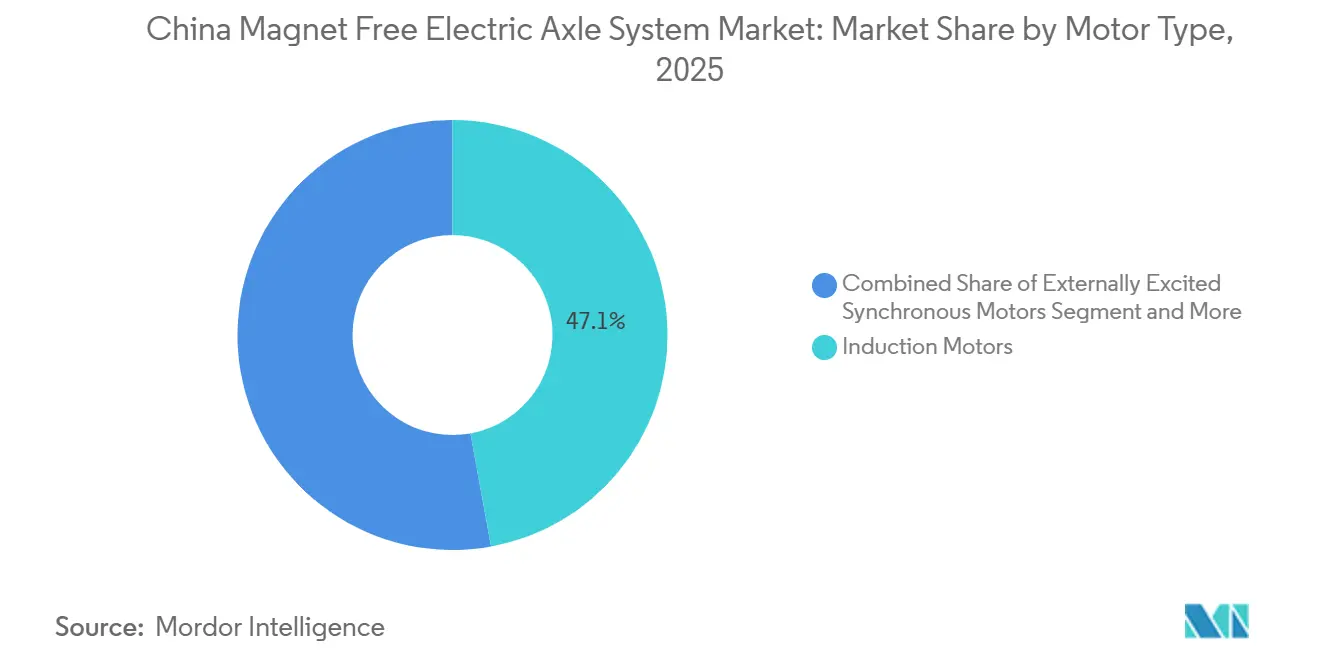
- By motor type, induction motors led with 47.13% of China Magnet Free Electric Axle System market share in 2025, while switched-reluctance motors are projected to expand at the fastest 15.17% CAGR through 2031.
- By drive type, fully electric configurations accounted for 64.22% of the China Magnet Free Electric Axle System market size in 2025 and are forecast to grow at a 16.78% CAGR to 2031.
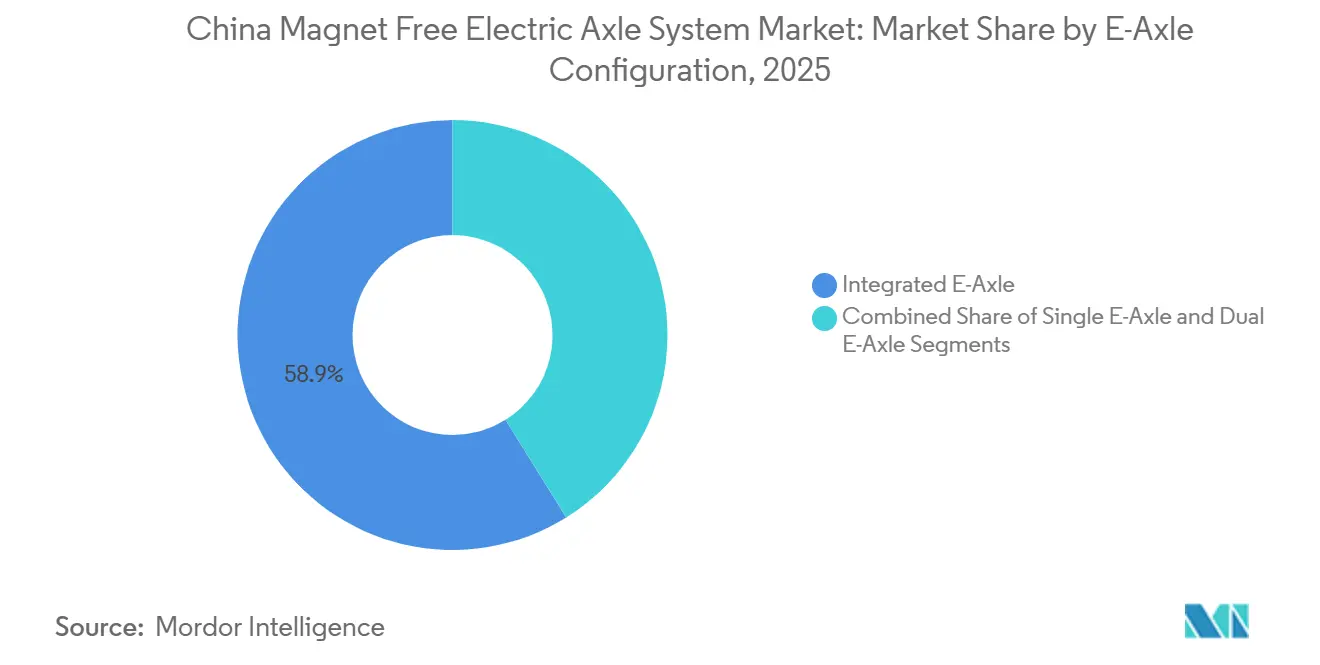
- By e-axle configuration, integrated systems captured 58.87% revenue share in 2025 and are advancing at a 14.67% CAGR through 2031.
- By vehicle type, passenger cars held 73.46% share in 2025, while commercial vehicles recorded the highest 16.42% CAGR to 2031.
Note: Market size and forecast figures in this report are generated using Mordor Intelligence’s proprietary estimation framework, updated with the latest available data and insights as of January 2026.
Worldwide, activity is shaped by contributions from multiple countries and regions, with China representing one among them. The global report on magnet free electric axle system market by Mordor Intelligence reflects how these countries and regional layers combine into a single system.
China Magnet Free Electric Axle System Market Trends and Insights
Drivers Impact Analysis*
| Driver | (~) % Impact on CAGR Forecast | Geographic Relevance | Impact Timeline |
|---|---|---|---|
| NEV Mandates and Local-Content Rules | +3.2% | National, provincial implementation | Medium term (2–4 years) |
| Rare-Earth Price Volatility Driving Magnet-Free Shift | +2.8% | National | Short term (≤ 2 years) |
| SR and EESM Control Algorithm Advances | +2.4% | China manufacturing | Short term (≤ 2 years) |
| Lower Ownership Cost Than PM E-Axles | +2.1% | Core markets, tier-2 expansion | Medium term (2–4 years) |
| Carbon-Footprint Reporting for Tier-1s | +1.9% | National, multinational chains | Long term (≥ 4 years) |
| Domestic SiC Chip Breakthroughs | +1.8% | National, export potential | Medium term (2–4 years) |
| Source: Mordor Intelligence | |||
Government NEV Mandates and Local-Content Rules
Beijing will raise the minimum electric range for plug-in hybrids, significantly increasing the requirement[1]“NEV Industry Development Plan (2021–2035),”, Ministry of Industry and Information Technology, miit.gov.cn. Under the revised dual-credit framework, permanent-magnet motors without domestic traceability will receive zero credits. This adjustment directs OEM investments towards induction and externally excited synchronous systems. Additionally, purchase-tax exemptions are now contingent on achieving a higher battery energy density. This benchmark becomes more attainable when utilizing a lighter, magnet-free motor rotor. Recent export licensing restrictions on overseas shipments of permanent-magnet drive units are encouraging foreign joint ventures to shift towards locally sourced induction modules. Collectively, these regulations establish a protective policy framework that accelerates the localization of magnet-free supply chains and motivates automakers to redesign their drivetrains efficiently.
Rare-earth Price Volatility Accelerates OEM Shift to Magnet-Free Motors
Neodymium-praseodymium oxide prices experienced a significant surge, driven primarily by disruptions in the Strait of Hormuz and the enforcement of stricter export quotas. In response, BYD is adjusting its strategy by increasing production of its induction motor while also advancing research and development on variable-flux permanent-magnet synchronous designs. By eliminating neodymium from their induction systems, OEMs can secure stable long-term pricing. This approach aligns with fleet operators' priorities for maintaining a consistent total cost of ownership (TCO). Urban logistics companies, deploying large numbers of vans annually, are now prioritizing cost stability over minor efficiency improvements. Consequently, they are rapidly transitioning to magnet-free e-axles. The growing demand is driving volume economies, reducing per-unit costs, and further reinforcing the shift away from magnets.
Breakthroughs in Control Algorithms for SR and EESM Motors
Chinese institutes introduced sensorless field-oriented control and model-predictive control techniques, significantly reducing torque ripple in switched reluctance motors. Externally excited synchronous motors achieved real-time field-current modulation, aligning their performance with permanent-magnet torque density across a broader speed range. ZF’s modular e-axle platform features software enabling OEMs to seamlessly switch between asynchronous and synchronous topologies without modifying gearsets. This innovation transforms motor selection into a supply-chain decision, sidelining its role as a performance differentiator. Furthermore, advancements in algorithms have shortened development lead times, allowing medium-sized OEMs to easily qualify multiple motor suppliers. This surge in competition has begun to erode the market share of established incumbents.
Lower Total Cost of Ownership vs. PM E-axles
Fleet operators, tracking costs over multi-year cycles, find that induction drivetrains reduce total cost of ownership (TCO) by a significant margin compared to their permanent-magnet counterparts. These operators avoid the price instability of rare-earth metals, which fluctuate considerably more than copper or electrical steel. With simpler rotors, maintenance requirements have decreased: induction buses now require motor overhauls less frequently than those using permanent magnets. Previously estimated energy-use penalties have narrowed significantly, thanks to SiC inverters achieving higher switching frequencies. Analysis of large bus fleets reveals energy consumption levels that are only slightly higher than the permanent-magnet benchmark, highlighting the economic feasibility of magnet-free systems even under the challenging conditions of dense urban stop-and-go traffic.
Restraints Impact Analysis*
| Restraint | (~) % Impact on CAGR Forecast | Geographic Relevance | Impact Timeline |
|---|---|---|---|
| High Inverter Cost at High Frequencies | -2.1% | National, cost-sensitive segments | Medium term (2–4 years) |
| NVH and Torque-Density Gap | -1.8% | Acute in premium segments | Short term (≤ 2 years) |
| Complex Thermal Management for E-Axles | -1.6% | Manufacturing hubs | Medium term (2–4 years) |
| No Unified Motor Insulation Standards >800 V | -1.2% | National, regulatory uncertainty | Long term (≥ 4 years) |
| Source: Mordor Intelligence | |||
Higher Inverter Cost for High-Frequency Operation
SR machines are increasingly turning to SiC MOSFETs, which come at a higher cost than traditional silicon IGBTs. This price increase erodes the bill-of-materials edge that permanent-magnet motors once enjoyed in city cars priced at the lower end of the market. While Tiancheng's larger wafers hold the promise of cost reductions, it's important to highlight that commercial yields are still trailing. Induction motors, while capable of efficient operation with cheaper silicon, experience a slight efficiency dip. As a result, a temporary pricing window has emerged. During this timeframe, premium car manufacturers are likely to stick with magnets, avoiding the extra costs tied to inverters.
NVH and Torque-Density Gap with PM Motors
Even after algorithmic smoothing, SR Motors' cabin noise levels remain higher than those of their permanent-magnet counterparts. Induction units lag in torque density, resulting in housings that are significantly heavier for the same output. BYD's induction unit achieves competitive acceleration using advanced flat-wire windings and direct oil cooling. However, it is noticeably heavier compared to a similar permanent-magnet system. Premium sedans, gauging customer satisfaction on cabin quietness, are reluctant to shift from magnetic to electric. They're waiting for either a reduction in noise-cancellation costs or for algorithmic advancements to bridge the gap.
*Our forecasts treat driver/restraint impacts as directional, not additive. The impact forecasts reflect baseline growth, mix effects, and variable interactions.
Segment Analysis
By Motor Type: Induction Motors Anchor Share as Switched-Reluctance Gains Traction
The China magnet free electric axle system market size for induction motor-type adoption reached equal to 47.13% share. SR designs expand at 15.17% CAGR through 2031, supported by nation-funded research that halves torque ripple. Due to established coil-winding plants and seamless software portability, OEMs continue to place their trust in induction. ZF's e-axle empowers automakers to switch between asynchronous and synchronous variants without altering the gearbox, serving as a safeguard against fluctuations in rare-earth prices.
Breakthroughs in control algorithms are steering SR motors closer to passenger car suitability. With algorithm intellectual property emerging as the pivotal differentiator over rotor hardware, suppliers are now bundling firmware licenses with their hardware deliveries. Externally excited synchronous motors are finding their place in heavy trucks and luxury tour buses, where extended maintenance intervals make slip-ring maintenance a viable option. As SR and induction choices evolve, procurement teams are now factoring in spot neodymium prices before finalizing orders, leading to a more dynamic mix of motor types over time.



By Drive Type: Full-Electric Dominance Underpins Volume Growth
Fully electric drive captured 64.22% of the China magnet free electric axle system market share in 2025. The segment rises at a 16.78% CAGR due to range parity with early plug-in hybrids and a rapid rollout of chargers. MIIT’s 100-km electric-only requirement erases the earlier cost edge of hybrids, which must now carry near-BEV battery packs yet still include internal-combustion engines.
Plug-in hybrids drift toward a niche role as range extenders for buses running along sparse highway charging corridors. Pure battery-electric simplifies e-axle software because there's no torque blending with engines, allowing SR motors to run in optimal zones. BYD sales data show BEVs topping PHEVs since April 2025, echoing the broader market tilt. Hybrids remain relevant for rural customers, but urban fleets and private buyers outside remote areas go straight to pure-electric powertrains.
By E-Axle Configuration: Integrated Systems Shrink Mass and Cost
Integrated e-axles represented 58.87% of the China magnet free electric axle system market size in 2025. They grew at a 14.67% CAGR as suppliers cram motors, inverters, and gearboxes into shared casings. Cost-sensitive compacts predominantly utilize single-axle units. However, as battery prices decrease, dual-axle designs are increasingly appearing in mainstream crossovers. Schaeffler’s EMR4 drive achieves impressive inverter efficiency, prompting automakers to embrace a slightly heavier cooling system to streamline assembly.
While integrated housings bear the brunt of thermal stress, adopting advanced systems that reduce current significantly mitigates copper losses. ZF’s innovative hairpin windings, paired with advanced silicon carbide technology, achieve remarkable continuous power output without any derating. Even as low-cost hatchbacks prioritize discrete layouts to save weight, the industry trend leans towards integration, with a projected default status in the near future.
By Vehicle Type: Commercial Fleets Accelerate Adoption Curve
Passenger cars delivered 73.46% of 2025 shipments. Commercial vehicles, however, posted a 16.42% CAGR; passenger volume growth lagged behind slightly. Light vans, prioritizing uptime and low maintenance, find the simpler rotors of induction motors appealing. Shenzhen’s fully electrified bus fleet showcases that magnet-free drivetrains perform efficiently in stop-start traffic, with only a marginal difference compared to their permanent-magnet counterparts.
Coaches and heavy trucks, operating on steady-state routes where torque density is less critical, are increasingly adopting externally excited synchronous or SR setups. In Tier-2 cities, where local air-quality goals take precedence but public-charging coverage is sparse, provincial subsidies are hastening the adoption. Premium-trim SUVs are venturing into dual e-axle AWD, whereas mid-tier crossovers are opting for single integrated units to maintain competitive sticker prices.
Geography Analysis
Tesla marked a significant achievement by rolling out its milestone integrated drive in Shanghai, a city where an impressive majority of its parts are sourced locally. Meanwhile, the Pearl River Delta buzzes with activity as BYD's induction-motor lines collaborate closely with nearby inverter PCB subcontractors, facilitating rapid engineering adjustments. In Jiangsu and Fujian provinces, the thriving production of SiC wafers caters to inverter manufacturers serving both passenger and commercial vehicles.
In a move to assert tighter control, Tier-1 cities have enacted stricter credit penalties on magnet imports. This decision has accelerated the adoption of induction technology in city taxis, ride-hailing services, and delivery vans. While Tier-2 and Tier-3 cities might lack a dense network of chargers, they're at the forefront of bus electrification, choosing induction drivetrains to avoid rare-earth material issues. Shenyang, nestled in the northeastern corridor, is witnessing a boost in market share, thanks to ZF's substantial investment in a new e-mobility plant serving both domestic OEMs and joint ventures.
Chongqing, located in the western regions, is emerging as a hub for second-tier suppliers, attracted by lower labor costs and appealing provincial tax holidays. Here, light commercial vehicles traverse challenging mountainous roads to deliver parcels. The resilience of induction motors against demagnetization proves crucial in these terrains. This strategic east-to-west supply chain division not only protects the market from regional disruptions but also guarantees major customers receive their logistics within a tight timeframe.
Mordor Intelligence provides coverage of the magnet free electric axle system market across other key regional markets, including Europe, each with their regulatory frameworks and demand patterns. Detailed country-level analysis extends to India, South Korea, Japan, and United States incorporating local coverage and market participation, as required.
Competitive Landscape
In a landscape marked by moderate concentration, key players like BYD, Tesla Shanghai, Nidec, and ZF command a significant combined share. Meanwhile, a host of regional firms, including SinoHytec and Shuanglin, cater to province-level bus tenders. BYD's strategy involves vertical integration of its battery, motor, and inverter lines. This approach not only fortifies its position against rare-earth risks but also allows flexibility between induction and variable-flux PM motors. Tesla, on the other hand, capitalizes on extensive local sourcing. This strategy not only cushions the impact of tariff fluctuations but also ensures the rapid delivery of drive units, often within a short timeframe of order placement.
ZF has introduced a modular architecture capable of accommodating both synchronous and asynchronous rotors. This innovation helps ZF navigate potential policy disruptions related to magnet traceability[2]"The basis of the SELECT platform", ZF AG, zf.com. In a strategic move, Schaeffler's merger with Vitesco consolidates expertise in motors, gearboxes, and power electronics. This alignment not only echoes BYD's holistic system-level strategy but also underscores a pivotal industry insight: the real profit potential lies in comprehensive e-axle solutions rather than isolated components.
Meanwhile, emerging players like San’an Optoelectronics are making strides by integrating forward into inverter modules, posing a challenge to established profit margins. As the industry evolves, expertise in control algorithms emerges as a critical differentiator. Suppliers that secure licenses for predictive control codes stand to gain significantly, reaping long-term royalties even as the hardware aspect becomes increasingly commoditized.
China Magnet Free Electric Axle System Industry Leaders
-
ZF Friedrichshafen AG
-
Nidec Corporation
-
BYD Co. Ltd.
-
Magna International
-
Meritor (Cummins)
- *Disclaimer: Major Players sorted in no particular order

Recent Industry Developments
- January 2026: United Automotive Electronic Systems Co., Ltd. (UAES) has commenced mass production of its next-generation 400V oil-cooled e-axle, marking the debut of its 3-in-1 oil-cooled e-axle assembly, featuring the newly developed PM6 power module, crafted in-house.
- June 2025: BorgWarner secured new electric-motor contracts with major Chinese OEMs and will double Wuhu plant capacity to serve platform-based e-axle programs.


China Magnet Free Electric Axle System Market Report Scope
The China magnet-free electric axle system market report is segmented by motor type (externally excited synchronous motors, induction motors, and switched reluctance motors), drive type (fully electric drive, hybrid drive, and plug-in hybrid drive), e-axle configuration (single e-axle and dual e-axle), and vehicle type (passenger cars and commercial vehicles). The market forecasts are provided in terms of value (USD).
| Externally Excited Synchronous Motors (EESM) |
| Induction Motors |
| Switched Reluctance Motors |
| Fully Electric Drive |
| Hybrid Drive |
| Plug-in Hybrid Drive |
| Single E-Axle |
| Dual E-Axle |
| Integrated E-Axle |
| Passenger Cars | Hatchbacks |
| Sedans | |
| SUV and MUVs | |
| Commercial Vehicles | Light Commercial Vehicles |
| Medium and Heavy Commercial Vehicles | |
| Buses and Coaches |
| By Motor Type | Externally Excited Synchronous Motors (EESM) | |
| Induction Motors | ||
| Switched Reluctance Motors | ||
| By Drive Type | Fully Electric Drive | |
| Hybrid Drive | ||
| Plug-in Hybrid Drive | ||
| By E-Axle Configuration | Single E-Axle | |
| Dual E-Axle | ||
| Integrated E-Axle | ||
| By Vehicle Type | Passenger Cars | Hatchbacks |
| Sedans | ||
| SUV and MUVs | ||
| Commercial Vehicles | Light Commercial Vehicles | |
| Medium and Heavy Commercial Vehicles | ||
| Buses and Coaches | ||


Key Questions Answered in the Report
What is the expected value of the China magnet free electric axle system market by 2031?
The market is forecast to reach USD 2.47 billion by 2031, recording a 13.74% CAGR from 2026.
Which motor type is growing fastest in new Chinese e-axle systems?
Switched-reluctance motors post the highest 15.17% CAGR due to improved control algorithms and domestic SiC supply.
How large is the fully electric share in China’s magnet-free e-axle deployments?
Fully electric drive already accounts for 64.22% of 2025 shipments and is expanding at 16.78% CAGR.
Why are Chinese OEMs favoring induction motors for commercial fleets?
Induction designs avoid rare-earth price spikes, lower total cost of ownership by 10–15%, and deliver proven reliability in urban bus fleets.
Page last updated on:





