
South Korea Magnet Free Electric Axle System Market Size and Share
Market Overview
| Study Period | 2019 - 2030 |
|---|---|
| Forecast Data Period | 2025 - 2030 |
| Historical Data Period | 2019 - 2023 |
| Market Size (2025) | USD 1.07 Billion |
| Market Size (2030) | USD 2.34 Billion |
| Growth Rate (2025 - 2030) | 17.07 % |
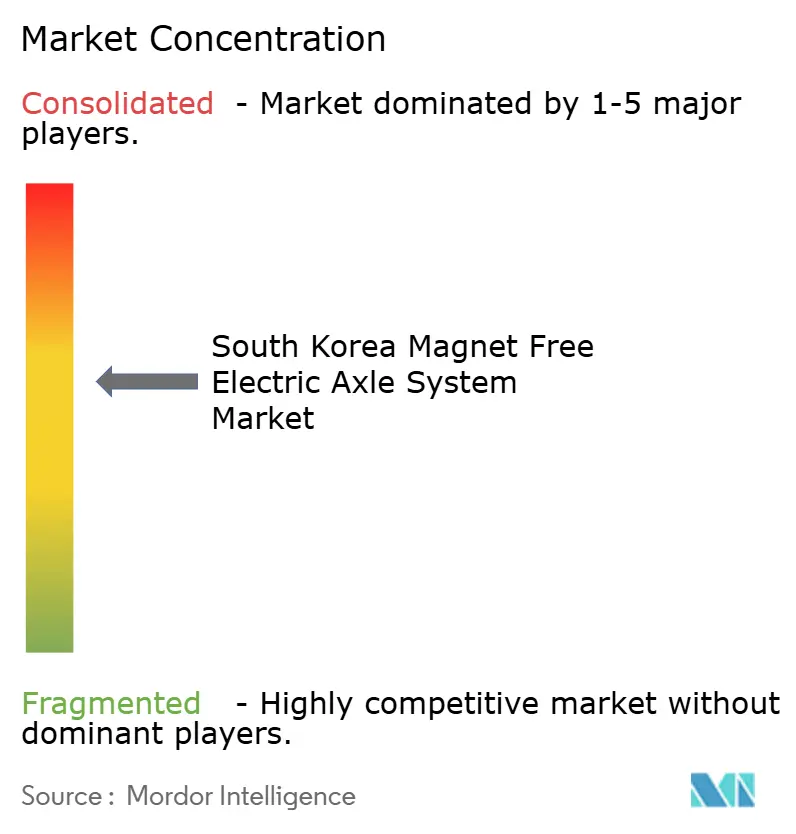
| Market Concentration | Medium |
Major Players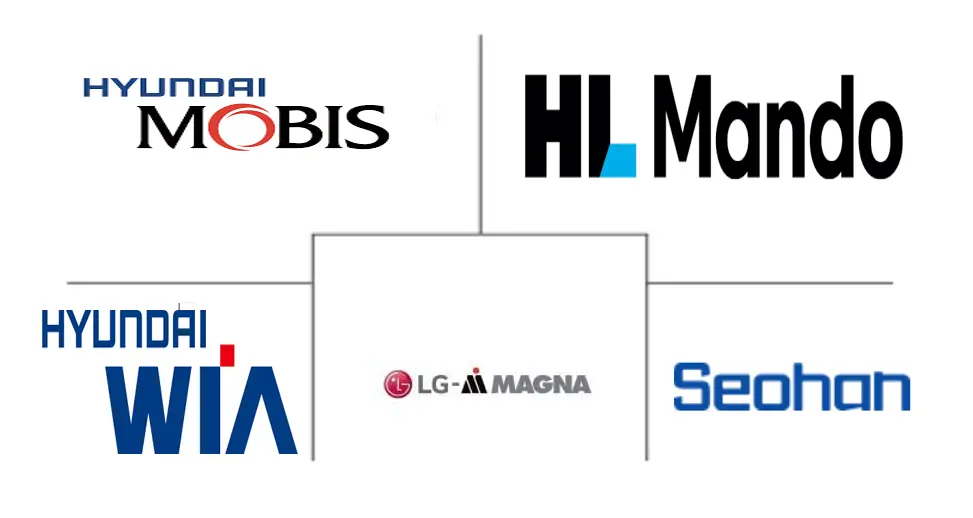
*Disclaimer: Major Players sorted in no particular order Image © Mordor Intelligence. Reuse requires attribution under CC BY 4.0. |
|

South Korea Magnet Free Electric Axle System Market Analysis by Mordor Intelligence
The South Korea magnet-free electric axle system market size is poised to be valued at USD 1.07 billion and is projected to reach USD 2.34 billion by 2030, reflecting a 17.07% CAGR during the forecast period (2025-2030); these figures anchor the South Korea magnet-free electric axle system market size outlook and underscore the sector’s brisk expansion. Strong demand catalysts emerge from a coordinated policy drive promoting zero-emission vehicles, hastening fleet electrification mandates, and ongoing volatility in rare-earth prices. Governments worldwide are implementing stringent regulations to reduce carbon emissions, while automakers are increasingly investing in electric vehicle (EV) technologies to meet these mandates. Additionally, the fluctuating prices of rare-earth elements, critical for EV production, are further driving innovation and strategic sourcing in the industry.
Key Report Takeaways
- By motor type, induction technology held a 46.07% share of the South Korea Magnet Free Electric Axle System Market in 2024; switched reluctance motors are projected to log an 18.40% CAGR during the forecast period (2025-2030).
- By drive type, fully electric technology held a 59.29% share of the South Korea Magnet Free Electric Axle System Market in 2024; fully electric systems are projected to grow at a 17.20% CAGR during the forecast period (2025-2030).
- By e-axle configuration, integrated systems captured a 63.53% share of the South Korea Magnet Free Electric Axle System Market in 2024, and are forecast to expand at a 19.10% CAGR during the forecast period (2025-2030).
- By vehicle type, passenger cars accounted for 71.14% share of the South Korea Magnet Free Electric Axle System Market in 2024. In contrast, medium and heavy commercial vehicles are expected to advance at a 21.30% CAGR during the forecast period (2025-2030).
Future direction is shaped by developments occurring across multiple countries and regions, with South korea contributing to the overall trajectory. The outlook on worldwide magnet free electric axle system market reflects how these are expected to evolve collectively.
South Korea Magnet Free Electric Axle System Market Trends and Insights
Drivers Impact Analysis*
| Driver | (~) % Impact on CAGR Forecast | Geographic Relevance | Impact Timeline |
|---|---|---|---|
| Govt ZEV Subsidies & 2030 EV Target (4.5M Units) | +4.2% | National; strongest pull in Seoul, Busan, Incheon | Medium term (2-4 years) |
| OEMs Adopting Integrated E-Axles | +3.1% | National; manufacturing hubs in Ulsan, Gwangju | Short term (≤ 2 years) |
| Magnet-Free Motors Rise Amid Rare-Earth Price Swings | +2.8% | Global supply chain impact; domestic production upside | Long term (≥ 4 years) |
| SiC Inverter Cost Drops Boost Efficiency | +2.5% | National; semiconductor cluster in Gyeonggi | Medium term (2-4 years) |
| Defense Electrifies Logistics Fleets | +1.9% | National; military procurement centers | Long term (≥ 4 years) |
| SK Innovates with Battery–Drive Co-Pack Modules | +1.3% | National; SK plants in Seosan, Changwon | Medium term (2-4 years) |
| Source: Mordor Intelligence | |||
Government ZEV Subsidies and 2030 4.5M EV Roadmap
Seoul's ambitious zero-emission vehicle roadmap creates unprecedented market pull for magnet-free e-axle systems, as subsidy structures increasingly favor domestically manufactured components that reduce import dependencies. The government's 2025 EV charging infrastructure budget increased 43% to KRW 618.7 billion, signaling a sustained commitment to electrification goals that directly benefit local drivetrain suppliers. The strategic emphasis on supply chain localization particularly advantages magnet-free technologies, eliminating reliance on rare Chinese earth supplies while qualifying for maximum subsidy support. This policy architecture creates a compounding effect where government procurement preferences align with private sector cost optimization, accelerating adoption beyond pure market forces. The 2030 target of 4.5 million EVs represents a significant increase from current levels, requiring domestic suppliers to scale production capabilities rapidly while maintaining technological competitiveness. Advanced manufacturing subsidies specifically target power electronics and motor technologies, positioning magnet-free systems as beneficiaries of demand-side incentives and supply-side industrial policy support.
OEM Shift to Integrated E-Axles
Korean automakers' strategic pivot toward integrated e-axle architectures fundamentally reshapes supplier relationships and technology requirements, as system integration demands favor magnet-free designs that offer superior thermal management and packaging flexibility. By 2030, the number of electrified vehicles is projected to hit 3.3 million units, necessitating e-axle technologies that can achieve cost parity with traditional drivetrains while meeting stringent reliability standards[1]"Hyundai Motor Unveils New ‘Hyundai Way’ Strategy and Outlines Mid- to Long-Term Goals at 2024 CEO Investor Day," HMG Newsroom, hyundaimotorgroup.com.. Integrated e-axles eliminate multiple mechanical interfaces, reducing system complexity and manufacturing costs while improving power density—advantages that magnet-free motors can exploit through their inherently robust construction and thermal characteristics. The shift toward software-defined vehicles amplifies this trend, as integrated systems enable more sophisticated control algorithms that compensate for the torque ripple challenges traditionally associated with switched reluctance and induction motors. Hyundai Mobis's development of extended-range electric vehicle systems demonstrates how integrated architectures create new market opportunities for magnet-free technologies in hybrid applications. This integration trend accelerates market consolidation, as OEMs prefer suppliers capable of delivering complete system solutions rather than individual components.
Rare-Earth Price Volatility Boosting Magnet-Free Motors
Persistent rare-earth supply chain disruptions and price volatility create compelling economic incentives for magnet-free motor adoption, as manufacturers seek to insulate themselves from geopolitical risks and commodity price fluctuations that can dramatically impact production costs. China's dominance in rare-earth processing, controlling over 80% of global supply, exposes Korean manufacturers to strategic vulnerabilities that magnet-free technologies can eliminate. Recent developments in ceramic-based permanent magnets by Korean research institutions demonstrate domestic innovation capabilities, yet the fundamental supply chain risks remain unchanged for rare-earth-dependent systems. Magnet-free motors offer predictable cost structures based on widely available materials like copper and steel, enabling more accurate long-term financial planning and pricing strategies. The Korean government's strategic materials stockpiling initiatives acknowledge these vulnerabilities while supporting domestic alternatives that reduce import dependencies. Manufacturing cost advantages become more pronounced as production scales increase, with magnet-free systems benefiting from established copper and steel supply chains that rare-earth alternatives cannot match.
Falling SiC Inverter Costs Improving Efficiency
Recent advancements in silicon carbide inverter technology are unlocking significant potential for magnet-free e-axle systems. Enhanced power electronics now offer the efficiency needed to overcome traditional limitations of induction and switched reluctance motors, making these alternatives more viable for electric vehicle platforms[2]"Silicon Carbide Prices Drop by Nearly 30%," trendforce.com.. Recent advancements in silicon carbide inverter technology pave the way for the widespread adoption of magnet-free e-axle systems. With improved power electronics, the efficiency hurdles that once limited induction and switched reluctance motors are being surmounted, positioning these motors as prime contenders for electric vehicle platforms[3]Nuying Huang, "China's aggressive SiC price war set to halve cost by 2025," DIGITIMES Asia, digitimes.com.. Advanced SiC inverters operating at higher switching frequencies can minimize torque ripple and acoustic noise in magnet-free systems, addressing two primary technical barriers to widespread adoption. Korean semiconductor companies' investments in SiC manufacturing capabilities, including Samsung's expanded automotive semiconductor production, create domestic supply chain advantages for local e-axle manufacturers. The efficiency improvements enabled by SiC technology can achieve system-level performance comparable to permanent magnet systems while maintaining cost and supply chain advantages. Thermal management benefits of SiC devices particularly complement magnet-free motors' inherent thermal robustness, creating synergistic system-level optimizations.
Restraints Impact Analysis*
| Restraint | (~) % Impact on CAGR Forecast | Geographic Relevance | Impact Timeline |
|---|---|---|---|
| NVH Challenges of SR and Induction Motors | -2.7% | National; acute consumer sensitivity in dense urban areas | Short term (≤ 2 years) |
| High Capital Cost of Local Copper-Rotor Casting | -1.8% | National; investment clusters in Ulsan, Daejeon | Medium term (2-4 years) |
| Thermal Derating on Mountainous Duty-Cycles | -2.1% | Regional; Gangwon and eastern provinces | Long term (≥ 4 years) |
| Tight Domestic Talent Pool for Power-Electronics Engineers | -1.4% | National; tech-hub concentration in Seoul and Daejeon | Medium term (2-4 years) |
| Source: Mordor Intelligence | |||
NVH Challenges of SR and Induction Motors
Noise, vibration, and harshness characteristics of switched reluctance and induction motors present significant market barriers, as Korean consumers demonstrate heightened sensitivity to acoustic comfort that permanent magnet alternatives can more easily satisfy. Research indicates that switched reluctance motors generate distinctive acoustic signatures at specific operating frequencies, requiring sophisticated control strategies and mechanical damping solutions that increase system complexity and cost. The absence of internal combustion engine noise in electric vehicles amplifies drivetrain acoustic issues, making NVH performance a critical differentiator in consumer acceptance and brand perception. Korean automakers' premium positioning strategies particularly emphasize refinement and comfort, creating additional pressure for magnet-free systems to achieve acoustic performance parity with permanent magnet alternatives. Advanced control algorithms and structural optimization techniques can mitigate these challenges, yet implementation requires significant engineering resources and validation testing that extends development timelines. The emergence of active noise cancellation technologies and improved vibration isolation methods offers potential solutions, though these add system complexity and cost that may offset some economic advantages of magnet-free designs.
High Capital Cost of Local Copper-Rotor Casting
Substantial capital requirements for establishing domestic copper-rotor die-casting capabilities create barriers to market entry and limit production scalability for Korean manufacturers seeking to localize magnet-free motor production. Precision copper-rotor casting requires specialized equipment and process expertise that differs significantly from traditional aluminum die-casting operations, necessitating significant technology investments and workforce training programs. The technical complexity of achieving consistent rotor quality while maintaining cost competitiveness demands advanced metallurgical capabilities and quality control systems that smaller suppliers may struggle to implement. Korean manufacturers face the strategic choice between importing rotors from established suppliers or investing in domestic production capabilities that require substantial upfront capital and extended payback periods. Government industrial policy support for advanced manufacturing technologies may partially offset these capital requirements, yet the fundamental economics remain challenging for companies without sufficient scale or financial resources. The concentration of copper-rotor manufacturing expertise in specific geographic regions creates additional supply chain risks that Korean manufacturers must navigate while building domestic capabilities.
*Our forecasts treat driver/restraint impacts as directional, not additive. The impact forecasts reflect baseline growth, mix effects, and variable interactions.
Segment Analysis
By Motor Type: Induction Motors Lead Despite SR Growth Acceleration
Induction motors maintain market leadership with 46.07% share of the South Korea Magnet Free Electric Axle System Market in 2024, reflecting their proven reliability and established manufacturing infrastructure, while switched reluctance motors demonstrate the strongest growth trajectory at 18.40% CAGR during the forecast period (2025-2030). The dominance of induction technology stems from decades of industrial application experience and well-understood control methodologies that minimize technical risks for OEM adoption. Switched reluctance motors' rapid growth reflects advancing control electronics capabilities that can exploit their inherent advantages in high-speed operation and fault tolerance. These are particularly valuable in commercial vehicle applications where durability outweighs acoustic refinement. Externally excited synchronous motors occupy a specialized niche, offering performance characteristics that bridge the gap between permanent magnet and fully magnet-free solutions, though their complexity limits broader adoption.
Permanent magnet motors retain relevance in specific applications where power density requirements justify rare-earth dependencies. Yet, their market share faces pressure from improving magnet-free alternatives and supply chain concerns. The technology evolution toward switched reluctance systems reflects broader industry trends favoring supply chain resilience over marginal performance advantages, particularly as control electronics sophistication reduces traditional performance gaps. Samsung Electro-Mechanics' development of high-voltage MLCCs specifically for automotive applications demonstrates the evolution of the component ecosystem that supports advanced motor control systems. This technological progression suggests continued market share migration toward magnet-free solutions as control system capabilities advance and manufacturing costs decline through scale effects.




By Drive Type: Fully Electric Dominance Reinforces Integration Trends
Fully electric drive systems command 59.29% share of the South Korea magnet free electric axle system market in 2024 while maintaining the highest growth rate at 17.20% CAGR during the forecast period (2025-2030), demonstrating market consolidation around pure electric architectures that maximize magnet-free motor advantages. The concentration in fully electric systems reflects Korean automakers' strategic focus on battery electric vehicles rather than complex hybrid architectures, simplifying drivetrain integration and reducing system costs. Hybrid drive applications maintain relevance in transitional market segments, yet their complexity disadvantages magnet-free motors that perform optimally in single-mode operation rather than frequent start-stop cycles. Plug-in hybrid systems occupy a diminishing market niche as battery costs decline and charging infrastructure expands, reducing the economic justification for dual-powertrain complexity.
The fully electric segment's growth acceleration reflects improving battery energy density and declining costs that eliminate range anxiety while maximizing the operational advantages of magnet-free motors in continuous-duty applications. Hyundai's development of extended-range electric vehicles demonstrates how system-level innovation can expand fully electric architectures into new market segments while maintaining magnet-free motor compatibility. This architectural evolution toward simplified electric drivetrains creates favorable conditions for magnet-free adoption, as system integration priorities favor robust, thermally stable motor technologies over peak performance optimization. The trend toward software-defined vehicles further reinforces fully electric dominance, as integrated control systems can optimize magnet-free motor performance through sophisticated algorithms that hybrid systems cannot fully exploit.
By E-Axle Configuration: Integrated Systems Drive Market Evolution
Integrated e-axle configurations dominate with 63.53% share of the South Korea Magnet Free Electric Axle System Market in 2024 and lead growth projections at 19.10% CAGR during the forecast period (2025-2030), reflecting OEM preferences for compact, thermally efficient solutions that simplify vehicle integration while optimizing manufacturing costs. The integration trend particularly benefits magnet-free motors, whose robust thermal characteristics and simplified cooling requirements align with space-constrained packaging demands that integrated architectures impose. Single e-axle systems serve specific market segments where cost optimization outweighs integration benefits, yet their growth potential remains limited by packaging constraints and thermal management challenges. Dual e-axle configurations address high-performance applications requiring all-wheel drive capabilities, though their complexity and cost limit adoption to premium vehicle segments.
Integrated systems' market leadership reflects fundamental shifts in automotive architecture toward centralized control and optimized packaging that magnet-free technologies can exploit through their inherent design flexibility. Hyundai Mobis's development of integrated charging control units that double EV charging speeds demonstrates how system integration creates new value propositions beyond traditional motor performance metrics. The thermal advantages of magnet-free motors become particularly valuable in integrated configurations where heat dissipation challenges intensify due to compact packaging requirements. This architectural evolution creates competitive advantages for suppliers capable of delivering complete integrated solutions rather than individual components, favoring established Korean manufacturers with system integration capabilities over component-focused competitors.

By Vehicle Type: Commercial Vehicles Emerge as Growth Engine
Passenger cars maintain market dominance with a 71.14% share of the South Korea Magnet Free Electric Axle System Market in 2024. Yet, medium and heavy commercial vehicles demonstrate the most substantial growth potential at 21.30% CAGR during the forecast period (2025-2030), reflecting fleet electrification mandates and total cost of ownership advantages that favor magnet-free motor technologies. The commercial vehicle segment's growth acceleration stems from regulatory pressures and operational economics prioritizing durability and maintenance simplicity over acoustic refinement, playing to magnet-free motors' inherent strengths. Light commercial vehicles occupy an intermediate position, balancing cost sensitivity with performance requirements that magnet-free systems can increasingly satisfy as control electronics advance. Passenger car applications within the hatchback, sedan, and SUV categories each present distinct requirements that influence motor technology selection, with urban-focused vehicles favoring acoustic refinement while larger vehicles prioritize thermal robustness.
The commercial vehicle growth trajectory reflects broader electrification trends in logistics and public transportation, creating substantial market opportunities for magnet-free systems optimized for continuous-duty operation and minimal maintenance requirements. Korea's government initiatives supporting electric cargo truck adoption, including subsidies for 8,200 units, demonstrate policy alignment with commercial electrification trends that benefit robust motor technologies. Fleet operators' focus on total cost of ownership rather than peak performance metrics creates favorable conditions for magnet-free adoption, as operational reliability and maintenance simplicity outweigh marginal efficiency differences. This market evolution suggests continued growth in commercial applications, while passenger car adoption depends on resolving NVH challenges through advanced control systems and mechanical optimization.
Geography Analysis
South Korea's domestic market concentration creates unique dynamics for magnet-free electric axle system adoption, as government industrial policy, established automotive manufacturing infrastructure, and strategic supply chain considerations converge to favor locally produced technologies. The nation's position as the world's fifth-largest automotive producer, with concentrated manufacturing hubs in Ulsan, Gwangju, and Asan, provides established supplier ecosystems that can adapt to magnet-free motor requirements while leveraging existing precision manufacturing and quality control capabilities. Seoul's metropolitan region is the primary demand center, accounting for approximately 25% of domestic EV sales. At the same time, government fleet procurement programs create additional market pull for domestically manufactured drivetrain components that align with supply chain localization objectives.
Regional policy variations within South Korea create differentiated market conditions. Gyeonggi Province's semiconductor cluster provides advanced power electronics development advantages, while traditional automotive regions like Ulsan focus on mechanical system integration and manufacturing scale. The mountainous terrain in Gangwon and eastern regions presents specific technical challenges for magnet-free motors, as thermal derating requirements in sustained high-load conditions can impact performance and require sophisticated thermal management solutions. Busan's port infrastructure facilitates component imports and finished vehicle exports, creating cost pressures that favor efficient manufacturing processes and supply chain optimization strategies that magnet-free technologies can support through reduced material complexity and import dependencies.
The government's strategic emphasis on defense logistics electrification creates additional geographic demand patterns, with military procurement centers and defense contractors concentrated in specific regions requiring specialized motor technologies prioritizing reliability and supply chain security over cost optimization. Hyundai Rotem's delivery of wheeled command vehicles to the Korean army demonstrates how defense applications create market opportunities for domestically produced drivetrain technologies. This geographic distribution of demand creates opportunities for regional specialization, with different areas focusing on specific motor types and applications that leverage local capabilities while serving distinct market segments within the broader magnet-free e-axle ecosystem.
Analysis of the magnet free electric axle system market by Mordor Intelligence spans multiple other regional evaluations across Europe, supported by country-level insights for Japan, India, China, and United States, wherein local market conditions keep varying from one country to another.
Competitive Landscape
Market concentration remains moderate, with the top five firms holding a significant share. Hyundai Mobis leads on scale, integrating e-axle, steering, and braking modules into one procurement platform to secure umbrella contracts with Hyundai and Kia. LG Magna e-Powertrain capitalizes on joint-venture access to Magna’s global process IP and LG’s legacy battery clientele to penetrate external OEM accounts.
Electronics convergence is reshaping competition: Samsung Electro-Mechanics pitches high-voltage MLCC portfolios bundled with gate-driver boards. SK On and SK Signet collaborate to sell battery-plus-e-axle turnkey kits to commercial fleet operators.
Software differentiation emerges as the next battleground: over-the-air torque calibration and predictive thermal control help minimize NVH and derating, directly influencing purchase decisions in the South Korean magnet-free electric axle system market. Start-ups like EVR Motors open local R&D offices to license axial-flux SR topologies, but capital-intensive rotor casting remains a scale gatekeeper, slowing extensive fragmentation.
White-space opportunities exist in specialized applications like defense vehicles and heavy commercial equipment, where performance requirements differ from passenger car applications, creating market niches for suppliers with specific technical capabilities and customer relationships. The emergence of software-defined vehicle architectures creates new competitive dimensions around control algorithm development and system integration capabilities that favor companies with both hardware manufacturing and software development expertise.
South Korea Magnet Free Electric Axle System Industry Leaders
-
Hyundai Mobis
-
HL Mando
-
Hyundai Wia
-
Seohan Auto
-
LG Magna E-Powertrain Co., Ltd.
- *Disclaimer: Major Players sorted in no particular order

Recent Industry Developments
- September 2024: Kia Corporation inaugurated the Kia Gwangmyeong EVO Plant, Hyundai Motor Group's first dedicated electric vehicle (EV) manufacturing facility. Located in South Korea's Kia Autoland Gwangmyeong, the plant has an annual production capacity of 150,000 units. It began producing the Kia EV3 earlier this year, with the EV4 scheduled for production in 2025. The 'EVO' in the plant's name reflects Kia's commitment to innovation and leadership in future mobility.
- March 2024: Renault Korea Motors Co., struggling with a prolonged slump, plans to invest over 700 billion won (USD 523 million) by 2027 to transform its Busan auto plant into an eco-friendly car-manufacturing hub. The company, part of the world’s fourth-largest auto group, signed a memorandum of understanding with the Busan Metropolitan City government to establish a future mobility center in South Korea’s second-largest city.


South Korea Magnet Free Electric Axle System Market Report Scope
| Externally Excited Synchronous Motors (EESM) |
| Induction Motors |
| Switched Reluctance Motors |
| Permanent Magnet Motors |
| Fully Electric Drive |
| Hybrid Drive |
| Plug-in Hybrid Drive |
| Single E-Axle |
| Dual E-Axle |
| Integrated E-Axle |
| Passenger Cars | Hatchbacks |
| Sedans | |
| SUV and MUVs | |
| Commercial Vehicles | Light Commercial Vehicles |
| Medium and Heavy Commercial Vehicles | |
| Buses and Coaches |
| By Motor Type | Externally Excited Synchronous Motors (EESM) | |
| Induction Motors | ||
| Switched Reluctance Motors | ||
| Permanent Magnet Motors | ||
| By Drive Type | Fully Electric Drive | |
| Hybrid Drive | ||
| Plug-in Hybrid Drive | ||
| By E-Axle Configuration | Single E-Axle | |
| Dual E-Axle | ||
| Integrated E-Axle | ||
| By Vehicle Type | Passenger Cars | Hatchbacks |
| Sedans | ||
| SUV and MUVs | ||
| Commercial Vehicles | Light Commercial Vehicles | |
| Medium and Heavy Commercial Vehicles | ||
| Buses and Coaches | ||


Key Questions Answered in the Report
What is the current value of the South Korea magnet free electric axle system market?
The sector stands at USD 1.07 billion in 2025.
How fast is the South Korea magnet free electric axle system market projected to grow?
It is forecast to expand at a 17.07% CAGR, reaching USD 2.34 billion in 2030.
Which motor technology holds the largest share?
Induction motors lead with 46.07% 2024 share, due to mature manufacturing infrastructure.
Which segment of vehicles will see the fastest growth in e-axle adoption?
Medium and heavy commercial vehicles are expected to grow 21.30% CAGR through 2030.
Why are integrated e-axles important?
They reduce manufacturing complexity, cut costs, and now hold 63.53% market share.
Which companies dominate the competitive landscape?
Hyundai Mobis and LG Magna e-Powertrain anchor domestic supply, with Bosch and ZF as key foreign contenders.
Page last updated on:





