
Magnet Free Electric Axle System Market Size and Share
Market Overview
| Study Period | 2019 - 2031 |
|---|---|
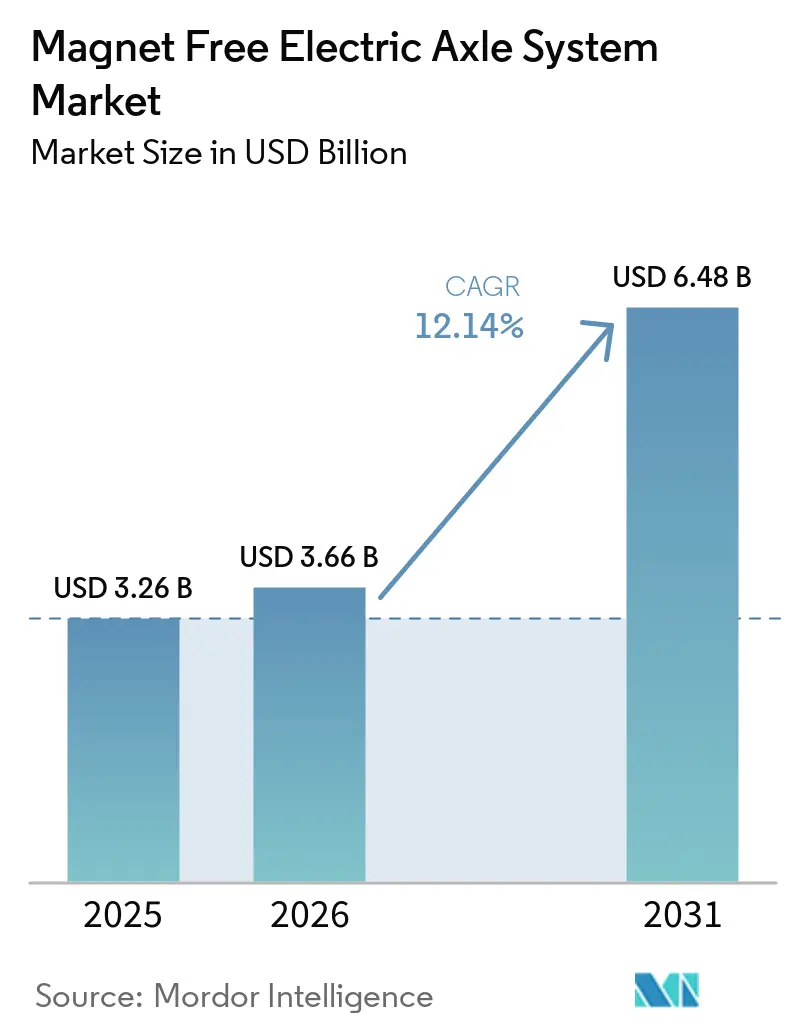
| Market Size (2026) | USD 3.66 Billion |
| Market Size (2031) | USD 6.48 Billion |
| Growth Rate (2026 - 2031) | 12.14 % |
| Fastest Growing Market | Asia-Pacific |
| Largest Market | Asia-Pacific |
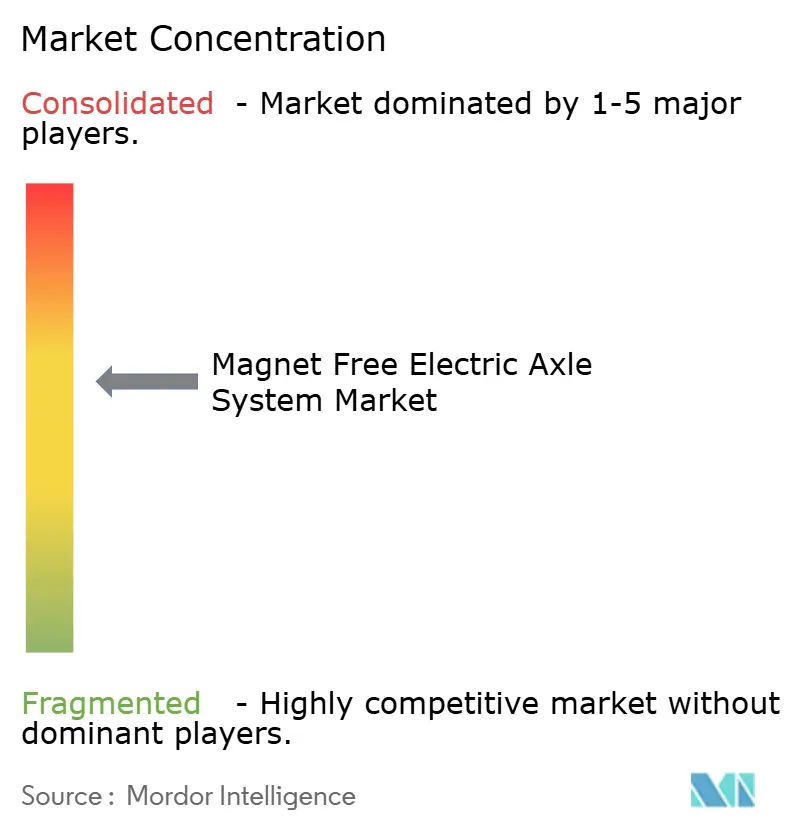
| Market Concentration | Medium |
Major Players *Disclaimer: Major Players sorted in no particular order Image © Mordor Intelligence. Reuse requires attribution under CC BY 4.0. | |
Magnet Free Electric Axle System Market Analysis by Mordor Intelligence
The magnet free electric axle system market size was valued at USD 3.26 billion in 2025, is estimated at USD 3.66 billion in 2026, and is projected to reach USD 6.48 billion by 2031, registering a 12.14% CAGR between 2026 and 2031. Amid rising geopolitical tensions over rare-earth supplies, automakers are shifting towards externally excited synchronous, induction, and switched reluctance motors. This transition allows them to sidestep the use of neodymium and dysprosium magnets in e-axles, thereby reducing both raw-material risks and long-term costs. These motors are now being paired with 800-volt silicon-carbide inverters, enabling automakers to achieve peak-power targets of 350 kilowatts, a benchmark once exclusive to permanent-magnet drives. Governments in the Asia-Pacific region are bolstering this industry shift with incentives that emphasize domestic production of electrical steel. Concurrently, the United States and the European Union are embedding clauses on critical minerals into tax credits, effectively sidelining magnet-based powertrains. As the disparity in power density narrows, urban logistics fleet operators are transitioning from diesel and magnet-based hybrid drives to rare-earth-free e-axles. These new e-axles not only align with zero-emission zone mandates but also offer a competitive total cost of ownership.
Key Report Takeaways
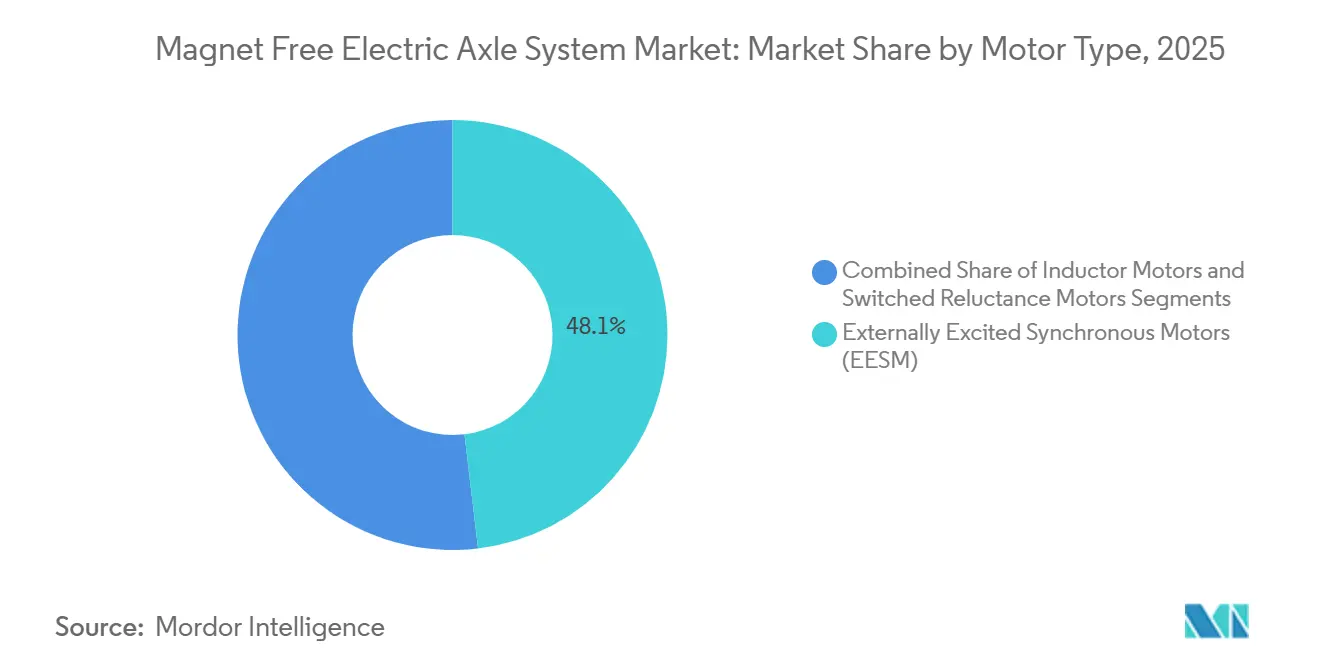
- By motor type, externally excited synchronous motors led the magnet free electric axle system market with 48.13% market share in 2025, while switched reluctance motors are projected to grow at a 14.17% CAGR through 2031.
- By drive type, hybrid drive systems accounted for 57.22% of revenue in 2025, whereas fully electric drive architectures are forecast to expand at a 17.64% CAGR through 2031.
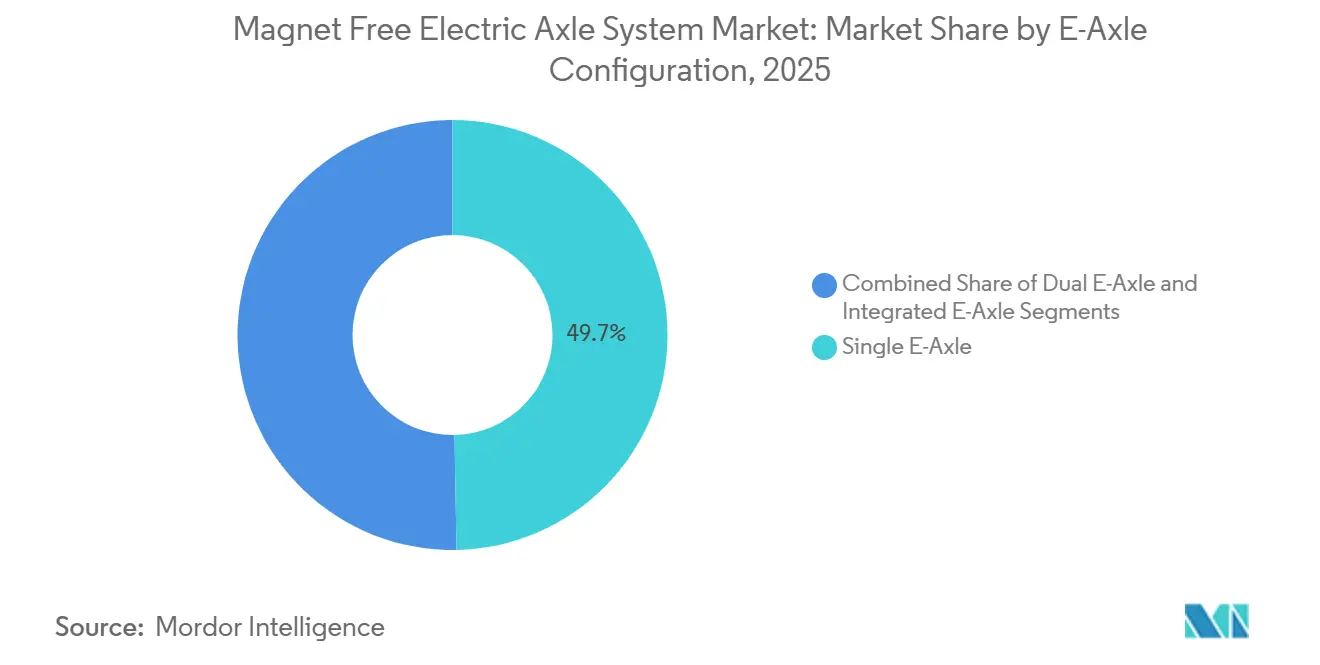
- By e-axle configuration, single e-axle setups accounted for 49.65% of 2025 deployments, while dual e-axle systems are advancing at a 16.61% CAGR to 2031.
- By vehicle type, passenger cars generated 57.33% of 2025 revenue, yet commercial vehicles are on track for a 15.29% CAGR through 2031.
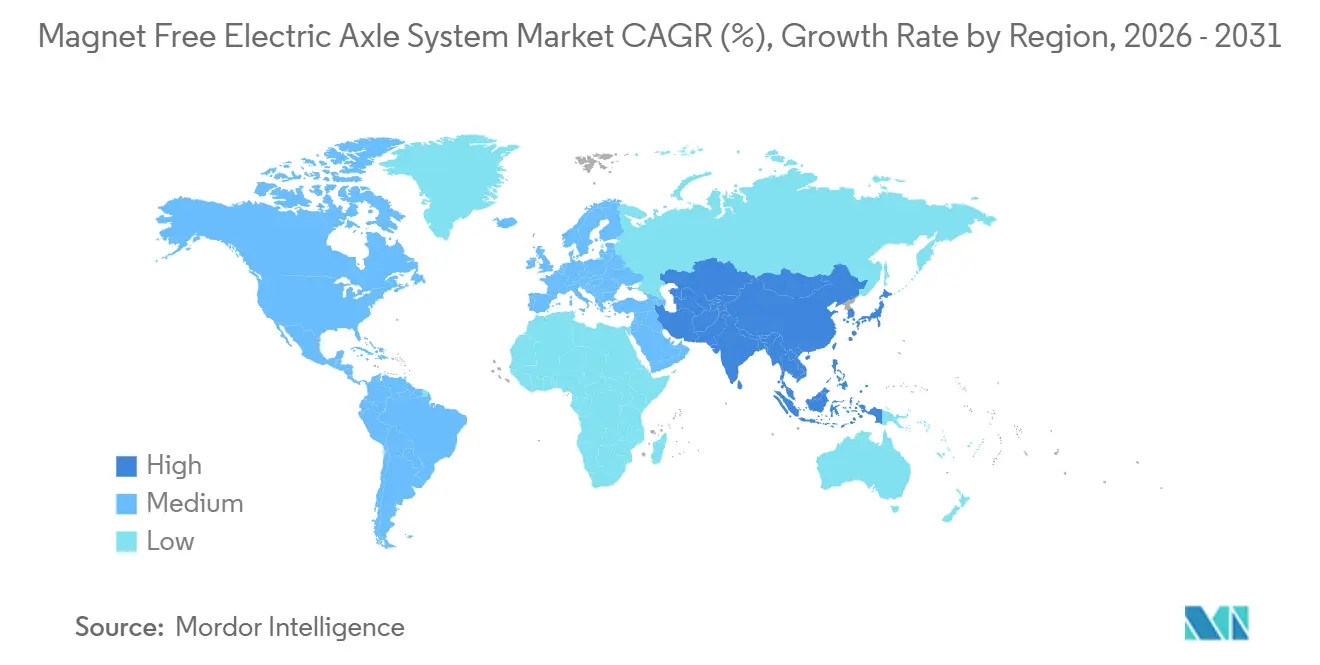
- By geography, Asia-Pacific captured 44.61% of the Magnet Free Electric Axle System market in 2025 and is expected to maintain a 15.71% CAGR through 2031.
Note: Market size and forecast figures in this report are generated using Mordor Intelligence’s proprietary estimation framework, updated with the latest available data and insights as of January 2026.
Market Trends and Insights
Drivers Impact Analysis of Magnet Free Electric Axle System Market*
| Driver | (~) % Impact on CAGR Forecast | Geographic Relevance | Impact Timeline |
|---|---|---|---|
| Rare-Earth Supply Chain Security | +2.8% | North America, Europe, Asia-Paicifc | Medium term (2-4 years) |
| Lower Lifetime Cost Than PM E-Axles | +2.1% | Global (early adoption in commercial fleets) | Short term (≤2 years) |
| OEM Carbon-Neutral and ESG Goals | +1.9% | Europe, North America | Long term (≥4 years) |
| Incentives for Non-Rare-Earth Motors | +1.6% | North America, Europe, spillover to Asia-Pacific | Medium term (2-4 years) |
| High-Si Electrical Steel Breakthroughs | +1.4% | Asia-Pacific manufacturing hubs | Long term (≥4 years) |
| Demand for Recyclable Powertrains | +1.0% | Europe, North America, and developed Asia-Pacific | Long term (≥4 years) |
| Source: Mordor Intelligence | |||
Supply-Chain Security from Rare-Earth Independence
China's export-licensing delays for dysprosium and terbium caused European spot prices to surge significantly, prompting OEMs to shift their e-axle roadmaps toward magnet-free motors. The country continues to dominate global heavy-rare-earth separation capacity, creating a bottleneck that Western refineries cannot resolve in the near term. A contract for induction motors by BorgWarner with a U.S. truck manufacturer demonstrates a strategic move to mitigate magnet shortages. Even with new refineries expected to increase production, Western output will meet only a small fraction of the demand, reinforcing the importance of magnet-free designs for achieving scalability and sovereignty. The EU’s Critical Raw Materials Act caps any single-country supply at 65% by 2030, cementing the adoption of magnet-free technologies[1].
Lower Lifetime Cost Versus PM E-Axles
Studies suggest that induction-motor e-axles achieve cost parity with permanent-magnet units after extended use in commercial duty cycles. This is attributed to their ability to avoid high neodymium costs and eliminate maintenance challenges associated with demagnetization. In externally excited designs, field-winding copper and lamination expenses are significantly lower than rare-earth procurement costs when neodymium prices increase substantially. Dana’s TM4 SUMO MD induction motor, designed to deliver continuous high power, operates entirely without rare-earth content. This innovation helps fleets avoid the need for magnet replacements over the long term. Additionally, EU battery passport regulations support the adoption of magnet-free motors, as rare-earth recycling is less efficient than the recovery rates of copper and steel, leading to higher end-of-life costs for permanent-magnet drives.
OEM Carbon-Neutral Targets and ESG Mandates
Stellantis, Ford, and Volkswagen have committed to achieving carbon-neutral operations. This move puts pressure on their supply chains to phase out high-footprint rare-earth magnets. In Inner Mongolia, Bayan Obo produces significant amounts of tailings for every ton of rare-earth oxide, presenting an externality that clashes with Scope 3 disclosure regulations. Valeo and MAHLE’s iBEE 48-volt EESM is designed for entry-level hybrids, balancing affordability with ESG compliance [2]. A life-cycle study reveals that eliminating neodymium can reduce global warming potential compared to PMSMs. Institutional investors have underscored these risks in proxy statements, further propelling the adoption of the magnet free electric axle system.
Regulatory Incentives Favoring Non-Rare-Earth Motors
The U.S. Inflation Reduction Act limits tax credits for electric vehicles (EVs) that use motor components sourced from "foreign entities of concern," positioning magnet-free e-axles as a clear path to compliance. Loans issued under the Advanced Technology Vehicles Manufacturing program require recipients to utilize domestically sourced induction or externally excited motors. Europe's RESourceEU Action Plan is directing funding into rare-earth-free research and development, aiming to significantly reduce magnet usage. Meanwhile, China is enhancing its New Energy Vehicle subsidies by offering additional rebates for magnet-free motors that incorporate locally sourced electrical steel, further promoting widespread adoption in the world's largest EV market.
Restraints Impact Analysis of Magnet Free Electric Axle System Market*
| Restraint | (~) % Impact on CAGR Forecast | Geographic Relevance | Impact Timeline |
|---|---|---|---|
| Lower Power/Torque Density | -1.8% | Global (performance vehicle focus) | Short term (≤2 years) |
| Higher Noise & Torque Ripple | -1.2% | Global (passenger cars) | Medium term (2-4 years) |
| High-Frequency Inverter Losses | -0.9% | Global (high-power e-axles) | Medium term (2-4 years) |
| SRM Control Software IP Limits | -0.7% | Regionally varied patent landscapes | Long term (≥4 years) |
| Source: Mordor Intelligence | |||
Lower Power/Torque Density Versus PM Motors
Permanent-magnet units achieve higher power density per liter compared to induction and externally excited motors. This difference forces OEMs to either enlarge housings or compromise on packaging in compact EVs. For instance, high-performance segments rely on magnets to deliver significant power output in a smaller volume. SRMs lag behind PMSMs in torque density at the same rotor diameters, which impacts payload capacity in heavy trucks. Research highlights that copper field losses can reduce continuous ratings under high temperatures, posing challenges for externally excited designs during demanding duty cycles. Additionally, torque-vectoring EVs require rapid response times, a benchmark that induction motors struggle to meet without relying on oversized and more expensive inverters.
Higher Acoustic and Torque Ripple Issues
Switched reluctance designs generate intrinsic torque ripple due to their doubly salient topology, leading to vibration that degrades cabin NVH unless mitigated. Advanced control techniques curtail ripple by 30% but impose processing overhead and an increase in inverter cost. Axial-gap SRMs promise better acoustic signatures yet require sophisticated electromagnetic force balancing. Comparative studies still rank PM synchronous motors quieter across typical driving profiles. Random-frequency PWM and current-tail shaping cut noise but raise implementation complexity. Passenger-car brands that prioritize refinement, therefore, move cautiously, slowing Magnet Free Electric Axle System market penetration in premium segments.
*Our forecasts treat driver/restraint impacts as directional, not additive. The impact forecasts reflect baseline growth, mix effects, and variable interactions.
Magnet Free Electric Axle System Market Segment Analysis
By Motor Type:
Innovation Anchors EESM LeadershipExternally excited synchronous motors accounted for 48.13% of 2025 revenue, reflecting the automaker's efforts to marry rare-earth independence with sinusoidal torque characteristics that consumers recognize as smooth, while switched reluctance motors are expected to grow at a CAGR of 14.17% through 2031. Induction motors prevail in fleets that value ruggedness over peak efficiency, while switched-reluctance motors are gaining popularity as silicon-carbide inverters dampen historical ripple, moving the Magnet Free Electric Axle System market toward broader acceptance. BMW’s sixth-generation eDrive confirms premium momentum by pairing an EESM with an 800 V SiC inverter delivering 400 kW without neodymium, a configuration that satisfies both ESG metrics and driver expectations.
Valeo and MAHLE’s iBEE brings 48-V EESM technology into mild hybrids, embedding rare-earth-free design in price-sensitive sub-segments. Meanwhile, induction motors are increasingly the front-axle choice in dual-motor AWD layouts, where their lower cogging torque reduces drag when decoupled- a bridge strategy until SRM matures.

By Drive Type:
Hybrid Flexibility Sustains VolumesHybrid drives accounted for 57.22% of 2025 revenue as OEMs leveraged magnet-free motors across plug-in and mild-hybrid models, which carry lower battery costs. Fully electric architectures are on track for 17.64% CAGR through 2031 because urban zero-emission zones and declining battery prices align to make rare-earth-free e-axles economically compelling, especially in last-mile logistics. Plug-in hybrids serve a transitional role, using magnet-free motors to meet the Inflation Reduction Act's mineral criteria while retaining combustion for long-haul trips.
Daimler Truck’s delivery of 75 eActros 600 units to Simon Loos in 2026 illustrates cost parity between full-electric magnet-free trucks and diesel in city routes. China’s subsidy structure, rewarding electric-only ranges above 50 km, further boosts magnet-free hybrids by offsetting the cost of high-silicon electrical steel. Plug-in hybrids will shrink in Europe as ICE sales bans approach, reallocating R&D spend toward fully electric e-axles, where magnet free electric axle system market growth concentrates.
By E-Axle Configuration:
Integration Yields EfficiencySingle e-axles accounted for 49.65% of deployments in 2025, favored for simplicity and cost in compact EVs and light trucks. Dual configurations will post a 16.61% CAGR through 2031 as premium brands pursue torque-vectoring AWD that demands independent front- and rear-motors. Heavy-duty applications are increasingly adopting integrated e-axles, which combine a motor, inverter, and gearbox in a single housing. This trend is driven by the need for efficient packaging and effective thermal management, despite the initial complexity involved.
ZF’s AxTrax and CeTrax demonstrate the versatility of modular kits, enabling OEMs to leverage magnet-free technology across various vehicle classes. This innovation is broadening the market footprint of the magnet free electric axle system. Rivian’s mid-size SUV is set to feature a dual-motor layout. This design prioritizes off-road torque vectoring, benefiting from the reduced cogging torque of induction units, especially when the front axles disengage for cruising. In China's urban vehicles, budget constraints have kept single e-axles in the lead. However, with advancements like high-silicon steels and lighter motor mass, there's a trend of dual systems gradually moving into the mid-market segment.
By Vehicle Type:
Commercial Fleets Accelerate AdoptionPassenger cars accounted for 57.33% of 2025 revenue, with SUVs and MUVs paying premiums for dual systems, while hatchbacks use single e-axles to meet price points in China and Europe. Commercial vehicles will expand at a 15.29% CAGR to 2031 as city logistics electrifies under regulation and magnet-free motors sidestep supply-chain risks that scare fleet operators.
Light commercial vans, now equipped with Dana's TM4 SUMO MD, are achieving diesel-equivalent payloads using induction drives. This advancement is paving the way for increased revenue in the magnet free electric axle system market. Volvo's FH Aero Electric, with an impressive range on a single charge, demonstrates that magnet-free e-axles are now viable for long-haul applications previously deemed unattainable. Meanwhile, BYD and Yutong have rolled out a significant number of induction-motor electric buses, providing transit agencies with established reference fleets. In the U.S., programs backed by the IRA are extending these economic benefits to parcel vans, interstate tractors, and refuse trucks. As a result, these commercial segments are emerging as the fastest-growing area in the magnet free electric axle system market.
Geography Analysis
APAC, Europe and North America Magnet Free Electric Axle System Market
Asia-Pacific held 44.61% of the 2025 magnet free electric axle system market share and is poised for a 15.71% CAGR through 2031, driven by China's dual-circulation strategy, which enhances domestic electrical-steel production, and India's PLI scheme, which provides reimbursements for local e-axle capital expenditures. Continental has made a major investment in a Tianjin electric-drive facility to produce EESM units using Baosteel’s ultra-thin steel. This initiative supports Chinese OEMs in meeting EU export regulations that limit reliance on single-country raw materials. Additionally, Japan’s Nidec has significantly expanded its e-axle production capacity and diversified its manufacturing operations to Serbia and Mexico, ensuring resilience against geopolitical risks while maintaining strong demand in the Asia-Pacific region [3].
Europe Magnet Free Electric Axle System Market
Europe, under strict rare-earth quotas, is seeing a shift as major automakers like BMW, Mercedes-Benz, and Volkswagen prioritize magnet-free motors and strengthen regional supply chains. Schaeffler’s production of magnet-free e-axles for hybrid programs exemplifies this transition. Furthermore, logistics fleets in cities such as Amsterdam and Barcelona are adopting dual-e-axle trucks from DAF and Volvo, advancing electrification efforts.
North America and LATAM Magnet Free Electric Axle System Market
North America is capitalizing on policy measures that discourage the use of Chinese magnet content, prompting automakers to adopt induction and EESM solutions that qualify for consumer tax credits. BorgWarner’s contract for a magnet-free drive module in a heavy-truck platform highlights the region's focus on local sourcing strategies. While Canada and the U.S. emphasize electrification of medium-duty delivery vehicles, Latin America is emerging as a key player. Brazil is actively attracting investments to reduce dependence on Asia, and Argentina is leveraging its lithium-centric ecosystems to align with the growing demand for magnet-free powertrains.
Mordor Intelligence provides coverage of the magnet free electric axle system market across other key regional markets, including Europe, each with their regulatory frameworks and demand patterns. Detailed country-level analysis extends to China, Japan, India, United States, and South Korea incorporating local coverage and market participation, as required.
Competitive Landscape
In the magnet free electric axle system market, the leading vendors—Continental, ZF, BorgWarner, Nidec, and Schaeffler—command a significant share of revenue. While Tier-1s strengthen their positions by vertically integrating SiC inverters with magnet-free motors to cater to premium EVs with high-output demands, smaller players focus on commercial vans and entry-level passenger cars, leveraging cost-optimized induction packages.
Technology remains the primary battleground. Infineon’s HybridPACK Drive G2 Fusion, which combines silicon and SiC chips, achieves impressive inverter efficiency. This advancement not only addresses the historically associated energy deficit with magnet-free motors but also broadens the market's addressable range. Meanwhile, patent races are intensifying: Continental and Schaeffler, focusing on innovation, have filed patents on field-winding thermal management, a technology that could offer continuous-power parity with permanent-magnet drives, making it particularly appealing to heavy-duty OEMs.
Price pressures are increasing. Chinese suppliers, notably Huawei and BYD, are undercutting Western prices on induction e-axles. This aggressive pricing strategy is pushing established players to either streamline their manufacturing processes or reconsider their presence in low-margin segments. Meanwhile, disruptors like Punch Powertrain and Vitesco Technologies are offering modular e-axle kits. These versatile kits can accommodate EESM, induction, or SRM motors, granting automakers the flexibility to future-proof their platforms without being tethered to permanent-magnet supply chains.
Magnet Free Electric Axle System Industry Leaders
-
ZF Friedrichshafen AG
-
Continental AG
-
Dana Incorporated
-
GKN Automotive
-
Schaeffler AG
- *Disclaimer: Major Players sorted in no particular order
Magnet Free Electric Axle System Market Companies Covered in this Report
- Continental AG
- ZF Friedrichshafen AG
- Schaeffler AG
- GKN Automotive
- Dana Incorporated
- Magna International
- BorgWarner Inc.
- Nidec Corporation
- American Axle & Manufacturing
- Valeo SA
- Mahle GmbH
- Vitesco Technologies
- Punch Powertrain
Recent Industry Developments in Magnet Free Electric Axle System Market
- July 2026: Nidec Corporation (Nidec) plans to commercialize magnet-free e-axles by 2028. In its five-year plan announced in May 2024, the company identified its e-axle business as a key area for structural reform and transformation. However, Nidec continues to develop the product with the objective of achieving future mass production.
- April 2025: Ricardo completed Alumotor, a 214 kW aluminum-wound propulsion unit delivering 92% efficiency for light commercial vehicles, funded by Innovate UK.
- March 2025: Advanced Electric Machines introduced HDRM300C, a second-generation magnet-free motor designed for heavy-duty commercial vehicles.
Global Magnet Free Electric Axle System Market Report Scope
The magnet free electric axle system market report is segmented by motor type (externally excited synchronous motors, induction motors, and switched reluctance motors), drive type (fully electric drive, hybrid drive, and plug-in hybrid drive), e-axle configuration (single e-axle and dual e-axle, ), vehicle type (passenger cars and commercial vehicles), and geography (North America, South America, Europe, Asia-Pacific, and Middle East and Africa). The market forecasts are provided in terms of value (USD).
Segmentation Overview
| Externally Excited Synchronous Motors (EESM) |
| Induction Motors |
| Switched Reluctance Motors |
| Fully Electric Drive |
| Hybrid Drive |
| Plug-in Hybrid Drive |
| Single E-Axle |
| Dual E-Axle |
| Integrated E-Axle |
| Passenger Cars | Hatchbacks |
| Sedans | |
| SUV and MUVs | |
| Commercial Vehicles | Light Commercial Vehicles |
| Medium and Heavy Commercial Vehicles | |
| Buses and Coaches |
| North America | United States |
| Canada | |
| Rest of North America | |
| South America | Brazil |
| Argentina | |
| Rest of South America | |
| Europe | Germany |
| United Kingdom | |
| Spain | |
| Italy | |
| France | |
| Netherlands | |
| Rest of Europe | |
| Asia-Pacific | India |
| China | |
| Japan | |
| South Korea | |
| Indonesia | |
| Rest of Asia-Pacific | |
| Middle East and Africa | United Arab Emirates |
| Saudi Arabia | |
| Turkey | |
| Egypt | |
| South Africa | |
| Rest of Middle East and Africa |
| By Motor Type | Externally Excited Synchronous Motors (EESM) | |
| Induction Motors | ||
| Switched Reluctance Motors | ||
| By Drive Type | Fully Electric Drive | |
| Hybrid Drive | ||
| Plug-in Hybrid Drive | ||
| By E-Axle Configuration | Single E-Axle | |
| Dual E-Axle | ||
| Integrated E-Axle | ||
| By Vehicle Type | Passenger Cars | Hatchbacks |
| Sedans | ||
| SUV and MUVs | ||
| Commercial Vehicles | Light Commercial Vehicles | |
| Medium and Heavy Commercial Vehicles | ||
| Buses and Coaches | ||
| By Geography | North America | United States |
| Canada | ||
| Rest of North America | ||
| South America | Brazil | |
| Argentina | ||
| Rest of South America | ||
| Europe | Germany | |
| United Kingdom | ||
| Spain | ||
| Italy | ||
| France | ||
| Netherlands | ||
| Rest of Europe | ||
| Asia-Pacific | India | |
| China | ||
| Japan | ||
| South Korea | ||
| Indonesia | ||
| Rest of Asia-Pacific | ||
| Middle East and Africa | United Arab Emirates | |
| Saudi Arabia | ||
| Turkey | ||
| Egypt | ||
| South Africa | ||
| Rest of Middle East and Africa | ||
Key Questions Answered in the Report
How large will the Magnet Free Electric Axle System market be by 2031?
It is forecast to reach USD 6.48 billion by 2031, expanding at a 12.14% CAGR from 2026.
Why are automakers shifting to magnet-free e-axles?
Rare-earth supply risks, ESG pressures, and new tax-credit rules favor induction, EESM, and SRM motors that eliminate neodymium and dysprosium.
Which region leads demand for magnet-free e-axles?
Asia-Pacific held 44.61% of 2025 sales and is projected to remain the largest, supported by Chinese and Indian industrial policies.
What motor type holds the biggest share today?
Externally excited synchronous motors command 48.13% of 2025 revenue owing to their balance of efficiency and rare-earth independence.