
Brazil Green IT Software Market Size and Share
Market Overview
| Study Period | 2020 - 2031 |
|---|---|
| Forecast Data Period | 2026 - 2031 |
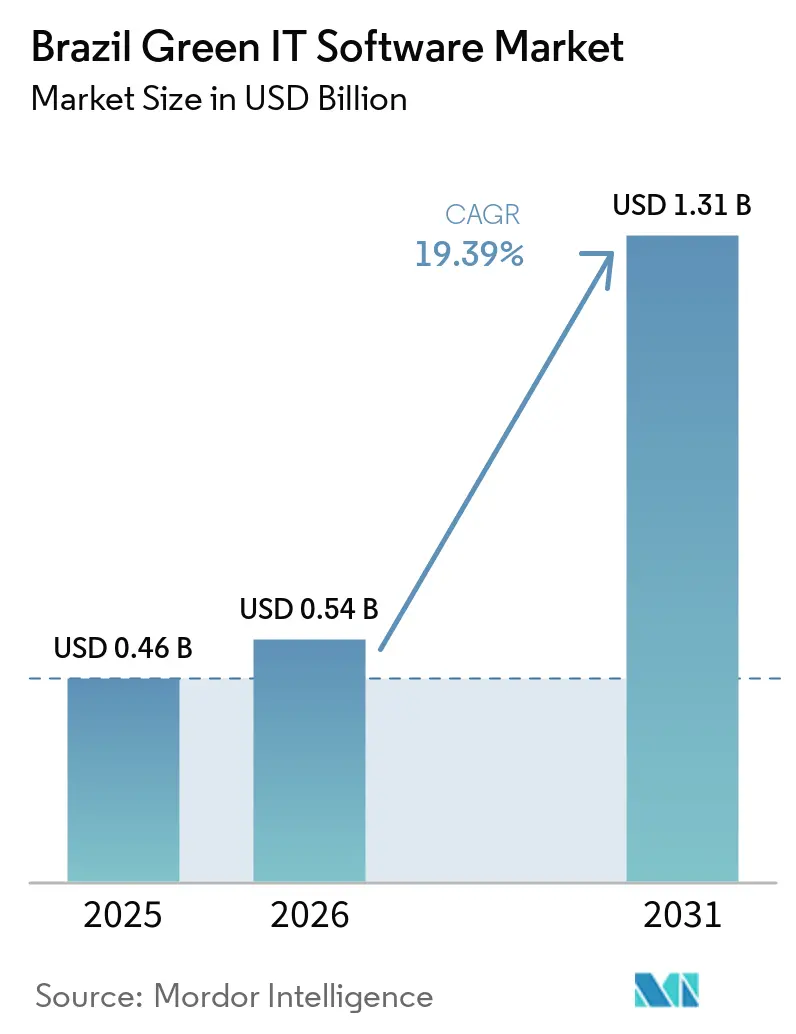
| Base Year Market Size (2025) | USD 0.46 Billion |
| Market Size (2026) | USD 0.54 Billion |
| Market Size (2031) | USD 1.31 Billion |
| Growth Rate (2026 - 2031) | 19.39 % |
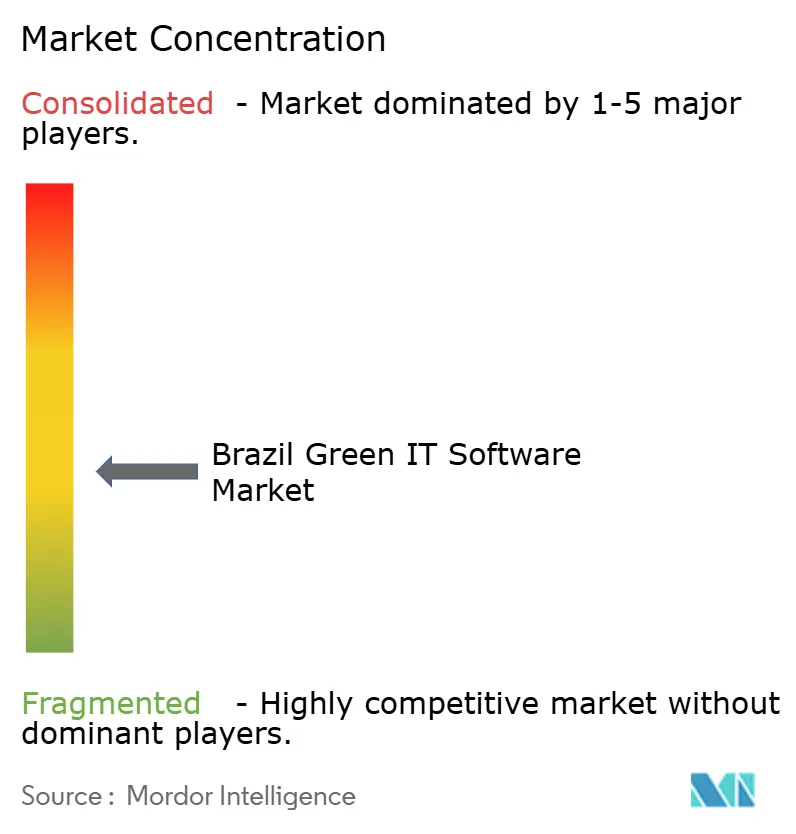
| Market Concentration | Medium |
Major Players *Disclaimer: Major Players sorted in no particular order Image © Mordor Intelligence. Reuse requires attribution under CC BY 4.0. | |
Brazil Green IT Software Market Analysis by Mordor Intelligence
The Brazil Green IT Software Market size was USD 0.46 billion in 2025 and is forecast to reach USD 1.31 billion by 2031 at a CAGR of 19.39% during 2026-2031. The market is moving from optional sustainability spending toward core operating spend because mandatory disclosure rules now require listed companies to build auditable reporting systems within fixed filing timelines. This shift is pulling procurement toward software that can collect emissions data, connect business functions, and support assurance-ready reporting without heavy manual work. The Brazil Green IT Software Market is also being shaped by a split between fast cloud deployment and rising concern around data control, which is keeping hybrid models relevant for regulated and infrastructure-heavy users. Demand still starts with large enterprises, yet the next layer of expansion is moving into smaller suppliers that must provide structured Scope 3 data to large domestic and European customers. Competitive activity in the Brazil Green IT Software Market is therefore favoring vendors that can combine carbon accounting, compliance workflows, and planning in a single platform instead of selling isolated reporting tools.
Key Report Takeaways
- By offering, software held 77.14% of the Brazil Green IT Software Market in 2025, while services are projected to expand at a 19.43% CAGR through 2031.
- By deployment, cloud-based delivery accounted for 65.17% share in 2025, while hybrid deployment is projected to grow at a 19.52% CAGR through 2031.
- By enterprise size, large enterprises held 70.12% share in 2025, while small and medium enterprises are projected to expand at a 19.63% CAGR through 2031.
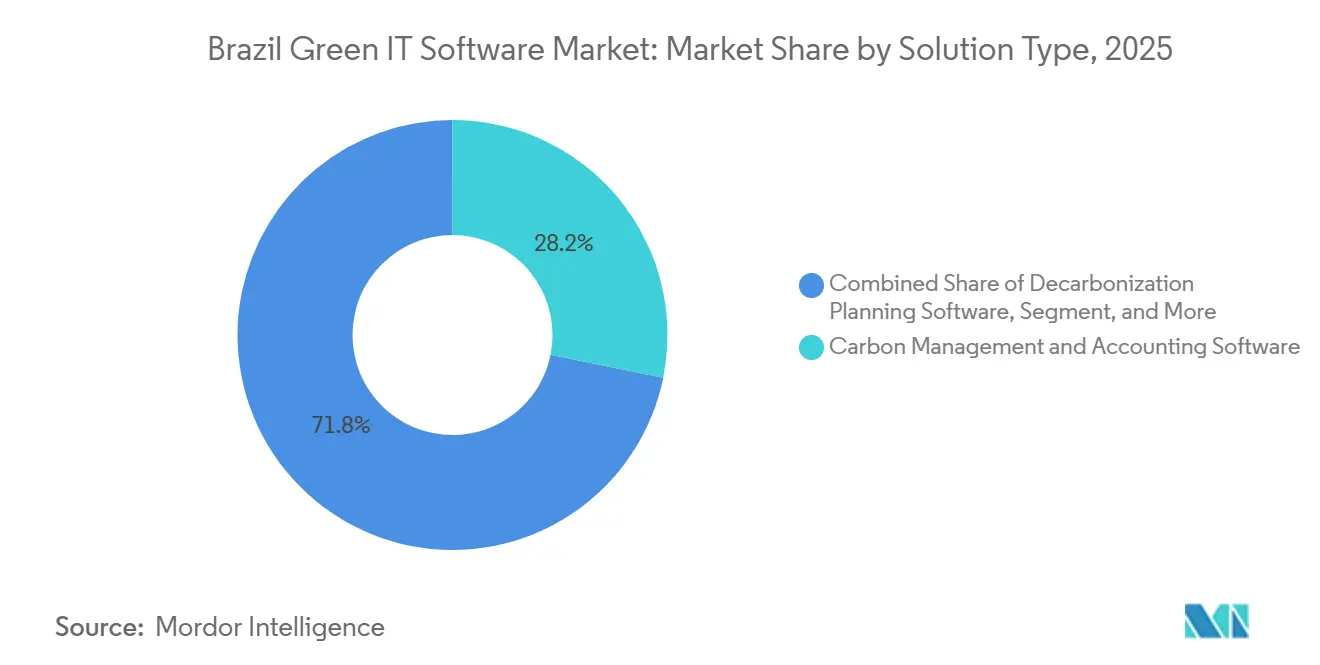
- By solution type, carbon management and accounting software captured 28.18% share in 2025, while decarbonization planning software is projected to grow at a 19.74% CAGR through 2031.
- By end user, IT and telecom held 23.13% share in 2025, while energy and utilities are projected to expand at a 19.81% CAGR through 2031.
Note: Market size and forecast figures in this report are generated using Mordor Intelligence’s proprietary estimation framework, updated with the latest available data and insights as of January 2026.
Brazil Green IT Software Market Trends and Insights
Drivers Impact Analysis*
| Driver | (~) % Impact on CAGR Forecast | Geographic Relevance | Impact Timeline |
|---|---|---|---|
| Rising Corporate ESG Disclosure Pressure | +4.5% | National, with early concentration in São Paulo and Rio de Janeiro financial centers | Short term (≤ 2 years) |
| Expansion of AI-Based Carbon Accounting Workflows | +3.8% | National, spill-over to Brasilia and industrial hubs in Minas Gerais and Paraná | Medium term (2-4 years) |
| Cloud-First Sustainability Reporting Adoption | +3.2% | National, early gains in São Paulo hyperscale corridor | Short term (≤ 2 years) |
| Energy Cost Optimization Across Data-Intensive Workloads | +2.9% | National, concentrated in data center-dense São Paulo and Rio de Janeiro | Medium term (2-4 years) |
| Demand for Audit-Ready Automated Evidence Trails | +2.4% | National, with particular relevance in BFSI, energy, and public sector | Medium term (2-4 years) |
| Supplier Emissions Visibility Requirements in Brazilian Value Chains | +2.1% | National, export-oriented industries in South and Southeast Brazil | Long term (≥ 4 years) |
| Source: Mordor Intelligence | |||
Rising Corporate ESG Disclosure Pressure
CVM Resolution 217 made IFRS S1 and IFRS S2 aligned disclosure mandatory for fiscal years beginning on January 1, 2026, which sharply raised the urgency of software buying in the Brazil Green IT Software Market.[1] That change matters because spreadsheet-based reporting does not provide the control, traceability, and consistency required once sustainability disclosures move into formal reporting cycles. Earlier adjustments to Resolution 193 in March 2025 also helped companies begin voluntary preparation before the mandatory cycle began, reducing hesitation but increasing demand for upgrades and system replacements. The result is that many listed companies are no longer choosing whether to digitize reporting; they are deciding how quickly they can install a reliable system. This pressure is strongest among firms that must coordinate finance, sustainability, legal, and operations teams under one reporting calendar. In the Brazil Green IT Software Market, regulation is therefore acting as both a timing accelerator and a demand driver.
Expansion of AI-Based Carbon Accounting Workflows
AI-enabled carbon accounting is transforming sustainability software in the Brazil Green IT Software Market from a periodic reporting tool into a continuous operating system. In May 2026, SAP announced that its new sustainability AI agents would become generally available by the end of 2026, with features focused on emissions tracking, EHS compliance management, and cross-functional governance.[2] IBM also introduced the IBM Envizi Emissions API in April 2026, enabling enterprises to embed GHG Protocol-aligned calculations directly into operational and ERP environments. These innovations reduce reliance on separate manual workflows and make sustainability data more accessible for routine planning and control. They also increase the value of platforms that can connect raw activity data with reporting logic and internal audit expectations. Within Brazil’s Green IT Software Market, this supports a gradual shift from static carbon accounting toward systems that also enable planning, oversight, and operational response.
Cloud-First Sustainability Reporting Adoption
Cloud-based implementation remains a major growth path because many companies need faster deployment than on-premise projects usually allow. Workiva and Grupo Report announced a partnership in May 2026 to help Brazilian organizations address mandatory IFRS S1 and S2 requirements with cloud-based reporting capabilities and local implementation support. This model suits companies that need to connect disclosure, internal review, and assurance preparation within a single digital workflow with limited time for buildout. The Brazil Green IT Software Market is benefiting from this, as cloud delivery shortens procurement-to-use timelines and reduces the burden of maintaining multiple reporting environments. At the same time, buyers are not treating cloud as a universal answer, because data control and sector-specific compliance still matter in finance, public entities, and energy. That is why cloud expansion in the Brazil Green IT Software Market is happening alongside a stronger interest in hybrid architecture rather than complete replacement.[3]
Energy Cost Optimization Across Data-Intensive Workloads
Energy monitoring is becoming increasingly important as the Brazilian data center base is expanding rapidly, adding pressure on power visibility across digital operations. U.S. Department of Commerce trade intelligence noted that grid-connected data center electricity demand in Brazil rose by more than 330% in a single year and could reach 13.2 GW by 2035, from 707 MW in 2023, if planned projects move forward. This scale of growth makes energy and carbon management software relevant not only for reporting, but also for basic operating discipline. Vendors that connect energy monitoring with emissions tracking are therefore addressing two procurement needs with a single platform, thereby strengthening their position in the Brazil Green IT Software Market. This is especially relevant for operators and large enterprises that must show a cleaner digital infrastructure while also containing energy costs. As data-intensive workloads expand, the Brazil Green IT Software Market is gaining from the overlap between efficiency software and disclosure software.
Restraints Impact Analysis*
| Restraint | (~) % Impact on CAGR Forecast | Geographic Relevance | Impact Timeline |
|---|---|---|---|
| Fragmented Sustainability Data Across Legacy Enterprise Systems | -2.8% | National, most acute in manufacturing and energy sectors outside São Paulo | Short term (≤ 2 years) |
| Limited Internal Green IT Skills in Mid-Sized Firms | -2.3% | National, particularly in secondary cities and mid-market enterprises | Medium term (2-4 years) |
| Data Residency And Compliance Concerns for Cloud Deployment | -1.8% | National, concentrated in BFSI and government sectors | Medium term (2-4 years) |
| Long Sales Cycles Due to Cross-Functional Buying Committees | -1.4% | National | Long term (≥ 4 years) |
| Source: Mordor Intelligence | |||
Fragmented Sustainability Data Across Legacy Enterprise Systems
Many companies still hold energy, production, logistics, and supplier data in separate systems, which slows adoption even when spending intent is present. The Brazil Green IT Software Market faces this issue most clearly in complex enterprises where ERP data, plant systems, spreadsheets, and supplier files do not follow one common emissions logic. IBM positioned its Envizi Emissions API as an integration layer for organizations that cannot replace core systems, which shows how central interoperability has become in real projects. Workiva also linked its Brazilian partnership model to assurance readiness, reflecting the need to consolidate scattered data into a single controlled reporting process. Fragmentation raises onboarding time and shifts buying toward vendors with stronger connectors, broader implementation support, and better document handling. In the Brazil Green IT Software Market, this slows smaller providers and makes implementation capability almost as important as product design.[4]
Limited Internal Green IT Skills In Mid-Sized Firms
The skills gap remains a real restraint because mid-sized firms often face the same reporting requests as large companies, yet lack the same internal teams. The UNDP partnership announced with the Government of Brazil in December 2024 was designed to equip MSMEs with sustainability reporting frameworks, tools, and resources, which shows that the capability gap is large enough to require institutional support. The government also launched the Empreender Clima platform during COP30 to widen access to green credit and sustainable technologies for micro and small businesses. These programs help build the base, but they do not remove the immediate burden of selecting, configuring, and governing specialized software. For many smaller users in the Brazil Green IT Software Market, the main problem is not a lack of interest in sustainability systems; it is limited staff capacity to run them well. That keeps demand tilted toward hosted models, managed services, and software with simpler deployment paths.
*Our forecasts treat driver/restraint impacts as directional, not additive. The impact forecasts reflect baseline growth, mix effects, and variable interactions.
Segment Analysis
By Offering: Software Leads While Services Build Long-Term Depth
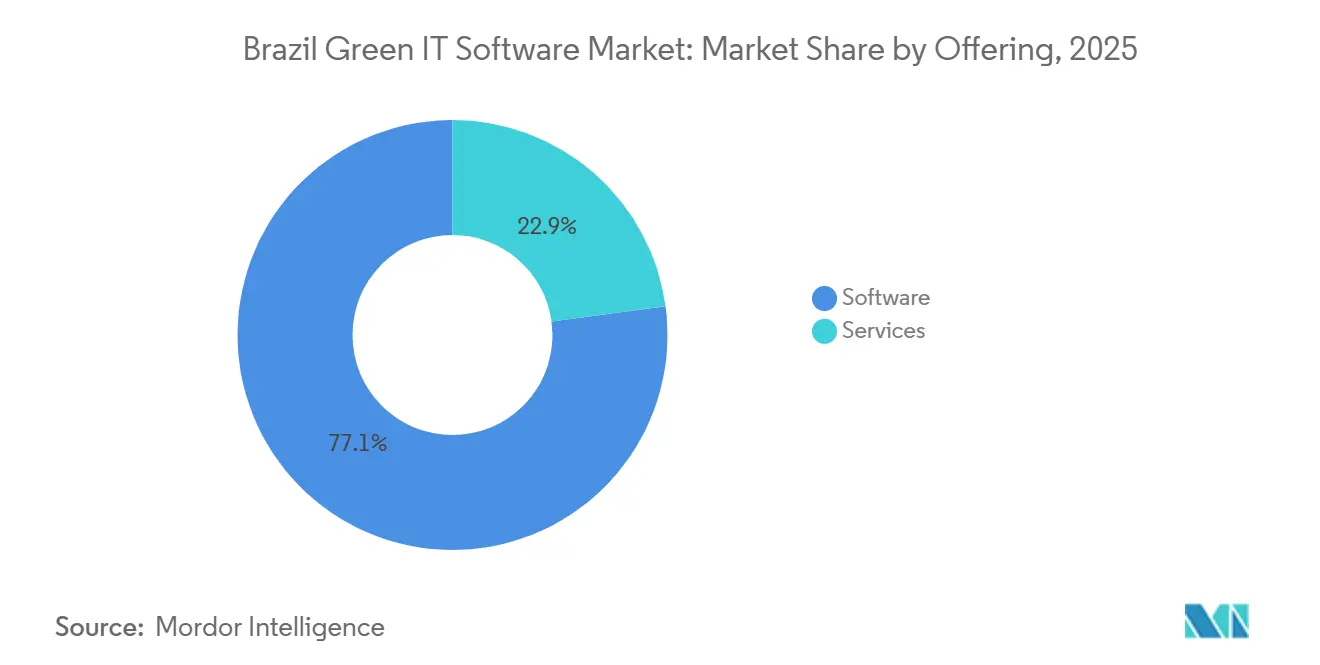
Software held 77.14% of the market in 2025, which shows that the Brazil Green IT Software Market still centers on platforms rather than advisory-led delivery. Buyers needed systems of record that could produce structured outputs within hard reporting timetables, so software naturally moved to the front of procurement plans. This pattern also reflects the need for repeatable controls across finance, operations, and sustainability teams instead of one-time project work. In the Brazil Green IT Software Market, software is the first purchase because it provides enterprises with a usable reporting base that can be expanded later. That starting position is especially strong among large organizations that already run broad enterprise technology stacks and prefer to extend existing environments.
Services are projected to grow at a 19.43% CAGR through 2031, which shows that implementation and ongoing support needs are rising as deployments become more complex. The Brazil Green IT Software Market is creating a long services tail because many customers must connect legacy systems, supplier data, and internal governance processes after the initial software purchase. SAP Brasil reported 35% growth in the adoption of sustainability solutions through 2024, supporting the view that software demand is driving follow-on implementation work across sectors. This is why services are not just an attachment to software, but a continuing requirement for configuration, localization, and controls. The Brazil Green IT Software Market is therefore likely to keep software in the lead while services gain share through post-deployment work and recurring compliance support.
By Deployment: Cloud Stays Largest While Hybrid Gains Strategic Weight
Cloud-based delivery accounted for 65.17% of the Brazil Green IT Software Market in 2025, confirming that fast implementation remains a major purchase priority. Many enterprises entered the current cycle needing to deploy tools quickly enough to support their first mandatory disclosure rounds, and cloud models fit that need better than long infrastructure projects. Cloud also supports easier updates, centralized workflow management, and lower day-to-day maintenance for internal teams. The Brazil Green IT Software Market has therefore favored cloud when buyers want a standard reporting layer without building an internal technical estate. This is particularly relevant for companies coordinating multiple business units that need a single disclosure process across the organization.
Hybrid deployment is projected to grow at a 19.52% CAGR through 2031, making it the fastest-growing architecture in this segment. That rise points to a buyer group that wants cloud speed for disclosure and workflow management, while still keeping sensitive operational data within internal systems. The Brazil Green IT Software Market is seeing this approach gain relevance in finance, public entities, and energy users, where operational information can carry regulatory or commercial sensitivity. It also suits enterprises with remote facilities or mixed legacy environments where a full migration is not practical in the short term. As the Brazil Green IT Software Market matures, hybrid design is becoming less of a transition model and more of a stable long-term choice for regulated and infrastructure-heavy customers.
By Enterprise Size: Large Enterprises Dominate While SMEs Add New Growth
Large enterprises held 70.12% of the market in 2025, indicating that the Brazil Green IT Software Market still generates most of its revenue from organizations with larger budgets and stronger reporting obligations. These buyers usually face greater scrutiny from investors, boards, auditors, and regulators, making the case for structured sustainability software more urgent. They also have the scale to run multi-module platforms across business units and connect sustainability reporting with finance, procurement, and risk functions. In the Brazil Green IT Software Market, large enterprises remain the anchor customer base because they can absorb complex deployments and move faster on enterprise-wide governance programs. This keeps current spending concentrated at the top end even as adoption expands into smaller tiers.
Small and medium enterprises are projected to grow at a 19.63% CAGR through 2031, giving this group the strongest momentum among enterprise sizes. The shift matters because many SMEs are being drawn into reporting workflows through supplier relationships rather than direct domestic regulation. The Brazil Green IT Software Market is therefore expanding into firms that need machine-readable Scope 3 data to retain access to multinational customer networks and export chains. The UNDP MSME partnership and the Empreender Clima platform both support this movement by reducing capacity and financing barriers at the small-business level. Even so, adoption in this tier will likely favor easier workflows, lighter integration, and a higher share of guided implementation. The Brazil Green IT Software Market can therefore expect SME growth to widen the customer base even if average deal sizes remain below those of large enterprises.
By Solution Type: Carbon Management Leads While Planning Tools Advance
Carbon management and accounting software captured 28.18% of the Brazil Green IT Software Market share in 2025, making it the core solution category in current demand. That leadership follows a clear sequence because companies usually need a credible emissions baseline before they can report, compare performance, or set reduction pathways. The Brazil Green IT Software Market is still in a stage where many buyers are building that first reliable baseline and need controlled data collection more than advanced scenario engines. ESG reporting and compliance tools sit close to this core because they convert emissions and governance data into disclosure-ready outputs. Sustainability data management platforms also matter because many enterprises must consolidate information from multiple functions into a single system before they can meet review and assurance needs.
Decarbonization planning software is projected to grow at a 19.74% CAGR through 2031, indicating that the Brazil Green IT Software Market is moving beyond historical accounting. This category becomes more relevant once organizations have enough trusted data to test transition options, compare pathways, and track progress against future targets. Facchini S/A began implementing SAP Sustainability Control Tower in February 2026 to centralize ESG metrics and automate data collection across 10 factories, using AI-assisted reporting and a sustainability memory framework. That example shows how planning tools become more useful when companies want decision support rather than only disclosure support. Energy and resource optimization software also benefits from this shift because efficiency and emissions management increasingly rely on the same operating data. In the Brazil Green IT Software Market, the long-term mix is likely to broaden from accounting-first adoption toward planning and optimization layers built on top of established reporting systems.
By End User: IT And Telecom Holds The Lead While Energy and Utilities Moves Fastest
IT and telecom accounted for 23.13% of Brazil's Green IT Software Market in 2025, placing it at the forefront of end-user demand. This leadership reflects the sector's dual role, as it must manage its own energy-intensive digital footprint while also supporting the platforms used by other sectors. The Brazil Green IT Software Market gains a steady base from these users because their operating models already depend on large volumes of structured data and centralized software control. Telecom and digital infrastructure operators also tend to face clear pressure on energy use, service continuity, and modernization, which keeps sustainability software relevant beyond a single reporting cycle. This makes the segment both a direct buyer and an enabling layer for wider market development across Brazil.
Energy and utilities are projected to grow at a 19.81% CAGR through 2031, which gives this segment the strongest forward pace among end users. The U.S. Department of Commerce pointed to very rapid growth in Brazilian data center electricity demand, which increases the need for traceability, efficiency monitoring, and cleaner energy documentation across connected infrastructure. The Brazil Green IT Software Market is likely to see stronger activity here, as utilities and energy-linked users must manage both operational data and the rising burden of climate-related reporting. Manufacturing also remains important because export-oriented producers need structured supplier and product-level sustainability data to maintain customer access. BFSI continues to matter due to formal disclosure and risk expectations, while retail, government, healthcare, and construction represent broader adoption pools that should deepen over time. In the Brazil Green IT Software Market, this spread of end users reduces dependence on one vertical and supports a more balanced growth path.
Geography Analysis
Brazil is the only geography covered in this report, and the Brazil Green IT Software Market is therefore shaped by internal concentration rather than cross-country market splits. The country has a strong position in South American digital infrastructure, which gives enterprise software vendors a large installed base of customers, data workloads, and compliance use cases to address. The Brazil Green IT Software Market is centered most heavily in São Paulo, while Rio de Janeiro and Brasilia continue to matter for state-linked procurement, regulated buyers, and large corporate decision-making. This pattern creates a first wave of adoption around the strongest corporate and institutional centers before a deeper spread into secondary industrial regions.
Regulatory structure is one of the main reasons Brazil stands out within South America. Mandatory disclosure for fiscal year 2026 under CVM Resolution 217 provides the Brazil Green IT Software Market with a stronger compliance foundation than many neighboring markets, where adoption remains more voluntary. Earlier changes to Resolution 193 also helped build preparation activity before the current mandatory phase began. The result is that the Brazil Green IT Software Market is not growing only because sustainability matters more, it is growing because formal reporting mechanics now require better systems. That gives Brazil a more structured demand environment than markets where disclosure timing is still less binding.
Geographic white space inside the country still matters because adoption is not evenly distributed across all business corridors. Export-oriented manufacturing and agricultural supply chains outside the main technology centers are creating new demand for supplier emissions visibility, structured reporting, and easier data exchange. Government-backed support through the UNDP MSME initiative and the Empreender Clima platform also points to broader adoption beyond the largest urban enterprise clusters. For that reason, the Brazil Green IT Software Market is likely to deepen geographically through supplier networks and smaller business programs, not only through top-tier corporate headquarters.
Competitive Landscape
The Brazil Green IT Software Market shows moderate fragmentation, with large global enterprise software vendors leading the largest accounts, while a broad field of specialist providers and service-led players still compete for mid-market and targeted use cases. This structure favors vendors that already sit within finance, ERP, cloud, or workflow environments, as sustainability features can then be added to systems customers already trust. The Brazil Green IT Software Market also leaves room for more focused suppliers because not every buyer wants a full enterprise suite with long deployment cycles and broad configuration layers. As a result, competition is shaped by a trade-off among platform breadth, implementation speed, integration depth, and ongoing service support.
One clear strategic move came from SAP in February 2025, when it launched the Net Zero Challenge and SAP Green Ledger solution in Brazil in collaboration with Pacto Global-Rede Brasil. Another came from IBM in April 2026, when it made the Envizi Emissions API generally available to help enterprises embed emissions calculations into existing systems rather than build separate reporting stacks. Workiva also strengthened its local position in May 2026 through its partnership with Grupo Report, tying product capability to local implementation support for Brazil's mandatory disclosure cycle. These actions show that competition in the Brazil Green IT Software Market is not only about software features, it is also about local execution and speed to compliance. Vendors that can integrate carbon accounting, disclosure controls, and audit readiness into a single process are likely to gain an advantage with larger buyers.
Proof of deployment is becoming an important competitive signal because buyers want evidence that platforms can operate effectively in real Brazilian conditions. CENIBRA became the first South American company to go live with SAP Green Token for EUDR compliance, embedding sustainability data into ERP supply chain workflows and showing how provenance and traceability can become part of competitive positioning. Facchini's 2026 implementation of SAP Sustainability Control Tower also shows how vendors are moving from basic reporting to operational and planning use cases in industrial environments. The Brazil Green IT Software Market therefore, rewards both scale and practical delivery, with larger platforms strongest at enterprise integration and smaller or more focused players competing on speed, fit, and affordability. That balance is why the market remains competitive even as global enterprise vendors hold a visible lead in the top account tier.
Brazil Green IT Software Industry Leaders
-
Microsoft Corporation
-
SAP SE
-
Oracle Corporation
-
IBM Corporation
-
Salesforce, Inc.
- *Disclaimer: Major Players sorted in no particular order
Recent Industry Developments
- May 2026: SAP announced that new sustainability AI agents will be made generally available by end of 2026, embedding agentic AI directly into emissions tracking, EHS compliance management, and cross-functional governance workflows. The agents are designed to automate multi-standard reporting across IFRS S2, GHG Protocol, and EHS regulatory frameworks without requiring manual data intervention, a capability relevant to Brazilian enterprises managing simultaneous CBPS and GRI obligations.
- April 2026: IBM launched the IBM Envizi Emissions API in general availability on April 28, 2026, enabling enterprises and software developers to embed GHG Protocol-aligned emissions calculations directly into existing systems and workflows. The solution addresses growing demand for real-time, scalable emissions data within enterprise operational environments and is positioned as an integration layer for organizations that cannot replace core operational systems.
- November 2026: The Brazilian government launched the "Empreender Clima" digital platform during COP30 in Belém, in partnership with the Ministry of Entrepreneurship, Microenterprise and Small Business (MEMP), Sebrae, and BNDES. The platform offers micro and small businesses green credit at reduced interest rates and access to sustainable technologies, establishing a policy channel that directly subsidizes green IT tool adoption at the SME tier.
- August 2025: SAP Brasil launched its fifth annual Sustainability Report at the SAP NOW AI Tour Brazil in São Paulo, reporting 35% growth in adoption of sustainability solutions, including SAP Sustainability Control Tower, SAP Green Ledger, and SAP Product Footprint Management, in Brazil through 2024. Deployments spanned retail, agribusiness, and industrial sectors, with generative AI integrated into carbon accounting workflows.
Brazil Green IT Software Market Report Scope
The Brazil Green IT Software market refers to platforms and services that enable Brazilian enterprises to integrate sustainability into IT operations by managing carbon emissions, optimizing energy and resource consumption, and ensuring compliance with ESG frameworks. These solutions include carbon management and accounting, ESG reporting and compliance, sustainability data management, decarbonization planning, and energy optimization software. By embedding sustainability intelligence into IT workflows, these platforms help organizations across Brazil reduce environmental impact, enhance operational efficiency, and align with national climate policies and global decarbonization goals. The market’s primary objective is to provide transparency, automate sustainability reporting, and support the transition toward greener, more resilient digital infrastructure across diverse industries.
The Brazil Green IT Software market report is segmented by Offering (Software, and Services), Deployment (Cloud-Based, On-Premise, and Hybrid), Enterprise Size (Large Enterprises, and Small and Medium Enterprises), Solution Type (Carbon Management and Accounting Software, ESG Reporting and Compliance Software, Sustainability Data Management Platforms, Decarbonization Planning Software, and Energy and Resource Optimization Software), End User (IT and Telecom, BFSI, Manufacturing, Energy and Utilities, Retail and E-Commerce, Government, Healthcare, Construction and Infrastructure, and Other End-User Industries). The Market Forecasts are Provided in Terms of Value (USD).
| Software |
| Services |
| Cloud-Based |
| On-Premise |
| Hybrid |
| Large Enterprises |
| Small and Medium Enterprises |
| Carbon Management and Accounting Software |
| ESG Reporting and Compliance Software |
| Sustainability Data Management Platforms |
| Decarbonization Planning Software |
| Energy and Resource Optimization Software |
| IT and Telecom |
| BFSI |
| Manufacturing |
| Energy and Utilities |
| Retail and E-Commerce |
| Government |
| Healthcare |
| Construction and Infrastructure |
| Other End-User Industries |
| By Offering | Software |
| Services | |
| By Deployment | Cloud-Based |
| On-Premise | |
| Hybrid | |
| By Enterprise Size | Large Enterprises |
| Small and Medium Enterprises | |
| By Solution Type | Carbon Management and Accounting Software |
| ESG Reporting and Compliance Software | |
| Sustainability Data Management Platforms | |
| Decarbonization Planning Software | |
| Energy and Resource Optimization Software | |
| By End User | IT and Telecom |
| BFSI | |
| Manufacturing | |
| Energy and Utilities | |
| Retail and E-Commerce | |
| Government | |
| Healthcare | |
| Construction and Infrastructure | |
| Other End-User Industries |
Key Questions Answered in the Report
What is the Brazil Green IT Software Market size in 2026 and how large will it be by 2031?
The report states the Brazil Green IT Software Market was USD 0.46 billion in 2025 and is forecast to reach USD 1.31 billion by 2031 at a 19.39% CAGR during 2026-2031.
What is driving demand for green IT software in Brazil right now?
The biggest driver is mandatory IFRS S1 and IFRS S2 aligned disclosure, which is pushing listed companies to replace manual reporting with auditable digital systems.
Which solution category leads current adoption in Brazil?
Carbon management and accounting software led with 28.18% share in 2025 because companies usually need a reliable emissions baseline before they expand into planning or optimization tools.
Why is hybrid deployment gaining traction if cloud already leads?
Cloud held 65.17% share in 2025, but hybrid is growing faster because many regulated and infrastructure-heavy users want cloud reporting workflows without moving all sensitive operating data off internal systems.
Which customer group is expanding fastest across enterprise size?
Small and medium enterprises are growing fastest at a 19.63% CAGR through 2031, largely because supplier reporting and Scope 3 data requests are moving down the value chain.
Which end-user segment is expected to grow fastest through 2031?
Energy and utilities are projected to expand at a 19.81% CAGR through 2031 as energy traceability, reporting needs, and digital infrastructure growth create stronger demand for monitoring and carbon software.