
Mexico Green IT Software Market Size and Share
Market Overview
| Study Period | 2020 - 2031 |
|---|---|
| Forecast Data Period | 2026 - 2031 |
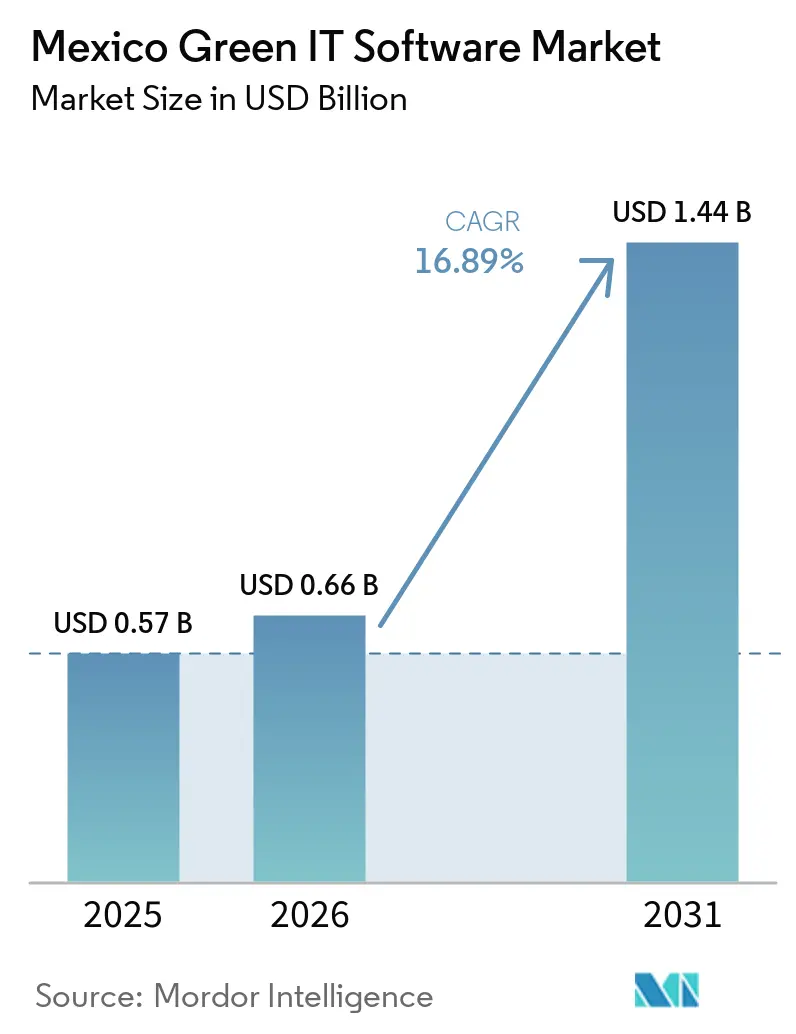
| Base Year Market Size (2025) | USD 0.57 Billion |
| Market Size (2026) | USD 0.66 Billion |
| Market Size (2031) | USD 1.44 Billion |
| Growth Rate (2026 - 2031) | 16.89 % |
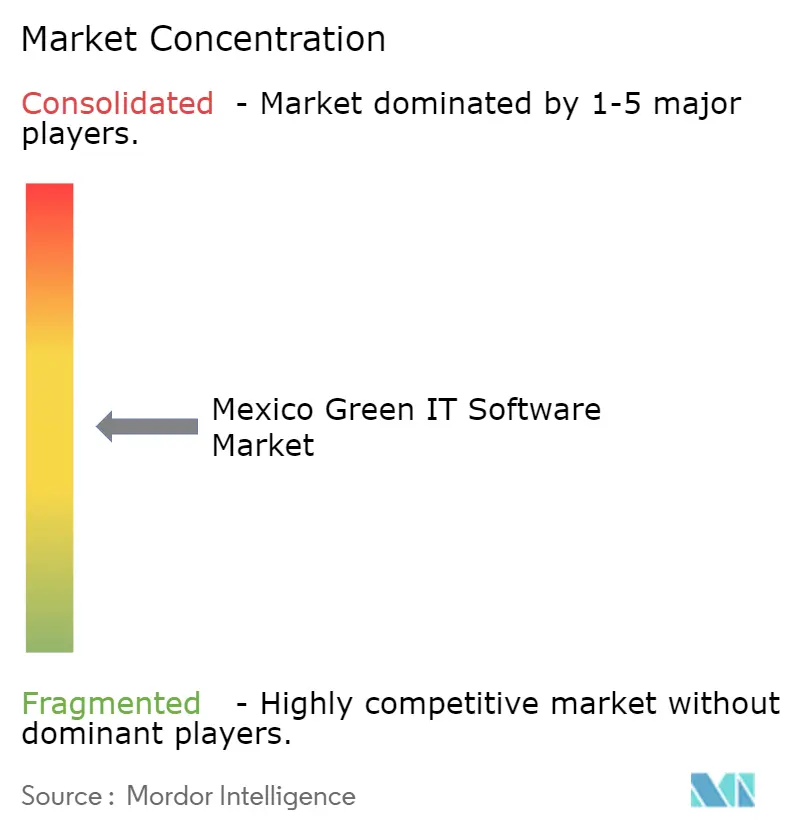
| Market Concentration | Medium |
Major Players *Disclaimer: Major Players sorted in no particular order Image © Mordor Intelligence. Reuse requires attribution under CC BY 4.0. | |
Mexico Green IT Software Market Analysis by Mordor Intelligence
The Mexico green IT software market size is projected to expand from USD 0.57 billion in 2025 and USD 0.66 billion in 2026 to USD 1.44 billion by 2031, registering a CAGR of 16.89% between 2026 and 2031. The Mexican green IT software market is moving from periodic sustainability reporting toward software-led systems that integrate carbon data, ESG disclosures, and operational workflows into a single framework. A major reason for this shift is the January 2025 CNBV resolution, which brought IFRS S1 and S2 sustainability disclosure rules into the formal reporting cycle for listed issuers and shortened software evaluation timelines across regulated enterprises. The effect extends beyond listed entities, because suppliers and service partners increasingly need auditable emissions and energy data to protect commercial relationships with larger customers. The Mexico green IT software market is also benefiting from a broader buildout of digital infrastructure, where new data center and cloud assets need stronger visibility into electricity use, greenhouse gas intensity, and renewable procurement. Competition remains active but not closed, because large global software vendors hold an advantage through existing enterprise relationships, while domestic and specialist providers still have room to grow in compliance support, implementation, and SME-focused use cases.
Key Report Takeaways
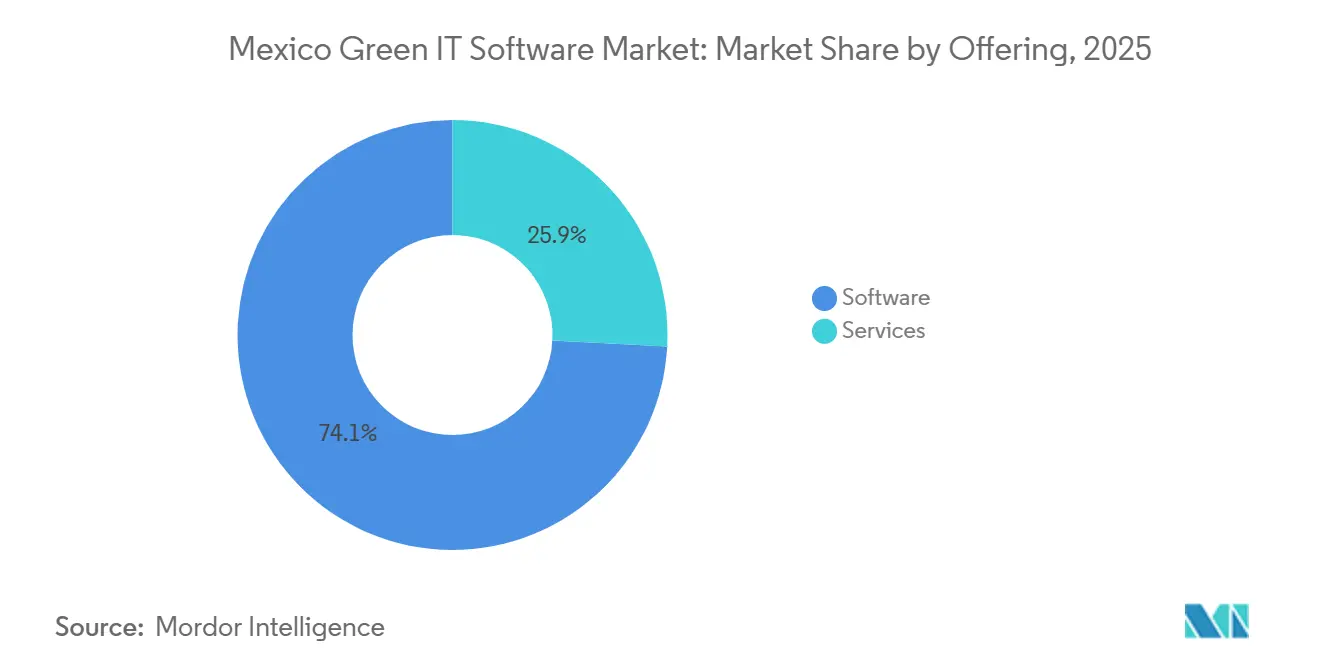
- By offering, software held 74.14% of revenue in 2025, while services are projected to expand at a 16.93% CAGR through 2031.
- By deployment, cloud-based delivery held 62.17% of the Mexico green IT software market share in 2025, while hybrid deployment is projected to grow at 17.04% through 2031.
- By enterprise size, large enterprises accounted for 67.12% of revenue in 2025, while SMEs are projected to expand at a 17.15% CAGR through 2031.
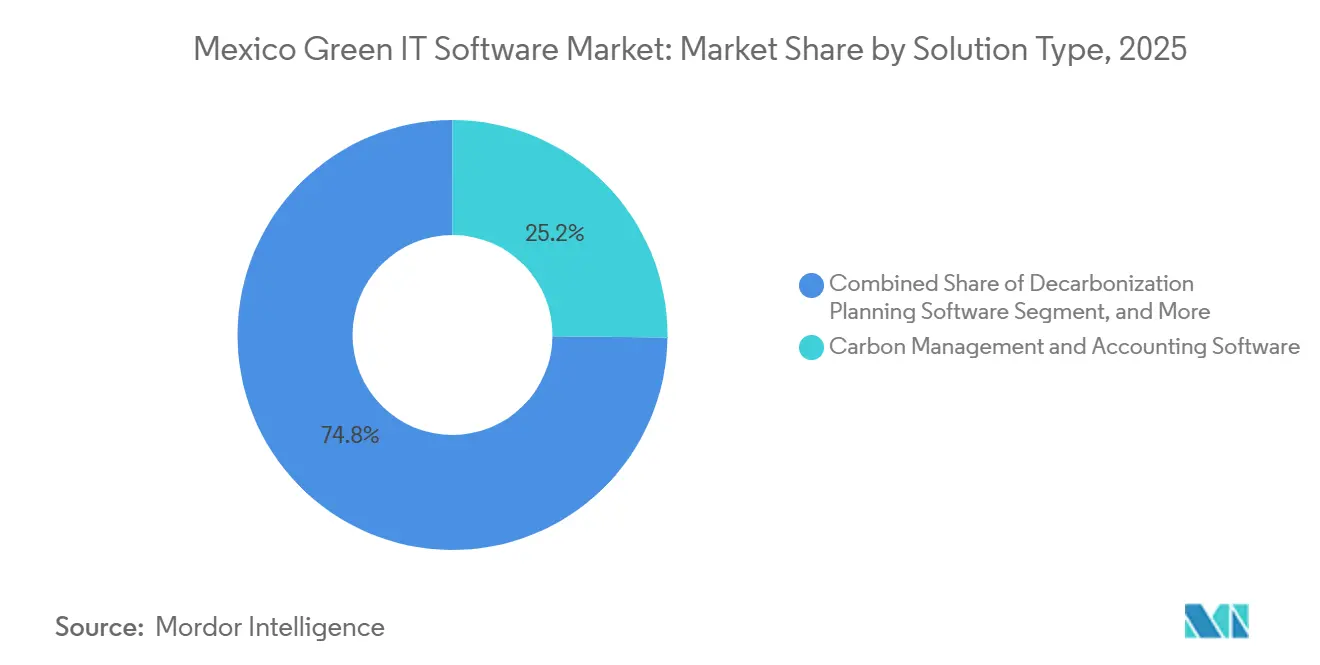
- By solution type, carbon management and accounting software captured 25.18% of the Mexico green IT software market size in 2025, while decarbonization planning software is projected to grow at 17.26% through 2031.
- By end user, IT and telecom held 20.13% of revenue in 2025, while energy and utilities are projected to expand at a 17.33% CAGR through 2031.
Note: Market size and forecast figures in this report are generated using Mordor Intelligence’s proprietary estimation framework, updated with the latest available data and insights as of January 2026.
Mexico Green IT Software Market Trends and Insights
Drivers Impact Analysis*
| Driver | (~) % Impact on CAGR Forecast | Geographic Relevance | Impact Timeline |
|---|---|---|---|
| Rising Demand for Energy-Efficient IT Operations | +4.2% | National, concentrated in Mexico City, Querétaro, Monterrey | Short term (≤ 2 years) |
| Expansion of Cloud-Native and Virtualized Infrastructure | +3.6% | National, with early gains in Querétaro hyperscale corridor | Short term (≤ 2 years) |
| Data Center Growth and Sustainability Compliance Pressure | +3.0% | Bajío region, including Querétaro and Guanajuato, with spillover to Mexico City and Monterrey | Medium term (2-4 years) |
| Need to Cut IT-Related Power Costs | +2.4% | National, with emphasis in energy-intensive manufacturing corridors | Medium term (2-4 years) |
| Embedded-Carbon Visibility in Multi-Cloud Environments | +1.8% | National, with early traction in BFSI and IT and telecom | Medium term (2-4 years) |
| Utilities-Linked Carbon Reporting for IT Procurement | +1.2% | National, with early gains in energy and utilities and government | Long term (≥ 4 years) |
| Source: Mordor Intelligence | |||
Rising Corporate Demand for Energy-Efficient IT Operations
Corporate buyers in the Mexico green IT software market are giving more weight to systems that can connect energy use, emissions records, and reporting outputs inside daily IT operations. This shift became more urgent after the CNBV published its January 2025 resolution, which made IFRS S1 and S2 disclosures mandatory for BMV- and BIVA-listed issuers, with first filings due in 2026 for FY2025 reporting.[1] The Mexico green IT software market is therefore seeing compliance demand spread outward from listed companies to suppliers that need consistent climate and energy information to stay aligned with enterprise customers. This pull is reinforced by Mexico’s sustainability reporting framework for non-listed entities, which, from January 1, 2025, brought 30 sustainability indicators, including greenhouse gas inventories and energy consumption disclosures, into financial statement notes under the NIS structure. As a result, the Mexico green IT software market is not expanding solely on environmental goals, because it is increasingly tied to financial, disclosure, and supplier management requirements that require repeatable, software-led processes.
Expansion Of Cloud-Native and Virtualized Infrastructure
The Mexico green IT software market is also gaining support from the wider adoption of cloud services, as distributed workloads require stronger measurement of energy use, activity levels, and carbon attribution across environments. Megaport stated that 84% of Mexican companies were already using some form of cloud service, while 57% were exploring AI and machine learning adoption, which enlarges the base for cloud-delivered sustainability applications. This pattern favors software that can classify emissions by workload, business unit, and provider, rather than relying on site-level estimates that are too broad for assurance-ready reporting.[2] Hybrid deployment is gaining attention in the Mexico green IT software market because regulated enterprises still keep sensitive cores on-premise while extending analytics, benchmarking, and disclosure layers into the cloud. That mix makes virtualized environments more measurable, but it also underscores the need for software that can reconcile cloud, on-premises, and supplier data into a single auditable structure.
Mexico Data Center Growth and Sustainability Compliance Pressure
The Mexico green IT software market is being boosted by data center expansion, as each new digital facility intensifies monitoring needs for electricity, cooling, emissions, water use, and renewable sourcing. KIO Data Centers announced the construction of MEX8 in Mexico City in March 2026 as a USD 70 million investment, with 79% of its energy to be sourced from renewables and a stated commitment to raise that share over time.[3] In the Mexico green IT software market, that kind of facility design creates direct demand for carbon accounting, energy optimization, and evidence trails that can support internal reviews and external reporting. The pressure is strengthened by Mexico’s clean energy policy direction, including PROSENER 2025-2030 and subsequent renewable generation permits, which underscore the importance of tracking the carbon content of purchased electricity and related claims. The result is that new digital infrastructure is turning sustainability software from a narrow reporting tool into a broader operating requirement across power, infrastructure, and compliance teams.[4]
Increasing Need to Cut IT-Related Power Costs
The Mexico green IT software market is also benefiting from a simple operating reality, because electricity has become a more visible cost line for enterprises running large server, storage, and network estates. When power use becomes harder to absorb, organizations place more value on software that can model workload scheduling, identify idle capacity, and support cooling and infrastructure efficiency decisions. This is especially relevant for manufacturers, telecom operators, and digital infrastructure owners, as they manage large, continuous energy loads that can be optimized only with granular, timely data. In the Mexico green IT software market, tools that connect power consumption with operational and financial metrics are therefore becoming easier to justify even before full assurance requirements take effect. The commercial case strengthens further when companies need the same data for internal cost control, customer disclosures, and future third-party assurance, because one data stream can serve several decision layers at once
Restraints Impact Analysis*
| Restraint | (~) % Impact on CAGR Forecast | Geographic Relevance | Impact Timeline |
|---|---|---|---|
| High Upfront Integration Cost for Legacy IT Estates | -2.8% | National, heaviest in manufacturing-heavy states including Nuevo León, Jalisco, and Coahuila | Short term (≤ 2 years) |
| Shortage of Green IT Skills and Change-Management Capability | -2.0% | National, with the widest gap in secondary cities and SME clusters | Medium term (2-4 years) |
| Limited Emissions Data Quality Across Distributed Assets | -1.4% | National, concentrated in multi-site manufacturing and retail | Medium term (2-4 years) |
| Grid Interconnection and Renewable Supply Constraints | -1.0% | Northern and Bajío corridors, with spillover to emerging data center hubs | Long term (≥ 4 years) |
| Source: Mordor Intelligence | |||
High Upfront Integration Cost for Legacy IT Estates
Legacy systems remain one of the clearest barriers in the Mexico green IT software market, because emissions and energy tools often need to connect with ERP records, utility data, asset registers, procurement systems, and finance workflows that were not built together. This challenge becomes more serious when sustainability figures must be reported inside formal financial disclosures rather than in separate environmental files. The NIS framework requires greenhouse gas information to be presented in a structured format, thereby increasing the need to align operational data with financial reporting systems and to review controls. Multi-subsidiary groups face the highest friction in the Mexico green IT software market because they must reconcile facility-level and supplier-level information across incompatible architectures before the data can support disclosure and assurance. That raises implementation cost, extends evaluation cycles, and makes service support an important part of software buying decisions.
Shortage Of Green IT Skills and Change-Management Capability
The Mexico green IT software market also faces a talent constraint, as effective deployments require people who understand IT operations, data systems, emissions accounting, and disclosure standards simultaneously. That combination is limited in many organizations, which slows configuration, narrows project scope, and pushes teams toward basic templates instead of deeper analytics. The pressure is rising because IFRS S2 reporting requires more than raw emissions totals, and it also calls for governance and climate-related disclosure processes that must be maintained consistently. Training and technical support programs are beginning to improve readiness among smaller firms, but the Mexico green IT software market still depends on a broader pool of practitioners who can manage data quality, workflow design, and organizational adoption. Until that capacity broadens, adoption will continue to move faster in enterprises with mature IT governance and stronger finance-technology coordination.
*Our forecasts treat driver/restraint impacts as directional, not additive. The impact forecasts reflect baseline growth, mix effects, and variable interactions.
Segment Analysis
By Offering: Software Leads, Services Expand With Deployment Maturity
Software accounted for 74.14% of revenue in 2025, keeping the core of the Mexico green IT software market centered on recurring-license and SaaS platforms rather than one-time project work. That position reflects the need for ongoing carbon accounting, ESG reporting, and sustainability data management, rather than periodic spreadsheet-based exercises. Enterprises prefer tools that can be updated quickly when disclosure rules change, as regulatory and assurance requirements become increasingly structured from one reporting cycle to the next. The software layer therefore remains the structural base for the Mexico green IT software market even as buyers widen their needs beyond reporting alone.
Services are projected to expand at a 16.93% CAGR through 2031, indicating that deployment maturity is now driving a second wave of spending after initial tool selection. The Mexico green IT software industry needs implementation support, as buyers must connect energy, financial, and supplier data before they can produce reliable disclosures. Service demand also rises when companies prepare for limited assurance and later reasonable assurance, because internal controls and data lineage need to be documented more formally. SAP’s sustainability product strategy, including Green Ledger, supports this pattern because the value of the software increases when clients connect carbon and financial records inside the same operating environment.
By Deployment: Cloud Dominates, Hybrid Advances On Compliance And Residency Needs
Cloud-based deployment accounted for 62.17% of revenue in 2025, giving it the largest share of the Mexico green IT software market by deployment model. This lead reflects the practical advantage of scaling sustainability software across many facilities and business units without rebuilding each environment locally. The model also fits companies that need faster updates, stronger collaboration, and centralized data collection for Scope 1, Scope 2, and Scope 3 reporting workflows. Widespread cloud use among Mexican companies supports this direction, because organizations already familiar with shared infrastructure are more open to SaaS-based sustainability platforms.
Hybrid deployment is projected to grow at a 17.04% CAGR through 2031, indicating that regulated enterprises are balancing flexibility with control. In the Mexico green IT software market, BFSI institutions, manufacturers, and other sensitive users often retain core systems on-premise while extending aggregation and analytics into the cloud. That pattern matches the need to keep certain data environments restricted while still enabling cross-site visibility, benchmarking, and reporting. Hybrid use is therefore less a temporary bridge and more a practical operating model for organizations that cannot move all sustainability-related data into one cloud environment at once.
By Enterprise Size: Large Enterprises Hold The Lead, SMEs Define The Next Expansion Layer
Large enterprises accounted for 67.12% of revenue in 2025, which kept the Mexico green IT software market anchored in companies with the funding and governance to manage broad sustainability programs. These organizations are more likely to face direct disclosure pressure, maintain multi-system IT environments, and need enterprise-grade tools that support controls, approvals, and auditability. The concentration of demand in this group also reflects their role as the first buyers of integrated carbon and ESG systems under the new reporting framework. As a result, large enterprises remain the near-term revenue base for the Mexico green IT software market even as the buyer pool broadens.
SMEs are projected to expand at a 17.15% CAGR through 2031, making them the most important long-term demand segment in the Mexico green IT software market. The NIS framework reduces part of the reporting burden for non-listed entities by providing smaller organizations with a structured path to quantify and disclose sustainability information. A second push comes from large customers that need supplier emissions information, as SME partners will increasingly need software-supported workflows to provide data that can withstand review. This makes SMEs more than a peripheral segment, since they extend demand into supplier networks, regional clusters, and compliance-linked procurement relationships.
By Solution Type: Carbon Accounting Leads, Decarbonization Planning Gains Strategic Weight
Carbon management and accounting software accounted for 25.18% of the Mexico green IT software market share in 2025, indicating that baseline measurement remains the top buying priority for most organizations. Without a credible inventory across Scope 1, Scope 2, and Scope 3, companies cannot produce consistent disclosures or build credible reduction plans. This gives carbon accounting tools a durable role as the first layer of the Mexico green IT software market, especially for buyers still establishing common data definitions and collection routines. The same starting point also supports adjacent tools such as ESG reporting platforms and sustainability data management applications, which depend on verified source data before they can add value.
Decarbonization planning software is projected to expand at a 17.26% CAGR through 2031, which signals a shift from measuring emissions to acting on them. In the Mexican green IT software industry, buyers are increasingly seeking systems that can connect reduction targets to operational changes, capital priorities, and implementation timelines. This is a logical extension of the assurance cycle, because companies need not only emissions totals but also defensible plans that explain how reductions will be pursued over time. Domestic platforms such as SinCarbono, Oxtron, and Dryas also show that this solution space is widening beyond global suites, especially where local reporting practices and Mexico-specific data inputs matter.

By End User: IT And Telecom Leads, Energy And Utilities Moves Fastest
IT and telecom accounted for 20.13% of revenue in 2025, giving this sector the leading position in the Mexico green IT software market among end users. The lead makes sense because these firms operate the infrastructure being measured, manage large digital estates, and often have earlier exposure to structured IT governance and reporting processes. Their role as both technology deployers and disclosure participants makes adoption more immediate than in sectors that are still building sustainability systems from a lower base. In practical terms, the Mexico green IT software market has relied on this segment as an early testing ground for broader platform adoption and workflow integration.
Energy and utilities are projected to expand at a 17.33% CAGR through 2031, making the segment the fastest-growing vertical in the Mexico green IT software market by end users. Clean energy policy direction and later permit activity increase the need to track generation mix, purchased electricity, and related carbon information in a more structured way. Utilities and adjacent operators also face stronger pressure to connect operational infrastructure data with investor and compliance reporting. That is why the segment is moving quickly, even though broader enterprise deployment maturity still varies across organizations.
Geography Analysis
Mexico accounted for 100% of the geographic scope in this report, and the Mexico green IT software market is shaped by a national regulatory change that moved climate disclosure from a voluntary reporting exercise to a mandatory enterprise process. The CNBV resolution published in January 2025 made Mexico the first North American country to require IFRS S1 and S2 sustainability reporting for all BMV and BIVA-listed issuers, with first reports due in 2026 for FY2025 data. That sequence matters because it gives the Mexico green IT software market a multi-year procurement path built around baseline measurement, reporting readiness, and later assurance controls. The same national framework also indirectly broadens demand, as large issuers need supplier and partner data to support consistent Scope 3 disclosures. Mexico, therefore, stands out not only for regulation itself but also for how quickly those rules move software decisions across finance, operations, and supply chain functions.
Within the country, Querétaro, Mexico City, and Monterrey stand out as the strongest demand nodes for the Mexico green IT software market. Querétaro matters because digital infrastructure investment and data center activity heighten the need for software that can monitor power use, emissions, and renewable sourcing in detail. Mexico City remains important because it concentrates major regulated enterprises and a large share of high-value corporate decision-making. Monterrey remains central because manufacturing, industry, and enterprise technology operations there create strong demand for energy, infrastructure, and supplier-related sustainability controls.
A second regional pattern comes from export-oriented industrial corridors, where supplier emissions requests increasingly influence software adoption even before local mandates take effect. That is relevant for automotive, electronics, aerospace, and industrial suppliers that need auditable data to remain aligned with customers operating under broader disclosure expectations. Guadalajara also plays a visible role in the Mexico green IT software market, as its software and IT services base can support integration work and the deployment of sustainability workflows. Secondary cities and smaller industrial zones still move more slowly, largely because legacy systems and skills gaps make implementation harder than in larger corporate centers. Overall, geographic demand in the Mexico green IT software market follows a clear logic: regulation, digital infrastructure, finance, and export supply chains create the strongest software pull first, and wider diffusion follows as systems and talent mature.
Competitive Landscape
The Mexico green IT software market has moderate concentration at the upper tier, because a group of global enterprise vendors already sits inside core ERP, ITSM, CRM, and cloud environments used by large organizations. SAP SE, Microsoft Corporation, IBM Corporation, ServiceNow, Inc., and Salesforce, Inc. benefit from this position because buyers can extend their existing technology estates rather than build a separate sustainability stack from the start. In the Mexico green IT software market, that installed-base advantage lowers switching friction and makes sustainability modules easier to justify within broader digital budgets. SAP strengthened this position with Green Ledger, launched in Q4 2024, which links carbon and financial accounting within a single system of record and makes emissions tracking part of standard enterprise workflows. That matters in Mexico because large enterprises often prefer to embed new compliance functions into systems they already trust rather than create another disconnected reporting layer.
ServiceNow and IBM expanded their collaboration in June 2026 to combine IBM’s AI and data capabilities with ServiceNow’s workflow platform, and this move is relevant to the Mexico green IT software market because data modernization and workflow control are central to sustainability execution. ServiceNow and Microsoft also deepened their partnership in May 2026 through integration between ServiceNow AI Control Tower and Microsoft Agent 365, which supports governance across connected enterprise workflows. These moves show that major vendors are not competing only on carbon calculation tools, because they are also competing on data integration, workflow orchestration, and control layers. In the Mexico green IT software market, those capabilities matter more as reporting shifts from static outputs toward repeatable, reviewable operating processes.
Below the platform tier, specialized providers compete by solving narrower but harder use cases such as supplier emissions collection, product carbon footprinting, and local data ingestion. Schneider Electric’s Resource Advisor+ added competitive weight on the operational side, and the company’s 2025 recognition across ESG and sustainability software evaluations supported its position with buyers that want a link between infrastructure data and enterprise reporting. The Mexico green IT software market also leaves room for local entrants such as sinCarbono, Oxtron, and dryas, because Mexico-specific methods, invoice-based data handling, and SME usability remain less standardized across large global platforms. This keeps the competitive field open at the lower and mid-market tiers, even while global firms hold the strongest position with large regulated enterprises.
Mexico Green IT Software Industry Leaders
-
IBM Corporation
-
Accenture PLC
-
Microsoft Corporation
-
SAP SE
-
Schneider Electric SE
- *Disclaimer: Major Players sorted in no particular order
Recent Industry Developments
- June 2026: IBM and ServiceNow announced an expanded collaboration integrating IBM's AI and data capabilities with ServiceNow's AI Platform, delivering joint solutions for enterprise data modernization, application modernization, and autonomous IT operations including sustainability data management at scale; joint solutions are targeted for general availability in the second half of 2026.
- May 2026: ServiceNow and Microsoft deepened their strategic partnership at Knowledge 2026, integrating ServiceNow AI Control Tower with Microsoft Agent 365 to deliver AI agent governance and cross-platform sustainability workflow orchestration for joint enterprise customers.
- May 2026: KIO Data Centers announced the construction of MEX8 in Mexico City, a USD 70 million investment increasing installed capacity by 4 MW, with 79% of its energy to be sourced from renewables and a commitment to increase that percentage over time, directly expanding the demand base for GHG tracking and energy optimization software in Mexico City's data center sector.
- December 2025: Mexico's SENER authorized 20 renewable energy generation permits across 16 companies for a combined 3,320 MW of new capacity with an estimated USD 4,752 million in investment, targeting the Mercado Eléctrico Mayorista with 25-year licenses and setting the foundation for expanded grid-based renewable procurement reporting by enterprise green IT platforms
Mexico Green IT Software Market Report Scope
The Mexico Green IT Software market refers to platforms and services that enable enterprises in Mexico to integrate sustainability into IT operations by managing carbon emissions, optimizing energy and resource consumption, and ensuring compliance with ESG frameworks. These solutions include carbon management and accounting, ESG reporting and compliance, sustainability data management, decarbonization planning, and energy optimization software. By embedding sustainability intelligence into IT workflows, these platforms help organizations across Mexico reduce environmental impact, enhance operational efficiency, and align with national climate policies and international decarbonization goals. The market’s primary objective is to provide transparency, automate sustainability reporting, and support the transition toward greener, more resilient digital infrastructure across diverse industries.
The Mexico Green IT Software market report is segmented by Offering (Software, and Services), Deployment (Cloud-Based, On-Premise, and Hybrid), Enterprise Size (Large Enterprises, and Small and Medium Enterprises), Solution Type (Carbon Management and Accounting Software, ESG Reporting and Compliance Software, Sustainability Data Management Platforms, Decarbonization Planning Software, and Energy and Resource Optimization Software), and End User (IT and Telecom, BFSI, Manufacturing, Energy and Utilities, Retail and E-Commerce, Government, Healthcare, Construction and Infrastructure, and Other End-User Industries). The Market Forecasts are Provided in Terms of Value (USD).
| Software |
| Services |
| Cloud-Based |
| On-Premise |
| Hybrid |
| Large Enterprises |
| Small and Medium Enterprises |
| Carbon Management and Accounting Software |
| ESG Reporting and Compliance Software |
| Sustainability Data Management Platforms |
| Decarbonization Planning Software |
| Energy and Resource Optimization Software |
| IT and Telecom |
| BFSI |
| Manufacturing |
| Energy and Utilities |
| Retail and E-Commerce |
| Government |
| Healthcare |
| Construction and Infrastructure |
| Other End-User Industries |
| By Offering | Software |
| Services | |
| By Deployment | Cloud-Based |
| On-Premise | |
| Hybrid | |
| By Enterprise Size | Large Enterprises |
| Small and Medium Enterprises | |
| By Solution Type | Carbon Management and Accounting Software |
| ESG Reporting and Compliance Software | |
| Sustainability Data Management Platforms | |
| Decarbonization Planning Software | |
| Energy and Resource Optimization Software | |
| By End User Industry | IT and Telecom |
| BFSI | |
| Manufacturing | |
| Energy and Utilities | |
| Retail and E-Commerce | |
| Government | |
| Healthcare | |
| Construction and Infrastructure | |
| Other End-User Industries |
Key Questions Answered in the Report
What is the current and forecast size of the Mexico green IT software market?
The Mexico green IT software market was valued at USD 0.57 billion in 2025, stood at USD 0.66 billion in 2026, and is projected to reach USD 1.44 billion by 2031 at a 16.89% CAGR.
What is driving demand for green IT software in Mexico?
Demand is being driven by mandatory sustainability disclosure rules, wider cloud adoption, stronger data center sustainability requirements, and a growing need to control IT-related power use.
Which deployment model leads adoption in Mexico?
Cloud-based deployment led with 62.17% share in 2025, while hybrid deployment is projected to expand fastest at a 17.04% CAGR through 2031.
Which companies are most visible in this space in Mexico?
SAP, Microsoft, IBM, ServiceNow, Salesforce, Schneider Electric, and local platforms such as sinCarbono, Oxtron, and dryas are among the most visible participants in the current landscape.
Which end-user segment is growing the fastest?
Energy and utilities is projected to grow the fastest at a 17.33% CAGR through 2031, while IT and telecom held the largest 2025 share at 22.13%.
Why are SMEs becoming more important for software vendors?
SMEs are projected to grow at 17.15% CAGR through 2031, supported by simplified reporting pathways and rising supplier data requests from larger companies that need Scope 3 visibility.