
United States Electric Vehicle Motor Lamination Market Size and Share
Market Overview
| Study Period | 2019 - 2031 |
|---|---|
| Forecast Data Period | 2026 - 2031 |
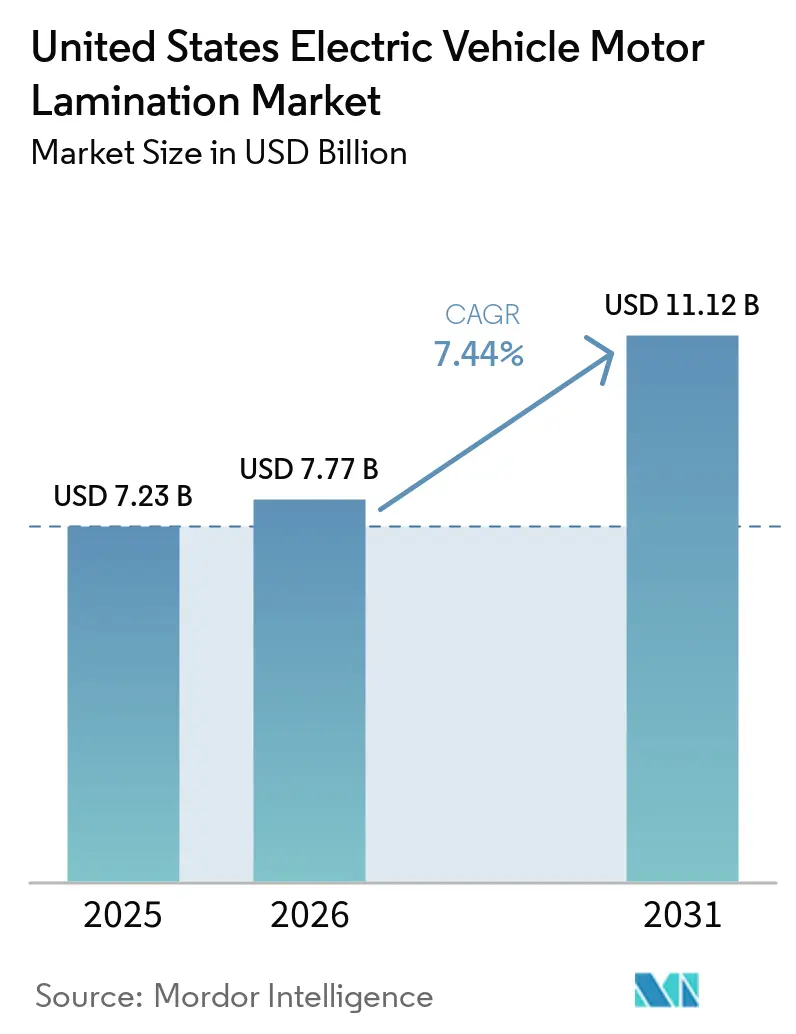
| Base Year Market Size (2025) | USD 7.23 Billion |
| Market Size (2026) | USD 7.77 Billion |
| Market Size (2031) | USD 11.12 Billion |
| Growth Rate (2026 - 2031) | 7.44 % |
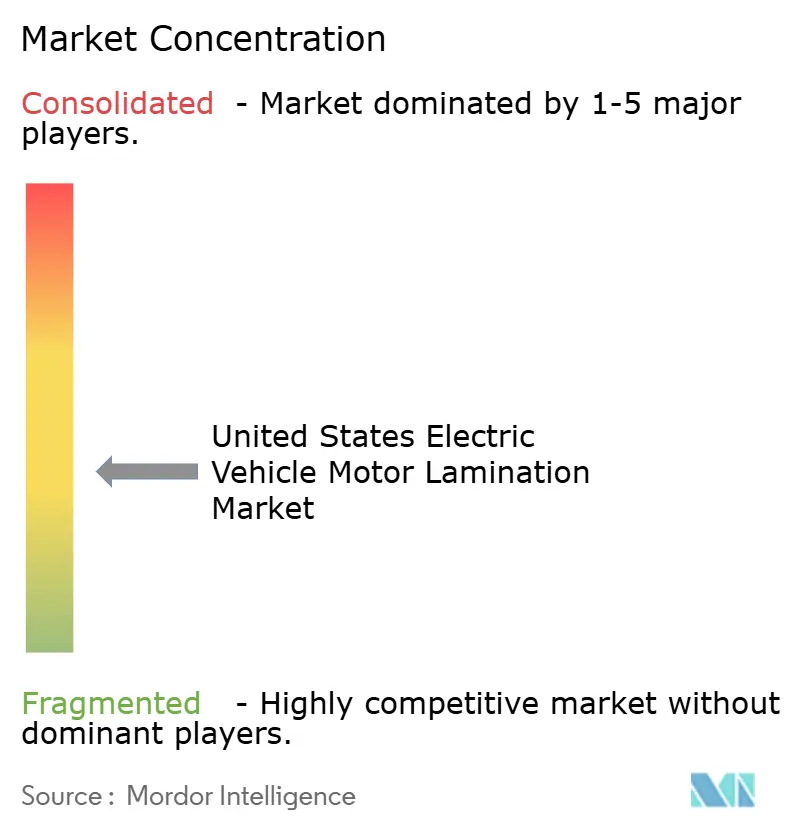
| Market Concentration | Medium |
Major Players *Disclaimer: Major Players sorted in no particular order Image © Mordor Intelligence. Reuse requires attribution under CC BY 4.0. | |
United States Electric Vehicle Motor Lamination Market Analysis by Mordor Intelligence
The United States electric vehicle motor lamination market size was valued at USD 7.23 billion in 2025 and is estimated to grow from USD 7.77 billion in 2026 to reach USD 11.12 billion by 2031, at a CAGR of 7.44% during the forecast period 2026 to 2031. The United States electric vehicle motor lamination market is being supported by a large domestic EV and battery investment pipeline, with the automotive sector announcing significant investments in United States manufacturing commitments since the IRA was passed, which keeps future motor demand closely tied to domestic production build-outs. Domestic electrical steel availability is also improving through Cleveland-Cliffs’ automotive-grade MOTOR-MAX offerings and ArcelorMittal’s planned Calvert facility, which reduces exposure to imported material and improves sourcing visibility for motor programs. The United States electric vehicle motor lamination market is also benefiting from tighter efficiency targets, state ZEV rules, and a shift toward thinner-gauge steel and higher-speed motor designs that raise technical requirements for stamped cores. Competitive pressure is rising as Tempel, EuroGroup Laminations, and Feintool push bonding and assembly technologies that compete on efficiency, noise control, and stack precision rather than only on tonnage. The September 2025 removal of the USD 7,500 federal EV consumer credit has shifted part of the product mix toward hybrids. Yet, demand for laminations remains durable because hybrid drives still require substantial motor core content per vehicle.
Key Report Takeaways
- By laminate type, electrical steel laminates held 79.12% of the United States electric vehicle motor lamination market share in 2025, while other laminate types are projected to expand at a 13.55% CAGR through 2031.
- By motor type, PMSM held 68.22% share in 2025, while SRM is forecast to record the highest CAGR at 12.27% through 2031.
- By vehicle type, passenger vehicles accounted for 63.25% share in 2025, while commercial vehicles are projected to grow at a 10.35% CAGR through 2031.
- By application, stator laminations accounted for 58.04% share in 2025, while rotor laminations are forecast to advance at an 11.86% CAGR through 2031.
Note: Market size and forecast figures in this report are generated using Mordor Intelligence’s proprietary estimation framework, updated with the latest available data and insights as of January 2026.
United States Electric Vehicle Motor Lamination Market Trends and Insights
Drivers Impact Analysis*
| Driver | (~) % Impact on CAGR Forecast | Geographic Relevance | Impact Timeline |
|---|---|---|---|
| Domestic EV Production Boom | +2.1% | National, with concentrated gains in Michigan, Georgia, Tennessee, and Ohio | Medium term (2-4 years) |
| DOE Mandating Ultra-Thin Laminations | +1.3% | National, with early adoption gains in the Midwest OEM clusters | Medium term (2-4 years) |
| Vertical Integration of E-Motors | +0.9% | National, concentrated in Michigan, Georgia, and Nevada | Medium term (2-4 years) |
| Domestic NOES Capacity Expansions | +0.7% | National, supply originating in Arkansas, Alabama, Ohio, and Pennsylvania | Long term (≥ 4 years) |
| State-Level ZEV Mandates | +0.7% | California-led, 11 additional states + DC adopting ACC II | Short term (≤ 2 years) |
| Rare-Earth-Free Motor Topologies | +0.5% | National, technology adoption-driven | Long term (≥ 4 years) |
| Source: Mordor Intelligence | |||
IRA-Fueled Domestic EV Production Boom
The United States electric vehicle motor lamination market is closely tied to the domestic EV production base that the IRA helped expand through manufacturing credits and plant investment decisions. Ongoing IRA provisions are expected to drive significant growth in EV sales in the United States by 2030. This surge sets the stage for a substantially larger installed base, fueling future motor demand. That scale matters for laminations because each additional drivetrain raises demand for precision steel stacks, coatings, and joining processes at the motor core level. The September 2025 end of the federal consumer EV credit has moderated some pure battery-electric momentum. However, it has not eliminated demand for motor laminations because hybrid systems still use substantial electric-drive content. The United States electric vehicle motor lamination market, therefore, keeps a durable volume base even when the vehicle mix shifts between full battery electric and hybrid platforms.
DOE Efficiency Targets Mandating Ultra-Thin Laminations
The United States electric vehicle motor lamination market is also being shaped by stricter motor efficiency standards that are forcing redesign across the supply chain. The DOE’s October 2023 rule set June 1, 2027, compliance for super-premium efficiency standards in 100 to 250 hp motors, and the January 2025 rule extended coverage to smaller motors from January 1, 2029 [1]“Energy Conservation Standards for Electric Motors Rulemaking,” U.S. Department of Energy, energy.gov. Reaching IE4 efficiency levels requires lower core loss, thinner laminations, and more precise punching quality, which directly increases processing demands on the steel grades used in EV motors. The DOE also noted that these efficiency shifts require thinner laminations and meaningful capital spending by manufacturers, which means the response is structural rather than temporary. The same review indicated that a notable share of ESEM shipments would need redesign, so the lamination stamping base faces a wide product refresh cycle even outside direct EV adoption. The United States electric vehicle motor lamination market gains a steady floor in demand from this redesign cycle because suppliers must qualify lower-loss stacks and upgraded material grades before the new compliance dates arrive.
Automaker Vertical Integration of E-Motors
The United States electric vehicle motor lamination market is moving toward longer and more technical sourcing agreements as automakers bring e-motor design and manufacturing in-house. BMW now builds the rotor, stator, transmission, and power converter for its sixth-generation eDrive internally, and the new unit reduces energy loss by 40% and weight by 10% versus the prior generation. GM’s stator core activity in Lockport, New York, and drive unit output in Toledo, Ohio, show that United States-based core consumption is becoming more concentrated around direct OEM programs. Lucid's Arizona-based program for in-house permanent magnet motors highlights a trend: OEMs are imposing stricter standards on geometry, coatings, and alloy choices. This shift benefits suppliers that co-develop laminations rather than merely offer standardized stampings. As a result, the United States market for electric vehicle motor laminations is evolving to prioritize qualifications, demanding that successful suppliers exercise tighter process controls and foster closer engineering collaborations with OEM buyers.
Domestic NOES Capacity Expansions (InduX, Cleveland-Cliffs)
The United States electric vehicle motor lamination market is gaining support from a broader domestic NOES base, which helps reduce sourcing risk and improves compliance with the United States content rules. Cleveland-Cliffs remains the only North American producer of automotive-quality electrical steel, and its MOTOR-MAX line is positioned specifically for high-frequency EV traction motors [2]“MOTOR-MAX Steels,” Cleveland-Cliffs, clevelandcliffs.com. ArcelorMittal’s planned USD 1.2 billion NOES facility in Calvert, Alabama, supported by USD 280.5 million in DOE tax credits, is expected to add 150,000 metric tons of annual output from the second half of 2027. The DOE’s 2025 supply chain readiness assessment still identified China’s dominant position in electrical steel processing as a risk to the United States transportation manufacturing, so every added domestic line improves resilience. More local NOES production also shortens lead times for stampers and reduces the risk of disruptions from imported coil delaying motor launches. The United States electric vehicle motor lamination market should therefore see a firmer domestic supply base as new steel capacity comes online and existing producers move deeper into EV-grade specifications.
Restraints Impact Analysis*
| Restraint | (~) % Impact on CAGR Forecast | Geographic Relevance | Impact Timeline |
|---|---|---|---|
| Electrical-Steel Price Volatility | -1.1% | National | Short term (≤ 2 years) |
| Supply-Chain and Capacity Bottlenecks | -0.8% | National, with particular pressure in Midwest manufacturing clusters | Medium term (2-4 years) |
| Scrap Rates from Precision Stamping | -0.4% | National | Medium term (2-4 years) |
| Permit Delays for Steel Lines | -0.3% | Regional, concentrated at specific plant-level locations | Long term (≥ 4 years) |
| Source: Mordor Intelligence | |||
Electrical-Steel Price Volatility
The United States electric vehicle motor lamination market remains exposed to swings in electrical steel prices, even though trade actions limit some import pressure. According to the American Iron and Steel Institute, China's steel exports are expected to increase significantly in the coming years, further distorting global reference pricing. The USITC decision published in 2026 kept countervailing and anti-dumping orders on NOES from several exporting countries, which supports domestic pricing discipline but does not remove raw material volatility. For lamination stampers, cost pass-through is often slower than input price changes because supply agreements with OEMs are negotiated over multiple years. That creates margin pressure during price spikes, especially when customers are unwilling to reopen terms mid-contract. The United States electric vehicle motor lamination market, therefore, faces a recurring profitability constraint even when end demand remains healthy.
Supply-Chain Concentration and Capacity Bottlenecks
The United States electric vehicle motor lamination market still operates with a narrow domestic supply base for automotive-grade NOES. Cleveland-Cliffs is the only current North American automotive-grade producer, while ArcelorMittal’s Calvert project will not reach the market until the second half of 2027. The DOE’s January 2025 supply chain assessment identified China’s dominant position in electrical steel processing as an ongoing sourcing risk for United States transportation manufacturing. The problem is more pronounced in ultra-thin gauges below 0.20 mm, where only a small group of global producers has the cold rolling and annealing capabilities needed for next-generation high-speed motors. Waelzholz’s April 2026 move into North America via a Mexico facility shows that suppliers clearly see this gap, but added capacity still needs time to qualify for automotive programs [3]“Electric Vehicles, Electrical Steel Strip Grades,” Waelzholz, waelzholz.com. The United States electric vehicle motor lamination market may therefore face periodic bottlenecks in premium gauges even as broader domestic tonnage improves.
*Our forecasts treat driver/restraint impacts as directional, not additive. The impact forecasts reflect baseline growth, mix effects, and variable interactions.
Segment Analysis
By Laminates Type: Electrical Steel Dominance With Rising Advanced Alloy Demand
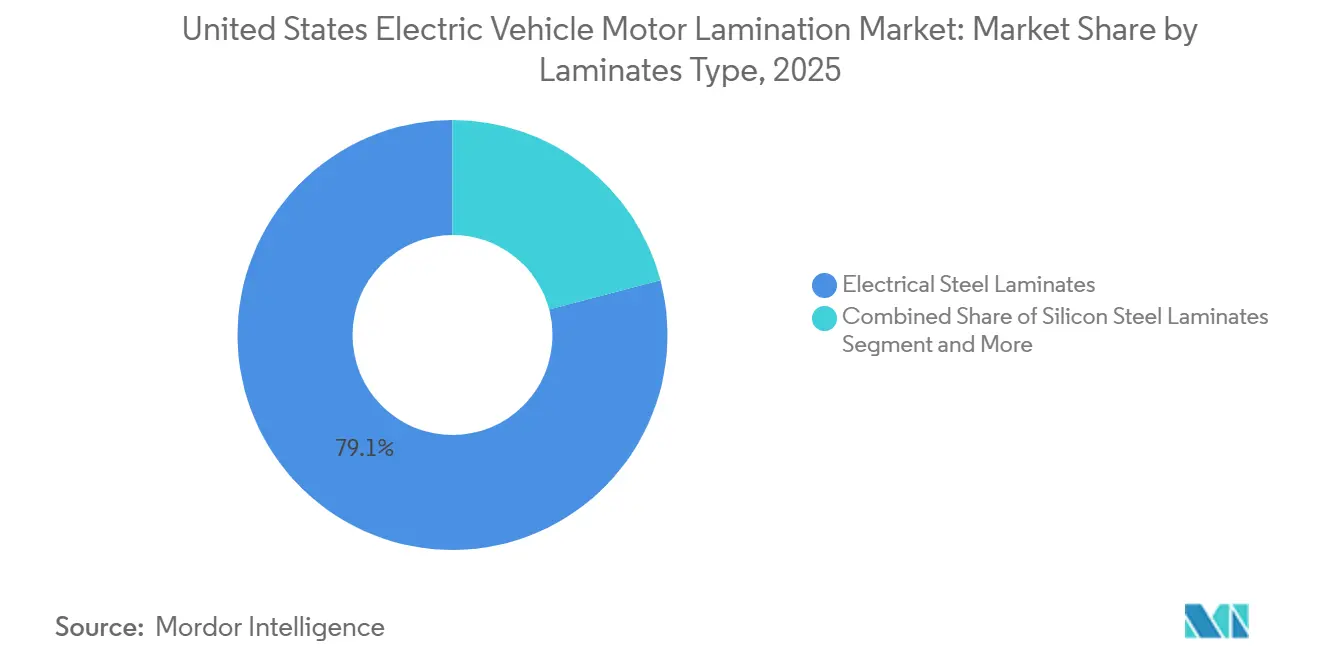
Electrical steel laminates held 79.12% of the United States electric vehicle motor lamination market share in 2025, which confirmed their central role in mainstream EV motor programs. This leadership comes from their balance of cost, magnetic performance, and manufacturing familiarity across high-volume traction motor designs. The United States electric vehicle motor lamination market still depends heavily on electrical steel because most OEM platforms need reliable, large-scale stamping and predictable qualification cycles more than they need maximum power density. Cleveland-Cliffs’ MOTOR-MAX product line supports this position because it is tailored for high-frequency automotive traction applications. The material also benefits from broad acceptance across suppliers that already know how to process, coat, and stack it at automotive volumes.
Other laminate types, mainly nickel-iron and cobalt-iron alloys, are projected to grow at a 13.55% CAGR through 2031, making them the fastest-moving material class in this segment. Carpenter Electrification states that Hiperco 50 alloys can deliver 30% higher power density, 25% more torque, and motor operation that is 10°C to 20°C cooler than conventional silicon steels. That profile makes advanced alloys more relevant in premium EVs and other applications where compact motor packaging matters more than raw material cost. Silicon steel still occupies the middle ground because newer grades such as Waelzholz NO 30-15 are extending performance without moving to much higher-cost alloys. Feintool’s glulock process, which enables stack thicknesses down to 0.1 mm and claims up to 15% greater motor efficiency, also helps electrical and silicon steel remain competitive for longer.



By Motor Type: PMSM Leadership With SRM Gaining Structural Ground
Permanent Magnet Synchronous Motors (PMSM) accounted for 68.22% of the United States electric vehicle motor lamination market in 2025, reflecting their strong position in current EV powertrains. Research indicates that PMSM efficiency and power density have consistently remained high, which explains why OEMs continue to favor the architecture in passenger EVs. The United States electric vehicle motor lamination market also benefits from this mix because PMSM designs place a premium on thinner and lower-loss laminations as operating frequencies rise. BMW’s sixth-generation eDrive and Lucid’s in-house drive units show how high-efficiency motor programs are pushing material and punching tolerances upward. Suppliers that can consistently meet those tolerances are better positioned to secure long-cycle OEM awards.
Switch Reluctance Motors (SRMs) are forecast to grow at a 12.27% CAGR through 2031, making them the fastest-growing motor type in the market. Its rise is tied to a stronger interest in rare-earth-free or reduced-rare-earth designs that shift performance emphasis toward rotor geometry and steel processing. Astemo announced a magnet-assisted synchronous reluctance motor with 180 kW output and only a 30% increase in size compared with conventional PMSM designs, indicating the trade-off is narrowing. BLDC motors continue to play a role in smaller premium and auxiliary applications, while induction motors remain relevant where durability and established sourcing are valued over maximum efficiency. The United States electric vehicle motor lamination market is therefore shifting toward a broader set of stator and rotor specifications than a single-architecture transition would have created.
By Vehicle Type: Passenger Vehicles Lead While Commercial Fleets Lift Growth
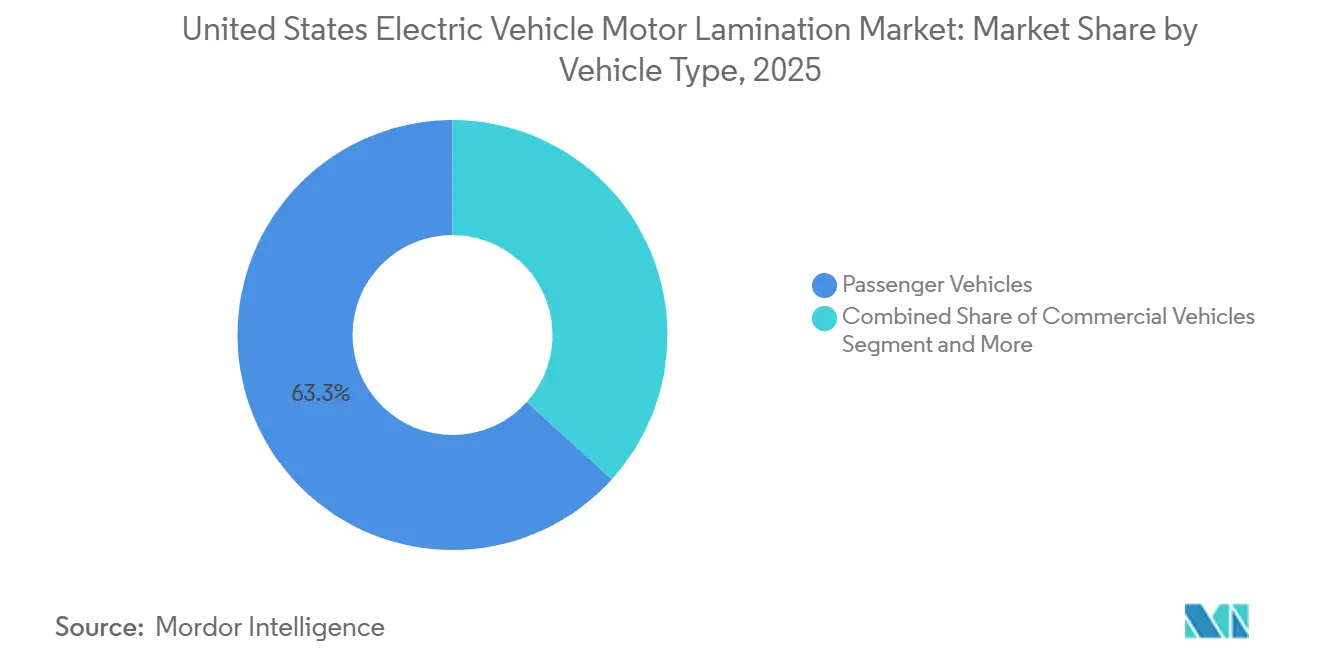
Passenger vehicles accounted for 63.25% of the market share in 2025, keeping them the largest outlet for motor laminations in the country. The established United States production footprint of Tesla, GM, Ford, Hyundai-Kia, and Rivian supports that lead. The Southeast attracted notable investments in EV and battery production through 2025, which reinforces the scale of future passenger vehicle output. The United States electric vehicle motor lamination market keeps a large passenger base, even with changing incentives, because hybrids still require substantial motor core stacks. That keeps lamination demand steadier than the pure battery-electric mix might suggest on its own.
Commercial vehicles are expected to grow at a 10.35% CAGR through 2031, which makes them the fastest-growing vehicle type. Tesla’s Nevada Semi factory is designed to produce 50,000 Class 8 trucks per year, a major new source of high-performance motor demand. Each tri-motor Semi has far higher lamination content than a single-motor passenger EV, so the demand effect is magnified at the motor-core level. ZM Trucks’ 2025 facility opening in Fontana adds another commercial demand point, while two-wheelers remain a smaller but gradually expanding outlet for urban delivery. The electric vehicle motor lamination industry in the United States is therefore gaining a second demand driver from fleet electrification, reducing overreliance on passenger EV volumes alone.
By Application: Stator Laminations Hold the Lead as Rotor Innovation Accelerates
Stator laminations held 58.04% of the United States electric vehicle motor lamination market share in 2025, making them the largest application segment. This lead reflects the stator’s central role in setting slot geometry, thermal behavior, peak efficiency, and torque density. The United States electric vehicle motor lamination market remains stator-heavy in volume because stators consume more electrical steel than rotors in most motor formats. Tempel’s Full Surface Bonding applies a 2- to 4-micron adhesive layer, compared with conventional coating thicknesses of 5- to 14-microns, which improves efficiency and helps reduce noise and vibration. Customer approvals at multiple automotive OEMs indicate that stator joining methods are moving quickly from development into production qualification.
Rotor laminations are forecast to grow at an 11.86% CAGR through 2031, making them the fastest-growing application segment. Higher rotor speeds and stronger interest in reluctance-based designs are raising the importance of mechanical strength, shape precision, and low-loss performance in rotor stacks. Waelzholz developed HS grades for motor speeds up to 25,000 rpm, which directly address the stress limits of high-speed rotor applications. EuroGroup Laminations’ patent for segmented rotor pack geometry that avoids edge contact shows how much innovation is now focused on rotor performance. The electric vehicle motor lamination industry in the United States is moving toward a more balanced stator-and-rotor technology race as higher-speed motors become more common.
Geography Analysis
The United States electric vehicle motor lamination market is growing, driven by rising domestic EV manufacturing, federal incentives such as the Inflation Reduction Act, and increasing emphasis on high-torque, energy-efficient motor designs. In June 2026, BMW completed its USD 1.7 billion investment in its South Carolina production plants as it prepared to launch fully electric vehicle production in the country. The completion of this investment demonstrated BMW’s confidence in the United States and reinforced South Carolina’s role at the center of BMW Group’s global operations. As of late 2024, Michigan had already drawn in substantial EV manufacturing investments, underscoring its pivotal role in the future consumption of motors and components. With GM’s Lockport stator operations and Ford’s Van Dyke Electric Powertrain Center, the region is tightly knit with direct motor production. This concentration fosters robust connections among steel processors, stampers, core assemblers, and final vehicle plants. The Midwest stands as the cornerstone of the United States electric vehicle motor lamination market, seamlessly blending automotive engineering, a deep supplier network, and large-scale assembly like no other corridor in the United States. By 2029, the Midwest Auto Alley cluster is set to account for a significant share of North America's BEV assembly output, solidifying its status as the primary hub for EV motors and their laminations.
Through 2025, the Southeast captured a significant portion of the nation's EV and battery manufacturing investments, positioning it as the most dynamic regional growth corridor for future lamination demand. Hyundai’s Metaplant near Savannah, Ford’s BlueOval campus in Tennessee, and BMW’s battery venture in South Carolina are broadening the region's motor and battery production landscape. Furthermore, ArcelorMittal’s upcoming Calvert NOES facility, set to enhance regional access to EV-grade electrical steel starting in 2027, promises to alleviate freight and lead-time challenges for local assemblers. The Southeast is witnessing the swiftest expansion in the United States' electric vehicle motor lamination market, with companies transitioning from mere announcements to fully operational plants.
California and other ACC II states require 35% of model year 2026 new passenger vehicle sales to be zero-emission, and the program rises to 100% by 2035 across jurisdictions that represent more than 30% of the United States new light-duty sales [4]“California Moves to Accelerate 100% New Zero-Emission Vehicle Sales by 2035,” California Air Resources Board, ww2.arb.ca.gov. Tesla’s first high-volume Semi factory in Sparks rolled out its first production unit in April 2026 and is designed to produce 50,000 Class 8 trucks per year, creating a large commercial-vehicle demand node in the West. California also reported a significant ZEV share of new passenger and commercial vehicle sales in 2024, confirming that western electrification remains ahead of the national curve. The United States electric vehicle motor lamination market gets an early demand signal from the West because policy adoption and fleet rollout both move faster there. That western pull is especially important for high-output commercial motors and other advanced applications where product qualification often starts before broader national rollout.
Competitive Landscape
The United States EV motor lamination supply chain is moderately fragmented across NOES producers, precision stampers, and integrated motor core assemblers. Cleveland-Cliffs remains the only domestic source of automotive-grade NOES. Still, that position is starting to face future pressure from ArcelorMittal’s Calvert build-out and wider United States steel investment plans. Worthington Industries, through Tempel, described itself as the global number 3 in motor lamination markets and noted that 90% of its sales are concentrated in North America. The United States electric vehicle motor lamination market is therefore being shaped less by a single dominant player and more by a contest between specialized capabilities, supply assurance, and customer qualification depth.
Technology is becoming the clearest point of separation in this market. Tempel’s FSB, Feintool’s glulock, and EuroGroup’s patented geometry work all aim to improve efficiency, reduce losses, and secure tighter customer approval rather than compete only on volume. Worthington Steel’s February 2026 tender offer for Kloeckner & Co and its expected annual synergies by the end of FY2028 show a push toward larger scale and broader service reach. Feintool’s USD 35 million Nashville expansion, completed in Q1 2025 with a new 1,600-ton direct servo transfer press, shows the same logic from a manufacturing footprint angle. The United States electric vehicle motor lamination market is rewarding suppliers that combine local capacity with proprietary process know-how and faster OEM response times.
POSCO Mobility represents a vertically integrated model that links electrical steel production to finished drive motor cores, which sets a high benchmark for supply chain control. Nippon Steel’s 2030 management plan committed nearly USD 11 billion to the United States Steel facilities through the end of 2028. It included plans to bring more advanced electrical steel capabilities into Big River Steel. If those plans advance as stated, competition in premium NOES and high-specification lamination feedstock should become meaningfully stronger after the current forecast period begins. White space still exists between advanced alloy production and full automotive-scale stator and rotor stack assembly by a United States-headquartered supplier. The United States electric vehicle motor lamination market remains open to companies that can combine premium materials, high-precision stamping, stack bonding, and direct co-development with automakers into a single domestic offering.
United States Electric Vehicle Motor Lamination Industry Leaders
Worthington Industries
EuroGroup Laminations
Carpenter Electrification
Feintool International
Cleveland-Cliffs Inc.
- *Disclaimer: Major Players sorted in no particular order

Recent Industry Developments
- April 2026: Tesla's first Class 8 Semi rolled off the high-volume production line in Sparks, Nevada, at a factory capable of producing 50,000 trucks per year. With a tri-motor powertrain, the Semi represents the largest single commercial demand catalyst for high-performance motor laminations in the United States.
- February 2026: Worthington Steel initiated a tender offer to purchase Kloeckner & Co at EUR 11 per share (approximately USD 12). The acquisition was projected to yield annual synergies of USD 150 million by the conclusion of FY2028. Once finalized, this deal would position Worthington as the second-largest steel service center in North America.
- December 2025: Nippon Steel's 2030 Medium- to Long-Term Management Plan committed approximately USD 11 billion in capital to US Steel facilities through end-2028, including new grain-oriented electrical steel capabilities at Big River Steel, leveraging Nippon Steel's proprietary technology.
- October 2025: Tempel Steel, a subsidiary of Worthington Steel, unveiled its innovative Full Surface Bonding (FSB™) technology. This involved applying a thin adhesive to electrical steel laminations before stacking, causing a notable reduction in wasted energy (core loss) and a decrease in noise, vibration, and harshness (NVH) in electric vehicle (EV) motors.


United States Electric Vehicle Motor Lamination Market Report Scope
The scope includes segmentation by laminates type (electrical steel laminates, silicon steel laminates, and other laminate types (nickel-iron, cobalt-iron, etc.), motor type (permanent magnet synchronous motors (PMSM), induction motors, switch reluctance motors (SRM), and brushless DC motors (BLDC)), vehicle type (passenger vehicles, commercial vehicles, and two-wheelers), and application (stator laminations and rotor laminations). Market size and growth forecasts are presented by value in USD.
| Electrical Steel Laminates |
| Silicon Steel Laminates |
| Other Laminates Types (Nickel-iron, Cobalt-iron, etc.) |
| Permanent Magnet Synchronous Motors (PMSM) |
| Induction Motors |
| Switch Reluctance Motors (SRM) |
| Brushless DC Motors (BLDC) |
| Passenger Vehicles |
| Commercial Vehicles |
| Two-wheelers |
| Stator Laminations |
| Rotor Laminations |
| By Laminates Type | Electrical Steel Laminates |
| Silicon Steel Laminates | |
| Other Laminates Types (Nickel-iron, Cobalt-iron, etc.) | |
| By Motor Type | Permanent Magnet Synchronous Motors (PMSM) |
| Induction Motors | |
| Switch Reluctance Motors (SRM) | |
| Brushless DC Motors (BLDC) | |
| By Vehicle Type | Passenger Vehicles |
| Commercial Vehicles | |
| Two-wheelers | |
| By Application | Stator Laminations |
| Rotor Laminations |


Key Questions Answered in the Report
What is the 2026 to 2031 growth outlook for United States electric vehicle motor laminations?
The United States electric vehicle motor lamination market is expected to grow from USD 7.77 billion in 2026 to USD 11.12 billion by 2031 at a 7.44% CAGR.
Which material type leads current demand in the United States EV motor cores?
Electrical steel laminates led with 79.12% share in 2025 because they still offer the best mix of cost, magnetic performance, and manufacturability for volume EV programs.
Which motor architecture is shaping premium lamination demand the most?
PMSM remains the leading motor type with 68.22% share in 2025, and its high efficiency and power density are driving demand for thinner and lower-loss laminations.
Why are rotor laminations growing faster than stator laminations in upcoming EV programs?
Rotor laminations are projected to grow at an 11.86% CAGR because higher motor speeds and reluctance-based designs are making rotor geometry, strength, and precision more important.
Page last updated on:


 Your data is secure and never sold or shared.


